Posted in Teaching, Theatre

What I’ve Learned about Learning Lines, Part II (or Act II)

Three-and-a-half years after returning to acting, I remain fascinated by the process of learning lines.

Back in 2014, after I finished performing in Third—the play that marked my return to the stage—I began researching the subject of line-learning. The two pieces of writing that resulted from that research (an annotated bibliography and an essay) are ones that I wrote primarily as models for my students. But the research, itself, is work that I would’ve done anyway. Chalk it up to my enduring interest in the subject.

I’m not sure what I expected to find, other than some examinations of best practices. Reading the lectures of Stella Adler, Uta Hagen, Sanford Meisner, and Lee Strasberg momentarily gave me a seat in the classrooms of those great acting teachers, but it didn’t offer much about the practice of line-learning, itself. Similarly, reading a research article on acting and cognitive functioning led me into the lecture halls of its coauthors—one a professor of psychology, the other a professor of theatre—demonstrating that acting may enhance memory, but not revealing how anyone actually learns lines.

So how do we do it?

I was too nervous—and too busy trying to remember my lines—to ask myself that question when I was in rehearsal and performance back in 2014. Only afterward could I begin the research that led to the essay that opened with these words:

How do actors learn their lines? It’s not the same act of memorizing that we perform as students when we commit to memory the steps of photosynthesis for a biology midterm. Actors learn lines to repeat them over and over in performance after performance, and yet must do so as if they have never spoken them before, to create ‘the illusion of the first time’ (Stanislavsky qtd. in Strasberg 35). Earlier this semester, I managed to learn lines for a play and repeat them in six performances, but I still don’t know how I did it. In fact, it was only after the play closed that I could bring myself to count the words. I was curious to know how many I’d memorized, but if I had counted them before I’d learned them, the process of memorizing would have been too daunting. And counting them during the run of the play could have undermined my performance; dwelling on how many words I was keeping in my head might have made me more prone to forget.

So how did I learn those 1,567 words and remember them?

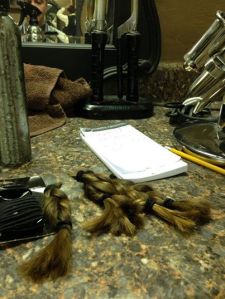
Fast forward to late April 2017, when I found myself cast in a role that required me to learn more than twice that number of words—yes, more than twice. After I picked up my script from the theatre, I began my ritual of cutting and pasting, literally cutting and pasting photocopies of my lines onto three-by-five note cards.

When I began cutting and pasting lines for my twentieth card, panic set in. The most lines I’d ever learned had fit onto twenty-two note cards. I was on card twenty, and I wasn’t even halfway through. How many cards would I have, and how would I ever learn all of these lines?

When I cut and pasted the last lines, I was on card fifty-two. If only I had a year, I thought. One card per week seemed manageable.

Somehow I did manage to learn all of those lines in matter of weeks—not months, or anything close to a year—though I’d feared that all those words (which I still haven’t counted) would far exceed what my brain could store and retrieve.

An earlier draft of these reflections included a list of guidelines I’ve developed. As I revised, I omitted them to avoid prescribing my own idiosyncratic process. Suffice to say, the ritual of cutting and pasting lines, as time consuming as it is, is worth the effort for me. As I cut and paste the words onto note cards, I sense that I am beginning to internalize not only the character’s speech patterns but also the structure of the play.

Though my research and ruminations haven’t taught me how I learn lines, I have developed a keener sense of what draws me back to the process again and again. As with writing, it’s the words. And as I wrestle now with these words on the page, I find myself hoping to be fretting over another stack of note cards soon.

Work Cited

Strasberg, Lee. A Dream of Passion: The Development of the Method. Ed. Evangeline Morphos. Little, Brown, 1987.
Posted in Reading, Writing

The White City’s Blueprint: The Architecture of Larson’s Narrative Nonfiction

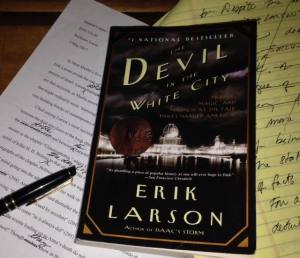
In Janet Maslin’s New York Times review of The Devil in the White City, she claims that Erik Larson avoids the risk of “turning [the book] into a random compendium.” For all of his density of detail, Larson does manage to avoid that risk, creating instead a gripping dual narrative—one that succeeds, as Maslin asserts that it does—but not by using what Maslin cites as tactics that might ordinarily seem “alarming.” Rather the techniques that Larson employs are among the very building blocks of contemporary narrative.

Chief among Larson’s most successful narrative strategies is his cross cutting, both between the dual storylines of the book (those of the Devil and the White City of the title) and between characters. One of his most compelling uses of cross cutting occurs in the chapter “Claustrophobia,” where Larson deftly shifts from the point of view of serial of killer H. H. Holmes, the devil of the title, to that of one of his victims, Anna “Nannie” Williams. In the first paragraphs of the chapter, Holmes and Anna are together in his office, where he asks her “if she would mind going into the adjacent room, the walk-in vault, to retrieve for him a document he had left inside” (294). Anna complies, and thereafter the point of view shifts between Anna inside the vault, believing “the door had closed by accident” (294), and Holmes standing outside the door, listening for the panic to come “as it always did” (295).

Readers witnessing the events leading up to Anna’s death do not stop to ask: How can Larson know what happened? Though they know in the back of their minds that only Holmes and Anna themselves could know what transpired, Larson’s dramatic cross cutting draws them so close to both the victim and her killer that they experience those moments as Holmes and Anna do.

In his endnotes, Larson addresses his reasons for depicting Anna’s murder as he did. Based on police speculation that Holmes killed both Anna and her sister, Minnie, in his vault, an earlier chronicler of Holmes’ exploits—Harold Schechter, author of Depraved (1994)—proposed that Holmes walked into the vault with Anna: “Grasping Nannie by the hand, he led her toward the vault” (Schechter qtd. in Larson 416). Rather than depicting the events as Schechter did, Larson presents Holmes sending Anna into the vault on a false errand because that scenario, in Larson’s words, “would have suited more closely his temperament” (416).

Whether Holmes sent Anna into his vault on a false errand, Larson’s compelling rendering of it exemplifies how the author employs the dramatic effects of fiction—not tactics that are “alarming” as Maslin claims, but ones that writers have commonly applied to narrative nonfiction for more than fifty years, since the publication of Truman Capote’s groundbreaking  account of the Clutter family murders in In Cold Blood. And like In Cold Blood, The Devil in the White City presents a true crime story with the narrative arc of a novel. But Larson’s book is more ambitious and broader in scope than Capote’s. Ultimately, The Devil in the White City is a hybrid of true crime and popular history—the gruesome murders of a serial killer juxtaposed with the construction of the magical white city that inspired Walt Disney and L. Frank Baum. For readers fascinated by the minds of criminals and visionary architects, it’s a page turner. And for writers drawn to the challenge of giving facts the appeal of fiction, it offers a blueprint.

Works Cited

Larson, Erik. The Devil in the White City. Vintage, 2004.

Maslin, Janet. “Add a Serial Murderer to 1893 Chicago’s Opulent Overkill.” Review of The Devil in the White City, by Erik Larson, The New York Times, 10 Feb. 2003, http://www.nytimes.com, Accessed 26 Apr. 2017.


Posted in Reading, Teaching

The Devil’s in the Details: Casting Larson’s “White City”

Scorsese and DiCaprio / Paramount

Last month, when Erik Larson cancelled his campus visit to Lenoir-Rhyne, our study of The Devil in the White City took an unexpected turn. No longer would our last weeks of reading be informed by the author’s own commentary. As I asked myself how my students and I might proceed in the absence of Larson, it occurred to me that the film adaptation in development could be the source of a series of assignments. Subsequently, I crafted a research exercise, an individual blog post assignment, and a follow-up collaborative blog assignment that involved looking ahead to the upcoming film while looking back at the pages of Larson’s book for textual support for possible casting choices.

Reading the cast recommendations that my students’ produced–each student’s individual choices as well as the expanded proposals that they produced collaboratively–revealed a level of detail and engagement with the subject that many of their previous short assignments lacked. Notably, most of their individual blog posts far exceeded the 150-word minimum length requirement.

Though I regret that my students and I didn’t have the opportunity to see Larson, I am grateful that his cancellation led me to rethink my approach to teaching The Devil in the White City.

The paragraphs that follow offer my version of the assignment: the casting recommendations that I wrote along with my students.


Martin Scorsese’s adaptation of Erik Larson’s The Devil in the White City—now in development at Paramount—will star Leonardo DiCaprio, an actor well suited to play the devil of the title, H. H. Holmes, not because he possesses the same “striking blue eyes” (35), as the charismatic serial killer—though he does—but instead because of DiCaprio’s ability to embody charming characters who trade in deception. Larson’s descriptions of Holmes as someone who could “bewitch men and women alike” (146) and who had “a talent for deflecting scrutiny” (364) bring to mind roles from his previous collaborations with Scorsese—notably Jordan Belfort of The Wolf of Wall Street—as well as Frank Abagnale, Jr. from Steven Spielberg’s Catch Me if You Can.

While DiCaprio—who bought the film rights to Larson’s book in 2010—is set to play Holmes, the rest of the film’s casting remains undetermined, or at least unknown to outsiders. One possible contender for Daniel Burnham, the other figure at the center of Larson’s book, is Hugh Bonneville. The Downton Abbey actor’s  ability to play a “decisive, blunt, and cordial” (35) figure is evidenced in his portrayal of that other turn-of-century character: Robert Crawley, Earl of Grantham. And Larson’s depiction of Burnham as a man who “symbolized all that stood in the way of [young architect Louis] Sullivan’s emerging ethos” recalls the tension between Grantham and his son-in-law, Tom Branson (Allen Leech).

For Frederick Law Olmsted, chief landscape architect and elder statesmen, Scorsese might turn to Anthony Hopkins. Though Hopkins’ frame is not slight, as Larson describes Olmsted’s (53), his face does fit the description of Olmsted’s as “worn and gray, except for his eyes, which gleamed beneath his skull like marbles of lapis” (113). More importantly, with his signature quiet intensity, Hopkins could masterfully convey Olmsted’s struggle as a visionary figure—a benevolent version of Westworld’s Dr. Ford—striving for his field to be “recognized as a distinct branch of the fine arts” (50), as he transforms the landscape of Jackson Park.

Although Dora Root, wife of John Root (Burnham’s partner in architecture) appears only briefly in the book, the passage in which Larson recounts her mixed emotions upon seeing the White City—finding the park “infinitely sad” but “entrancing” all at once (253)—is among the most poignant that Larson writes. As the widow witnessing the fair that her husband didn’t live to see, Laura Linney could deliver a nuanced performance akin to hers as Abigail Adams, beloved wife and advisor to the second president, in the HBO miniseries John Adams. And Linney’s co-star in John Adams, Paul Giamatti, could adeptly portray detective Frank Geyer, who “never tired” (349) in his investigation of Holmes’ crimes, echoing Giamatti’s role in The Illusionist as Uhl, the police inspector who doggedly pursued Eisenheim (Edward Norton).

Paul Dano / twitter.com
Prendergast / chicagonow.com

Lastly, Paul Dano comes to mind as an apt candidate for the role of Patrick Prendergast, the young Irish immigrant whose murder of Carter Henry Harrison turns the fair’s closing ceremony into a memorial for the slain Chicago mayor. The meltdown that Dano exhibited as Dwayne Hoover in Little Miss Sunshine, when Dwayne’s sister, Olive (Abigail Breslin) reveals to him that he can’t become a pilot (because he’s colorblind), illustrates Dano’s ability to convincingly play the unstable—and eventually delusional assassin—in his “accelerating mental decline” (183).

Work Cited

Larson, Erik. The Devil in the White City. Vintage, 2004.


Scorsese’s choices will likely differ from the ones that my students and I have presented, but the process, itself, of returning to the pages of Larson’s book to explore casting possibilities has offered a valuable exercise in textual analysis, one I may return to in future semesters. Even if the books that my students and I study aren’t slated for film production–and many of them will not be–we can still ask the question, whom would I cast? as a starting point for exercising our imaginations along with our intellects.

Posted in Reading, Writing

A Poet’s Apprenticeship Behind Bars

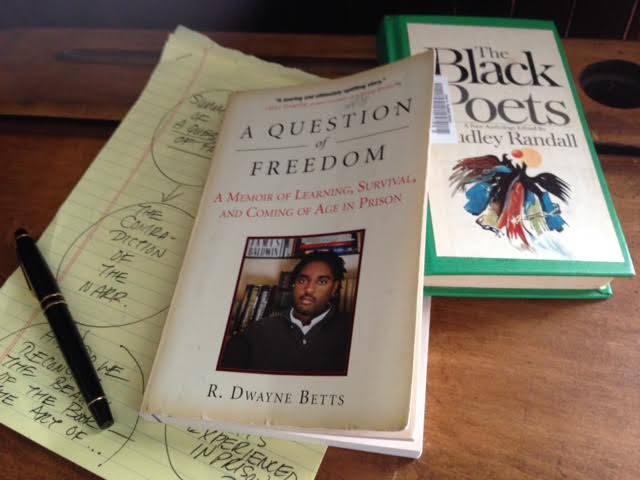
Dwayne Betts’ A Question of Freedom chronicles his development as a writer during his years behind bars for a carjacking he committed at sixteen. Betts’ memoir pulls readers into the cells of the prisons that housed him, places where, in Betts’ words, “I have lived things I will not recover from” (176), but also where he observes that he “found creativity” (63). The knowledge that Betts discovered his voice behind bars prompts a troublesome question: Would he have found it elsewhere? Whether he would have become a writer outside of prison remains unclear. There is however, certainty in this: As a man who became a writer in prison, his writing and incarceration are inextricably linked. Betts’ testament to that, his memoir, tells not only the story of his prison sentence but also the story of the words of others coming to shape his own story and leading him to find his voice as a poet. For all that he shows his readers of prison, Betts’ memoir is ultimately more about the transformative power of art.

In the chapter “Joseph’s Hand,” Betts meditates on the unconventional drawing style of another inmate, a young man whose pen scratches lead Betts to see art in a new way:

I went to prison and found creativity I’d never thought to search for on the streets. I had been there for a few months and ran into Joseph, drawing in a way that broke down all of my ideas of what a picture should look like and what it should do. (63)

Joseph’s drawing was a revelation to Betts, what he describes as a “symbol for the idea that art can translate, subconsciously and consciously, your world into your images” (64).

Later, Betts finds his own path as an artist after someone slips a copy of Dudley Randall’s anthology The Black Poets under his cell door. As he reads Randall’s book in solitary confinement, he discovers that his desperation and isolation enable him to see the words on the page as he has never seen them before. In his own words, “[s]olitary confinement gave me a gift I could have gotten nowhere else: the opportunity to start looking for the sense behind the words” (165). For Betts, The Black Poets serves both as a groundbreaking influence and a motif in A Question of Freedom. The first sentence of the memoir alludes to Etheridge Knight’s For Freckled-Faced Gerald”—a poem Betts first encounters in Randall’s anthology—paraphrasing its lines, “sixteen years hadn’t even done / a good job on his voice” (6-7). And lines from Knight’s poem also serve as the epigraph for the second part of the memoir.

Near the end of A Question of Freedom, Betts reflects on The Black Poets as he recalls receiving a response to a letter that he had written to the poet Tony Hoagland:

When I’d gotten my first book of poems, The Black Poets by Dudley Randall, I was a seventeen-year-old kid in a solitary confinement cell wondering if he was going to survive prison. By the time Mr. Hoagland wrote me, I was a few years away from release and still standing. (217)

Readers unfamiliar with The Black Poets cannot see initially how importantly that volume of poetry figures in the pages of Betts’ memoir, but slowly its significance becomes clear, just as the scratches of Joseph’s pen slowly—and seemingly miraculously—become a hand. The lines of Betts’ memoir serve as testament not only to his survival but also to the troubling truth that prison, for all of its harrowing experiences, gave Betts a writing life, endowing him with gift for “[w]eaving prison’s hurt into poetry” (165).

Would Betts have become a writer without the creativity that he discovered in prison and the way of reading that he found in solitary confinement?  Betts’ memoir yields no clear answer to that question, nor does it offer a definitive answer to why he made the mistake—the moment of aberrant behavior—that led to more than eight years behind bars. Prison, as Betts observes, “blossoms contradictions” (181). The gift he found there, one of  “carving a voice” (123) remains one of those contradictions, one that will likely remain in the minds of readers long after they have followed Betts out of the pages of his memoir to a place where many inmates will never return.

Works Cited

Betts, R. Dwayne. A Question of Freedom. Avery, 2009.

Knight, Etheridge. “For Freckled-Faced Gerald.” The Black Poets. Ed. Dudley Randall. Bantam, 1971. p. 205.


Posted in Theatre

Looking Back at Nancy on the Third Anniversary of “Third”

Laurie Jameson (Jill Roberts) and Nancy Gordon (Jane Lucas) / Ashley Potter Photography

In Nancy Gordon’s first scene in Third, she sits on a park bench outside the college bookstore and tells her friend and colleague Laurie Jameson how a boy she dated her freshman year taught her that Robert Frost’s “Stopping by Woods on a Snowy Evening” scans exactly to “Hernando’s Hideaway.” Nancy begins to sing the lines and Laurie joins in. Singing heartily, so caught up in the fun of it, Laurie doesn’t notice at first that Nancy has stopped singing. She can’t repeat the line “And miles to go before I sleep,” because she doesn’t know whether she has miles to go. Soon she will undergo a bone marrow transplant.

The early drafts of Wendy Wasserstein’s final play, Third, didn’t include Nancy. Three years ago as I prepared to play her, I learned  that when Wasserstein added her as a friend for Laurie, she was adding an autobiographical character, a cancer survivor who would live on after Wasserstein died,  just three months after Third opened in New York in October 2005.

7/8 gone for "Third"
7/8 gone for “Third”

Whenever the prospect of playing Nancy frightened me–which it did, often–I reminded myself of Wasserstein’s courage and how creating Nancy sustained her as her health declined. What an honor and a privilege it was to tread the boards in Nancy’s shoes.

As I reflect on Foothills Performing Arts’ production of Third, on the third anniversary of its opening, I remain grateful for director Mark Shell’s artistic vision and faith in me, and for the stellar cast and crew: Jill Roberts, Justin Thomas, Carla Robinson, David Kerley, Dustin Greene, Amber Ellis Biecker, Tony Hendrix, Heather Lee Hendrix, Aleesha Hendrix, Jared Smith, and Josh Wolfe.


Posted in Reading, Teaching, Writing

Carving a Voice Out of the Air: An Evening with Dwayne Betts

R. Dwayne Betts / Rachel Eliza Griffiths

In the first paragraphs of Dwayne Betts’ memoir, A Question of Freedom (2009), he recounts his ride to the Fairfax County jail after his arrest for carjacking: a “certifiable” crime in Virginia, which meant that then-sixteen-year-old Betts would be treated as an adult under state law. Last Thursday night when Betts took the stage at Lenoir-Rhyne, he began by reading those paragraphs, returning to the backseat of that police car, where “[e]verything near enough for me to touch gleamed with the color of violence” (3). After reading from his memoir, Betts turned to his collections of poems, Shahid Reads His Own Palm (2010) and Bastards of the Reagan Era (2015), alternating his readings with stories of his years in prison and his writing. He expressed his concern that some people cited his memoir as evidence that prison benefited him, because he had finished his high school education behind bars; and since leaving, he had completed his undergraduate degree at the University of Maryland, an MFA in Creative Writing at Warren-Wilson, and a law degree at Yale. To see his post-incarceration successes as evidence that his years behind bars benefited him, Betts said, was a misinterpretation. Following his Q&A with the audience, Betts concluded by saying that he’d been desperate and lucky–“but sometimes desperate and lucky works out.”

Among the anecdotes that Betts shared with the audience was one focusing on his answer to a question about one of his poems. A reader asked him why an otherwise innocuous poem ended with an image of crack cocaine. To illustrate why he ended the poem that way, Betts turned to August Wilson’s play Fences, telling the audience how the character Troy tries to explain his adultery to his wife, Rose, by likening his decision to a moment in a baseball game. He’s wrong, Betts said, but it’s the only way Troy knows how to try to communicate what he means. In Betts’ words, “sometimes you only have what you have to explain the world.”

Betts’ memoir isn’t an easy read, showing as it does what a life behind bars can do to the mind and the body. But it also tells the story of the power of the written word, how books sustained Dwayne Betts and led him to become a writer, “carv[ing] a voice out of the air” (123). Though many of my students aren’t drawn to writing or to reading books, I believe that the experience of studying  A Question of Freedom and hearing Betts speak has deepened their understanding of the vital role that reading and writing can play in their lives.

Work Cited

Betts, R. Dwayne. A Question of Freedom.  Avery, 2009.

Posted in Teaching, Theatre

Niagara Falls Again: A Postscript

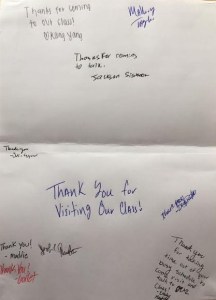
Thank-you card by Mallory Taylor
Thank-you card by Kiyah Davender

When Stephanie Lindsay, who played Karla in the recent LR Playmakers’ production of Wonder of the World, first visited class on February 6, the students had not begun drafting their analyses of the play and opening night was more than a week away. Today when Lindsay returned for a follow-up visit, the students had submitted their revisions of their papers and many had also seen one of the performances of the show. After all of the students projected their analyses-turned-blog posts on the big screen and spoke briefly about the focus of their writing, Lindsay led them in a discussion that traced the journey of the play from page  to stage.

Along with her insightful remarks regarding the actors’ and the director’s roles in bringing the characters to life, Lindsay reflected on the vital opportunity that live theatre offers us in the digital age: the experience of sharing stories together face to face in real time in an increasingly fragmented culture.

thank-you-card-4As Lindsay spoke, my thoughts turned to the readings that I selected for the course, ones that we can see performed on stage or that we can see addressed by the visiting writers who wrote them. In a course titled Critical Thinking and Writing, virtually any texts could serve as our subjects of inquiry. But studying plays produced at Lenoir-Rhyne and books written by the university’s visiting writers creates opportunities for face-to-face, real-time experiences that the study of other texts doesn’t allow.

Thank you, Stephanie Lindsay, for bringing Karla to life, both on the stage and in the classroom, and thank you for your observations on live theatre and stage craft. And thanks also to Kiyah and Mallory for producing cards to express our gratitude.

Posted in Theatre

Signs in Niagara Land: The Quest for Meaning in “Wonder of the World”

David Lindsay-Abaire’s farce Wonder of the World chronicles Cass Harris’ search for meaning as she embarks on a new life in Niagara after discovering that her husband of seven years, Kip, has harbored a secret sexual perversion. Once she reaches her destination, she finds that life away from Kip is no honeymoon either but a series of encounters with an assortment of eccentrics grappling with their own losses.

For Cass, the loss is one of innocence. No longer innocent of the knowledge of her husband’s bizarre fetish, she ww-script-notesstruggles to come to terms with it. Though Cass chooses to start a new life, she continues to see the world through the lens of the ninth-grade teaching job that she leaves behind (along with Kip), equating her mistake of marriage to a mathematical miscalculation. As she explains to Kip: “Look, I agreed to marry you based on what I knew to be true. Kip equals X. X will make me happy. Everything added up. Seven years later I find out that you’re not X at all, you’re Z. And if you’re Z, then I did the math wrong” (1.1). Ever the math teacher, Cass perceives the world as a series of signs with determinate meaning, a tendency that seems to compound the difficulty of her quest. On the bus to Niagara, where Cass adopts fellow traveler Lois Coleman as her sidekick, Cass continues to think in terms of numbers, measuring her old life as “463 road signs behind me” (1.2). Though she eventually loses track of the signs, she remains focused on her numbered to-do list, which includes becoming a contestant on The Newlywed Game, a show that turns couples’ compatibility into a numbers game.

Unlike Cass, her husband, Kip, does not seek meaning in numbers. When Karla and Glen (partners in marriage as well as private investigation), confide to Lois that Kip has hired them to track down Cass, Glen notes that Kip “[s]tarted to put two and two together” (1.7). For Kip, “started” is the operative term. He is not a numbers man. The proof that he offers of their undying love—including the ring they found, “the sign,” as Kip a calls it (2.1) —is insubstantial evidence in the eyes of Cass. Their sign systems aren’t the same; they speak different languages. For Kip, numbers games are “crass and divisive” (1.2).

When couples counselor Janie, clad in a clown suit, leads Cass and her cohort of misfits through a Newlywed-style ww-draft-1therapy session, Cass says that “[i]t’s not just a game! Things have meaning. Or at least they should” (2.3). Her emphasis on “should” indicates that she has embraced the concept that meaning may be indeterminate. But neither she nor the other characters can leave numbers behind, not altogether. After Captain Mike, Kip’s rival for Cass’ affection, accidentally shoots himself, rather than reflecting on his death, the characters attempt to quantify fears as they quibble over which is number one: being alone, public speaking, or needles (2.3).

Only Karla seems to yield to the idea that answers may elude us. As she observes to Lois: “I don’t even think about my marriage anymore. Why this, why that? I have no idea how it works, and that’s fine by me. It’s like Stonehenge, an unknowable mystery that the world has come to accept” (2.4).

ww-draft-2The final scene on the river leaves the audience, along with Cass and Lois, in a holding pattern. What happens remains unclear. The ambiguity comes at a risk; it may try the patience of audience members who find the play’s farcical humor too ridiculous or contrived, or as New York Times reviewer Ben Brantley wrote “forced rather than organic.” For others, though, the grotesqueness of Cass’ Niagara Land may serve as an apt metaphor for our own absurd political terrain with its crass and divisive stream of fake news and alternative facts. Perhaps asking “[w]hen does the clarity come?” (2.4) and persisting in our quest for it will sustain us, like Cass and Lois, as we find ourselves over a barrel.
Works Cited

Brantley, Ben. “Setting Forth, the Wind in Her Sails.” Review of Wonder of the World, by David Lindsay- Abaire, The New York Times, 2 Nov. 2001, http://www.nytimes.com, Accessed 18 Jan.  2017.

Lindsay-Abaire, David. Wonder of the World. Dramatists Play Service, 2003.

Posted in Reading

“I am not what I am”: The Enduring Façade of Iago

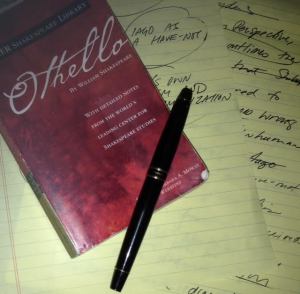
othello-and-draftSusan Snyder’s “Othello: A Modern Perspective,” considers the various approaches Shakespeare scholars have offered to the question, what’s the source of the tragedy? Is it Iago, the inhuman embodiment of evil? Is it Iago, the human villain? Is it Othello, himself? Or is it the social forces of Venice? Though all of these approaches are valid—and as Snyder observes, “[n]either separately nor in conjunction can they offer anything like ‘the whole truth’” (288)—Iago’s actions as an all-too-human have-not, someone who feels left behind, is the answer that resonates in the minds of many of us now.

Our recent campaign season has spotlighted citizens who, like Iago, believe that they have been passed over, and we have witnessed repeatedly the discrepancy between appearance and reality that Iago masterfully exploits. In the first scene of the play, when Iago recounts Othello’s appointment of Cassio as his lieutenant, he observes that Cassio lacks his experience in the field, noting that “Mere prattle without practice / Is all his soldiership” (1.1.27-28) and “Preferment goes by letter and affection / And not by old gradation” (1.1.38-39).  For Iago, it’s another way of saying the system is rigged.

To set things right for himself, “honest” Iago manipulates not only the gullible Roderigo but everyone else, “show[ing] out a flag and sign of love / Which is indeed but sign” (1.1.173-74). As he betrays Roderigo, Cassio, and Othello, even as he publicly conveys the utmost devotion, he also offers the appearance of Desdemona’s handkerchief—first in the hands of Cassio and later in Bianca’s—as the “ocular proof” (3.3.412) of Desdemona’s infidelity.

That ocular proof stokes the jealous rage that leads Othello to murder Desdemona, an irrational act of violence that points to the Moor’s own tragic flaw and indirectly to prevailing social forces. We see Desdemona and Emilia fall victim not only to the husbands who murder them but also to their prescribed roles in Venetian society. Still, if not for Iago, Desdemona and Emilia would live, as would Othello and Roderigo. As Lodovico says to Iago, “This is thy work” (5.2.427).

Iago’s “work,” as Lodovico puts it, is an evil that continues to haunt us, not because it’s inhuman but because it’s all too real. We know the hatred engendered by the have-nots and the ease with which mere appearance can seem to be ocular proof—a problem that’s compounded for us in the digital age, both in politics and in our personal lives. Othello leaves us wondering who our own Iagos may be, not just the trolls wreaking havoc on Twitter for all to see, but also the BFFs—“I am your own forever” (3.4.546)—stroking our egos even as their private messages poison us.

Works Cited

Shakespeare, William. Othello. Ed. Barbara A. Mowat and Paul Werstine. Folger Shakespeare Library Edition, Simon and Schuster, 2009.

Snyder, Susan. “Othello: A Modern Perspective.” Folger Shakespeare Library: Othello by William Shakespeare, edited by Barbara A. Mowat and Paul Werstine, Simon and Schuster, 2009. pp. 287-98.


Posted in Reading, Writing

Shenanigans Again and Again: An Evening with Sarah Vowell

Sarah Vowell / Bennett Miller

Thursday night at Lenoir-Rhyne, Sarah Vowell spoke of herself as a writer who takes her readers on a trip with her. Seeing Vowell interviewed on stage was a similar journey, one that led the audience from her childhood in Montana to her most recent book, Lafayette in the Somewhat Unites States (2015), with digressions along the way on Charlies Angels, the Trail of Tears, Louis Armstrong, The Incredibles, and Paul Gauguin.

When interviewer Mike Collins asked Vowell about her work on This American Life, she spoke of her writing process, noting that although the stories she wrote sounded casual, there wasn’t one from her twelve-year stint on the show (1996-2008) that underwent fewer than sixty-four revisions. Vowell recalled that Ira Glass, producer and host of the show, chided her for her repeated tangents–what she calls shenanigans–reminding her again and again of the need for brevity in radio. Paring her writing for the airwaves taught Vowell that she was better suited to writing books because they gave her room for shenanigans, citing her detour through the Oneida Community in Assassination Vacation.

In response to an audience member’s question about her writing process, Vowell said that it begins while she is travelling. Vowell explained that she takes “voluminous notes” on index cards. Later, when she returns home, she puts the cards on her living room floor and the process of organizing her research begins. The image of Vowell sitting cross-legged in her living room, placing cards on the floor in front of her as if she’s playing Solitaire, reminds me of her earlier remarks about radio, how each of those casual-sounding pieces she wrote was the product of sixty-four or more drafts. The meandering narratives of her books have a casual quality as well, but they’re the product of a highly organized process.

Vowell is one of the featured authors in the Visiting Writers Series as well as the author of this year’s Campus Read, Assassination Vacation. Her interview with WFAE’s Mike Collins was recorded for later broadcast on Charlotte Talks.

Work Cited

Vowell, Sarah. Visiting Writers Series Interview by Mike Collins. 27 Oct. 2016, P.E. Monroe Auditorium, Lenoir-Rhyne U., Hickory, NC.