Posted in Reading, Social Media, Teaching, Writing

Reading for the Norton Writer’s Prize

W. W. Norton’s decision to replace its Scholar’s Prize with the Writer’s Prize reflects some recent and not-so-recent changes in undergraduate writing assignments. From 1998 to 2008, the Scholar’s Prize recognized what Norton calls “an outstanding undergraduate essay on a literary topic,” an essay of the sort that many of us who teach composition frequently wrote when we were freshman. Our own students write fewer literary analyses than we did, because many composition courses are no longer literature based. Instead, they’re interdisciplinary.
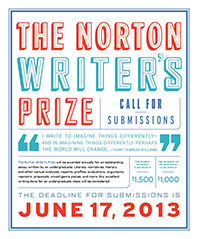
writers_prize_2013I’ve been thinking about these changes for the past few days as I’ve reread my students’ work to select something to nominate for the fourth annual Norton Writer’s Prize, a competition that invites a broad range of submissions, encompassing the variety of writing that’s now typical of composition classes: “[l]iteracy narratives, literary and other textual analyses, reports, profiles, evaluations, arguments, memoirs, proposals, mixed-genre pieces, and more: any excellent writing done for an undergraduate writing class will be considered.”

For their final major writing assignment of the school year, my students wrote ethical reasoning arguments per program requirement. But over the course of the year, they also wrote blog posts, snail mail, personal narratives, timed essay exams, cover letters, résumés, and highly imaginative scripts in which they placed themselves in conversation with the writers of some of the articles and essays they’d read. For some students, those scripts evolved into traditional research arguments. For others, the process of working with those sources revealed that their real research interest lay elsewhere.

I wish I could have nominated more than one piece of writing. For reasons of privacy, I won’t address the particulars of the one that I chose, and I won’t offer any details from the nominating letter that I wrote to accompany it. I will note, instead, how many students shone brightest when an assignment took them by surprise, asking that they write in new ways.

Posted in Reading, Writing

“A Good Way of Putting Things”

Early in the novel Mountains of the Moon, Louise Alder recounts how her teacher Miss Connor read Louise’s (Lulu’s) story aloud in class because Miss Connor “reckons I got a good way of putting things” (65).

Mountains of the Moon (2012)

Author I. J. Kay (a pseudonym) has a good way of putting things as well. But that good way of hers makes for no easy read. Though the first American edition of her debut novel appeared last July, it’s no beach book. Kay’s fractured narrative forces us to read carefully for shifts in diction and setting that signal the age and whereabouts of Louise (a.k.a. Kim, Beverley, Jackie, Dawn, and Catherine) through a parade of squalor that ends with her release from prison for a crime she may or may not have committed.

Confusing? Yes, but keep reading. Chances are, you’ll find yourself less confused. And more and more impressed with Kay’s achievement.

At thirty-one, after her ten-year prison stint, Louise travels to Uganda to see up close those mountains she first saw as a child in the pages of her book on Africa, a gift from her grandfather.

As a young teenager, she receives another book as a gift from a father figure. “The Velvit Gentleman,” as she calls him, a surreal sugar daddy—Professor Higgins and lover—gives her Lord of the Flies, which she slings across the floor of the psych ward after reading the death of Piggy.

“I wouldn’t have given it to you if I’d thought it would upset you so much,” Anton, “the Velvit Gentleman,” says. “Will you continue with it, though?”

“Seems rude not to,” Lulu answers. “Was a shock how bad I believed it. You said it was fiction, lies, but it int. It int.”

“Good,” Anton says. “That’s the point; stories tell lies in the service of truth” (287).

Kay’s own lies in the service of truth ring truer than those that shock her protagonist. Lulu’s no middle-class kid stuck on an uninhabited island. Donning a Masai’s red cloth and wielding a spear or not, she’s more warrior than any of Golding’s boys.

What makes her a warrior? The mountains (of the title) that dwell in her imagination, the ones she dreams of and writes about on wallpaper “wonky where the pattern is bossed” (87) to counter violence, poverty, and neglect.

Though flawed as all novels are—and undoubtedly some of its shortcomings escaped me—Mountains of the Moon shines with fresh language, Kay’s “good way of putting things,”  that invigorates Louise’s story, reminding us of what novels can achieve but rarely do.

Kay. I. J. Mountains of the Moon. New York: Viking, 2012.

Posted in Reading, Teaching, Writing

Flying Without a Map

Movies and the Meaning of Life (2005), which includes the essay “Flying Without a Map: Chasing Amy and the Quest for Satisfying Relationships”

I don’t want my students to feel as if they’re flying without a map.

So, as a model for them—many of whom are currently writing annotated bibliographies–I spent the better part of the morning composing the sample annotation that follows. The process awakened in me an interest in writing about Chasing Amy and Jerry L. Walls’ study of the film. Perhaps that’s a project for the summer.

Walls, Jerry L. “Flying Without a Map: Chasing Amy and the Quest for Satisfying Relationships.” Movies and the Meaning of Life. Ed. Kimberly A. Blessing and Paul J. Tudico. Chicago: Open Court, 2005. 137-149.

“Flying without a Map: Chasing Amy and the Quest for Satisfying Relationships” considers Kevin Smith’s film Chasing Amy (1997) as a reflection of our moral ambiguity. In the words of the essay’s author, Jerry L. Walls, Chasing Amy offers “a vivid picture of what happens to us emotionally, morally, and relationally when we try to revise morality in some fairly radical ways, while still holding onto selected parts of our traditional morality” (140).

In his analysis of the film’s principle characters, Walls cites Edward O. Wilson’s article “The Biological Basis of Morality,” highlighting the two options Wilson identifies as the ones that determine and divide our worldviews: (1) that moral and ethical principles “exist outside of the human mind,” or (2) “they are inventions of human minds” (141). Subsequently, Walls’ examination of Holden McNeil (Ben Affleck), who holds the former view, and Alyssa Jones (Joey Lauren Adams), who holds the latter view, illustrates how Alyssa challenges Holden to rethink his beliefs. While Holden tells Alyssa that he likes girls “Because that is the standard,” he cannot explain to her why he believes what he believes or why he should believe it.

Walls chronicles Holden’s and Alyssa’s moral evolution, noting the irony of Holden’s 180-degree shift, marked by the solution he proposes to Alyssa and Banky (Jason Lee), and concludes his essay by suggesting that Chasing Amy depicts “an even larger quest,” one for God (149).

Though I agree with Walls’ central thesis (that the film offers “a vivid picture of what happens to us emotionally, morally, and relationally when we try to revise morality. .  .”), I disagree with his conclusion, which rests on the questionable assumption that religion offers a map that other foundations for ethics and morals cannot. It comes as no surprise that Walls as a professor of the philosophy of religion turns to faith in the final pages of his essay. But by choosing that path, he overlooks how the film’s characters—all comic-book artists—turn to art as a way of making sense of their lives.

Posted in Social Media, Teaching, Writing

Letters of Recommendation

Last week in the midst of writing letters of recommendation, I decided to devote my next blog entry to the subject. As I tried to explain to students why they should waive their rights to read their letters, I realized that in our age of social media, many students have never stopped to consider why they should waive their rights to read what their professors and employers have written about them.

Here’s why: You’re asking someone with whom you have an excellent working relationship to vouch for your abilities. If you aren’t sure the person thinks highly enough of you to write a strong recommendation, don’t ask that person for a letter. Ask someone else.

Not waiving your rights implies not only a lack of trust–I’m asking you to write a letter, but I don’t trust that it will be good–it also indicates a degree of self-doubt. (I doubt that I’m good enough.) When selection committees and potential employers read your application, you don’t want them to question your trust in others or your confidence in yourself.

When you ask someone to write a letter for you, give that person a copy of your resume. As a professor, I can address my students’ work in the classroom, but I can’t refer to their extracurricular activities and awards if I don’t know what they are.

Lastly, on a practical note, make sure that you give your letter-writers the full address of the company, school, or scholarship foundation to which you are applying. Even if the letter-writer will be submitting the letter to you in a sealed envelope to include in your application–and often that’s the case–the letter-writer still needs the full address of the recipient.

Why does the letter-writer need the recipient’s address if the letter-writer isn’t going to mail the letter?

The answer is simple: The recipient’s address appears in a business letter below the date and above the salutation (Dear Dr./Professor/Mr./Ms.). If a letter-writer doesn’t follow proper form, the recipient may question his or her credibility. And you don’t want  selection committees and potential employers to question the person you’ve called upon to vouch  for you.

For more valuable advice on letters of recommendation, see Mitch Harden’s “Waiving Your Rights“–which isn’t just about waiving your rights, it offers other useful tips as well.

Posted in Reading, Teaching

Groundhog Day and Nietzsche

Movies and the Meaning of Life (2005), which includes the essay “What Nietzsche Could Teach You: Eternal Return in Groundhog Day.”

For Monday my Focused Inquiry students will read “What Nietzsche Could Teach You,” which considers the film Groundhog Day (1993) as an illustration of eternal return. It’s an essay I’ve never taught before. I decided to teach it this semester as a way of responding to a suggestion some students offered last spring on their anonymous questionnaires—specifically that we discuss more of the big questions that we ponder throughout our lives.

So, for our first post-Groundhog Day class, we’ll view scenes from the film and consider the evolution of Phil Connors (Bill Murray), from unhappy weatherman living for the future to renascence man happily embracing the present.

According to James H. Spence, author of “What Nietzsche Could Teach You,” Phil Connors’ change signifies his rejection of the Christian view of linear time in which the future gives value to the present. Nietzsche’s alternative, his eternal return, posits that “[r]ather than moving on to a better (or worse, if we are bad) place after this life, we would relive our life over and over again, exactly as we had before” (274).

Today as I meditate on Spence’s essay and on the film, I’m aware of how rarely I live in the moment, and I’m reminded of a line that friend and teacher Doug Jones often says: We teach what we need to learn. We do, Doug. We really do.

Spence, James H. “What Nietzche Could Teach You: Eternal Return in Ground Hog Day.” Movies and the Meaning of Life. Ed. Kimberly A. Blessing and Paul J. Tudico. Chicago: Open Court, 2005. 274.

Posted in Reading, Social Media, Teaching, Writing

Storytelling and Simulated Worlds

Sunday’s New York Times Magazine featured an essay on narration that a friend mentioned on Facebook. I didn’t see her comment initially because I don’t frequent Facebook. My husband posts there several times a day though, so he passed the news along to me. Now that I’ve read the essay, I’m ready to enter the conversation–but not on Facebook, where it seems too late. My friend’s request–“I’d love to hear more thoughts on this”–now lies buried beneath four days of links and “likes” and photos.

The essay “Once Upon a Time, There was a Person Who Said, ‘Once Upon a Time‘” reminds me of Ray Bradbury’s story “‘The Veldt” (1950), which my students and I read and studied this week. The  story’s crystal-walled virtual-reality nursery leads the Hadley children away from creativity toward passivity. When the son, Peter, admonishes his father for removing the picture painter from the nursery, George Hadley replies: ‘. . . I wanted you to learn to   paint all by yourself, son” (76).

“I don’t want to do anything but look and listen and smell,” Peter replies. “What else is there to do?” (76).

Ray Bradbury’s short story collection The Illustrated Man (1950), which includes “The Veldt.”

In “Once Upon a Time. . . ,” writer Steven Almond addresses how visual media (Bradbury’s crystal-walled virtual-reality) has changed how we conceive of storytelling. “Traditionally,” Almond writes, “stories represented an active collaboration. Listeners and readers were called upon to create the world described by the artist. Film advanced a new model of collaboration. An array of artists (screenwriters, actors, cinematographers, set designers, etc.) worked together to invent an ultra-vivid artificial world. The audience’s role became increasingly passive–to absorb and react, not to imagine. Television shrunk the wonders of film and delivered them directly to our living rooms.”

The absence of narration in “the shrunken wonders of film”–now shrunken to fit our iPhone 5 screens–isn’t simply the loss of a literary device. It’s the atrophy of an essential skill: one that enables us to make sense of the world. It’s no surprise that Almond’s creative writing students produce short stories that lack coherence. Or that many of the freshman in my classes struggle to produce essays of more than 1,500 words. If I write any more, I’ll be repeating myself, they often say, not because they can’t write more, but because they can’t imagine writing more. To do so would require the sustained attention and reflection that our digital culture leaves behind.

Posting to Facebook about the decline of narration isn’t the equivalent of driving and texting about the dangers of driving and texting. But it does underscore a consistent contradiction in our lives. As a writer and a teacher, I attempt to reconcile that incongruity with blog posts–writing that my students and I can draft and revise before our words enter the sphere Almond describes as “the simulated world through which most of us flit from one context to the next, from Facebook post to Tumblr feed to YouTube clip, from ego moment to snarky rant to carnal wormhole.”

Posted in Social Media, Teaching, Writing

Social Media in the Classroom, Tommy’s Blog

For the past several years, I’ve explored various ways of incorporating social media into my UNIV 112, Focused Inquiry II classes, offering students the option of maintaining blogs and creating a Facebook page for the course, which students weren’t required to “like,” but were encouraged to post to as an alternative to blogging. I was still uncertain of how I would introduce social media next semester, when one of my former students, Tommy McPhail, sent me an email message, which I include below with his permission.

29 November 2012

Prof. Lucas,

I recently underwent a Cultural Discovery Project for my EDUS 476 class (the introductory course to being an RA at VCU). Afterwards, I wrote a blog post comprising my thoughts, and the response was incendiary. Within 24 hours, my post went viral received thousands of hits. To date, the post has received over 40,000 hits on Tumblr alone, and was one of the top posts on Reddit, in addition to being signal-boosted by various Facebook networks, Philadelphia Slutwalk, and my favorite author. I’ve received a plethora of encouragement, criticism, heartfelt praise, objection, and even a marriage proposal from a blogger in New Zealand. The very idea that my writing could reach so many people worldwide, let alone evoke such a response, has been both overwhelming and inspiring. It was only fitting that I forward this along to you. I would not have been able to accomplish something like this without you and your class. It really inspired me, particularly the social media components, to start using my blog for social advocacy purposes. Thank you so much for all that you do. I hope you enjoy the piece.

My essay and the accompanying appendix are attached for your convenience. Here is a link to my original post:

Tommy’s blog post on his Cultural Discovery Project and the overwhelming response it received attest to the value of social media as platforms on which students’ work in the classroom–in Tommy’s case, EDUS 476–can have a life outside of the classroom with an audience of thousands of readers. At last count, Tommy’s Tumblr post had prompted 46,935 notes.

Now I know how I’ll introduce social media next semester: I’ll begin with Tommy’s blog.

Posted in Reading, Teaching

Front Porch Reading at Topsail Island, Volume II

Topsail Island (2011)

The two books that I need to read before the beginning of the semester didn’t go into the suitcase.  I almost packed them, but then I stopped myself. It was our vacation, after all. So I chose, instead, a couple from the stack on the nightstand: The Best American Non-Required Reading 2011—more on that beach-appropriate reading in another blog entry to come—and  Tina Fey’s Bossypants.

Bossypants (2011)

Even though I read Bossypants purely for pleasure, I found myself making notes on a passage that I’ll refer to when I teach oral communication in my Focused Inquiry classes this fall. In a section of the book titled “The Rules of Improvisation that will Change Your Life and Reduce Belly Fat,*” Tina Fey discusses the importance of speaking in statements “instead of apologetic questions”:

No one wants to go to a doctor who says, ‘I’m going to be your surgeon? I’m here to talk to you about your procedure? I was first in my class at Johns Hopkins, so?’ Make statements with your actions and your voice (85).

That’s valuable advice for all of us who strive to improve our public speaking, and Fey’s laugh-out-loud example teaches us more succinctly and effectively than volumes of oral communication theory.

Posted in Reading, Writing

VCU’s Southern Film Festival: Screening Southern Rebellion

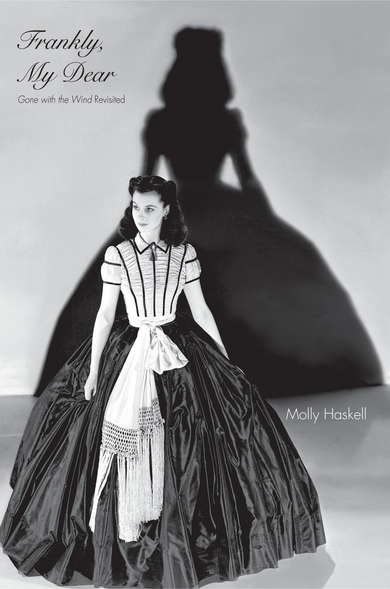
Frankly, My Dear (2009)

Molly Haskell grew up here in Richmond, and it’s here that she fell in love with movies. One of her most vivid childhood memories finds her standing before a magazine rack in the Broad Street station waiting for the train to Florida, and persuading her father to buy her a magazine devoted to the child star Margaret O’Brien.* The pleasure Molly Haskell took in reading that movie magazine is one she would later pass on to the readers of her own film reviews and books.” Those are some of the words that I spoke about Haskell Friday night when I introduced her as keynote speaker at the third annual VCU Southern Film Festival at the Virginia Museum of Fine Arts.

In her keynote address, Haskell discussed her most recent book, Frankly My Dear: Gone With the Wind Revisited (2009), which expolores Gone With the Wind as the product of three strong personalities: author Margaret Mitchell, film producer David O. Selznick, and actress Vivien Leigh. Published on the seventieth anniversary of the film’s release, Haskell’s book looks back more than eighty years to Mitchell’s drafting of the novel in the 1920s, while also considering the book and film in multiple cultural contexts and reflecting on its enduring presence in our collective memory and imagination.

Margaret Mitchell’s Gone With the Wind (2011)

Haskell‘s speech led into the screening of the recent documentaryMargaret Mitchell: American Rebel (2011), which features Haskell as well as John Wiley, Jr., who co-authored–along with Ellen F. BrownMargaret Mitchell’s Gone With the Wind: A Bestseller’s Odyssey from Atlanta to Hollywood (2011). Both Wiley, of Midlothian, and Brown, of Richmond, were in the audience Friday night as well, and after the film they joined Haskell on stage for a panel discussion moderated by me.

At the outset of the panel, I noted that the publication of Brown and Wiley‘s book marked an important contribution to Mitchell scholarship as well as studies of book publishing and copyright. Though I was prepared to offer more talking points  about their work and Haskell‘s, I didn’t need to. Their own observations about Mitchell, her novel, and the film prompted a nearly hour-long conversation with the audience, cut short only by the announcement that the museum would close at 9 p.m.

When one man sitting near the front of the auditorium expressed his ambivalence about calling himself a fan, I was reminded of the “Seven Stages of Gone With the Wind” that Haskell outlines in Frankly My Dear:

“For those of us who fell under its spell, the range of emotions attached to the film fluctuate over time with the predictable volatility of a love affair and its aftermath, in my own case what we might clinically designate as the Seven Stages of Gone With the Wind: Love, Identification, Dependency, Resentment, Embarrassment, Indifference, and then something like Half-Love again, a more grown-up affection informed by a film-lover’s appreciation of the small miracle by which a mere ‘woman’s film’ with a heroine who never quite outgrows adolescence was tansfigured into something much larger, something profoundly American, a canvas that contains, if not Walt Whitman’s multitudes, at least multiple perspectives” (xiii).

Along with those words of Haskell‘s about the Seven Stages of Gone With the Wind, I would’ve liked to address how fans of the novel and the film have formed online communities, particularly on Facebook. That’s something that Ellen Brown mentioned back stage when the four of us–Brown, Wiley, Haskell, and I–were clipping on our wireless microphones.

In their introduction to Margaret Mitchell’s Gone With the Wind, Brown and Wiley write: “We do not claim to have rewritten Gone With the Wind, but we have refocused the lens” (3). Similarly, Haskell‘s Frankly My Dear refocuses the lens, and the insights of the three authors inspired Friday’s night’s audience to see the book and film anew.

*The childhood memory of Haskell‘s that I mentioned in my introduction is one that she recounts in From Reverence to Rape: The Treatment of Women in the Movies (1974, Second Edition 1987).