Posted in Teaching

Ethics and the Dark Side of Loyalty

The Good, The Bad & the Difference (2002)

On November 8, as an exercise in ethical reasoning, students in my Focused Inquiry classes formulated responses to questions submitted to Randy Cohen during his tenure as the writer of The New York Times column “The Ethicist.” Students worked collaboratively in four groups, with each of the four responding to a different question regarding campus ethics. One question addressed the market-style dining system, another dealt with course evaluations, and the other two, unsurprisingly, concerned cheating and plagiarism. The four questions–which appear at the end of this blog entry–prompted considerable discussion, enough to insure that I’ll repeat the exercise again next fall as an introduction to applying ethical frameworks.

Students in my Focused Inquiry classes considered those questions of ethics only a day before the announcement of the firing of legendary Nittany Lions coach Joe Paterno and Penn State President Graham Spanier following the arrest of Paterno’s former assistant coach, defensive coordinator Jerry Sandusky, on charges related to the sexual abuse of minors.

Sexual abuse—in Sandusky’s case, of eight young boys over a fifteen-year period—doesn’t present us with an ethical question. Its atrocity isn’t an arguable point. But what we would have done if we were Mike McCreary—if we had seen what he saw in the locker-room shower—is another matter altogether.

In his November 14 column in The New York Times, “Let’s All Feel Superior,” David Brooks addresses the vanity that followed the news of the atrocity: “The vanity is the outraged reaction of a zillion commentators over the past week, whose indignation is based on the assumption that if they had been in Joe Paterno’s shoes, or assistant coach Mike McQueary’s shoes, they would have behaved better. They would have taken action and stopped any sexual assaults.”

Though we may believe that we “would have behaved better,” historically we haven’t. Brooks cites complicity in the face of the Holocaust and the Rwandan genocide as examples of the normalcy bias that prevents people from “process[ing] the horror in front of them.” Brooks also notes people’s motivated blindness–“they don’t see what is not in their interest to see.”

On the November 18 broadcast of NPR’s Tell Me More, ethicist Jack Marshall, founder of ProEthics, observed how the events at Penn State exemplify the dark side of loyalty: “And the dark side, in this case, is that people were so focused on the football program, and so focused on the university, that their loyalty blotted out all other considerations, including a prime directive, which is loyalty to the human race, to our children, to the innocent.”

When we return to questions of ethics next semester, it’s likely that students will raise the subject of the Penn State scandal. If they do, it will present an opportunity to consider how acting ethically isn’t synonymous with following the law.

Along with demonstrating the difference between ethics and law, and the power of the normalcy bias and motivated blindness, the recent events at Penn State underscore how even our greatest ethical values, such as loyalty, can lead us to act unethically.

The ethical questions that follow are the ones that my students addressed in class on November 8. The first three are collected in Randy Cohen’s book The Good, the Bad & the Difference (2002). The fourth question appeared in Cohen’s column on January 20, 2008.

  1. The mandatory meal plan at my college allows you to eat as much as you want but prohibits taking food out of the dining hall. However, I think it’s okay to slip a sandwich in my backpack because I am only a little freshman, and the college needs to budget for lacrosse players. My sister, Shayna, believes this is tantamount to bringing an extra-large purse to a Holiday Inn buffet? What do you think? –Erin and Shayna Silverman, Boiceville, New York
  2. I attend an Ivy League university where students are graded on a curve. During the midterm exam, the student next to me was copying answers from my paper. Because a higher score would mean a lower grade for me, I intentionally wrote some incorrect answers, waited until she handed in her test booklet, and then changed my answers to the correct ones. Was this wrong? –Brenna Tinkel, Philadelphia
  3. A college student called last week to say his ‘friend’ had visited my Web page, lifted something I wrote, and turned it in as her own work. Suspicious, her professor plans to search the Web; if he finds the paper was plagiarized, he’ll recommend expulsion. The student implored me to take the paper off my site, lest his ‘friend’s’ academic career, and possibly her life, be ruined. What do I do? –Anonymous
  4. Our university requires us students to write anonymous evaluations of our professors. On one evaluation, a student made derogatory comments about a professor’s sexual orientation. The university hired a handwriting expert to confirm the identity of the culprit so punishment could be administered. The university claims the student broke the code of conduct, but if anonymity was promised, is this investigation ethical?” –S.C., Georgia
Posted in Reading, Theatre, Writing

“One’s Whole Being Becomes Absorbed”

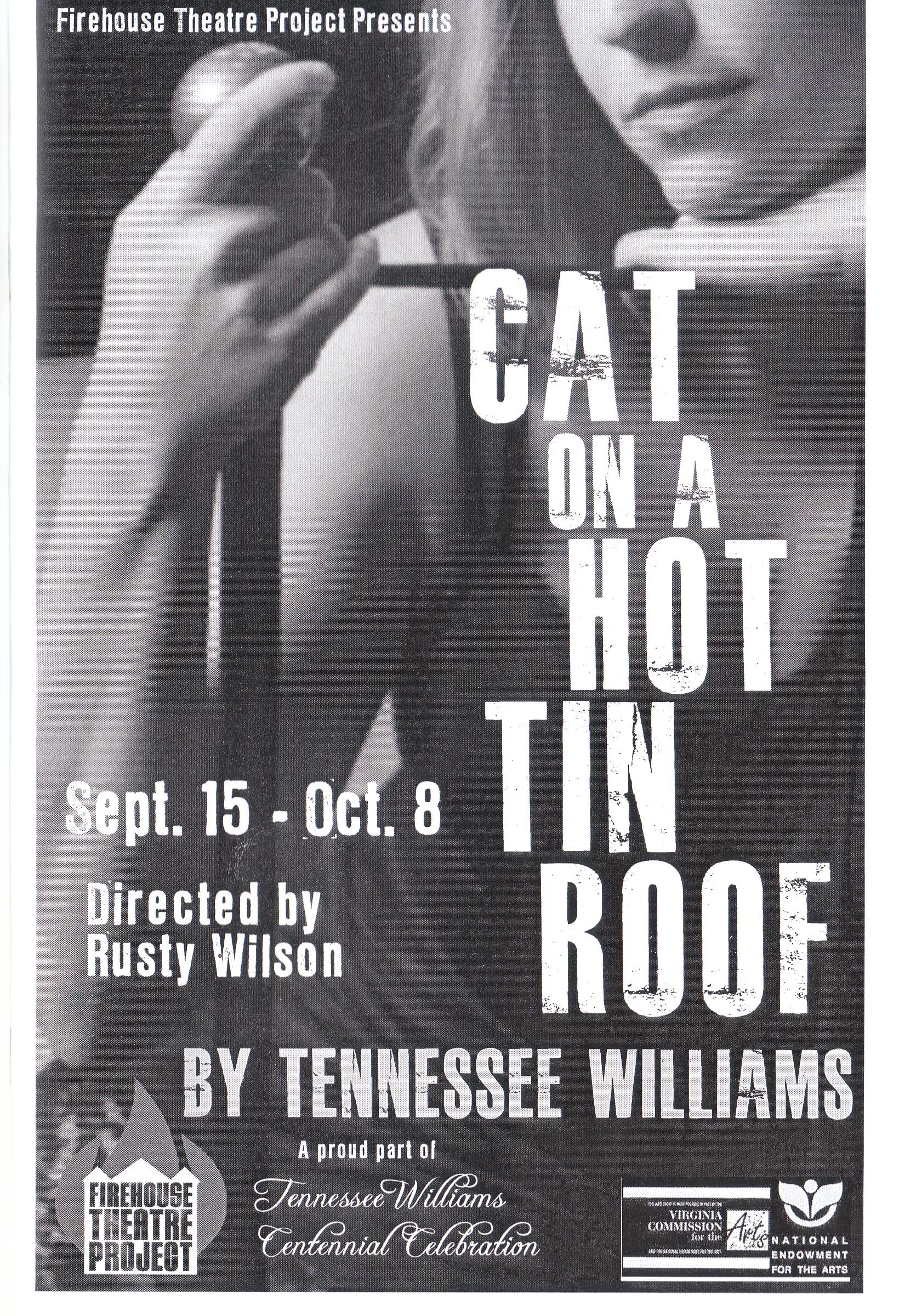
FTP’s Cat on a Hot Tin Roof, September 15 – October 8, 2011

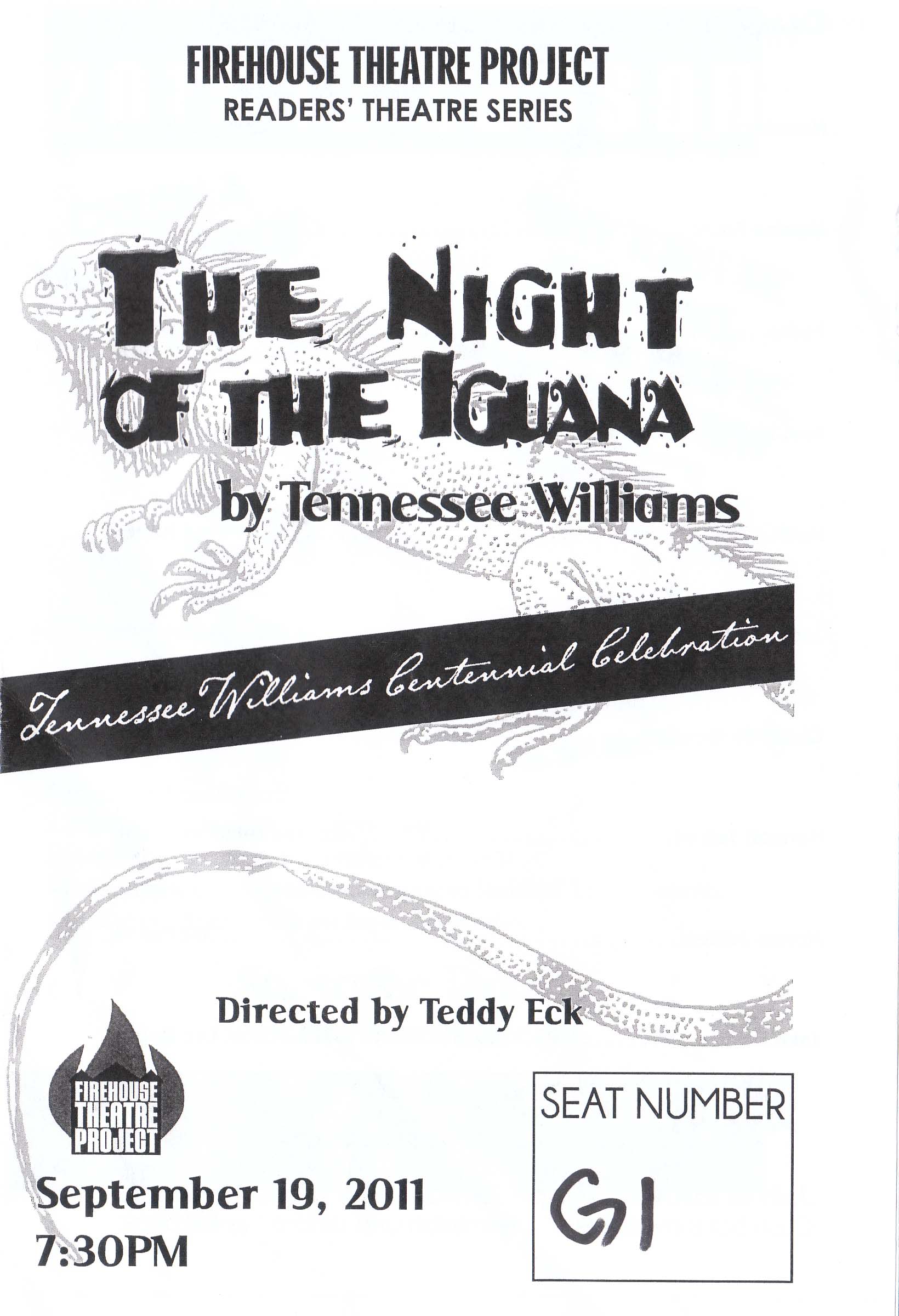
The Firehouse Theatre’s September 19 staged reading of The Night of the Iguana and its current production of Cat on a Hot Tin Roof–both part of Richmond’s Centennial Celebration of Tennessee Williams–sent me back to the pages of Williams’ plays, which I’ve been rereading in the Library of America edition: Plays 1937-1955.

Williams’ Plays 1937 -1955 (2000)

I keep thinking of these words of Big Mama’s: “Time goes by so fast. Nothin’ can outrun it. Death commences too early–almost before you’re half-acquainted with life–you meet the other. . . .” In a recent Fresh Air interview, actress Margo Martindale told Terry Gross how saying those lines as a student differed from saying them decades later:

“I played Big Mama in Cat on a Hot Tin Roof when I was 20 years old at the University of Michigan. And then I played Big Mama on Broadway in 2004. The speech at the end of that play — ‘Time goes by so quickly …’ — boy did that have different weight from when I was 20 years old to when I was 50-something-odd years old. It’s all about what you’ve experienced. You can’t teach that to a younger actor. You have to have lived that.” In the current Firehouse production,
Jacqueline Jones
speaks Big Mama’s lines from experience as well, delivering one of the cast’s strongest performances.

In his introduction to Camino Real, Williams writes of the all-consuming nature of play writing: “It is amazing and frightening how completely one’s whole being becomes absorbed in the making of a play. It is almost as if you were frantically constructing another world while the world that you live in dissolves beneath your feet, and that your survival depends on completing this construction at least one second before the old habitation collapses.”

Today when I was completing an application for a grant, I thought of how it would enable my whole being to become absorbed–at least briefly–in the writing process in a way that it can’t when I’m teaching. Grants buy us time, which “goes by so fast. Nothin’ can outrun it.”

Posted in Reading, Social Media, Teaching, Theatre, Writing

On Readers’ Theatre, Blackboard, and Turning Away from the Screen

I planned to devote this blog entry—my first in two weeks—to the Virginia Blackboard User’s Group Conference, which I attended on Friday. But what lingers in my mind today isn’t the conference, it’s the personal narratives that my students presented in class after their draft workshop on Thursday.

To shift students’ focus away from “correcting” their classmates’ writing, I decided to devote the second half of class to Readers’ Theater. After students read and commented on their group members’ drafts, each group chose an essay to perform for the class, assigned parts, and assembled impromptu costumes and props.

To honor the students’ privacy, I won’t reveal any details about their personal narratives; I will simply say that their work left a lasting
impression on me. As readers they offered descriptive rather prescriptive comments, and as performers they gave their stories a life in the classroom that was separate and distinct from the words on the page.

FTP’s The Night of the Iguana

The idea of combining a draft workshop with Readers’ Theater stems from my renewed interest in drama and my recent experiences at  Readers’ Theater performances staged at the Firehouse, including the September 19 reading of The Night of the Iguana, part of Richmond’s Centennial Celebration of Tennessee Williams.

The power of live theater and its influence on my teaching also speaks to my experience at yesterday’s Blackboard conference. Though I use Blackboard on a daily basis—and it’s usually projected on the screen in the classroom at least once during each of my Tuesday-Thursday classes—for me it’s simply a tool: a content management system for content that’s always changing.

During yesterday’s conference sessions, many in the audience divided their attention between the large screens at the front of the room and the small screens in their hands and their laps. In the 1:15 session, I overheard a man say his iPad was attached to his thigh.

More and more I see the need for opportunities to turn away from the screen and to face each other.  Though I don’t agree with many of David Mamet’s sentiments—in particular some of his pronouncements in his latest book, The Secret Knowledge: On the Dismantling of American Culture (2011)—I do concur with his notion that people go to the theater to see that real communication between human beings is still possible.  I know for me it’s true. My own return to the theater is in part a response to our increasingly digital lives.

Posted in Writing

Writing 26.2, and Tennessee Williams, Too

Chop Suey Books, 2913 West Cary Street, Richmond, VA

Local writers gathered for workshops on the second floor of Chop Suey Books this weekend, and in between sessions sipped Tall Bike Coffee on the sidewalk and ordered burgers and hot dogs from store owner/grill master Ward Tefft–all as part of  a 26.2 All-Write, All-Night Writing Marathon and Cook-Out to benefit the Richmond Young Writers.

At Saturday’s opening session, “Write Now,” workshop leader Valley Haggard, Executive Director of Richmond Young Writers, led us through a couple of timed writing exercises from Natalie Goldberg‘s Writing Down the Bones, a book that I read years ago and now realize that I need to revisit.

Vivien Leigh and Marlon Brando as Blanche DuBois and Stanley Kowalski in the 1951 film adaptation of the 1947 play / britannica.com.

Early in the afternoon, I left Chop Suey to focus on another writer’s work across the street: To mark the beginning of Richmond’s  Tennessee Williams’ Centennial Celebration, the Byrd Theatre hosted a free screening of A Streetcar Named Desire, introduced by Carol Piersol, Artistic Director of the Firehouse Theatre (and my acting teacher), and John Knapp, Artistic Director of Richmond Triangle Players.

After Streetcar, I returned to Chop Suey and to my own writing, catching the end of a Writing Sampler workshop followed by a free-writing session.  I noticed something that I hadn’t seen earlier in the day. On the curtain that serves as the door to the closet in the back corner of the writing room, someone had pinned a sign that read “Enter the Fort of Solitude.” Throughout the free-writing session, one of the Richmond Young Writers wrote there, behind the curtain.

At the end of the free-writing session, I retreated to my own Fort of Solitude on Grace Street but returned to Carytown before daylight.  On the sidewalk across from Chop Suey,  author Eliezer Sobel led  a small circle of writers through a sunrise meditation and writing session. When we closed our eyes to begin, it was still dark. When we opened our eyes, it was light, and we wrote about 9/11 and other numbers on our brains.

Posted in Teaching, Theatre

“Acting Lessons for Teachers”

Acting Lessons for Teachers. 2nd Ed. (2007).

I wish I could have read Acting Lessons for Teachers (1994, 2007) in 1990 when I was teaching my first college classes. Robert T. Tauber and Cathy Sargent Mester‘s book would have shown me that my teaching act wasn’t a gimmick but a pedagogical necessity–not simply because I was a twenty-two-year-old who could have passed for seventeen but because all of us who teach are performers.

Despite its title, Acting Lessons for Teachers doesn’t offer tutorials on craft but instead describes the acting strategies that enhance teaching: physical and vocal animation, teacher role-playing, strategic entrances and exits, humor, props, suspense and surprise, and creative use of space. It also presents anecdotes from teachers, both K-12 and college professors, who have successfully employed those strategies in the classroom. Raymond J. Clough, Professor Emeritus of Modern Languages at Canisius College, recalls an evening in the mid-1960s when he saw Vincent Price perform a dramatic reading of Edgar Allan Poe’s “The Tell-Tale Heart.” For Clough, then a young college teacher, Price’s mesmerizing performance served as an epiphany, illustrating the importance of “training the voice” and of “knowing materials cold” (192).

Scott Richardson, Professor of Classics at St. John’s University, recounts how he presents a Viewer Mail segment in his classes to address the relevance of studying a dead language and broader questions regarding the value of higher education (202). To introduce the Greek god Dionysus, he invokes The Rocky Horror Picture Show (203).

While some teachers readily draw on the tools of actors in the classroom, others would rather not identify themselves as performers, believing that focusing on performance emphasizes entertainment over instruction. But all of us who teach–whether we call ourselves performers or not–share the aim of instructing our students, which requires their attention.  Acting Lessons for Teachers shows us how we can capture that attention as an actor would.

Posted in Reading, Writing

The Writing Show’s Voldemort Panel

James River Writers’ Writing Show

At Thursday night’s Writing Show–Tall, Dark, and Creepy?: Writing a Believable Villain, author John Milliken Thompson thanked James River Writers for scheduling the event between natural disasters. Despite the pre-Irene showers, a crowd of about seventy-five gathered in the pavillion of the Richmond Childrens’ Museum to hear Thompson, author of The Reservoir,  Katherine Neville, author of The Eight, and Alma Katsu, author of The Taker, discuss villains–both their own and others.

The show’s host, writer Meriah Crawford, an Assistant Professor in VCU’s University College as well as a private investigator, referred to the authors assembled on stage as the “Voldemort Panel.” Along with Voldemort, the panelists discussed Hannibal Lechter, another villain known to more movie-goers than readers. Neville observed that what drives The Silence of the Lambs isn’t the search for Buffalo Bill but the character of Hannibal Lechter. Thompson noted his affinity for villains like Wickham of Jane Austen’s Pride and Prejudice, a character who isn’t evil incarnate but who is deeply flawed. Katsu bemoaned the tendency for some writers to provide motivation for every villian’s actions: It’s a zombie, come on, she said.

Though villains dominated the conversation, the panelists and the host also addressed the importance of the writing habit, of returning to the desk every day. That’s a challenge for all three panelists, who are currently promoting new books. In the words of Thompson, promoting a book is like a wedding ceremony: You want to share your love of the writing with everyone, but then you’re ready to go back to the part that you do in private.

Posted in Reading, Teaching

Discussing VCU’s Summer Reading

The Other Wes Moore (2010)

This morning I met with twenty-five first-year students to discuss  The Other Wes Moore, VCU’s 2011 Summer Reading Program selection, as part of Welcome Week. Though classes don’t begin until tomorrow, the students I met with today–and the other members of the freshman class who met with other faculty, administrators, and staff during  Welcome Week discussions–engaged in an academic conversation similar to the ones that they will  encounter in their Focused Inquiry classes.

I was impressed by the number of students who were willing to express their ideas both in small-group and large-group discussion. (Our one-hour session included both.) I attribute the high level of participation in part to the nature of the  Welcome Week Summer Reading sessions, giving students the opportunity to engage in an academic discussion that isn’t led by someone who will evaluate their performance and record it in a grade book. Instead, the sessions offer an introduction to and preparation for the academic conversations that they will encounter later  in the classroom.

Several of the students I met with today mentioned the lines that were repeatedly addressed in the session for discussion leaders that I attended on August 15: “The chilling truth is that his story could have been mine. The tragedy is that my story could have been his ” (xi).

Those lines from Moore’s introduction also appear on the jacket–part of the book that’s the work of the publisher, not the writer. Wes Moore mentioned that fact when he spoke with the Focused Inquiry Faculty yesterday in a meeting interrupted by the earthquake. After we evacuated the Hibbs building, Moore generously continued to speak with the faculty while we stood on Shafer Court, awaiting news. In his discussion–both both pre and post-earthquake–Moore focused not on the lines that lend themselves to book-jacket blurbs, but on the crucial roles of  the people in his life–relatives, role models, and mentors–who, in his words, “kept pushing me to see more than what was directly in front of me, to see the boundless possibilities of the wider world and the unexplored possibilities within myself” (179).

The earthquake prevented Wes Moore from addressing the freshmen at convocation yesterday, but his words have spoken to many of the students I met with today. And their willingness to consider differing opinions about his book shows that they, too, are willing to see beyond their own experiences to the wider world.

Posted in Social Media, Theatre

An Online Dating Musical

FTP’s Hearts on Line, August 14 and 15, 2011.

If you saw Hearts on Line last Sunday or Monday, you were face to face with characters pursuing relationships that began without face-to-face contact. I’ve been thinking about that since I saw Monday night’s performance, which I almost didn’t see.  I was one of the last people ushered to the section of folding chairs set up for the overflow crowd.

Live theater has far less cultural impact than the Internet now, yet  the staged reading of Hearts on Line played to sold-out crowds on both nights of its run at the Firehouse, August 14-15.

Playwright Rebecca Jones, Marketing Program Coordinator for VCU’s School of Business, depicts online dating with humor and insight, and the successful run of her show at the Firehouse attests to the value of black box theater as a venue for reflecting on our increasingly digital lives–if we’re willing to unplug for an evening.

Posted in Reading, Writing

River City Reads: “Ashes to Water”

Ashes to Water (2010)

Last night at the office of Richmond’s Frontier Project, on the corner of East Franklin and 20th Street, writer and actress Irene Ziegler  met with readers to discuss her mystery novel Ashes to Water:  the July-August selection for Richmond’s city-wide book club co-sponsored by Chop Suey Books and River City Reads. Rather than reading a long passage from her work–as many authors do–Ziegler alternated short excerpts from Ashes to Water and Rules of the Lake, its prequel, with reflections on writing and anecdotes from her life growing up in Pre-Disney, Florida.

As an author who is also an actress, Ziegler possesses an awareness of audience that many writers lack. When an author reads an entire chapter, even the best listeners are likely to lose their way. One image captures our interest, we linger with it, and never catch up to the narrative that’s unfolding. Ziegler encouraged the audience to write about what scares us and recounted how Francine Prose offered the same advice to playwright David Lindsay-Abaire. Following her advice,  he wrote Rabbit Hole, which received the Pulitzer Prize for drama in 2007.

Read more about Ashes to Water in the blog post for August 9 and on Irene Ziegler’s website.

Posted in Reading, Teaching

“Do Androids Dream of Electric Sheep?”

Do Androids Dream of Electric Sheep? (1968)

This afternoon, I met with several of my Focused Inquiry colleagues to discuss Phillip K. Dick’s novel Do Androids Dream of Electric Sheep?, the holiday reading that will bridge UNIV 111 and 112.  Though students won’t read the novel until December or early January, I will address it–at least briefly–when they study Art Spiegelman‘s In the Shadow of No Towers on September 13 and 15, following the tenth anniversary of 9/11.

I have taught In the Shadow of No Towers in the spring semester for the past two years but  thought it would be worthwhile to consider Spiegelman‘s graphic memoir of the days that followed 9/11 on the days that follow the tenth anniversary.

On page 7, Spiegelman writes: “My ‘leaders’ are reading the book of Revelations.  . . .  I’m reading the paranoid science fiction of Phillip K. Dick.” Why does Spiegelman want us to know what he was reading–and what our leaders were reading–in the days following 9/11? What does he want to tell us? Those are a couple of the questions I may pose in class on September 13 or 15–and perhaps again in January when we study “the paranoid science fiction of Phillip K. Dick.”

Do Androids Dream of Electric Sheep? is new to me–I have just begun reading it–so I don’t know yet how I will approach it in class. My tentative plans include  incorporating a study of excerpts from the graphic novel adaptation from Boom Studios and concluding the semester with a study of Blade Runner, Ridley Scott‘s film adaptation–or perhaps, more accurately, his re-imagining–of the novel.