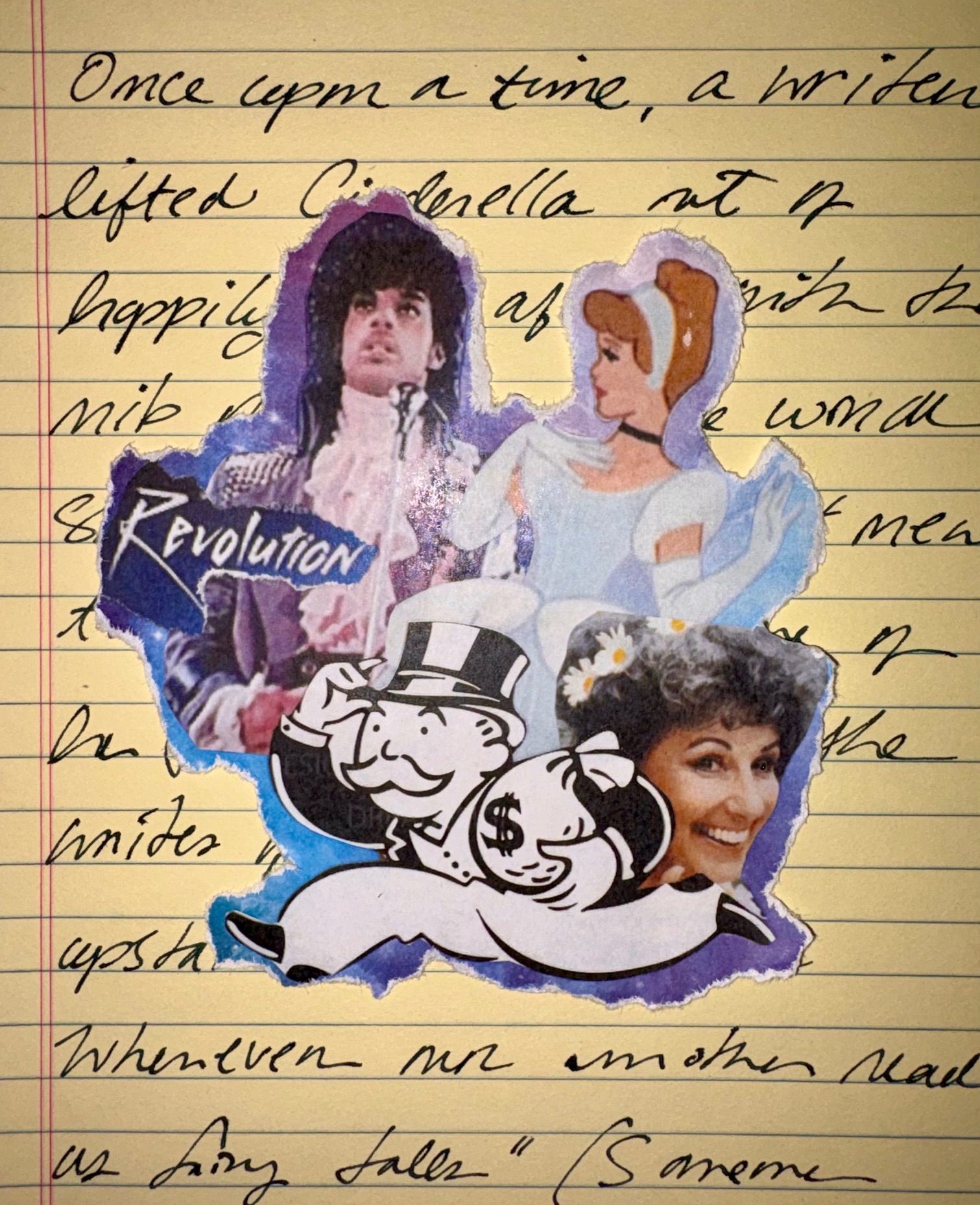
Once upon a time, a writer lifted Cinderella out of happily-ever-after with the nib of her pen.
The world she was mining wasn’t new terrain for her. In one of her poems, for instance, she writes of “the ghost upstairs who hovered whenever / our mother read us fairy tales” (“Someone called,” lines 6-7). But rather than reflecting on happily-ever-after stories (as she does there), she was confronting a happily-ever-after with questions: What now? How does one proceed?—questions that we find ourselves asking over and over as our world threatens to vanish in a cloud of radioactive fallout.
Though young children cannot grasp the full implications of that existential crisis–or the others of our long, dark nights of the soul–they, too, are profoundly affected by the traumas of loss, of separation and death, that they encounter. For them, fairy tales, with their unambiguous messages, offer clear-cut pictures of right and wrong, and good and evil, to navigate their inner turmoil. In The Uses of Enchantment, psychologist Bruno Bettelheim wrote of fairy tales as purveyors of “ideas on how to bring [a child’s] inner house in order, and on that basis be able to create order in his life” (5). But what if, as adults, we are faced with leaders who themselves lack the moral development aided by the fairy tales of our childhood–people who have become the one-dimensional villains of those stories; and what if, consequently, the houses we must put into order aren’t our inner ones but the ones of Pennsylvania Avenue and Capitol Hill?
Those are some of the questions that the writer, Debra Kaufman, may have asked herself when she brought Cinderella into the here-and-now, to create a sense of order–as she did when she picked “lentils, from cinders–” in an upended world growing less and less recognizable as our own.
Cinderella, in her numerous and occasionally contradictory iterations, remains part of our collective memory and frequent fodder for debate and deconstruction. In her dark critique of Cinderella, poet Anne Sexton left the title character and her prince hermetically sealed in the happily-ever-after, “like two dolls in a museum case” (line 34). Kaufman breaks the glass, liberating the couple to challenge the notion that their fates are sealed.
And so, Kaufman’s Cinderella leads us as adults, as her former self once guided us as children. She enters our world–ready to leave behind the after of the happily-ever, evolving from the naïve ingenue of central casting–to learn what she in turn reminds us that we must do ourselves: draw on inner strength.
Works Cited
Bettelheim, Bruno. The Uses of Enchantment: The Meaning and Importance of Fairy Tales. 1975. Knopf, 1977.
Kaufman, Debra. After the Wedding, Revolution. Directed by Barb Young, Creative Greensboro Evening of Short Plays, No. 40, 9-l2 April 2026, Stephen D. Hyers Theatre, Greensboro, NC.
—. Outwalking the Shadow. Redhawk, 2023.
Sexton, Anne. “Cinderella.” The Complete Poems of Anne Sexton. 1981. Mariner, 1999. pp. 255-58.
Postscript
Writing of her adaptation of Paul Green’s anti-war play, Johnny Johnson, Kaufman likened her work to the title’s character’s labor as a stone carver: “My work would primarily be to chisel away parts that made the story lag or go off in directions that did not serve the play overall” (95). I am grateful to her for carving After the Wedding, Revolution–it, too, an antiwar play of sorts–and I am thankful for the opportunity to play a role in its premiere.
 Jane Lucas