Overview
An annotated bibliography is a list of sources on a subject that includes a summary of each source. Some bibliographies include additional information, such as commentary on the source and the authors’ credentials, which is the type of bibliography that you will compose along with your final essay for the course.
Key Features
- Your final essay, an introductory essay of three or more paragraphs, presents the subject of your bibliography and addresses your purpose for compiling it. In other words: What drives your research? What interests you in the subject, and what question, or questions, do you seek to answer about it? Also, it considers what larger project might develop from your final essay and annotated bibliography, and lastly, what would serve as its theoretical framework? In other words, through what academic lens would you examine your subject?
- A complete MLA-style bibliography entry for each source.
- A one-paragraph summary of each source, followed by a shorter second paragraph that addresses the purpose that the source might serve in a larger project. Would it serve as a point of comparison or contrast to another source? Would it support or challenge an idea presented in another source? Is it a secondary source that sheds light on the meaning of a primary source? The last question pertains primarily to bibliographies that focus on one of the writers studied in the course. Lastly, a brief third that names the author and includes his or her credentials.
Preliminary Work—What to Complete in Class Today
Personal Interview
Your final essay and annotated bibliography will focus on one of the authors we have studied or one of the elements of the course, including (1) blogging in the classroom, (2) limiting screen time, (3) writing longhand, and (4) playing Scrabble. As a starting point, you will conduct a short personal interview that will serve as one of the sources for your project. If you decide that you do not want to use the interview that you conduct today, you are welcome to include another one in your project. Keep in mind, however, that the interview you include in your project must be conducted with a student currently enrolled in section eight or eighteen, and the subject of the interview must be the subject of your project.
Questions to ask your interviewee include the following:
- What experience, if any, did you have with the subject (the reading or the aspect of the course) before you encountered it in English 1103?
- Has it changed your perspective on reading and/or writing? If so, how?
- Will you continue to pursue the subject (read more work by the author, continue the classroom practice or activity) after the conclusion of the semester?
After you conduct your interview, compose on the worksheet provided a sentence in which you introduce a quotation from the interview with a signal phrase, such as, According to . . . , or [insert first and last name] notes or observes or points out that . . . .” Your quotation will not be followed by a parenthetical citation because it is a form of oral communication (without page or paragraph numbers). See the sample on your worksheet.
Follow your quotation with an annotated bibliography entry in this format:
Annotated Bibliography
Last Name, First Name. Interview. Conducted by Your First Name Your Last Name. Day Month Year.
Your bibliographic entry will be followed by three paragraphs. See today’s worksheet for details.
Final Essay and Annotated Bibliography Assignment
- Begin by conducting a short personal interview and composing an annotated bibliographic entry for the interview. For more information, see today’s worksheet and the paragraphs under the header PRELIMINARY WORK—What to Complete in Class Today.
- Compose an annotated bibliographic entry for the source that serves as the starting point for your research. See the list of texts that follows.
- Use the HPU Libraries site, and Google Scholar to locate a minimum of three additional reliable and relevant print sources (articles, essays, and/or books) devoted to the same subject. Compose your summary, commentary, and credentials paragraphs in complete sentences, introduce quotations with signal phrases, and include parenthetical citations where needed. Your bibliography must include five sources, four of which must be print. (Your personal interview is a nonprint source.) If you wish to include an additional non-print source, such as a video, you may include that as a sixth source. Also, if you choose to use both articles on limiting screen time that were distributed in class (Allison Aubrey’s and Maryanne Wolf’s), you will need to include an additional print source.
- After you have composed your annotated bibliography entries, write an introductory essay that (1) presents the subject of your bibliography, and (2) addresses your purpose for compiling it. In other words: What drives your research? What question do you seek to answer about your subject? Also, (3) What larger project might develop from your bibliography? Would it be a project for a course in psychology, science, education, or another discipline? What would serve as its theoretical framework? In other words, through what academic lens would you examine your subject? Address all five of your sources in your essay and quote at least two of them.
Though your introductory essay will precede your annotated bibliography, you will compose it last because you will need to reread and summarize your sources before you will know how to address them in your essay.
Directions for Researching, Drafting, Revising, and Submitting
- Devote today’s class primarily to conducting a personal interview and composing an annotated bibliography entry for the interview. You will have two additional Wednesdays to work in class on your final essay and annotated bibliography before you post your revision to Blackboard and to your WordPress blog.
- Before class on the due date: Post a copy of your revision to Blackboard and to your blog. In your blog post, omit the first-page information included in your file submitted to Blackboard (your name, professor’s name, course and section, and date). Add to your blog post an image that documents some part of your writing process away from the screen, such as the summary of your source in your journal, today’s worksheet, or a page of your draft. Also, add an embedded link to a relevant website. Even though your work for this assignment will take place primarily in front of the screen, your writing process still involves putting pen to paper, and photographic documentation of that on your blog is a requirement of the assignment.
Sample Annotated Bibliography Entries
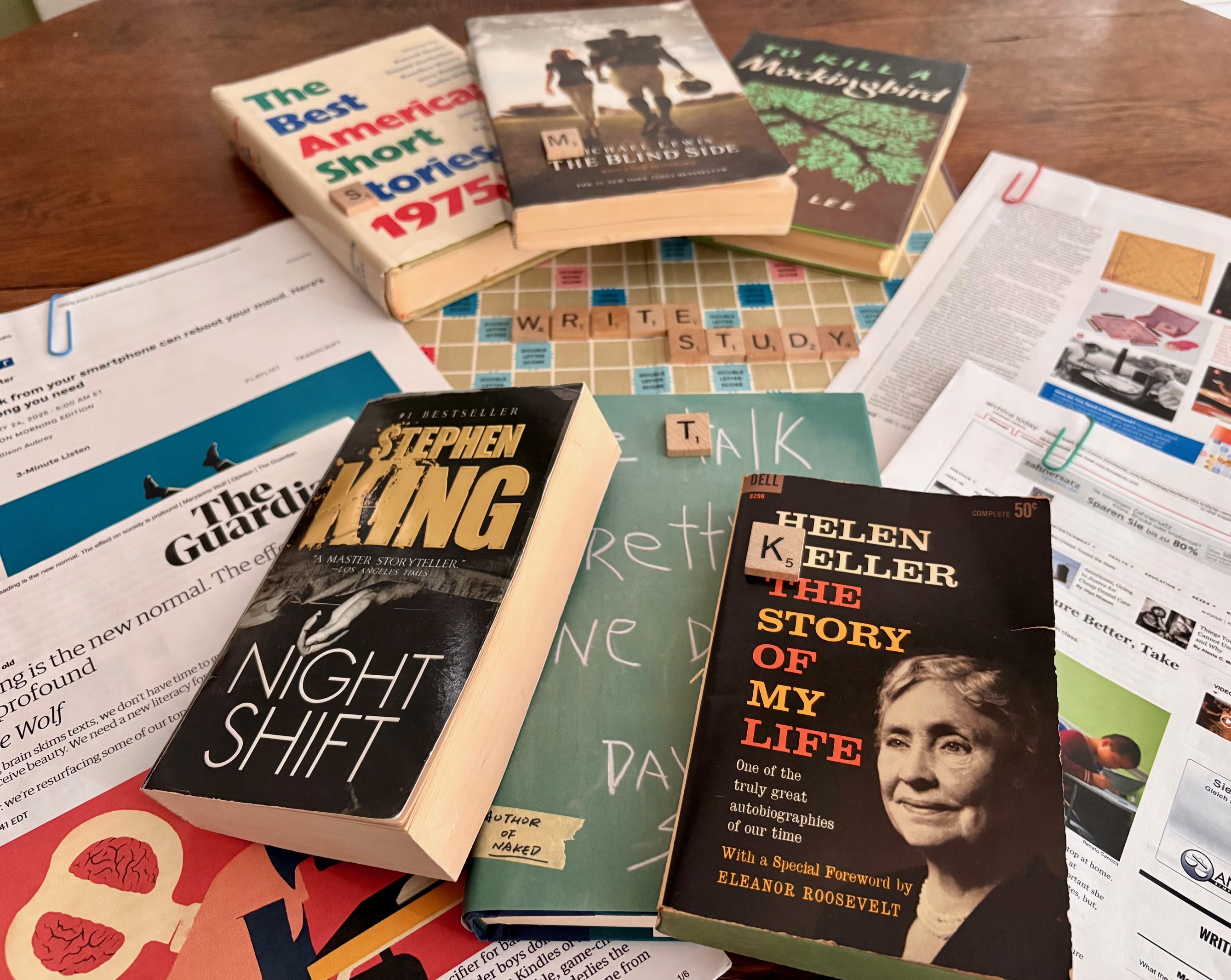
Aubrey, Allison. “A Break from Your Smartphone Can Reboot Your Mood: Here’s How Long You Need.” NPR, 24 Fb. 2025. https://www.npr.org/2025/02/24/nx-s1-5304417/smartphone-break-digital-detox-screen-addiction#:~:text=Researchers%20studied%20what%20happened%20when,felt%20better%20after%20the%20break.
Barthelme, Donald. “The School.” The Best American Short Stories 1975, edited by Martha Foley, Houghton Mifflin, 1975. pp. 8-11.
Junod, Tom. “The Falling Man.” Esquire, vol. 140, no. 3, Sept. 2003, pp. 176+. Gale Academic OneFile Select, https://link.gale.com/apps/doc/A106423422/EAIM?u=hpu_main&sid=bookmark-EAIM&xid=ce48797f.
Keller, Helen. “The Day Language Came into My Life.” https://janelucasdotcom. files.wordpress.com/2025/08/a0461-3.thedaylanguagecameintomylife_keller.pdf.
King, Stephen. “Strawberry Spring.” Nigh Shift. Anchor, 2011. pp. 268-82.
Klara, Robert. “Scrabble.” Adweek, vol. 61, no. 13, 15 June 2020, pp. 22-23. ProQuest, https://libraryproxy.highpoint.edu/login?url=https://www.proquest.com/magazine/scrabble/docview/241647624/se-2.
Lee, Harper. Chapter One. To Kill a Mockingbird. Lippincott, 1960. pp. 9-19.
Lewis, Michael. Chapter One: “Back Story.” The Blind Side. 2006. Norton, 2009. pp. 15-16.
Richtel, Matt. “Blogs vs. Term Papers.” New York Times, 20 Jan. 2012. ProQuest, https://libproxy.highpoint.edu/login?url=https://www.proquest.com/blogs-podcasts-websites/blogs-vs-term-papers/docview/2216251885/se-2.
Sedaris, David. “Me Talk Pretty One Day.” Me Talk Pretty One Day. Little, Brown, 2000. pp. 166-73.
Wolf, Maryanne. “Skim Reading is the New Normal. The Effect on Society is Profound.” The Guardian, 25 Aug. 2018, https://www.theguardian.com/commentisfree/2018/aug/25/skim-reading-new-normal-maryanne-wolf.
Grade Criteria
An A final essay and annotated bibliography includes these components:
- An introductory essay of three or more paragraphs that (1) presents the subject of your bibliography, and (2) addresses your purpose for compiling it. In other words: What drives your research? What question do you seek to answer about one of the subjects that you’ve studied in the course or about one aspect of the course? Also, (3) what larger project might develop from your bibliography? Would it be a project for a course in science, psychology, education, or another discipline? What would serve as its theoretical framework? In other words, through what academic lens would you examine your subject?
- A complete works cited/bibliographic entry for a minimum of *five reliable and relevant sources, four of which are print. Alphabetize the list by the writers’ last names.
- A one-paragraph summary of each source followed by a shorter paragraph of commentary, and a third that names the author and includes his or her credentials.
An A final essay and annotated bibliography complies with the requirements above and is also cohesive and relatively free of surface errors.
A B final essay and annotated bibliography effectively meets all of the requirements above but may be flawed by minor issues of organization and/or surface errors.
A C final essay and annotated bibliography meets most but not all of the requirements above and may also be flawed by issues of organization and/or surface errors.
A D final essay and annotated bibliography meets only a few of the requirements above and may also be flawed by issues of organization and/or surface errors.
An F final essay and annotated bibliography fails to meet the requirements above and may also be flawed by substantial issues of organization and/or surface errors.
Next Up
Wordplay Day! To prepare for class, revisit the Dictionary and World Builder pages on the Scrabble website, the Merriam-Webster Scrabble Word Finder page, and review the blog posts devoted to Scrabble tips.
 Jane Lucas