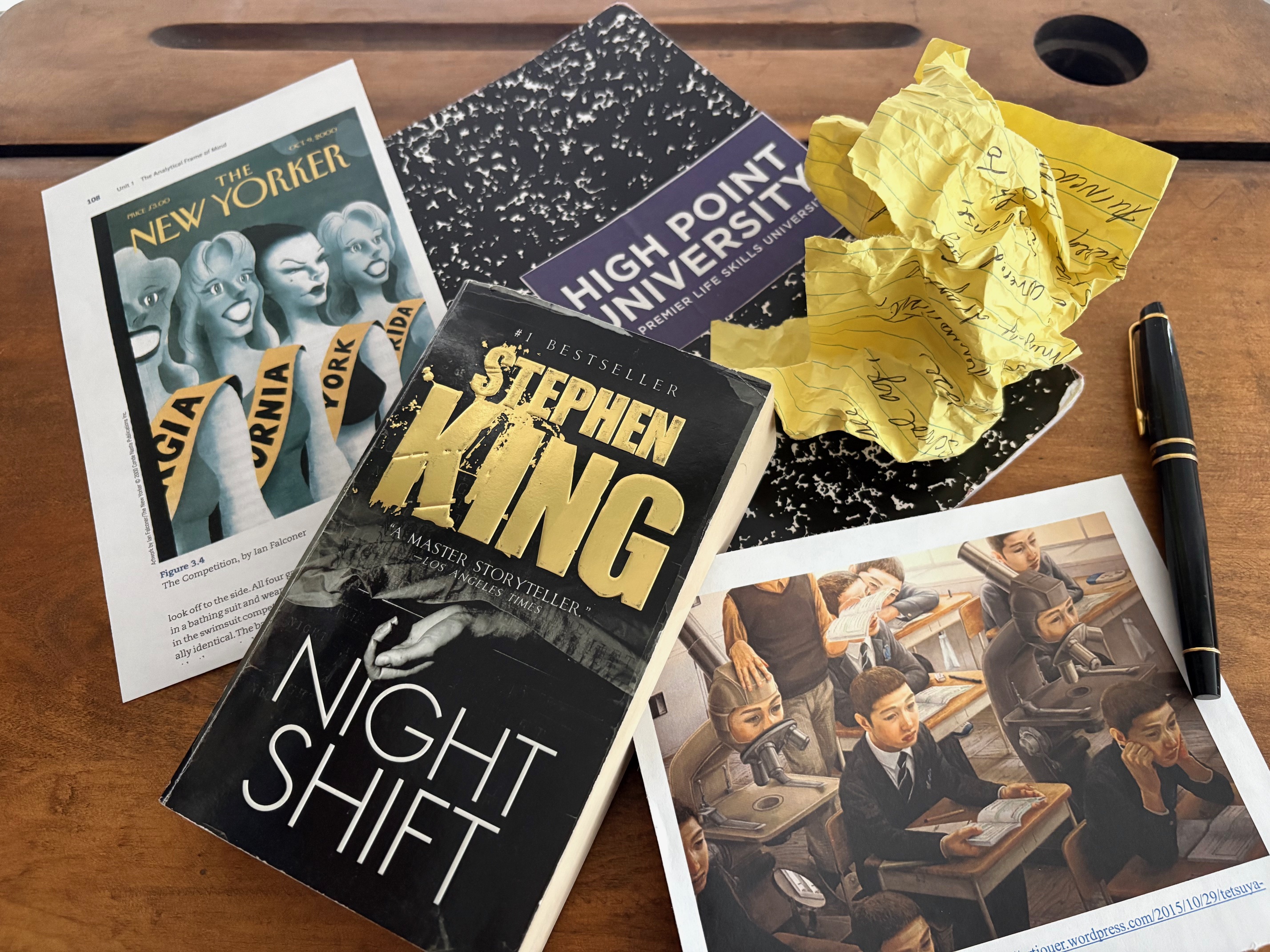
In class next Wednesday, you will compose a final reflective essay that documents your work in the second half of the semester, focusing on what you consider some of your most significant work and the features or aspects of the course that have benefited your development as a writer and a student. Since you have already written a reflective essay on your final essay and annotated bibliography, your final reflection should focus on other assignments and features of the course.
If you are interested in developing the analysis of The Competition or Seedlings from your March 30 group assignment, your final reflection offers you an opportunity for that closer examination of Ian Falconer’s New Yorker Cover or Tetsuya Ishida’s painting. If you plan to address one of those visual texts, reexamine it before next Wednesday. The Competition is featured in Chapter Three of Writing Analytically, and both The Competition and Seedlings are included in the March 31 class notes, along with model summaries and commentaries.
In your reflective essay, you will include one relevant quotation from your reading, introduced by a signal phrase, and followed by a parenthetical citation. The line you quote may be from a pertinent section of Writing Analytically or from one of the other course readings completed in the second half of the semester. Either way, be sure to record the work cited entry in the correct format in your journal. During the writing of your reflection, which is a handwritten assignment, you will not have the option of referring to any electronic resources. You may refer only to your journal, your textbook, and your class handouts.
At the end of your reflection, you will include a work cited entry for the text that you quote. Unlike the samples that follow, your entry will have a hanging indent in the second line and any subsequent lines.
Sample Works Cited Entries
Aubrey, Allison. “A Break from Your Smartphone Can Reboot Your Mood: Here’s How Long You Need.” NPR, 24 Feb. 2025. https://www.npr.org/2025/02/24/nx-s1-5304417/smartphone-break-digital-detox-screen-addiction#:~:text=Researchers%20studied%20what%20happened%20when, felt%20better%20after%20the%20break.
Hu, Charlotte. “Why Writing by Hand is Better for Memory and Learning.” Ed. Lauren J. Young. Scientific American, 21 Feb. 2024, https://www.scientificamerican.com/article/why-writing-by-hand-is-better-for-memory-and-learning/.
King, Stephen. “Strawberry Spring.” Nigh Shift. Anchor, 2011. pp. 268-82.
Klara, Robert. “Scrabble.” Adweek, vol. 61, no. 13, 15 June 2020, pp. 22-23. ProQuest, https://libraryproxy.highpoint.edu/login?url=https://www.proquest.com/magazine/ scrabble/docview/241647624/se-2.
Richtel, Matt. “Blogs vs. Term Papers.” New York Times, 20 Jan. 2012. ProQuest, https://libproxy.highpoint.edu/login?url=https://www.proquest.com/blogs-podcasts-websites/blogs-vs-term-papers/docview/2216251885/se-2.
Rosenwasser, David, and Jill Stephen. “Making an Interpretation: The Example of a New Yorker Cover.” Writing Analytically, 9th edition. Wadsworth/Cengage, 2024. pp. 107-112.
Wolf, Maryanne. “Skim Reading is the New Normal. The Effect on Society is Profound.” The Guardian, 25 Aug. 2018, https://www.theguardian.com/commentisfree/2018/aug/25/skim-reading-new-normal-maryanne-wolf.
Up Next
Wordplay Day! To prepare for class, revisit the Dictionary and World Builder pages on the Scrabble website or the Merriam-Webster Scrabble Word Finder page, and review the blog posts devoted to Scrabble tips.
Coming Soon
In class on Monday, you will read a designated classmate’s final essay and annotated bibliography, compose a handwritten response to it, and transcribe your feedback as a comment on the student’s WordPress blog. After your Scrabble debriefing, you will receive instructions for your peer response, and you will have the remainder of the class period to complete it.
Bonus Assignment
- Attend High-PURCS (HPU’s Undergraduate Research and Creative Works Symposium), and take notes in your journal on five of the posters or sessions. Include in your notes the poster numbers or session names.
- Look for a QR code labeled The Assignment.
- Scan the code and reply to the questions, which include reviewing five presentations. You will need to identify the presentation session and ID (ie. poster # or oral session name) and the presenter’s name. Then you will be instructed to summarize what you have learned in the oral presentation or talking with a poster presenter.
- Complete the questionnaire on Tuesday. The form will close on Wednesday morning.
You do not need to submit your High PURCS notes to me. The event organizers will identify your names in the spreadsheet populated by the survey and send them to me.
In addition to providing you with a bonus assignment opportunity, attending High-PURCS gives you a chance to support other HPU students’ research and creative endeavors–and it may also spark ideas for projects of your own.
 Jane Lucas