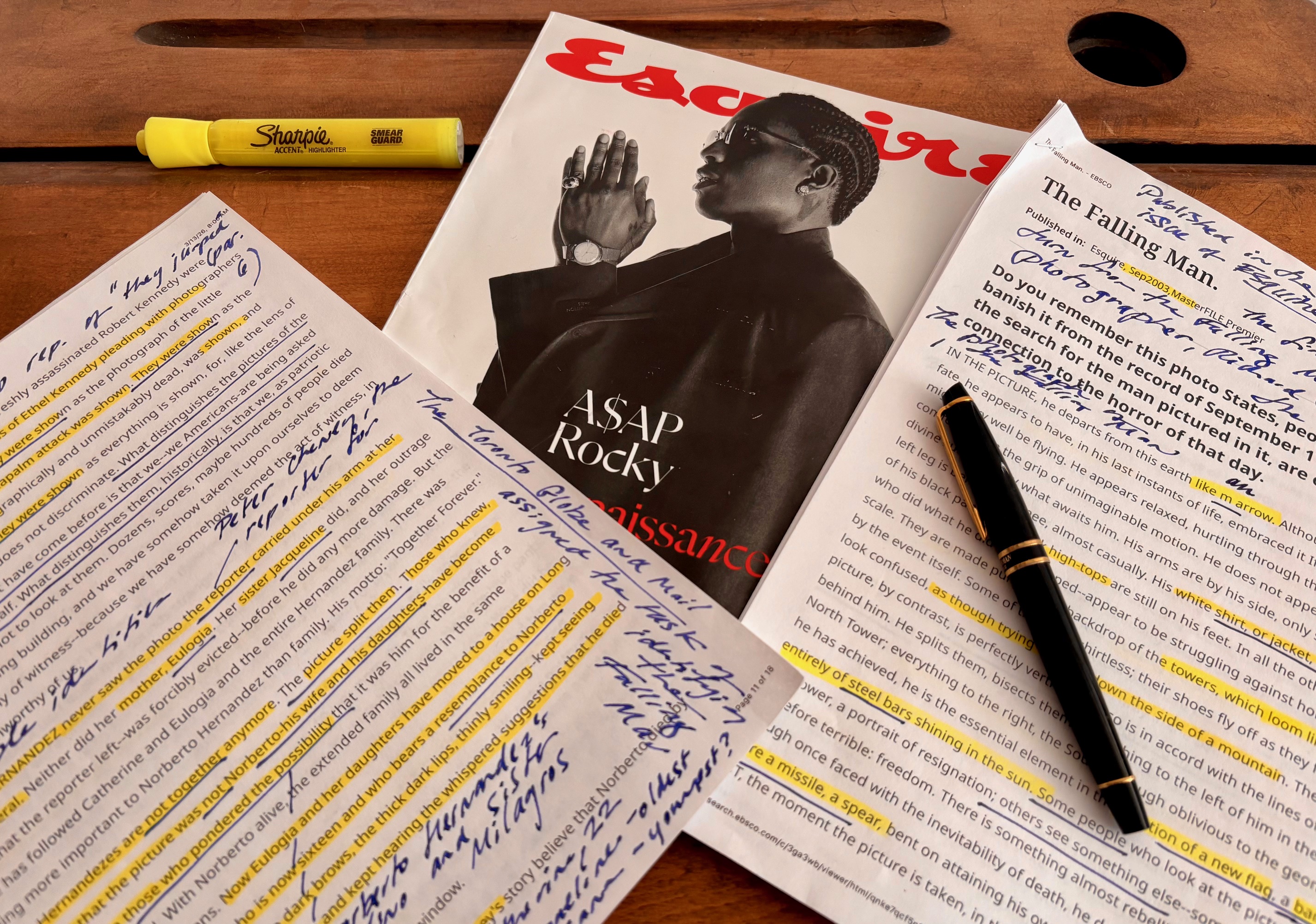
When I opened the current issue of Esquire, I didn’t expect to spot the name Tom Junod. What I saw out of the corner of my eye wasn’t a byline; Junod had left Esquire to write for ESPN The Magazine in 2016. The name I’d grown accustomed to seeing as a byline was instead the first words of a feature titled “Family Secrets,” by John Hendrickson.
Hendrickson’s feature focuses on the recent publication of Tom Junod’s first book, a memoir. I realized that “Family Secrets” could serve as a source in an annotated bibliography devoted to Junod’s writing–and, time permitting, I could read his new memoir, In the Days of My Youth I was Told What it Means to be a Man. And that book could serve as a source as well.
Although I could have begun my writing process by drafting a bibliographic entry for “Family Secrets,” instead I began with an bibliographic entry for “The Falling Man,” as a model for those of you who choose Junod’s writing as your subject.
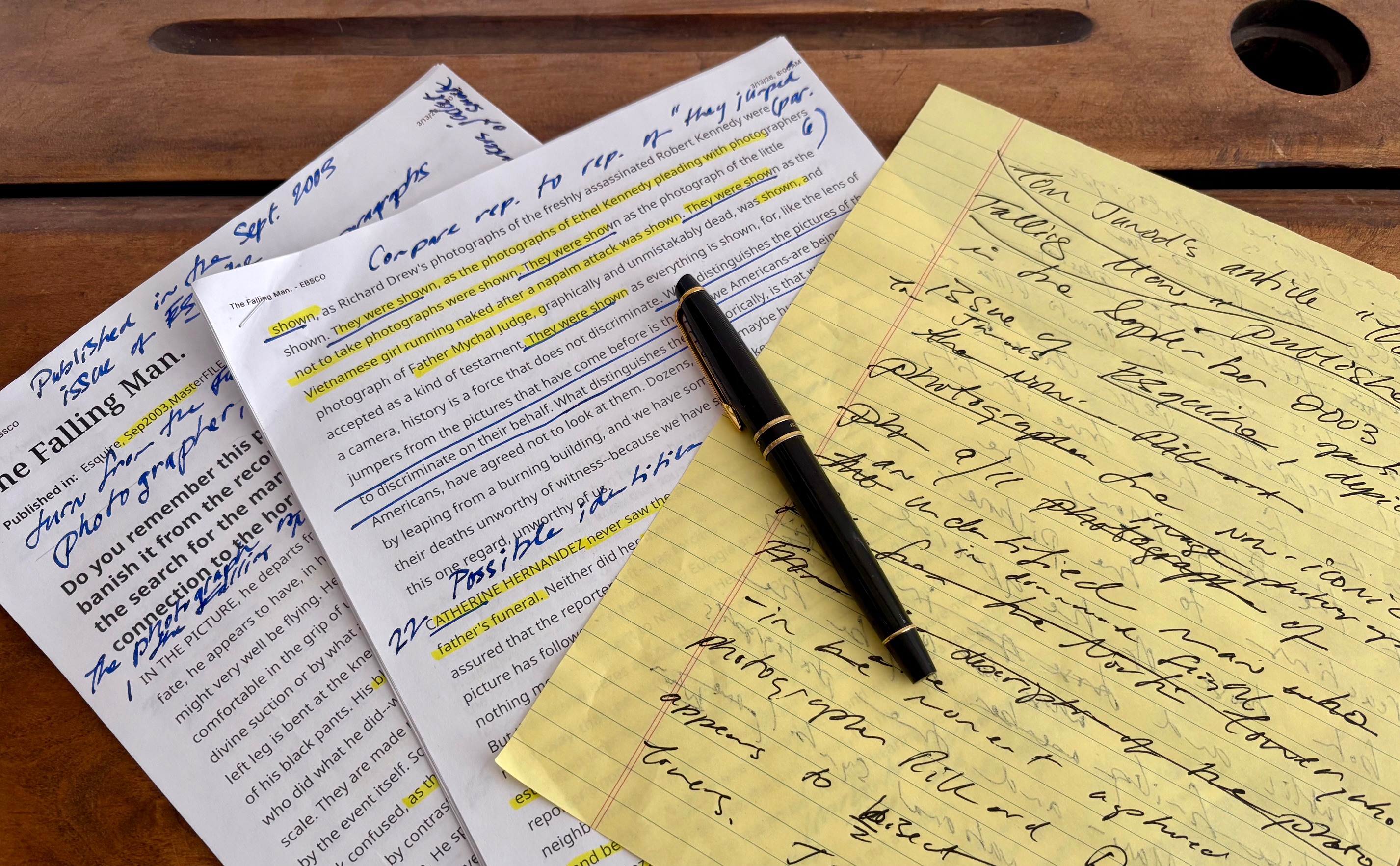
I prepared to draft by rereading “The Falling Man” in its entirety twice, highlighting words and phrases on my first rereading, and writing extensive annotations in the margins on the second. As a result of that close examination of Junod’s article, I was not only able to draft a bibliographic entry but also discover patterns in his prose–including apparent contradictions and repetition of words or phrases for emphasis–that I will be able to address elsewhere in my essay and bibliography.
Twice rereading Tom Junod’s seventeen-page, 7,000-plus-word article was time-consuming, but the effort paid off by generating substantial material for my project. If your own essay and bibliography focuses on Tom Junod’s writing, you should follow the same steps. Examining only the first two paragraphs of a writer’s article is sufficient for a short analysis but not for a research project devoted to his work.
Annotated Bibliographic Entry for “The Falling Man”
Junod, Tom. “The Falling Man, vol. 140, no. 3, Sept. 2003, pp. 176+. ProQuest, https://libproxy.highpoint.edu/login?url= https://www.proquest.com/ magazines/falling-man/docview/210268344/se-2.
Published in the September 2003 issue of Esquire, Tom Junod’s “The Falling Man” focuses on the now-iconic 9/11 image of an unidentified man in downward flight, who appears to bisect the Twin Towers. Junod chronicles the moments leading up to AP photographer Richard Drew capturing the photo, Toronto Globe and Mail reporter Peter Chaney’s search for the true identity of the Falling Man, the reactions to the picture—both those of the public and of grieving families (whose loved one could be its subject), and the photograph’s status as a national symbol.
Junod’s thorough and riveting account of Richard Drew’s photograph and its life beyond the frame illuminates the role of the Falling Man in American culture and showcases the writer’s award-winning prose. “The Falling Man” remains an essential reference for studies of the iconography of 9/11, as well as studies of Junod’s writing.
Tom Junod, a senior writer for ESPN, has also written for Life, Sports Illustrated, and GQ, where his articles garnered two National Magazine Awards. Among Junod’s other notable works are hisEsquire profile of Fred Rogers, “Can You Say . . . ‘Hero’?”—the inspiration for the Tom Hanks’ film It’s a Beautiful Day in the Neighborhood—and his newly-published memoir In the Days of My Youth I was Told What it Means to be a Man.
Next Up
Wordplay Day! To prepare for class, revisit the Dictionary and World Builder pages on the Scrabble website, or the Merriam-Webster Scrabble Word Finder page, and review the blog posts devoted to Scrabble tips.
Coming Soon
On Monday, as an exercise in creating a primary source for your annotated bibliography, you will conduct an interview with one of your classmates. Details TBA.
 Jane Lucas