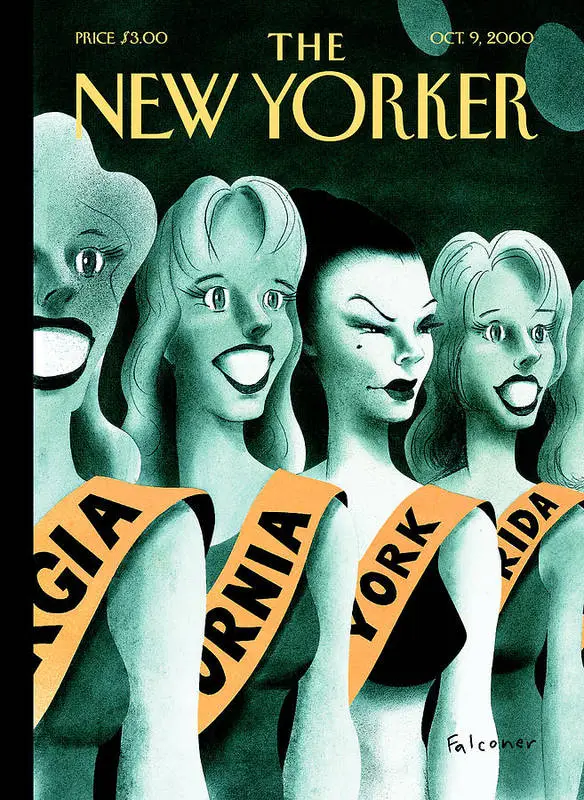
Monday in class, after you examined Ian Falconer’s New Yorker cover The Competition, you studied Tetsuya Ishida’s painting Seedlings (1998) and chose one of those two visual texts as the subject of a writing exercise: a paragraph of summary followed by a paragraph of analysis. That exercise served both as a departure from your study of written texts and as additional writing practice. The summary and analysis of Seedlings that I wrote as samples for you appear below.
Summary
Tetsuya Ishida’s painting Seedlings depicts a classroom of uniformed teenagers, all males, whose teacher, seen only from the shoulders down, holds a textbook in one hand. The teacher drapes his other hand on the head of one of the pupils, one of two students presented as microscopes with human faces.
Analysis
Although the subject at hand is biology, the study of living organisms, the student seedlings barely seem alive themselves as they stare blankly into the distance. The uniformity Ishida depicts, with their haircuts, crested blazers, striped neckties, and rows of desks, takes a surrealistic twist with the images of the two pupils who have transformed into microscopes. By placing the teacher’s hand on one of the students-turned-microscope, Ishida indicates that the instructor—himself objectified by the absence of his head—approves of the metamorphosis. For him, the goal of education seems to be that transformation: for the individual to be consumed by the device of study itself, to become a cold, metallic instrument.
As I noted in class yesterday, you will have the opportunity to revisit The Competition or Seedlings, or both, in the final reflection that you will compose next Monday.
Yesterday in class, after we studied Ian Falconer’s New Yorker cover The Competition, we examined Tetsuya Ishida’s painting Seedlings (1998), and you chose one of those two visual texts as the subject of a writing exercise–a bibliographic entry, followed a paragraph of summary and a second paragraph of commentary–as practice is your ongoing annotation work. My versions of the assignment, which I wrote as samples for you, appear below.
Summary
Tetsuya Ishida’s Seedlings depicts a classroom of uniformed Japanese teenagers, all males, whose teacher, seen only from the shoulders down, holds a textbook in one hand. The teacher drapes his other hand on the head of one of the pupils, one of two students presented as microscopes with human faces.
Commentary
Although the subject at hand is biology, the study of living organisms, the student seedlings barely seem alive themselves as they stare blankly into the distance. The uniformity Ishida depicts with their haircuts, crested blazers, striped neck ties, and rows of desks, takes a surrealistic twist with the images of the two pupils who have transformed into microscopes. By placing the teacher’s hand on one of the students-turned-microscope, Ishida indicates that the instructor—himself objectified by the absence of his head—approves of the metamorphosis, that for him, the goal of education is for the individual to be consumed by the subject itself, becoming merely a cold metallic instrument.
. . . and a Second Look at The Competition
Falconer, Ian. “The Competition.” Writing Analytically by David Rosenwasser and Jill Stephen, 9th edition, Wadsorth/Cengage, 2024. p. 108.
Summary
Ian Falconer’s mostly black-and-white New Yorker cover The Competition depicts four beauty pageant contestants, three of whom stand in stark contrast to Miss New York. Her dark hair, angular body, narrowed eyes, tightly pursed lips, and two-piece bathing suit set her apart from the nearly-identical blondes–Miss Georgia, Miss California, and Miss Florida–with wide-open eyes and mouths and one-piece bathing suits.
Commentary
The self-satisfied expression of Miss New York suggests what the authors of Writing Analytically present as the second of two possible interpretations for The Competition: “[T]he magazine is . . . admitting , yes America, we do think that we’re cooler and more individual than the rest of you, but we also know that we shouldn’t be so smug about it” (Rosenwasser and Stephen 112).
Work Cited
Rosenwasser, David and Jill Stephen. Chapter 3: “Interpretation: Asking So What?” Writing Analytically, 9th edition. Wadsworth/Cengage, 2024. pp. 81-118.
Next Up
In class on Wednesday, you will compose a short essay that reflects on the process of researching, drafting and revising your final essay and annotated bibliography. In it, you will include one relevant quotation from the article that served as a starting point for your project or a relevant quotation from Writing Analytically.
Today in class, after I collect your worksheets for lesson four of Check, Please! we will examine Donald Barthelme’s short story “The School,” and in groups of three or four you will address in writing some of the elements of the story that you might explore in an analysis. Among the elements of Barthelme’s story that you will considered are these:
the narrator and the narrative voice
conflict
narrative shift (Where does “The School” make an unexpected turn?)
Whether the subject of your analysis is Bartheleme’s story or one of our earlier readings, you will begin your first paragraph with a summary of the text. Remember that a summary is an objective synopsis of a text’s key points. It should be written in third person and present tense. For example, if you choose to analyze “The School,” you might summarize it this way:
Donald Barthelme’s short story “The School” recounts a series of classroom lessons that end with the deaths of plants and animals–deaths that serve as a prelude to the unexplained death of a Korean orphan, followed by the senseless deaths of classmates and family members.
Notice that the summary above does not comment on the story in any way. What follows the summary will be the beginning of your commentary, or analysis, the thesis statement that offers your particular close reading, or interpretation, of the story. The passage below is the same as the one above, but at the end of it I have added a thesis statement in bold.
Donald Barthelme’s short story “The School” recounts a series of classroom lessons that end with the death of plants and animals–deaths that serve as a prelude to the death of a Korean orphan, followed by the deaths of classmates and family members. With conversational narration, accumulation of detail, and a shift in fictional mode, Barthelme deftly depicts the reality of the fleeting nature of life, even as the story itself veers from reality.
If I were to continue to write the analysis that I began in the previous paragraph, I would follow that opening paragraph with body paragraphs that address each of the three story elements that I include in my thesis: (1) “conversational narration,” (2) “accumulation of detail,” and (3) “shift in fictional mode.”
Next Up
Wordplay Day! To prepare for class, revisit the Dictionary and World Builder pages on the Scrabble website, and review the blog posts devoted to Scrabble tips.
Yesterday in class, we examined Tetsuya Ishida’s painting Seedlings (1998), and you composed in your journal a one-paragraph summary followed by a paragraph of commentary or analysis. My version of the assignment, which I wrote as a sample for you, appears below.
Summary
Tetsuya Ashida’s Seedlings depicts a classroom of uniformed Asian teenagers, all males, whose teacher, seen only from the shoulders down, holds a textbook in one hand. He drapes his other hand on the head of one of the pupils, one of two students presented as microscopes with human faces.
Commentary
Although the subject at hand is biology, the study of living organisms, the student seedlings barely seem alive themselves as they stare blankly into the distance. The uniformity Ishida depicts with their haircuts, crested blazers, striped neck ties, and rows of desks, takes a surrealistic twist with the images of the two pupils who have transformed into microscopes. By placing the teacher’s hand on one of the students-turned-microscope, Ishida indicates that the instructor—himself objectified by the absence of his head—approves of the metamorphosis, that for him, the goal of education is for the individual to be consumed by the subject itself, becoming merely a cold metallic instrument.
Next Up
Wordplay Day! To prepare for class, revisit the Dictionary and World Builder pages on the Scrabble website, and review the posts on my blog devoted to Scrabble tips.
Today in class, you identified one of the ideas expressed by three of the education experts featured in Matt Richtel’s article “Blogs vs. Term Papers”: Douglas B. Reeves, William H. Fitzhugh, and Andrea A. Lunsford. Collaboratively, you paraphrased each idea in a sentence that began with the person’s name and credential. As a model, I offered the example below.
Example: Professor Cathy N. Davidson of the City University of New York maintains that blogging offers students a more relevant alternative to the traditional term paper (ctd. in Richtel).
The abbreviation “ctd.” lets readers know that the idea is cited, or mentioned, in Matt Richtel’s article.
Indirect Quotations
If I had quoted Davidson, rather than paraphrasing her, the abbreviation “qtd.,” for “quoted,” would appear in parentheses to indicate that I quoted Davidson. Both a paraphrase of Davidson’s words drawn from Richtel’s article, and a direct quotation of her words drawn from Richtel’s article are referred to as indirect quotations because Davidson is a source who is cited or quoted in another source (Richtel).
In our discussion of Richtel’s article, I noted that Davidson was a professor at Duke at the time the article was published in The New York Times. One student asked how a writer should address such a change. One option is an explanatory endnote; you can also include it in the sentence itself, as I do in the example that follows.
Example: As a professor at Duke, Cathy N. Davidson turned to blogs to offer students a more relevant alternative to the traditional term paper (ctd. in Richtel). Now at the City University of New York, she continues to embrace new technologies.
When to Paraphrase, When to Quote
I could have asked you to quote Reeves, Fitzhugh, and Lunsford, but putting their ideas into your own words requires more thought, and more specifically moves you closer to analysis. As the authors of your textbook note: “You will almost invariably begin to interpret a source once you start paraphrasing its key language” (Rosenwasser and Stephen 221).
Summary and Analysis
A summary objectively presents key points; it answers the question, what is it? An analysis answers the questions, what does it mean, and how is itsmeaning constructed?
Here is the summary that I wrote in my notebook after I read Matt Richtel’s article.
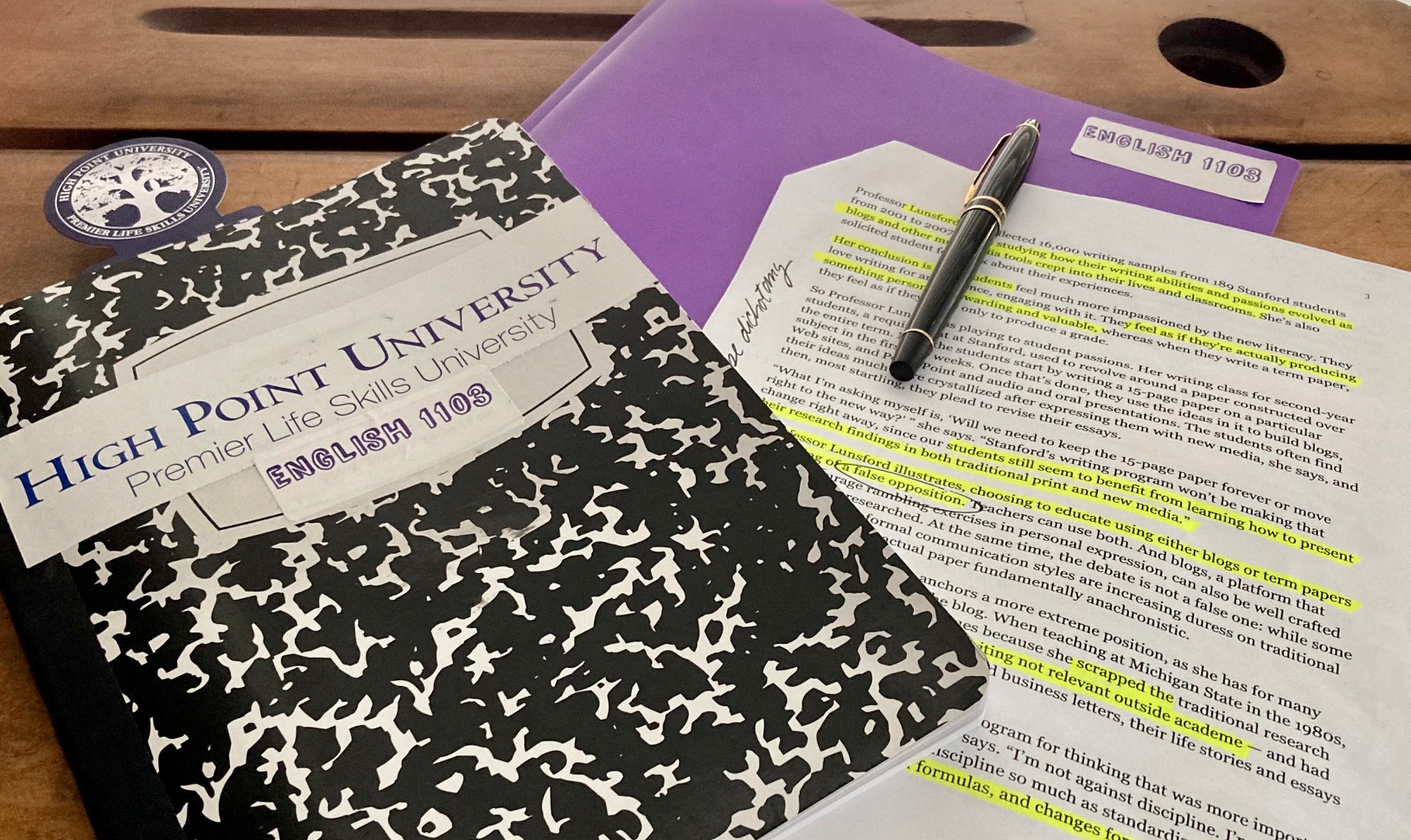
In “Blogs vs. Term Papers,” Matt Richtel reports on the debate in higher education on how best to teach writing in the digital age. While some professors have followed the lead of City University of New York’s Cathy Davidson, replacing the traditional term paper with shorter, more frequent blog assignments, their detractors—including Douglas B. Reeves, columnist for The American School Board Journal and William H. Fitzhugh, editor of The Concord Review—argue that blog writing lacks the academic rigor that fosters critical thinking. For Andrea Lunsford, professor of writing at Stanford University, pitting blogs against term papers creates a false opposition. Rather than replacing term papers with blog posts, Lunsford requires students to produce multi-modal assignments: term papers that evolve into blogs, websites, and video presentations.
Summarizing the key points of the article led me to think about the article’s structure, how Richtel presents Davidson’s ideas followed by Reeves’ and Fitzhugh’s, returns to Davidson’s, introduces Lunsford’s, and ends by returning again to Davidson’s. In the 9:15 class we considered this possible interpretation of Richtel’s choices:
By devoting more of his article to Davidson’s and Lunsford’s practices–and ultimately giving Davidson the last word–Matt Richtel reveals that he favors their approaches to teaching writing over the ideas advocated by Reeves and Fitzhugh.
In the 10:40 class, we considered that interpretation as well as a second one:
Matt Richtel devotes more of his article to Davidson’s and Lunsford’s practices–and ultimately gives Davidson the last word–because she and Lundsford are innovators. Richtel doesn’t need to detail ideas that are already familiar to his readers.
Both are valid claims; the success of either depends on how effectively the writer presents evidence as support.
Logical Fallacies
Richtel’s article “Blogs vs. Term Papers” mentions two common types of logical fallacies to avoid:
Reductio ad absurdum is a form of the straw man argument. It involves oversimplifying an opponent’s argument by reducing it to an absurdity.
False opposition or false dichotomy implies that two possibilities are mutually exclusive. Richtel’s headline–in all likelihood written by a copy editor rather than himself–indicates a false dichotomy. (A term paper can be presented as a blog post.) False opposition is one form of hasty generalization.
For more on logical fallacies, see Writing Analytically, 93-97.
Next Up
This Friday, August 27, will mark the first of our weekly Wordplay Days. To prepare for class, read the Scrabble Rules and review the Ground Rules for Wordplay posted on Blackboard (and below). To up your game, browse the Scrabble site’s Tips and Tools.