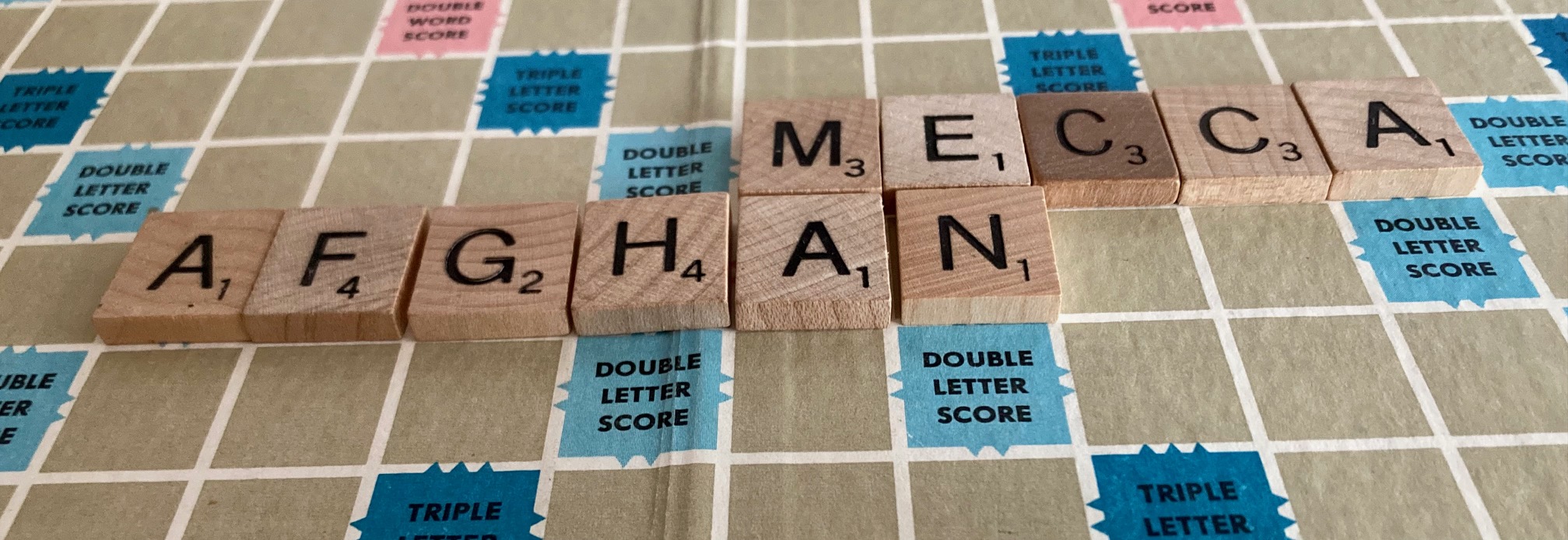
The first Scrabble post of the semester featured first names that are also common nouns, making them playable in Scrabble. Today’s post includes place names and words derived from places, or toponyms–more proper nouns that are playable in Scrabble because they’re also common nouns. Studying these words offers you additional opportunities to broaden your vocabulary and up your game.
- afghan: a wool blanket
- alamo: a cottonwood poplar tree
- alaska: a heavy fabric
- berlin: a type of carriage
- bermudas: a variety of knee-length, wide-legged shorts
- bohemia: a community of unconventional, usually artistic, people
- bolivia: a soft fabric
- bordeaux: a wine from the Bordeaux region
- boston: a card game similar to whist
- brazil: a type of tree found in Brazil used to make instrument bows (also brasil)
- brit: a non-adult herring
- cayman: a type of crocodile, also known as a spectacled crocodile (also caiman)
- celt: a type of axe used during the New Stone Age
- chile: a spicy pepper (also chili)
- colorado: used to describe cigars of medium strength and color
- congo: an eellike amphibian
- cyprus: a thin fabric
- dutch: referring to each person paying for him or herself
- egyptian: a sans serif typeface
- english: to cause a ball to spin
- french: to slice food thinly
- gambia: a flowering plant known as cat’s claw (also gambier, which is a small town in Ohio)
- geneva: gin, or a liquor like gin
- genoa: a type of jib (a triangular sail), also known as a jenny, first used by a Swedish sailor in Genoa
- german: also known as the german cotillon, an elaborate nineteenth-century dance
- greek: something not understood
- guinea: a type of British coin minted from 1663 to 1813
- holland: a linen fabric
- japan: to gloss with black lacquer
- java: coffee
- jordan: a chamber pot
- kashmir: cashmere
- mecca: a destination for many people
Reading for Monday
At the beginning of class today, I will distribute copies of an opinion piece on Scrabble and a student’s final essay and annotated bibliography devoted to the game. Before Monday’s class, read and annotate both–not simply by underlining and circling words but by writing questions and observations in the margins or between the lines. As you compose your annotations, consider how and where the student might have incorporated any additional details from the opinion piece, “Scrabble is a Lousy Game,” into his essay or his commentaries in his bibliography.
Next Up
Wordplay Day! To prepare for class, revisit the Dictionary and World Builder pages on the Scrabble website, the Merriam-Webster Scrabble Word Finder page, and review the blog posts devoted to Scrabble tips, including this one.
Coming Soon
On Monday, during your Scrabble debriefing, I will check your annotations for the sample student essay “The Depths of Scrabble” and the opinion piece “Scrabble is a Lousy Game.” Afterward, you and two or three of your classmates will collaboratively complete an exercise on the readings, and we will conclude class with a discussion of the two.
 Jane Lucas