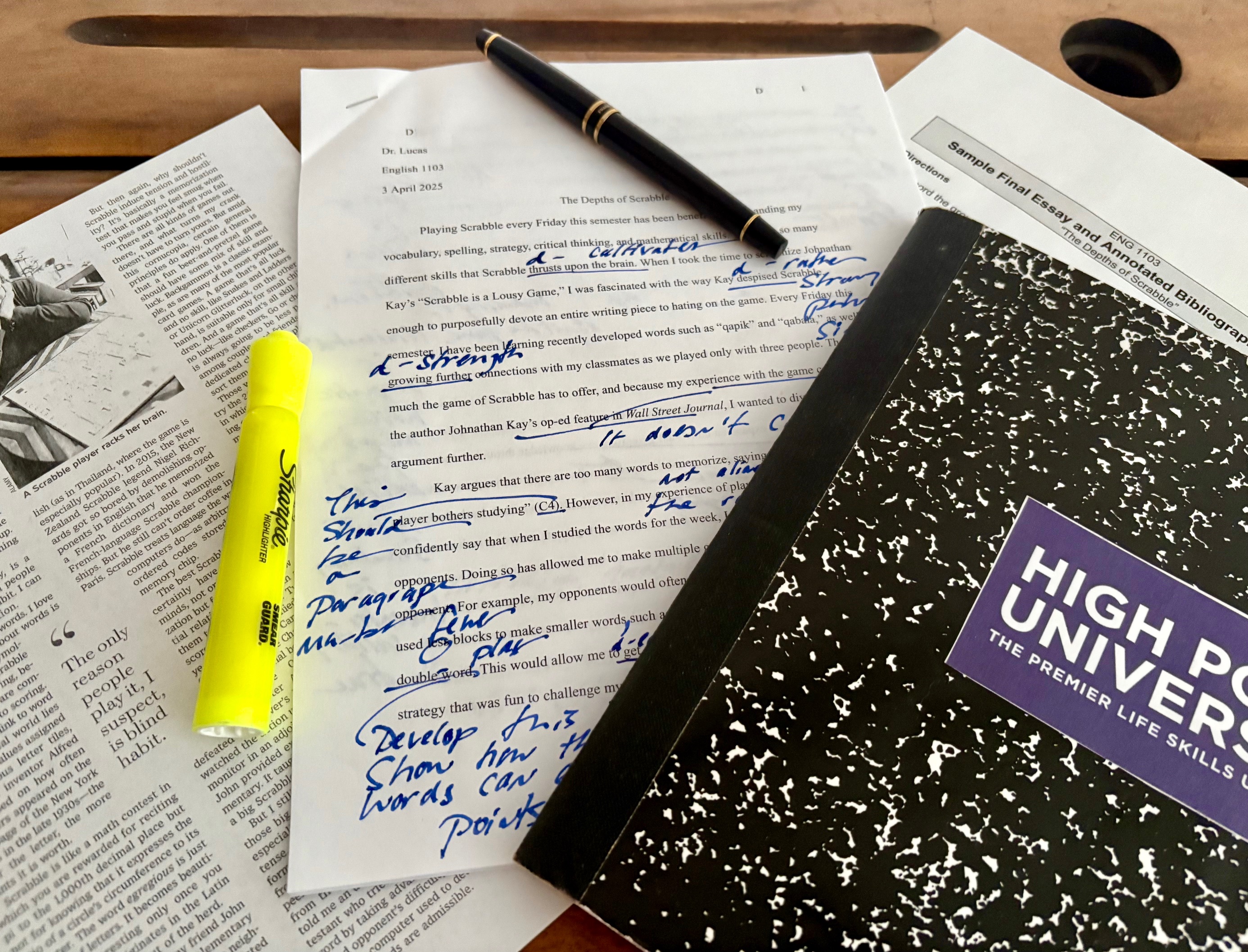
Yesterday’s class focused on a review of the sample student essay and annotated bibliography “The Depths of Scrabble,” an exercise that should continue to serve as a guide for you as you develop and revise your own essay and bibliography.
The notes that follow address points of content and form, some that we addressed in class, others that we didn’t. As you continue your own research and writing, revisit these notes.
Content
- In his introduction, the writer addresses his subject and his reason for researching it. Still, his final essay lacks two key components: (1) it does not quote two of his sources, and (2) the conclusion does not address the larger project that might develop from the research and the theoretical framework for that project.
- The writer’s mention of specific, uncommon words that he has learned for Scrabble play is admirable, but he does not define the words. Also, in his discussion of “qi” and “xi” (par. 2), he does not clarify that the primary reason for playing those words is the high point value of “q” and “x.”
- The words “no real Scrabble player bothers studying” (par. 2) are presented as a line from Jonathan Kay’s “Scrabble is a Lousy Game,” but that line does not appear in Kay’s opinion piece. It’s an inaccurate paraphrase.
- The writer incorrectly uses the words “less” (par. 2), “opinionated” (par. 3), and “commutative” (par. 3). He also misspells the last name of Ian Hargreaves, the one of one of his sources, as Hargraves (par. 3). Additionally, such inaccurate statements as “Scrabble thrusts upon the brain” (par. 1) indicate that the writer has not revised his prose.
- While Jonathan Kay is a Scrabble detractor, writing that he “devotes[s] an entire piece to hating on the game” (par. 1) is a statement with diction appropriate for casual conversation but not for formal academic prose.
- The commentaries in the writer’s annotations do not adequately demonstrate the sources’ usefulness to other researchers studying Scrabble. In his commentary on Stefan Fatsis’s article “The Case of the Stolen Blanks,” he misses the opportunity to create a connection between the cheating reported by Fatsis and the instances of cheating recounted by Kay.
Form
- The manuscript does include the required Times New Roman font, the running header with the last name and page number, and the first page information (student’s name, professor’s name, etc.), but the bibliographic entries do not have hanging indents, and the first lines of the paragraphs of the summaries, commentaries, and credentials are not indented five spaces or one-half inch.
- The sources in the annotated bibliography are not alphabetized by last name.
- The presence of the capital “K” in one of his interviews with a classmate demonstrates that he has referred to the student by first name rather than last, which begins with “D.” In formal writing, people are referred to by first and last name when they are first mentioned. On subsequent references, they are referred to by last name. Fictional characters are an exception to that rule.
- Two parenthetical citations, one in the essay and one in the bibliography, are presented incorrectly, and the writer omits the first portion of the bibliographic entry for Ian Hargreaves’s article.
Next Up
On Wednesday, you will have the class period to devote to additional research and writing for your final essay and annotated bibliography, and at the end of class, you will submit a summary of the work that you completed.
Also, I will distribute a checklist for you to refer to as you finalize your revisions over the next week.

