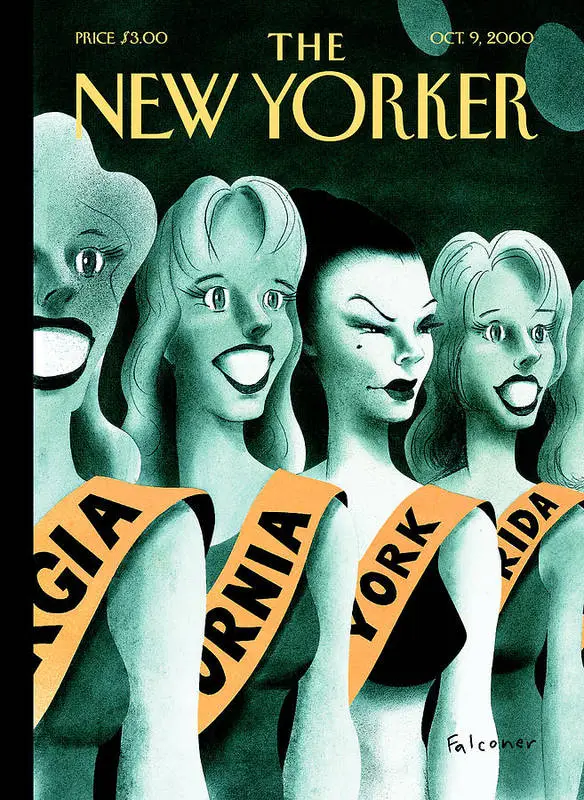
Yesterday in class, you and two or three of your classmates collaboratively examined Ian Falconer’s The Competition and Kazuo Ishiguro’s Seedlings. Afterward, you chose one of the two as the subject for an individual two-paragraph exercise in composing summary and analysis.
Below are three sample paragraphs that I wrote as models for you. The first is a summary of Falconer’s cover. The second and third offer close readings of the magazine cover. Each integrates one of the two interpretations that the authors of Writing Analytically offer. You were not required to address the textbook authors’ interpretations in your own analysis. I included them in the samples below because they serve as models for integrating a source’s commentary into your analysis, models you may want to follow if you choose to write about The Competition in your final reflection for the course.
Summary
Ian Falconer’s mostly black-and-white New Yorker cover The Competition depicts four beauty pageant contestants, three of whom stand in stark contrast to Miss New York. Her dark hair, angular body, narrowed eyes, tightly pursed lips, and two-piece bathing suit set her apart from the nearly identical blondes–Miss Georgia, Miss California, and Miss Florida–whose wide-open eyes and mouths and one-piece bathing suits are typical of pageant contestants.
Analyses
The contrast between the raven hair and eyes of Miss New York and the platinum-blonde and pale-eyed contestants from Georgia, California, and Florida suggests what the authors of Writing Analytically present as the first of two possible interpretations: The cover “speak[s] to American history, in which New York has been a major point of entry for generations of immigrants, embracing diversity and conformity, while viewing the rest of the nation as more homogenous” (Rosenwasser and Stephen 112).
The self-satisfied expression of Miss New York suggests what the authors of Writing Analytically present as the second of two possible interpretations: “[T]he magazine is . . . admitting, yes America, we New Yorkers do think that we’re cooler and more individual and less plastic than the rest of you, but we also know that we shouldn’t be so smug about it” (Rosenwasser and Stephen 112).
Work Cited
Rosenwasser, David and Jill Stephen. “Making an Interpretation: The Example of a New Yorker Cover.” Writing Analytically, 9th edition. Wadsworth/Cengage, 2024. pp. 107-112.
As you continue to work on your final essay and annotated bibliography, review these samples as models for your own summaries and close readings of your sources.
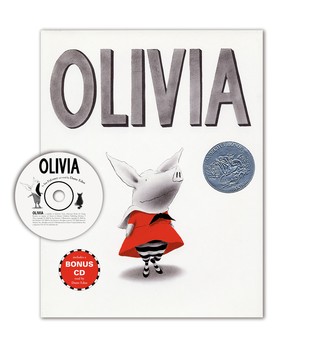
If the style of Ian Falconer’s New Yorker cover seems familiar to you, it may be because you encountered his work when you were a child. His book Olivia, published in 2000, received the 2001 Caldecott Medal, an award the Association for Library Service bestows upon the book they deem the best children’s picture book of the year. Falconer followed Olivia with several sequels, including Olivia Saves the Circus and Olivia Helps with Christmas.
Thursday’s blog post will offer a second look at the other visual text we examined yesterday: Tetsua Ishida’s painting Seedlings.
. . . Continuing Your Revisions
As you continue to revise, refer to the checklist I distributed in class, and have included below, to ensure that your essay and bibliography comply with all assignment requirements.
Final Essay
- Presents the subject of the bibliography and the purpose for compiling it; in other words, what drives the research, and what question do you seek to answer?
- Addresses all your sources at least briefly and quotes a minimum of two of them.
- Introduces quotations with signal phrases and follows them with parenthetical citations. The only exception to the parenthetical citation rule is any quotation from the peer interview.
- Concludes with a paragraph that mentions a larger project that might develop from it, in what discipline that project might be produced, and what would serve as its theoretical framework.
Annotated Bibliography
- Each entry begins with a complete MLA-style bibliographic citation.
- Each bibliographic citation is followed by three paragraphs: one of summary, a second of commentary, and a third that includes the author’s credentials.
- The commentary paragraphs do not simply restate the information in the summaries but instead demonstrate the usefulness of the sources to researchers and make some connections among them. You are not required to mention another source in each commentary, but you should aim to do so at least once.
- The sources in the bibliography are alphabetized by the authors’ last names.
MLA Style
- The file’s font is twelve-point Times New Roman, including the running header.
- The running header, which includes your last name and the page number, appears one-half inch from the top of the page, on the right side.
- All required first-page information is included in the upper left.
- The file is double-spaced, with no extra space between any sections.
- All paragraphs are indented five spaces, or one-half inch.
- All bibliographic citations have hanging idents; in other words, their formatting is the opposite of a conventional paragraph. (The first line is flush left, and any subsequent lines are indented.)
Next Up
Tomorrow in class, you will compose a reflective essay that focuses on the processes of planning, drafting, and revising your final essay and annotated bibliography. The due date for your revision is tomorrow, before class, but you have until the hard deadline, Friday, November 21, before class, to post your revision to Blackboard and publish it on your WordPress blog.
If you are still revising your essay and bibliography tomorrow, in your reflection, you will refer to your writing as ongoing.
In your reflection, you will include a minimum of one relevant quotation from Writing Analytically or from one of the sources included in your bibliography. Before class, identify the passage you plan to quote, and draft a sentence with it in your journal. Also, be sure to write in your journal a complete MLA-style work cited entry for the source you plan to quote. That preparation will ensure that you have ample time to integrate the quotation into your reflection and compose your work cited entry before the end of Wednesday’s class period. You will not have the option to refer to your essay online, so a handwritten version of the information you’ll need is essential.

 Jane Lucas