This morning in class, you will plan and compose a reflective essay that documents your writing process and includes at least one relevant quotation from Writing Analytically or one of the articles included in your bibliography. You will introduce your quotation with a signal phrase and follow your essay with a works cited entry.
Questions to Consider in Your Reflection
- What aspect of the writing seemed the most challenging? Locating relevant sources? Composing your annotations? Developing the final essay? Why did that aspect seem the most challenging?
- Did your subject change? If so, what was your original subject, and why did you change it?
- What do you consider the strongest element of your final essay and annotated bibliography?
- At what point in the process did you decide on a title? Did you change the title during the writing process? If so, what was the original title?
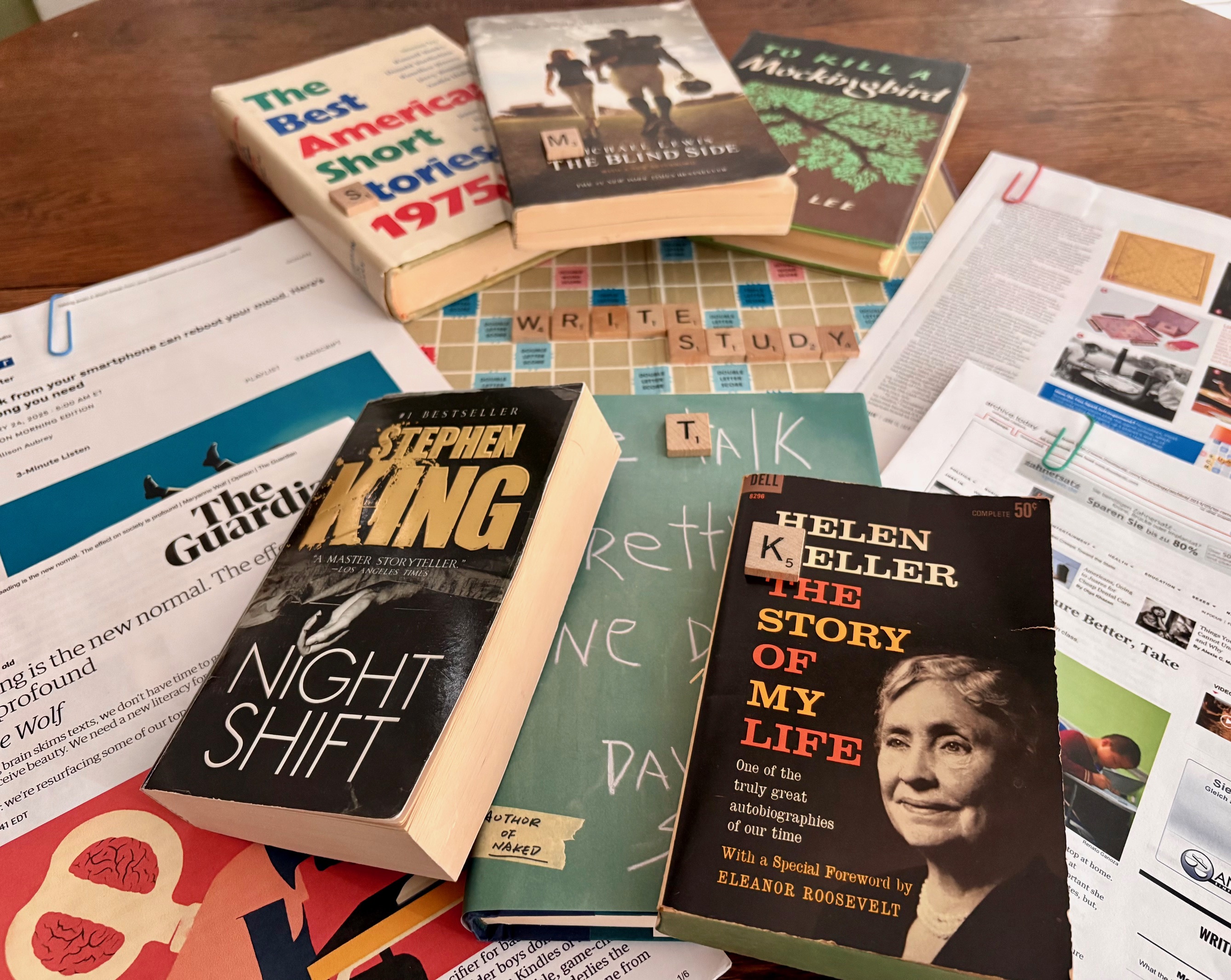
- What image that documents part of your writing process away from the screen did you include in your blog post? Why did you choose that particular image?
- To which relevant website did you include an embedded link in your blog post?
Sample Quotations with Signal Phrases
- The authors of Writing Analytically advise writers to “frame material with a phrase such as ‘according to Sprayberry’ or ‘as Gruen argues'” (Rosenwasser and Stephen 344).
- Rosenwasser and Stephen advise writers to “frame material with a phrase such as ‘according to Sprayberry’ or ‘as Gruen argues'” (344).
The parenthetical citation in the first sample above includes the authors’ last names because they are not named in the sentence. The parethetical citation in the second sample above does not include the authors’ last names because they are named in the sentence.
Sample Works Cited Entries
Rosenwasser, David and Jill Stephen. “Integrating Quotations into Your Paper.” Writing Analytically, 9th edition. Wadsworth/Cengage, 2024. pp. 343-46.
—. “Two Methods for Conversing with Sources.” Writing Analytically, 9th edition. Wadsworth/Cengage, 2024. p. 325.
—. “Ways to use a Source as a Point of Departure.” Writing Analytically, 9th edition. Wadsworth/Cengage, 2024. p. 326.
Note that your work cited entry in your reflection–and all of the work cited entries and bibliographic entries except for the ones on your blog–should have a hanging indent.
Journal Exercise
Time permitting, you will have the opportunity to begin an exercise that you should complete in your journal no later than Monday, November 24, before class.
Next Up
Wordplay Day! To prepare for class, revisit the Dictionary and World Builder pages on the Scrabble website, the Merriam-Webster Scrabble Word Finder page, and review the blog posts devoted to Scrabble tips.
 Jane Lucas