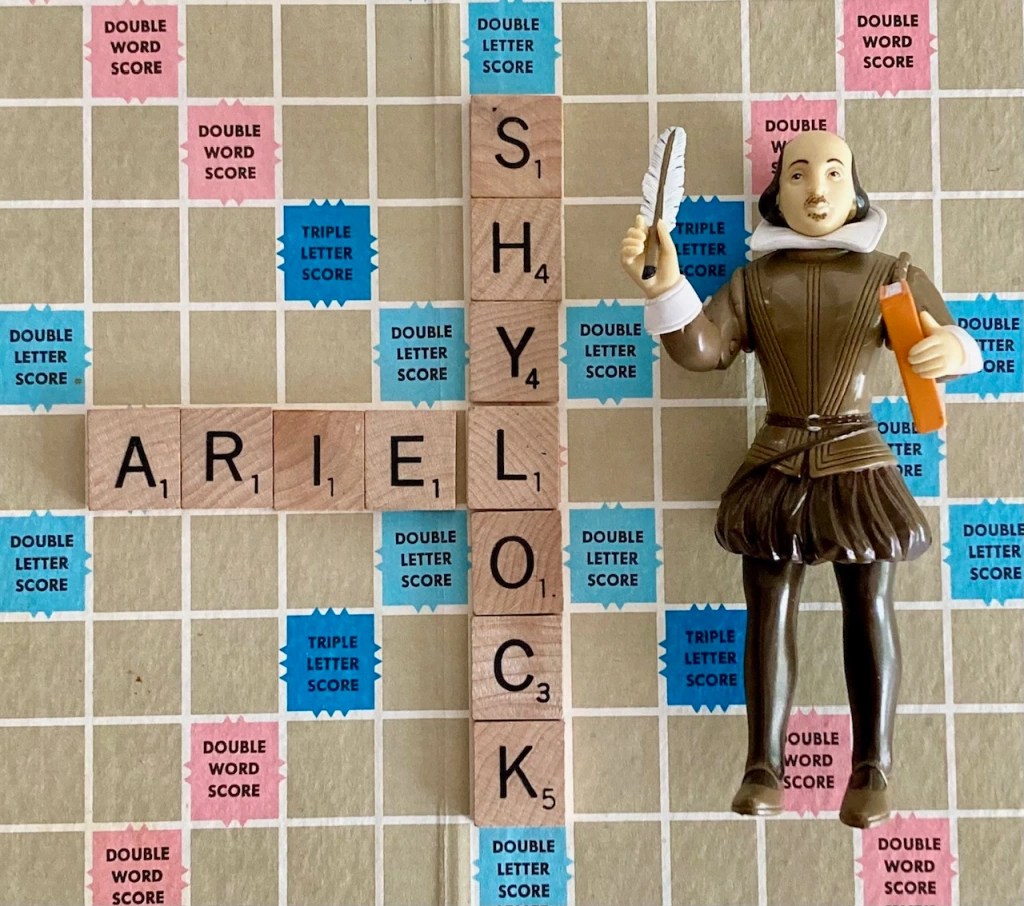
Today’s Scrabble post features Shakespeare characters whose names are also playable common nouns.
- ariel: a gazelle found in Africa (Ariel, The Tempest, 1611-12)
- dogberry: the fruit of a dogwood tree (Dogberry, Much Ado about Nothing, 1598-1599)
- hamlet: a village (the title character of Hamlet, 1600-1601)
- lear: learning (the title character of King Lear, 1605-1606)
- puck: a disk used in ice hockey and other games (Puck, A Midsummer Night’s Dream, 1595-1596)
- romeo: a seductive lover, a male lover (one of the title characters in Romeo and Juliet, 1594-1595)
- shylock: to lend money with a high interest rate (Shylock, The Merchant of Venice, 1596-1597)
Next Up
Wordplay Day! To prepare for class, revisit the Dictionary and World Builder pages on the Scrabble website, the Merriam-Webster Scrabble Word Finder page, and review the blog posts devoted to Scrabble tips, including this one.
Coming Soon
Monday in class, you will compose a final reflective essay that documents your work in the second half of the semester, focusing on what you consider some of your most significant work and the feature or features of the course that have benefited your development as a writer and a student. Since you have already written a reflective essay on your final essay and annotated bibliography, your final reflection should focus on other assignments and features. The texts you have read in the second half of he semester include these:
- “Blogs vs. Term Papers”
- “A Break from Your Smartphone can Boost Your Mood . . . ”
- The Competition
- “How a Small North Carolina College . . . ”
- “Scrabble is a Lousy Game”
- Seedlings
- “Speed Reading is the New Normal”
- “Strawberry Spring”
- “To Remember a Lecture Better, Take Notes by Hand”
- Sample final essays and annotated bibliographies (“The King of Storytelling,” “Scrabble as a Game Changer in the College Classroom”)
In your reflection, you will include a minimum of one relevant quotation from Writing Analytically or from one of the texts we studied in the second half of the semester. Before class, identify the passage you plan to quote, and draft a sentence with it in your journal. Also, be sure to write in your journal a complete MLA-style work cited entry for the source you plan to quote. That preparation will ensure that you have ample time to integrate the quotation into your reflection and compose your work cited entry before the end of the class period. You will not have the option to consult texts online, so a handwritten version of the information you need is essential.
 Jane Lucas