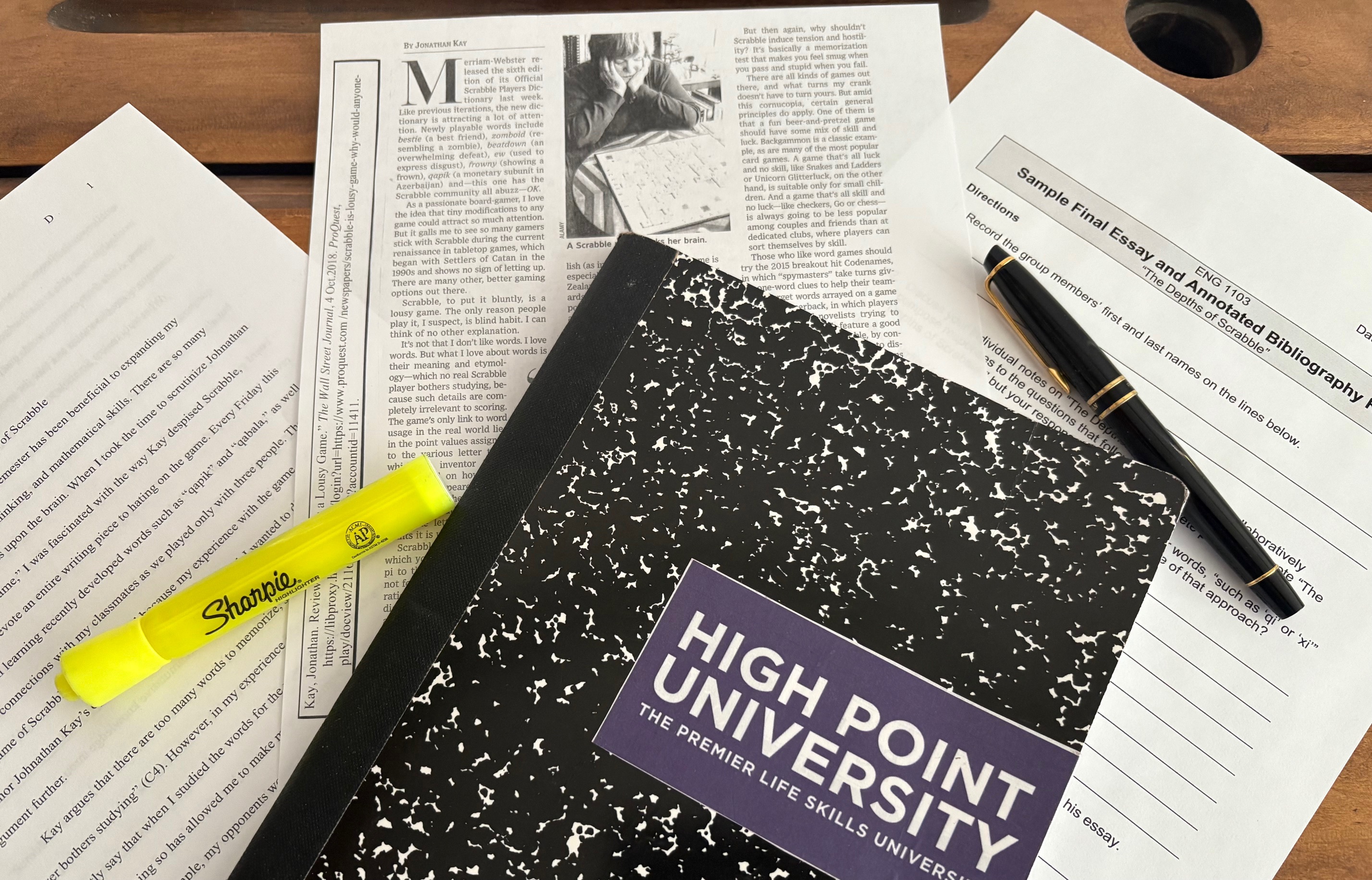
This morning in class, after your Scrabble debriefing, you and two or three of your classmates will discuss your individual notes on “Scrabble is a Lousy Game” and “The Depths of Scrabble,” then collaboratively compose answers to a series of questions about the final essay and the annotated bibliography.
Among the questions to consider are these: How and where might the writer of “The Depths of Scrabble” have incorporated additional points from the opinion piece, “Scrabble is a Lousy Game,” into his essay or his commentaries in his bibliography?
Tomorrow’s blog post will serve as a follow-up to our examination of “The Depths of Scrabble” and provide more details about its content and form.
Next Up
On Wednesday, you will have the class period to devote to additional research and writing for your final essay and annotated bibliography, and at the end of class, you will submit a summary of the work that you completed.
Also, I will distribute a checklist for you to refer to as you finalize your revisions over the next week.
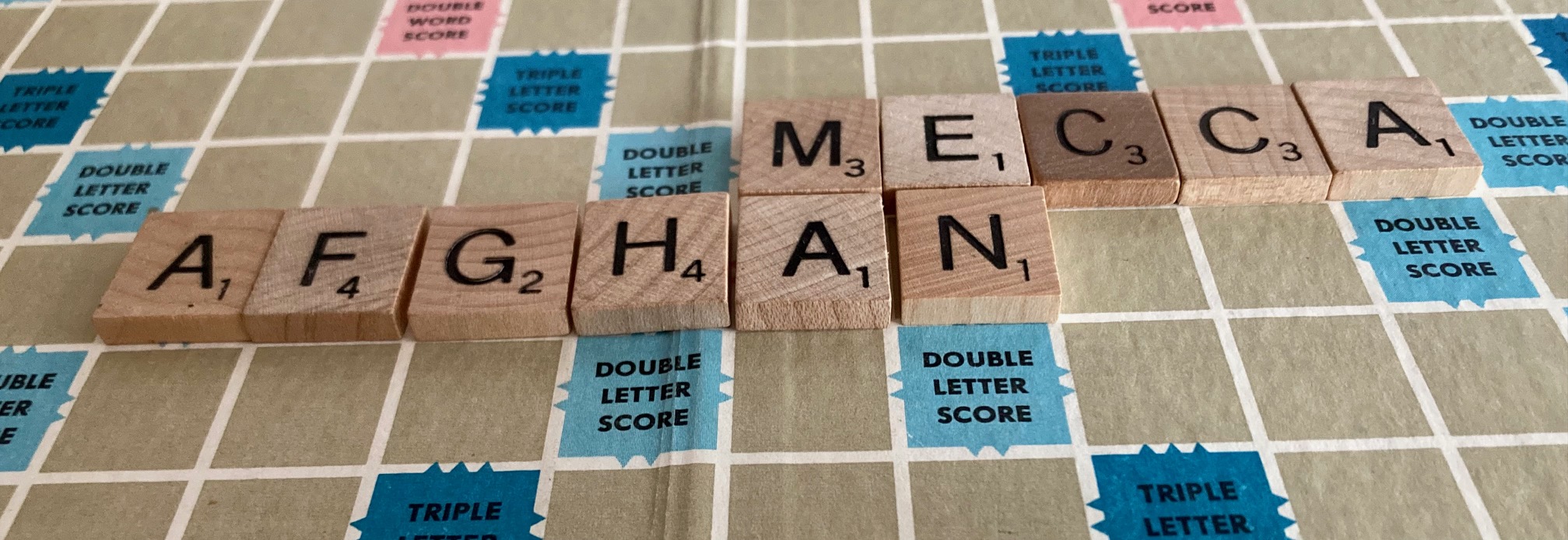
The first Scrabble post of the semester featured first names that are also common nouns, making them playable in Scrabble. Today’s post includes place names and words derived from places, or toponyms–more proper nouns that are playable in Scrabble because they’re also common nouns. Studying these words offers you additional opportunities to broaden your vocabulary and up your game.
afghan: a wool blanket
alamo: a cottonwood poplar tree
alaska: a heavy fabric
berlin: a type of carriage
bermudas: a variety of knee-length, wide-legged shorts
bohemia: a community of unconventional, usually artistic, people
bolivia: a soft fabric
bordeaux: a wine from the Bordeaux region
boston: a card game similar to whist
brazil: a type of tree found in Brazil used to make instrument bows (also brasil)
brit: a non-adult herring
cayman: a type of crocodile, also known as a spectacled crocodile (also caiman)
celt: a type of axe used during the New Stone Age
chile: a spicy pepper (also chili)
colorado: used to describe cigars of medium strength and color
congo: an eellike amphibian
cyprus: a thin fabric
dutch: referring to each person paying for him or herself
egyptian: a sans serif typeface
english: to cause a ball to spin
french: to slice food thinly
gambia: a flowering plant known as cat’s claw (also gambier, which is a small town in Ohio)
geneva: gin, or a liquor like gin
genoa: a type of jib (a triangular sail), also known as a jenny, first used by a Swedish sailor in Genoa
german: also known as the german cotillon, an elaborate nineteenth-century dance
greek: something not understood
guinea: a type of British coin minted from 1663 to 1813
holland: a linen fabric
japan: to gloss with black lacquer
java: coffee
jordan: a chamber pot
kashmir: cashmere
mecca: a destination for many people
Reading for Monday
At the beginning of class today, I will distribute copies of an opinion piece on Scrabble and a student’s final essay and annotated bibliography devoted to the game. Before Monday’s class, read and annotate both–not simply by underlining and circling words but by writing questions and observations in the margins or between the lines. As you compose your annotations, consider how and where the student might have incorporated any additional details from the opinion piece, “Scrabble is a Lousy Game,” into his essay or his commentaries in his bibliography.
On Monday, during your Scrabble debriefing, I will check your annotations for the sample student essay “The Depths of Scrabble” and the opinion piece “Scrabble is a Lousy Game.” Afterward, you and two or three of your classmates will collaboratively complete an exercise on the readings, and we will conclude class with a discussion of the two.
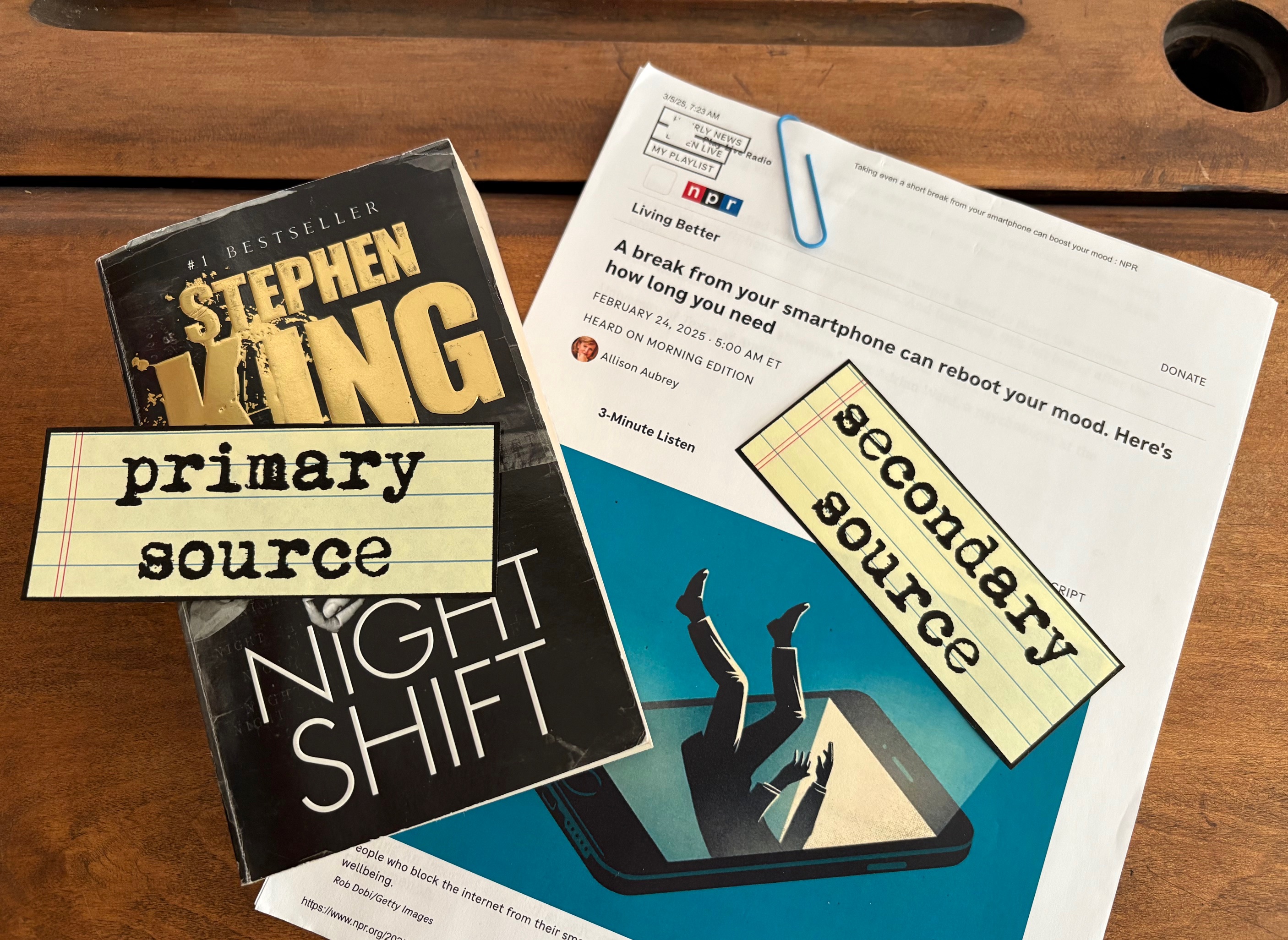
In class on Monday, I noted that the writer of “The King of Storytelling” mistakenly refers to Marc Hye-Knudsen’s article “How Stephen King Writes and Why” as his primary source. If you are researching an author, such as Stephen King, your primary sources are pieces of writing composed by that author–in King’s case, short stories and novels–as well as published interviews with the author. If King is the subject of your final essay and annotated bibliography, your primary source–or at least one of your primary sources–is “Strawberry Spring.” Hye-Knudsen’s article “How Stephen King Writes and Why,” other critical essays devoted to King’s writing, and reviews of his fiction are secondary sources.
If you are researching blogging in the classroom, Matt Richtel‘s New York Times article “Blogs vs. Term Papers” would be a primary resource because it is a firsthand report on the practices of the platform’s supporters and detractors in higher education.
For research on writing longhand, the Atlantic article “To Remember a Lecture Better, Take Notes by Hand” serves as a secondary source because its author, Robinson Meyer, reports on the research by Pam Mueller and Daniel Oppenheimer published in the journal Psychological Science.
Similarly, if you are researching smartphone use, “A Break from Your Smartphone. . .” serves as a secondary source because its author, Allison Aubrey, reports on the research published in PNAS NEXUS, a publication of the National Academy of Science.
If the subject of your research is writing longhand or smartphone use, you are welcome to include both the primary source and the secondary sources listed above as two of your four print sources.
If you are researching limiting screen time beyond smartphone use, Maryanne Wolf’s “Skim Reading is the New Normal . . .” serves as your starting place. Wolf’s article is a hybrid of sorts; it’s an opinion piece that serves as a secondary source for research conducted by educators and researchers in psychology and humanities, including Anne Mangen and Ziming Liu.
The interview that you conducted with your classmate is a primary source because it is the interviewee’s firsthand account of his or her experience with the subject that serves as your focus.
Theoretical Frameworks
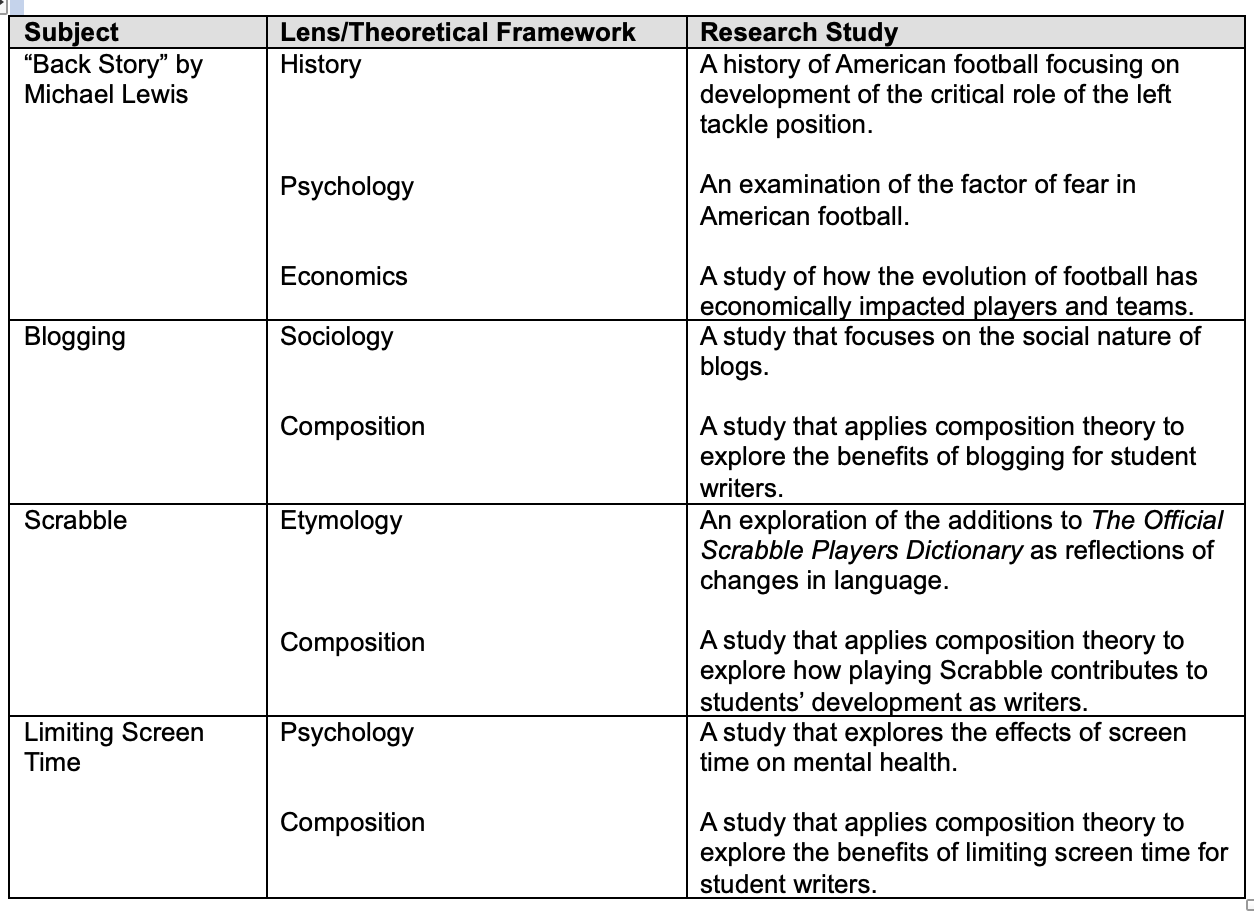
As part of the conclusion of your final essay, you will identify a theoretical framework that would guide your research if you chose to develop your final essay and annotated bibliography into a larger project for an upper-level course. To offer examples of how to apply those frameworks to your subjects, I created the table below and distributed copies in class.
The table is by no means comprehensive, but it demonstrates how your essays and annotated bibliographies can develop into larger projects for a variety of disciplines. I did not include “Strawberry Spring” in the table, but I asked you in class what theoretical frameworks you might apply to a research project on King’s fiction. A literary framework is an obvious choice–you could analyze one or more of the narrative’s elements–but three others to consider are these:
History: a study that examines “Strawberry Spring” as commentary on the Vietnam War.
Psychology: a study that explores King’s depiction of his narrator as a prototypical serial killer.
Business: a study that explores King’s active role in the marketing of his fiction and the ways that his authorpreneurship can serve as a model for writers and entrepreneurs in other fields.
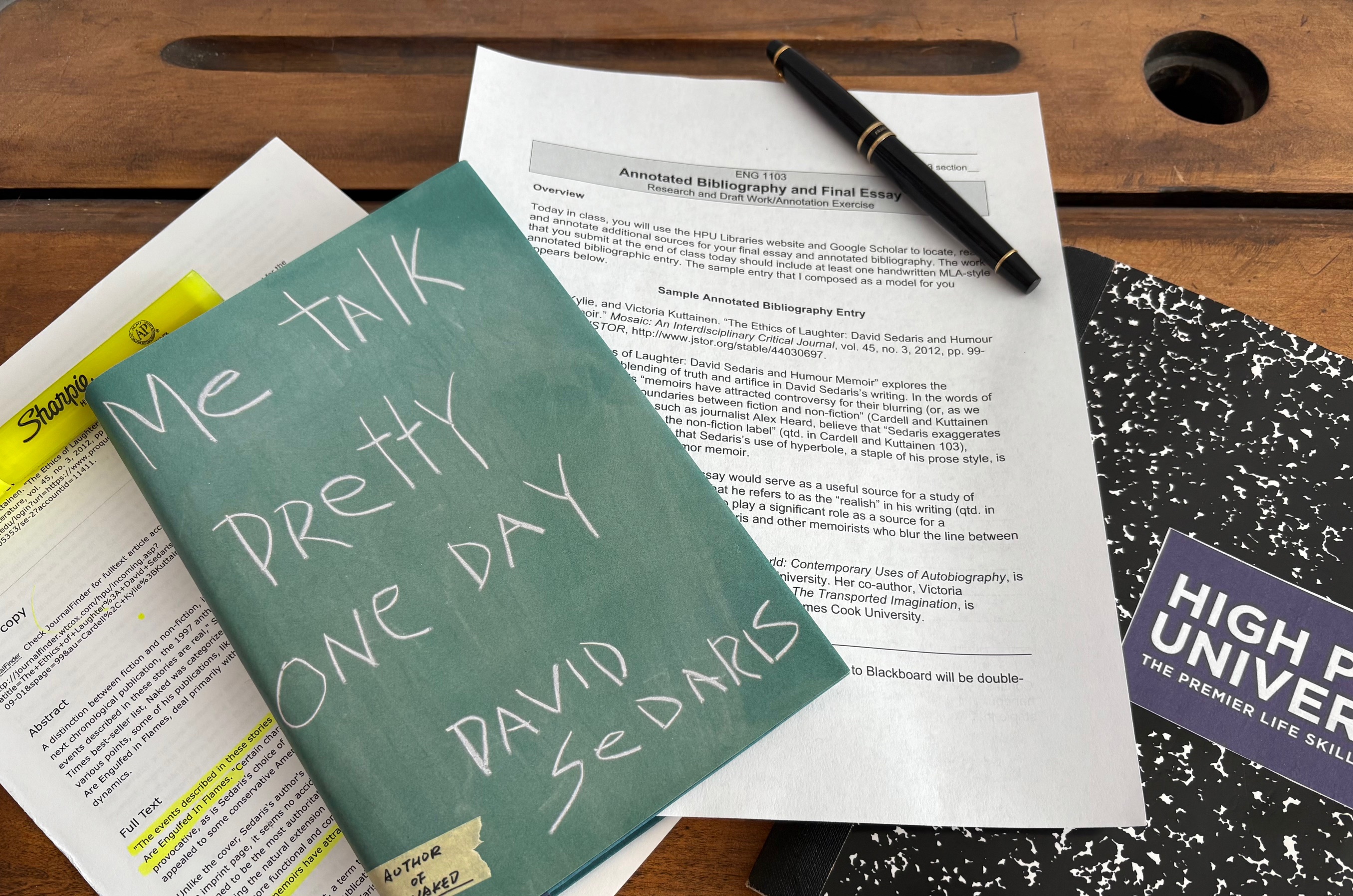
Today in class you will use the HPU Libraries website and Google Scholar to locate, read, and annotate additional sources for your final essay and annotated bibliography. The work that you submit at the end of class today should include at least one handwritten MLA-style annotated bibliographic entry. The sample entry that I composed as a model for you appears below.
Cardell, Kylie, and Victoria Kuttainen. “The Ethics of Laughter: David Sedaris and Humour Memoir.” Mosaic: An Interdisciplinary Critical Journal, vol. 45, no. 3, 2012, pp. 99-114. JSTOR, http://www.jstor.org/stable/44030697.
“The Ethics of Laughter: David Sedaris and Humour Memoir” explores the implications of the blending of truth and artifice in David Sedaris’s writing. In the words of the authors, Sedaris’s “memoirs have attracted controversy for their blurring (or, as we argue, contesting) of boundaries between fiction and non-fiction” (Cardell and Kuttainen 100). While some critics, such as journalist Alex Heard, believe that “Sedaris exaggerates too much for a writer using the non-fiction label” (qtd. in Cardell and Kuttainen 103), Cardell and Kuttainen assert that Sedaris’s use of hyperbole, a staple of his prose style, is ethical in the context of the humor memoir.
Cardell’s and Kuttainen’s essay would serve as a useful source for a study of Sedaris’s mingling of the real and what he refers to as the “realish” in his writing (qtd. in Cardell and Kuttainen 99). It could also play a significant role as a source for a comparative study of the writing of Sedaris and other memoirists who blur the line between fiction and nonfiction.
Kylie Cardell, Ph.D., author of Dear World: Contemporary Uses of Autobiography, is Associate Professor of Humanities at Flinders University. Her co-author, Victoria Kuttainen, Ph.D., author of Unsettling Stories and The Transported Imagination, is Associate Professor of Art and Creative Media at James Cook University.
Note that the blog format of the annotated bibliographic entry above is different from MLA format, which features paragraph indentations and double spacing.
The bibliographic entry above and the three paragraphs that follow total 241 words. The minimum word count for the entire assignment (essay and bibliography together) is 1,800 words.
If you compose five annotations of the length of the one above, you will be well on your way to completing your 1,800-word minimum, and your bibliography may be longer than your essay.
Next Up
Wordplay Day! To up your game and increase your word power, revisit the Dictionary and World Builder pages on the Scrabble website, and review the blog posts devoted to Scrabble tips.
Yesterday’s class focused on a review of the sample student essay and annotated bibliography “The King of Storytelling,” an exercise that should continue to serve as a guide for you as you develop and revise your own essay and bibliography.
The notes that follow address points of content and form, some that we addressed in class, others that we didn’t. As you continue your own research and writing, revisit these notes.
Content
The essay’s introduction does fulfill its basic requirements: It addresses the writer’s purpose for compiling it, clarifies what drives the research and what interests the writer in the subject, and also states what questions the writer seeks to answer.
The body paragraphs of the essay do include a minimum of two quotations from two of the five sources; however, the student does not mention all of the sources in the body pargraphs. In the introduction, he lists the five sources, but two of them are simply referred to as “two other articles” (par 1).
The student misses the opportunity to draw on lines from “Strawberry Spring” as examples of the writing strategies that King recommends. In the third and fourth paragraphs, the student mentions King’s advice to avoid using adverbs that end in ly and to avoid passive voice but offers examples of neither.
Consider again the examples that I projected on the screen:
“‘He got another one,'” someone said to me, his face pallid with excitement” (273).
“He got another one,” someone said excitedly.
The first sentence, which is King’s, is more effective than the second one because the ly-ending adverb “excitedly,” which modifies the verb “said,” contributes virtually nothing to the story or to the reader’s experience of it. “Excitedly” is abstract; it isn’t something readers can see. They can, however, see a “face pallid with excitement” (273), an image that indicates that the speaker’s heightened state of emotion isn’t all together pleasant since “pallid” is a paleness associated with illness.
Springheel Jack . . . “I saw those two words in the paper this morning” (269).
Springheel Jack . . . Those two words in the paper this morning were seen.
Springheel Jack . . . Those two words in the paper this morning were seen by me.
The first sentence, which is King’s, is more effective than the second and third ones because it is written in active voice. Because the narrator is performing the action in the sentence, seeing the words in the paper, readers are looking over his shoulder, seeing the news story for themeslves. In the second sentence, no one performs the action. In the third, the narrator is present but is the recipient of the action. Both the second and the third sentences distance the reader from the narrator, making them passive observers of a passive narrator.
Including such examples would enable the student to enhance his essay in several ways: (1) he would demonstrate his understanding of active voice, passive voice, and ineffectual ly-ending adverbs, (2) he would illustrate how King draws on his own writing advice in his fiction, and (3) he would synthesize information from a secondary source (Marc Hye-Knudsen’s “How Stephen King Writes and Why”) with information from a primary one (Stephen King’s “Strawberry Spring”).
Such enhancements are always the products of revision. Only after rereading your sources and annotating them can you begin to see how they complement one another.
Form
The parenthetical citations include only the author’s last name, and in some cases only part of the last name. The only quotation that should not be followed by a parenthetical citation is the one from the student’s interview with his classmate.
The bibliographic information for two of the three scholarly sources is incomplete and the entries are marred by errors of mechanics and style.
Wherever the parenthetical citation (Knudsen) appears, the student should have replaced it with a (Hye-Knudsen 8) or (Hye-Knudsen, par. 12), depending on whether the source is paginated. Additionally, if the words are actually Stephen King’s, the student should attribute those words to him with a parenthetical citation for an indirect quotation: (King qtd. in Hye-Knudsen 8) or (King qtd. in Hye-Knudsen, par. 12).
Neither the bibliographic entry for Brown’s article or Hye-Knudsen’s includes the title of the journal where the article was published. The absence of the titles coupled with the absence of page or paragraph numbers in the parenthetical citations may lead readers to wonder whether the student actually accessed and read the articles or simply read abstracts or excerpts. More troubling than the omission of the journal names are the references to Brown’s short article as a book. No careful examination of a text would lead the reader to conclude that it’s a full-length book if it’s only a few pages long.
Next Up
Tomorrow you will have the class period to continue your research and writing. Although you will be working on your laptops and tablets, you will still be required to submit a handwritten exercise at the end of the class period. It will consist of a bibliographic entry for a source that is not one of the articles distributed in class; in other words, one that you have located on your own. To ensure that you have ample time to complete your bibliographic entry–including the publication information, the summary, the commentary, and the author’s credentials–give yourself a head start by completing part of the entry before Wednesday.
Some of you have probably located an additional source on your own and drafted a bibliographic entry for it. If that’s the case, you will simply have to transcribe it for tomorrow’s exercise, which means that you will be able to devote class time to locating, reading, and/or taking notes on additional sources.
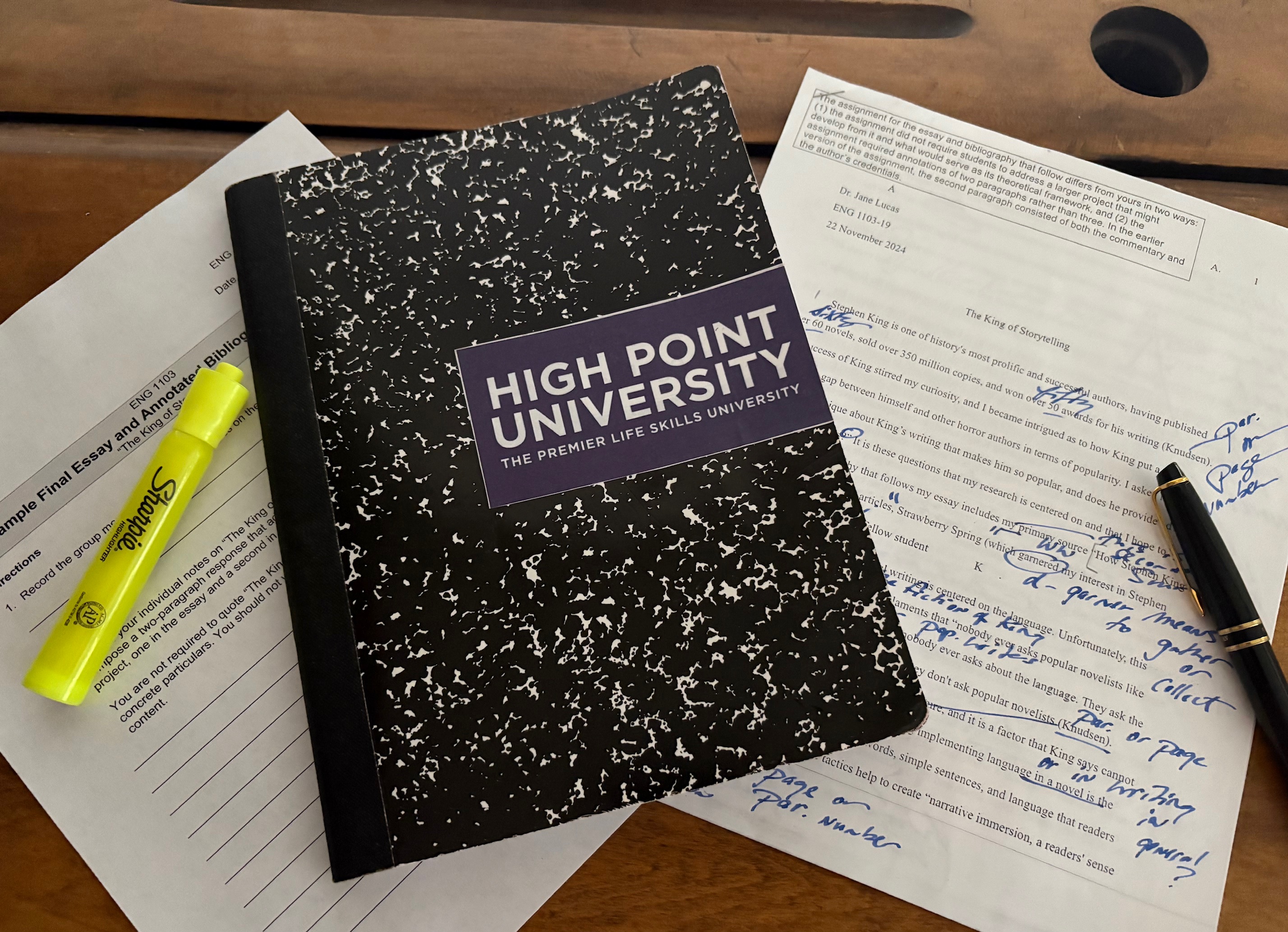
This morning in class, after your Scrabble debriefing, you and two or three of your classmates will discuss your individual notes of “The King of Storytelling,” then collaboratively compose a two-paragraph response that addresses at least two specific details in the project: one in the essay and a second in the annotated bibliography.
You are not required to quote “The King of Storytelling,” but your response should offer concrete particulars. You should not write in general terms about the project’s form or content.
As you review the essay and bibliography, keep in mind two crucial differences between “The King of Storytelling,” written in 2024, and your own project in progress: (1) the assignment did not require students to address a larger project that might develop from it and what would serve as its theoretical framework, and (2) the assignment required annotations of two pargraphs rather than three. In the earlier version of the assignment, the second paragraph consisted of both the commentary and the author’s credentials.
Tomorrow’s blog post will serve as a follow-up to our examination of “The King of Storytelling” and provide more details about its content and form.
Next Up
At the beginning of class on Wednesday, we will discuss locating sources and will review a model annotated bibliography entry. After that, you will have the remainder of the class period to work on an annotation of your own

 Jane Lucas