Today, in place of our in-person class, you will read and evaluate two student literacy narratives: “Creativity is Key” and “The Journey of the Greatest Story.” You will also read my model literacy narrative, “A Bridge to Words,” which appears below as a model for your own blog post.
Directions for writing and posting your evaluations of the student literacy narratives are included in the second half of this post, below the notes on “A Bridge to Words.”
A Bridge to Words
To a small child, the pages of a newspaper are enormous. Looking far back through the years, I see myself, not yet school age, trying to hold up those long, thin sheets of newsprint, only to find myself draped in them, as if covered by a shroud. Of course, back then, my inability to hold a newspaper properly was of little consequence. Even if I could have turned the pages as gracefully as my parents did, I couldn’t decipher the black marks on the page; thus, my family’s ritual reading of the newspaper separated them from me. As the youngest and the only one who couldn’t read, I was left alone on the perimeter to observe. My family’s world of written words was impenetrable; I could only look over their shoulders and try to imagine the places where all those black marks on the page had carried them—these people, my kin, who had clearly forgotten that I was in the room.
My sister, who was three years older, had her very own news source: The Mini Page, a four-page miniature paper that arrived at our house as an insert in the Sunday edition. While our parents sat in their easy chairs poring over the state and local news, my sister, Jo, perched at the drop-front desk and occupied herself with articles, puzzles, and connect-the-dots.
Finally, one Sunday, someone noticed me on the margin and led me into our family’s reading circle. Whether it was one of my parents or my sister, I don’t know. I remember only the gesture and the words: someone handing me the Sunday comics and saying, “You can read part of the funny pages, too. You can read Henry.”
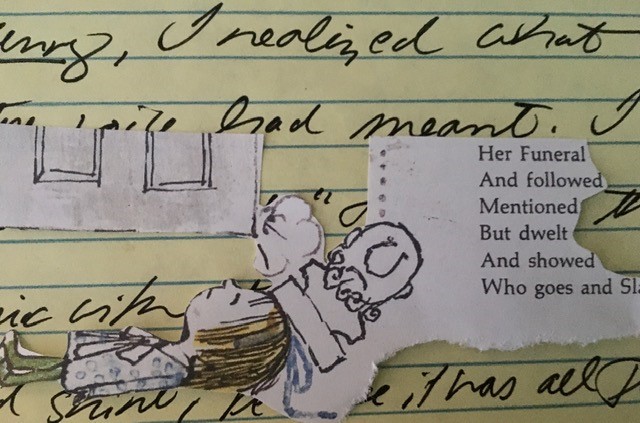
I took the giant page and laid it flat in the middle of the oval, braided rug on the floor of the den. Once I situated the page, I lay on top of it with my eyes just inches above the panels of the comic strip. To my parents, my prone position was a source of amusement, but for me it was simply a practical solution. How else was someone so small supposed to manage such a large piece of paper?
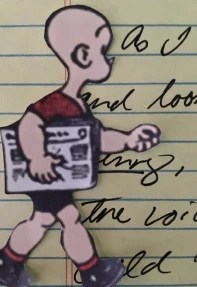
As I lay on the floor and looked at the comic strip’s panels, I realized what the voice had meant. I could “read” Henry, the comic with the bald boy in a red shirt, because it consisted entirely of pictures. In between panels of Henry walking, there were panels of him standing still, scratching his hairless head. I didn’t find Henry funny at all. I wondered how that pale forerunner of Charlie Brown had earned a prime spot in the funnies. Still, I was glad he was there. He was the bridge that led me to the written word.
Reading the wordless comic strip Henry for the first time was the beginning of a years-long habit of stretching out on the floor with newspapers and large books—not thick ones but ones that were tall and wide, among them one of my childhood favorites: The Golden Book of Fun and Nonsense. My sister and I spent hours lying on our bedroom floor, the pink shag carpet tickling our legs as we delighted in the antics of Rebecca, the mischievous title character of one of the poems.
“Rebecca”—which my sister read to me before I could read it myself—introduced me to the word “abhors,” the very sound of which appealed to me. Sometimes before Jo had finished reading the opening lines, my uncontrollable giggles collided with her perfect mock-serious delivery. As the last word in the first line, “abhors” serves as a lead-in to an enjambment: the continuation of a sentence or clause in a line break. It would be years before I learned the term “enjambment,” but I was immediately swept away by its effect in the opening lines: “A trick that everyone abhors/ In Little Girls is Slamming Doors” (Belloc 61). The first line lured me into the second one, and so on and so on. I was drawn both to the individual word “abhors”—with its side-by-side “b” and “h,” rare in English—and the way the words joined, like links in a chain, to yank me giggling through Rebecca’s cautionary tale:
It happened that a marble bust
Of Abraham was standing just
Above the door this little lamb
Had carefully prepared to slam,
And down it came! It knocked her flat!
It laid her out! She looked like that.
Her funeral sermon (which was long
And followed by a sacred song)
Mentioned her virtues, it is true,
But dwelt upon her vices too,
And showed the dreadful end of one
Who goes and slams the door for fun. (61)
Why these particular early memories visit me now, I don’t know. Perhaps rereading Art Spiegelman’s graphic memoir Maus with my students has roused the wordless Henry and the word-filled Golden Book of Fun and Nonsense from the corner of my brain where they’ve slumbered. The former wakes and stretches out in my mind as a bridge to the latter: a spot in the world of words I’ve inhabited ever since.
Work Cited
Belloc, Hilaire. “Rebecca.” The Golden Book of Fun and Nonsense, edited by Louis Untermeyer, illustrated by Alice and Martin Provenson, Golden Press, 1970, p. 61.
Continuing Your Revisions, Notes on “A Bridge to Words”
As you revise your literacy narrative, look back at “A Bridge to Words” and note the elements listed below.
- Appositives
- Scene
- Figurative language
- Gaps in memory/what the narrator doesn’t know
- The story’s significance, how the writer conveys it subtly
The sections that follow focus on the elements listed above, ones you should aim to include as you continue to revise your own literacy narrative.
Appositives
Using an appositive–a group of words that renames or defines a noun or noun phrase–not only helps you develop your writing but also enables readers to better relate to your writing through the specifics that the appostives offer. Examine each of the four passages below, and note how each appositive expands on the ideas presented in the noun, the noun phrase, or the noun clause that precedes it.
- Early in the essay, I write that “[m]y sister, who was three years older, had her very own news source, The Mini Page, a four-page miniature paper that arrived at our house as an insert in the Sunday edition (par. 2).
- I incude another appositive to specify the gesture and the words of a family member: “I remember only the gesture and the words: someone handing me the Sunday comics and saying, “You can read part of the funny page, too. You can read Henry” (par. 3).
- When I turn to an appositive again, I do so define a term that may be unfamiliar to some readers: “As the last word in the first line, ‘abhors’ serves as the lead-in to an enjambment: the continuation of a sentence or clause in a line break” (par. 7).
- Lastly, I fashion an appostive in the conclusion to convey the significance of the memories I have recounted: “The former wakes and stretches out in my mind as a bridge to the latter: a spot in the world of words I’ve inhabited ever since” (par. 8).
Scene
With the words, “[f]inally, one Sunday,” I shift from summary to scene for the first time (par. 3). The previous paragraphs describe the reading ritual that occurred every Sunday.
Figurative Language
Instances of figurative language in the narrative include “as if covered by a shroud” (par. 1), “like links in a chain” (par. 7), and an extended metaphor in the conclusion, where I personify the comic strip Henry and The Golden Book of Fun and Nonsense, depicting them as slumbering in my brain:
“Perhaps rereading Art Spiegelman’s graphic memoir Maus with my students has aroused the wordless Henry and the word-filled Golden Book of Fun and Nonsense from the corner of my brain where they’ve slumbered. The former wakes and stretches out in my mind as a bridge to the latter: a spot in the world of words I’ve inhabited ever since” (par. 8).
Directions for Writing and Posting Your Evaluations
- After you have read and written notes on the two student literacy narratives, review the requirements and grade criteria on your literacy narrative assignment sheet. (Your draft is attached to that handout, and an additional copy is posted in the Major Paper Assignments folder on Blackboard.)
- Determine a grade for each of the two literacy narratives, and compose a response of two or more complete sentences that includes (1) the complete title of each student literacy narrative, (2) the letter grades for each, and (3) a brief explanation of why each narrative merits the grade you assigned. Post your comment as a reply to this blog post by 11:50 a.m. today, Monday, January 26.
- To post your comment, click the title of the post, “ENG 1103: Model Literacy Narrative, ‘A Bridge to Words . . . ,'” then scroll down to the bottom of the post. There you will see the image of an airmail envelope with a box for your comment. Type your comment in the box and click Comment.
I will make your evaluations visible after the 11:50 a.m. deadline.
Posting Your Literacy Narrative to Blackboard and WordPress
If we had met in person today, in the second half class, I would have taken you through the steps of posting your literacy narrative to Blackboard and WordPress. Tomorrow’s post will include step-by-step instructions. In the meantime, consider watching these YouTube videos on submitting an assignment to Blackboard and publishing a post on WordPress.
Next Up
In class on Wednesday, you will compose a short reflective essay focusing on the process of planning, drafting, and revising your literacy narrative. If you are still in the process of completing your essay on Wednesday (since you have until Friday morning’s hard deadline to post it), your reflection will address your work in progress. Bring your copy of the textbook, Writing Analytically, to class.
Before class, read “On Keeping a Writer’s Notebook” (157-58) and “Writing from Life: The Personal Essay” (161-64). Those sections of the textbook serve as companion pieces to your writing thus far in English 1103, and reading and taking notes on those sections will prepare you to compose part of the reflective essay you will write in class on Wednesday.
After you have read and taken notes on “On Keeping a Writer’s Notebook” and “Writing from Life: The Personal Essay,” choose a phrase, clause, or sentence relevant to your writing process and draft in your journal a short passage that connects that quotation to your writing. That passage will serve as part of your reflection. Detailed instructions for composing your reflection and including your chosen quotation will be included on the handout that I distribute on Wednesday.

 Jane Lucas
After reading both papers, here is my final grade for both:
Paper One; Creativity is Key – I will give this paper a C, and that is because for one, it is not a narrative. Whoever wrote this paper is explaining why they want to be a writer, not a story on why they want(ed) to become one. There’s no moment that motivated her to become a writer, and there are no scenes the reader could visualize. Besides that, there are some grammar issues, formatting issues, and it’s just unorganized. The only good thing about this essay is that the writer included two personal anecdotes, or tried to. It meets the basic requirements in the rubric, but the writer could’ve did more. It’s like the writer did the assingnment because he/she had to do it.
Paper Two; The Journey of the Greatest Story – I give this paper an A, and here is why! The paper already opens with some visual, and engaging scene. It tells us the setting, and when this writing is taking place as well. It goes into great detail too, like when the writer talks about the teacher grinning, or the silence in the room, reading it makes you feel like you are there. Unlike the other story, this one is well organized it has a narrative in it, and it has a lot of emotional detail in it as well. I will say some of the sentences I read were repetitive, and after I read it aloud there are some punctuation that doesn’t need to be there. Other than that everything is good, it meets the requirements in the rubric.
For “Creativity is Key,” I would give it a C based on the literacy narrative rubric. It does tell a personal story about the writer’s experiences with writing, and it includes some detail about assignments they enjoyed, like the southern gothic story and the personality essay. However, it doesn’t fully meet all the assignment guidelines. The biggest issue is length, it feels much shorter than a typical 600-word literacy narrative, which makes the story feel rushed and not fully developed. The essay also doesn’t use very vivid detail, and the reflection on why these experiences matter in the writer’s literacy journey feels kind of surface-level. On top of that, there are quite a few grammar and sentence problems that distract from the story. Because it follows some of the guidelines but not all, and has issues with development and surface errors, I think a C fits best.
For “The Journey of the Greatest Story,” I would give it an A according to the rubric. This essay clearly follows the assignment guidelines by telling one focused story about reading The Awakening and how that moment changed the writer’s relationship with reading. It uses vivid detail, like describing the classroom, the silence after the ending, and the conversation with the teacher, which really brings the experience to life. The reflection is also strong and shows real depth of understanding, especially when the writer explains how they started to see themselves differently as a reader and connect more personally to stories. The essay is well organized, flows smoothly, and has very few noticeable grammar issues. Overall, it tells a meaningful story, explains why it matters, and is polished, which is why it fits the description of an A literacy narrative.
To start off with the essay, The Journey of the Greatest Story, I would give it the grade of an A. I would give this literacy narrative an A because from the beginning to the very end it felt like a story was being told. It felt very engaging for the audience, as well as for the writer and I think it is important that when a story is being told something is felt across the board, which this narrative does. This narrative also includes heavy figurative language, good grammar and punctuation, descriptive words, and vivid imagery, which was all a large part of what an A criteria strives for. It was well organized and had little to no errors. I also appreciated that it included dialogue and provided a specific story. The narrator also brings us back in at the conclusion to express present feelings as well, which is important when answering the prompt.
For the narrative, Creativity is Key, I would give it a grade of a C+ or B- (something in between the grade of a C and B). This is because it was a good essay. It had somewhat of a hook at the beginning and a question to be answered throughout the essay, but I do not feel like the story was told in the best way to comply with what the beginning of the narrative gave us. It did not feel like a vivid story was being told and almost felt all over the place with other stories thrown in here and there. This story had good examples and a way to keep readers engaged, but the vocabulary was lacking and there was little figurative language used. There were other elements that I liked and seemed adequate for writing a narrative, but it was all surface level, which is what a C and B criteria really get at. The self-reflection as a conclusion was good and enlightening when connecting back to the opening paragraph, but again, it did not tell a story, more than it did feel like a reflection assignment.
The narrative, “Creativity is Key”, would in my opinion receive a B. The writing does clearly cover the entire prompt and includes great creative detail. However, in some spots the organization weakens and there is some repetition. This would match the rubric to be a B grade as it is overall well put together but has some organization and deeper explanation problems.
The narrative, “The Journey of the Greatest Story”, would in my opinion receive a letter A grade. The writing is very easy to follow while also demonstrating great organization and creative depth. This essay fits the rubric for the grade letter A.
-Avery Clark
In the literacy narrative, “The Journey of the Greatest Story,” I would rate the literacy narative an A. This is because, the writer uses vivid details, like the slamming of the book and dialogue to convey her emotions about reading the, “The Awakening.” Near the end of the narrative, you can see, the writer be able to personally connect herself, from what she reads, to her life now, which is something she was not able to do before. She takes the novel, and lives by it day by day, showing her perosnal connection to the book, and how it was the first time she was able to relate and apply a book, in her life. However, thorughout the narrative, there was small grammar mistakes, and her dialogue should have been in seperate lines, when a different person talked. But, overall her essay used good details, dilagoue, had a good personal connection, and drawed the reader’s in which is why I give this literacy narrative an A.
In the literacy narrative, “Creatvity is Key,” I would rate the essay an B. This is because, the essay lacked, vivid deatils, dilaougue, and was hard to see the signifgance of his story. Though the writer does explain why he likes writing over reading, because they feel free. They also mention, Track and Field and how that shaped there experince with writing, but I feel like, they could have added more details to show us, why there experince changed during that time. Furthermore, near the end of the essay, they relates there experince of writing, to writing this essay. He mentions how for them to enjoy writing they can’t be told what to write, but instead has to feel a passion for it. They then tie it into the literacy narrative, and tell us that they enjoyed writing the narrative, because it was more free, and they got to talk about there experinces. In conclusion, I think this essay has lots of potential, and is good. But, if they would have added more details, or even dialogue to explain there track and field experince, and how that shaped them, then it could be an A.
“Creativity is Key”- C
In the first student literacy narrative, “Creativity is Key”, the student explains why they would want to be a writer, not a reader. This narrative is written with a casual tone, and seemed to ramble. The student should have broken up the paragraphs, avoided the use of compound words, and added specific examples and details. This is a ‘C’ grade work.
“The Journey of the Greatest Story”- A
The second student literacy narrative, “The Journey of the Greatest Story”, explains the authors’ personal significance of a book to the reader through a story with specific details. Additionally, the insightful title, engaging opening, and correct formatting with each of the titles of works mentioned, earns this narrative an ‘A’ letter grade.
The first literacy narrative I graded was Creativity is key. After reading this essay I would give it a grade of a C and if I could be more exact in grading a . This essay only hits on a few of the requirements which is what keeps it from getting a solid grade. The big issues are the lack of detail in this narrative it’s hard to visualize what the author conveying in there writing. In addition the essay does not meet the 600 word minimum requirement which will always tank a grade./
The second narrative I graded is titled The Journey of the Greatest story. I would give this essay a Grade of B and if I could be more exact a A-. This essay meets all the requirements for a good grade. The narrative features great detail which really made the essay easy to connect and allowed the reader to connect with the author’s feelings and visualize the environment. The only issue I have with this essay which is more of a nitpick is I feel the title doesn’t let me know what this essay could be about. In fact the title is more of the opposite of what happens in the narrative. It’s titled The Journey of the Greatest Story yet a decent chunk of the essay talks about how they disliked the ending of the story the author was reading I feel like the title is more like a window to the theme of the paper rather than what it’s about.
I would give the “Creativity is Key” a letter score of B. This narrative of me does clearly explain the writer’s preference of writing over their reading, and it also includes a meaningful personal experience that describes the southern Gothic in an essay about personality which gives a description of what this person actually believes in and shows their style of writing. This also describes how creative and self expression this personal and literary ability has changed throughout their journey. Some problems with this essay are the length. Obviously it is not up to the standards of what the requirements are and it also relies more on explaining the scene and it could’ve been stronger and more vivid in detail and specific moments. It’s more of a broad explanation instead of focusing on one deeper reflection on one moment. Overall, this is a good narrative. It just needs to focus on more specific moments rather than an overall experience.
From a different perspective, “The Journey of the Greatest Story” Timmy earns a letter grade of A. This narrative to me is way more vivid and describes the scene in the classroom and effectively captures the writer’s true emotions when it comes to responding to the reading of The Awaken which shows a clear turning point in the relationship between this writer and literature. This reflection on this reading is a personal reflection and shows how the writer has learned to embrace the meaning behind what they read and how they read it. This narrative focuses on a specific moment and really does focus at one moment, not just abroad experience of literature in their life. The places where this narrative couldn’t prove is with their writing. It could be a little bit less of an extended and stretched out in some areas in the wording could be more just direct and conclusive with the dialogue.
I believe that “Creative is Key” is a (c) after reading it as it lacks detail and organization. In addition to this, it does not reach the 600 word requirement. I think that this essay would benefit from breaking up the second paragraph, adding more vivid detail, avoiding run-on scentences, and introducing dialouge specificly with track and feild as well as football. Based on the literacy narrative rubric this is why I think it is a (C).
After reading “The Journey of the Greatest Story” it is an (A) as it clearly fufills the literacy narrative requirements. The essay included figurative language, with vivid detail, and dialouge, and it remains well organized with strong language and minimal errors throughout. It also hit the 600 word requirement unlike “Creative is Key”.
after reviewing “Creativity Is Key” I would give this narrative a grade of B-. This narrative clearly explains the writer’s preference for writing over reading and uses strong personal experiences, especially on self-reflection and athletics, to show growth as a writer. However I think the writer could’ve done a better job using more vivid scenes and figurative language to deepen its impact.
I would assign “ The journey of the Greatest Story” a grade of an A-. I give this narrative this grade because it included a clear scene, emotional engagement with a text and a thoughtful reflection. I think the narrative used a strong sense of significance but could have been slightly more concise in places.
I gave the literacy narrative “Creativity is Key” a C. This is because the writer lacks details and stays at a surface level for the majority of the paper. Another problem is that they didn’t meet the 600 word requirement, along with this the writing quality gets weak throughout the writing.
In the literacy narrative “The Journey of the Greatest Story” I gave it an A. This narrative earned an A because of it’s detail of writing, and wording that kept me interested in what’s being said through the entire paper. This paper met the 600 word requirement, keeping a high level of writing throughout the majority of the writing.
After reading “Creativity is Key” I would give it a B-. The story isn’t vivid and fails to paint a picture, but it fulfills the other requirements. I noticed a few grammatical errors as well.
I would give “The Journey of the Greatest Story” an A+. It fulfills every aspect of the rubric. Its vivid and paints a clear picture, tells a story about how the ending of a book impacted them, and I don’t notice any grammatical errors.
“The Journey of the Greatest Story” is a B+ essay because it illustrates a clear, meaningful scene focused on the student’s emotional reaction to The Awakening and reveals an important shift in the way the writer is reading. The dialogue between the student and teacher is an excellent juncture, although it is a bit more expositional than scene-oriented and could be made even more understated in its importance.
“Creativity Is Key” gets a C+ because although it successfully conveys the writer’s personal choice of writing over reading and provides such relevant, personal experiences, it is too reflective and descriptive, not narrative enough. It would have done better with more specific moments and scenes, more sensory detail, and the clear connection of these literacy events to the writer’s growth.
Because Nicole Marin is encountering technical difficulties with her WordPress account, I am posting her evaluation on her behalf:
Creativity is key: I give this narrative a B. I give this narrative a B, because the message was good but there wasn’t an organized structure in the narrative. I feel like it could have been better organized and I felt like it would switch from topic to topic without a smooth transition.
The Journey of the Greatest Story: I give this narrative a C+. I think that the voice behind the passage is powerful. I also believe that it shares a good message of self growth. However there were some grammar issues and again the structure wasn’t great. It also lacked a good topic transition and a well structured outline.
Creativity is key: This narrative should earn a C. The paper is only 497 words, when it should be at least 600. The narrative could have been better organized. If the paper had been 600 words, it would have earned a B.
The Journey of the Greatest Story: This narrative should earn an A. It complies with all the assignment guidelines. I also don’t see any glaring grammar issues. The writing is very engaging and paints a picture well.