This morning, in place of our in-person class, you will compose a response to a designated* classmate’s literacy narrative. Directions for the assignment follow. Read the directions in their entirety before you begin typing your response. If you have any questions, please email me.
Directions
- Go to the class blog page, and click on the link for the blog of the classmate whose name follows yours. If you are last on the list, go to the blog of the student whose name is first.
- *If your designated classmate’s blog is not linked to the page, or his or her literacy narrative is not published, choose another classmate’s blog.
- Read the classmate’s literacy narrative.
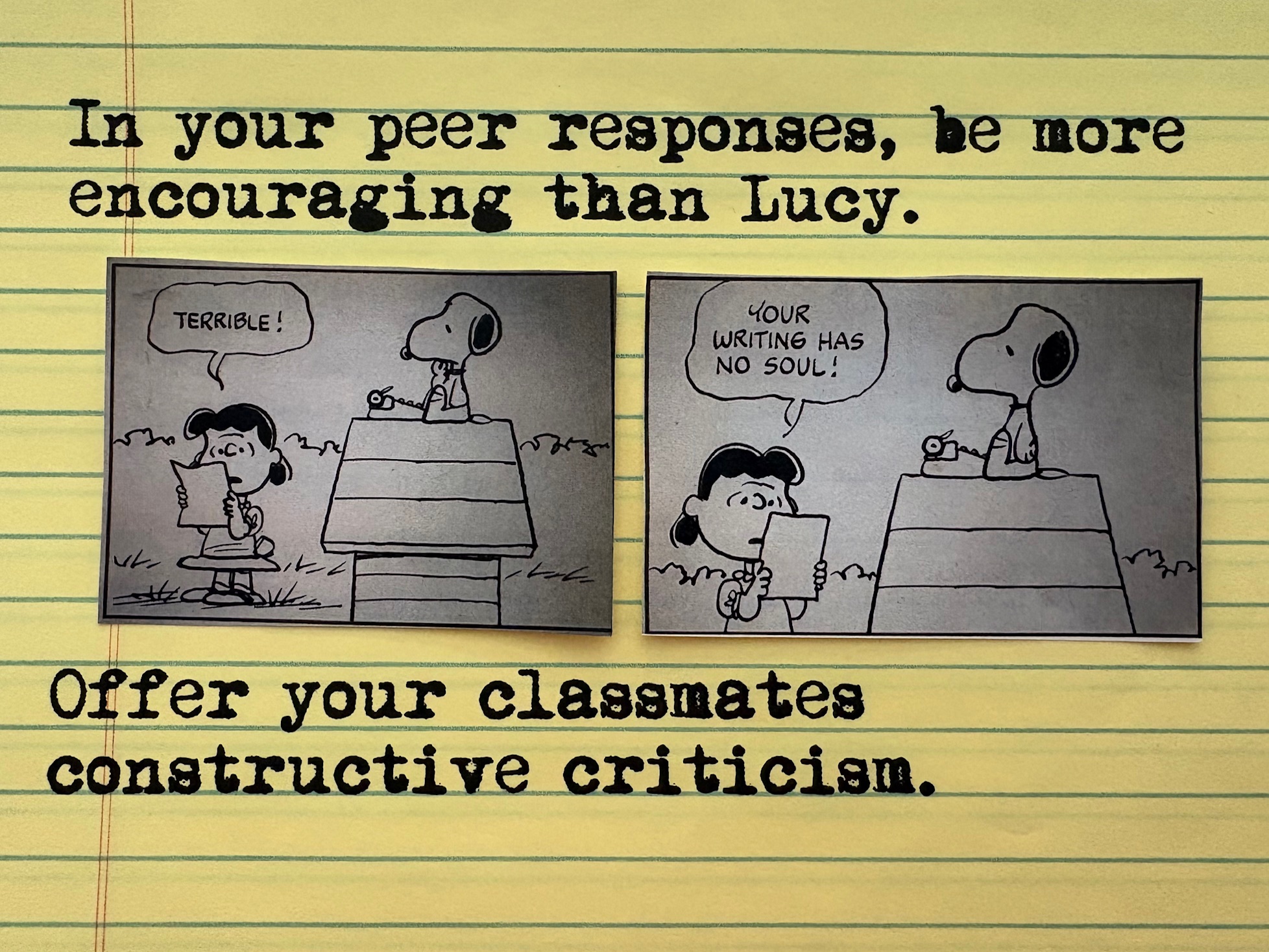
- Compose a one- or two-paragraph response (75 words, minimum) that includes both the classmate’s name and the title of his or her literacy narrative. In your comment, address one or more of these elements: the title, vivid details, scene, dialogue, the image documenting part of the writing process away from the screen, the embedded link to a relevant website. Note that you will mention the classmate by name, but you will not refer to him or her in third person. In other words, you will not write, John’s description made me feel as if I were with him in his fourth-grade classroom. Instead, you will write, John, your description made me feel as if I were with you in your fourth-grade classroom.
- Recommended (not required): Draft your comment longhand in your journal.
- After you have composed your response, review the section of Writing Analytically devoted to basic writing errors, or BWEs (426-44), and correct any that you can identify in your blog response. This step is for your own comment, not your classmate’s literacy narrative.
- Type your response as a comment. You should see a leave comment/reply option at the top or bottom of the post. If you do not see that option, click the title of the blog post, and scroll down. You should then see leave comment/reply.
- Before you click leave comment/reply, copy your comment (on a PC, copy with control + c; on a Mac, copy with command + c).
- After you submit your comment on your classmate’s blog post, return to this post, and paste your comment as a reply (on a PC, paste with control + v; on a Mac, paste with command + v). This step is critical because your classmate may not approve your comment, which means it will not be visible on his or her blog post. To receive credit for the assignment, you must post your duplicate comment as a reply to this blog post, “ENG 1103: Literacy Narrative Peer Responses.“ To submit your comment, click the title of the post, then scroll down to the bottom. There you will see the image of an airmail envelope with a box for your comment. Type your comment in the box and click Comment. Post your comment by the end of today’s class period (11:50 a.m.).
I will make your comments visible after the deadline.
You are not required to read other classmates’ literacy narratives, but I encourage you to browse their blogs and read the posts that pique your interest.
Journal Exercise: Alternate Portraits
Since we are not meeting in person today, I will not conduct a check of the alternate portraits journal exercise that you completed, but you may have the opportunity to draw on that writing for another assignment. For now, think of that exercise as a warm-up for your analysis.
If you were absent on the day I distributed copies of the exercise, or you misplaced your copy, see the directions included in the class notes for January 21.
The photograph of Taylor Swift that accompanies Amanda Petrusich’s New Yorker piece will be included in tomorrow’s class notes.
If in-person classes are held on Wednesday, I will return your literacy narrative reflections with my annotations. Along with my handwritten notes, you will receive a handout of general notes on your reflective writing. An additional copy of those notes follows.
Reflection Notes
- The directions for your reflective essay did not specify that you should double-space your writing, but know that in the future, you should always double-space your reflections and any other individual pieces of writing that you compose in class and submit for evaluation. The double-spacing guideline does not apply to group exercises and other shorter assignments.
- You will not see a grade on your reflective essay for your literacy narrative, because that reflection and the two you will compose for your other two major writing assignments are not assigned grades. Instead, they factor in the grades for the major assignments themselves.
- You will see a grade on the midterm and final reflections that you compose because those are stand-alone assignments.
- All the reflections that you compose are essays, albeit short ones, and should consist of at least three paragraphs: an introduction, a body paragraph, and a conclusion.
- Just as you indent the first line of each paragraph of an MLA-style typed document, the first line of each of your handwritten paragraphs should be indented approximately five spaces or one-half inch. In English 1103, the one exception to the indentation guideline is the writing on your blog. WordPress posts are easier to manage if you retain the default block style.
- In all your reflections, you will be required to integrate a minimum of one quotation from a written text, either from a section of Writing Analytically or another course reading. Follow the directions for preparing to write your reflections, which will be posted on my blog. If you arrive at class unprepared or underprepared, you are likely to produce a reflection with a quotation that isn’t gracefully woven into your writing or one that isn’t properly cited.
Next Up
In class on Wednesday, we will read a short story by Donald Barthelme. As an introduction to him and his fiction, read this biographical sketch. After you read the sketch, compose a one- or two-paragraph journal entry that includes (1) what you have learned about his writing style, and (2) what you have learned about readers’ and critics’ mixed responses to his writing.