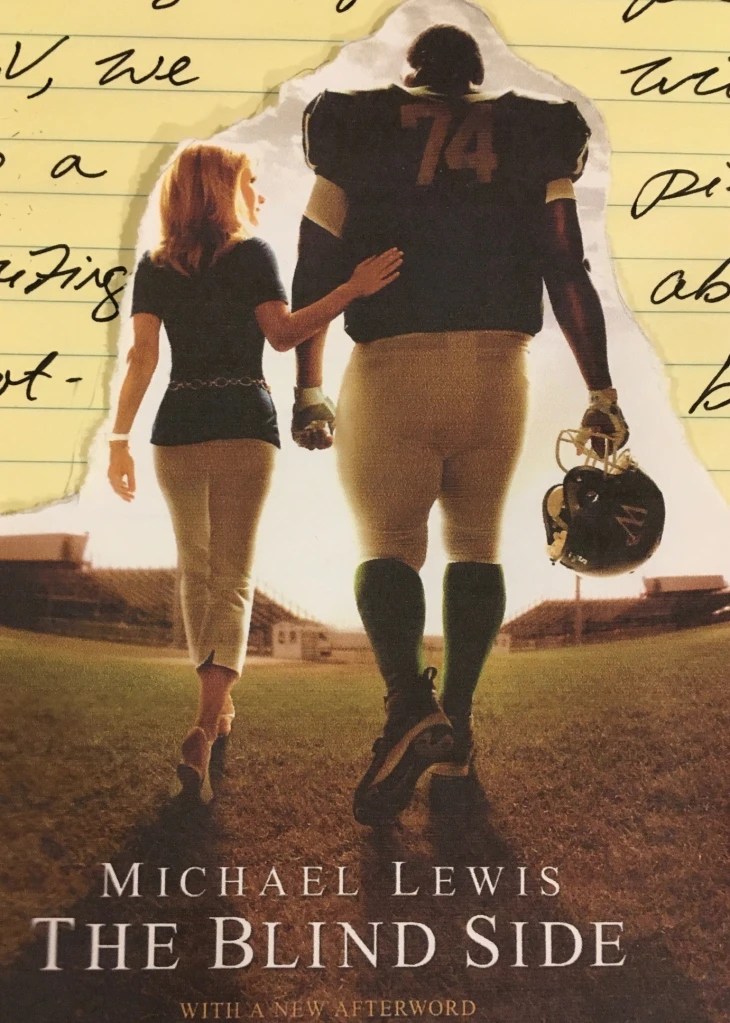
Yesterday in class, we examined “Back Story,” the first chapter of Michael Lewis’s The Blind Side, which begins with Lewis’s depiction of the moments in the November 1985 Redskins-Giants football game leading up to the injury that ended quarterback Joe Theismann’s career:
“From the snap of the ball to the snap of the first bone is closer to four seconds than to five. One Mississippi: The quarterback of the Washington Redskins, Joe Theismann, turns and hands the ball to running back John Riggins. He watches Riggins run two steps forward, turn, and flip the ball back to him. It’s what most people know as a “flea-flicker,” but the Redskins call it a “throw-back special.” Two Mississippi: Theismann searches for a receiver but instead sees Harry Carson coming straight at him. It’s a running down—the start of the second quarter, first and 10 at midfield, with the score tied 7–7—and the New York Giants’ linebacker has been so completely suckered by the fake that he’s deep in the Redskins’ backfield. Carson thinks he’s come to tackle Riggins but Riggins is long gone, so Carson just keeps running, toward Theismann. Three Mississippi: Carson now sees that Theismann has the ball. Theismann notices Carson coming straight at him, and so he has time to avoid him. He steps up and to the side and Carson flies right on by and out of the play. The play is now 3.5 seconds old. Until this moment it has been defined by what the quarterback can see. Now it–and he–is at the mercy of what he can’t see” (15).
What Theismann cannot see is Lawrence Taylor. A second later, as Taylor sacks Theismann, Taylor’s knee drives straight into Theismann’s lower right leg, leading to the “snap of the first bone” that Lewis mentions in the first sentence. He hooks the reader by linking the beginning of the play, “the snap of the ball” to the gruesome “snap of the first bone” that will follow. Lewis develops the paragraph using the common one-Mississippi, two-Mississippi method of marking seconds to present the events leading up to the compound fracture that ends Theisman’s career.
Lewis doesn’t dramatize the injury itself because his interest lies instead in the blind side that led to it and subsequently elevated the status and salary of the left tackle, the player who protects the quarterback’s blind side. Rather than immediately continuing the action of the play he presents in the opening of the chapter, Lewis turns away from the 3.5-second moment to show how, in his words, “Lawrence Taylor altered the environment and forced opposing players and coaches to adapt” (17).
When you’re struggling to develop a piece of writing, reread the opening paragraph of The Blind Side. Study how Lewis dramatizes 3.5 seconds–yes, only 3.5 seconds–with 224 words.
In your groups yesterday, you wrote of how Lewis returns to the chapter’s opening scene with the words “[f]our Mississippi” (21). Delaying the resumption of that scene for several pages gives Lewis the opportunity to develop the backstory of the title: how Lawrence Taylor redefined the role of running back and fundamentally changed the game.
In response to the “Seems to Be about X, But Could also Be (Or is ‘Really’) about Y” question, some of you wrote that “Back Story” could also be (or is really) about (1) the factor of fear in football. Others observed that the chapter may also be about (2) Lawrence’ Taylors role in the evolution of the sport, (3) the origin of the term blind side, (4) Taylor’s ultimate demise, (5) the media’s exploitation of injuries, and (6) the dangerous nature of the sport–a sport with injuries that can not only end players’ careers but can also have long-term consequences, including Chronic Traumatic Encephalopathy (CTE).
Work Cited
Lewis, Michael. “Back Story.” The Blind Side. 2006. W.W. Norton, 2009. pp. 15-23.
Planning for Your Analysis
To explore possible topics for your analysis, repeat the a seems-to-be-about . . . but-could-also-be-(or-is-really)-about . . . exercise that you and your group members completed collaboratively in class.
Directions
- Review the essays, short fiction, chapters, and chapter excerpt that you have read for class, and determine which one you are most likely to choose as the subject of your analysis.
- In your journal, compose a seems-to-be-about . . . but-could-also-be-(or-is-really)-about . . . statement for that essay, story, chapters, or chapter excerpt. Begin your sentence with the author’s name and the title.
- After you have composed your x–y statement, write a list of words and phrases in the text that demonstrate how the essay, short story, chapter, or chapter excerpt could also (or really) be about what you have stated.
The essays, short story, chapters, and chapter excerpt to consider include these:
- Davis Sedaris’s “Me Talk Pretty One Day”
- Helen Keller’s “The Day Language Came into My Life”
- Martin Luther King, Jr.’s “Letter from Birmingham Jail”
- Chapter One of Harper Lee’s To Kill a Mockingbird
- Donald Barthelme’s “The School”
- Michael Lewis’s “Back Story,” the first chapter of The Blind Side
This exercise requires you to write only one x-y statement about one of the texts listed above. However, if you don’t yet have an inkling of what you want to write about, repeating the process with each text may lead you to a topic.
I will not collect your x-y journal exercise, but you should complete it in preparation for Wednesday’s class.
Note that you will have the option to write about a larger portion of Lee’s chapter, which is posted in the readings folder on Blackboard. You will also have the option to write about a seventh text, which we will examine in class on Wednesday.
Next Up
Tomorrow in class, you will begin planning and drafting your analysis, which will focus on one of the texts that we have studied, including David Sedaris’ “Me Talk Pretty One Day,” Helen Keller’s “The Day Language Came into My Life,” Martin Luther King, Jr.s “Letter from Birmingham Jail,” the excerpt from Harper Lee’s Novel To Kill a Mockingbird, and Michael Lewis’s “Back Story,” the first chapter of The Blind Side.
- If you have misplaced your copy of any of the readings or were absent the day that I distributed copies, download a copy from Blackboard and print it.
- If you would like to analyze a larger section of the first chapter of To Kill a Mockingbird, download a copy of Chapter One from Blackboard and print it.
 Jane Lucas