As an introduction to Michael Lewis, whose writing we will examine in class today, you read this overview of his publications. After you read it, you composed a one- or two-paragraph journal entry that addressed these questions: (1) Two of Lewis’ books on one subject have both been adapted for film. What is the subject, and what are the titles of the two books (and films)? (2) A third book of his, one devoted to a different subject, has also been adapted for film. What is the subject, and what is the title of the book (and film)?
As we read the first chapter of one of his books, consider what elements of his writing would attract filmmakers to his work. We will closely examine the opening of the chapter, paying special attention to its repetition of words and phrases. Later in class, we will read the remainder of the chapter and you will address in writing why Lewis may have chosen to delay the continuation of the action that he depicts in the opening paragraph.
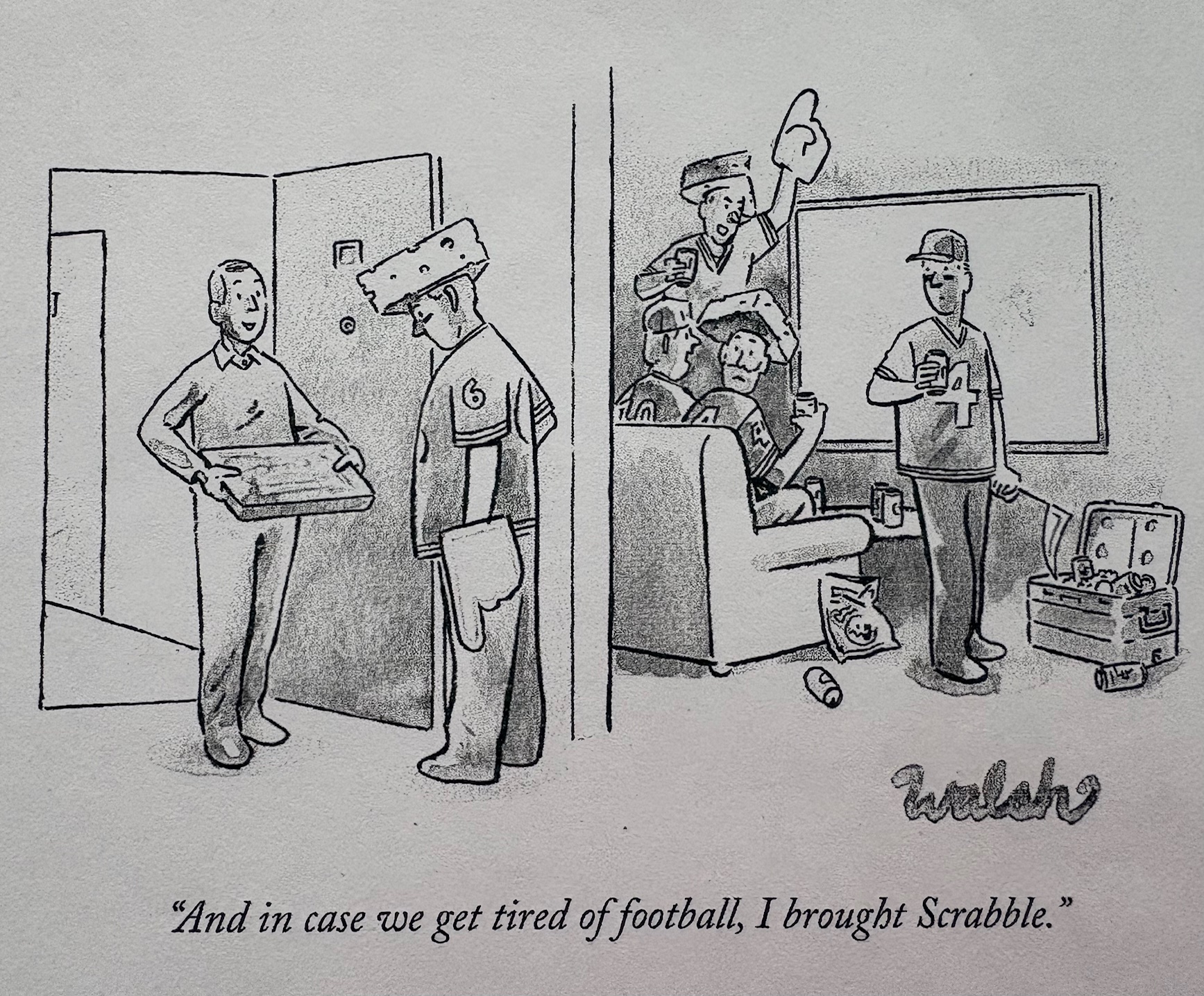
As a segue from your Scrabble debriefing to your study of Michael Lewis’s “Back Story,” the cartoon below is included on your group assignment sheet.
Walsh, Liam. Cartoon. The New Yorker, 27 Jan. 2020. p. 64.
Food Cheeseheads for thought: This cartoon ran in The New Yorker shortly after the Packers lost the NFC title game to the 49ers and shortly before San Francisco lost Super Bowl LIV to the Chiefs. Would the Cheeseheads depicted here have opted to play Scrabble rather than watch the game that their team lost its chance to play, or would they have savored schadenfreude, watching the 49ers lose to Kansas City?
Next Up
In class on Wednesday, you will begin planning and drafting your second major writing assignment, your analysis. The chapter of Michael Lewis’s writing that we examine in class today and the other texts we have studied thus far in English 1103–“MeTalk Pretty One Day,” “The Day Language Came into Life,” “Letter from Birmingham Jail,” the excerpt from the first chapter of To Kill a Mockingbird,” and “The School“–are among the pieces of writing that may serve as the subject of your upcoming analysis.
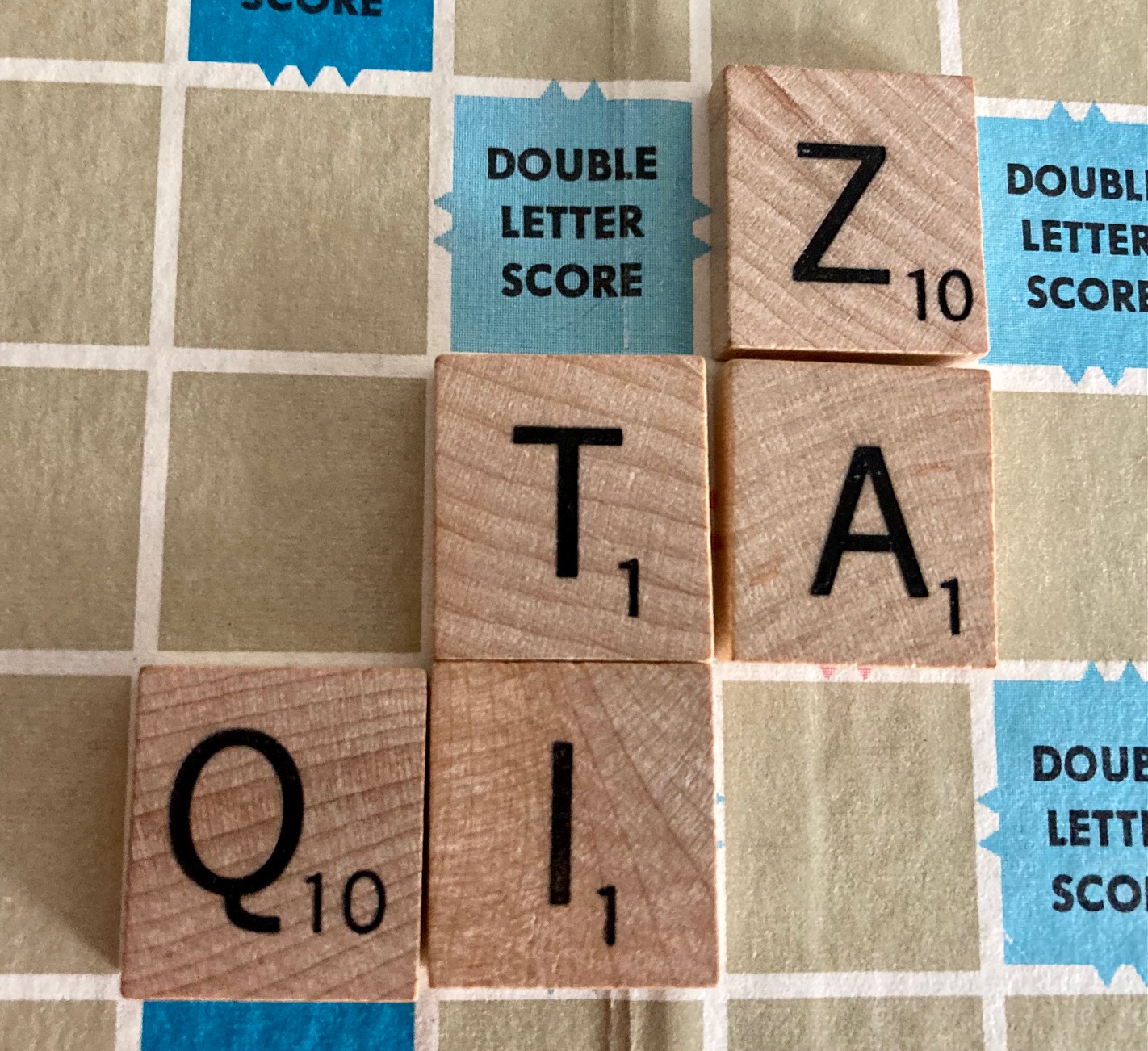
Today’s blog post is the final installment in the series of posts devoted to playable two-letter words. Learning these two-letter words, as well as the other two-letter words in the alphabet, will enable you to see more options for play and increase the number of points you earn in a single turn.
qi: the central life force in Chinese culture (also ki)
re: a tone of the diatonic scale
sh: used to encourage silence
si: a tone of the diatonic scale (also ti)
so: a tone of the diatonic scale (also sol)
ta: an expression of thanks
ti: a tone of the diatonic scale
to: in the direction of
uh: used to express hesitation
um: used to express hesitation
un: one
up: to raise (-s, -ped, -ping)
us: a plural pronoun
ut: the musical tone C in the French solmization system, now replaced by do
we: a first-person plural pronoun
wo: woe
xi: a Greek letter
xu: a former monetary unit of Vietnam equal to one-hundreth of a dong (also sau, pl. xu)
As an introduction to Michael Lewis, whose writing we will examine in class on Monday, read this overview of his publications. After you read it, compose a one- or two-paragraph journal entry that addresses these questions: (1) Lewis’s two books on one subject have both been adapted for film. What is the subject, and what are the titles of the two books (and films)? (2) A third book of his, one devoted to a different subject, has also been adapted for film. What is the subject, and what is the title of the book (and film)?
Coming Soon
In class on Wednesday, you will begin planning and drafting your second major writing assignment, your analysis. The chapter of Michael Lewis’ writing that we examine in class on Monday and the other texts we have studied thus far in English 1103–“MeTalk Pretty One Day,” “The Day Language Came into Life,” “Letter from Birmingham Jail,” the excerpt from the first chapter of To Kill a Mockingbird,” and “The School“–are among the pieces of writing that may serve as the subject of your upcoming analysis.
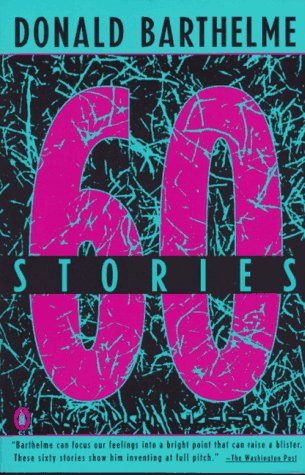
Yesterday in class, we examined Donald Barthelme’s “The School” as another potential subject for your analysis. In groups, you and your classmates considered these elements.
The narrator and the narrative voice
Conflict
A short passage that strikes you as interesting, revealing, or strange
The Narrator and the Narrative Voice
The words and phrases you and your classmates used to describe the narrator, Edgar, and his voice include these:
“casual”
“emotionless”
“funny and go with the flow”
“indifferent”
“a little questionable”
“monotonus”
Do any of those descriptions seem at odds with the narrator’s words or actions? If so, what might account for that discrepancy?
When the narrator, Edgar, says, “Of course we expected the fish to die” (9), he emphasizes the word expected, something you cannot do in monotone because emphasis in speech requires modulation.
In his account of the death of the students’ puppy, Edgar says, “I got it [the puppy’s body] out of there before the kids got to school. I checked the supply closet each morning, routinely, because I knew what was going to happen. I gave it to the custodian” (9). Later, when Edgar notes why his class didn’t adopt another orphan after the death of Kim, he says, “[W]e didn’t have the heart” (9).
Are those the words and deeds of an “emotionless” or “indifferent” character?
Conflict
All of your groups addressed the existential conflict of life versus death. The children want the plants and animals in their classroom to live. They want the Korean orphan, Kim, to live; they want their classmates and relatives to live, but the children are repeatedly faced with death.
Consider the lines below, and ask yourself what conflicts they reveal.
“[T]he boiler was shut off for days because of the strike” (8).
“But the lesson plan called for a tropical-fish input at that point, there was nothing we could do” (9).
“I don’t know what’s true and what’s not” (10).
Interesting, Revealing, or Strange
The lines that follow are the ones that you identified as interesting, revealing, or strange.
Bartheleme’s narrator observes that the school “had an extraordinary number of parents passing away, for instance” (10).
Edgar notes, “I forgot to mention Billy Brandt’s father, who was knifed fatally” (10).
The children ask, “[I]s death that which gives meaning to life . . . ? (10), and their teacher replies, “[N]o, life is that which gives meaning to life” (10).
The students ask Edgar, “[W]ill you make love now with Helen . . .?” (10). Instead, he embraces her, and “[T]hen the new gerbil walked in” (11).
In the examples above, I have included only signal phrases and quotations. However, in your analyses—as in your group responses yesterday—you will need to follow your quotations with commentary that demonstrates what makes the lines interesting, revealing, or strange.
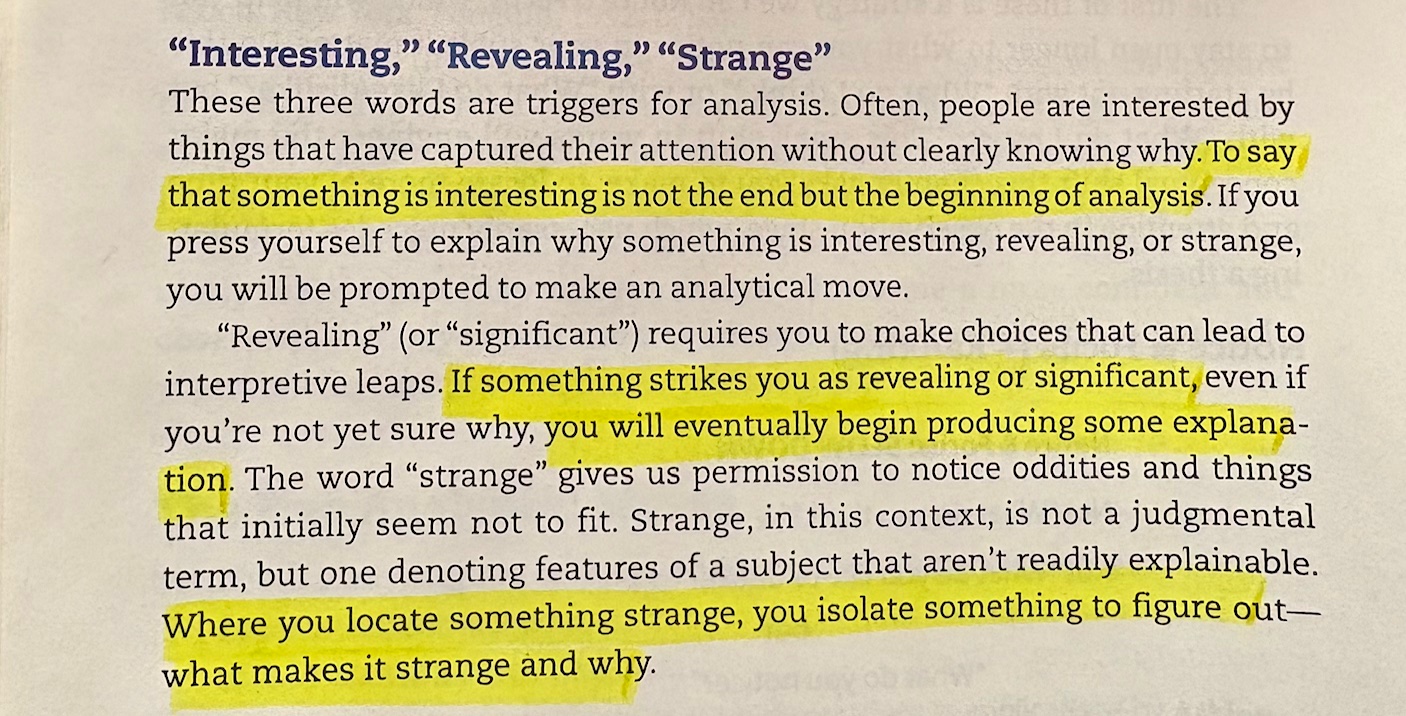
Once you have decided on a subject for your analysis, repeat the interesting-revealing-strange exercise with the text you have chosen. As the textbook’s authors observe, those three words are “triggers for analysis” (Rosenwasser and Stephen 24).
Works Cited
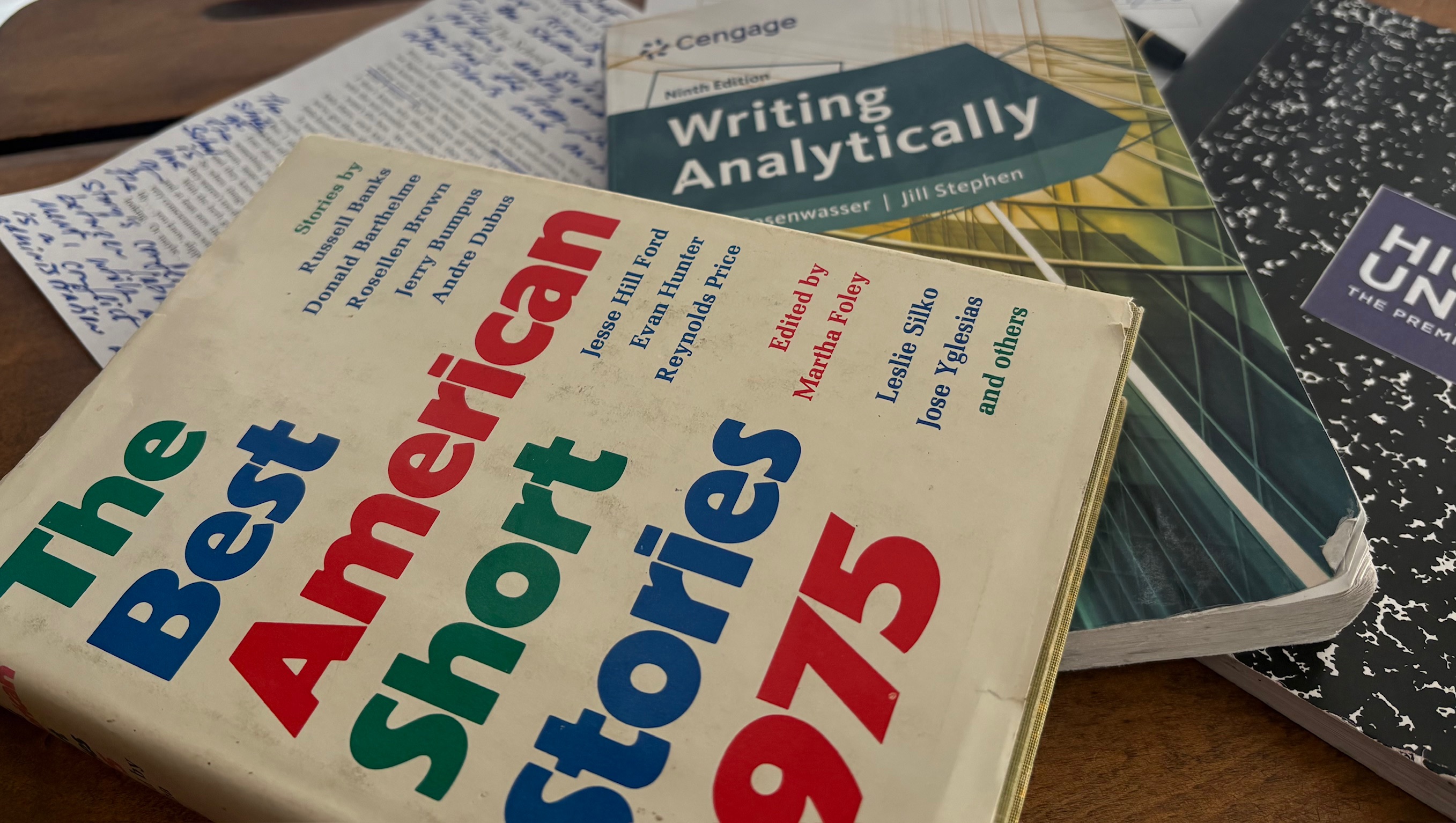
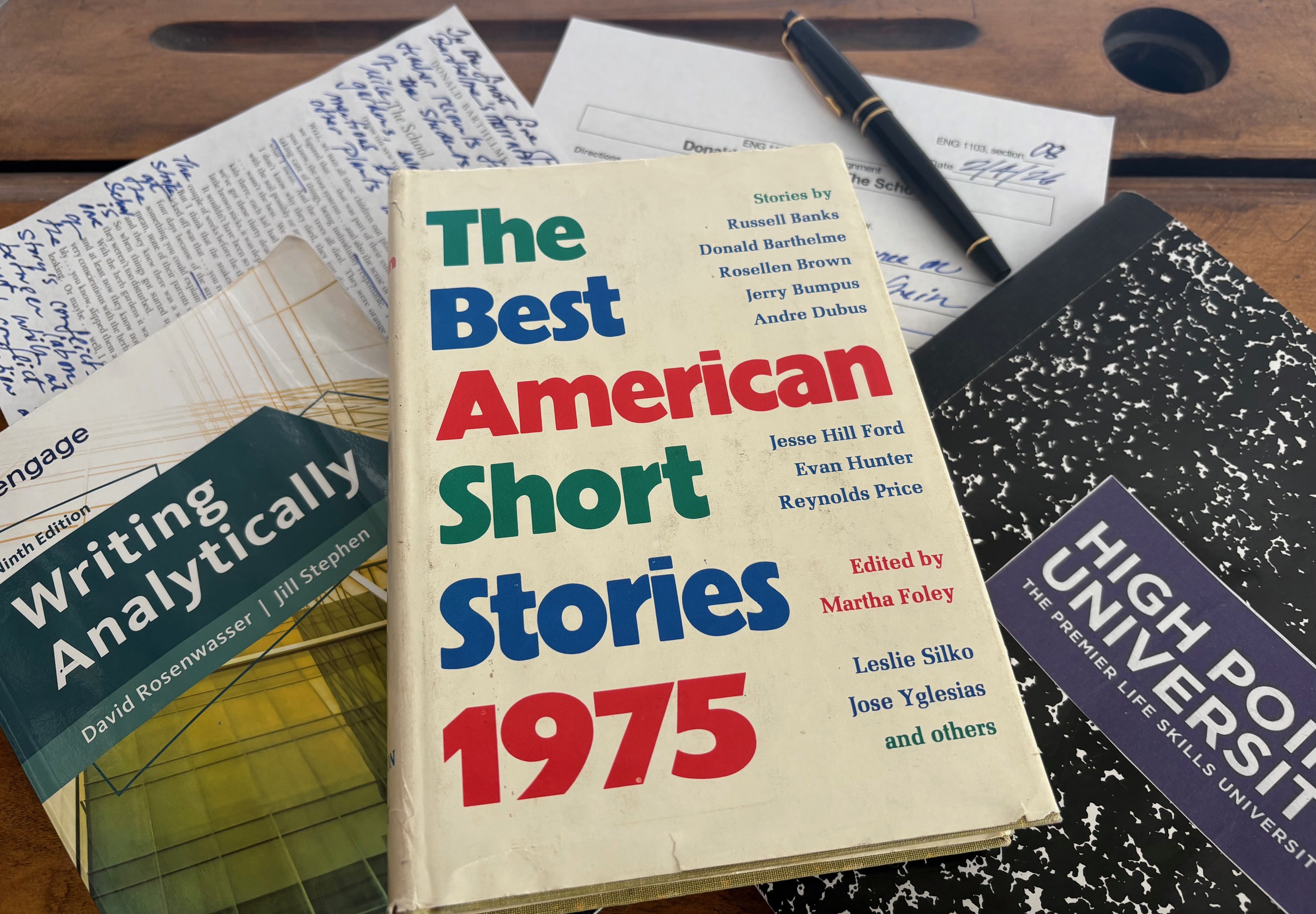
Barthelme, Donald. “The School.” The Best American Short Stories 1975, edited by Martha Foley. Houghton Mifflin, 1975. pp. 8-11.
Rosenwasser, David, and Jill Stephen. “‘Interesting,’ ‘Revealing,’ ‘Strange,'” Writing Analytically, 9th edition. Wadsworth/Cengage, 2024. p. 24.
Pop Quiz
Rather than listing the answers to the questions on last Friday’s quiz, I have followed each question below with a note regarding where to find the answer. By finding the answers yourself, you will learn more than you would from simply reading them in a list.
From your reading for today, what did you learn about Donald Barthelme’s writing style or readers’ and critics’ responses to his fiction? See the February 3 class notes.
The class notes for last week included detailed commentary on the two student literacy narrative samples you read for class. What is one of the details you learned from those notes? See the January 27 class notes.
Last week’s class notes included step-by-step directions for posting your literacy narrative to Blackboard and WordPress. What is one of the steps you learned from those notes? See the January 27 class notes.
Your most recent Scrabble post covers two topics? What is one of them? See the January 29 class notes.
What is the subject of the two short sections of Writing Analytically assigned for reading before class on Monday, February 2? See Writing Analytically (48-50).
What is the bonus assignment in yesterday’s notes? Briefly note what was asked of you. See the February 3 class notes.
Your quiz also included two bonus opportunities. Answers for those bonuses appear in the January 29 class notes. If you aren’t familiar with Aesop’s fable of The Hare and the Tortoise,” you can read it on the Library of Congress site or on Project Gutenberg.
Be sure to write notes in your journal on all of your readings, including the notes posted on my blog. Before each class begins, take out your journal and review your notes. Those practices will increase your knowledge of what you read and ensure that you will earn high grades on your pop quizzes.
Kudos to Dylan Virga for completing yesterday’s bonus assignment, and congratulations to Sierra Welch, whose literacy narrative title, “Why I Hate the Letter R,” was selected by Dylan.
“The School,” originally published in The New Yorker magazine, was one of twenty-one stories chosen for the annual Best American Short Stories anthology in 1975.
This morning in class, we will examine Donald Barthelme’s short story “The School,” and in groups of three or four, you will write about elements of the story you might explore in an analysis:
The narrator and the narrative voice
Conflict
A short passage that strikes you as interesting, revealing, or strange
Whether you choose Bartheleme’s story or one of our other readings for your analysis, you will begin your first paragraph with a summary of the text. Remember that a summary is an objective synopsis of a text’s key points. It should be written in third person and present tense. For example, if you choose to analyze “The School,” you might summarize it this way:
Donald Barthelme’s short story “The School” recounts a series of classroom lessons that end with the deaths of plants and animals–deaths that serve as a prelude to the unexplained death of a Korean orphan, followed by the unexpected deaths of classmates and family members.
Notice that the summary above does not comment on the story in any way. What follows the summary will be the beginning of your commentary, or analysis, the thesis statement that offers your particular close reading, or interpretation, of the story. The passage below is the same as the one above, but at the end of it I have added a thesis statement in bold.
Donald Barthelme’s short story “The School” recounts a series of classroom lessons that end with the death of plants and animals–deaths that serve as a prelude to the unexplained death of a Korean orphan, followed by the unexpected deaths of classmates and family members. With conversational narration, accumulation of detail, and a shift in fictional mode, Barthelme deftly depicts the reality of the fleeting nature of life, even as the story itself veers from reality.
If I were to continue to write the analysis that I began in the previous paragraph, I would follow that opening paragraph with body paragraphs that address each of the three elements that I include in my thesis: (1) conversational narration, (2) accumulation of detail, and (3) shift in fictional mode.
Donald Barthelme in 1964. Photograph: Ben Martin/Time Life/Getty
As an introduction to Donald Barthelme, whose fiction we will examine in class tomorrow, read this biographical sketch. After you read the sketch, compose a one- or two-paragraph journal entry that includes what you have learned about his writing style, and what you have learned about readers’ and critics’ mixed responses to his fiction.
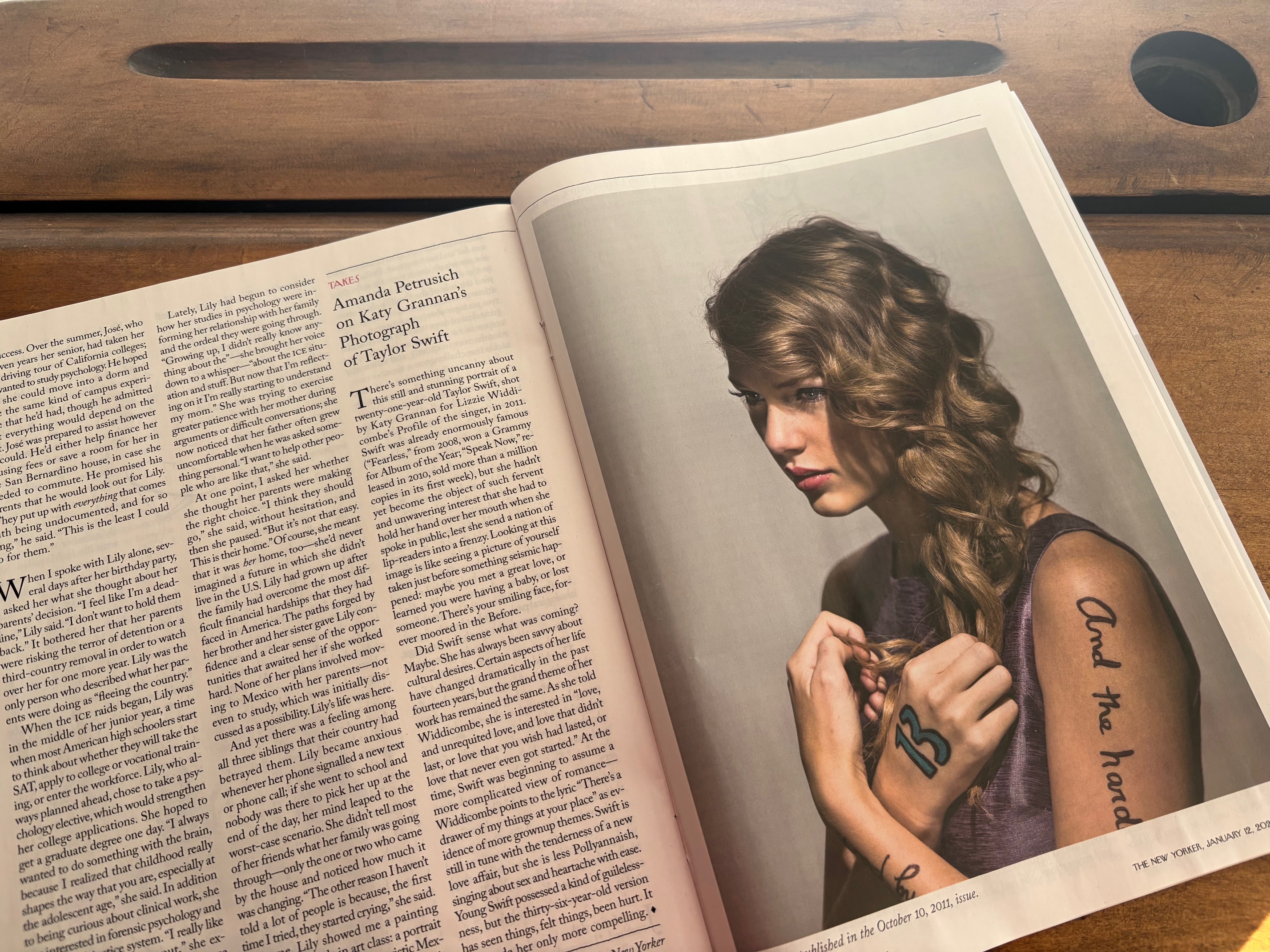
Donald Barthelme’s “The School,” the story that we’ll read tomorrow in class, was originally published in The New Yorker, the magazine that recently featured “Katy Grannan’s Photograph of Taylor Swift.” That picture of Swift appears below. I did not include it on your assignment handout because the photograph itself wasn’t important to the exercise. The assignment asked you to explore how a writer creates an unconventional portrait of a subject by forgoing physical description and focusing instead on other elements, such as mood and contrast. That journal exercise on the Swift portrait–or a reading assignment of your choice–serves as a warm-up for your analysis.
Petrusich, Amanda. “Amanda Petrusich on Katy Grannan’s Photograph of Taylor Swift.” The New Yorker, 12 Jan. 2026, pp. 44. Photo credit: Katy Grannan.
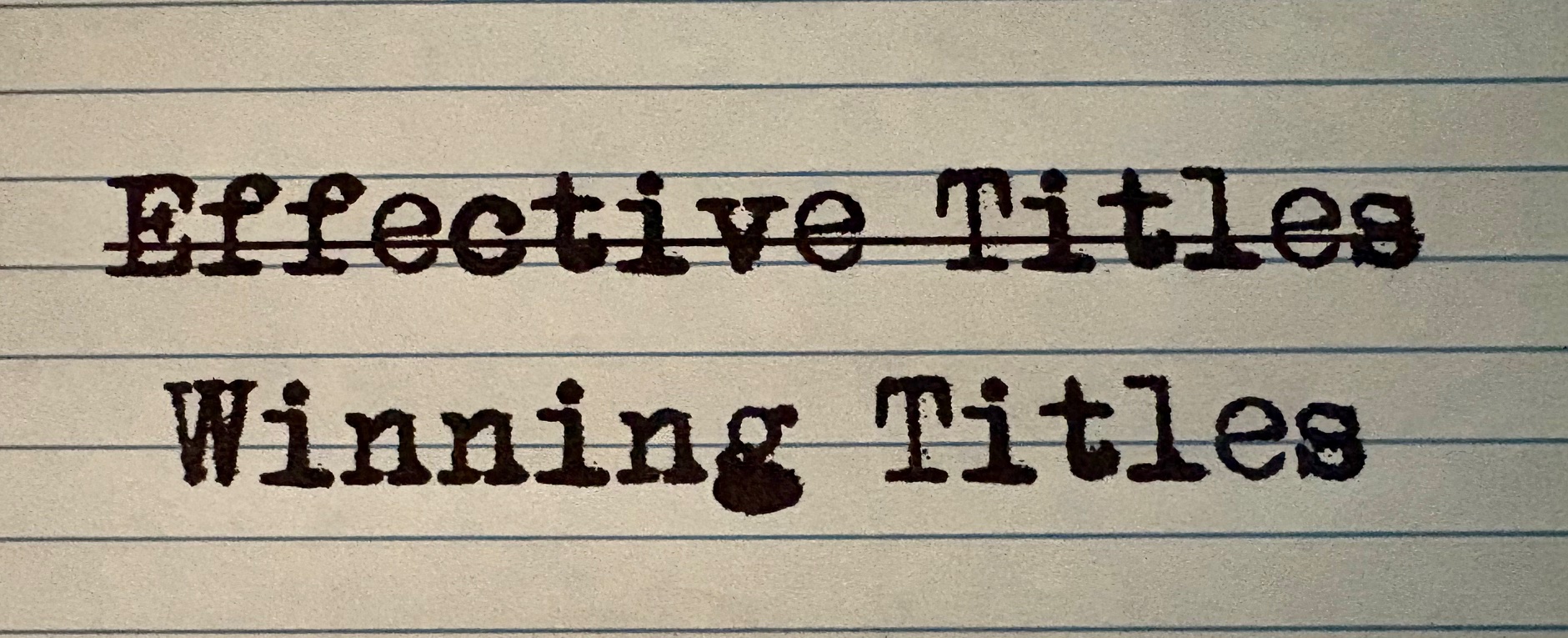
What makes a title effective? That’s an important question to consider since the title contains the first words of yours that a reader will encounter. First, it should be descriptive; it should evoke an image in the reader’s mind. It should also be relevant to your subject; it should convey something about the writing that will follow. Lastly, it should be intriguing; it should create in the reader a desire to keep reading. With those traits in mind, review the titles of your classmates’ literacy listed below. Which of them is most effective and why?
“Breaking through the Pages”
“The Beauty of Discomfort”
“A Challenge Wrapped in a Smile”
“Editing the Story of Myself”
“Finding My Way through Words”
“Giving Voice to the Unheard”
“How to Write about Myself”
“My Eighth Grade Spanish Class”
“The Paper that Changed my Life”
“The Passage”
“Prompted to Say More”
“Reading Changed My Mind”
“Surviving Ingrid”
“Why I Hate the Letter R“
“Writing is Hard”
Bonus Assignment Opportunity
Directions
Determine which of the literacy narrative titles you deem most effective.
Compose a comment of one complete sentence or more that includes (1) the title enclosed in quotation marks, and (2) a brief explanation of its effectiveness.
Post your comment as a reply to this blog entry no later than 5 p.m. today, Tuesday, February 3. (To post your comment, click on the post’s title, and scroll down to the bottom of the page. You will then see the image of an airmail envelope with a leave comment option.)
I will approve your comments (make them visible) before Wednesday’s class.
Next Up
In class on Wednesday, we will read and discuss Donald Barthelme’s short story “The School.” That story and the texts we have studied thus far in English 1103–“MeTalk Pretty One Day,” “The Day Language Came into Life,” “Letter from Birmingham Jail,” and the excerpt from the first chapter of To Kill a Mockingbird–are among the pieces of writing that may serve as the subject of your upcoming analysis. Before you begin drafting that assignment on Wednesday, February 11, we will examine two more texts that may serve as your subject.
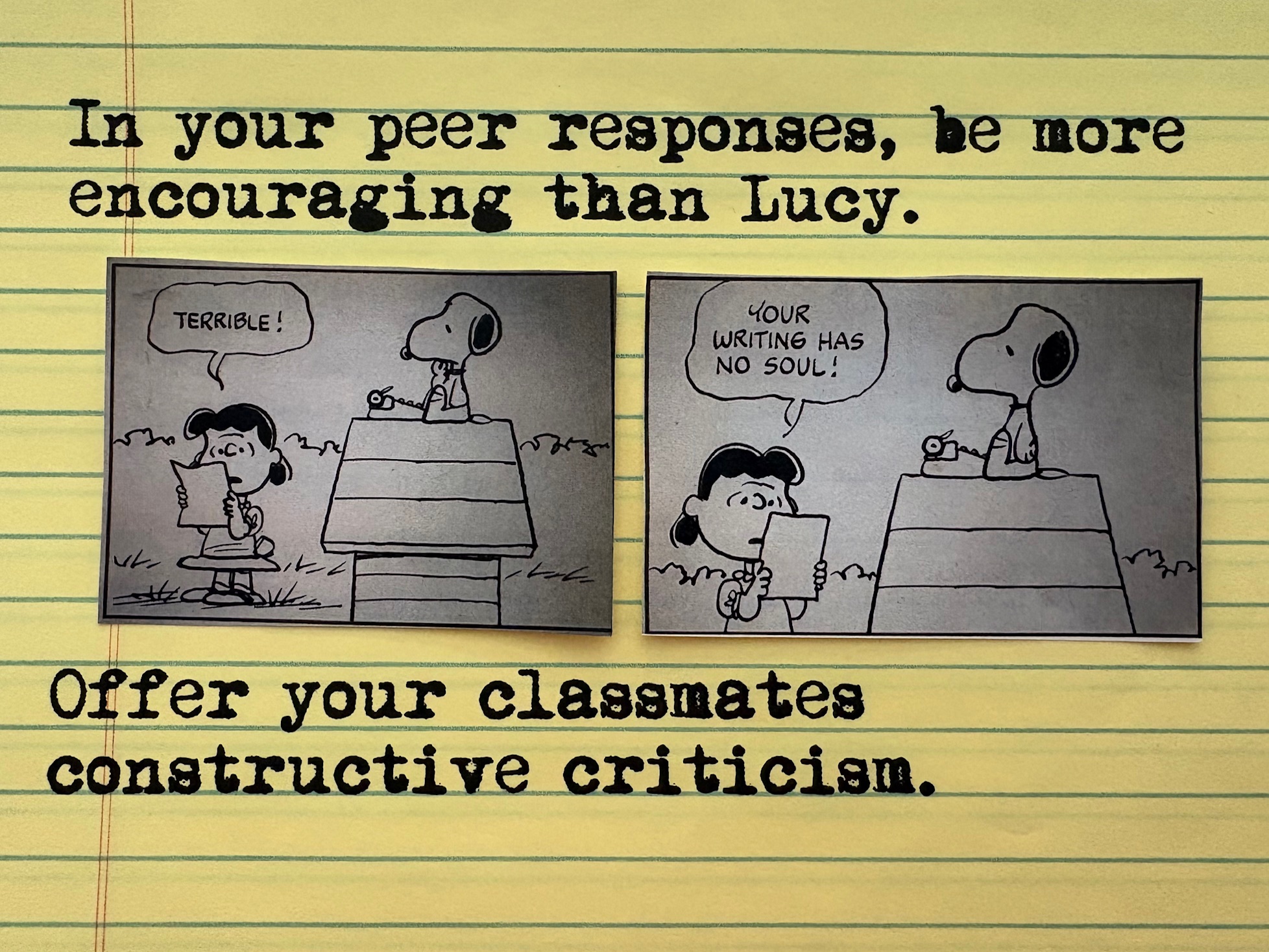
Panels from a Sunday Peanuts comic strip by Charles Schulz, 10 February 1974.
This morning, in place of our in-person class, you will compose a response to a designated* classmate’s literacy narrative. Directions for the assignment follow. Read the directions in their entirety before you begin typing your response. If you have any questions, please email me.
Directions
Go to the class blog page, and click on the link for the blog of the classmate whose name follows yours. If you are last on the list, go to the blog of the student whose name is first.
*If your designated classmate’s blog is not linked to the page, or his or her literacy narrative is not published, choose another classmate’s blog.
Read the classmate’s literacy narrative.
Compose a one- or two-paragraph response (75 words, minimum) that includes both the classmate’s name and the title of his or her literacy narrative. In your comment, address one or more of these elements: the title, vivid details, scene, dialogue, the image documenting part of the writing process away from the screen, the embedded link to a relevant website. Note that you will mention the classmate by name, but you will not refer to him or her in third person. In other words, you will not write, John’s description made me feel as if I were with him in his fourth-grade classroom. Instead, you will write, John, your description made me feel as if I were with you in your fourth-grade classroom.
Recommended (not required): Draft your comment longhand in your journal.
After you have composed your response, review the section of Writing Analytically devoted to basic writing errors, or BWEs (426-44), and correct any that you can identify in your blog response. This step is for your own comment, not your classmate’s literacy narrative.
Type your response as a comment. You should see a leave comment/reply option at the top or bottom of the post. If you do not see that option, click the title of the blog post, and scroll down. You should then see leave comment/reply.
Before you click leave comment/reply, copy your comment (on a PC, copy with control + c; on a Mac, copy with command + c).
After you submit your comment on your classmate’s blog post, return to this post, and paste your comment as a reply (on a PC, paste with control + v; on a Mac, paste with command + v). This step is critical because your classmate may not approve your comment, which means it will not be visible on his or her blog post. To receive credit for the assignment, you must post your duplicate comment as a reply to this blog post, “ENG 1103: Literacy Narrative Peer Responses.“ To submit your comment, click the title of the post, then scroll down to the bottom. There you will see the image of an airmail envelope with a box for your comment. Type your comment in the box and click Comment. Post your comment by the end of today’s class period (11:50 a.m.).
I will make your comments visible after the deadline.
You are not required to read other classmates’ literacy narratives, but I encourage you to browse their blogs and read the posts that pique your interest.
Journal Exercise: Alternate Portraits
Since we are not meeting in person today, I will not conduct a check of the alternate portraits journal exercise that you completed, but you may have the opportunity to draw on that writing for another assignment. For now, think of that exercise as a warm-up for your analysis.
If you were absent on the day I distributed copies of the exercise, or you misplaced your copy, see the directions included in the class notes for January 21.
The photograph of Taylor Swift that accompanies Amanda Petrusich’s New Yorker piece will be included in tomorrow’s class notes.
If in-person classes are held on Wednesday, I will return your literacy narrative reflections with my annotations. Along with my handwritten notes, you will receive a handout of general notes on your reflective writing. An additional copy of those notes follows.
Reflection Notes
The directions for your reflective essay did not specify that you should double-space your writing, but know that in the future, you should always double-space your reflections and any other individual pieces of writing that you compose in class and submit for evaluation. The double-spacing guideline does not apply to group exercises and other shorter assignments.
You will not see a grade on your reflective essay for your literacy narrative, because that reflection and the two you will compose for your other two major writing assignments are not assigned grades. Instead, they factor in the grades for the major assignments themselves.
You will see a grade on the midterm and final reflections that you compose because those are stand-alone assignments.
All the reflections that you compose are essays, albeit short ones, and should consist of at least three paragraphs: an introduction, a body paragraph, and a conclusion.
Just as you indent the first line of each paragraph of an MLA-style typed document, the first line of each of your handwritten paragraphs should be indented approximately five spaces or one-half inch. In English 1103, the one exception to the indentation guideline is the writing on your blog. WordPress posts are easier to manage if you retain the default block style.
In all your reflections, you will be required to integrate a minimum of one quotation from a written text, either from a section of Writing Analytically or another course reading. Follow the directions for preparing to write your reflections, which will be posted on my blog. If you arrive at class unprepared or underprepared, you are likely to produce a reflection with a quotation that isn’t gracefully woven into your writing or one that isn’t properly cited.
Next Up
In class on Wednesday, we will read a short story by Donald Barthelme. As an introduction to him and his fiction, read this biographical sketch. After you read the sketch, compose a one- or two-paragraph journal entry that includes (1) what you have learned about his writing style, and (2) what you have learned about readers’ and critics’ mixed responses to his writing.
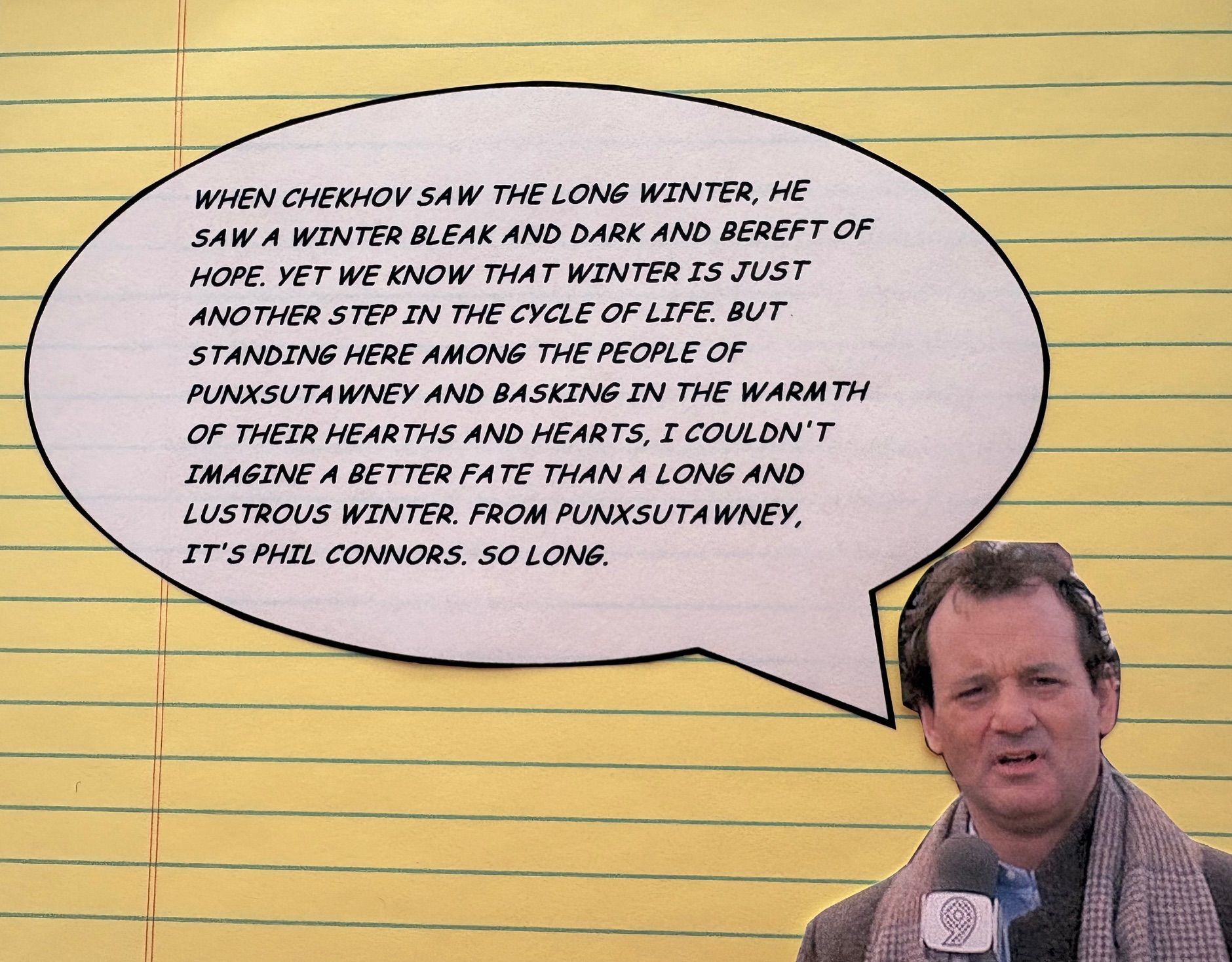
Groundhog Day, Directed by Harold Ramis, performances by Bill Murray and Andie McDowell, Columbia, 1993.


 Jane Lucas