Group Presentations
On Monday, after your Scrabble debriefing, you will receive the assignment for the short group presentation you and three or four of your classmates will deliver on Wednesday, March 11. You will have the majority of Monday’s class period to devote to planning, and you will have the first ten minutes of Wednesday’s class for final preparations.
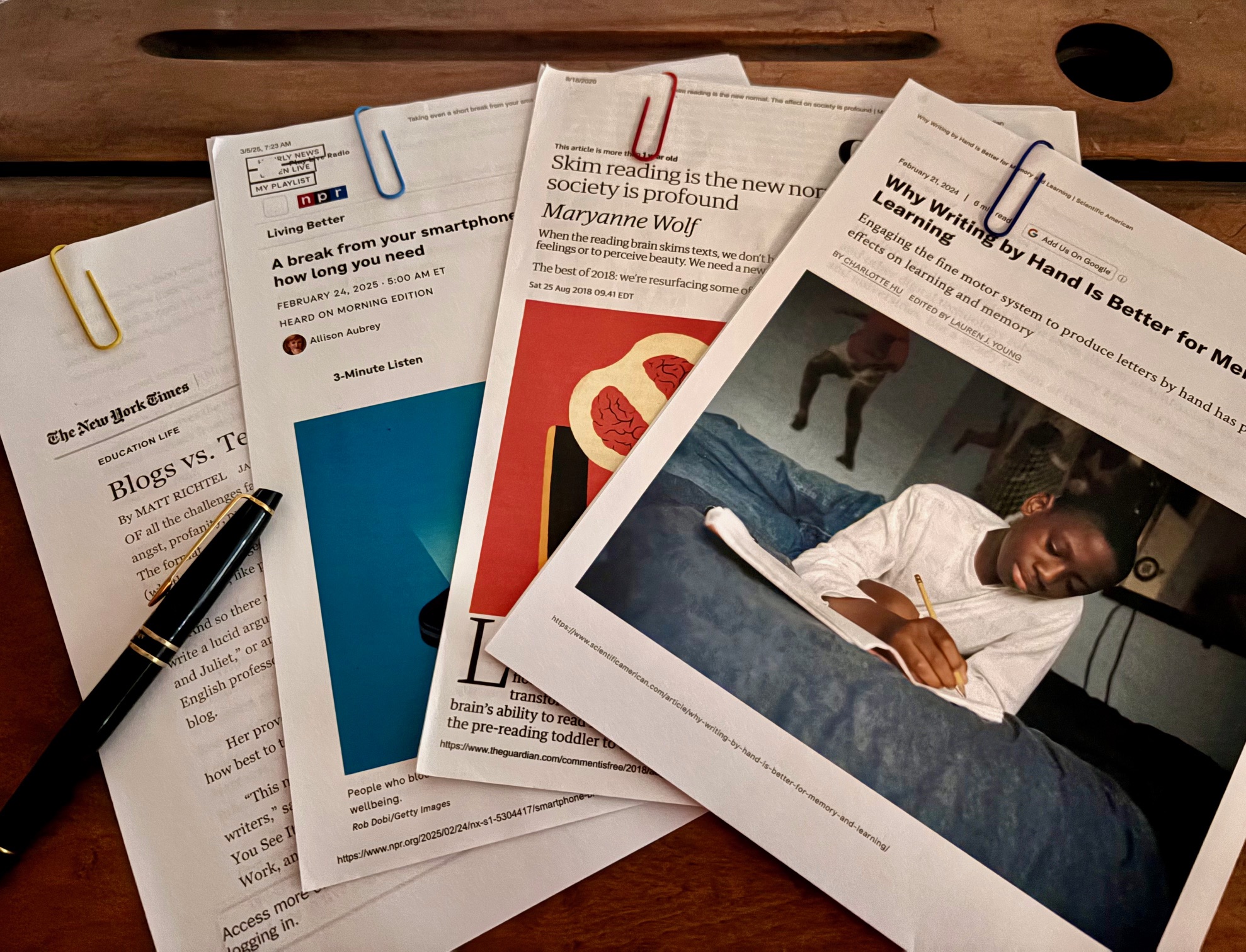
The subject of your presentation will be an article focusing on one of these aspects of English 1103:
- Blogging
- Limiting screen time
- Reading printed texts (rather than reading online articles and ebooks)
- Writing longhand
Although you and your group members will focus on only one of the four articles, all of you will read and annotate the other three in preparation for your classmates’ presentations.
If you decide to devote your final essay and annotated bibliography to one of the aspects of the course covered in the group presentations, the article focusing on that subject will serve as the starting point for your project.
Final Essay and Annotated Bibliography
Which aspect of the course or which of the writers we have studied are you interested in examining further? Your answer to that question will determine the subject of your final essay and annotated bibliography.
In preparation for beginning your research next week, review the list below and freewrite in your journal on the subjects that appeal to you most.
- Donald Barthelme
- Blogging
- Tom Junod
- Helen Keller
- Limiting screen time
- Martin Luther King, Jr.
- Harper Lee
- Michael Lewis
- Reading printed texts (rather than reading online articles and ebooks)
- Scrabble
- David Sedaris
- Writing longhand
If you choose to research one of the writers we have studied, keep in mind that your project will be an exploration of the author’s words, not his or her life. Your aim is not to write a biography, but instead a study of the writer’s craft.
Bonus Assignment
Directions
- Go to the class blog page, and click on the link for the blog of the classmate whose name precedes yours. If you are first on the list, go to the blog of the student whose name is last.
- If your designated classmate’s blog is not linked to the page, or his or her analysis is not published, choose another classmate’s blog.
- Read the classmate’s analysis.
- Compose a one- or two-paragraph response (75 words, minimum) that includes both the classmate’s name and the title of his or her analysis. In your comment, address one or more of these elements: the title, the thesis, evidence to support the thesis and/other claims, organization, the conclusion, the image documenting part of the writing process away from the screen, the embedded link to a relevant website. Note that you will mention the classmate by name, but you will not refer to him or her in third person. In other words, you will not write, John’s examples of “The School”‘s incongruities effectively demonstrate Donald Barthelme’s postmodernist approach to storytelling. Instead, you will write, John, your examples of “The School”‘s incongruities effectively demonstrate Donald Barthelme’s postmodernist approach to storytelling.
- Recommended (not required): Draft your comment longhand in your journal.
- Type your response as a comment. You should see a leave comment/reply option at the top or bottom of the post. If you do not see that option, click the title of the blog post, and scroll down. You should then see leave comment/reply.
- Before you click leave comment/reply, copy your comment (on a PC, copy with control + c; on a Mac, copy with command + c).
- After you submit your comment on your classmate’s blog post, return to this post, and paste your comment as a reply (on a PC, paste with control + v; on a Mac, paste with command + v). This step is critical because your classmate may not approve your comment, which means it will not be visible on his or her blog post. To receive credit for the assignment, you must post your duplicate comment as a reply to this blog post, “ENG 1103: Looking Ahead.“ To submit your comment, click the title of the post, then scroll down to the bottom. There you will see the image of an airmail envelope with a box for your comment. Type your comment in the box and click Comment. Post your comment by the 5 p.m. on Thursday, March 12.
I will make your comments visible after the deadline.
Next Up
On Monday, you will begin planning your group presentations. For more details, see the first paragraph of this post. I will provide additional instructions in class.

 Jane Lucas
Nick Beeker’s “The Man Who Changed the Game Forever”
Nick, I enjoyed reading your analysis of Michael Lewis’s “Back Story.” Your title, “The Man Who Changed the Game Forever,” is repeated in the thesis and the conclusion, which helps reiterate Lawrence Taylor’s impact on the game of football. You also mentioned Lewis’s sentence structure and how it creates the same suspense as Lawrence Taylor’s aggression. This observation is insightful, as it draws a clear parallel between the author’s stylistic choices and the intensity of Taylor’s playing style.
The image you included to show your writing process is very effective. It clearly displays the notes you made on the text, which makes your writing steps easy to see. Placing the image at the end of your layout draws a connection to your analysis of how Lewis structures his narrative. You guide your reader just as Lewis begins his chapter with Joe Theisman’s injury before exploring Taylor’s background. This parallel between your layout and Lewis’s writing adds to your analysis.
Izzy , I really enjoyed reading your analysis on ” The school” Your thesis clearly explains how Donald Barthelme used repetition and dialogue to explore different understandings of life and death, you made sure to support it well with specific examples from the story. I especially liked how you pointed out the repeated phrasing after each death, such as “they weren’t too disturbed” and “of course we expected,” because it shows how the narrator’s tone shifts between indifference and reflection.
Your organization also works well because you move from conflict to repetition and then to the students’ questions about death, which helps the reader follow your argument. One suggestion might be to expand a little more on your conclusion, especially the idea that Edgar realizes “there was value everywhere.” Explaining how this realization connects back to the earlier deaths could make your final point even stronger.
Aidan, your analysis of “The Day Language Came into My Life” does a good job of explaining how Keller uses sensory imagery to help her readers understand her experiences. I like how you touched on the smell, and touch since those two things replace her sight and hearing. The examples you used such as: like honeysuckle, and the broken doll further support that Keller invites her readers into how it feels to be her. Those quotes help show how powerful her writing is despite all of the limitations she faced.
Also, another thing I enjoyed reading was the part where you talked about light and darkness, which to me is another thing that strengthens your analysis. Especially when you connected the lost ship and the compass which shows how language did change her life. The conclusion is great as well, as it reflects on how language gave Keller freedom and connection. Overall, your essay is well-organized, and uses strong textual evidence to support your thesis and writing; how Hellen Keller’s discovery of language transformed her understanding of the world.
Sierra, I really enjoyed reading your analysis “Critiques Leading to Triumphs” Your title clearly reflects the overarching main idea of your essay, showing how Sedaris’s difficult time and experiences in French class eventually lead to his success. Your thesis about how Sedaris uses structure and figurative language to show that motivation can come from adversity is clear and well supported with evidence from the text, like the gibberish words and the teachers harsh comment about the Cesarean section.
Your organization of your essay was well thought out as the reader is able to move through the beginning, middle, and end of Sedaris’s experiences learning French. This makes is easy to see his progression improve over time. One suggestion I have would be to shorten a few sentences so your analysis flows more smoothly. Overall, your analysis was very impressive and does a great job showing how challenges can lead to personal growth!
Elise Claire, I enjoyed reading your analysis of “The School” by Donald Barthelme. You began with a well-built summary that gave an overview of the story and introduced your thesis. You also did a good job of using quotes from the reading to support your claim that Barthelme’s story focuses on death and how people make sense of it. Following each of the quotes, “We expected the tropical fish to die, that was no surprise,” “I got it out of there before the kids got to school,” and “… Is death that which gives meaning to life?” you explained what the line meant and its relevance to your analysis. This aspect of your writing showed that you truly focused on and understand this short story.
One suggestion would be to include the image documenting your experience of this writing process at the beginning of the blog post rather the end, and to use more descriptive or creative wording when choosing your title. This way, the readers can be hooked by a fun title and your personalized image with the blog article. Great job, Elise Claire!
Davis, I agree with your claim about photography being a harsh but an important way to record history in your analysis of “The Falling Man.” Your explanation of how Junod slowly reveals that the photo is from 9/11 works well as evidence because it supports that the author wants readers to carefully examine the image. That helped support your idea that the photo represents more than just one person, and instead symbolizes the larger tragedy.