
Yesterday in class, after your Scrabble debriefing, we examined David Sedaris‘s essay “Me Talk Pretty One Day,” and you and two or three of your classmates collaborated on an exercise that involved identifying an instance of tension in the essay. Locating such a moment in another writer’s work provides you with a model for creating tension in your own story, which is key to maintaining the reader’s interest and propelling the narrative forward.
As models for you, I included the examples below on your worksheet.
Examples
- In “Me Talk Pretty One Day,” David Sedaris introduces tension when he writes, “the students exhibited an ease and confidence I found intimidating” (167).
- In “Me Talk Pretty One Day,” the author introduces tension when he writes, “the students exhibited an ease and confidence I found intimidating” (Sedaris 167).
I included two examples because the correct format for the citation is determined by the content of the sentence, specifically, whether the author is named. The first example includes only the page number in parentheses because the author is named in the sentence. The second example includes the author’s name in parentheses because he is not named in the sentence. Including the author’s name in both places would be redundant.
Here are some of the instances of tension that you identified in “Me Talk Pretty One Day”:
Moments of Tension in “Me Talk Pretty One Day”
- The French teacher asks the Yugoslavian student if she “love[d] your little war” (Sedaris 169).
- Sedaris conveys the underlying pressure in the classroom when he recounts how “the optimist struggled to defend herself” (169).
- The author renders tension when he writes, “‘I hate you,’ she said to me one afternoon. Her English was flawless . . . I couldn’t help but take it personally” (Sedaris 171).
- Sedaris notes, “The teacher, through word and action, conveyed the message that if this was my idea of an identity, she wanted nothing to do with it” (171).
- The writer recalls that “[His] fear and discomfort crept beyond the borders of the classroom” (Sedaris 171).
- The narrator observes, “the teacher hadn’t meant to stab the girl, but neither did she spend much time apologizing” (Sedaris 172).
Talking Points
Your groups also identified a minimum of three talking points in Sedaris’s essay, parts of the narrative you had questions about, or any passages that you deemed particularly interesting or revealing. Section one did not have time for post-exercise discussion. In section eight, a student addressed Sedaris’s use of gibberish, or nonsense words, such as “meimslsxp” (167), as an effective way to convey Sedaris’s utter lack of understanding of his French teacher’s speech.
Nonsense Words and Italics
If you include nonsense words in your literacy narrative or any words in a language other than English, those words should be italicized because MLA style requires that words in languages other than English be italicized. See the examples in “Me Talk Pretty One Day,” beginning on page 167.
Figurative Language
One of the notable features of Sedaris’s writing is his use of figurative speech, including metaphor (direct comparison), simile (a comparison using like or as), and hyperbole (extreme exaggeration):
- Metaphor: “everybody into the language pool, sink or swim” (Sedaris 167).
- Simile: “like a translation of one of those Playmate of the Month data sheets” (Sedaris 168).
- Hyperbole: “front teeth the size of tombstones” (Sedaris 168).
Work Cited
Sedaris, David. “Me Talk Pretty One Day.” Me Talk Pretty One Day. Little Brown, 2000. pp. 166-73.
“What’s in a Name” Follow-Up
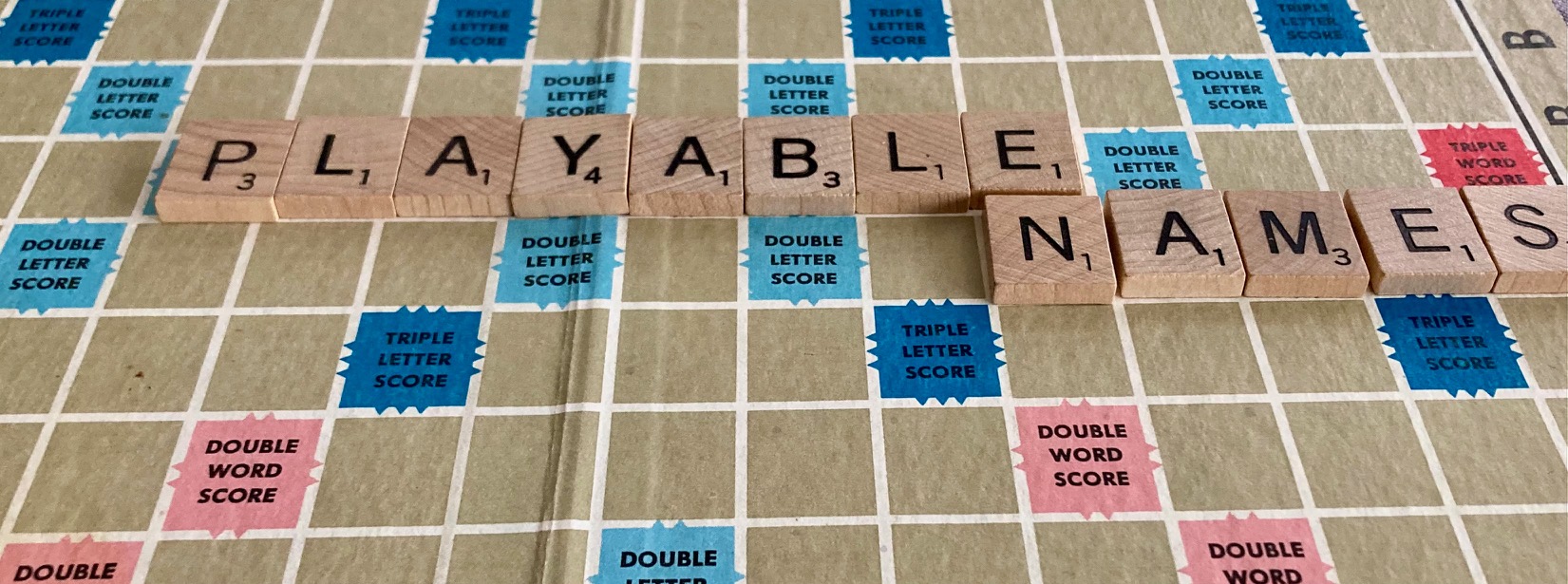
Friday’s blog entry offered a bonus assignment credit to any student who posted a response identifying the classmates whose names are also common nouns, which makes them playable Scrabble words.
The playable names of your classmates appear below in bold, followed by the definitions in parentheses.
Section 1
- Grace (ease and fluidity of movement) Duffy
- Brenna Murphy (a potato)
- Bridgett Murphy (a potato)
- Hayden Porter (a person who carries baggage)
- Will (used to express futurity) Roberts
- Madi Stone (a piece of rock)
Section 8
- Dev (deva, a Hindu god) Broomer
- Parker (one who parks) Davenport (a small desk or large upholstered sofa)
- Ariana Foy (a farewell feast or gift)
- Devyn Jones (a craving)
- Lance (a spear-like weapon) Morgan (a unit of distance between two genes)
- Cole (a plant of the cabbage family) Wilhelmsen
Kudos to Avery Broadbent, Madison Haugk, Vivian Laliberte, Michael McNamara, Layla Rothberg, and Alexis Zavalashin for identifying your classmates’ playable names. For their efforts, they will receive bonus assignment credit in the short assignments and participation category.
I will offer additional bonus assignments, so be on the lookout for those. Reading all the notes that I post for you here, on my blog, will ensure that you don’t miss those opportunities.
Using AI Ethically for Your Literacy Narrative
Using generative AI to write your literacy narrative and presenting an AI agent’s words as your own violates High Point University’s Honor Code and is grounds for an F. However, there are ethical ways to use AI for your literacy narrative, such as for brainstorming topics.
As a model for your own possible brainstorming with AI, I prompted ChatGPT to ask me a series of questions to help me decide which one of two events I might be able to render more vividly in a literacy narrative: (1) “reading” the panels of the comic strip Henry (before I could read words) as a way of joining my family’s ritual of newspaper reading, and (2) memorizing my lines for a play in which my character, María, speaks solely in Spanish. The images below are screenshots of that conversation.
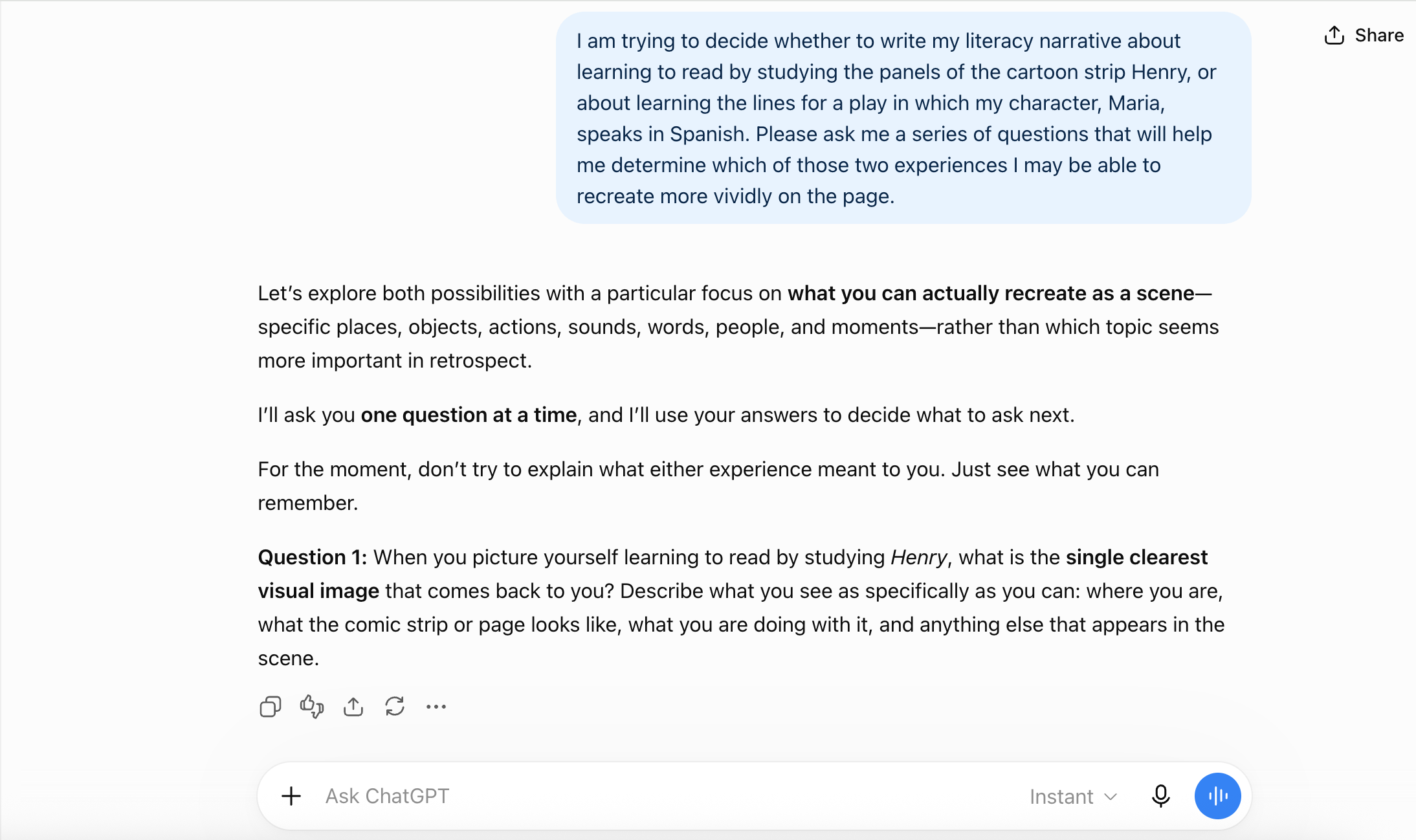
Review the screenshot above and note how many specifics I offer about the two topics I’m considering and how I ask the AI agent to ask me a series of questions. Developing your initial question and requesting multiple questions in response will lead to a more productive exchange of ideas.

Question six, pictured above, and my answer serve as a key turning point in the conversation. Earlier questions posed by the AI agent asked me for details about the two experiences. Here I turn from focusing on the setting of the first of the two (my family’s den) and the action (“reading” Henry) to the implications. What was the moment of recognition or revelation? What was the significance of the event? Those are questions you will answer–not necessarily explicitly but implicitly–in the conclusion of your narrative.
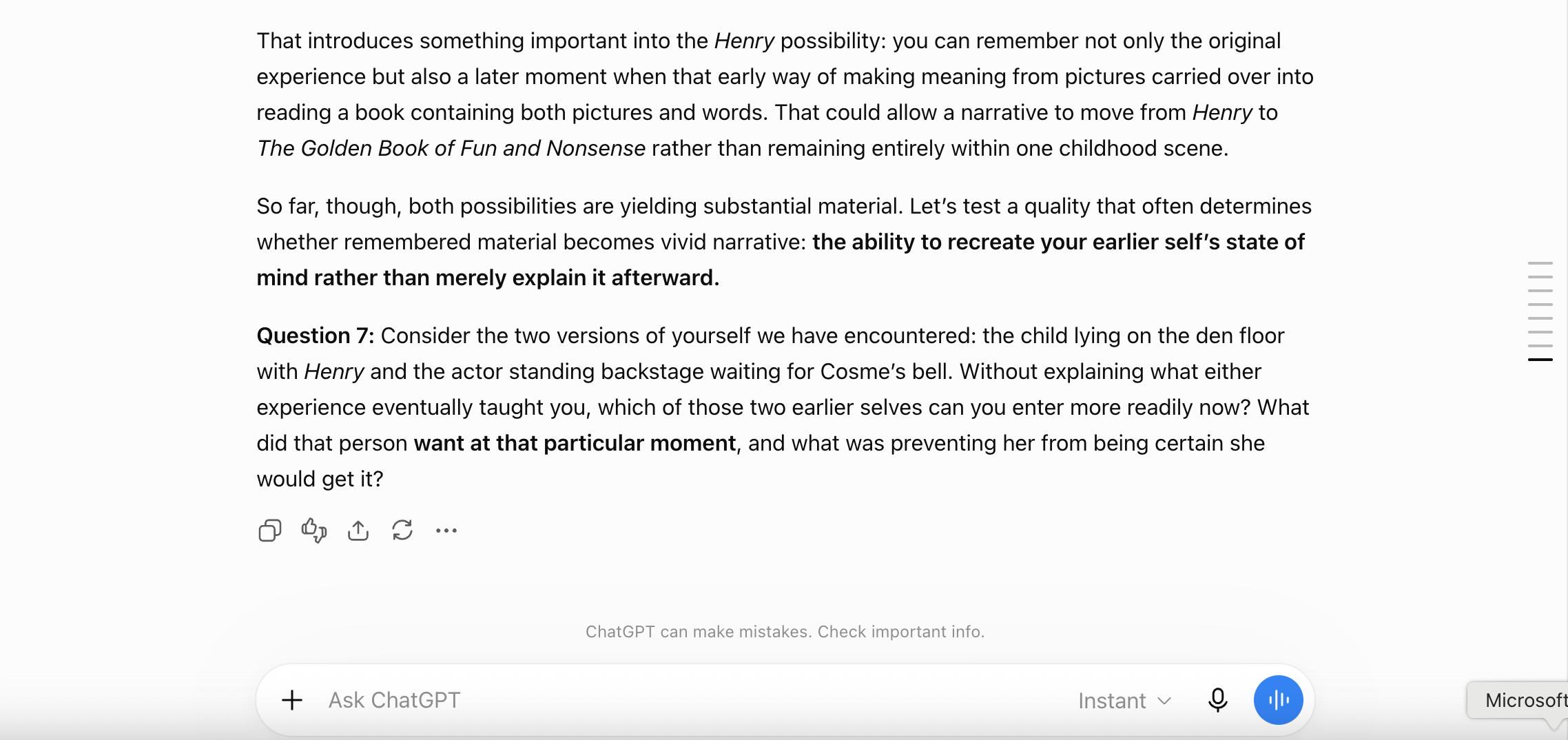
In response to my answer to question six, pictured above, the AI agent raises another important point: In addition to conveying the importance of the experience, I need to be able to enter the mind of that earlier self, that preschooler who could not read yet.
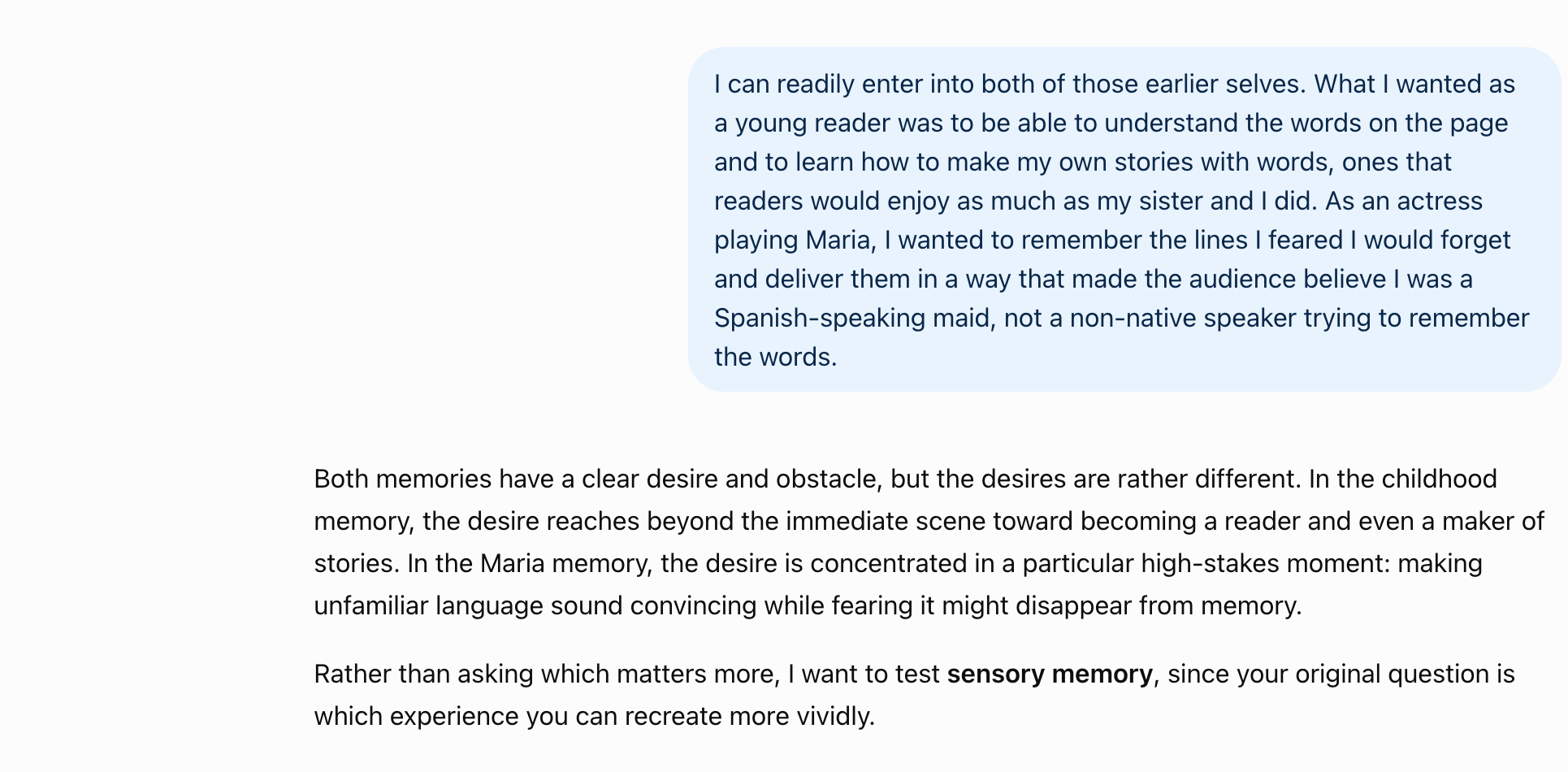
In response to my answer to question seven, pictured above, the AI agent clearly delineates the differences between the two experiences and notes that both “have a clear desire and obstacle.” When you are planning your literacy narrative, ask yourself, what did I want, and what might have prevented me from getting it? Desires and obstacles figure in all compelling stories.

Question eight, pictured above, asks me to make a “quick mental inventory” of the sensory details from each experience, another important step in the writing process. Those particulars will enable readers to enter into the memory with you, as if they are looking over your shoulder. You may not remember many sensory details now, but trust the process. The more you think about the experience and put your thoughts on paper, the more you will recall.
You are welcome to use ChatGPT, as I have here, or one of the other AI agents, such as Anthropic’s Claude, Microsoft 365’s Copilot, or Google’s Gemini, but remember that the words of your literacy narrative must be your own. If you think brainstorming with an AI agent will tempt you to seek an AI-generated literacy narrative, do not use AI. Instead, brainstorm with a classmate or a consultant at HPU’s Writing Center.
Congratulations to Bridgett Murphy and Sophia Stewart for winning copies of Me Talk Pretty One Day in yesterday’s drawing.
Next Up
In class tomorrow, you will begin drafting your literacy narrative, an account of a learning experience involving reading, writing, or learning to speak a language. As part of your prewriting process, revisit “Me Talk Pretty One Day” and consider how you might incorporate some of the elements David Sedaris includes. Repeat the process with Helen Keller’s “The Day Language Came into My Life” when you read and annotate it.

