Dressing the Part
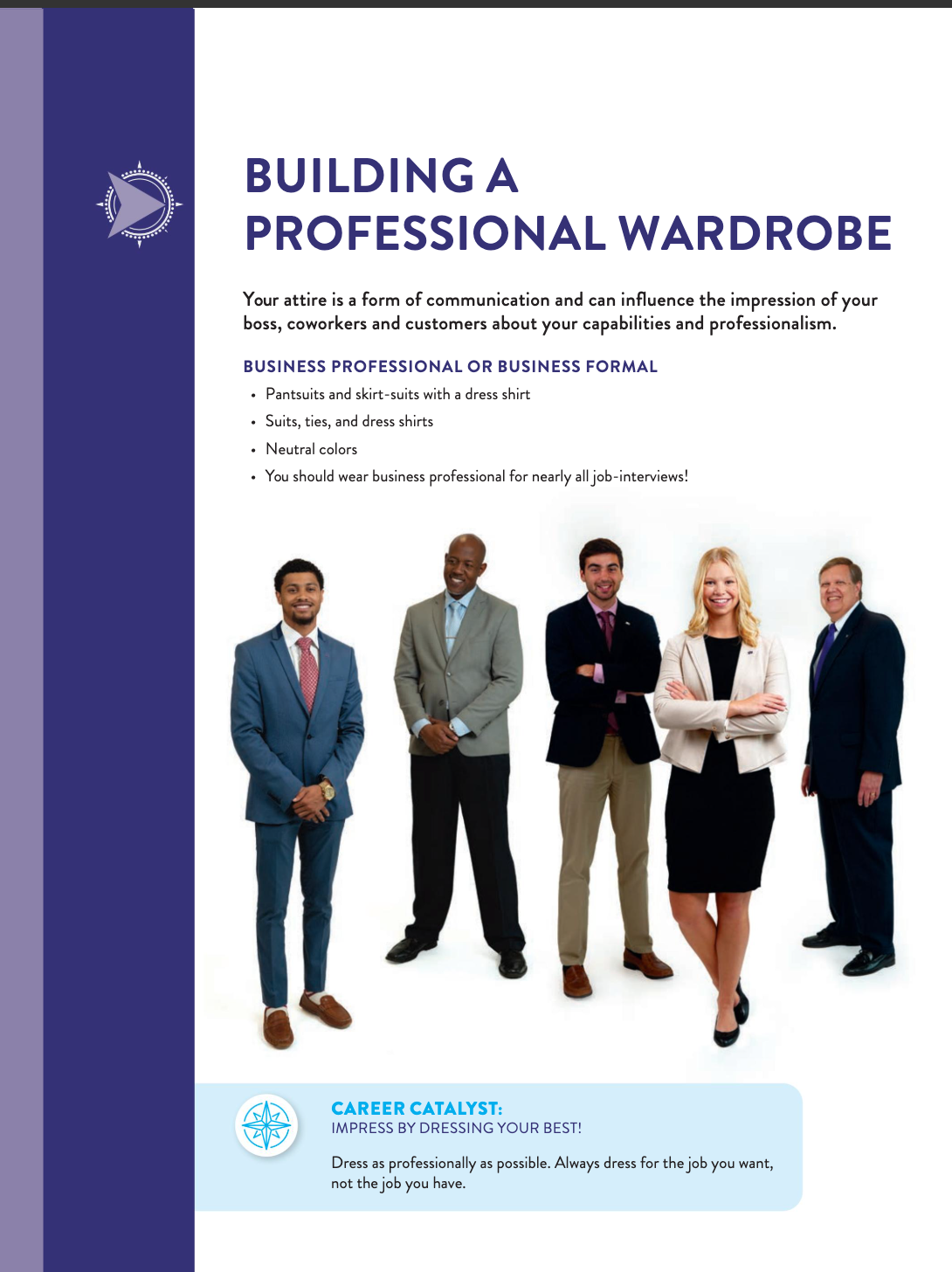
The page featured above, from HPU’s Career and Professional website, notes that “[y]our attire is a form of communication and can influence the impression of your boss, your coworkers and customers about your capabilities and professionalism.”
In The Language of Clothes, Allison Lurie writes: “For thousands of years, human beings have communicated with one another first through the language of dress” (3). As you prepare for your presentation, keep that in mind. We communicate with our clothes first, and what you wear will speak to the audience before you say your first words.
Closely examine the HPU Career and Professional Development page above and the one below. Pay attention not only to the clothes the models are wearing, but also to the accompanying written text.
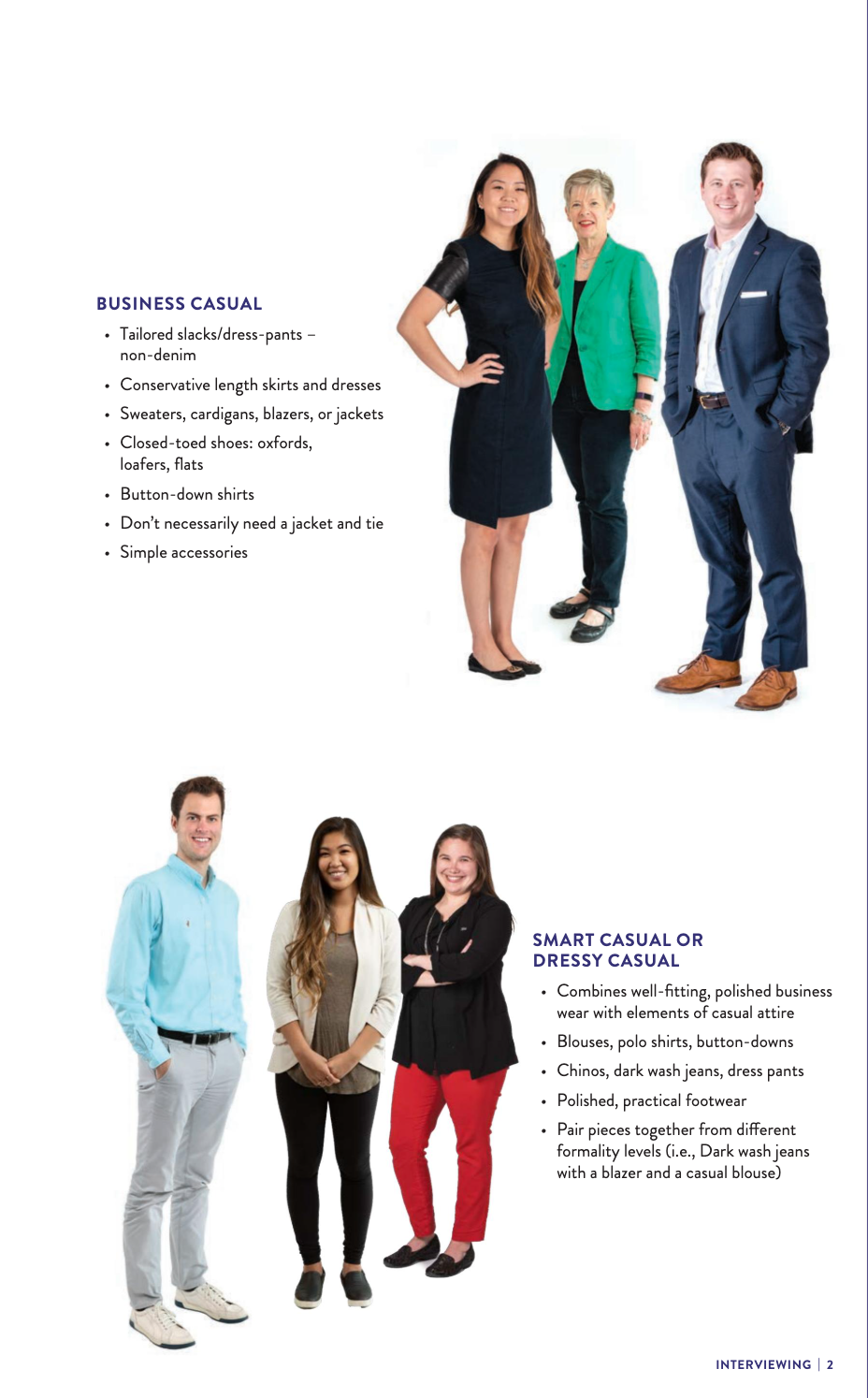
Consider not only what the models are wearing, but also what they are not wearing. Some of the clothing don’ts are included in the bulleted points.
According to HPU’s Career and Professional Development Center, what should you wear “for nearly all job interviews”?
Other Forms of Nonverbal Communication
Just as we speak with our clothing, we communicate with our posture and gestures. Keep your hands out of your pockets to avoid signaling a variety bad traits:
- A lack of trustworthiness. Standing with your hands in your pockets can indicate that you have something to hide.
- Poor communication skills. Connecting with your audience involves effective gestures, which require the use of your hands.
- A lack of confidence or interest. Keeping your hands in your pockets may be construed as a sign of insecurity or a lack of enthusiasm.
- Distractability and an unprofessional manner. You may appear too casual if you are fiddling with items in your pocket, such as keys.
- Indolence or arrogance. Audience members may perceive your hands-in-pockets stance as disrespectful
Proper posture is key. As I noted in your presentation assignment handout, your ears should be directly above your shoulders.
Also, do not shift your weight from one foot to the other. If that is a tendency of yours–a distracting habit called rocking the boat–stand with your feet perpendicular to each other. If you do, you will not be able to shift your weight from one foot to the other.
Do not stand with your arms crossed in front of your chest. That is widely perceived as a defensive posture.
When you walk to the front of the room, and when you return to your seat, do not shuffle your feet. Do not shuffle them at any other time, either. Like keeping your hands in your pockets, shuffling can project a lack of confidence. It can also make you more likely to trip, which you would not want to do in an interview. Some people have a tendency to shuffle when they wear such shoes as UGG Scuffettes/Tazzes and Birkenstock Zermatts. If you tend to scuff in your Scuffettes (or the like) be mindful of that tendency, and ask yourself this: Are these the shoes I should wear to my interview?
Verbal Communication
Paying attention to your nonverbal communication should not come at the cost of your verbal communication. Be concise and focused. Do not use filler words, such as um, like, and you know, indicates that you are neither.
Do not mispronounce important by omitting the sound of the first t (im-por-ANT, rather than im-por-TANT). Natural speech can be key to conveying authenticity, but that particular mispronunciation is not a dialect trait; it’s a trendy instance of t-glottalization, which replaces the t sound with a pause or catch in the throat, called a glottal stop. That phenomenon–prevalent almost exclusively among young women–has been popularized by social media and reality TV.
Some interview coaches–and HPU’s Career and Professional Development Center as well–recommend the STAR approach (Situation, Task, Action, and Result) as a method for presenting a point with an illustration. Though you are not required to use the STAR approach, it offers one effective way to show how a particular assignment or aspect of English 1103 demonstrates your qualifications.
Works Cited
“Interviewing.” Office of Career and Professional Development, High Point University. https://www.highpoint.edu/careerinternships/interviewing.
Lurie, Allison. The Language of Clothes. Random House, 1981.
Kudos
Students who attended last Tuesday’s High-PURCS and completed the online assignment for the event not only showed their support for other High Point students’ scholastic endeavors but also took advantage of the opportunity to view poster displays and to hear discussions that may inspire ideas for their own projects. These classmates attended High-PURCS:
- Jermaine Cain
- Madison Davis
- Sofia Marin
Kudos to Jermaine, Madison, and Sofia. For their initiative, they have a earned a bonus assignment credit.
Next Up
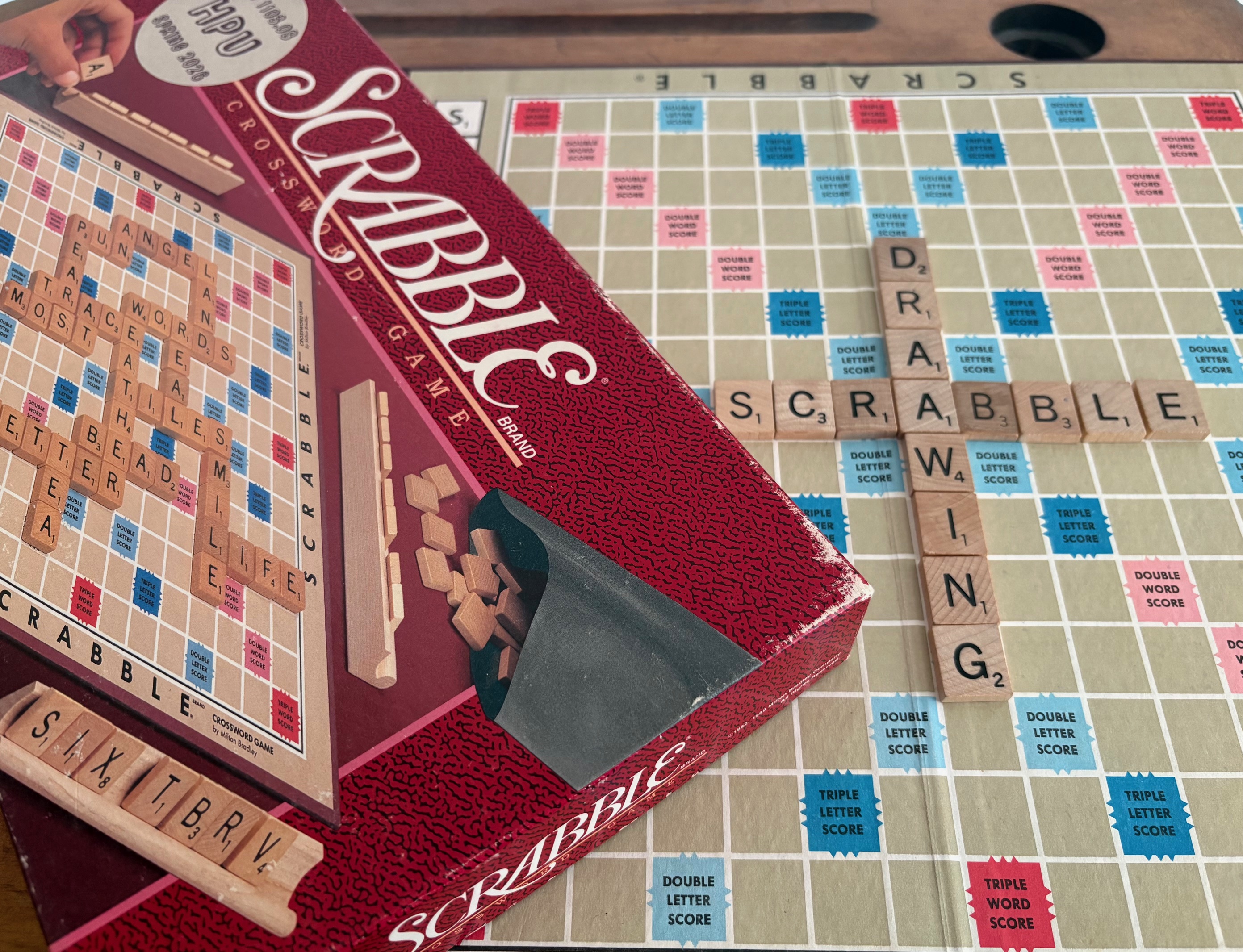
Wordplay Day! To prepare for class, revisit the Dictionary and World Builder pages on the Scrabble website or the Merriam-Webster Scrabble Word Finder page, and review the blog posts devoted to Scrabble tips, including tomorrow’s.
Our final Wordplay Day of the semester will include a drawing for the vintage Scrabble game pictured above.
Bonus Assignment
Even though the images of the models in today’s blog post are featured in a guide for interviewing, some of the models’ stances are don’ts for interviewees. What are those stances, and why are they interview don’ts?
Directions
- Determine which of the models’ stances are interview don’ts.
- Compose a comment of one complete sentence or more that identifies the stances and notes why they are frowned upon in interviews. You do not need to include all the reasons. One for each stance will suffice.
- Post your comment as a reply to this blog entry no later than 9 a.m. tomorrow, Wednesday, April 22. (To post your comment, click on the post’s title, and scroll down to the bottom of the page. You will then see the image of an airmail envelope with a leave comment option.)
I will approve your comments (make them visible) after tomorrow’s deadline.

 Jane Lucas
The models above that display the interview don’ts are the guy in the purple tie and the woman in the black dress, who both have their arms crossed in front of their chest. In the next picture there is a guy in a navy suit who has his hands inside of his pockets, as well as the guy under him in the light blue shirt who also has hands in his pockets. Right next to him stands a woman in red pants with her arms crossed and shifting her weight to one side.
In both images, the figures have their arms and hands crossed, as well as, hands in their pockets. Some of them are leaning to the side a little, or leaning forward. These are frowned upon because, having your arms crossed could be perceived as a defensive posture. Putting your hands in your pockets could be perceived as, lack of trustworthiness, poor communication skills, lack of confidence, and it could just been seen as being disrespectful. Leaning could also mean the things listed prior as well. All of this could give the audience or interviewer the wrong impression!
Having your hands in your pockets is considered innapropriate during an interview as it shows a lack of self-esteem and that you are not trustworthy. It is not appropriate for interviewees to cross their arms over their chest due to the impression of defensiveness amd close mindness that this posture conveys. Sloughing should be avoided as it gives the impression of having no energy or not wanting to be there. The act of putting pressure on one leg at a time “rocking the boat” is also considered bad behavior during an interview. Your first impression is very important too, you should avoid wearing simple unadequate clothing and tight revealing clothes, you should aim for a bussiness casual look which usually includes a dress skirt, a nice blouse, a suit and tie, etc…