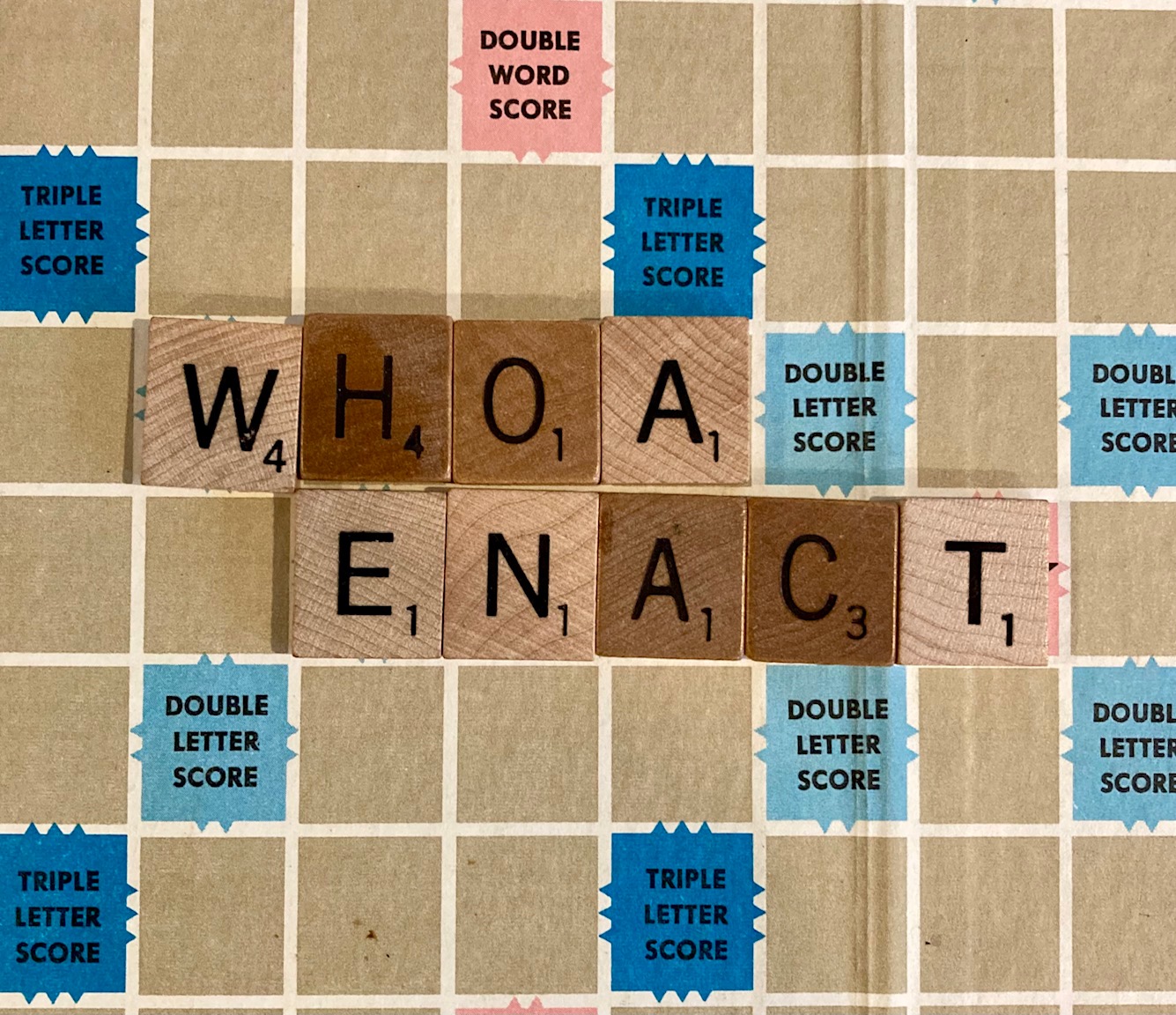
Parallel play increases your score through the points you earn by spelling more than one word in a single turn. In the first play of the hypothetical game pictured above, the first player or team would score sixteen points by spelling enact with the t on the center double word square. With the second turn, the other player or team could take advantage of the opportunity for parallel play. If the team knew that aa is a type of lava, they could earn twenty-four points with four words: whoa, he, on, and aa.
Aa is one of sixteen playable two-letter words beginning with a. Learning these two-letter words, as well as the others that follow in the alphabet, will enable you to see more options for play and increase the number of points you earn in a single turn.
aa: a type of stony, rough lava
ab: an abdominal muscle
ad: an advertisement
ae: one
ag: agriculture
ah: an exclamation
ai: a three-toed sloth
al: a type of East Indian tree
am: the first-person singular present form of to be
an: an indefinite article
ar: the letter r
as: similar to
at: in the position of
aw: an expression of sadness or protest
ay: a vote in the affirmative (also aye)
Important Note about Challenges
The game rules inside the Scrabble box top do not specify that a player or team that challenges a playable word will lose a turn, but David Bukszpan’s book Is That a Word? notes that the player or team does lose a turn. According to Bukszpan:
“[I]f a word is challenged and found not to be legal (called a phony in Scrabble parlance), the player that set it down loses a turn. Conversely, if a challenged word is found to be playable, the challenger loses his turn” (19).
Work Cited
Bukszapan, David. Is That a Word?: From AA to ZZZ, the Weird and Wonderful Language of SCRABBLE. Chronicle, 2012. p.19.
Coming Soon
At the beginning of class on Wednesday, January 18, I will collect your completed worksheet for Lesson One of the Check, Please! starter course. If you are absent tomorrow when I distribute worksheets or you misplace your copy, you can download and print one from Blackboard.
College writing offers you the opportunity to develop skills, such as supporting arguments with evidence, writing effective thesis statements, and using transitions well, but it also gives you the opportunity to develop habits. Successful college students develop certain habits of mind, a way of approaching learning that leads to success.
In 2011, the Council of Writing Program Administrators (CWPA), the National Council of Teachers of English (NCTE), and the National Writing Project (NWP) identified eight habits of mind that successful college students adopt.
In class on Monday, we began an exercise in written reflection focusing on four of the eight habits of mind. Later in class today, we will begin writing about the four that you did not address in your writing on Monday. The paragraphs that follow include the descriptions of the habits that you examined (and the ones you will examine today), as well as the questions that you answered in writing (and the ones you will answer in writing today).
Curiosity
Are you the kind of person who always wants to know more? This habit of mind will serve you well in courses in which your curiosity about issues, problems, people, or policies can form the backbone of a writing project.
WRITING ACTIVITY: What are you most curious to learn about? What experiences have you had in which your curiosity has led you to an interesting discovery or to more questions?
Openness
Some people are more open than others to new ideas and experiences and new ways of thinking about the world. Being open to other perspectives and positions can help you to frame sound arguments and counterarguments and solve other college writing challenges in thoughtful ways.
WRITING ACTIVITY: In the family or the part of the world in which you grew up, did people tend to be very open, not open at all, or somewhere in the middle? Thinking about your own level of open-mindedness, reflect on how much or how little your own attitude toward a quality like openness is the result of the attitudes of the people around you.
Engagement
Successful college writers are involved in their own learning process. Students who are engaged put effort into their classes, knowing that they’ll get something out of their classes—something other than a grade. They participate in their own learning by planning, seeking feedback when they need to, and communicating with peers and professors to create their own success. Write about a few of the ways you try (or plan to try) to be involved in your own learning. What does engagement look like to you?
WRITING ACTIVITY: Write about a few of the ways you try (or plan to try) to be involved in your own learning. What does engagement look like to you?
Creativity
You may be thinking that you have to be an artist, poet, or musician to display creativity. Not so. Scientists use creativity every day in coming up with ways to investigate questions in their field. Engineers and technicians approach problem solving in creative ways. Retail managers use creativity in displaying merchandise and motivating their employees.
WRITING ACTIVITY: Think about the field you plan to enter. What forms might creativity take in that field?
Persistence
You are probably used to juggling long-term and short-term commitments—both in school and in your everyday life. Paying attention to your commitments and being persistent enough to see them through, even when the commitments are challenging, are good indicators that you will be successful in college.
WRITING ACTIVITY: Describe a time when you faced and overcame an obstacle in an academic setting. What did you learn from that experience?
Responsibility
College will require you to be responsible in way you may not have had to be before. Two responsibilities you will face as an academic writer are to represent the ideas of others fairly and to give credit to writers whose ideas and language you borrow for your own purposes.
WRITING ACTIVITY: Why do you think academic responsibility is important? What kind of experience have you already had with this kind of responsibility?
Flexibility
Would your friends say you are the kind of person who can just “go with the flow”? Do you adapt easily to changing situations? If so, you will find college easier, especially college writing. When you find, for example, that you’ve written a draft that doesn’t address the right audience or that your peer review group doesn’t understand at all, you will be able to adapt. Being flexible enough to adapt to the demands of different writing projects is an important habit of mind.
WRITING ACTIVITY: Describe a situation in which you’ve had to make changes based on a situation you couldn’t control. Did you do so easily or with difficulty?
Metacognition (Reflection)
As a learner, you have probably been asked to think back on a learning experience and comment on what went well or not well, what you learned or what you wished you had learned, or what decisions you made or didn’t make. Writers who reflect on their own processes and decisions are better able to transfer writing skills to future assignments.
WRITING ACTIVITY: Reflect on your many experiences as a writer. What was your most satisfying experience as a writer? What made it so?
Next Up
Friday marks the first Wordplay Day of the semester. To prepare for class, review the Scrabble Ground Rules posted in Blackboard, as well as the Tips and Tools pages on the Scrabble website. Also, look for a Scrabble tips posts on my blog. Most weeks of the semester, I will publish a post devoted to Scrabble strategies.
Am I the person who will teach your English 1103 class? I posed that question yesterday in class as a starting point for analysis, one of the key features of the course.
To begin the collaboration and inquiry that will figure prominently this semester—along with analysis—you worked together in groups to find the answers to some of the most frequently asked questions about the course. Continue to review the syllabus, which is posted in the Content section of Blackboard. An additional copy of the syllabus is included at the end of this blog entry. If you have any questions about the assignments, the course policies, or the calendar, please let me know.
Textbook
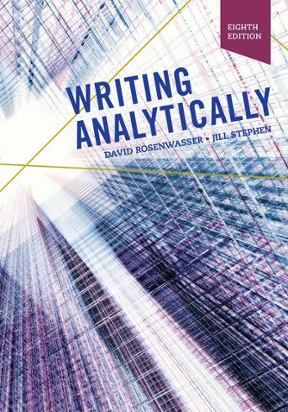
All of you in sections 23 and 24 of English 1103 are required to have the paperback edition of the textbook, Writing Analytically, 8th edition, by David Rosenwasser and Jill Stephen. Bring your copy to class on the days when the title, Writing Analytically, appears in bold on the course calendar. On those days, we will examine portions of the chapters in class and complete some of the exercises related to the reading.
Your first reading assignment in the textbook will be scheduled for mid-September, which will give you ample time to order and receive your copy before you are required to have it in class. (Unlike my copy, pictured at the top of this blog entry, your textbook will not be in a binder.) Your textbook’s cover looks like this:
Other Required Materials
Writer’s notebook/journal, bring to every class.
Loose leaf paper (for drafts and short in-class assignments), bring to every Monday and Wednesday class
Pen with dark ink, bring to every class
Pocket portfolio (for class handouts), bring to every class
WordPress Blog
As practice in developing your web literacy and writing for a broader online audience, you will maintain a free WordPress blog for the class. As soon as possible, create a free blog at wordpress.com. After you create your blog, email the address, or URL, to me, and I will link your blog to our class page, English at High Point. If you encounter technical difficulties creating your blog or publishing a post, email help@wordpress.com or contact the HPU Help Desk: helpdesk@highpoint.edu, 336-841-HELP (3457).
You will post the revisions of all of your major writing assignments both to your blog and to Blackboard. The posts that you publish for class will be public. You are welcome to create additional posts on your own. If you prefer for some of those posts to be private, keep them in draft form or choose the private visibility option.
You may also be asked to post comments to your classmates’ blogs and to mine.
Last month, Hasbro and Merriam-Webster published the seventh edition of the official Scrabble dictionary, which includes about five-hundred newly playable words, including these words featured in the November 16 National Public Radio story about the additions:
As you continue to revise your final reflection, consider visiting The Writing Center. If you do so, you will earn five bonus points for consulting with a Writing Center tutor.
To schedule an appointment, visit https://highpoint.mywconline.com, email the Writing Center’s director, Justin Cook, at jcook3@highpoint.edu, or scan the QR code below. To earn bonus points for your final essay and annotated bibliography, consult with a writing center tutor no later than Thursday, December 1.
Monday in class we examined Tetsuya Ishida’s painting Seedlings, which is one of the texts that you may address in your final reflection, which you began drafting in class on Wednesday. If you choose to include Seedlings, your works cited entry for the painting should follow this format:
Rosenwasser, David and Jill Stephen. “Analysis Does More than Break a Subject into Its Parts.” Writing Analytically, 8th edition. Wadsworth/Cengage, 2019. pp. 4-5.
—“Making an Interpretation: The Example of a New Yorker Cover. Writing Analytically, 8th edition. Wadsworth/Cengage, 2019. pp. 84-89.
Last Wednesday class, in you read one of your classmate’s analyses and composed a blog response to that student’s essay. This morning I asked you to revisit that exercise with a classmate’s final essay and annotated bibliography. As part of the assignment, I asked you to look for the nine basic writing errors outlined in Writing Analytically (342). Those errors are as follows:
Sentence fragments
Comma splices and fused (run-on) sentences
Errors in subject-verb agreement
Shifts in sentence structure (faulty predication)
Errors in pronoun reference
Misplaced modifiers and dangling participles
Errors in using possessive apostrophes
Comma errors
Spelling/diction errors that interfere with meaning
Continue to return to the textbook’s pages devoted to the nine basic errors as you work on your writing assignments for English 1103 and your other courses.
Two weeks ago, I published a blog post that listed twenty-four words with three vowels. Knowing those words, and others with multiple vowels, proves useful when you’re faced with a rack of mostly, or all, vowels. Here’s a list twenty more four-letter words with three vowels:
naoi: ancient temples (pl. of naos)
obia: form of sorcery practiced in the Caribbean (also obeah)
odea: concert halls (pl. of odeum)
ogee: an S-shaped molding
ohia: a Polynesian tree with bright flowers (also lehua)
olea: corrosive solutions (pl. of oleum)
olio: a miscellaneous collection
ouzo: a Turkish anise-flavored liquor
raia: a non-Muslim Turk (also rayah)
roue: a lecherous old man
toea: a currency in Papua, New Guinea
unai: a two-toed sloth (pl. unai; an ai is a three-toed sloth)
This morning in class, as part of your blog response assignment, I asked you to look for the nine basic writing errors as you read your classmate’s analysis.
The authors of your textbook, Writing Analytically, identify these as the nine basic writing errors:
Sentence Fragments
Comma splices and fused (run-on) sentences
Errors in subject-verb agreement
Shifts in sentence structure (faulty predication)
Errors in pronoun reference
Misplaced modifiers and dangling participles
Errors in using possessive apostrophes
Comma errors
Spelling/diction errors that interfere with meaning
Next Up
Friday is Wordplay Day. To increase your word power and up your game, revisit the Tips and Tools on the Scrabble website and also review my blog posts devoted to Scrabble.
Today in class we read Stephen King’s short story “Strawberry Spring,” which was published in Ubris magazine in 1968 and included in King’s first short story collection, Night Shift (1978).
For the collaborative exercise that you completed after we read the story, I asked you to determine whether you could identify any details that indicate why the narrator may have murdered any of his victims. Although there is no indication that the narrator knew Gale Cermann or Adelle Parkins, he did know Ann Bray, which he reveals after he tells the readers that she was editor of the school newspaper: “In the hot, fierce bubblings of my freshman youth I hade submitted a column idea to the paper and asked for a date–turned down on both counts” (paragraph forty-one).
I also asked you to identify words and phrases that illustrate how the story is not only a horror story but also a commentary on war, the Vietnam War in particular, and the Vietnam era. Some of the words and phrases you may have identified include these:
(Ice) sculpture of Lyndon Johnson . . . “cried melted tears” (paragraph four)
Civil War cannons (paragraphs five and seventy-four)
The dove “lost its frozen feathers” (paragraph five)
The fog (paragraphs seven, twenty, twenty-nine, thirty-one, forty-three, forty-four, fifty-two, sixty-four, sixty-six, seventy, seventy-five, and seventy-six)
“[W]ho had been drafted” (paragraph thirty-two)
SDS (paragraph forty-eight)
Quagmire (paragraph fifty)
“[A] series of draft protests and a sit-in” (paragraph seventy)
In addition to those questions on your assignment sheet, I asked you to try to identify the two literary allusions in King’s story. The first is an allusion to J.R.R. Tolkein’s The Lord of the Rings trilogy: “You half expected to see Gollum or Frodo or Sam go hurrying past” (paragraph five). The second is an allusion to a poem by Carl Sandburg, titled–perhaps unsurprisingly–“The Fog.”





 Jane Lucas