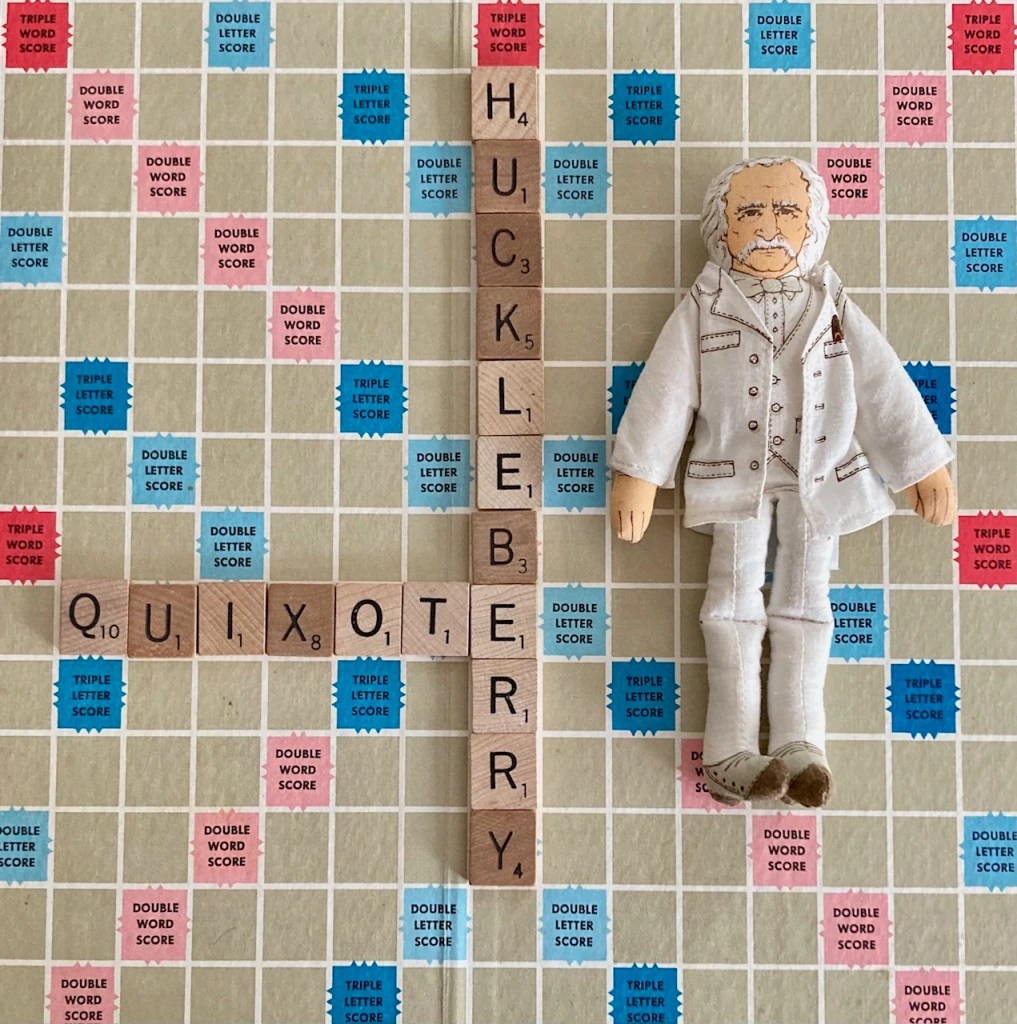
This final Scrabble post of the semester features the names of authors and characters that are playable words. Learning these will not only increase your word power (and up your game), it will also broaden your knowledge of literature. If you haven’t read some of classics listed here, I encourage you to check them out.
eyre: a long journey (the last name of of the title character in Charlotte Bronte’s Jane Eyre, 1847)
dickens: a devil (Charles Dickens, 1812-1870)
fagin: a person, usually an adult, who instructs others, usually children, in crime (from a character of that type in Dickens’ Oliver Twist, 1838)
holden: the past participle of hold (Holden Caulfield, the protagonist in J.D. Salinger’s The Catcher in the Rye, 1951)
huckleberry: a berry like a blueberry (the first name of the title character in Mark Twain’s Adventures of Hucklebery Finn, 1884)
oedipal: describing libidinal feelings of a child toward the parent of the opposite sex (from the title character in Sophocles’ Oedipus Rex, c. 429 B.C.)
quixote: a quixotic, or extremely idealistic person; also quixotry, a quixotic action or thought (the title character in Michael de Cervantes’ Don Quixote, Part I: 1605, Part II: 1615)
Next Up
Your final assignment for the course will be your individual oral presentation, which you will deliver during the exam period. See my April 22 blog post, and the handout I distributed that day, for detailed instructions.
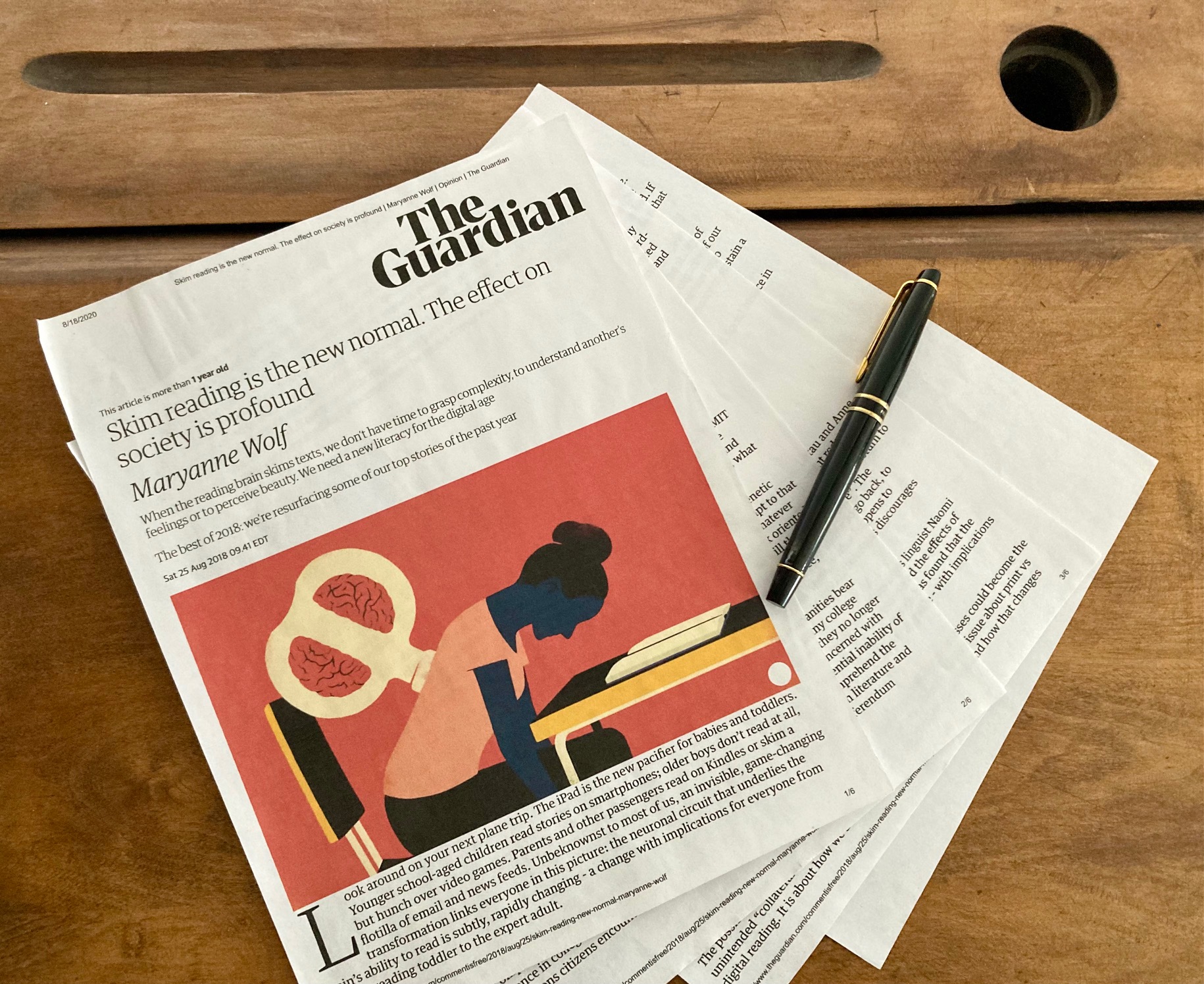
Today in class we will examine Maryanne Wolf’s Guardian essay “Skim Reading is the New Normal.” If your final essay and annotated bibliography focuses on limiting screen time, consider including Wolf’s essay as an additional source.
Note that Wolf mentions several studies of the effects of screen use. If you use Wolf’s essay as a source, look carefully at the ideas you cite and determine whether they are hers or those of a researcher she mentions. If they are the ideas of another researcher, be sure to include the appropriate parenthetical citation for an indirect source. See the samples in last Tuesday’s post.
After we examine Wolf’s essay, you will have the remainder of the class period to conduct additional research and compose additional portions of your final essay and annotated bibliography. Tasks to undertake include these:
Using the HPU Libraries databases to locate additional sources.
If the subject of your final essay/annotated bibliography has a Wikipedia page, locating that page, scrolling down to the list of references, and identifying one that might serve as one of your sources.
Using Google Scholar to locate a potential source.
Composing an annotation for one of your sources.
Reviewing the sources you have gathered and noting what similarities and differences you can identify among them. Those similarities and differences may serve as material for your essay or your commentaries.
Revising your final essay.
Next Up
Wordplay Day! To prepare for class, revisit the Dictionary and World Builder pages on the Scrabble website, and review the posts on my blog devoted to Scrabble tips,
Yesterday in class we examined Donald Barthelme’s short story “The School,” and in groups of two, three, or four you addressed in writing some of the elements of the story that you might explore in an analysis. As I mentioned last week, if you find the prospect of analyzing “The School” more appealing than analyzing one of the texts we studied previously (“Me Talk Pretty One Day,” “The Day Language Came into My Life,” the opening of “The Falling Man,” “Back Story”), you are welcome to change the subject of your analysis to “The School.”
Among the elements of Barthelme’s story that you considered yesterday are these:
the narrator and the narrative voice
conflict
narrative shift (Where does “The School” make an unexpected turn?)
Whether the subject of your analysis is Bartheleme’s story or one of our earlier readings, you will begin your first paragraph with a summary of the text. Remember that a summary is an objective synopsis of a text’s key points. It should be written in third person and present tense. For example, if you choose to analyze “The School,” you might summarize it this way:
Donald Barthelme’s short story “The School” recounts a series of classroom lessons that end with the deaths of plants and animals–deaths that serve as a prelude to the unexplained death of a Korean orphan, followed by the senseless deaths of classmates and family members.
Notice that the summary above does not comment on the story in any way. What follows the summary will be the beginning of your commentary, or analysis, the thesis statement that offers your particular close reading, or interpretation, of the story. The passage below is the same as the one above, but at the end of it I have added a thesis statement in bold.
Donald Barthelme’s short story “The School” recounts a series of classroom lessons that end with the death of plants and animals–deaths that serve as a prelude to the death of a Korean orphan, followed by the deaths of classmates and family members. With conversational narration, accumulation of detail, and a shift in fictional mode, Barthelme deftly depicts the reality of the fleeting nature of life, even as the story itself veers from reality.
If I were to continue to write the analysis that I began in the previous paragraph, I would follow that opening paragraph with body paragraphs that address each of the three story elements that I include in my thesis: (1) “conversational narration,” (2) “accumulation of detail,” and (3) “shift in fictional mode.”
Next Up
In class on Wednesday, after I collect your fourth Check, Please! assignments, I will return your handwritten analysis plans and drafts (with my notes), and you will have the remainder of the class period to devote to revising on your laptops and tablets. Because next week is spring break, you will have two additional weeks to continue revising. Your revision is due on Blackboard and on your WordPress blog Wednesday, March 6 (before clas). The hard deadline in Friday, March 8 (before class).
Last Monday in class, in addition to studying the first pages of “Back Story,” the opening chapter of Michael Lewis’s book The Blind Side, we examined the beginning of Tom Junod‘s essay “The Falling Man, published in Esquire magazine two years after 9-11. After we read the first paragraph, I asked you to consider these questions:
The long first paragraph of Junod’s essay could be two or more paragraphs. If you were Junod, where might you have divided the paragraph?
Why do think he chose not to divide it?
Junod might have started a second paragraph with the words “[i]n all the other pictures,” because there he shifts the focus from the Falling Man to the photographs of other people who jumped from the Twin Towers. An opportunity for a third paragraph comes with the words “[t]he man in the picture, by contrast” where Junod turns his attention back to the Falling Man. And he might have begun a fourth paragraph with “[s]ome people who look at the picture,” because there he shifts to viewers’ perceptions of the Falling Man.
The first paragraph is over four-hundred words long, a length I advise you to avoid in your own writing paragraphs. Generally, one-hundred to one-hundred-and-fifty words is a suitable length. As a rule, you should begin a new paragraph whenyou present a new idea or point. If you have an extended idea that spans multiple paragraphs, each new point within that idea should have its own paragraph. But the first paragraph of “The Falling Man” is an exception. For Junod, choosing not to divide the first paragraph creates an unbroken movement that parallels the unbroken downward flight of his subject, the Falling Man. Outside of the photograph, “he drops and keeps dropping until he disappears.” With “disappears,” the last word of the paragraph,” the Falling Man disappears from the page, and Tom Junod turns to the photographer, whom we learn later in the essay is Richard Drew.
Unless you subscribe to Esquire, the magazine’s paywall will deny you access to the full text of “The Falling Man”; but if you’re interested in reading it in full, you can access it through the HPU Library site by following these steps:
Under the heading “Search HPU Libraries . . . ,” click on the “Articles” tab.
Under the “Articles” tab, type Tom Junod “Falling Man” Esquire in the search box and click “search.”
On the next screen, you will see a brief summary of the article. Click “Access Online” to view the full article.
Donald Barthelme’s “The School”
Today in class, we will read Donald Barthelme’s short story “The School,” and you and two or three of your classmates will collaboratively compose an assignment that addresses the story’s narrator, its conflicts, its narrative shift, and other elements you would examine if you chose–and some of you may–to write your analysis on the story. Tomorrow’s blog post will be devoted “The School.”
Next Up
At the beginning of class on Wednesday, I will collect your worksheets for the fourth lesson in the Check, Please! starter course. If you were absent the day that I distributed the worksheet or you misplaced your copy, you can download a copy from Blackboard and print it. After I collect your worksheets, I will return your analysis drafts with my comments, and you will have the remainder of the class period to begin revising on your laptops. Because spring break is next week, you will have an additional two weeks to work on your analysis before you post your revision to Blackboard and to your WordPress blog. The due date is Wednesday, March 6 (before class). The hard deadline is Friday, March 8 (before class).
Yesterday’s class was devoted primarily to reading and responding to the blog post of one of your classmates’ literacy narratives. Elements you considered in your response included these:
the title
vivid details
dialogue, the use of scene and/or summary
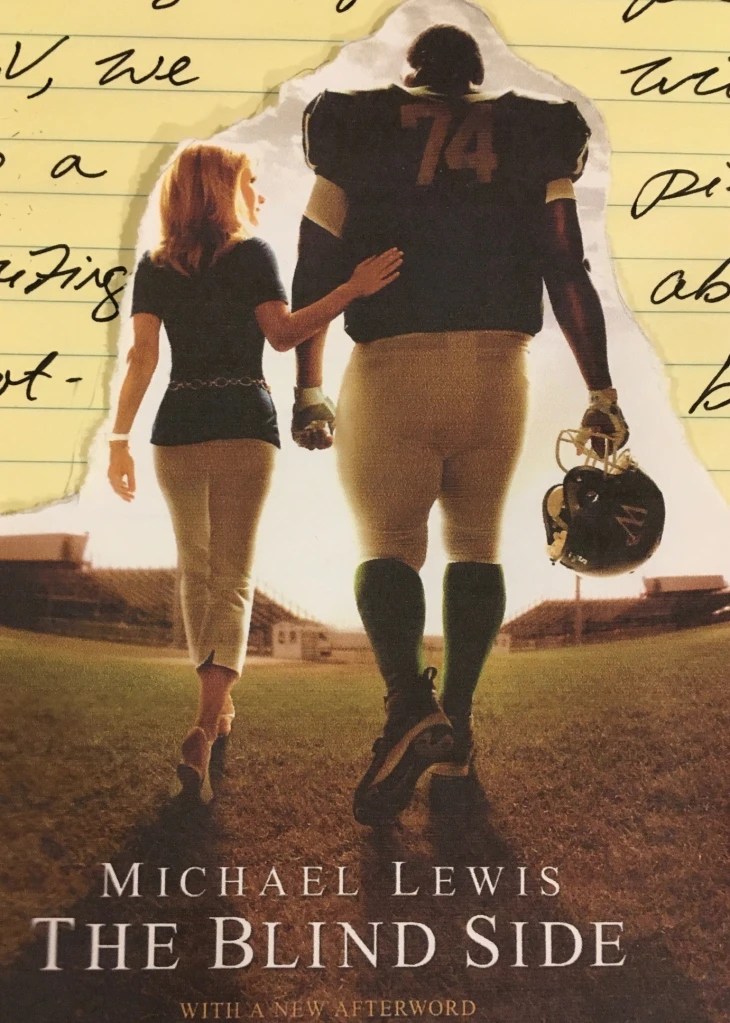
Before you began that assignment, we examined the opening pages of “Back Story,” the first chapter of Michael Lewis‘s The Blind Side, which dramatizes the moments in the November 1985 Redskins-Giants football game leading up to the injury that ended quarterback Joe Theismann’s career:
“From the snap of the ball to the snap of the first bone is closer to four seconds than to five. One Mississippi: The quarterback of the Washington Redskins, Joe Theismann, turns and hands the ball to running back John Riggins. He watches Riggins run two steps forward, turn, and flip the ball back to him. It’s what most people know as a ‘flea-flicker,’ but the Redskins call it a ‘throw-back special.’ Two Mississippi: Theismann searches for a receiver but instead sees Harry Carson coming straight at him. It’s a running down—the start of the second quarter, first and 10 at midfield, with the score tied 7–7—and the New York Giants’ linebacker has been so completely suckered by the fake that he’s deep in the Redskins’ backfield. Carson thinks he’s come to tackle Riggins but Riggins is long gone, so Carson just keeps running, toward Theismann. Three Mississippi: Carson now sees that Theismann has the ball. Theismann notices Carson coming straight at him, and so he has time to avoid him. He steps up and to the side and Carson flies right on by and out of the play. The play is now 3.5 seconds old. Until this moment it has been defined by what the quarterback can see. Now it–and he–is at the mercy of what he can’t see” (15).
What Theismann cannot see is Lawrence Taylor. A second later, as Taylor sacks Theismann, Taylor’s knee drives straight into Theismann’s lower right leg, leading to the “snap of the first bone” that Lewis mentions in the first line of the chapter. He hooks the reader by linking the beginning of the play, “the snap of the ball” to the gruesome “snap of the first bone” that will follow. Lewis develops the opening paragraph using the common one-Mississippi, two-Mississippi method of marking seconds to present the events leading up to the compound fracture that ends Theisman’s career.
Lewis doesn’t dramatize the injury itself because his interest lies instead in the blind side that led to it and subsequently elevated the status and salary of the left tackle, the player who protects the quarterback’s blind side.
When you’re struggling to develop a piece of writing, reread the opening paragraph of The Blind Side. Observe how Lewis dramatizes 3.5 seconds–yes, only 3.5 seconds–with about two-hundred words.
Yesterday, after we studied the opening of The Blind Side, we examined the first two paragraphs of Tom Junod‘s Esquire magazine feature “The Falling Man” and considered why Junod may have chosen to present the beginning of his essay as an unusually long single paragraph, one that could have been divided into three or more paragraphs.
Peer Responses
In the last few minutes of Monday’s class (or on your own if you were still completing your blog comment at the end of class), you began reading your other classmates’ literacy narratives and began taking notes on them in your journal.
Once you have read and taken notes on all of the essays, compose a brief comment that states which of the narratives is the strongest and why. Include in your response the title of the narrative, the writer’s first and last name, and the section number. Post your response as a comment on this blog post no later noon on Thursday, February 15.
After the posting deadline (but not immediately after), I will make the comments visible. In the coming days and weeks, we will look at some of the comments in class, as well as the literacy narratives that they address.
Next Up
In class on Wednesday you will begin planning and drafting your analysis, which will focus on one of the texts that we have studied in class, including Martin Luther King Jr.’s “Letter from Birmingham Jail,” David Sedaris‘s “Me Talk Pretty One,” Helen Keller‘s “The Day Language Came into My Life,” Michael Lewis‘s “Back Story,” and Tom Junod‘s “The Falling Man.” If you have misplaced your copy of any of those or were absent the day that I distributed copies, you can download a copy from Blackboard and print it. Next Monday we will examine an additional text that may serve as the subject of your analysis. If it appeals to your more than the text you write about on Wednesday, you are welcome to change your subject to that latest addition to the readings.
This morning in class you will read one of your classmate’s literacy narratives, compose a response to it, and post your response as a comment on the student’s blog.
Directions
Go to the class page, and click on the link for the blog of the of classmate whose name follows yours on the roster. If you are last on the list, go to the blog of the student whose name is first on the list.
If the student’s blog is not accessible, email the student and ask that he/she/they email you a copy of his/her/their literacy narrative.
Read the classmate’s narrative and compose a response (seventy-five words, minimum) that addresses one or more of these elements: the title, vivid details, dialogue, the use of scene and/or summary.
Does the blog post include an image that documents part of the blogger’s writing process away from the screen? ___ (yes or no)
Does the post include a relevant embedded link? ___ (yes or no)
Write on the lines provided on your worksheet and use the back of the sheet if you need additional space.
After you have composed your response longhand on your worksheet, type your response as a comment for the blogger. You should see a leave comment/reply option at the top or bottom of the post. If you do not see that option, click on the title of the blog post, and scroll down. You should then see leave comment/reply.
Submit your worksheet at the end of class today. You will submit your paper copy of your comment because the blogger may not choose to make your comment visible. You will receive credit for this assignment only if you submit your worksheet at the end of class today.
In the last few minutes of class (or on your own if you’re still completing your blog comment at the end of class): Begin reading your other classmates’ literacy narratives, and take notes on them in your journal. After you have read and taken notes all of the essays, compose a brief comment that states which of the narratives is the strongest and why. Include in your response the title of the narrative, the writer’s first and last name, and the section number. Post your response as a comment on my February 13 blog post no later noon on Thursday, February 15.
Next Up
In class on Wednesday, you will begin planning and drafting your analysis longhand. The following Wednesday, February 21, I will return your handwritten drafts with my notes, and you will have the class period to begin revising on your laptops and tablets. After that, you will have an additional two weeks to continue working on your analysis before posting it to Blackboard and to your WordPress blog. (You have an additional week because of Spring Break, February 24-March 3.) The due date for your analysis is Wednesday, March 6 (before class); the hard deadline is Friday, March 8 (before class).
Today, along with continuing our study of Sedaris’s “Me Talk Pretty One Day,” we will begin to examine “The Day Language Came into My Life,” the first pages of Chapter Four of Helen Keller’s autobiography, The Story of My Life.
One of the aspects of Sedaris’s essay that you examined last Wednesday was his movement from summary to scene. The first of those occurs with these words of his teacher’s: “If you have not meimslsxp or lpgpdmurct by this time, then you should not be in this room” (167).
You also identified Sedaris’s hyperbole “front teeth the size of tombstones” (168), and his use of metaphors and similes, including these:
“not unlike Pa Kettle trapped backstage at a fashion show” (167).
“everybody into the language pool, sink or swim” (167).
“like a translation of one of those Playmate of the Month data sheets” (168).
Today in class you will closley examine the final paragraphs of David Sedaris’s “Me Talk Pretty One Day” and Helen Keller’s “The Day Language Came into My Life,” and collaboratively compose a paragraph that addresses what the last paragraph of each narrative conveys about the significance of the writer’s learning experience. In your examination of Keller’s essay/chapter excerpt, address the quotation “‘like Aaron’s rod with, with flowers’” (par. 9). If you do not recognize that allusion, simply show how the quotation connects to the clause that precedes it.
Together, these two essays by David Sedaris and Hellen Keller demonstrate two vastly different ways to present a literacy narrative. “Me Talk Pretty One Day” offers a quirky look at the challenges of learning French from a sarcastic, soul-crushing instructor. Keller’s story poignantly recounts learning to make meaning through the sign language of her teacher, Annie Sullivan, learning that certain finger positions mean “water” for those who cannot hear it, and for others, like her, who can neither see nor hear it.
Sedaris, David. “Me Talk Pretty One Day.” Me Talk Pretty One Day. Little Brown, 2000. pp. 166-73.
Next Up
On Wednesday you will begin work on your own literacy narratives. At the beginning of class, after I collect your second Check, Please! worksheets, I will distribute the copies of the assignment, and you will have the remainder of the class period to plan and draft longhand. Next Wednesday I will return your handwritten drafts, and you will have the class period revise on your laptops. You will have an additional week to continue revising before you post your revision to Blackboard and to your WordPress blog. The due date is Wednesday, February 7; the hard deadline is the morning of Friday, February 9.
Today in class we will examine David Sedaris‘s essay “Me Talk Pretty One Day,” and you and three of your classmates will collaborate on an exercise that asks you to examine–and subsequently address in writing–these elements of his literacy narrative:
scene and summary–you will examine how and where Sedaris shifts from one to the other
hyperbole
metaphors and similes
Each of these elements can play an important role in a narrative, none more so than scene, which is vital to a story’s life. Without it, a narrative falls flat. With summary, a writer compresses time to offer an overview of events. Through scene, a writer lets time unfold in front of the readers’ eyes, which is what readers prefer. They are drawn into a narrative when they can see for themselves what is happening.
Next Up
Wordplay Day! To prepare for class, revisit the Dictionary and World Builder pages on the Scrabble website, and review tomorrow’s Scrabble post.
To honor Martin Luther King, Jr., today, I am asking you to you engage in a close study of his epistolary essay “Letter from Birmingham Jail.” Although I could ask you to listen to a recording of it, I ask that you to read it instead. King’s gift for oratory is well known, but for students of writing, closely examining his words on the page is a more pertinent exercise than listening to his voice.
What makes King’s letter an effective piece of writing? With that question in mind, consider these words: “Perhaps it is easy for those who have never felt the stinging darts of segregation to say, ‘Wait” (par. 14). Here King is addressing his initial audience, the eight white Birmingham-area clergymen who criticized his protest as “unwise and untimely” (par. 1). He suggests to those men that waiting to act isn’t difficult when you yourself aren’t the victim of injustice, when you haven’t, in King’s words, “felt the stinging darts of segregation” (par. 14). The sentence is notable not only for the contrast it illustrates between King’s reality and the lives of his readers but also for the words that King uses to show that contrast.
Consider King’s sentence and the paraphrase that follows:
Perhaps it is easy for those who have never felt the stinging darts of segregation to say, “Wait.”
Maybe it is simple for people who have not experienced segregation to say, “Wait.”
King’s sentence is stronger than the paraphrase that follows it because of the “stinging darts.” Writing that someone has not “experienced segregation” is abstract. Readers do not feel the general experience in the second sentence, but they feel King’s “stinging darts.” Sensory details strengthen sentences by appealing to readers’ senses, and figurative language invigorates writing by making the unfamiliar familiar. King’s white readers have not been the victims of segregation, but his choice of words makes them feel the sting.
While King’s “stinging darts” sentence—a relatively short one—is laudable, the long, winding sentence that follows is nothing short of staggering.
It starts with these words: “But when you have seen vicious mobs lynch your mothers and fathers at will and drown your sisters and brothers at whim.” King presents those atrocities in an introductory dependent clause, one whose full meaning depends on an independent clause that follows. But rather than immediately turning to an independent clause to complete the thought, King expands the sentence with this series of dependent clauses:
when you have seen hate filled policemen curse, kick and even kill your black brothers and sisters;
when you see the vast majority of your twenty million Negro brothers smothering in an airtight cage of poverty in the midst of an affluent society;
when you suddenly find your tongue twisted and your speech stammering as you seek to explain to your six year old daughter why she can’t go to the public amusement park that has just been advertised on television, and see tears welling up in her eyes when she is told that Funtown is closed to colored children, and see ominous clouds of inferiority beginning to form in her little mental sky, and see her beginning to distort her personality by developing an unconscious bitterness toward white people;
when you take a cross county drive and find it necessary to sleep night after night in the uncomfortable corners of your automobile because no motel will accept you;
when you are humiliated day in and day out by nagging signs reading “white” and “colored”;
when your first name becomes “n—,” your middle name becomes “boy” (however old you are) and your last name becomes “John,” and your wife and mother are never given the respected title “Mrs.”;
when you are harried by day and haunted by night by the fact that you are a Negro, living constantly at tiptoe stance, never quite knowing what to expect next, and are plagued with inner fears and outer resentments;
when you are forever fighting a degenerating sense of “nobodiness”–(par. 14).
The independent clause that readers have been waiting for, the statement that completes the thought is this: “then you will understand why we find it difficult to wait” (par. 14). Those words could have immediately followed the first dependent clause, but instead King offers nine more dependent clauses, ten darts that sting his readers.
Ten dependent clauses connected by semicolons followed by a dash and an independent clause, a total of 316 words: That is not a structure I recommend for the sentences you write in English 1103, but it’s a valuable model, nevertheless.
I hope that you, as citizens, will continue to study the words of his letter. As your writing teacher, I hope that you will return to the sentence that I have examined in detail here. Along with showing his readers why his nonviolent protests could not wait, that sentence of King’s demonstrates how to develop a piece of writing through the accumulation of detail—not just the when, but the when and when and when . . . .
In class on Wednesday we will return to “Letter from Birmingham Jail” and examine David Sedaris’s essay “Me Talk Pretty One Day” as a model for the literacy narrative you will begin drafting next week. Before class, read Sedaris’s essay (posted in the readings folder on Blackboard), and compose two journal entries, one for “Letter from Birmingham Jail” and a second for “Me Talk Pretty One Day.” Each entry should consist of (1) a one-paragraph summary of the essay, and (2) a second paragraph of commentary. In your commentary, address the elements that make the writing effective. Consider how you can draw on those same features in your own prose.
Yesterday in class, we examined Tetsuya Ishida’s painting Seedlings (1998), and you composed in your journal a one-paragraph summary followed by a paragraph of commentary or analysis. My version of the assignment, which I wrote as a sample for you, appears below.
Summary
Tetsuya Ashida’s Seedlings depicts a classroom of uniformed Asian teenagers, all males, whose teacher, seen only from the shoulders down, holds a textbook in one hand. He drapes his other hand on the head of one of the pupils, one of two students presented as microscopes with human faces.
Commentary
Although the subject at hand is biology, the study of living organisms, the student seedlings barely seem alive themselves as they stare blankly into the distance. The uniformity Ishida depicts with their haircuts, crested blazers, striped neck ties, and rows of desks, takes a surrealistic twist with the images of the two pupils who have transformed into microscopes. By placing the teacher’s hand on one of the students-turned-microscope, Ishida indicates that the instructor—himself objectified by the absence of his head—approves of the metamorphosis, that for him, the goal of education is for the individual to be consumed by the subject itself, becoming merely a cold metallic instrument.
Next Up
Wordplay Day! To prepare for class, revisit the Dictionary and World Builder pages on the Scrabble website, and review the posts on my blog devoted to Scrabble tips.








 Jane Lucas