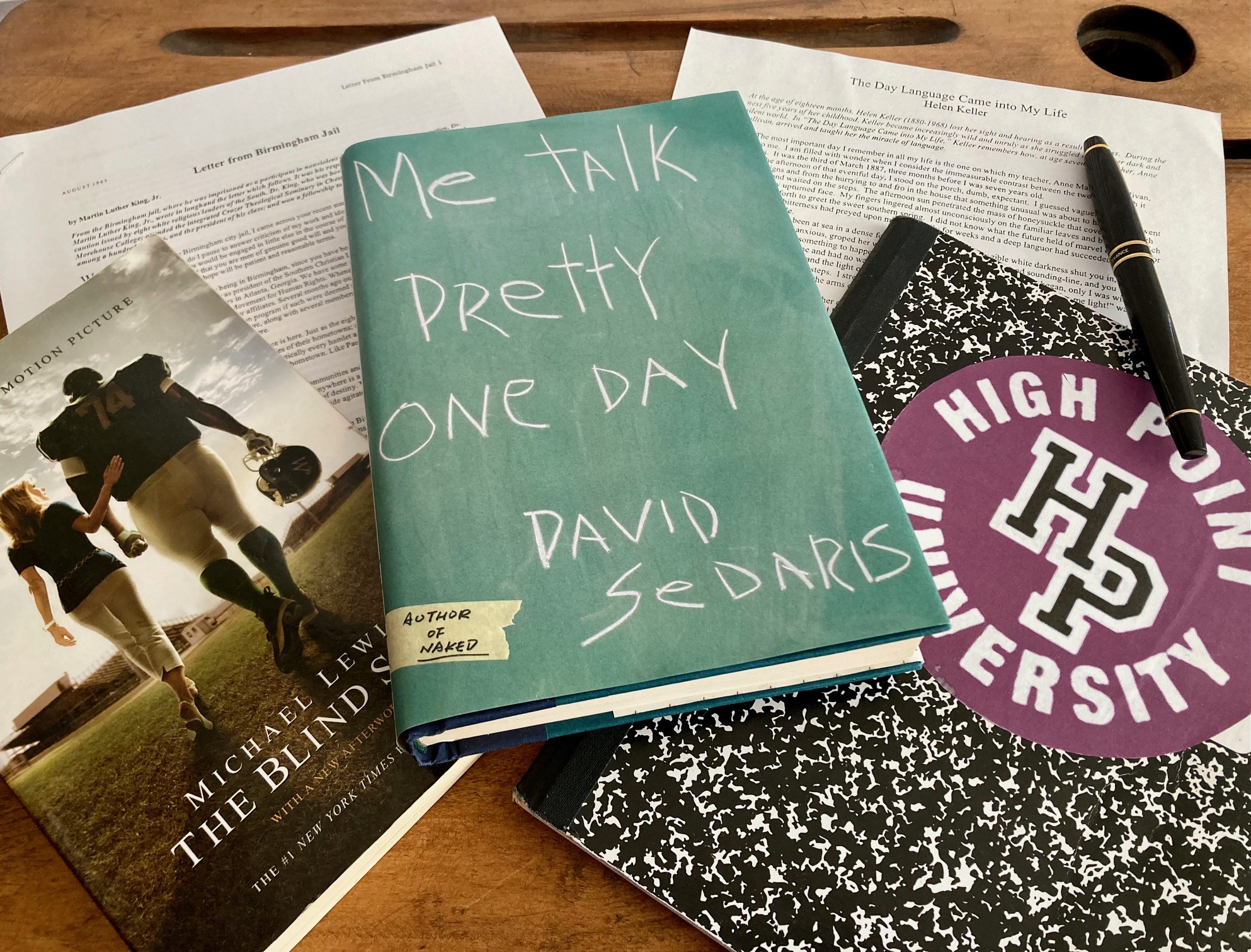
Tomorrow in class, you will begin planning and drafting an analysis, your second major writing assignment for the course. Your subject may be any one of the following texts that we have studied.
“Me Talk Pretty One Day” by David Sedaris
“The Day Language Came into My Life” by Helen Keller
“Letter from Birmingham Jail” by Martin Luther King, Jr.
“Back Story” by Michael Lewis
As I noted in yesterday’s post, you should review your assigned readings, and determine which one appeals to you most as a subject for analysis. I asked you to consider this question: Which text are you most interested in examining in closer detail to determine what makes it an effective piece of writing? Your answer to that question is likely the best subject for you. That said, in the process of planning and drafting, your answer may change. Sometimes the writing process involves discovering that a subject you weren’t interested in–or were less interested in than others–deserves a closer look.
Rather than trying to begin the writing process with a thesis (or main claim, or controlling idea), jot down the words, phrases, and sentences from the text that have lingered in your mind the most. Ask yourself these questions:
What do some of these words, phrases, and sentences have in common?
How are they different?
What patterns can you identify among them?
After repeated readings, do any of them seem to take on additional meanings?
Answering those questions will lead you to identify patterns that will give you the framework for your analysis.
Elements to address in your analysis include these:
Scene
Summary
Figurative language
Sensory details
Structure
Theme
To determine one of the themes of your subject, think about the ideas that the writer conveys throughout the text. Humor in the face of adversity and antagonism (“Me Talk Pretty One Day”), language as illumination and liberation (“The Day Language Came into My Life”), social injustice and the urgency of nonviolent protest (“Letter from Birmingham Jail”), fear and the unseen (“Back Story”) are among the themes to consider.
Keep in mind that themes are abstractions that writers convey through concrete details. If you address a theme in your subject, be sure to refer to concrete details that convey that theme.
As you continue to work on your analysis, read these sections of Writing Analytically:
“Focus on Individual Words and Sentences” (49-50)
“Find the Analytical Potential: Locate an Area of Uncertainty” (120-21)
“Six Rules of Thumb for Responding to Assignments more Analytically” (121-23)
Next Up
At the beginning of class on Wednesday, you will submit your third Check, Please! worksheet, and you will have the rest of the class period to begin planning and drafting your analyses.
Today’s class will be devoted primarily to reading and responding to the blog post of one of your classmates’ literacy narratives. Elements you will consider in your response included these:
the title
vivid details
scene and summary (and dialogue, if present)
the conclusion
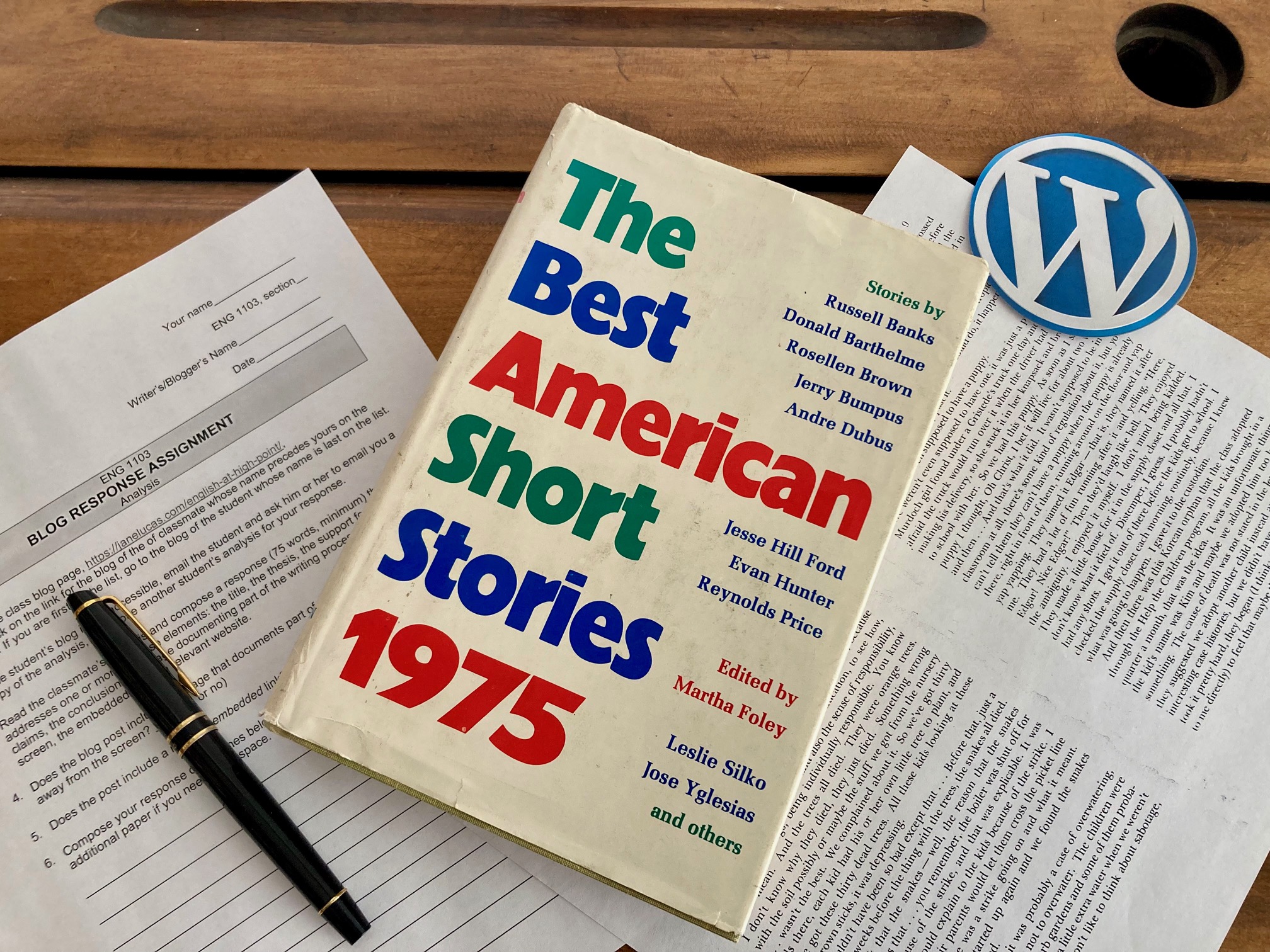
the image documenting part of the writing process away from the screen
the link to a relevant website
Before you begin that assignment, we will examine the opening pages of “Back Story,” the first chapter of Michael Lewis‘s The Blind Side, which dramatizes the moments in the November 1985 Redskins-Giants football game leading up to the injury that ended quarterback Joe Theismann’s career:
“From the snap of the ball to the snap of the first bone is closer to four seconds than to five. One Mississippi: The quarterback of the Washington Redskins, Joe Theismann, turns and hands the ball to running back John Riggins. He watches Riggins run two steps forward, turn, and flip the ball back to him. It’s what most people know as a ‘flea-flicker,’ but the Redskins call it a ‘throw-back special.’ Two Mississippi: Theismann searches for a receiver but instead sees Harry Carson coming straight at him. It’s a running down—the start of the second quarter, first and 10 at midfield, with the score tied 7–7—and the New York Giants’ linebacker has been so completely suckered by the fake that he’s deep in the Redskins’ backfield. Carson thinks he’s come to tackle Riggins but Riggins is long gone, so Carson just keeps running, toward Theismann. Three Mississippi: Carson now sees that Theismann has the ball. Theismann notices Carson coming straight at him, and so he has time to avoid him. He steps up and to the side and Carson flies right on by and out of the play. The play is now 3.5 seconds old. Until this moment it has been defined by what the quarterback can see. Now it–and he–is at the mercy of what he can’t see” (15).
What Theismann cannot see is Lawrence Taylor. A second later, as Taylor sacks Theismann, Taylor’s knee drives straight into Theismann’s lower right leg, leading to the “snap of the first bone” that Lewis mentions in the first line of the chapter. He hooks the reader by linking the beginning of the play, “the snap of the ball,” to the gruesome “snap of the first bone” that will follow (15). Lewis develops the opening paragraph using the common one-Mississippi, two-Mississippi method of marking seconds to present the events leading up to the compound fracture that ends Theisman’s career.
Lewis doesn’t dramatize the injury itself because his interest lies instead in the blind side that led to it and subsequently elevated the status and salary of the left tackle, the player who protects the quarterback’s blind side.
When you’re struggling to develop a piece of writing, reread the opening paragraph of The Blind Side. Observe how Lewis dramatizes 3.5 seconds–yes, only 3.5 seconds–with about two-hundred words.
Next Up
In class on Wednesday, after you submit your worksheets for the third lesson of Check, Please!, you will begin planning and drafting your analysis, your second major writing assignment for the course. To prepare for Wednesday’s class, review your assigned readings, and determine which one appeals to you most as a subject for analysis. Which text are you most interested in examining in closer detail to determine what makes it an effective piece of writing? Your answer to that question is likely the best subject for you.
Yesterday before you and your group members assessed the literacy narratives that you read for class, we examined a page (pictured above) from Harper Lee’s novel To Kill a Mockingbird. That page from Chapter One serves as a useful model for three narrative elements: summary, scene, and dialogue–at least two of which will figure in your literacy narrative.
The first paragraph of the passage sets the scene with summary, designating the “summertime boundaries” within which the narrator, Jean Louise, “Scout,” Finch, and her older brother, Jem, may play outdoors (12). The short one-sentence paragraph that follows continues the summary, informing readers that the summer Scout has just summarized is the one in which Dill (Charles Baker Harris) first visits Maycomb, Alabama.
With the first words of the next paragraph, “[e]arly one morning,” Scout shifts from summary to scene (12). All of the remaining paragraphs except the final one continue the scene with dialogue. Scout returns to summary with the words “Dill was from Meridian” (12).
Note that Harper Lee begins a new paragraph whenever the speaker changes. Also note that every line of dialogue does not include a dialogue tag, such as “he said” or “she said.” If a passage of dialogue includes only two speakers, none of the paragraphs require dialogue tags after the speakers’ first lines because the start of a new paragraph signals to the reader that the other person is speaking. If a dialogue includes three or more speakers–such as Scout’s conversation with Jem and Dill–occasional tags are essential.
In my notes above, I have been careful to distinguish between the author, Harper Lee, and the narrator, the fictional character Scout. When you write about an autobiographical work, such as a literacy narrative, you may use the terms writer and narrator interchangeably. When you write about a work of fiction, it’s important to separate the narrative voice from the author. Reserve the term author for published writers. When you write about a piece of student writing, refer to the student as a writer, not an author.
Sample Student Literacy Narratives
The paragraphs that follow include detailed but not comprehensive notes on the two sample narratives that you assessed in class yesterday. Look to these notes as a guide for editing your own literacy narrative.
“Creativity is Key”
The writer changes the font of the body of the paper to Times New Roman but does not change the font of the running header, which should also be Times New Roman.
The writer incorrectly adds an extra space between the first-page course information (in the upper left) and between the title and the first line of the essay. MLA-style manuscripts are double-spaced. Note that later, the writer also incorrectly adds space between the paragraphs.
The title should be typed in twelve-point font, which is the font size that should be used throughout the document.
The title should not appear in boldface.
In MLA style, all major words in a title, including the final one, are capitalized (“key” should be “Key).
Form, which is the focus of the previous notes, is less important than content, but easily avoidable errors of form may prevent a reader from appreciating the content of your narrative. Creating a compelling story is hard work, proofreading isn’t. If you don’t get the easy part right, readers may stop reading.
The second “sentence” of the second paragraph is a fragment because the meaning of “one being my senior year . . .” is dependent upon the clause that ends the previous sentence. See Writing Analytically, page 426-29.
The comma between “all” and “matter” is a comma splice. See Writing Analytically, 429.
“[R]eal life” should be hyphenated (as real-life) when it functions as a compound modifier. Ditto for “open minded” and “four to five.”
Errors of letter case–upper rather than lower, or vice versa–are mistakes of mechanics, which are prevalent in the second paragraph “Track, “Field,” “Defensive,” “Back,” and “Athlete” should all began with a lower-case letter.
“[F]elt like” should be “felt as if.” In comparisons, use “like” before a noun and “as if” before a clause.
“I’m a writer that” should be “I’m a writer who.” The correct relative pronoun for a person is “who,” not “that.”
The essay is not a narrative. The writer mentions his experience writing a Southern gothic story, and he briefly recounts writing about his training for track and field and international football (soccer), but the writer offers very few details. Focusing on one of those experiences and recreating one or more moments from it would transform the essay into a narrative and develop it into one that meets the six hundred-word minimum requirement.
“Giving a Speech: Worst Nightmare to Best Feeling”
In the second line of the second paragraph, “Megan” is a parenthetical element that should be set off by commas. See Writing Analytically, 441.
The parenthetical element is the next line, “Mrs. Hron’s,” is correctly set off with commas, but the word that precedes “Mrs. Hron’s” should be possessive (“teacher’s,” not “teachers”).
Several other minor punctuation errors occur in the essay, but overall it’s a strong literacy narrative that’s notable for its vivid scenes and the writer’s self-deprecating humor.
Notes on Monday’s Quiz
Rather than posting the answers to the quiz, I am asking you to review the sample student literacy narratives, my annotations on your assignments, and the class notes for January 28 and February 3 and to find the answers on your own. Doing so will enable you to retain more of the course content from the past two weeks of class.
Keep in mind that one of the reasons we write is to remember. Taking notes on all of the blog entries that I publish and on all of your other reading assignments will both engage you in learning process and enable you to demonstrate your learning in the course.
Integrating Quotations
Writing your reflective essay on your literacy narrative tomorrow will include an exercise in integrating a quotation into your writing, a practice you will engage in more frequently as the semester progresses.
In your reflection, you are required include a minimum of one relevant quotation from the textbook, Writing Analytically, which you will introduce with a signal phrase and follow with a parenthetical citation.
Examples
The authors of Writing Analytically observe that “[o]ne goal of a writer’s notebook is to teach yourself through repeated practice that you are capable of finding things to write about” (Rosenwasser and Stephen 157).
In Writing Analytically, Rosenwasser and Stephen note, “to a significant extent, writing of all kinds tells a story—the story of how we have come to understand something” (162).
In the first example above, the authors’ last names appear in the parenthetical citation because they are not named in the signal phrase. In the second example, only the page number appears in the parenthetical citation because the authors are named in the signal phrase.
At the end of your essay, you will include a work cited entry for the section of the textbook that you quote.
Sample Work Cited Entries
Rosenwasser, David and Jill Stephen. “On Keeping a Writer’s Notebook.” Writing Analytically, 9th edition. Wadsworth/Cengage, 2024. pp. 157-58.
Rosenwasser, David and Jill Stephen. “Writing from Life: The Personal Essay.” Writing Analytically, 9th edition. Wadsworth/Cengage, 2024. pp. 161-63.
Next Up
In class tomorrow, you will compose a short essay that reflects on the processes of planning, drafting and composing your literacy narrative. If you do not post your essay to Blackboard and WordPress before class (you have until Friday morning to do so), you should refer to your work as ongoing. Be sure to bring your copy of Writing Analytically to class.
The excerpt featured in the image above (on the far right) isn’t part of a literacy narrative; it’s a page from Harper Lee’s novel To Kill a Mockingbird. That page from Chapter One serves as a useful model for three narrative elements, at least two of which will figure in your literacy narrative. We will examine the page today in class, and I will address the page in more detail in Wednesday’s class.
After we examine the page from To Kill a Mockingbird, you and two or three of your classmates will collaboratively assess the two student literacy narratives that you read for today’s class.
First, you will discuss your annotations on “Creativity is Key,” and you will collaboratively compose a brief assessment, a minimum of one complete sentence. After that, you will use the grade criteria on your literacy narrative assignment sheet to assign a grade for the essay.
Next, you will complete the steps above with the second literacy narrative, “Giving a Speech: Worst Nightmare to Best Feeling.”
Next Up
In class on Wednesday, you will compose a short essay that reflects on the processes of planning, drafting and composing your literacy narrative. If you do not post your essay to Blackboard and WordPress before class (you have until Friday morning to do so), you should refer to your work as ongoing.
Remember that Wednesday is the first day that you are required to bring your copy of Writing Analytically to class. In the reflection that you write in class, you will quote one relevant line from the textbook. Reviewing tomorrow’s blog post, which will include notes on quoting Writing Analytically, will ensure that you are able to effectively integrate a quotation into your essay in the allottted time.
Hillaire Belloc’s “Rebecca,” illustrated by Alice and Martin Provensen
Today in class, we will examine the model literacy narrative “A Bridge to Words,” which you read for today, and you and two or three of your classmates will collaboratively compose a piece of writing that addresses these elements of the essay:
scene
figurative language
gaps in memory/what the narrator doesn’t know
the story’s significance–how the writer conveys it subtly
As you continue to revise, consider the role of those elements your own literacy narrative, and ask yourself what changes may enhance them.
A Bridge to Words
To a small child, the pages of a newspaper are enormous. Looking far back through the years, I see myself, not yet school age, trying to hold up those long, thin sheets of newsprint, only to find myself draped in them, as if covered by a shroud. But of course, back then, my inability to hold a newspaper properly was of little consequence. Even if I could have turned the pages as gracefully as my parents did, I couldn’t decipher the black marks on the page; thus, my family’s ritual reading of the newspaper separated them from me. As the youngest and the only one who couldn’t read, I was left alone on the perimeter to observe. My family’s world of written words was impenetrable; I could only look over their shoulders and try to imagine the places where all those black marks on the page had carried them—these people, my kin, who had clearly forgotten that I was in the room.
My sister, who was three years older, had her very own news source: The Mini Page, a four-page miniature paper that arrived at our house as an insert in the Sunday edition. While our parents sat in their easy chairs poring over the state and local news, my sister, Jo, perched at the drop-front desk and occupied herself with articles, puzzles, and connect-the-dots.
Finally, one Sunday, someone noticed me on the margin and led me into our family’s reading circle. Whether it was one of my parents or my sister, I don’t know. I remember only the gesture and the words: someone handing me the Sunday comics and saying, “You can read part of the funny pages, too. You can read Henry.”
I took the giant page and laid it flat in the middle of the oval, braided rug on the floor of the den. Once I situated the page, I lay on top of it with my eyes just inches above the panels of the comic strip. To my parents, my prone position was a source of amusement, but for me it was simply a practical solution. How else was someone so small supposed to manage such a large piece of paper?
As I lay on the floor and looked at the comic strip’s panels, I realized what the voice had meant. I could “read” Henry, the comic with the bald boy in a red shirt, because it consisted entirely of pictures. In between panels of Henry walking, there were panels of him standing still, scratching his hairless head. I didn’t find Henry funny at all. I wondered how that pale forerunner of Charlie Brown had earned a prime spot in the funnies. Still, I was glad he was there. He was the bridge that led me to the written word.
Reading the wordless comic strip Henry for the first time was the beginning of a years-long habit of stretching out on the floor with newspapers and large books—not thick ones but ones that were tall and wide, among them one of my childhood favorites: The Golden Book of Fun and Nonsense. My sister and I spent hours lying on our bedroom floor, the pink shag carpet tickling our legs as we delighted in the antics of Rebecca, the mischievous title character of one of the poems.
Carl Thomas Anderson’s comic strip character Henry
“Rebecca”—which my sister read to me before I could read it myself—introduced me to the word “abhors,” the very sound of which appealed to me. Sometimes before Jo had finished reading the opening lines, my uncontrollable giggles collided with her perfect mock-serious delivery. As the last word in the first line, “abhors” serves as a lead-in to an enjambment: the continuation of a sentence or clause in a line break. It would be years before I learned the term “enjambment,” but I was immediately swept away by its effect in the opening lines: “A trick that everyone abhors/ In Little Girls is Slamming Doors” (Belloc 61). The first line lured me into the second one, and so on and so on. I was drawn both to the individual word “abhors”—with its side-by-side “b” and “h,” rare in English—and the way the words joined, like links in a chain, to yank me giggling through Rebecca’s cautionary tale:
It happened that a marble bust Of Abraham was standing just Above the door this little lamb Had carefully prepared to slam, And down it came! It knocked her flat! It laid her out! She looked like that.
Her funeral sermon (which was long And followed by a sacred song) Mentioned her virtues, it is true, But dwelt upon her vices too, And showed the dreadful end of one Who goes and slams the door for fun. (61)
Why these particular early memories visit me now, I don’t know. Perhaps rereading Art Spiegelman’s graphic memoir Maus with my students has roused the wordless Henry and the word-filled Golden Book of Fun and Nonsense from the corner of my brain where they’ve slumbered. The former wakes and stretches out in my mind as a bridge to the latter: a spot in the world of words I’ve inhabited ever since.
At the beginning of class on Wednesday, you will submit your worksheet for the second lesson in the Check, Please! course. After that, I will return your literacy narrative drafts with my notes, and you will have the remainder of the class period to begin your revisions. You will have an additional week to continue to revise. The due date for posting your revison to Blackboard and to your WordPress blog is Wednesday, February 5 (before class); the hard deadline is Friday, February 7 (before class).
Today in class, you will begin planning and drafting your first essay assignment, a literacy narrative, which is an account of a learning experience involving reading, writing, or learning to speak a language.
Begin by asking yourself some of these questions: How have you come to think about yourself as a reader or writer? What were some of your most formative experiences as a reader or writer? What are some of the do’s and don’ts you have learned about writing? How has what you have learned about reading or writing enhanced your confidence and skill in that role? You don’t need to respond to all of those questions. Try picking one or two as a starting point, then begin bringing one of those experiences to life.
Your aim is to recreate your experience on the page and then to reflect on its significance. Your focus may be any one of the following:
a memory of a reading or writing assignment that you recall vividly
someone who helped you learn to read or write
a writing-related school event that you found humorous or embarrassing
a particular type of writing that you found (or still find) especially difficult or challenging
a memento that represents an important moment in your development as a reader or writer
learning to speak a second langauage
Detailed instructions are included in the assignment handout that you will receive in class today. An additional copy of the handout is posted on Blackboard in the essay assignments folder.
Notes on Last Friday’s Quiz
Rather than posting the answers to the quiz, I am asking you to review the class notes for January 9, 10, 13, and 17 to find the answers on your own. Doing so will enable you to retain more of the course content from the first two weeks of class.
Keep in mind that one of the reasons we write is to remember. Taking notes on all of the blog entries that I publish will both engage you in learning process and enable you to demonstrate your learning in the course.
Next Up
Wordplay Day! To prepare for class, review the Dictionary and World Builder pages on the Scrabble website. Also review tomorrow’s Scrabble post.
To honor Martin Luther King, Jr., today, I am asking you to you engage in a close study of his epistolary essay “Letter from Birmingham Jail.” Although I could ask you to listen to a recording of it, I ask that you to read it instead. King’s gift for oratory is well known, but for students of writing, closely examining his words on the page is a more pertinent exercise than listening to his voice.
What makes King’s letter an effective piece of writing? With that question in mind, consider these words: “Perhaps it is easy for those who have never felt the stinging darts of segregation to say, ‘Wait” (par. 11). Here King is addressing his initial audience, the eight white Birmingham-area clergymen who criticized his protest as “unwise and untimely” (par. 1). He suggests to those men that waiting to act isn’t difficult when you yourself aren’t the victim of injustice, when you haven’t, in King’s words, “felt the stinging darts of segregation” (par. 11). The sentence is notable not only for the contrast it illustrates between King’s reality and the lives of his readers but also for the words that King uses to show that contrast.
Consider King’s sentence and the paraphrase that follows:
Perhaps it is easy for those who have never felt the stinging darts of segregation to say, “Wait.”
Maybe it is simple for people who have not experienced segregation to say, “Wait.”
King’s sentence is stronger than the paraphrase that follows it because of the “stinging darts.” Writing that someone has not “experienced segregation” is abstract. Readers do not feel the general experience in the second sentence, but they feel King’s “stinging darts.” Sensory details strengthen sentences by appealing to readers’ senses, and figurative language invigorates writing by making the unfamiliar familiar. King’s white readers have not been the victims of segregation, but his choice of words makes them feel the sting.
While King’s “stinging darts” sentence—a relatively short one—is laudable, the long, winding sentence that follows is nothing short of staggering.
It starts with these words: “But when you have seen vicious mobs lynch your mothers and fathers at will and drown your sisters and brothers at whim.” King presents those atrocities in an introductory dependent clause, one whose full meaning depends on an independent clause that follows. But rather than immediately turning to an independent clause to complete the thought, King expands the sentence with this series of dependent clauses:
when you have seen hate filled policemen curse, kick and even kill your black brothers and sisters;
when you see the vast majority of your twenty million Negro brothers smothering in an airtight cage of poverty in the midst of an affluent society;
when you suddenly find your tongue twisted and your speech stammering as you seek to explain to your six-year-old daughter why she can’t go to the public amusement park that has just been advertised on television, and see tears welling up in her eyes when she is told that Funtown is closed to colored children, and see ominous clouds of inferiority beginning to form in her little mental sky, and see her beginning to distort her personality by developing an unconscious bitterness toward white people;
when you take a cross-county drive and find it necessary to sleep night after night in the uncomfortable corners of your automobile because no motel will accept you;
when you are humiliated day in and day out by nagging signs reading “white” and “colored”;
when your first name becomes “n—,” your middle name becomes “boy” (however old you are) and your last name becomes “John,” and your wife and mother are never given the respected title “Mrs.”;
when you are harried by day and haunted by night by the fact that you are a Negro, living constantly at tiptoe stance, never quite knowing what to expect next, and are plagued with inner fears and outer resentments;
when you are forever fighting a degenerating sense of “nobodiness”–(par. 11).
The independent clause that readers have been waiting for, the statement that completes the thought is this: “then you will understand why we find it difficult to wait” (par. 11). Those words could have immediately followed the first dependent clause, but instead King offers nine more dependent clauses, ten darts that sting his readers.
Ten dependent clauses connected by semicolons followed by a dash and an independent clause, a total of 316 words: That is not a structure I recommend for the sentences you write in English 1103, but it’s a valuable model, nevertheless.
I hope that you, as citizens, will continue to study the words of his letter. As your writing teacher, I hope that you will return to the sentence that I have examined in detail here. Along with showing his readers why his nonviolent protests could not wait, that sentence of King’s demonstrates how to develop a piece of writing through the accumulation of detail—not just the when, but the when and when and when . . . .
Yesterday morning in class, as models for your own literacy narrative, we examined David Sedaris‘s “Me Talk Pretty One Day” and “The Day Language Came into My Life,” Chapter Four of Helen Keller’s autobiography, The Story of My Life.
In groups of three, you and your classmates collaboratively addressed the following questions:
Which of Helen Keller’s paragraphs present scene, and which provide summary?
Where does Davis Sedaris first shift from summary to scene?
Where does Sedaris use figurative language?
Where does he employ hyperbole?
Bonus: Where does Keller include a biblical allusion?
Here are the answers to those questions:
The first, third, and ninth paragraphs of Helen Keller’s chapter provide summary. The majority of the chapter’s paragraphs–six of the nine, or two-thirds–present scene.
Sedaris’s first shifts from summary to scene when his French teacher says, “If you have not meimslsxp or lpgpdmurct by this time, then you should not be in this room” (167).
He employs similes when he writes “not unlike Pa Kettle trapped backstage at a fashion show” (167) and “like a translation of one of those Playmate of the Month data sheets” (168). Also, he includes a metaphor when he writes, “everybody into the language pool, sink or swim” (167).
Sedaris turns to hyperbole when he writes that one student had “front teeth the size of tombstones” (168). Due to our time constraints, I did not ask you to address figurative langauge in Keller’s chapter, but note that she uses it as well when she writes, “I was like that ship before my education began” (par. 3).
In the final paragraph of Keller’s chapter, she presents a biblical allusion with the words “like Aaron’s rod, with flowers” (par. 9). That line from the book of Numbers refers to the sprouting of flowers from the staff of Aaron. For Aaron and his brother, Moses, that flowering signified that their family was chosen to do the work of God. Similarly, for Keller, the blossoming of the world through language served as a revelation: the knowledge that words could give meaning to all that she could neither hear nor see.
For that exercise yesterday, I asked you to focus first on summary and scene because they are important methods of treating time in narratives. Simply put, scene shows the reader what is taking place, while summary tells the reader what has happened over time. Secondly, I asked you to examine details of language. Scene is to time what concrete details are to the senses. The specifics of figurative language–what the metaphors and similes show us–allow readers to experience a story as if they are looking over the narrator’s shoulder.
As you begin planning your own literacy narrative, look back at these notes and reread “Me Talk Pretty One Day” and “The Day that Language Came into My Life.” The acts of rereading model essays and analyzing their elements will strengthen your ability to craft your own literacy narrative.
Sedaris, David. “Me Talk Pretty One Day.” Me Talk Pretty One Day. Little Brown, 2000. pp. 166-73.
Next Up
Wordplay Day! To prepare for class, look to the Dictionary and World Builder pages on the Scrabble website, and review the posts devoted to Scrabble tips.
This morning in class, as models for your own literacy narratives, we will examine David Sedaris‘s “Me Talk Pretty One Day” and “The Day Language Came into My Life,” the first pages of Chapter Four of Helen Keller’s autobiography, The Story of My Life.
In groups of three or four, you and your classmates will collaboratively address the following questions:
Which of Helen Keller’s paragraphs present scene, and which provide summary?
Where does Davis Sedaris first shift from summary to scene?
Where does Sedaris use figurative language?
Where does he employ hyperbole?
Bonus: Where does Keller include a biblical allusion?
The first two questions focus on scene and summary because they are important methods of treating time in narratives. Simply put, scene shows the reader what is taking place, while summary tells the reader what has happened over time.
The last three questions focus on details of language. Scene is to time what concrete details are to the senses. Such details allow readers to experience the story as if they are looking over the narrator’s shoulder.
Together, Sedaris’s essay and Keller’s chapter excerpt demonstrate two vastly different ways to present a literacy narrative. “Me Talk Pretty One Day” offers a quirky look at the challenges of learning French from a sarcastic, soul-crushing instructor. Keller’s story poignantly recounts learning to make meaning through the sign language of her teacher, Annie Sullivan, learning that certain finger positions mean “water” for those who cannot hear it, and for others, like her, who can neither see nor hear it.
Next Up
Wordplay Day! To prepare for class, look to the Dictionary and World Builder pages on the Scrabble website, and review the posts devoted to Scrabble tips.
Today in class you will compose a final reflective essay that documents your work in the second half of the semester, focusing on what you consider some of your most significant work and the feature or features of the course that have benefited your development as a writer and a student. Since you have already written a reflective essay on your final essay and annotated bibliography, your final reflection should focus on other assignments and features, including two or three of the following:
Studying one of the texts we have examined in the second half of the semester, including “The Case for Writing Longhand,” The Competition, “Scrabble is a Lousy Game,” Seedlings, “Skim Reading is the New Normal,” “Strawberry Spring,” or the sample final essay and annotated bibliography (“Scrabble as a Game Changer in the College Classroom”)
Writing for an online audience beyond the classroom/creating and maintaining a WordPress blog
Delivering your group presentation on one of the lessons in the Check, Please! Course
Collaborating with your classmates on in-class writing assignments
Playing Scrabble/Collaborating with your teammates on Wordplay Day
Writing longhand
Limiting screen time
Keeping a journal
Focus on one, two, or three assignments or features of the course.
Include in your reflective essay the following elements:
A title that offers a window into your reflection
An opening paragraph that introduces your focus and presents your thesis
Body paragraphs that offer concrete details from your work to support your thesis.
A relevant quotation from Writing Analytically or a relevant quotation from one of the texts that we have studied in the second half of the semester. Introduce your quotation with a signal phrase and follow it with a parenthetical citation. Refer to your citation handout for models.
A conclusion that revisits the thesis without restating it verbatim
Rosenwasser, David and Jill Stephen. “Arriving at an Interpretive Conclusion: Making Choices.” Writing Analytically, 9th edition. Wadsworth/Cengage, 2024. pp.111-12.
Rosenwasser, David and Jill Stephen. “Integrating Quotations into Your Paper.” Writing Analytically, 9th edition. Wadsworth/Cengage, 2024. pp. 343-46.
Rosenwasser, David and Jill Stephen. “The Idea of the Paragraph.” Writing Analytically, 9th edition. Wadsworth/Cengage, 2024. pp. 307-313.
Rosenwasser, David and Jill Stephen. “Two Methods for Conversing with Sources.” Writing Analytically, 9th edition. Wadsworth/Cengage, 2024. p. 325.
Rosenwasser, David and Jill Stephen. “Ways to use a Source as a Point of Departure.” Writing Analytically, 9th edition. Wadsworth/Cengage, 2024. p. 326.
Enjoy the holiday. When class resumes on Monday, December 2, we will examine the article that I distributed today and assigned for you to read. If you were absent, download a copy from Blackboard and print it. Also on Monday, you will receive your assignment for your exam-period presentation. Details TBA.