Today in class we will read Stephen King‘s short story “Strawberry Spring,” which was published in Ubris magazine in 1968 and included in King’s first short story collection, Night Shift (1978).
For the collaborative exercise that you will complete after we read the story, I will ask you to determine whether you can identify any details that indicate why the narrator may have murdered any of his victims. Although there is no indication that the narrator knew Gale Cerman, Adelle Parkins, or Marsha Curran, but he did know Ann Bray.
I will also ask you to identify words and phrases that illustrate how the story is not only a horror story but also a commentary on war, the Vietnam War in particular, and the Vietnam era.
Lastly, I will ask you to try to identify the two literary allusions in King’s story. We will address these questions at the beginning of class on Wednesday, and I will post the answers on my blog.
Next Up
We will review “Strawberry Spring” at the beginning of Wednesday’s class, and you will have the remainder of the period to devote to research and writing for your final essay and annotated bibliography.
Draft collage with Iron Maiden’s Steve Harris and Bruce Dickinson (L-R) and an illustration of Gustave Dore’s edition of Samuel Taylor Coleridge’s “The Rime of the Ancient Mariner.”
To offer you a second sample analysis, I have posted the essay that follows, one that I wrote as a model for my English literature students in 2020. “Rockin’ the Boat: Iron Maiden’s Metal Mariner” examines a heavy metal reimagining of Samuel Taylor Coleridge’s poem “The Rime of the Ancient Mariner” (1798, 1817).
Rockin the Boat: Iron Maiden’s Metal Mariner
A sailor kills a bird of good omen, his destructive act dooms his shipmates and curses him with retelling the tale over and over: So the story of the Ancient Mariner goes. Yet those plot details convey neither the epic nature of Samuel Taylor Coleridge’s poem nor its influence on later writers. Only the poem itself places readers fully in the imaginative realm of the tale, but its late eighteenth-century diction creates a gulf between the poem and contemporary readers. Consequently, one of the challenges of introducing “The Rime of the Ancient Mariner” to millennial students is bridging that gulf. Iron Maiden’s adaptation offers one solution. By eliminating the shifts in the narrative voice and updating the story with contemporary language, their heavy-metal version draws listeners into the story with emphatic rhythms that capture the spirit of the original lines.
Archaic words, such as “stoppeth” (line 2), have a way of stopping readers in their tracks, calling attention to their temporal distance from the poem. Along with the distancing effect of the language, the shifts from one speaker to another can pose problems for twenty-first century readers. Although the Mariner tells his own story, the first words that he speaks are in the fifth stanza. The four stanzas that precede his first words are voiced alternately by an unnamed narrator and the wedding guest who becomes the Mariner’s captive audience. In prose such shifts are easily navigated with paragraphing and dialogue tags. Most poems, however, lack such signals, and their absence in Coleridge’s poem compounds its difficulty. Not only are some of the words obstacles, it’s not always clear who is speaking them.
Iron Maiden’s adaptation eliminates those issues with updated diction and a consistent narrative voice. Rather than shifting speakers, Iron Maiden’s version presents the tale sung by a single storyteller, not the sailor himself, but a narrator who tells listeners to “[h]ear the rime of the ancient mariner” (1). Those first words of the song, penned by lead singer Bruce Dickinson, form an imperative sentence: a command with the understood subject “you”—“[You] hear the rime . . . ” (1). I am master and commander of this story, Dickinson seems to say, and you will hear it now. Such is the power of the imperative. Rather than leaving the reader questioning, as Coleridge’s first stanzas may, Iron Maiden’s song speaks directly to listeners, taking hold of them with the pull of a powerful tide, drawing them out to sea to witness the Mariner as he kills the albatross and seals his fate.
The nature of that fate, that the Mariner must tell his tale over and over, is effectively emphasized by the song’s repetition. The recurrence of the words “on and on,” which first appear to underscore the length of the voyage (17, 18) are repeated in the last line: “And the tale goes on and on and on” (89). That ending may be more fitting than the original. The “sadder and wiser” (624) listener at the end of Coleridge’s poem also appears in the last verse of the song. But by returning to the retelling of the story, the song’s ending shifts the focus from the wedding guest who hears the story only once to the teller who must tell it over and over.
Making the Mariner’s story more accessible through song is valuable not only as an introduction to the poem but also as a starting point for understanding its influence on later English writers, including Mary Shelley, the second-generation Romantic who featured both images and lines from the poem in her novel Frankenstein. Coleridge’s poem was one of Shelley’s favorites, one that she first encountered as a child when the poet recited it in her father’s study (Karbeiner xiii). Iron Maiden’s version captures the spirit of what Mary Shelley, Coleridge’s fan girl, heard: the epic ballad of an eighteenth-century rock star.
Works Cited
Coleridge, Samuel Taylor. “The Rime of the Ancient Mariner.” The Norton Anthology of British Literature: The Romantic Period. 10th ed. Stephen Greenblatt, General Editor. W. W. Norton, 2017. pp. 448-64.. EMI, 1984.
Iron Maiden. “Rime of the Ancient Mariner.” Power Slave. EMI, 1984.
Karbeiner, Karen. Introduction: “Cursed Tellers, Compelling Tales—The Endurance of Mary Shelley’s Frankenstein.” Frankenstein by Mary Shelley. 1818, 1831. Barnes and Noble, 2003.
“The School,” originally published in The New Yorker magazine, was one of twenty-one stories chosen for the annual Best American Short Stories anthology in 1975.
This morning in class we will examine Donald Barthelme’s short story “The School,” and in groups of three or four you will address in writing some of the elements of the story that you might explore in an analysis. As I mentioned last week, if you find the prospect of analyzing “The School” more appealing than analyzing one of the texts we studied previously (“Me Talk Pretty One Day,” “The Day Language Came into My Life,” the opening of “The Falling Man,” “Back Story”), you are welcome to change the subject of your analysis to “The School.”
The elements of Barthelme’s story that you will consider this morning are these:
the narrator and the narrative voice
conflict
narrative shift (Where does “The School” make an unexpected turn?)
Whether you analyze Bartheleme’s story or one of our earlier readings, you will begin your first paragraph with a summary of the text. Remember that a summary is an objective synopsis of a text’s key points. It should be written in third person and present tense. For example, if you choose to analyze “The School,” you might summarize it this way:
Donald Barthelme’s short story “The School” recounts a series of classroom lessons that end with the deaths of plants and animals–deaths that serve as a prelude to the unexplained death of a Korean orphan, followed by the senseless deaths of classmates and family members.
Notice that the summary above does not comment on the story in any way. What follows the summary will be the beginning of your commentary, or analysis, the thesis statement that offers your particular close reading, or interpretation, of the story. The passage below is the same as the one above, but at the end of it I have added a thesis statement in bold.
Donald Barthelme’s short story “The School” recounts a series of classroom lessons that end with the death of plants and animals–deaths that serve as a prelude to the death of a Korean orphan, followed by the deaths of classmates and family members. With conversational narration, accumulation of detail, and a shift in fictional mode, Barthelme deftly depicts the reality of the fleeting nature of life, even as the story itself veers from reality.
If were to continue to write the analysis that I began in the previous paragraph, I would follow that opening paragraph with body paragraphs that address each of the three story elements that I include in my thesis: (1) “conversational narration,” (2) “accumulation of detail,” and (3) shift in fictional mode.
Next Up
In class on Wednesday, after I collect your fifth Check, Please! assignments, I will return your handwritten analysis plans and drafts (with my notes), and you will have the remainder of the class period to devote to revising on your laptops and tablets. You will have an additional week to continue revising. Your revision is due on Blackboard and on your WordPress blog the morning of Wednesday, October 4. The hard deadline in Friday, October 6.
This morning, after I collect your fourth Check, Please! assignment, you will begin your analysis of one of the texts we have studied in class, which include these:
The first paragraphs of “Back Story” by Michael Lewis
“The Day Language Came into My Life” by Helen Keller
The first paragraphs of “The Falling Man” by Tom Junod
“Me Talk Pretty One Day” by David Sedaris
On Monday we will read a short story, “The School” by Donald Barthelme, which will serve as an additional option for your analysis. If you begin an analysis of one of the texts listed above and decide you would rather write about “The School,” you are welcome to change your focus.
As a starting point for your analysis planning, this morning you will read the pages in Writing Analytically devoted to analysis. Among the key points to keep in mind as you write are these:
“One common denominator in all effective analytical writing is that it pays close attention to detail” (5).
“In order to understand a subject, we need to discover what it is ‘made of,’ the particulars that contribute most strongly to the character of the whole” (5).
“[A]sk not just ‘What is it made of?’ but also ‘How do these parts help me to understand the meaning of the subject as a whole?”’ (5).
“Analytical writing is more concerned with arriving at an understanding of a subject than it is with either self-expression or changing readers’ views” (5).
Next Wednesday, September 27, I will return your handwritten drafts with notes, and you will have the class period to begin revising on your laptops and tablets. You will have an additional week to continue to revise. Your revisions are due on Blackboard and on your blogs on Wednesday, October 4. The hard deadline is Friday, October 6.
Next Up
Wordplay Day! To prepare for class, revisit the Dictionary and World Builder pages on the Scrabble website, and review the posts on my blog devoted to Scrabble tips.
Today’s class will be devoted primarily to reading and responding to the blog post of one of your classmates’ literacy narratives. Elements to consider in your response include these:
the title
vivid details
dialogue, the use of scene and/or summary
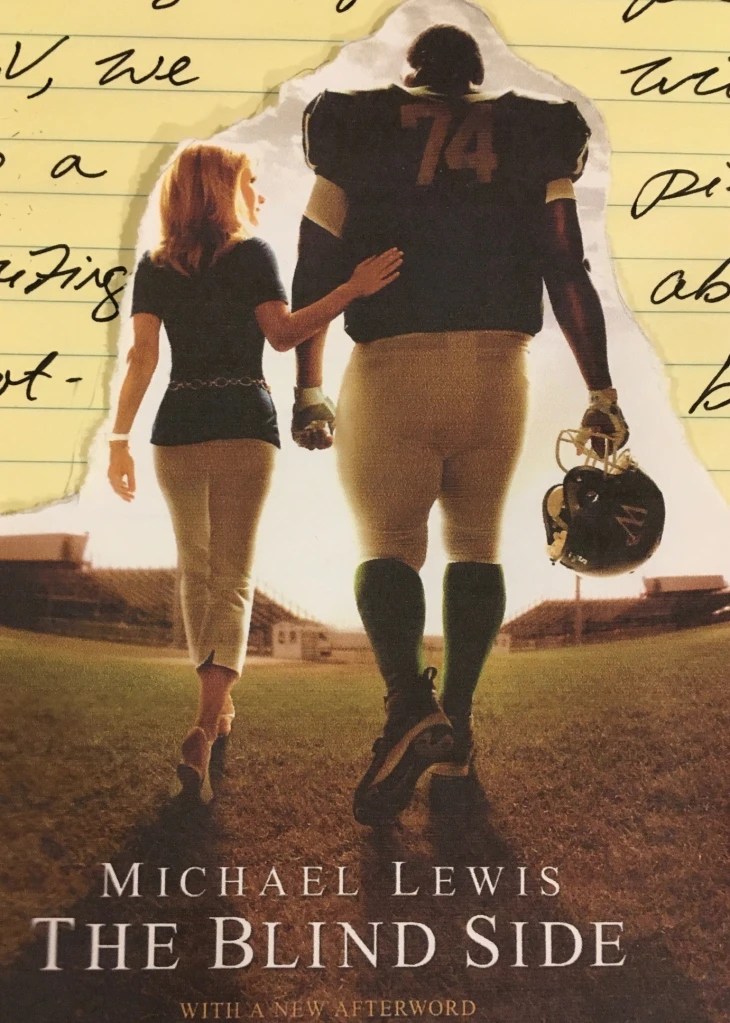
After you complete that assignment, you will begin reading the opening pages of “Back Story,” the first chapter of Michael Lewis’s The Blind Side, which dramatizes the moments in the November 1985 Redskins-Giants football game leading up to the injury that ended quarterback Joe Theismann’s career:
“From the snap of the ball to the snap of the first bone is closer to four seconds than to five. One Mississippi: The quarterback of the Washington Redskins, Joe Theismann, turns and hands the ball to running back John Riggins. He watches Riggins run two steps forward, turn, and flip the ball back to him. It’s what most people know as a “flea-flicker,” but the Redskins call it a “throw-back special.” Two Mississippi: Theismann searches for a receiver but instead sees Harry Carson coming straight at him. It’s a running down—the start of the second quarter, first and 10 at midfield, with the score tied 7–7—and the New York Giants’ linebacker has been so completely suckered by the fake that he’s deep in the Redskins’ backfield. Carson thinks he’s come to tackle Riggins but Riggins is long gone, so Carson just keeps running, toward Theismann. Three Mississippi: Carson now sees that Theismann has the ball. Theismann notices Carson coming straight at him, and so he has time to avoid him. He steps up and to the side and Carson flies right on by and out of the play. The play is now 3.5 seconds old. Until this moment it has been defined by what the quarterback can see. Now it–and he–is at the mercy of what he can’t see” (15).
What Theismann cannot see is Lawrence Taylor. A second later, as Taylor sacks Theismann, Taylor’s knee drives straight into Theismann’s lower right leg, leading to the “snap of the first bone” that Lewis mentions in the first sentence. He hooks the reader by linking the beginning of the play, “the snap of the ball” to the gruesome “snap of the first bone” that will follow. Lewis develops the paragraph using the common one-Mississippi, two-Mississippi method of marking seconds to present the events leading up to the compound fracture that ends Theisman’s career.
Lewis doesn’t dramatize the injury itself because his interest lies instead in the blind side that led to it and subsequently elevated the status and salary of the left tackle, the player who protects the quarterback’s blind side.
When you’re struggling to develop a piece of writing, reread the opening paragraph of The Blind Side. Study how Lewis dramatizes 3.5 seconds–yes, only 3.5 seconds–with 224 words.
Next Up
In class on Wednesday you will begin planning and drafting your analysis, which will focus on one of the texts that we have studied in class, including David Sedaris‘s “Me Talk Pretty One,” Helen Keller‘s “The Day Language Came into My Life,” Tom Junod‘s “The Falling Man,” and Michael Lewis‘s “Back Story.” If you have misplaced your copy of any of those or were absent the day that I distributed copies, you can download a copy from Blackboard and print it. Next Monday we will examine an additional text that may serve as the subject of your analysis. If it appeals to your more than the text you write about on Wednesday, you are welcome to change your subject to that latest addition to the readings.
Yesterday in class, in addition to studying my sample literacy narrative “A Bridge to Words,” we examined the opening paragraphs of Tom Junod‘s essay “The Falling Man, published in Esquire magazine two years after 9-11. When you wrote in your journal about the first two paragraphs of Junod’s essay, I asked you to consider these questions:
The long first paragraph of Junod’s essay could be two or more paragraphs. If you were Junod, where might you have divided the paragraph? Why do think he chose not to divide it?
Where does Junod employ similes?
Though “The Falling Man” is not a literacy narrative, it is an excellent example of creative nonfiction. As you continue to revise your literacy narrative, what in Junod’s essay might prove useful to you as a model?
Junod might have started a second paragraph with the words “[i]n all the other pictures,” because there he shifts the focus from the Falling Man to the photographs of other people who jumped from the Twin Towers. An opportunity for a third paragraph comes with the words “[t]he man in the picture, by contrast” where Junod turns his attention back to the Falling Man. And he might have begun a fourth paragraph with “[s]ome people who look at the picture,” because there he shifts to viewers’ perceptions of the Falling Man.
The first paragraph is over four-hundred words long, longer than some of your literacy narratives will be. I advise you to avoid writing paragraphs of that length. Generally, one-hundred to one-hundred-and-fifty words is a suitable length. As a rule, you should begin a new paragraph whenyou present a new idea or point. If you have an extended idea that spans multiple paragraphs, each new point within that idea should have its own paragraph. But the first paragraph of “The Falling Man” is an exception. For Junod, choosing not to divide the first paragraph creates an unbroken movement that parallels the unbroken downward flight of his subject, the Falling Man. Outside of the photograph, “he drops and keeps dropping until he disappears.” With “disappears,” the last word of the paragraph,” the Falling Man disappears from the page, and Tom Junod turns to the photographer, whom we learn later in the essay is Richard Drew.
Junod’s use of figurative include these lines:
“he departs from this earth like an arrow”
“the towers . . .loom like colosssi”
“they look confused, as though trying to swim down the side of a mountain”
“as though he were a missile, a spear”
Unless you subscribe to Esquire, the magazine’s paywall will deny you access to the full text of “The Falling Man”; but if you’re interested in reading it in full, you can access it through the HPU Library site by following these steps:
Under the heading “Search HPU Libraries . . . ,” click on the “Articles” tab.
Under the “Articles” tab, type Tom Junod “Falling Man” Esquire in the search box and click “search.”
On the next screen, you will see a brief summary of the article. Click “Access Online” to view the full article.
Next Up
Wednesday in class you will compose a short essay that reflects on the process of planning, drafting, and revising your literacy narrative. In addition to revisiting your own final narrative and the writing that led up to it, you will address one or more of the essays that you examined as models.
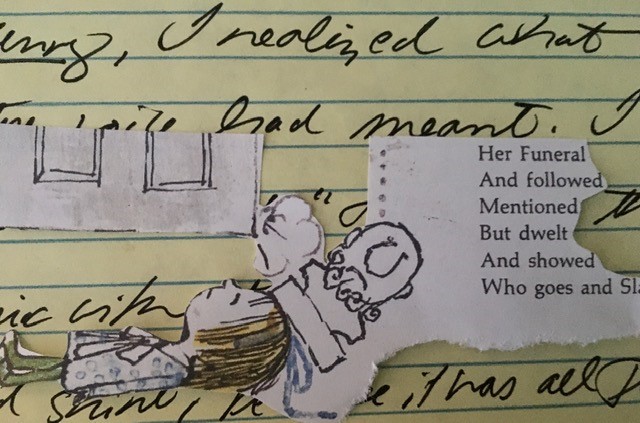
Hilaire Belloc’s “Rebecca,” illustrated by Alice and Martin Provensen
As you continue to revise your literacy narrative, look to the one that follows as another model. This narrative, “A Bridge to Words,” is one that I wrote as a sample for my students in 2021.
A Bridge to Words
To a small child, the pages of a newspaper are enormous. Looking far back through the years, I see myself, not yet school age, trying to hold up those long, thin sheets of newsprint, only to find myself draped in them, as if covered by a shroud. But of course, back then, my inability to hold a newspaper properly was of little consequence. Even if I could have turned the pages as gracefully as my parents did, I couldn’t decipher the black marks on the page; thus, my family’s ritual reading of the newspaper separated them from me. As the youngest and the only one who couldn’t read, I was left alone on the perimeter to observe. My family’s world of written words was impenetrable; I could only look over their shoulders and try to imagine the places where all those black marks on the page had carried them—these people, my kin, who had clearly forgotten that I was in the room.
My sister, who was three years older, had her very own news source: The Mini Page, a four-page miniature paper that arrived at our house as an insert in the Sunday edition. While our parents sat in their easy chairs poring over the state and local news, my sister, Jo, perched at the drop-front desk and occupied herself with articles, puzzles, and connect-the-dots.
Finally, one Sunday, someone noticed me on the margin and led me into our family’s reading circle. Whether it was one of my parents or my sister, I don’t know. I remember only the gesture and the words: someone handing me the Sunday comics and saying, “You can read part of the funny pages, too. You can read Henry.”
I took the giant page and laid it flat in the middle of the oval, braided rug on the floor of the den. Once I situated the page, I lay on top of it with my eyes just inches above the panels of the comic strip. To my parents, my prone position was a source of amusement, but for me it was simply a practical solution. How else was someone so small supposed to manage such a large piece of paper?
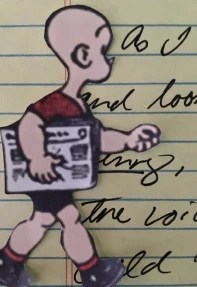
As I lay on the floor and looked at the comic strip’s panels, I realized what the voice had meant. I could “read” Henry, the comic with the bald boy in a red shirt, because it consisted entirely of pictures. In between panels of Henry walking, there were panels of him standing still, scratching his hairless head. I didn’t find Henry funny at all. I wondered how that pale forerunner of Charlie Brown had earned a prime spot in the funnies. Still, I was glad he was there. He was the bridge that led me to the written word.
Reading the wordless comic strip Henry for the first time was the beginning of a years-long habit of stretching out on the floor with newspapers and large books—not thick ones but ones that were tall and wide, among them one of my childhood favorites: The Golden Book of Fun and Nonsense. My sister and I spent hours lying on our bedroom floor, the pink shag carpet tickling our legs as we delighted in the antics of Rebecca, the mischievous title character of one of the poems.
Carl Thomas Anderson’s comic strip character Henry
“Rebecca”—which my sister read to me before I could read it myself—introduced me to the word “abhors,” the very sound of which appealed to me. Sometimes before Jo had finished reading the opening lines, my uncontrollable giggles collided with her perfect mock-serious delivery. As the last word in the first line, “abhors” serves as a lead-in to an enjambment: the continuation of a sentence or clause in a line break. It would be years before I learned the term “enjambment,” but I was immediately swept away by its effect in the opening lines: “A trick that everyone abhors/ In Little Girls is Slamming Doors” (Belloc 61). The first line lured me into the second one, and so on and so on. I was drawn both to the individual word “abhors”—with its side-by-side “b” and “h,” rare in English—and the way the words joined, like links in a chain, to yank me giggling through Rebecca’s cautionary tale:
It happened that a marble bust Of Abraham was standing just Above the door this little lamb Had carefully prepared to slam, And down it came! It knocked her flat! It laid her out! She looked like that.
Her funeral sermon (which was long And followed by a sacred song) Mentioned her virtues, it is true, But dwelt upon her vices too, And showed the dreadful end of one Who goes and slams the door for fun. (61)
Why these particular early memories visit me now, I don’t know. Perhaps rereading Art Spiegelman’s graphic memoir Maus with my students has roused the wordless Henry and the word-filled Golden Book of Fun and Nonsense from the corner of my brain where they’ve slumbered. The former wakes and stretches out in my mind as a bridge to the latter: a spot in the world of words I’ve inhabited ever since.
Today in class we will return to David Sedaris‘s essay “Me Talk Pretty One,” and you and three of your classmates will collaborate on an exercise that asks you to examine–and subsequently address in writing–these elements of his literacy narrative:
scene and summary–you will examine how and where Sedaris shifts from one to the other
metaphors and similes
hyperbole
conclusion–specifically how the conclusion conveys the story’s significance without stating explicitly, this experience was significant because. . . .
Each of these elements plays an important role in narrative, none more so than scene, which is vital to a story’s life. Without it, a narrative falls flat. With summary, a writer compresses time to offer an overview of events. Through scene, a writer lets time unfold in front of the readers’ eyes, which is what readers prefer. They are drawn into a narrative when they can see for themselves what is happening.
Along with continuing our study of Sedaris’s “Me Talk Pretty One Day,” we will begin to examine “The Day Language Came into My Life,” the first pages of Chapter Four of Helen Keller’s autobiography, The Story of My Life.
Together, these two essays by David Sedaris and Hellen Keller demonstrate two vastly different ways to present a literacy narrative. “Me Talk Pretty One Day” offers a quirky look at the challenges of learning French from a sarcastic, soul-crushing instructor. Keller’s story poignantly recounts learning to make meaning through the sign language of her teacher, Annie Sullivan, learning that certain finger positions mean “water” for those who cannot hear it, and for others, like her, who can neither see nor hear it.
And by the Way
Last week in class, I mentioned that David Sedaris’s sister Amy is an actress who is perhaps best known for her role as Deb in the movie Elf (2003). Here is a picture of her and her brother:
On Wednesday you will continue to work on your own literacy narratives. At the beginning of class, after I collect your second Check, Please! worksheets, I will return your handwritten drafts. You will have the class period to revise on your laptops and an additional week to continue revising before you post your revision to Blackboard and to your WordPress blog. The due date is Wednesday, September 13; the hard deadline is the morning of Friday, September 15.
Mike Caulfield, author of Check, Please! and Director of Blended and Networked Learning at Washington State University. https://webliteracy.pressbooks.com/ front-matter/updated-resources-for-2021/.
At the beginning of class on Wednesday, August 30, I will collect your worksheets for Lesson One of the Check, Please! starter course. My sample version of the assignment appears below, as well as on your worksheet and on Blackboard.
Sample Check, Please! Assignment
Check, Please! Lesson One Assignment
In the first lesson of the Check, Please! Starter Course, Mike Caulfield, author of the course and Director of Blended and Networked Learning at Washington State University, introduces the four-step SIFT approach to determining the reliability of a source: (1) “Stop,” (2) “Investigate,” (3) “Find better coverage,” and (4) “Trace claims, quotes, and media to the original context.”
One of the most useful practices presented in lesson one is what the author terms the “Wikipedia Trick.” Deleting everything that follows a website’s URL (including the slash), adding a space, typing “Wikipedia,” and hitting “enter” will yield the site’s Wikipedia page. The Wikipedia entry that appears at the top of the screen may indicate the source’s reliability or lack thereof.
The most memorable segment of lesson one is the short, riveting video “The Miseducation of Dylann Roof,” which begins with the narrator asking the question, “How does a child become a killer?” Produced by the Southern Poverty Law Center, it documents how algorithms can lead unskilled web searchers down paths of disinformation. In the worst cases, such as Roof’s, algorithms can lead searchers to the extremist propaganda of radical conspiracy theorists.
As a model for your own literacy narrative, today in class will examine “Me Talk Pretty One Day,” originally published in Esquire magazine and later as the title essay in David Sedaris’s 2000 essay collection.
To read more of Sedaris’s essays, see the list of links under the heading Writing and Radio on his website.
Next Up
As you begin work on your own literacy narrative on Wednesday, study Sedaris’s essay as a model, and consider how he uses the following:
Shifts from summary to scene and vice versa
Figurative language
Hyperbole
Vivid detail
Look for opportunities to use those elements in your own essay.
Am I the person who will teach your English 1103 class? I posed that question this morning at the beginning of class as a starting point for analysis, one of the key features of the course.
To begin the collaboration and inquiry that will figure prominently this semester—along with analysis—you will work together in groups today to find the answers to some of the most frequently asked questions about the course. After class, continue to review the syllabus, which is posted in Blackboard. If you have any questions about the assignments, the course policies, or the calendar, please let me know.
Textbook
All of you in sections 19 and 20 of English 1103 are required to have the paperback edition of the textbook, Writing Analytically, 8th edition, by David Rosenwasser and Jill Stephen. Bring your copy to class on the days when the title, Writing Analytically, appears in bold on the course calendar. On those days, we will examine portions of the chapters in class and complete some of the exercises related to the reading.
Your first reading assignment in the textbook will be scheduled for mid-September, which will give you ample time to order and receive your copy before you are required to have it in class. (Unlike my copy, pictured at the top of this blog entry, your textbook will not be in a binder.) Your textbook’s cover looks like this:
Other Required Materials
Writer’s notebook/journal, bring to every class.
Loose leaf paper (for drafts and short in-class assignments), bring to every Monday and Wednesday class
Pen with dark ink, bring to every class
Pocket portfolio (for class handouts), bring to every class
WordPress Blog
As practice in developing your web literacy and writing for a broader online audience, you will maintain a free WordPress blog for the class. As soon as possible, create a free blog at wordpress.com. After you create your blog, email the address, or URL, to me, and I will link your blog to our class page, English at High Point. If you encounter technical difficulties creating your blog or publishing a post, email help@wordpress.com or contact the HPU Help Desk: helpdesk@highpoint.edu, 336-841-HELP (3457).
You will post the revisions of all of your major writing assignments both to your blog and to Blackboard. The posts that you publish for class will be public. You are welcome to create additional posts on your own. If you prefer for some of those posts to be private, keep them in draft form or choose the private visibility option.
You may also be asked to post comments to your classmates’ blogs and to mine.