Posted in Reading, Teaching

Welcome Back to English 242

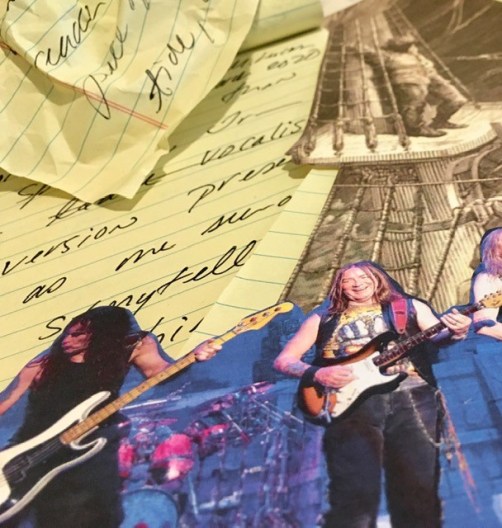
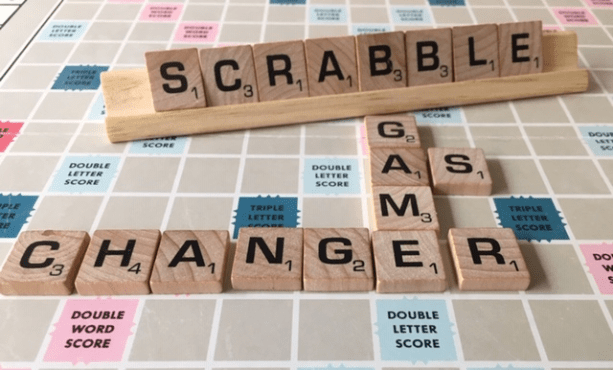
Graphic Title: Victorians Online, For Reading like the Dickens

Dear Readers,

As we begin a new chapter online, consider how less remote we are than the arctic explorer Robert Walton was when he wrote to his sister, Margaret Saville, in England.

Since our seated classes were canceled before your copies of the Victorian volume of the Norton anthology were issued, I have included in this blog post a list with links to texts that we’ll study that are available through Project Gutenberg.

Before I write more about the list, I should address the subtitle of the paper-craft graphic above (one I created recently during some much-needed time away from the screen). The phrase “like the dickens” is not a reference to the Victorian author. It’s a euphemism. More specifically, it’s a minced oath: an expression that’s created by altering the spelling or pronunciation of a word that’s considered profane. Shakespeare penned the minced oath “like the dickens,” for “like the devilkins” (little devils), in his comedy The Merry Wives of Windsor, which he wrote more than two-hundred years before Charles Dickens was born.

Now to the list, and a second one that follows. The first is a chronological list of the longer Victorian works that we will study. The second includes the MLA-style works cited entries for the four texts, plus MLA style entries for both Mary Shelley’s Frankenstein on Project Gutenberg and your Barnes and Noble paperback edition. When you write about these texts, you will need to include MLA-style documentation. Bookmark this page for quick reference.

Remember to check your CVCC email and Blackboard regularly for updates and assignments.

We will get through these days.

Sincerely sequestered,

Dr. Lucas

Longer* Victorian-era Readings

*Longer readings for English 242. By Victorian standards, these book-length works aren’t long; A Christmas Carol and The Strange Case of Dr. Jekyll and Mr. Hyde are novellas, and “The Speckled Band” is a short story.

Sample MLA Works Cited Entries

Carroll, Lewis. Alice’s Adventures in Wonderland. 1865. Project Gutenberg, http://www.gutenberg.org/files/11/11-h/11-h.htm. Accessed 22 Mar. 2020.

Dickens, Charles. A Christmas Carol. 1843. Project Gutenberg,  https://www.gutenberg.org/files/46/46-h/46-h.htm. Accessed 22 Mar. 2020.

Doyle, Sir Arthur Conan. “The Adventure of the Speckled Band.” 1892. https://www.gutenberg.org/files/1661/1661-h/1661-h.htm. Accessed 22 Mar. 2020.

Shelley, Mary. Frankenstein. 1818, 1831. Introduction and Notes by Karen Karbeiner. Barnes and Noble, 2003.

Shelley, Mary. Frankenstein. 1818, 1831. Project Gutenberg, http://www.gutenberg.org/files/84/84-h/84-h.htm. Accessed 22 Mar. 2020.

Stevenson, Robert Louis. The Strange Case of Dr. Jekyll and Mr. Hyde. 1886. http://www.gutenberg.org/cache/epub/42/pg42-images.html. Accessed 22 Mar. 2020.


Posted in Reading, Teaching

Rockin’ the Boat: Iron Maiden’s Metal Mariner

A sailor kills a bird of good omen, his destructive act dooms his shipmates and curses him with retelling the tale over and over: So the story of the Ancient Mariner goes. Yet those plot details convey neither the epic nature of Samuel Taylor Coleridge’s poem nor its influence on later writers. Only the poem itself places readers fully in the imaginative realm of the tale, but its late eighteenth-century diction creates a gulf between the poem and contemporary readers. Consequently, one of the challenges of introducing “The Rime of the Ancient Mariner” to millennial students is bridging that gulf. Iron Maiden’s adaptation offers one solution. By eliminating the shifts in the narrative voice and updating the story with contemporary language, their heavy-metal version draws listeners into the story with emphatic rhythms that capture the spirit of the original lines.

Archaic words, such as “stoppeth” (line 2), have a way of stopping readers in their tracks, calling attention to their temporal distance from the poem. Along with the distancing effect of the language, the shifts from one speaker to another can pose problems for twenty-first century readers. Although the Mariner tells his own story, the first words that he speaks are in the fifth stanza. The four stanzas that precede his first words are voiced alternately by an unnamed narrator and the wedding guest who becomes the Mariner’s captive audience. In prose such shifts are easily navigated with paragraphing and dialogue tags. Most poems, however, lack such signals, and their absence in Coleridge’s poem compounds its difficulty. Not only are some of the words obstacles, it’s not always clear who is speaking them.

Iron Maiden’s adaptation eliminates those issues with updated diction and a consistent narrative voice. Rather than shifting speakers, Iron Maiden’s version presents the tale sung by a single storyteller, not the sailor himself, but a narrator who tells listeners to “[h]ear the rime of the ancient mariner” (1). Those first words of the song, penned by lead singer Bruce Dickinson, form an imperative sentence: a command with the understood subject “you”—“[You] hear the rime . . . ” (1). I am master and commander of this story, Dickinson seems to say, and you will hear it now. Such is the power of the imperative. Rather than leaving the reader questioning, as Coleridge’s first stanzas may, Iron Maiden’s song speaks directly to listeners, taking hold of them with the pull of a powerful tide, drawing them out to sea to witness the Mariner as he kills the albatross and seals his fate.

The nature of that fate, that the Mariner must tell his tale over and over, is effectively emphasized by the song’s repetition. The recurrence of the words “on and on,” which first appear to underscore the length of the voyage (17, 18) are repeated in the last line: “And the tale goes on and on and on” (89). That ending may be more fitting than the original. The “sadder and wiser” (624) listener at the end of Coleridge’s poem also appears in the last verse of the song. But by returning to the retelling of the story, the song’s ending shifts the focus from the wedding guest who hears the story only once to the teller who must tell it over and over.

Making the Mariner’s story more accessible through song is valuable not only as an introduction to the poem but also as a starting point for understanding its influence on later English writers, including Mary Shelley, the second-generation Romantic who featured both images and lines from the poem in her novel Frankenstein. Coleridge’s poem was one of Shelley’s favorites, one that she first encountered as a child when the poet recited it in her father’s study (Karbeiner xiii). Iron Maiden’s version captures the spirit of what Mary Shelley, Coleridge’s fan girl, heard: the epic ballad of an eighteenth-century rock star.

Works Cited

Coleridge, Samuel Taylor. “The Rime of the Ancient Mariner.” The Norton Anthology of British Literature: The Romantic Period. 10th ed. Stephen Greenblatt, General Editor. W. W. Norton, 2017. pp. 448-64.. EMI, 1984.

Iron Maiden. “Rime of the Ancient Mariner.” Power Slave. EMI, 1984.

Karbeiner, Karen. Introduction: “Cursed Tellers, Compelling Tales—The Endurance of Mary Shelley’s Frankenstein.” Frankenstein by Mary Shelley. 1818, 1831. Barnes and Noble, 2003.

Posted in Reading, Writing

Cinderella of Buck’s Peak

What makes a book a page-turner? If it’s fiction, it’s the narrative arc. If it’s nonfiction, it’s the same arc imposed on truths that are stranger than the lies of novels. Tara Westover’s Educated is a case in point. In the chapter where she recounts performing the title role in the musical Annie, the prevailing image of the teenage Tara is not one of herself, but rather Tara as the iconic orphan, her “brown hair [dyed] cherry red” (86). By depicting herself as that fictional heroine in a chapter that ends with Y2K, Westover creates a rags-to-riches narrative in miniature, a nesting doll within the larger Cinderella story of the memoir.

At the beginning of the chapter, as Tara rehearses for Annie, the source of tension that drives the narrative is her father’s obsession with preparing for what he proclaims will be the post-Y2K chaos that will usher in the Second Coming of Christ. Gene Westover’s adherence to Y2K conspiracy theories and his distrust of doctors and public schools set Tara apart from the other teenagers in rehearsal. The Worm Creek Opera House, like the ball in Cinderella, is another world, where the words people spoke “seemed ripped from another reality” (86).

From her father’s obsession with Y2K, the source of tension in the chapter shifts to the obstacle that presents itself when Tara learns from the director that she must provide her own costumes. The old, tattered clothes that Annie wears as an orphan in Act I are a cinch to find in the Westovers’ basement, but in Act II Tara must take the stage in the beautiful dresses that Daddy Warbucks, Annie’s millionaire benefactor, buys for her. Lacking the dresses that she needs sends Tara and her mother on a search—a heroine’s quest—for suitable ones. Westover recounts that she and her mother drive one-hundred miles round-trip, scouring every second-hand store to no avail. It seems that Tara will have no gown for the ball, but her mother devises another plan as a last resort: She drives Tara to Aunt Angie’s house, where Angie loans Tara some of her daughter’s Sunday dresses. Helping Tara try on the fancy dresses, “knotting the sashes, fastening the buttons, plumping the bows” (87), Aunt Angie becomes the fairy godmother of the moment, setting Tara back on her path.

Annie isn’t the only stage role Tara plays, but it’s the only one Westover describes in her memoir; she doesn’t even mention the others by name. They remain the unnamed characters in “the next play” and “the one after that” (87). By limiting the depiction of her theatre life to Little Orphan Annie, Westover leaves readers with the image of her as the scrappy heroine whose rags-to-riches narrative parallels her own story as well as Cinderella’s. And the last pages of the chapter present another link to the girl with the glass slipper. In both stories, the heroine believes that the world will change at midnight. But in Educated Gene Westover’s delusions are the real fairy tale. After 2000 arrives without incident, Tara looks at her father watching television in the dark, noting that “[h]e seemed smaller to me than he had that morning” (91).

In Bruno Bettelheim’s classic study of fairy tales, he observes that “[i]f Cinderella is to become master of her own fate, her parents’ authority must be diminished” (257). Readers of Educated see that parental authority diminish as Tara watches her father become smaller in her eyes—as parents, both real and imagined, often do. Westover’s readers enter the terrain of Buck’s Peak knowing that the perils of an abusive brother, a paranoid, delusional father, and a three-ton pair of scissors aren’t the exaggerated obstacles of a fairy tale or comic strip. Instead they’re genuine threats in a hard-knock life that Tara only narrowly escapes. She doesn’t live happily ever after, but she does achieve an education and a sense of self—if not a sense of peace.

Works Cited

Bettelheim, Bruno. The Uses of Enchantment: The Meaning and Importance of Fairy Tales. 1976. Knopf, 1977.

Westover, Tara. Educated. Random, 2018.

Posted in Reading, Teaching, Writing

ENG 112: A Lust for Lists

This semester I created a new introductory assignment for my students in English 112: Writing and Research in the Disciplines. The idea came to me while I was thinking about the work involved in producing a bibliography. That gathering and compiling of sources, an essential part of the research process, is a tedious undertaking for many students. Yet list-making, itself, is something that many of us turn to in discussions of our favorite things. Think Maria von Trapp and Oprah. The list could go on.

It occurred to me that such lists could serve as introductions, getting-to-know-you opportunities that would also offer practice in compiling MLA-style bibliographies, discographies, filmographies, and TVographies.

Creating lists of their favorite things—whether books, music, films, or TV series—may make the process of producing citations less dull. I hope it does. Even if it doesn’t, the lists will offer us starting points for conversations about some unfamiliar things that may someday join our own lists of favorites.

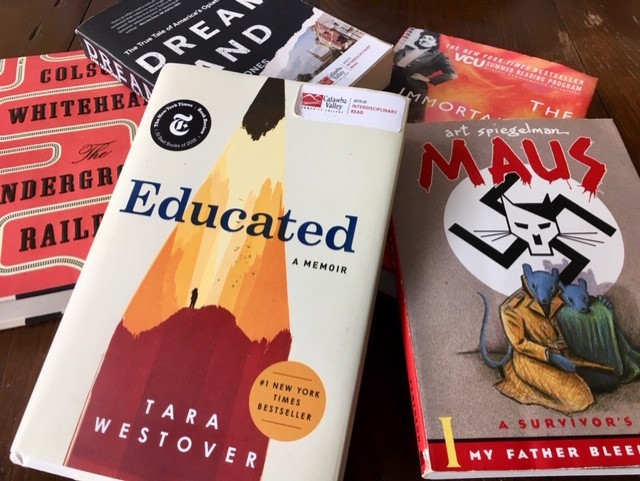
For my top-five list, I chose my favorite Common Reads—or as some schools call them, Campus Reads or Interdisciplinary Reads. I have these books on my brain because I’m currently teaching Tara Westover’s memoir Educated, this year’s Interdisciplinary Read at Catawba Valley Community College. As I meditate on Tara Westover’s book, my thoughts turn to how her memoir differs from other Common Reads that I’ve studied with my students.

Exploring a single book, such as Westover’s, over the course of a semester bears witness to the volumes we can learn about writing through the slow, careful study of well-wrought prose. When the pages are only slightly more familiar to me than they are to my students—which has been the case with every Common Read that I’ve taught—the experience has enabled me to model the pursuit of lifelong learning that I aim to foster in my students.

Bibliography

Quinones, Sam. Dreamland: The True Tale of America’s Opioid Epidemic. 2015. Bloomsbury, 2016.

Skloot, Rebecca. The Immortal Life of Henrietta Lacks. Crown, 2010.

Spiegelman, Art. Maus. 1991. Pantheon, 1992.

Westover, Tara. Educated. Random, 2018.

Whitehead, Colson. Underground Railroad. Doubleday, 2016.

Posted in Reading, Teaching

Navigating Dark Passages

J.M.W. Turner’s “Slave Ship” (1840) / W.W. Norton

At first glance, the painting The Slave Ship seems primarily a showcase for the artist J.M.W. Turner’s use of light and color. But the painting’s title, its subtitle, and closer inspection of its details reveal that Turner’s painting speaks to the  consequences of slavery and oppression, as well as the ways in which we depict such injustices. Readers who encounter The Slave Ship in conjunction with other Victorian-age literature may be reminded not only of the words of John Ruskin–once owner of the painting, who described its “awful but glorious light” (385)–but also of the realization by Frankenstein’s monster that without money or social status, he was considered a “vagabond and a slave” (Shelley 107).

Those words of Shelley’s not only express the sentiments of nineteenth-century slaves and abolitionists, they also echo the words of her mother, pioneering feminist Mary Wollstonecraft. When the monster recounts Saphie’s education, he observes how “[t]he young girl spoke in high and enthusiastic terms of her mother, who, born in freedom spurned the bondage of which she was now reduced. She instructed her daughter in the tenets of her religion [Christianity], and taught her to aspire to higher levels of intellect, and an independent spirit, forbidden to the female followers of Mahomet” (110).

Works Cited

Ruskin, John. Excerpt from “The Slave Ship.” The Norton Anthology of British Literature: The Victorian Age. 10th ed. Stephen Greenblatt, General Editor. W. W. Norton, 2017. p. 385.

Shelley, Mary. Frankenstein. 1818, 1831. Introduction and Notes by Karen Karbiener. Barnes and Noble, 2003.

Turner, J.M.W. Slave Ship (Slavers Throwing Overboard the Dead and Dying–Typhoon Coming On). The Norton Anthology of British Literature: The Victorian Age. 10th ed. Stephen Greenblatt, General Editor. W. W. Norton, 2017. C1.

Posted in Reading, Teaching

The Ring and the River

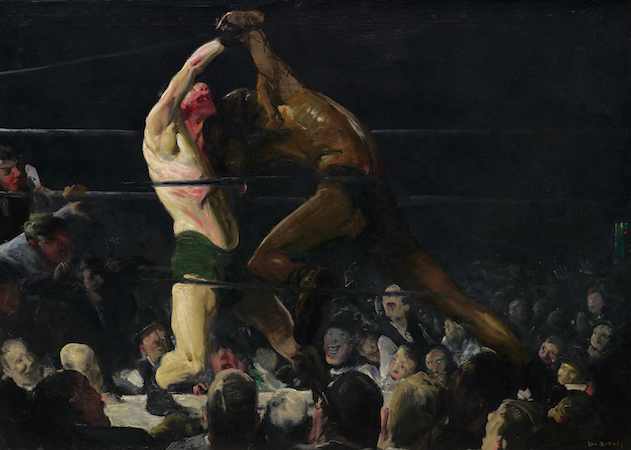
Both Members of This Club, George Bellows, 1909 / W.W. Norton

Each volume of The Norton Anthology of English and American Literature now features a full-color section of visual art that offers readers the opportunity to consider the parallels between the words on the page and the paint on the canvases of the same era. That opportunity prompted me to create an assignment series for my British Literature students that asks them to write a blog post about one of the works of art and make connections between that visual art and one or more of their readings. This blog post, “The Ring and the River,” is one that I composed as a model for my British Literature students. I chose a painting from the American anthology to avoid the risk that my students would think that the blog post they wanted to write had already been written.

As a member of the Ashcan school of artists, painter George Bellows championed the representation of American society in its many forms, in particular the working classes. Seeing Bellows’ painting Both Members of This Club in The Norton Anthology of American Literature brings to mind one of the novels included in the anthology: Mark Twain’s Adventures of Huckleberry Finn.  Bellows turned to the boxing ring to depict America as Twain turned to the Mississippi River. The opponents in the ring evoke the racial conflict at the heart of Twain’s narrative, and the grotesque faces of the crowd mirror the images of the mob in Chapter 22. In the words of Colonel Sherburn, “[t]he pitifulest thing out is a mob” (200).

 Work Cited

Twain, Mark. Adventures of Huckleberry Finn. The Norton Anthology of American Literature: 1865-Present. 9th ed. Robert S. Levine, General Editor. W. W. Norton, 2017. pp. 108-290.


Posted in Reading, Teaching, Theatre

María Gringa

I’m standing in the dark with my ear to the curtain, trying not to think about the large stock pot I’m holding, or how easily it could slip from my damp, sweaty hands. I’m trying to block those thoughts with the words that I’m speaking in my mind, over and over, until I hear my cue:
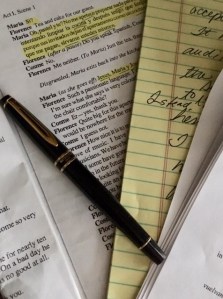
FLORENCE Please ring again.

Cosme rings the bell a second time, on this occasion with more force. After a short pause, the sound of a pan [stock pot] being slammed down is heard off stage. (1.1)

Finally dropping the stock pot offers no relief from my anxiety; instead it heightens it, because it means that I’m closer to saying María’s lines, and closer to the risk that they’ll slip away from me.

FLORENCE Ah, that sounds promising. Here she comes.

María, the Mexican cook and housemaid, enters. (1.1)

I part the curtain and cross into the unknown, a place where I don’t know whether the words that I’ve prepared to say will come to me again, as I, María, approach my boss, Florence Foster Jenkins, the worst singer in the world. Florence will ask María to bring tea and cake for her and her guest, her soon-to-be accompanist, Cosme McMoon. Disgruntled María savors the opportunity to tell Florence that she doesn’t feel like preparing cake and tea. She’s trying to clean the kitchen, and then she has to clean the carpet because Florence and her guests make such a mess. With what little Florence pays her, Florence can just serve herself. And so María tells her that:

Oh, pastel y te? No me apetece preparar nada para su mariquita. Estoy intentando limpiar la cocina y después tengo que limpiar la moqueta porque sus invitados dejan el apartamento como un cochinero. Con lo poco que me pagan, sírvanse ustedes mismos. (1.1)

I’m speaking the words rapid-fire—not as if I’m reciting lines in a script, but as if I’m someone I’m not: a fluent speaker. But no hablo español.

The rush that comes with being in the moment fades as I exit. My next line will be far shorter than the first, but as I wait backstage for my cue, I will be holding something far heavier than a stock pot: a large serving tray with a teapot, two teacups, a plate with a slice of cake, plus napkins and cutlery.

As I hold the tray, my hands begin to sweat again, and I’m trying not to think about how easily I could lose my grip (in more ways than one).  I’m trying to block that thought by mouthing my next line, one with a phrase that’s particularly hard for me to say. I think that saying luego me vuelvan (then come back) means voicing consonant clusters that aren’t common in English. But don’t take my word for it. This gringa’s no linguist.

Then once again I’m on stage, speaking the words rapid-fire, blasting through luego me vuelvan as if it’s second nature, when that couldn’t be further from the truth. And again the anxiety returns as soon as I exit. Despite the apparent ease of what I’ve done onstage, backstage I will always believe—throughout the entire three-week, ten-performance run—that the lines are about to slip away from me.

Why would anyone put herself through that?

The truth is, I almost didn’t.

It wasn’t the part I’d auditioned for, but that’s not the reason I was hesitant to say yes. Instead, I was reluctant because I believed that audiences would find me utterly unconvincing as a maid from Guadalajara. And I imagined that the same audiences that would bristle at the sight (and sound) of a fair-skinned, blue-eyed María would also be indignant at the director’s decision to cast an actor who wasn’t Latina.

Recently I was reminded of my reluctance to play María when my composition students and I were studying the essay “Always Living in Spanish,” in which Marjorie Agosín meditates on the vital need of writing in Spanish as a way to hold onto her native Chilé.  

As I gazed at the thumbnail photograph of Agosín on the page of the textbook, I asked myself: Would you have been so hesitant to accept the role of María if you’d known of this fair-skinned, blue-eyed Latina?

Writing of her perilous circumstances as a child who’d fled her home country, Agosín observes: “Daily I felt the need to translate myself for the strangers living around me, tell them why we’re in Georgia, why we are different, why we had fled, why my accent was so thick, and why I did not look Hispanic” (80).

Though I have experienced nothing remotely close to Agosín’s peril, backstage as María, I felt the weight of her words: “I had left a dangerous place that was my home, only to arrive in a dangerous place that was not” (80).

The stage is always a dangerous place, but accepting a role in another tongue meant venturing out of the dangerous place that was my home and into new dangerous territories: a place where some would say I shouldn’t (for lack of authenticity) and another place where some would say I couldn’t (for lack of believability). Those voices ran through my head until the director wore me down.

So this gringa said yes.

For all of my concerns about authenticity and believability, the real danger was the words, themselves. It hadn’t occurred to me that the challenge inherent in learning lines would be compounded by the cognitive shift required of learning them as a non-native speaker. When I say kitchen, in my mind, I see a kitchen. When I say cocina, I don’t. For the first time, I wasn’t visualizing my lines. Instead I was memorizing a series of unfamiliar sounds. I knew their English translation—and I’d kept a transcription with my script—but as a novice speaker, I couldn’t link the signs to the signifiers.

I had actually studied Spanish as a high-school and college student, but I conjugated my last Spanish verb more than thirty years ago, and I’d been a mediocre student at best. One of my most vivid memories of high school is a conversation with my Spanish teacher after class. Holding my quiz marked with a red F, he said: “Josefina [my sister, Jo] is so smart. What happened to you?” Would Señor Grave de Peralta have ever believed that theatre-goers would ask, “Are you bilingual?”

I am always grateful for the opportunity to return to the stage. As a nonmusical woman of a certain age, that chance comes all too seldom. Looking back at the months of rehearsal and performance of Glorious!, I am particularly thankful for the opportunity to embody a Guadalajaran. As María Gringa, I became a stranger in a strange and dangerous new place. I not only faced a new challenge as an actor, I also became a better teacher for my students who are non-native speakers. As María Gringa, I gained insight into the fears and anxieties they face when they struggle to make meaning of a series of unfamiliar sounds.

Three months after María Gringa left the stage for the last time, I was cast as an English-speaking French housekeeper. After learning an entire role in a different tongue, learning an accent alone seemed a cinch, though it proved otherwise.

After one of the performances, an audience member who’d also seen me as María Gringa asked me, “What’s your real accent?”

“Eastern North Carolinian,” I said.

He seemed rather disappointed.

Works Cited

Agosín, Marjorie. “Always Living in Spanish.” The Norton Guide to Writing with Readings and Handbook. 4th ed., by Richard Bullock, Maureen Daly Goggin, and Francine Weinberg, 2016, pp. 79-81.

Quilter, Peter. Glorious! Samuel French, n.d.

Posted in Reading, Teaching, Writing

Scrabble as a Game Changer in the Writing Classroom, Part 2

For my students’ final writing assignment in English 111: Writing and Inquiry, they compose a reflective essay that addresses the features of the course that have contributed to their development as writers and critical thinkers. As I embarked on this final assignment with them, my thoughts repeatedly returned to the hours they had devoted to playing Scrabble on Wordplay Days, a bimonthly feature that I included in my classes for the first time this semester.
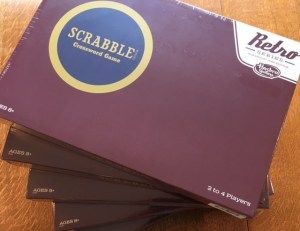
When the students in the Monday-Wednesday 8 o’clock class tore the plastic from the boxes of Retro Edition Scrabble, I had no idea how they would respond to the game. Back in August, when I had decided to include bimonthly Wordplay Days on the calendar, I did so to achieve two of my goals as a teacher: first, to offer students an opportunity to collaborate on low-stakes assignments that would develop their critical thinking skills and word power; and second, to provide another chance for them to turn away from screens.

A year earlier, in August 2017, when I revised my writing class curriculum to minimize my students’ screen time, I did so because both the research of psychologists and my own anecdotal evidence revealed the critical need to do so for the benefit of students’ mental health and cognitive development. With that in mind, I reserved more class time for my students to turn the pages of our textbook, to read aloud and pore over words, and to compose essay drafts in longhand—all while still maintaining blogs and devoting class time to typing essay revisions and posting comments to their classmates’ blogs.

Over the summer, as I looked back on the previous school year, I thought of the students’ faces. Some had seemed to express genuine interest, but more often they conveyed resignation or resistance. Research and my own observations of students’ progress assured me that my teaching practices were sound, but I remained troubled by how reading and writing away from the screen, rereading for deeper understanding, and putting pen to paper all seemed like drudgery to my students. How could I enliven the classroom? I asked myself. Scrabble came to me as an answer as I mulled over possibilities for collaborative classroom activities. By using a grading system with a participation and preparedness category, I am able to give students opportunities to improve their grades with low-stakes assignments, such as submitting monthly letters in stamped, addressed, and sealed envelopes. I do not grade the students on the quality of their letter writing (since I don’t read them). Instead, I grade them for the act of submitting the letters for me to mail.

I realized that I could similarly grade students for their participation in Scrabble Days, or—as I chose to call them—Wordplay Days, if I devised a score sheet that I could use to document their participation.

“Each team will appoint a scorekeeper,” I told the students on the first Wordplay Day, “but your grades will not be based on those scores. Instead, they will be based on your participation and the completion of the score sheet. If you participate in the game, don’t reach for your smartphones, and complete the score sheet, you will achieve one-hundred percent participation for the day.”

Then I held my breath.

The students gathered in their designated groups (drawn at random by a student volunteer) and began to play. When the class period ended, I had to remind them that it was time to leave. Let me repeat that: When the class period ended, I had to remind them that it was time to leave. What I had witnessed on that first Wordplay Day was not only students forming words on Scrabble boards but also posing questions about words (Is that a word?), and passing around the box top to study the rules of play. As they played, their postures and facial expressions changed. They were comfortable and happy. It’s not an overstatement to say that Scrabble transformed the classroom.

Noting that transformation isn’t to say that all of the students liked Scrabble. Some clearly didn’t. But even the students who agreed that “Scrabble, to put it bluntly, is a lousy game” (Kay C5) seemed to appreciate the opportunity to earn credit for an activity that didn’t seem dull or menial. And their other work in the classroom began to seem less arduous to them. Perhaps they didn’t mind reading and writing as much when they knew more Wordplay Days were still to come. Or perhaps they began to make connections between their book work and board play as they increased their word power and became more sophisticated strategists.

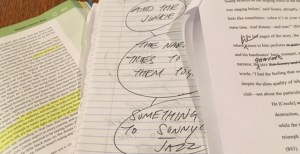
One of the first reading assignments that followed the inaugural Wordplay Day focused on games—not board games but electronic ones. When my students and I read portions of Sam Anderson’s “Just One More Game . . .” in class, I was struck by his reference to Jane McGonigal. Anderson notes that “[i]n her book Reality is Broken, Jane McGonigal argues that play is possibly the best, healthiest, most productive activity a human can undertake—a gateway to our ideal psychological state” (108). What I witnessed when my students played Scrabble seemed to attest to that. But McGonigal, I later learned, is a video game designer. My awareness of the research that links screen time with increased anxiety, depression, and sleep deprivation (Twenge par. 43) makes the notion of video games as a “gateway to our ideal psychological state” (Anderson 108) seem perverse.

That said, I am not opposed to electronic versions of Scrabble and similar word games, such as Words with Friends. But replacing board-game Scrabble with its digital counterpart—or with another video game, or smartphone app—would be contrary to my aim of limiting students’ screen time. And bearing in mind the research, I believe there’s a critical need to repeat this unpopular line at the beginning of class: “Your digital devices should be tucked away.”

As the semester progressed, fewer students were staring at screens when I entered the classroom, and rarely—and in some classes never—did I find myself asking a student to put away a phone during a Scrabble game.

About a month before the semester’s end, on a day when the students enjoyed a scheduled break from classes, our school’s administrators, faculty, and staff were on hand for an event called the Tenth-Grade Extravaganza, which brings more than one-thousand high school students to our campus to learn about the college.

Late in the day, one of the campus administrators shepherded the last tour group to the Blackbox Theatre, where I was assisting the theatre professor and her student volunteers. The last portion of the Theatre Department’s tour took place in the costume area, where we had set up a station for selfies and group photos. On a table nearby, we’d placed hats and various props for students to pose with. As the students fiddled with the hats and props, trying one, then another, their shepherd-administrator nudged me and said: “That girl over there has looked sad throughout the tour, but when she put that sock puppet on her arm, her face lit up with joy.” When I turned and saw that tenth-grader’s joyful face, she became one of my own students who had transformed before my eyes. The sock puppet was her Scrabble.

My return this semester to public higher education marked my first experience with lockdown drills. While they are new to me, most of my students’ years in school have long been disrupted by periodic exercises in avoiding slaughter. Witnessing how quickly they sprang into action, how the protocol was second nature to them, was heartbreaking. As I crouched with them in the corner, I thought of how now, more than ever, classrooms need to provide our students with a gateway out of the darkness and into joy.

Works Cited

Anderson, Sam. “Just One More Game . . . : Angry Birds, Farmville, and Other Hyperaddictive Stupid Games.” The Norton Field Guide to Writing with Readings and Handbook. 4th ed., by Richard Bullock, Maureen Daly Goggin, and Francine Weinberg. Norton, 2016, pp. 105-110.

Kay, Jonathan. Review. “Scrabble is a Lousy Game.” The Wall Street Journal, 6-7 Oct. 2018, C.5.

Twenge, Jean. “Have Smartphones Destroyed a Generation?” The Atlantic, https://www.theatlantic.com/magazine/archive/2017/09/has-the-smartphone-destroyed-a-generation/534198/Sept. 2017, Accessed 28 Aug. 2018.

Posted in Reading, Teaching, Writing

Scrabble as a Game Changer in the Writing Classroom

Scrabble Game Changer

In October, after I read Jonathan Kay’s Wall Street Journal review “Scrabble is a Lousy Game,” I meditated on his criticism of Scrabble as a word game that deemphasizes semantics. I asked myself, if I want my students to play a board game that cultivates word power and critical thinking skills, is Scrabble the game to choose? Thus, Kay’s review became the starting point for my research on the cognitive benefits of Scrabble play. As I scrolled through search results, I found only a couple of articles that specifically addressed Scrabble in the college classroom, but many that focused on the value of the game, itself, for sharpening the mind.

Article and draft

The dearth of articles on Scrabble in the college classroom may be explained by the emphasis on classwork with assessable outcomes rather than activities that foster the habits of mind essential to lifelong learning. The bibliography that follows includes Kay’s review, the starting point for my research, along with three refereed research articles. Two offer windows into the classrooms of professors whose students play Scrabble: one an English professor at a two-year college in California, the other a professor of engineering at a polytechnic university in Russia. The third article addresses cognitive evaluations of competitive Scrabble players and what they reveal about how experience shapes word recognition.

How much does Scrabble play cultivate our word power? The answer to that question remains unclear, but the research of psychologists and educators points to the merits of team Scrabble for improving not only our language skills, but also our facility with critical thinking, team-building, and spatial skills.

As I review my research on Scrabble, I look forward to searching for additional studies and commentary on the game. Whether it will lead to a larger project of my own, I do not know. But the knowledge I have gained will inform my teaching as I continue to revise the curriculum and consider additional opportunities for wordplay in the classroom.

Annotated Bibliography

Fletcher, Jennifer. “Critical Habits of Mind: Exposing the Process of Development.” Liberal Education, Winter 2013, pp. 50-55. Association of American Colleges and Universities, https://www.aacu.org/publications-research/periodicals/critical-habits-mind-exposing-process-development. Accessed 26 Nov. 2018.

“Critical Habits of Mind” addresses the teaching practices of a group of college math and writing faculty who collaborated to develop lessons to foster intellectual capacities, such as motivation and self-efficacy. Developmental educational instructors from three California colleges, Cabrillo, California State University-Monterey Bay, and Hartnell College, partnered to pilot classroom activities, including clicker technology, peer writing review, improvisation, metacognitive writing activities (e.g. “Math Anxiety Essays”), and Scrabble Fridays. Reflecting on their collaboration, author Jennifer Fletcher, associate professor of English at CSUMB, observes that foregrounding procedural knowledge, as their pilot activities did, enabled them to couple their teaching of discipline-specific content with the set of behaviors essential to teaching and learning.

Fletcher’s account of Hartnell writing instructor Hetty Yelland’s Scrabble Fridays is of particular value to educators who are considering Scrabble play as a classroom activity. Fletcher notes that Yelland’s observes “the extra effort students have to make to overcome the boredom—and their passive word knowledge—that eventually leads to more active and internalized language practices” (54).

Hargreaves, Ian S., et al. “How a Hobby Can Shape Cognition: Visual Word Recognition in Competitive Scrabble Players.” Memory & Cognition, vol. 40, no. 1, 2012, pp. 1-7. ProQuest, http://nclive.org/cgi-bin/nclsm?url=http://search.proquest.com/docview/952889499?accountid=9935.

“How a Hobby Can Shape Cognition” presents the findings of Canadian researchers in the Departments of Psychology and Medicine at Calgary University who investigated how the word recognition skills of competitive Scrabble players differed from those of age-matched nonexperts. The researchers’ cognitive evaluations revealed differences only in Scrabble-specific skills, such as anagramming. Also, the researchers observed that Scrabble expertise was associated with two specific effects: vertical fluency and semantic deemphasis. The study’s results indicate that experience shapes visual word recognition.

The research of Ian Hargreaves and his colleagues at the University of Calgary is pertinent to educators who seek to understand the cognitive benefits of frequent Scrabble play. Notably, the semantic deemphasis that the study identifies—and that Jonathan Kay addresses in his review—contrasts the gains in language skills that Hetty Yelland observes in her English students.

Kay, Jonathan. Review. “Scrabble is a Lousy Game.” The Wall Street Journal, 6-7 Oct. p. C. 5.

In “Scrabble is a Lousy Game,” writer and editor Jonathan Kay criticizes Scrabble for its lack of emphasis on semantics. In Kay’s words, the game “is like a math contest in which you are rewarded for reciting pi to the 1,000th decimal place but not knowing that it expresses the ratio of a circle’s circumference to its diameter” (C5). Kay asserts that the best board games for casual players involve a mix of luck and skill and recommends two other board games, Codenames and Paperback, as better options for wordplay.

While Kay’s review focuses on the competitive player’s approach to Scrabble, the concerns he raises about the game’s deemphasis of word meaning and the frustration that novice players can experience warrant the attention of educators who are considering introducing Scrabble play into their classrooms. And his recommendations of Codenames and Paperback offer teachers two word-game options to pursue as alternatives Scrabble.

Kobzeva, Nadezda. “Scrabble as a Tool for Engineering Students’ Critical Thinking Skills and Development.” Procedia: Social and Behavioral Sciences, no. 182, 2015, pp. 369-74. ScienceDirect, https://www.sciencedirect.com/science/article/pii/S1877042815030669. Accessed 26 Nov. 2018.

“Scrabble as a Tool for Engineering Students’ Critical Thinking Skills and Development” presents research involving second-year engineering students and teachers of EFL (English as a Foreign Language) at Tomsk Polytechnic University in Tomsk, Russia. The students—all non-native speakers of English—played Scrabble as an in-class and out-of-class-activity for one academic year. At the end of the year, the best six student players competed in teams in a tournament against two teams of the six EFL teachers. Throughout the tournament—which was conducted outside of the classroom to relieve students of the pressure to obtain a high score—the researcher, Nadezda Kobzeva, observed the contrast in the students’ and teachers’ practices as players. While the EFL instructors possessed an advanced knowledge of English language, they were newcomers to Scrabble. On the other hand, the engineering students with limited knowledge of English relied on the skills they developed throughout their year-long Scrabble program. In the feedback the students provided after the tournament, which they won, the majority of students rated the skills they developed as Scrabble players as excellent in all five fields assessed, including team-building, thinking, spatial skills, vocabulary, and spelling.

Kobzeva, a professor of engineering at Tomsk, focused his research on engineering students, but his findings are valuable to researchers and teachers in other fields who seek answers to the questions of how Scrabble can be used effectively as a learning tool, and what specific skills students may develop through frequent play.

Posted in Reading

“There isn’t any other tale to tell”: Polyphony and Epiphany in “Sonny’s Blues”

James Baldwin’s short story “Sonny’s Blues” depicts the life of a young jazz musician and addict, as seen through the eyes of his older brother. The inciting incident—what prompts the older brother to tell Sonny’s story—is a police report in the newspaper, citing Sonny’s arrest the night before. Reading that brief story, one that reduces his brother to someone who “peddle[s] and us[es] heroin” (813), leads the older-brother-narrator to meditate on the events that led to Sonny’s incarceration. The news of his arrest—albeit a brief item in the paper—plays a critical role in the opening paragraph, providing not only the inciting incident but also a counterpoint for the improvisation that breathes life into Sonny’s character. Despite the narrator’s initial dislike of Sonny’s music, the structure of his own storytelling mimics the composition of jazz, underscoring the kinship of his nonlinear, polyphonic story and the piano playing of his brother.

In the second paragraph of the story, the narrator recounts how he thought about Sonny all day “while [he] taught [his] classes algebra” (813). Placing the narrator in the classroom gives Baldwin the opportunity both to show how the students remind the narrator of Sonny as a youth and how the narrator’s occupation further differentiates him from his younger brother. Unlike the algebra that the narrator teaches, Sonny’s music and his life are disjointed.

As the narrator continues to reflect on his brother’s disjointed life, his thoughts are punctuated with the sound of the school bell and a boy “whistling a tune, at once very complicated and very simple” (814). Those noises create the offbeat rhythms of syncopation, signature sounds of jazz. The story’s syncopation builds as it takes an unexpected turn when the narrator encounters an old neighborhood friend of Sonny’s, another heroin addict who engages him in a conversation about Sonny’s arrest. That dialogue between the narrator and the junkie leads the narrator’s story back to the newspaper report, while the juke box at a nearby bar “blast[s] away with something black and bouncy” (816).

Along with the story’s syncopation, its polyphony—another defining characteristic of jazz—builds, adding to the story’s voices the words of Sonny, himself, first in the pages of his letter and later in his face-to-face conversations with the narrator. Sonny’s return to New York after the war prompts the narrator to think back on the story of his father witnessing the death of his own brother, a young guitarist run over by a drunken carload of white men. That story, told to the narrator by his mother, introduces not only the voice of his mother but also his father’s voice, indirectly—as well as the scream of the dying brother, the narrator’s uncle, and the guitar strings “flying” (825) as the car rolls over him.

The sounds of the uncle’s gruesome death aren’t the only notes of tragedy sung as the story’s polyphony builds. The narrator’s two-year-old daughter, Grace—whose death makes Sonny’s trouble real—dies from polio: “[T]he reason she hadn’t screamed was that she couldn’t get her breath. And when she did scream, it was the worst sound, Isabel [the narrator’s wife] says, that she’d ever heard in all her life, and she still hears it sometimes in her dreams” (833).

Such tragedies leave little wonder why Sonny or anyone else might turn to music or drugs, or both, as a way, in Sonny’s words, “to keep from shaking to pieces” (837). The link between heroin and jazz is one that Baldwin first makes implicitly, when Sonny mentions Bird (Charlie Parker) to the narrator, who has no idea who Parker is (828). Though Sonny doesn’t refer to Parker’s heroin use, his addiction—as legendary as his musical genius and inextricably tied to it—is likely in the forefront of the minds of many readers who see the parallels between Parker and Sonny.

That implicit connection between music and heroin becomes explicit later in the story when Sonny reflects on the singing voice of the tambourine player at the street revival: “‘When she was singing before,’ said Sonny, abruptly, ‘her voice reminded me for a minute of what heroin feels like sometimes—when it’s in your veins. It makes you feel sort of warm and cool at the same time. And distant—and sure’” (836).

In the last pages of the story, the narrator accompanies Sonny to a jazz club downtown, where he listens to him perform. Finally, with that performance, Sonny’s piano and his bandmates’ bass, trumpet, and drums join the polyphonic voices of the narrative. For the narrator, the quartet’s jazz remains a foreign language. In the narrator’s words, “I had the feeling that something had happened, something I hadn’t heard” (843). Yet despite the alien quality of what he hears, the narrator experiences an epiphany in the night club—not about the particular notes he hears, but rather about their aim:

He [Creole] and his boys up there were keeping it new, at the risk of ruin, destruction, madness, and death, in order to find new ways to make us listen. For, while the tale of how we suffer, and how we are delighted, and how we may triumph is never new, it always must be heard. There isn’t any other tale to tell. (843)

With those words, the narrator begins to make meaning—not of Sonny’s particular jazz stylings but of his striving to tell old stories in new ways. The climax of Sonny’s set is also the epiphany of the narrator’s own polyphonic, syncopated, narrative. As the narrator observes of Creole, Sonny’s bandleader, he “seemed to be saying, listen. Now these are Sonny’s blues” (843). And as Baldwin’s readers listen, they may say: These are his brother’s blues, too.

Work Cited

Baldwin, James. “Sonny’s Blues.” The Norton Field Guide to Writing with Readings and Handbook. 4th ed., by Richard Bullock, Maureen Daly Goggin, and Francine Weinberg, 2016, pp. 813-44.