If your initial plan doesn’t seem to be taking shape, turn away from your draft for a while. Try brainstorming or freewriting in your journal. Don’t concern yourself with spelling and structure; attend to those matters later. The aim of brainstorming and freewriting is to get your ideas on paper as quickly as you can.
For more on brainstorming and freewriting, see A Writer’s Reference (6).
Write Your Uncertainty into Your Story
If you’re unsure of some details, make your uncertainty part of your literacy narrative. Art Spiegelman does just that in the epigraph for Maus when he writes, “I was ten or eleven . . .” (5).
Look to Maus and An American Childhood as Models
Continue to examine Maus as a model. Study how Spiegelman creates tension in the panels of his comic. Also reread the excerpts from Annie Dillard’s memoir, An American Childhood, included in my September 9 blog post (“ENG 111: Of Maus and Memoirs, Part II”). Look to Dillard’s words as models for creating dialogue and shifting back and forth from scene to summary.
Seek More Models
For starters, see the New York Times feature “The 50 Best Memoirs of the Past 50 Years.” The description of each memoir in the list includes a short quotation, a sentence or two, from the book. Browse the list, and if you read a line that you find evocative, write it down in your journal. Here’s one that I recorded in my journal:
He [J.M. Coetzee] feels like a crab pulled out of its shell, pink and wounded and obscene” (qtd. Szalai).
Writing of himself in third person, Coetzee vividly depicts the vulnerability that many of us feel when we put ourselves on the page for others to see.
For additional models, I offer the list below, which includes five literacy narratives written by former English 111 students of mine and two written by me.
Last week I advised you to Study Spiegelman’s scenes closely. As you continue to read Maus, and as you prepare to write your first essay for English 111, your literacy narrative, note which panels of Spiegelman’s convey conflict, either a character’s inner conflict or a character’s conflict with another character. Conflict, which is essential to narrative, appears on virtually every page of Maus.
The first half of Chapter 2, “The Honeymoon,” depicts six conflicts or problems:
Vladek combatting his medical condition (heart disease, diabetes)
the policemen’s pursuit of Anja
the interrogation of Anja’s aide, the seamstress, Miss Stefanska
Art questioning his father’s storytelling
Anja’s struggles with post-partum depression, and
the train passengers facing the threat of the Nazi regime, signified by the flag in the center of the page (32).
Scene and Summary
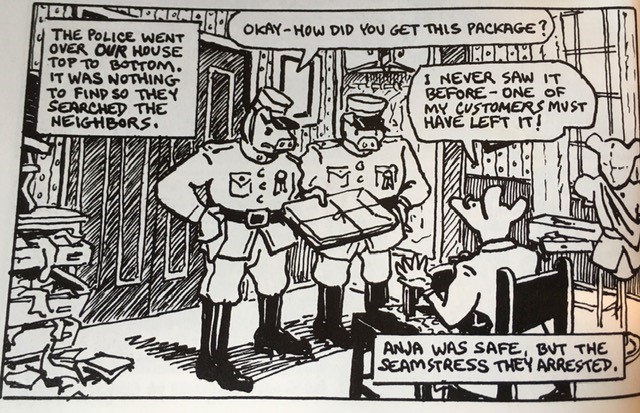
As a comic, Maus consists primarily of scenes but it includes summary as well. In the panel below, which depicts Miss Stefanska’s interrogation by the Polish police, the scene is depicted with the panel’s drawing and its speech balloons. Spiegelman presents summary in the rectangles.
Spiegelman, Art. Maus I. Pantheon, 1986. p. 28.
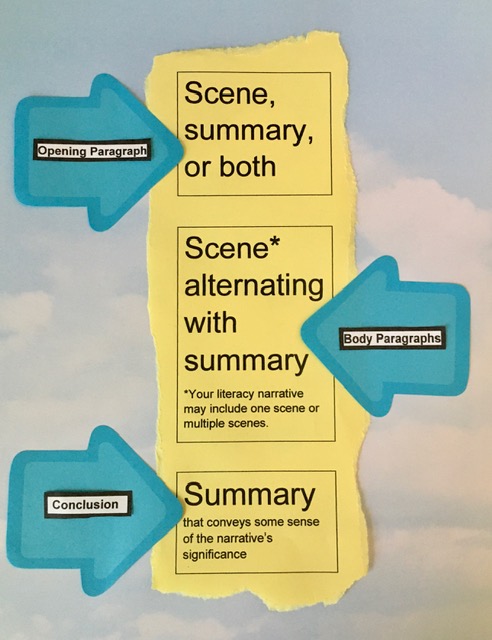
Scene and summary are the building blocks of narratives. Simply put, scenes show and summaries tell. Narratives can consist primarily of scenes, but ones that rely heavily on summary don’t capture our imagination. As you plan your literacy narrative, keep this in mind: Readers would rather be shown than told.
The paper-craft graphic below illustrates the organization of scene and summary in a narrative essay.
Dialogue
Maus demonstrates the important role that dialogue often plays in narrative, but it doesn’t show how dialogue is presented in an essay. In comics, dialogue appears in speech balloons. Prose narratives (essays, short stories, novels, and book-length nonfiction) present dialogue with lines of speech enclosed in quotation marks and with dialogue tags. A dialogue tag is a short phrase at the beginning, in the middle, or at the end of the dialogue that attributes the dialogue to a particular person or character.
“Have you chosen a topic for your literacy narrative?” she asked.
In the sentence above, she asked is the dialogue tag.
When you write dialogue, you begin a new paragraph whenever the speaker changes. That’s why paragraphs of dialogue are generally short, often only one line.
Consider the dialogue below, from Annie Dillard’s memoir, An American Childhood:
Dillard, Annie. An American Childhood. Harper & Row, 1987. p. 112.
In the first paragraph, Annie Dillard summarizes how her mother would tell her to spell words. In the second paragraph, Dillard moves to the scene of one particular evening, the night when her mother says there’s a deer in the hall. Only the first of the three short paragraphs that follow the summary includes a dialogue tag. The other two don’t need tags because the new paragraph itself, the indentation of five spaces, signals a change in the speaker.
Once you’ve established who the speakers are in a dialogue between two people, you don’t need to include dialogue tags.
Notice that the first and last paragraphs include single quotation marks within the lines of dialogue. In the first paragraph, the words poinsettia and sherbet are enclosed in single quotation marks because words referred to as words are enclosed in quotation marks. Since the two words are contained within a longer quotation, Dillard’s mother’s line of dialogue, the words are enclosed in single quotation marks.
In the last paragraph, the words I know are enclosed in single quotation marks because the mother is quoting her daughter.
Words referred to as words in dialogue and quotations within lines of dialogue are enclosed in single quotation marks.
For more information on quotation marks, see A Writer’s Reference (279-80).
Look to the passage that follows as another model for your literacy narrative. Here, Annie Dillard recounts seeing an amoeba for the first time:
Finally late that spring I saw an amoeba. The week before, I had gathered puddle water from Frick Park; it had been festering in a jar in the basement. This June night after dinner I figured I had waited long enough. In the basement at my microscope table I spread a scummy drop of Frick Park puddle water on a slide, peeked in, and lo, there was the famous amoeba. He was as blobby and grainy as his picture; I would have known him anywhere.
Before I had watched him at all, I ran upstairs. My parents were still at table, drinking coffee. They, too, could see the famous amoeba. I told them, bursting, that he was all set up, that they should hurry before his water dried. It was the chance of a lifetime.
Father had stretched out his long legs and was tilting back in his chair. Mother sat with her knees crossed, in blue slacks, smoking a Chesterfield. The dessert dishes were still on the table. My sisters were nowhere in evidence. It was a warm evening; the big dining-room windows gave onto blooming rhododendrons.
Mother regarded me warmly. She gave me to understand that she was glad I had found what I had been looking for, but that she and Father were happy to sit with their coffee, and would not be coming down. She did not say, but I understood at once, that they had their pursuits (coffee?) and I had mine. She did not say, but I began to understand then, that you do what you do out of your private passion for the thing itself.
I had essentially been handed my own life, in subsequent years my parents would praise my drawings and poems, and supply me with books, art supplies, and sports equipment, and listen to my troubles and enthusiasm, and supervise my hours, and discuss and inform, but they would not get involved with my detective work, nor hear about my reading, nor inquire about my homework or term papers or exams, nor visit the salamanders I caught, nor listen to me play piano, nor attend my field hockey games, nor fuss over my insect collection. My days and nights were my own to plan and fill.
Those paragraphs from An American Childhood don’t include any direct quotations. In the second paragraph, Dillard recounts what her mother said, but she doesn’t present it as dialogue. If the exact words spoken aren’t crucial to a scene, you can present the conversation indirectly, as Dillard does above.
Narratives Don’t Have to Center on Dramatic Events
The excerpts that you’ve just read from An American Childhood demonstrate how to write dialogue and shift between scene and summary. And perhaps most importantly, they demonstrate this: Narratives don’t have to center on dramatic events.
If you think that you don’t have a story to write as your literacy narrative, look again at Dillard’s depiction of herself as a student of the natural world. There’s no dramatic conflict, but there’s desire. First, she wants to see an amoeba, something she’s never seen before. Second, she wants her parents to share her excitement, but they don’t. With her microscope, Annie Dillard develops her knowledge of nature, but the larger learning experience that takes place is her realization that “you do what you do out of your private passion for the thing itself” (149). She has “essentially been handed [her] own life” (149).
What quiet, significant learning experience of yours has lingered in your mind? Your answer to that question could be the start of your literacy narrative.
Literacy Narrative Topics
I included your options in the previous blog post and am listing them here as well:
any early memory about writing, reading, speaking, or another form of literacy that you recall vividly
someone who taught you to read or write
someone who helped you understand how to do something
a book that has been significant to you in some way
an event at school that was related to your literacy and that you found interesting, humorous, or embarrassing
a literacy task that you found (or still find) especially difficult or challenging
a memento that represents an important moment in your literacy development
the origins of your current attitudes about writing, reading, or speaking
creating and maintaining your WordPress blog
Length Requirement
Your literacy narrative should be no fewer than five-hundred words. I encourage you to challenge yourself to exceed the minimum.
When to Begin
You are not required to begin your literacy narrative before the class period devoted to drafting, but you are welcome to sketch out ideas and begin drafting in your journal.
Dillard, Annie. An American Childhood. Harper & Row, 1987.
Last week I asked you to focus your journal writing on the epigraph for Maus I, first by writing a short summary and afterward by writing about how the short two-page epigraph relates to Chapter 1.
Here’s my version of that journal exercise:
In Art Spiegelman’s epigraph for Maus I, “Rego Park, N.Y., c. 1958,” he recounts the events of a summer’s day when he was ten or eleven years old. He and two of his friends are racing together on roller skates until one of Artie’s skates comes loose and he falls. Rather than waiting for Artie, the other two boys skate away, leaving him behind to be the “Rotten egg” (5). After Artie returns home, his father asks why he is crying. When Artie tells his father what happened, his father questions his son’s use of the word “friend.” He replies, “If you lock them together in a room with no food for a week . . . / . . . Then you could see what is, friends! . . .” (6).
The cutting remark that Spiegelman’s father makes as he saws wood illustrates the communication breakdown between him and Artie. Spiegelman’s depiction of that gulf foreshadows the trials he will encounter: struggling to understand his father and himself as he aims to make meaning of their lives through his comics.
Notice how the first paragraph, the summary, does not express my opinion. By definition, summaries are objective. When you write a summary, you aim to convey a text’s main ideas in your own words but without offering your own opinion.
Analysis
In the second paragraph, I turn to analysis. I connect the father’s cutting, or unkind, remark to the sawing of the wood, which is itself an act of separation—a detail that I might add to the paragraph if choose to develop my analysis.
Summary and analysis are building blocks of both academic and professional writing. We summarize to increase our understanding of texts, and we analyze them to demonstrate our ability to think critically.
For more information on summary and analysis, see pages 63-64 of A Writer’s Reference.
Writing about Maus in Your Journal
After you complete each reading assignment in Maus, summarize it in your journal. You are not required to analyze each reading, but you should make note of any questions you have and points that you would like to address in class.
What to Focus on as You Read Maus
Because Maus is a memoir and your first essay assignment for English 111 is a literacy narrative, a form of memoir, focus on this question: How can Maus serve as a model for my own memoir, my literacy narrative?
In your literacy narrative, which you will draft and revise in September, you will write on one of these topics:
any early memory about writing, reading, speaking, or another form of literacy that you recall vividly
someone who taught you to read or write
someone who helped you understand how to do something
a book that has been significant to you in some way
an event at school that was related to your literacy and that you found interesting, humorous, or embarrassing
a literacy task that you found (or still find) especially difficult or challenging
a memento that represents an important moment in your literacy development
the origins of your current attitudes about writing, reading, or speaking
creating and maintaining your WordPress blog
Spiegelman, Art. Maus I. Pantheon, 1986. p. 6.
Maus isn’t a precise model; it’s a book-length comic rather than an essay, but Spiegelman’s memoir serves as a guide for us as writers. Here are some points to consider:
Consider the title, Maus, the subtitle of the book, A Survivor’s Tale, and the subtitle of Part I, My Father Bleeds History. What does each one tell you about the book? After you decide on a topic for your literacy narrative, ask yourself what you want the title to tell the reader. Will your essay also have a subtitle? Sometimes the best title isn’t clear at the beginning of the writing process. Think about your title, but don’t get hung up on it. Return to it after you have finished drafting.
Study Spiegelman’s scenes. Your narrative will include one or more scenes, but yours will be created solely with words, rather than with words and drawings. As you examine the panels in Maus, note which ones convey conflict, either a character’s inner conflict or a character’s conflict with another character. Conflict is essential to narrative.
Note that the epigraph for Maus could be scenes in a literacy narrative. Imagine the two scenes in paragraph form. What would Art Spiegelman add as the final paragraph to give his readers some sense of the narrative’s significance? (What did it mean to him, and what did he learn from it?)
Congratulations to Caeley Arney, the first student to solve the mystery of May the fourth.
And the early-bird bonus points go to Caeley and these nine additional students: Grey Sacona, Breanna Bowman, Paige Lewis, Bryan Alba, Luke Noble, Madison St. Clair, Ruben Castillo, Joe Van Story, and Joe Robins! Well done, and May the Fourth be with You!
What links English 242 to the British actors Benedict Cumberbatch and Johnny Lee Miller? The answer is three characters, two that we reflected on when we moved online in March and a third that’s the focus for the final week of the course, which begins today.
Both Cumberbatch and Miller have played the role of Sherlock Holmes; Cumberbatch portrayed him in the BBC series Sherlock (2010-17), set in present-day London, and Miller played him in the CBS series Elementary, which transformed the Scotland Yard detective into an investigator in present-day New York City. In between the launches of those two series, Cumberbatch and Miller performed together in the Royal National Theatre production of Frankenstein (2011). The two actors alternated the roles of Victor and the Creature and shared the Olivier Award (the equivalent of Broadway’s Tony) for their performances. The pairs of photographs that follow feature Cumberbatch and Miller as Holmes and in their dual roles in Frankenstein.
Top: (L-R) Cumberbatch and Miller as Sherlock Holmes / CBS, BBC; Bottom: Trading the roles of Victor and the Creature in Frankenstein / Royal National Theatre
Playwright Nick Dear‘s Frankenstein and the series Sherlock and Elementary are but three of the many adaptations that attest to the enduring appeal of the narratives that bookend our semester. The popularity of Sir Arthur Conan Doyle‘s detective and his many incarnations in film and television inspired the first of three options for your blog response this week.
Option One:
Have you watched Sherlock, Elementary, or one of the Holmes films featuring Robert Downey, Jr. as the title character? If so, address the similarities and differences between the portrayal of the detective on screen and Sir Arthur Conan Doyle‘s portrayal of him in “The Adventure of the Speckled Band.” If you write about Sherlock or Elementary, don’t focus on the obvious difference in the time setting, ditto for the location (New York City) of Elementary. Include both the title of the series/film and the actor’s name in your response.
Option Two:
“The Adventure of the Speckled Band” belongs to the subgenre of detective story known as the locked room mystery, in which a murder occurs in a closed space where the perpetrator seemingly vanishes into thin air, and there are few, if any, suspects. Which detail about the locked room mystery of Julia Stoner’s death, or her bedroom where the murder took place, do you find most intriguing?
Option Three:
In The Norton Anthology of British Literature, the editor notes that Sir Arthur Conan Doyle named “The Adventure of the Speckled Band” as his favorite Sherlock Homes story and that “[m]any fans have agreed; readers’ polls over the years have frequently rated ‘The Speckled Band’ as the best Holmes story of all” (920). If you have you read another Sherlock Holmes story that you favor over “The Adventure of the Speckled Band,” write a response that addresses its merits. If you’ve read other Holmes stories and prefer “The Speckled Band,” explain why.
Extra Credit:
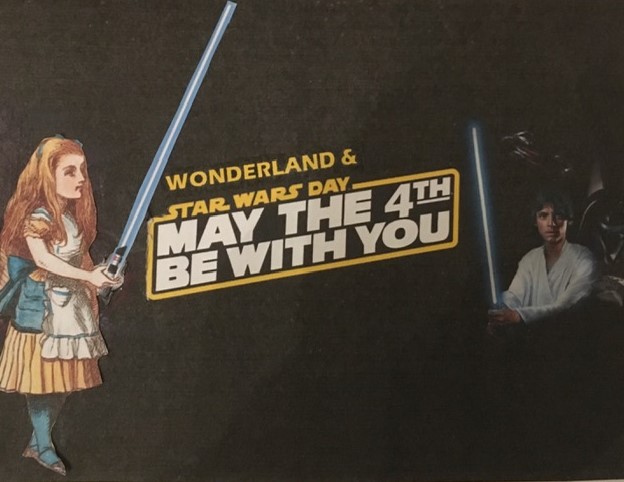
It’s no mystery why the force is with us today, but how does May the fourth figure in one of the works of Victorian literature that we’ve studied? In your response, cite the two lines that together solve the mystery. Follow each quotation with a parenthetical citation.
Remember to check your CVCC email and Blackboard regularly for updates.
Work Cited
Robson, Catherine. Biographical Note: “Sir Arthur Conan Doyle, 1859-1930.” The Norton Anthology of British Literature: The Victorian Age. 10th ed. Stephen Greenblatt, General Editor. W.W. Norton, 2018. pp. 920-21.
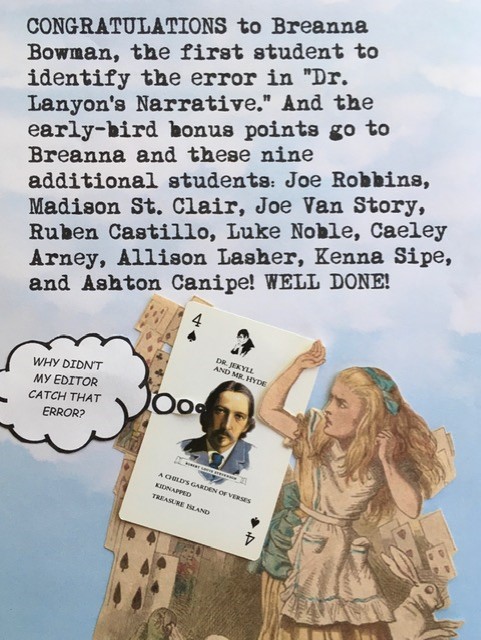
Congratulations to Breanna Bowman, the first student to identify the error in “Dr. Lanyon’s Narrative.” And the early-bird bonus points go to Breanna and these nine additional students: Joe Robbins, Madison St. Clair, Joe Van Story, Ruben Castillo, Luke Noble, Caeley Arney, Allison Lasher, Kenna Sipe, and Ashton Canipe! Well done!
The date of Jekyll’s letter to Lanyon should be January 9, not December 10. Here’s the note on the error in The Norton Anthology of English Literature:
Stevenson’s own error; the first sentence of ‘Dr. Lanyon’s Narrative’ makes it clear that the letter should be dated ‘9th January.’ Literary critic Richard Dury attributes the slip to the following circumstances: Stevenson had originally wanted to publish his story in time for the Christmas market and align Lanyon’s witnessing of Hyde’s transformation with December, a time for mysterious events. Later he forgot to change the detail. (794n1)
Work Cited
Stevenson, Robert Louis. The Strange Case of Dr. Jekyll and Mr. Hyde. 1886. The Norton Anthology of British Literature: The Victorian Age. 10th ed. Stephen Greenblatt, General Editor; Catherine Robson, Volume Editor. W.W. Norton, 2018. pp. 767-809.
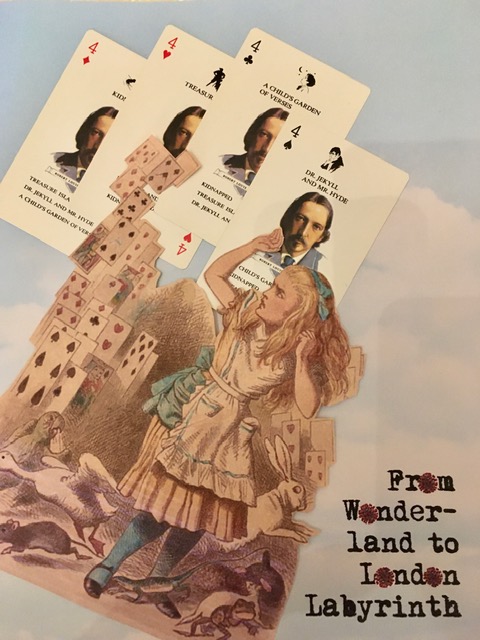
As I reread the last chapter of Alice’s Adventures in Wonderland, John Tenniel’s illustration of the cards “flutter[ing] down” on Alice reminded me of my earliest memories of Robert Louis Stephenson. He was part of my childhood not only as the man behind A Child’s Garden of Verses but also as one of the faces that stared out from the cards in my hand when my sister, my cousins, and I played the game of Authors.
Writing of Stevenson as a children’s author, the Scottish novelist Margot Livesey notes:
That I and so many others came to his work so young has made us consider him a children’s author from whom we have little to learn as adults. This opinion is one that his contemporaries would not have shared, either in his particular case or as a general rule. Victorian adults felt free to embrace so-called children’s books without apology. Stevenson’s father often reread The Parent’s Assistant, a volume of children’s stories, and Virginia Woolf records being taken to Peter Pan on her twenty-third birthday with no signs that this was a childish treat.
Writing of the experience of reading Stevenson’s Gothic tale, Livesey observes that
[s]lowly but inexorably we are being led into a strange country, where the relationship between Jekyll’s prim white hand and Hyde’s orgiastic hairy paw will be revealed. The two are not merely opposites, or alter egos. In [novelist Vladimir] Nabokov’s helpful analogy Hyde is a precipitate of Jekyll. We might also think of him as Jekyll’s son.
That idea of Hyde as Jekyll’s son inspired the first option for this week’s assignment.
Option One:
Henry Jekyll’s scientific ambition and its monstrous product, Edward Hyde, link Stevenson’s novella to one of its Gothic precursors, Mary Shelley’s Frankenstein. Do the similarities between Victor Frankenstein and Dr. Jekyll seem more apparent in Dr. Hastie Lanyon’s accounts of Henry Jekyll, or in Jekyll’s own “Full Statement of the Case”? Why?
Option Two:
The editor of the Victorian volume of The Norton Anthology of British Literature notes that “our familiarity with the outline of the story may not prepare us for the psychological and ethical complexity of the original” (Robson 766). What passage in The Strange Case of Dr. Jekyll and Mr. Hyde best exemplifies that complexity?
Option Three:
In “The Double Life of Robert Louis Stevenson,” Margot Livesey names Mr. Utterson, Jekyll’s lawyer, as “the best possible witness to the horror of Hyde.” Do you think Utterson is the best character to guide readers through the story? Which other character might serve as guide, and how would that change alter the narrative?
Extra Credit:
Early in “Dr. Lanyon’s Narrative,” Robert Louis Stevenson made an error that went unnoticed by his editor. What is it?
Remember to check your CVCC email and Blackboard regularly for updates and assignments.
Robson, Catherine. Biographical Note: “Robert Louis Stevenson, 1850-1894.” The Norton Anthology of British Literature: The Victorian Age. 10th ed. Stephen Greenblatt, General Editor. W.W. Norton, 2018. pp. 765-66.
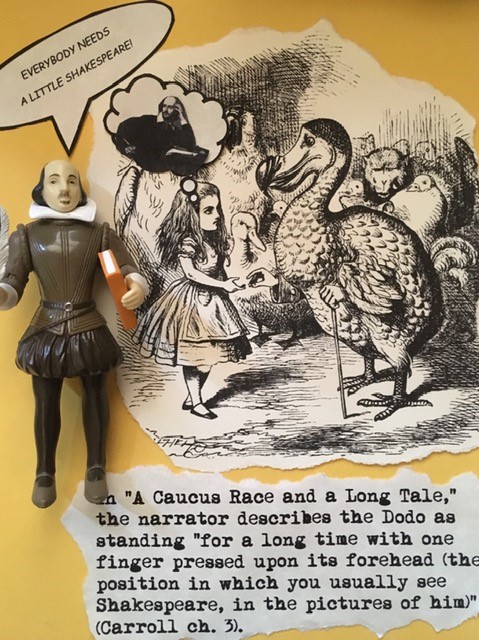
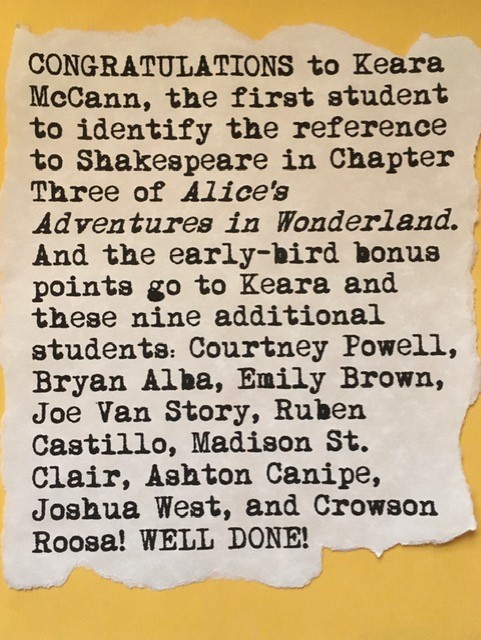
CONGRATULATIONS to Keara McCann, the first student to identify the reference to Shakespeare in Chapter 3 of Alice’s Adventures in Wonderland:
In “A Caucus Race and a Long Tale,” the narrator describes the Dodo as standing “for a long time with one finger pressed upon its forehead (the position in which you usually see Shakespeare, in the pictures of him).”
And the early-bird bonus points go to Keara and these nine additional students: Courtney Powell, Bryan Alba, Emily Brown, Joe Van Story, Ruben Castillo, Madison St. Clair, Ashton Canipe, Joshua West, and Crowson Roosa! WELL DONE!
Thank you for all of your thoughtful and detailed feedback on the untitled monologue and The Story of Shabath.Before we turn from drama to poetry, I offer these follow-up notes:
Untitled Monologue
Mia noted the problematic detail of Deen’s parole. I didn’t mention that issue in my introductory remarks because it’s one with an easy fix. The officer needs a motive for his encounter with Deen, but that motive needn’t be a parole violation. A confrontation prompted by an unrelated minor offense—such as a speeding ticket or a shoplifting arrest—would add to the monologue’s irony. That said, who other than an officer might prompt Deen’s rant?
Brendan, Zane, and Brandy recommended delaying Deen’s revelations about her role in her family’s tragedies. I addressed the subject of sequence in my previous post for the same reasons that Brendan, Zane, and Brandy mentioned. If the audience is introduced to Deen as an unlikable young woman but one who is nevertheless a devoted friend to Carol, the revelation that Deen is responsible for her parents’ death and her brother’s paralysis will transform her from mildly annoying to morally reprehensible. The structure of that transformation might be similar to that of Donald Barthelme’s “The School,” as Brendan suggested.
Trevor recommended “Six Feet Under” and “An Inconvenient Inheritance” as possible titles. Is there a line of Deen’s—such as “So here’s the thing”—that might serve as the title?
The Story of Shabath
Trevor suggested that the monorail could appear as a projected image in the background, and that sound effects and props could differentiate Shabath Aizwald’s memories. Those recommendations remind us that playwrights’ scripts—unlike creative nonfiction, fiction, and poetry—are starting points for collaboration (among the director, the actor/s, and the technical crew); it’s important to imagine how the story might move from page to stage. Trevor’s mention of props and sound effects leads me to Mia‘s observation about the number of acts and scenes
If stage hands costumed as citizens of Laghaz entered and exited with the props that signal shifts from one memory to the next, those visual cues could enable the monologue to unfold as one seamless scene.
Brennan, Zane, Mia, and Brandy observed that the audience learns more about the kingdom of Laghaz than they do about Shabath himself. What motivated him to found Faya? What in particular was painful about his regenerative process? What were the physical and emotional costs, and how might Shabath convey those through his words and actions?
Mia noted Shabath’s potential drug problem. Whether the elixir he injects is medicinal or detrimental to his health, its effects could develop his character and serve as a source of tension.
Brennan‘s words “the rain . . . mixed with a man pondering his life on a high-speed monorail” brings to mind Philip K. Dick’s Do Androids Dream of Electric Sheep?, a novel that the writer might find instructive to read, or reread, with an eye toward the rendering of the speech of the bounty hunter Rick Deckard.
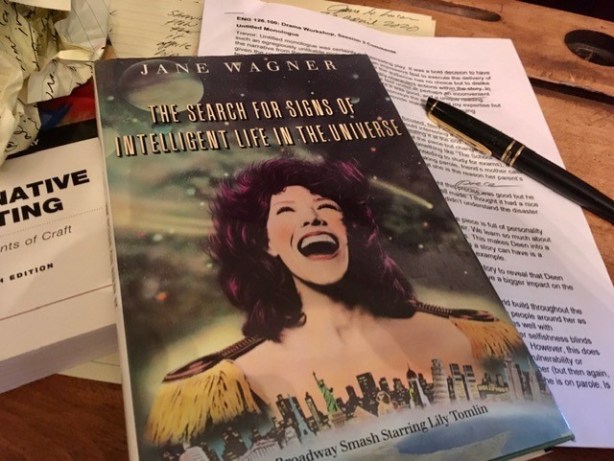
To the writers of both scripts, I recommend Jane Wagner‘s play The Search for Signs of Intelligent Life in the Universe. It’s a one-woman show featuring a series of monologues linked by the narrator, Trudy, a deranged bag lady who befriends alien visitors who are studying Earth as “a planet still in its puberty” (136). I recommend it to the writer of the untitled monologue for the characters’ diction and speech patterns. To the writer of The Story of Shabbath, I recommend examining how Wagner’s monologues develop the individual characters while also addressing social problems.
Work Cited
Wagner, Jane. The Search for Signs of Intelligent Life in the Universe. 1985. Harper & Row, 1986.
Introduction to Poetry
As we turn from drama to poetry, consider again Janet Burroway’s, Carolyn Kizer’s, and Theodore Roethke’s observations about the similarities between the two genres:
Her [Carolyn Kizer’s] mentor Theodore Roethke . . . advised thinking of a poem ‘as a three-act play, where you move from one impulse to the next, and then there is the final breath, which is the summation of the whole.’ Kizer points out that Roethke’s poem ‘I knew a Woman’ (p. 127) contains the line ‘She taught me turn, and Counter-turn, and Stand,’ which is ‘the essence of the dramatic structure. It’s what a long poem has to do. It doesn’t require physical action, but there has to be some mental or emotional movement that carries through the poem.’ (313-14)
If a poem mimics dramatic structure and involves movement, it will need, like a story or drama, to achieve conclusion. In Roethke’s description, this achievement is the ‘final breath,’ or, in his line above the ‘and Stand’ of the poem. (314)
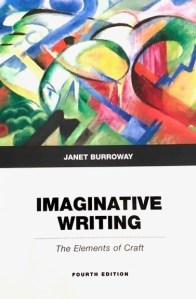
In Chapter 10 of Imaginative Writing, Janet Burroway includes three self-reflexive poems about language and writing (319-21). If you haven’t chosen a subject for your workshop poem/s, consider writing a poem that focuses on language or one of your own pieces of writing, another poem or a work of prose.
You might also try writing an ekphrastic poem: one about or inspired by another work of art. “Overblown,” the sample poem that I posted for you on Blackboard, is an ekphrastic poem that I wrote based on Momoyo Torimitsu’s Somehow I Don’t Feel Comfortable (the giant inflated pink rabbit in the photo) for an Art of Poetry Catawba Valley event at the Hickory Museum of Art.
For additional models and sources of inspiration, I encourage you to reread these poems in Imaginative Writing:
“I Knew a Woman” by Theodore Roethke (127)
“Nude Interrogation” by Yusef Komunyakaa (156)
“A Story about the Body” by Robert Hass (187)
“Columbine High School/Littleton, CO” by Albert Goldbarth (188)
“Woodchucks” by Maxine Kumin (188-89)
“The Hammock” by Li-Young Lee (189-90)
“The One Girl at the Boys Party” by Sharon Olds (312-13)
Since you are working on your poetry workshop assignment this week, you are not required to post a comment in response to this post, but I strongly encourage you to post one of the following as a brief response:
Any other poems in Imaginative Writing that you recommend to your classmates as models or sources of inspiration
A link to a poem that you admire and would encourage your classmates to read
Any of Janet Burroway‘s “Try This” exercise that have been helpful to you as you’ve drafted your poem/s
Remember to check your CVCC email and Blackboard regularly for updates and assignments.
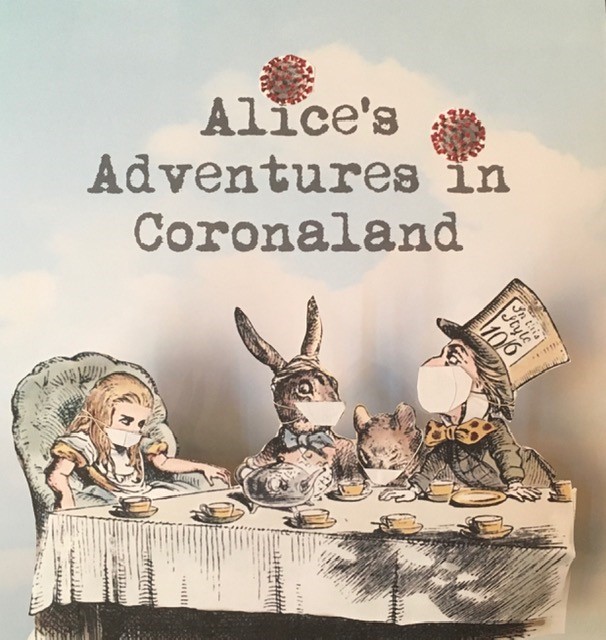
The title of this post, “Curiouser and Curiouser!,” is the first line of Chapter 2 of Alice’s Adventures in Wonderland. Though the phrase is grammatically incorrect—as Alice acknowledges later in the sentence (the standard comparative is “more curious”)—it’s a fitting response for someone who finds herself, as Alice does, “opening out like the largest telescope that ever was” (Carroll ch. 2). “Curioser and curiouser!”: apt words for Alice, as well as for us as we slog our way through these nonstandard days in Coronaland.
Before the curiousness of Chapter 2 begins, in Chapter 1, Alice asks, “What is the use of a book . . . without pictures or conversation?” With those words of Alice’s in mind, consider the illustrations in the first edition of Alice’s Adventures in Wonderland, ones drawn by Carroll’s collaborator, John Tenniel. (Since they aren’t included in the Project Gutenberg edition that you’re reading, I have included a link to them above).
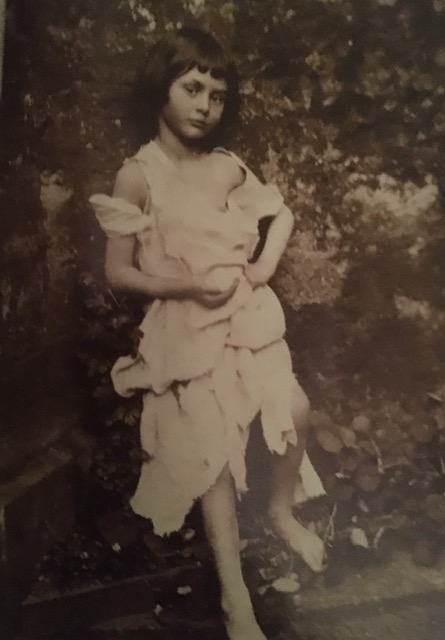
Alice Liddell photographed by Dodgson (Carroll) / W.W. Norton
If you had received your copies of Volume E of the Norton Anthology, you would see in its pages the picture of Alice Liddell here. Charles Lutwidge Dodgson (Lewis Caroll)—who photographed Liddell and was a friend of hers—was an early advocate of photography, which was a new art form in the Victorian era. Liddell was the inspiration for Alice’s Adventures in Wonderland and its sequel, Through the Looking-Glass, but she wasn’t the model for Tenniel’s illustrations.
Costumed in rags for this picture, Alice Liddell was far from a beggar child; she was the daughter of Dean Liddell, principal of Christ Church College of Oxford University, where Dodgson (Carroll) taught mathematics.
Dodgson’s profession as a mathematician leads me to the first of four options that I have developed for your assignment onAlice’s Adventures in Wonderland. Be sure to read the directions (below the options) before you begin, and note the extra-credit opportunity that follows the directions.
OPTION ONE: Although the Alice books are his legacy, Dodgson was a mathematician by profession. Address one or more passages in Alice’s Adventures in Wonderland that are demonstrably the product of a mathematical mind.
OPTION TWO: In The Norton Anthology’s introduction to Alice’s Adventures in Wonderland, the editor notes that both Alice books “provide a wealth of information about the forms and contents of a well-to-do little girl’s education at the mid-point of the Victorian era” (724). Address one or more passages that reveal details of the “forms and contents” of Alice’s schooling.
OPTION THREE: In 1989, two American high school students who were researching Alice’s Adventures in Wonderland made a new discovery about Chapter 3, one that led to the publication of their findings in Jabberwocky, (now named The Carrollinian), the British journal of the Lewis Carroll society. Read the New York Timesarticle about the students’ discovery, and address both the discovery and the “Long Tale” of Chapter 3.
OPTION FOUR: Read “9 Ways Artists Have Imagined Alice in Wonderland,” and address one of the nine artists’ illustrations. Include the artist’s name and cite at least one short passage that the illustration captures effectively.
DIRECTIONS: Compose a comment of at least fifty words. Include a minimum of one quotation from Alice’s Adventures in Wonderland introduced with a signal phrase and followed by a parenthetical citation. If you name Carroll in the signal phrase, include only the abbreviation for the chapter followed by the chapter number. For example: (ch. 1). If you do not name Carroll in the signal phrase, include the author’s last name, the abbreviation for the chapter, and the chapter number. For example: (Carroll ch. 1). Note that the c is lower case. For more information on citations, see OWL. Post your comment no later than 5 p.m. on Thursday, April 23.
EXTRA CREDIT: Emily Brown was the first student to identify the ghost of Hamlet’s father as the literary ghost that the narrator mentions in the first stave of A Christmas Carol. That earned Emily an extra-credit assignment in the participation and preparedness category. Shakespeare himself is mentioned in Alice’s Adventures in Wonderland. The first student who posts a comment identifying the sentence that mentions him will receive an extra-credit assignment.
Remember to check your CVCC email and Blackboard regularly for updates and assignments.




 What links English 242 to the British actors Benedict Cumberbatch and Johnny Lee Miller? The answer is three characters, two that we reflected on when we moved online in March and a third that’s the focus for the final week of the course, which begins today.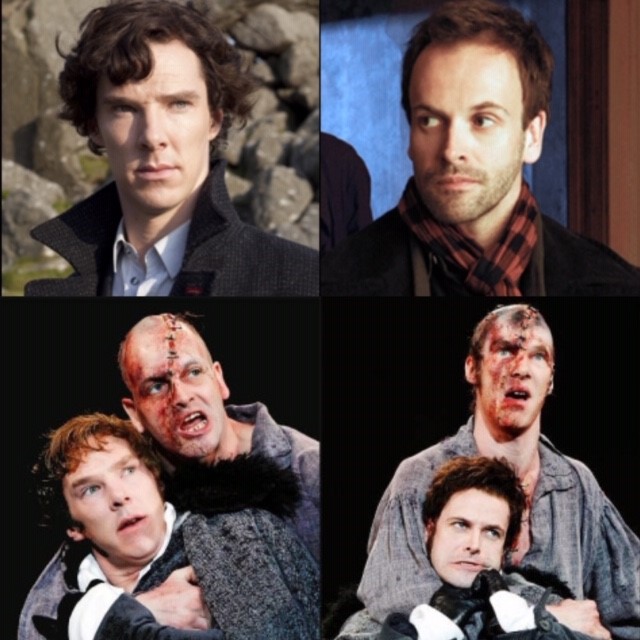
 As I reread the last chapter of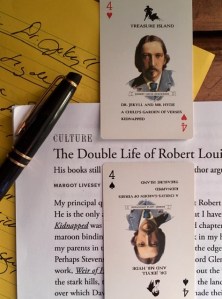
 Drama Follow-Up
 you move from one impulse to the next, and then there is the final breath, which is the summation of the whole.’ Kizer points out that Roethke’s poem ‘I knew a Woman’ (p. 127) contains the line ‘She taught me turn, and Counter-turn, and Stand,’ which is ‘the essence of the dramatic structure. It’s what a long poem has to do. It doesn’t require physical action, but there has to be some mental or emotional movement that carries through the poem.’ (313-14)
 sample poem that I posted for you on Blackboard, is an ekphrastic poem that I wrote based on Momoyo Torimitsu’s Somehow I Don’t Feel Comfortable (the giant inflated pink rabbit in the photo) for an