 James Baldwin’s short story “Sonny’s Blues” depicts the life of a young jazz musician and addict, as seen through the eyes of his older brother. The inciting incident—what prompts the older brother to tell Sonny’s story—is a police report in the newspaper, citing Sonny’s arrest the night before. Reading that brief story, one that reduces his brother to someone who “peddle[s] and us[es] heroin” (813), leads the older-brother-narrator to meditate on the events that led to Sonny’s incarceration. The news of his arrest—albeit a brief item in the paper—plays a critical role in the opening paragraph, providing not only the inciting incident but also a counterpoint for the improvisation that breathes life into Sonny’s character. Despite the narrator’s initial dislike of Sonny’s music, the structure of his own storytelling mimics the composition of jazz, underscoring the kinship of his nonlinear, polyphonic story and the piano playing of his brother.
In the second paragraph of the story, the narrator recounts how he thought about Sonny all day “while [he] taught [his] classes algebra” (813). Placing the narrator in the classroom gives Baldwin the opportunity both to show how the students remind the narrator of Sonny as a youth and how the narrator’s occupation further differentiates him from his younger brother. Unlike the algebra that the narrator teaches, Sonny’s music and his life are disjointed.
As the narrator continues to reflect on his brother’s disjointed life, his thoughts are punctuated with the sound of the school bell and a boy “whistling a tune, at once very complicated and very simple” (814). Those noises create the offbeat rhythms of syncopation, signature sounds of jazz. The story’s syncopation builds as it takes an unexpected turn when the narrator encounters an old neighborhood friend of Sonny’s, another heroin addict who engages him in a conversation about Sonny’s arrest. That dialogue between the narrator and the junkie leads the narrator’s story back to the newspaper report, while the juke box at a nearby bar “blast[s] away with something black and bouncy” (816).
Along with the story’s syncopation, its polyphony—another defining characteristic of jazz—builds, adding to the story’s voices the words of Sonny, himself, first in the pages of his letter and later in his face-to-face conversations with the narrator. Sonny’s return to New York after the war prompts the narrator to think back on the story of his father witnessing the death of his own brother, a young guitarist run over by a drunken carload of white men. That story, told to the narrator by his mother, introduces not only the voice of his mother but also his father’s voice, indirectly—as well as the scream of the dying brother, the narrator’s uncle, and the guitar strings “flying” (825) as the car rolls over him.
The sounds of the uncle’s gruesome death aren’t the only notes of tragedy sung as the story’s polyphony builds. The narrator’s two-year-old daughter, Grace—whose death makes Sonny’s trouble real—dies from polio: “[T]he reason she hadn’t screamed was that she couldn’t get her breath. And when she did scream, it was the worst sound, Isabel [the narrator’s wife] says, that she’d ever heard in all her life, and she still hears it sometimes in her dreams” (833).
Such tragedies leave little wonder why Sonny or anyone else might turn to music or drugs, or both, as a way, in Sonny’s words, “to keep from shaking to pieces” (837). The link between heroin and jazz is one that Baldwin first makes implicitly, when Sonny mentions Bird (Charlie Parker) to the narrator, who has no idea who Parker is (828). Though Sonny doesn’t refer to Parker’s heroin use, his addiction—as legendary as his musical genius and inextricably tied to it—is likely in the forefront of the minds of many readers who see the parallels between Parker and Sonny.
That implicit connection between music and heroin becomes explicit later in the story when Sonny reflects on the singing voice of the tambourine player at the street revival: “‘When she was singing before,’ said Sonny, abruptly, ‘her voice reminded me for a minute of what heroin feels like sometimes—when it’s in your veins. It makes you feel sort of warm and cool at the same time. And distant—and sure’” (836).
In the last pages of the story, the narrator accompanies Sonny to a jazz club downtown, where he listens to him perform. Finally, with that performance, Sonny’s piano and his bandmates’ bass, trumpet, and drums join the polyphonic voices of the narrative. For the narrator, the quartet’s jazz remains a foreign language. In the narrator’s words, “I had the feeling that something had happened, something I hadn’t heard” (843). Yet despite the alien quality of what he hears, the narrator experiences an epiphany in the night club—not about the particular notes he hears, but rather about their aim:
He [Creole] and his boys up there were keeping it new, at the risk of ruin, destruction, madness, and death, in order to find new ways to make us listen. For, while the tale of how we suffer, and how we are delighted, and how we may triumph is never new, it always must be heard. There isn’t any other tale to tell. (843)
With those words, the narrator begins to make meaning—not of Sonny’s particular jazz stylings but of his striving to tell old stories in new ways. The climax of Sonny’s set is also the epiphany of the narrator’s own polyphonic, syncopated, narrative. As the narrator observes of Creole, Sonny’s bandleader, he “seemed to be saying, listen. Now these are Sonny’s blues” (843). And as Baldwin’s readers listen, they may say: These are his brother’s blues, too.
Work Cited
Baldwin, James. “Sonny’s Blues.” The Norton Field Guide to Writing with Readings and Handbook. 4th ed., by Richard Bullock, Maureen Daly Goggin, and Francine Weinberg, 2016, pp. 813-44.
 In “Just One More Game . . . ,” journalist and critic Sam Anderson examines the appeal of hand-held video games—Tetris and its offspring—observing the concurrence of the crumbling of the Berlin Wall and Japanese game-maker Nintendo’s introduction of the Game Boy, the hand-held device that freed gamers to play wherever they chose. No longer were they confined to play within the walls of rec rooms and arcades.

 In my mind I have traveled back to my tenth-grade English classroom, to a desk where I haven’t sat for more than thirty-five years. Yet despite that temporal distance, parts of that room remain vivid to me: the side-by-side, long, narrow window and back door typical of public high schools built in the early 1970s and the air conditioning unit below the window. It was, in fact, the first public school in our county that was air-conditioned.
 In Zadie Smith’s novel Swing Time, the narrator recalls how she and her childhood friend Tracey watched snippets of Top Hat over and over to study Fred Astaire and Ginger Rogers’ dance routine for “Cheek to Cheek.” Recounting Tracey’s knack for forward-winding the video tape to the exact moment she sought, the narrator observes that “she [Tracey] began to read the dance, as I never could, she saw everything” (56). As I read those words, I realized that Tracey’s attention to detail and her ability to see “the lesson within the performance” (56), was the same practice of close study that I require of myself and my students.
 The title of Zadie Smith’s novel Swing Time evokes not only the Fred Astaire film of the same name, but also the structure of the narrative, itself. Shifting back and forth from the distant past of the narrator’s childhood in north London to her recent days, in New York and West Africa, the novel swings in space and time as she recounts two intertwining stories: one of her childhood friendship with a classmate who possesses a gift for dance (that she herself lacks); the other of her decade-long stint as a personal assistant for an international pop star. Long before readers know how the friendship and the job end, they learn that both ended badly. In the prologue, as the narrator watches a clip of Astaire dancing with his shadows in Swing Time, she realizes that she has spent her life in silhouette, first as a shadow to her friend Tracey, and later to her celebrity employer, the Madonna-esque Aimee. In the narrator’s words: “I had always tried to attach myself to other people . . . I had never had any light of my own” (4). To underscore the narrator’s shadow identity, Smith never names her; throughout the novel she remains the unnamed “I.”
 Designing a course that dovetails with campus cultural events not only means crafting new assignments every semester but also reading some books that I might not choose to read—much less teach—on my own. While those challenges could dissuade me from starting anew each semester, repeatedly reinventing English 131 has proven to have lasting benefits. Books whose authors we can see face to face when they visit campus and plays that come to life on the university stage give the course an immediacy it would not have otherwise. And though I cannot fully place myself in the role of my students, I can at least come closer to that by giving myself the task of studying different texts, as they do, every semester. As a writer, I avoid the cliché comfort zone, but as a teacher, I embrace the concept. I try not to get too comfortable. I allow myself to stumble, as Erik Larson, author of The Devil in the White City, would say.
 Chief among Larson’s most successful narrative strategies is his cross cutting, both between the dual storylines of the book (those of the Devil and the White City of the title) and between characters. One of his most compelling uses of cross cutting occurs in the chapter “Claustrophobia,” where Larson deftly shifts from the point of view of serial of killer H. H. Holmes, the devil of the title, to that of one of his victims, Anna “Nannie” Williams. In the first paragraphs of the chapter, Holmes and Anna are together in his office, where he asks her “if she would mind going into the adjacent room, the walk-in vault, to retrieve for him a document he had left inside” (294). Anna complies, and thereafter the point of view shifts between Anna inside the vault, believing “the door had closed by accident” (294), and Holmes standing outside the door, listening for the panic to come “as it always did” (295).
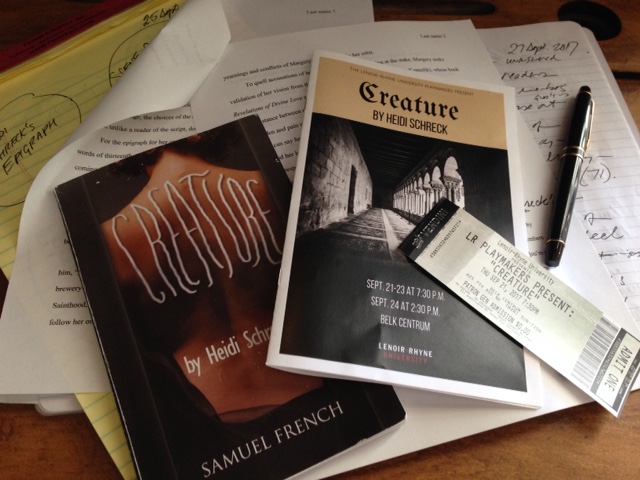 An epigraph stands out as a curious element in a play. For readers of the script, that quotation,which precedes the opening of the play and presents its prevailing theme, offers a signpost to guide them on their journey. However, for those who first encounter the play on the stage, the choices of the director and the actors must convey that idea, which the audience, unlike readers of the script, does not see in written form.
 Jane Lucas