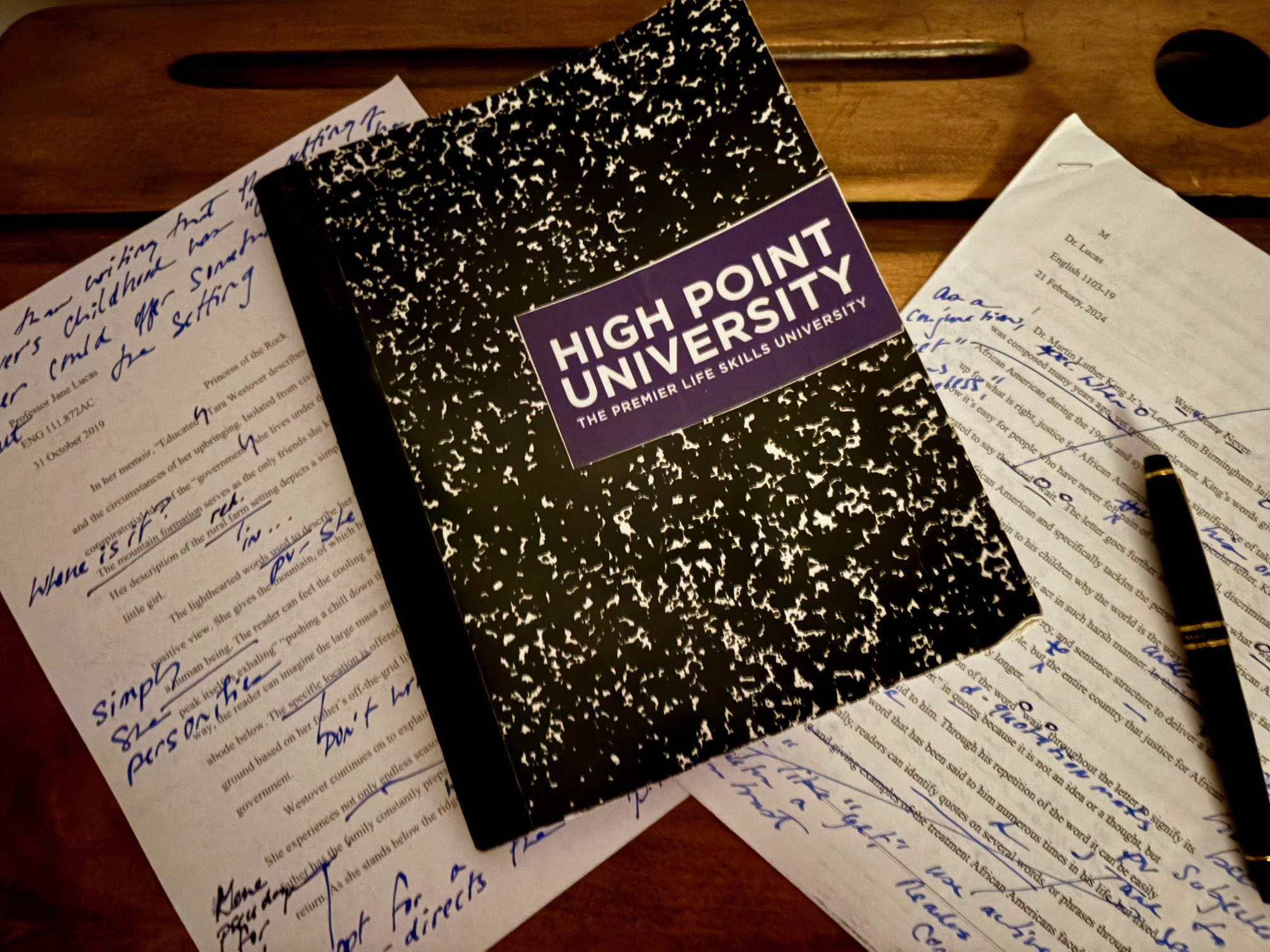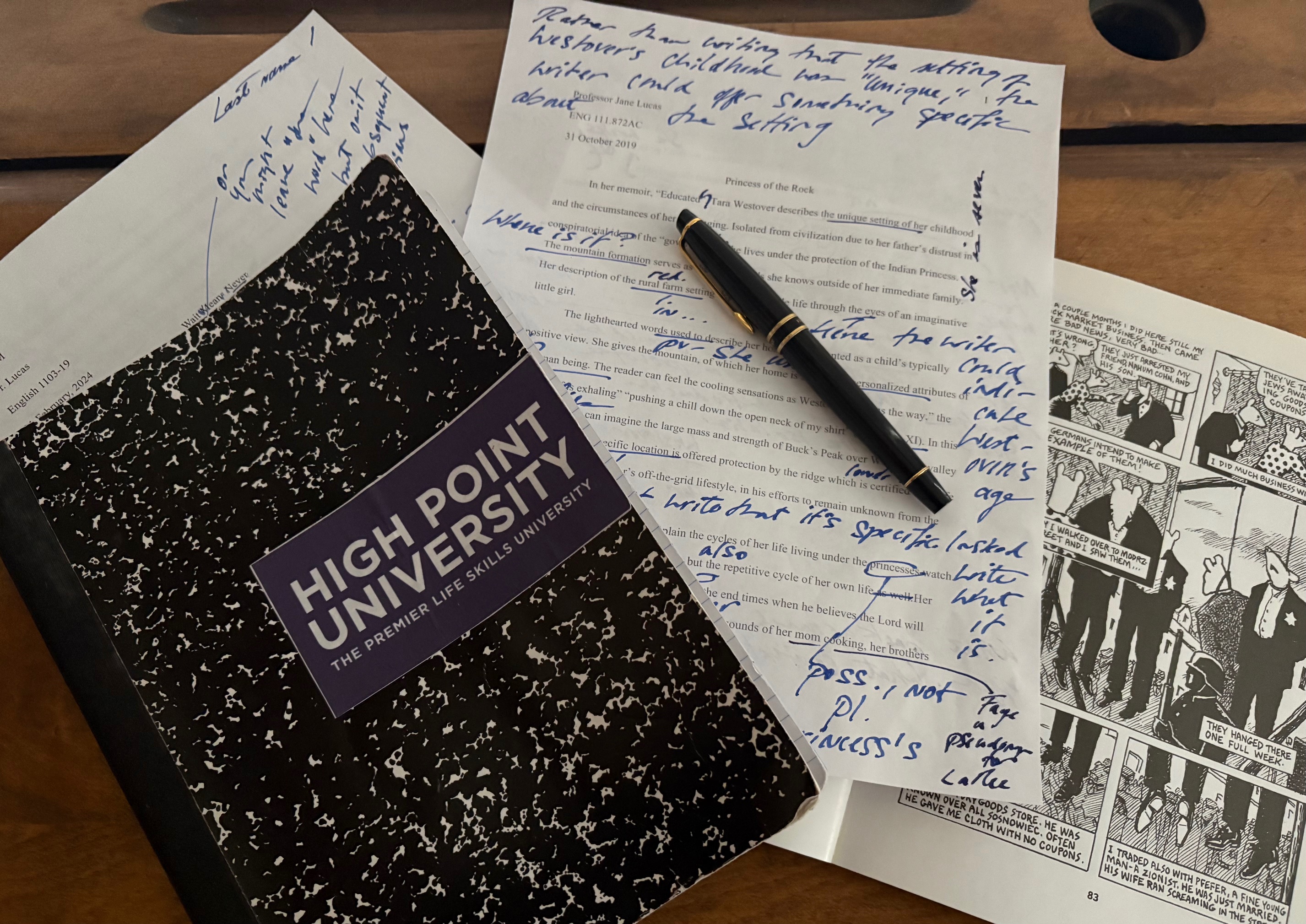
At the beginning of yesterday’s class, we examined “Wait Means Never,” the sample student analysis of Martin Luther King Jr.’s “Letter from Birmingham Jail,” and “Princessof the Rock,” the analysis of the prologue to Tara Westover’s memoir, Educated. Today’s post presents more detailed notes on the essays’ content and form. As you continue to revise, return to these notes for reminders of dos and don’ts for your own analysis.
“Wait Means Never” Content
- Rather than beginning with a summary of Martin Luther King, Jr.’s “Letter from Birmingham Jail,” the writer comments on the letter by observing its relevance. Instead the writer should state what the letter is, an epistolary essay King wrote in 1962 while he was jailed in Alabama for leading nonviolent protests.
- The writer ends the first paragraph with a thesis, but the statement is primarily description. Essentially, the writer states that King uses stylistic devices to deliver his message to a wider audience, but a thesis or main claim in a textual analysis should offer an assertion about how the writer’s use of those devices achieve a particular effect. The recommended revision that we examined in class–the one on the handout that I distributed–is included below, under the Revision heading.
- The writer observes that King repeats “the word ‘wait’ throughout the letter” (par. 2), but King does not introduce that word until his eleventh paragraph. The writer could revise his thesis to focus specifically on King’s eleventh paragraph because that portion of the letter is the source of his claims and textual support.
- In the body paragraphs, the writer effectively details King’s diction and sentence structure, but a couple of inaccuaracies undercut the prose. Neither “from bad to worse” (par. 3) nor “at the end of the letter” (par. 5) is accurate.
- After ending the final body paragraph with ”’wait'” (par. 5), the writer turns to a conclusion that reads more like the ending of a history report than a textual analysis. Simply revising the opening of the last paragraph to begin, “[t]he words of Dr. Martin Luther King . . .” would maintain the focus of the analysis, the words themselves. The writer could still address the letter’s role in history by noting how the words have endured as a rallying cry for peaceful nonviolent protest. Consider how else the writer might give the analysis closure.
“Wait Means Never” Form
- The document lacks a running header.
- Because the writer is referring to wait and never as words in his title, both should be italicized.
- In the first line, the writer defines King’s letter as a “speech of literature” (par. 1). Although King was an orator, his “Letter from Birmingham Jail,” is not one of his speeches. As the title indicates, it’s a letter. Labeling the letter “literature” is unnecessary because the analysis that unfolds will reveal the literary quality of the prose. If the writer wants to address the letter’s status as a work of literature, in the conclusion, he might note that many students first encounter King’s letter in the pages of their high school and college anthologies.
- In the first sentence of the introductory paragraph and the second sentence of the second paragraph, the writer uses coordinating conjunctions that indicate contrast, but the clauses those words connect are not in contrast. See “yet remains” (par. 1) and “but irked” (par. 2). In both cases, “and” would be the accurate conjunction. That said, “yet remains” introduces an assessment of the letter–in particular, its relevance–which shouldn’t be part of the summary at the beginning of the analysis.
- The writer refers to King’s voice as “the narrator’s” (par. 2), but a narrator is a person who tells a story, usually a work of fiction or a narrative poem. King should be referred to as the writer or the author.
- The clauses “it can easily be acknowledged” (par. 2) and “it can be identified” (par. 5) are passive constructions that de-emphasize the subject. The sentences that contain those clauses should be revised to show the action that King performs as a writer. The second-paragraph sentence might be rewritten as this: King’s repetition of wait emphasizes how frequently he has heard the word and how its “piercing familiarity” (par. 11) has increased his frustration. The two sentences convey the same idea, but the revision is eleven words shorter.
Introductory Paragraph
The paragraphs below are the first paragraph of “Wait Means Never” and my revised version.
Original Introductory Paragraph
Dr. Martin Luther King Jr.’s “Letter from Birmingham Jail,” is a speech of literature that was composed many years ago yet remains relevant. King’s words give insight into the life of an African American during the 1960s and symbolize the significance of taking action and standing up for what is right, justice for African Americans. In this particular letter, King speaks about how it’s easy for people who have never felt pain of being oppressed, discriminated against, and segregated to say the word “wait.” The letter goes further into detail about what “wait” truly means for an African American and specifically tackles the perspective of an American father who also has to explain to his children why the world is the way it is, yet that father does not quite know himself why people act in such a harsh manner. In this letter, Martin Luther King Jr. utilizes repetition, detail, vivid imagery, and sentence structure to deliver a message to not just one person, or even a hundred people, but the entire country that justice for African Americans cannot be a patient matter.
Revision
Dr. Martin Luther King, Jr.’s “Letter from Birmingham Jail” responds to the eight white clergymen who drafted an open letter addressing King’s involvement in the civil rights movement, urging him to seek justice in the courts rather than in the streets. In his answer to the clergymen, King asserts that a Christianity that permits racial oppression and prejudice is immoral and stands in direct opposition to the teachings of the gospel. Though King’s letter draws on his 1956 sermon “Paul’s Letter to American Christians,” the hallmark of his epistolary essay is not the rhythmic cadences of his baritone voice, but instead its artful composition. With the repetition of the word wait and a series of dependent clauses, King encapsulates his testimony and delays the end of the letter’s longest sentence, creating a holding pattern that forces readers to experience their own wait.
“Princess of the Rock” Content
- The writer refers to the “unique setting” (par. 1) of Tara Westover’s childhood, but doesn’t specify the location of the mountains that are home to Buck’s Peak, which features the image of the Indian Princess, Westover’s friend and protector. Identifying Buck’s Peak as part of the Bear River Range in southeast Idaho would give readers a better sense of the setting.
- What appears to be the essay’s thesis–the sentence that begins, “Her description of the rural farm . . .”–is itself description rather than analysis. Shifting the focus from the fact that Westover depicts herself as a child to what Westover achieves through the adult retrospective narrator’s presentation of her younger self would move the essay in the direction of critical study.
- The writer states that Westover uses “lighthearted words” (par. 2), but the line that she quotes as evidence to support her claim is not lighthearted.
- Only near the end of the essay–in the fifth of its six paragraphs–does the writer identify the excerpt she is analyzing as the prologue of the memoir. Identifying the text as the prologue in the introduction and addressing its function in the thesis is another change that would move the essay in the direction of critical study. (What background or context does the prologue provide? What does it foreshadow?)
“Princess of the Rock” Form
- The memoir’s title, Educated, is incorrectly enclosed in quotation marks (par. 1).
- Commas incorrectly follow closing quotation marks (par. 1).
- The phrase “rural farm setting” (par. 2) is redundant.
- The passive construction “[t]he lighthearted words used” (par.2 ) should be recast in active voice: Westover uses lighthearted words . . .
- The first quotation from Educated (par. 2) should not include the author’s last name, and the Roman numerals should be lower-case.
- The word “princesses” (par. 3) should be possessive rather than plural (princess’s).
- The word “has” (par. 3) should be replaced with an action verb–such as demands or forces to enliven the sentence and give readers a better sense of Westover’s father. The writer should also note that the father’s name in the memoir is Gene, a pseudonym for Val.
- The second quotation from Educated (par. 3) lacks both a signal phrase and a parenthetical citation.
- The third paragraph ends with an instance of faulty predication.
- The writer refers to “Tara’s family” (par. 4) and “Tara wish[ing]” (par. 6) when she should refer to Westover’s and Westover.
Conclusions
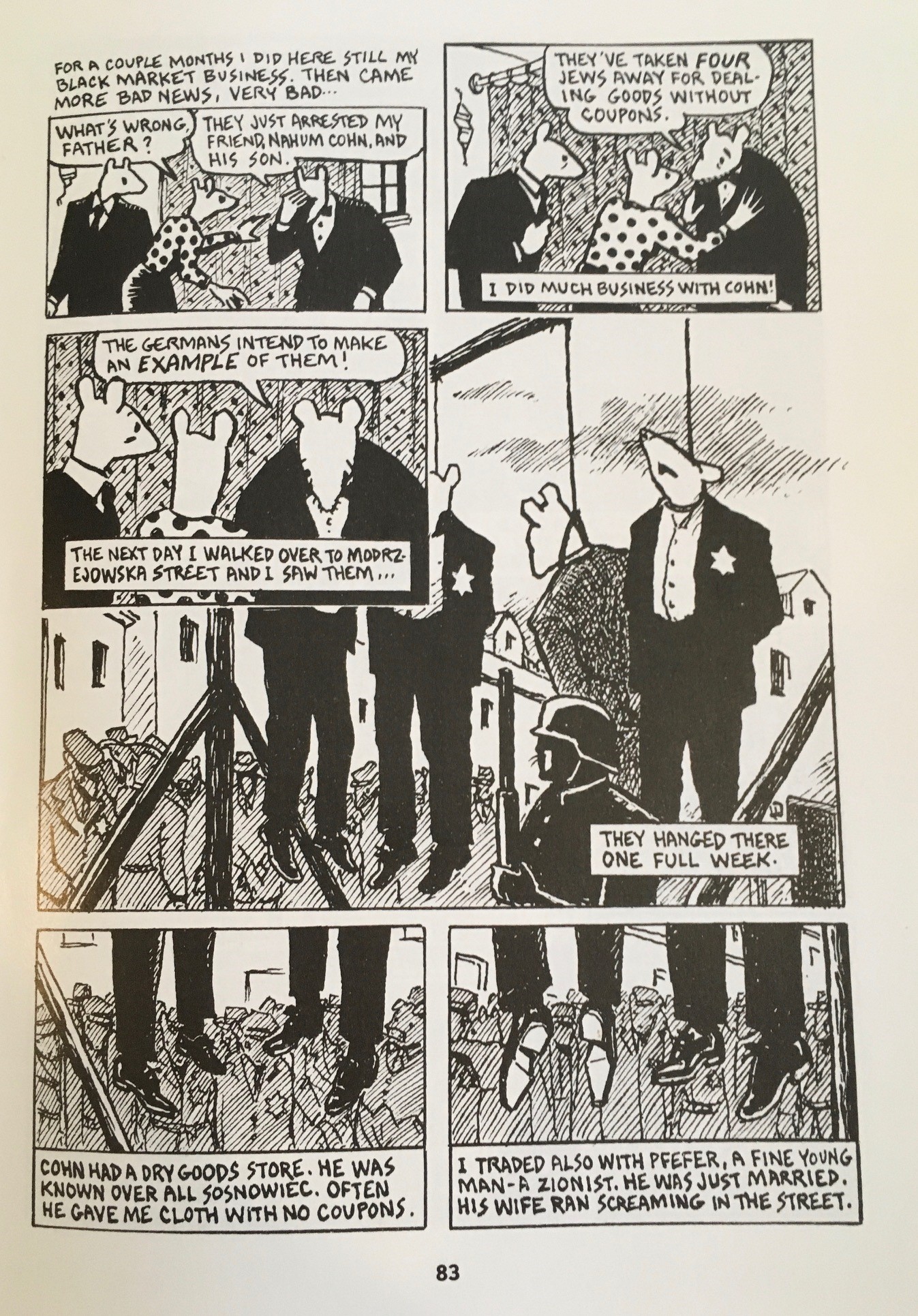
Effective strategies for concluding analyses include (1) offering an insight about the text or an additional quotation from it, (2) revisiting the thesis without stating it verbatim, and (3) pointing to the broader implications of the analysis. In “The Strange Fruit of Sosnowiec,” I employ two of the three, specifically one and three. Look back at the final paragraph and note how each sentence offers insights about Maus or points to its broader implications.
As I have noted before, you should avoid the phrase in conclusion or any variation on it at the beginning of the final paragraph of your essay. While that transitional phrase can be useful in a speech (because the audience cannot see that the end is near), there is no reason to write those words when readers can see for themselves that only one paragraph remains. For more, see Harvard University Writing Center’s notes on conclusions.
Relevant Embedded Links
The relevant embedded link that you include in the blog post for your analysis should be a primary or secondary source, not a background one, such as Wikipedia, Encyclopedia Britannica, or a social cataloguing website, such as Goodreads. Appropriate websites to link include the authors’ own sites, sites where the full-text of the essay or chapter is available (without a paywall), and authors’ pages on publications that employ them, such as Michael Lewis’s page on the ESPN site. The list below includes a link to one appropriate site for each of the seven subjects. If you are unsure whether a site is appropriate to link to your analysis, ask me or simply use the relevant link below.
- Donald Barthelme’s “The School”: https://www.newyorker.com/magazine/1974/06/17/the-school
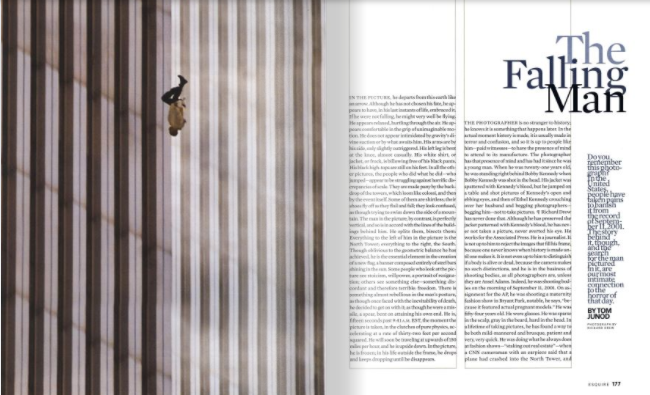
- Tom Junod’s author bio on ESPN: https://espnpressroom.com/us/bios/tom-junod/
- Helen Keller’s “The Day Language Came into My Life”: https://janelucas.com/wp-content/uploads/2025/08/a0461-3.thedaylanguagecameintomylife_keller.pdf
- Harper Lee’s To Kill a Mockingbird website: https://www.tokillamockingbird.com/harper-lee
- Martin Luther King Jr.’s “Letter from Birmingham Jail”: https://minio.la.utexas.edu/webeditor-files/coretexts/pdf/1963_mlk_letter.pdf
- Michael Lewis’s website: https://www.michaellewiswrites.com/#top
- David Sedaris’s website: https://www.davidsedarisbooks.com
Note that for search purposes, the sites above are listed as complete URLs, not as embedded links. In your blog post, the site address should be embedded in a word or phrase, just as the links are embedded in the earlier sections of this post (and in my other posts).
Next Up
On Wednesday, you will compose a short reflective essay focusing on the process of planning, drafting, and revising your analysis. If you are still in the process of completing your essay on Wednesday (since you have until Friday morning’s hard deadline to post it), your reflection will address your work in progress.
Before class, review the sections of the textbook, Writing Analytically, that have guided you in the writing of your analysis:
- “Focus on Individual Words and Sentences” (48-49).
- “How Long?: Paragraphs, Readers, and Writers” (308).
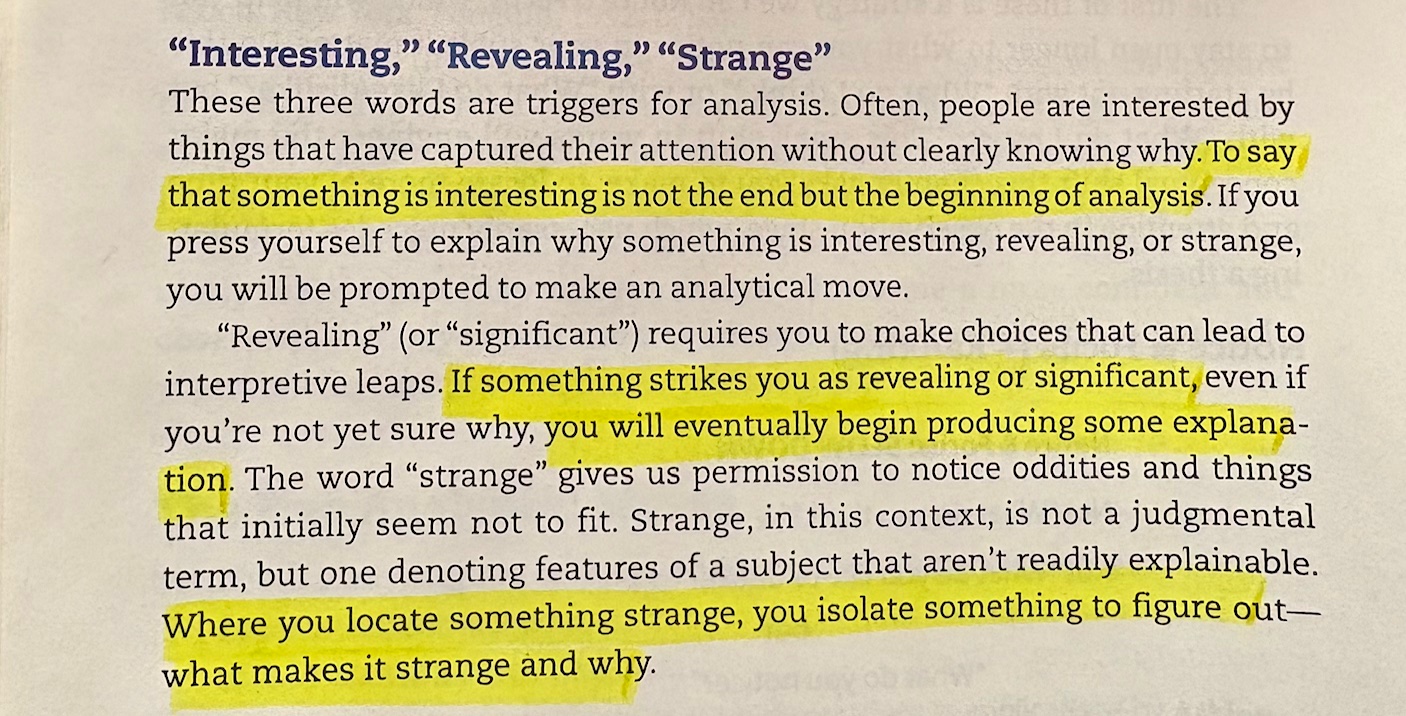
- “‘Interesting,’ ‘Revealing,’ ‘Strange’” (24).
- “Seems to Be About X, But Could Also Be (Or is ‘Really’) About Y’” (104-7).
- “What a Good Analytical Thesis Is and Does” (241-42).
- “Words Matter” (49-50).
After you have reviewed those sections of Writing Analytically, choose a phrase, clause, or sentence relevant to your writing process and draft in your journal a short passage that connects that quotation to your writing. That passage will serve as part of your reflection. Detailed instructions for composing your reflection and including your chosen quotation will be included on the assignment handout that I distribute on Wednesday. Remember to bring your textbook to class.