Posted in English 1103, Scrabble

ENG 1103: A Close Study of the Board

Developing the ability to analyze involves becoming more observant. As you continue to play Scrabble on Wordplay Days this semester, consider how each game is an additional exercise in becoming more observant. 

Examine the image at the top of this post. There you will see what could be the opening play in a game of Scrabble. Any of the three letters in “lox” could be on the center square. Why might the player, or team, have placed the “l” rather than the “o” on the center square?

The image directly above this paragraph illustrates the potential benefit of not placing the “o” on the center square. If the opponent has two high-value consonants, the first player, or team risks the chance of the opponent playing those consonants and doubling their value on the bonus squares, whereas it’s unlikely that the opponent will be able play consonants–high value ones or not–on both sides of the “I” or the “x.”

Coming Soon

In class on Wednesday, September 29, you will submit your completed worksheet for the third lesson in the Check, Please! assignment series. The students in the 10:40 a.m. class received the worksheet today. The students in the 9:15 a.m. class will receive the worksheet on Monday. Also, you can download the worksheet at the link below. In class on Wednesday, you will begin drafting your midterm reflection. For that preliminary work, you will need to bring a paper copy of your revised analysis to class.

Posted in English 1103, Scrabble, Teaching

ENG 1103: Scrabble/Bingo

If a player, or a team, uses all seven of its tiles in one play, the player, or team, earns fifty points in addition to the points for the words played. Congratulations to the team of Zack Chadwell and Tanner Rothenbereger in the 9:15 class for Scrabbling by building on “trap” with “minutes” (using a blank for the s), and also forming “am” (first-person singular form of the verb “be”) and “pi” (the numerical value of the ratio of the circumference of a circle to its diameter), which later in the game became “pig.”

If the players had not seen the opportunity to form the two-letter words “am” and “pi,” they would not have Scrabbled.

Look for opportunities that two-letter words can offer. There are sixteen two-letter words starting with a, so you have a 62% chance that any tile you put after an a will form a word.

Posted in English 1103, Scrabble, Teaching

ENG 1103: Irritable Vowel Syndrome

What if you begin a game of Scrabble with only vowels? The image above shows what could be the first three words played in a game in which no player (or team) has a consonant. None of the three words yields many points, but the “e” in “oe” offers the opportunity for a player to score a double triple. Playing “be'” or “me” and another word vertically would earn the player eighteen points for the “b” or “m” alone; playing “h” or “w” would earn the player twenty-four points for the “h” or “w” alone.

Often playing a vowel-only word brings opportunities for high scores later. Here are some of the words you can play if you find yourself without consonants:

  • aa: a type of stony, rough lava
  • ae: one
  • ai: a three-toed sloth
  • eau: water (pl. eaux)
  • oe: a whirlwind off the Faero islands
  • oi: an expression of dismay (also oy)

In class someone asked about the pronunciation of aa. It is pronounced ah-ah.

Congratulations to the team of Braeden Thompson and Nate Alleman in the 10:40 class. Braeden and Nate scored a 126-point double-triple play with the word “evaporate,” which they formed by adding the letters “e,” “a,” “t,” and “e” to the word “vapor” played in a previous turn.

Next Up

In class on Monday, September 13, we will explore ways for you to proceed with the revision work that you will begin in class on Wednesday. For class, read the overview to Chapter 2 of Writing Analytically and bring your copy of the textbook to class.

Posted in English 1103, Scrabble, Teaching

ENG 1103: Let the Games Begin

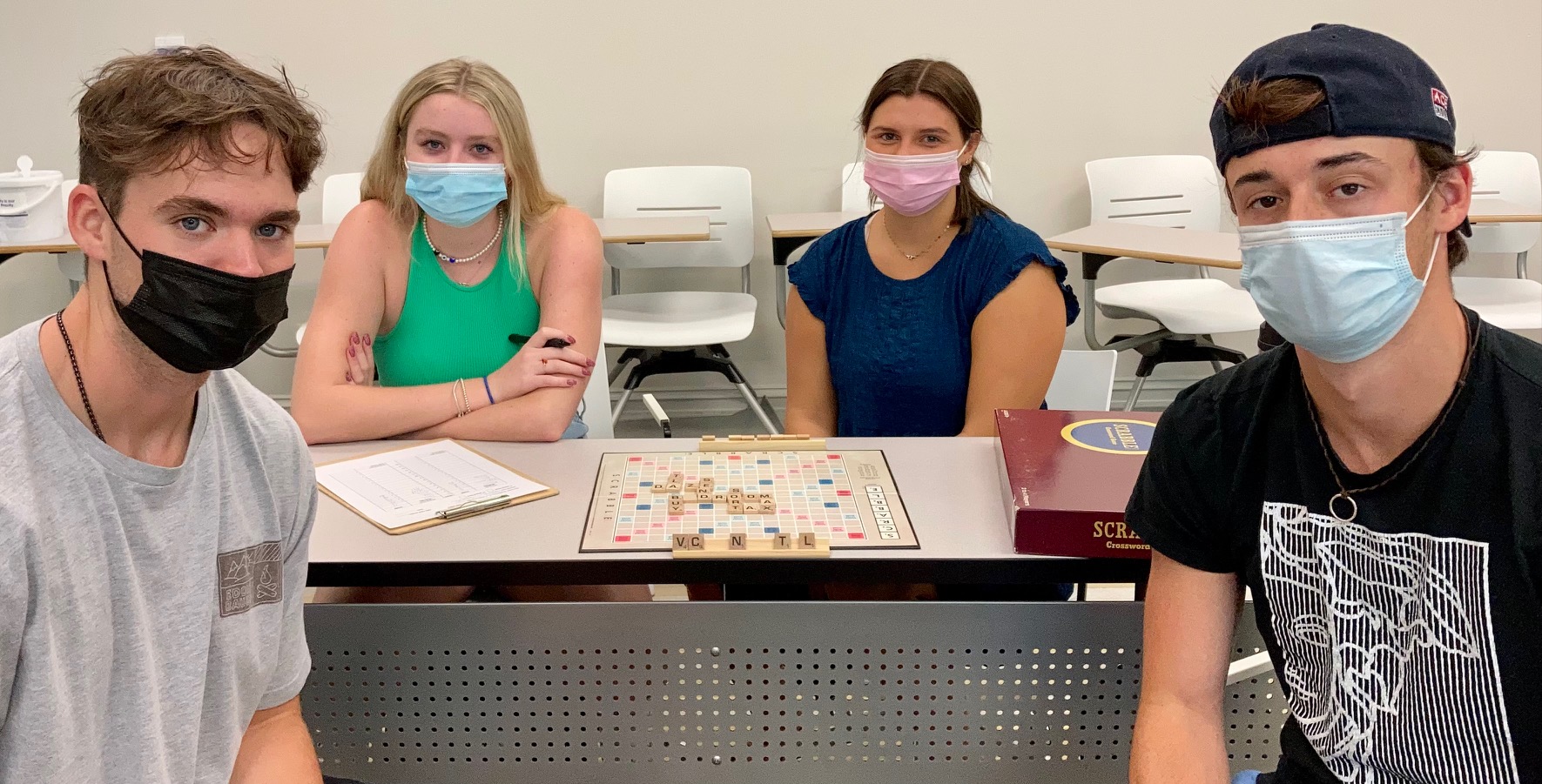
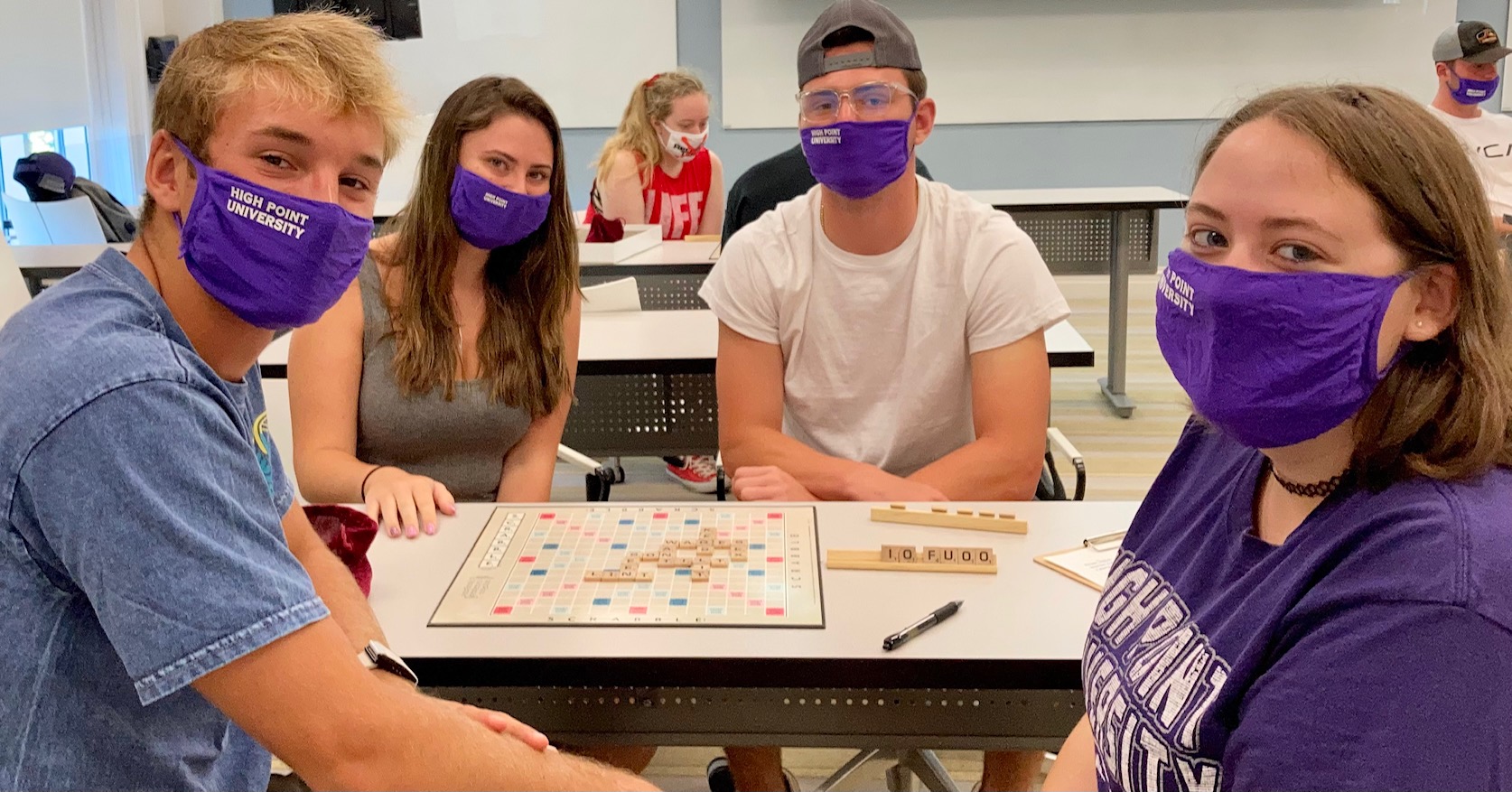
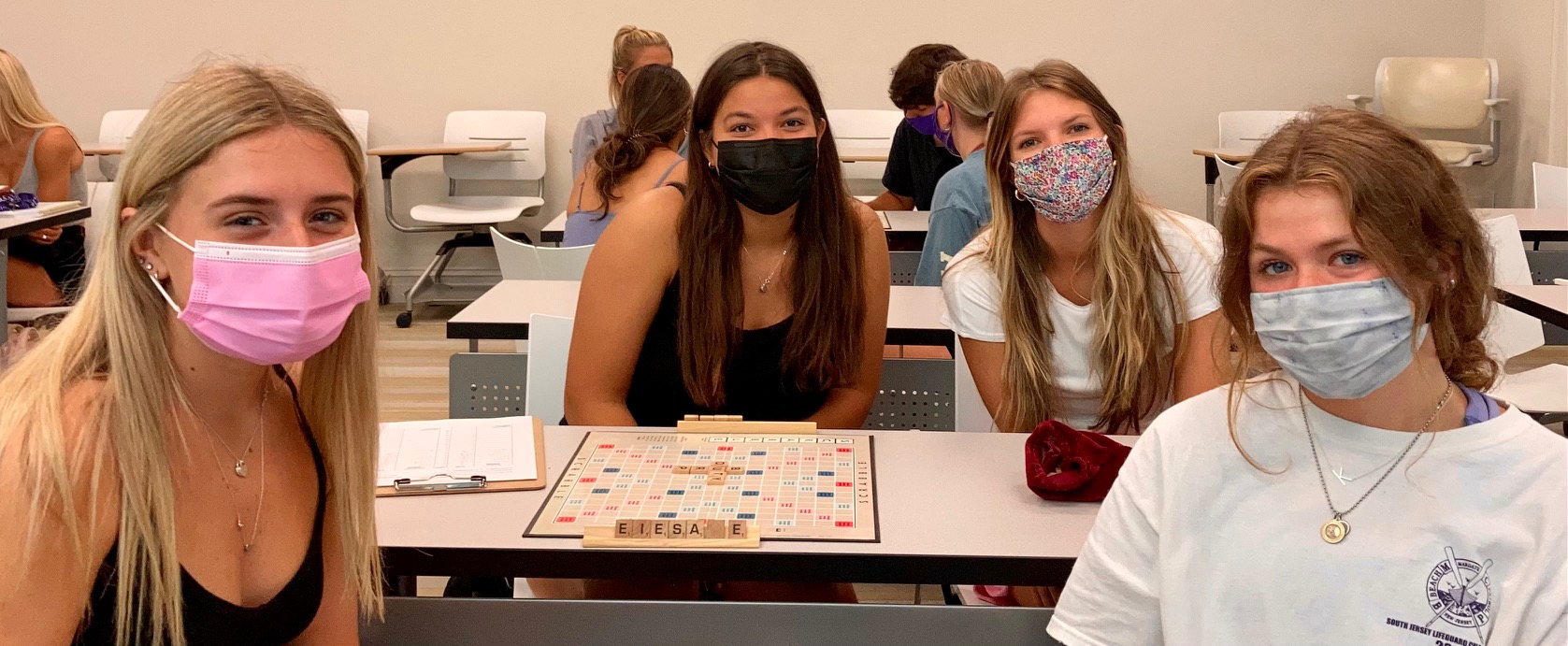
Ordinarily Wordplay Days are days when we all turn away from our screens, but yesterday I took the opportunity to photograph you as a way of helping us continue to put names with faces. In between the photographs of you and your classmates, I’ve included lists of some first names that are playable in Scrabble (because they are common nouns as well as proper ones). Continue to review these pictures and their captions to learn the names of your classmates, and study the lists of names in between to build your vocabulary.

9:15-10:25 a.m. (L-R): Bella Scricco, Sam Peterson, Kylie Ciammaichella, Jolie Zavaglia
  • Al: a type of East Indian tree
  • Alan: a breed of hunting dog (also aland, alant)
  • Alec: a herring
  • Ana: a collection of miscellany about a specific topic
  • Anna: A former Indian coin
9:15-10:25 a.m. 1103.18 (L-R): Charlie Godin, Charlotte Sullivan, Audrey Duclos, Cameron Silver
  • Barbie: a barbecue
  • Belle: a pretty woman
  • Ben: an inner room
  • Benny: an amphetamine pill
  • Bertha: a type of wide collar
9:15-10:25 a.m. (L-R): Tanner Rothenberger, Meghan Reilley, Andrew Amato, Kenzie Hagens
  • Beth: a Hebrew Letter
  • Biff: to hit
  • Bill: a charge for goods or services
  • Billy: a short club
  • Bo: a friend
9:15-10:25 a.m. (L-R): Erin Infantino, Logan Kennedy
  • Bobby: a policeman
  • Bonnie: pretty (also bonny)
  • Brad: a small nail or tack
  • Carl: a peasant or manual laborer (also carle)
  • Carol: to sing merrily
9:15-10:25 a.m. (L-R): Jillian Pandiscia, James Hope, Arnav Gupta, Zack Chadwell
  • Celeste: a percussive instrument (also celesta)
  • Chad: a scrap of paper
  • Chevy: to chase (also chivy)
  • Christie: a type of turn in skiing (also christy)
  • Clarence: an enclosed carriage
10:40-11:50 a.m. (L-R): Nate Alleman, Gabbie Sewade, Gabby, Znutas, Ani Markin
  • Dagwood: a large stuffed sandwich (named after the comic strip character who was fond of them)
  • Daphne: a flowering shrub with poisonous berries
  • Davy: a safety lamp
  • Deb: a debutante
  • Devon: a breed of cattle
10:40-11:50 a.m. (L-R): Christian Coletta, Austin Donaldson, Aaron Jackson, Tyler Hudson
  • Dexter: located to the right
  • Dom: a title given to some Monks
  • Don: to put on a piece of clothing
  • Donna: an Italian woman of repute
  • Erica: a shrub of the heath family
10:40-11:50 a.m. (L-R): Christina Muniz, Madeleine Bee, Audrey Giles
  • Fay: to join together closely
  • Florence: a former European gold coin
  • Franklin: a nonnoble medieval English landowner
  • Fritz: a nonworking or semi-functioning state
  • Gilbert: a unit of magneto-motive force
10:40-11:50 a.m. (L-R): Braeden Thompson, Ryan Benjamin, Anderson Tracy, Kendall Krasinski
  • Gilly: to transport on a type of train car
  • Graham: whole wheat flour
  • Hank: to secure a sail
  • Hansel: to give a gift to, usually to commence a new year (also handsel)
  • Harry: to harrass
10:40-11:50 a.m. (L-R): Emma Steadman, Maddie Pierre, Julia Patti, Kiley McTamney
  • Henry: a unit of electric inductance
  • Herby: full of herbs
  • Jack: to hoist with a type of lever
  • Jacky: a sailor
  • Jake: okay, satisfactory

To learn whether a name is playable in Scrabble, type it in the box on the Scrabble Dictionary page, and click “GO!”

Next Up

For class on Monday, August 30, read “Skim Reading is the New Normal.” Afterward, compose brief reading notes in your journal. Include (1) the title and author, (2) the main points, and (3) any questions or observations you would like to address in class. If you are unfamiliar with any of the terms in the article, look up their meanings and jot those in your journal as well.

Posted in Scrabble, Teaching, Writing

ENG 111: A Game for Hardscrabble Times

The Guardian article “Spell Bound” notes that the exact beginning of Scrabble is “debatable,” adding that “Scrabble experts are the kind of people who like to debate it at length.” In a piece of writing such as this–one that begins at the beginning of the game–the starting point could be Lexico, which is the game that Alfred Mosher Butts developed before he invented Scrabble–which, by the way, wasn’t named Scrabble until Butts sold the game to Jacob Brunot. That’s when the game that Butts had christened Criss-Cross Words became the game that would multiply to more than 150 million sets worldwide, a game that can now be found in a third of homes in America (Bukszpan 16).

If that description of Scrabble’s beginnings doesn’t capture your interest–perhaps because you don’t think of yourself as a word person–consider this: Scrabble’s inventor wasn’t a word person either. Butts was fascinated by games of all sorts and saw word games as the category that offered the most opportunities for innovation. For him, that innovation meant creating a game in which the frequency of letters corresponded with their frequency in the English language. As part of his research, he documented how often each letter appeared on the front page of the newspaper. E is most common, so there are twelve E’s in Scrabble but only one tile for each of the rarest of letters: J, K, Q, X, and Z. For many players, including me, part of Scrabble’s appeal is the combination of skill and luck. Word power alone won’t win the game. You don’t know which letters you will draw or which seven letter tiles are on your opponent’s rack. And for many players, another source of the game’s appeal is its synthesis of crosswords and anagrams.

Since creating words from anagrams is a process of letter scrambling, James Brunot may have chosen the name Scrabble in part for its similarity to scramble, but the word scrabble itself is apt for a game that often requires a player to struggle (or scrabble) to make a word from a seemingly impossible combination of tiles. It’s notable, too, that Scrabble’s beginnings date to the 1930s, when its inventor was an out-of-work architect. He wanted to create a diversion from the dark days of the Depression. Now it’s a game that many of us have returned to, pantomiming the ghosts of those first-generation players. Once again, it’s a game for hardscrabble times.

Works Cited

Bukszpan, David. Is That a Word?: From AA to ZZZ, the Weird and Wonderful Language of Scrabble. Chronicle, 2012.

“Spell Bound.” The Guardian, 27 June 2008, https://www.theguardian.com/lifeandstyle/2008/jun/28/healthandwellbeing.familyandrelationships.