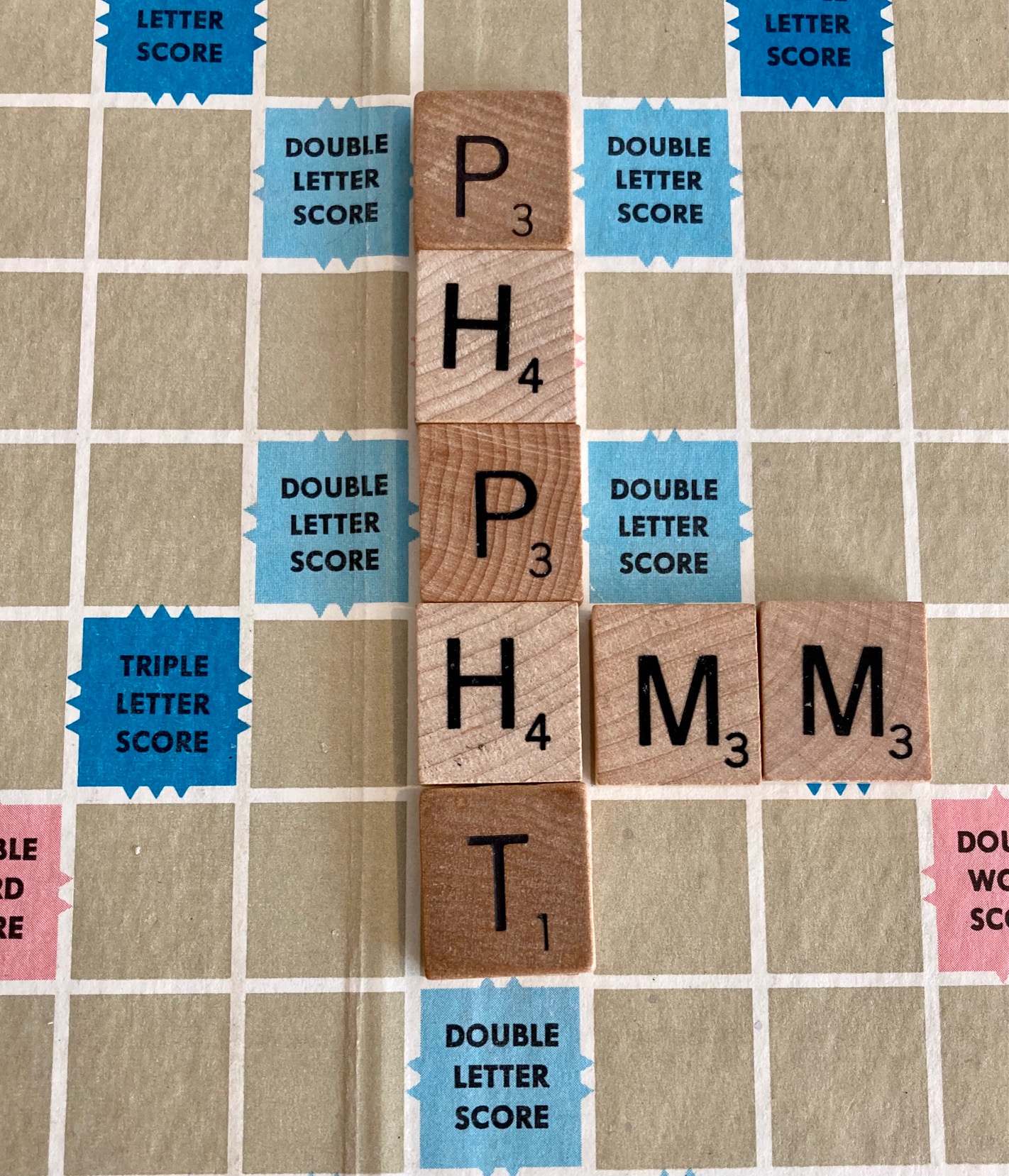
Learning nth (an unspecified number) and other all-consonant words can enable you to continue the game when you’re faced with a rack without vowels.
brr: used to indicate that one is cold
crwth: an ancient stringed instrument (pl. -s)
cwm: a cirque (a deep, steepwalled basin on a mountain, pl. -s, prounounced to rhyme with “boom”)
hm: used to express thoughtful consideration (also “hmm“)
mm: used to express assent or satisfaction
nth: describing an unspecified number in a series
phpht: used as an expression of mild anger or annoyance (also “pht“)
psst: used to attract someone’s attention
sh: used to urge silence (also “shh” and “sha“)
tsk: to utter an exclamation of annoyance (-ed, -ing, -s)
tsktsk: to “tsk” (-ed, -ing, -s)
Next Up
Wordplay Day! To prepare for class, revisit the Dictionary and World Builder pages on the Scrabble website. Also review the blog posts devoted to Scrabble tips, including this one.
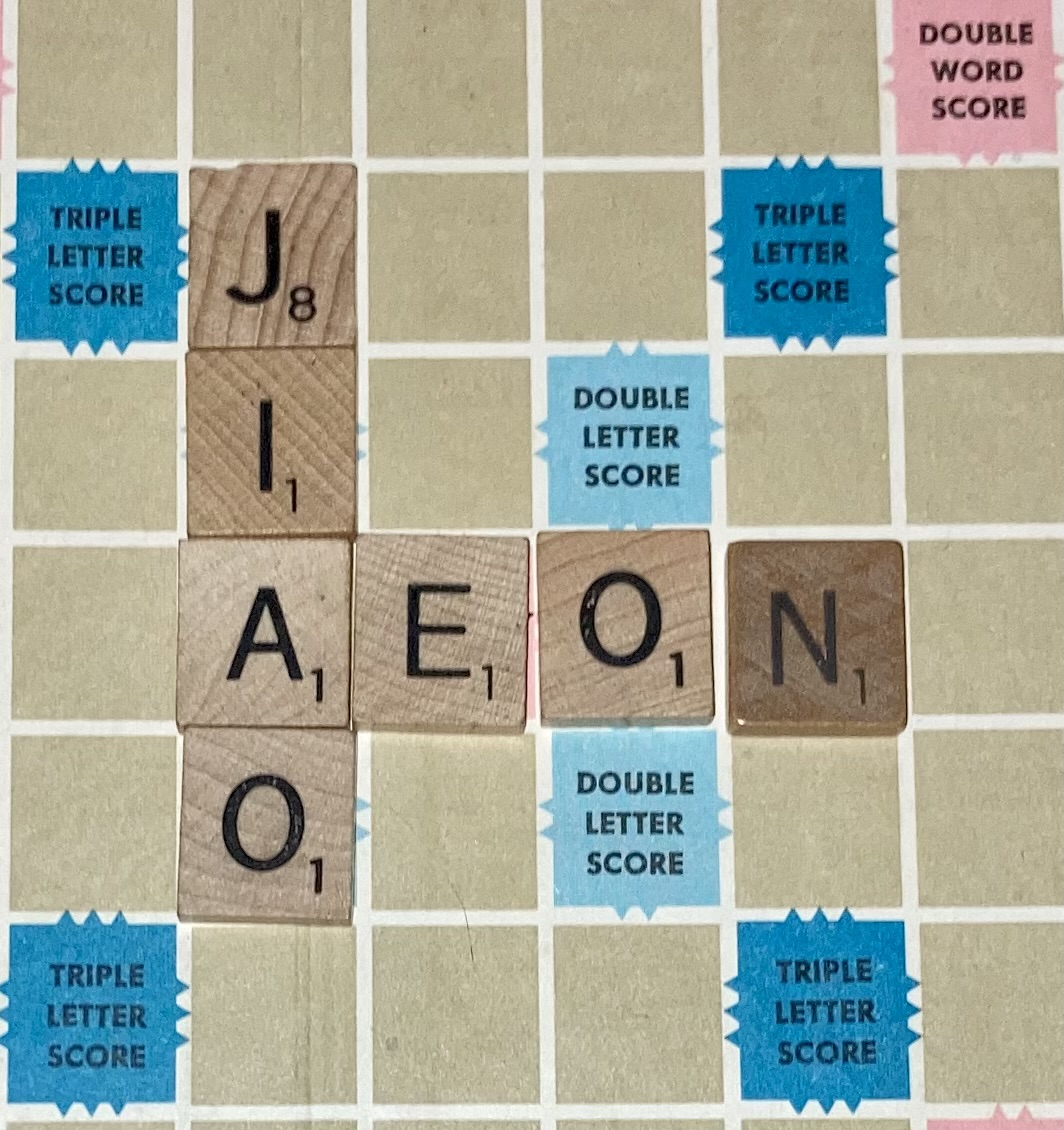
Knowing words with multiple vowels proves useful when you’re faced with a rack of mostly, or all, vowels. Here’s a list of the first twenty-two playable four-letter words with three vowels:
aeon: a long period of time (also eon)
agee: to one side (also ajee)
agio: a surcharge applied when exchanging currency
ague: a sickness associated with malaria
ajee: to one side (also agee)
akee: a tropical tree
alae: wings (pl. of ala)
alee: on the side shielded from wind
amia: a freshwater fish
amoa: a kind of small buffalo
awee: a little while
eaux: waters (pl. of eau)
eide: distinctive appearances of things (pl. of eidos)
emeu: an emu
etui: an ornamental case
euro: an Australian marsupial, also known as wallaroo, for being like the kangaroo and the wallaby; also a unified currency of much of Europe
ilea: the terminal portions of small intestines (pl. of ileum)
ilia: pelvic bones (pl. of ilium)
jiao: a Chinese currency (also chiao)
luau: a large Hawaiian feast
meou: to meow
moue: a pouting expression
Next Up
Wordplay Day! To prepare for class, revisit the Dictionary and World Builder pages on the Scrabble website. Also review this post.
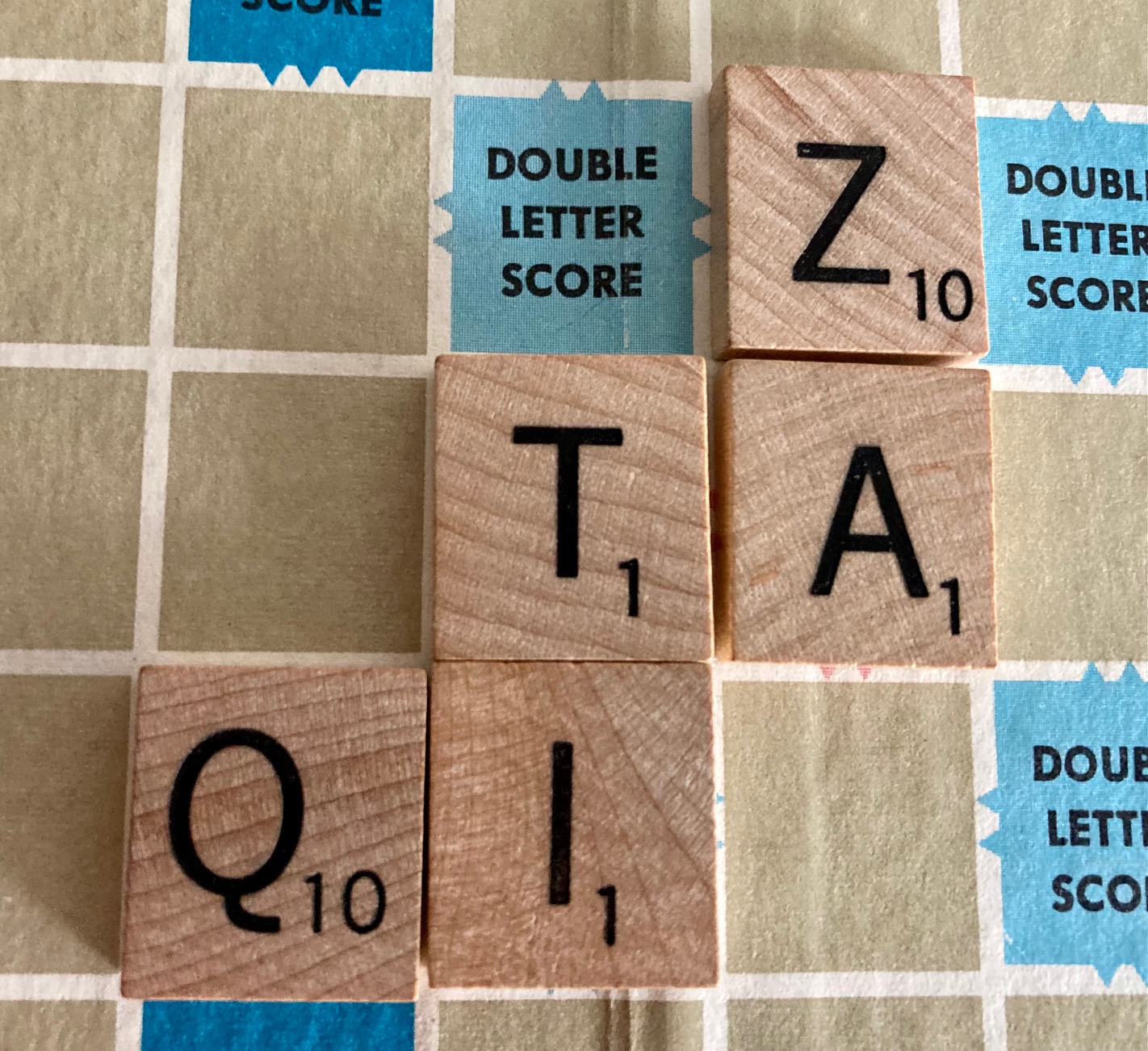
Today’s blog post is the final installment in the series of posts devoted to playable two-letter words. Learning these two-letter words, as well as the other two-letter words in the alphabet, will enable you to see more options for play and increase the number of points you earn in a single turn.
qi: the central life force in Chinese culture (also ki)
re: a tone of the diatonic scale
sh: used to encourage silence
si: a tone of the diatonic scale (also ti)
so: a tone of the diatonic scale (also sol)
ta: an expression of thanks
ti: a tone of the diatonic scale
to: in the direction of
uh: used to express hesitation
um: used to express hesitation
un: one
up: to raise (-s, -ped, -ping)
us: a plural pronoun
ut: the musical tone C in the French solmization system, now replaced by do
we: a first-person plural pronoun
wo: woe
xi: a Greek letter
xu: a former monetary unit of Vietnam equal to one-hundreth of a dong (also sau, pl. xu)
ya: you
ye: you
yo: an expression used to attract attention
za: pizza
Next Up
Wordplay Day! To prepare for class, revisit the Dictionary and World Builder pages on the Scrabble website. Also review the posts on my blog devoted to Scrabble tips, including this one.
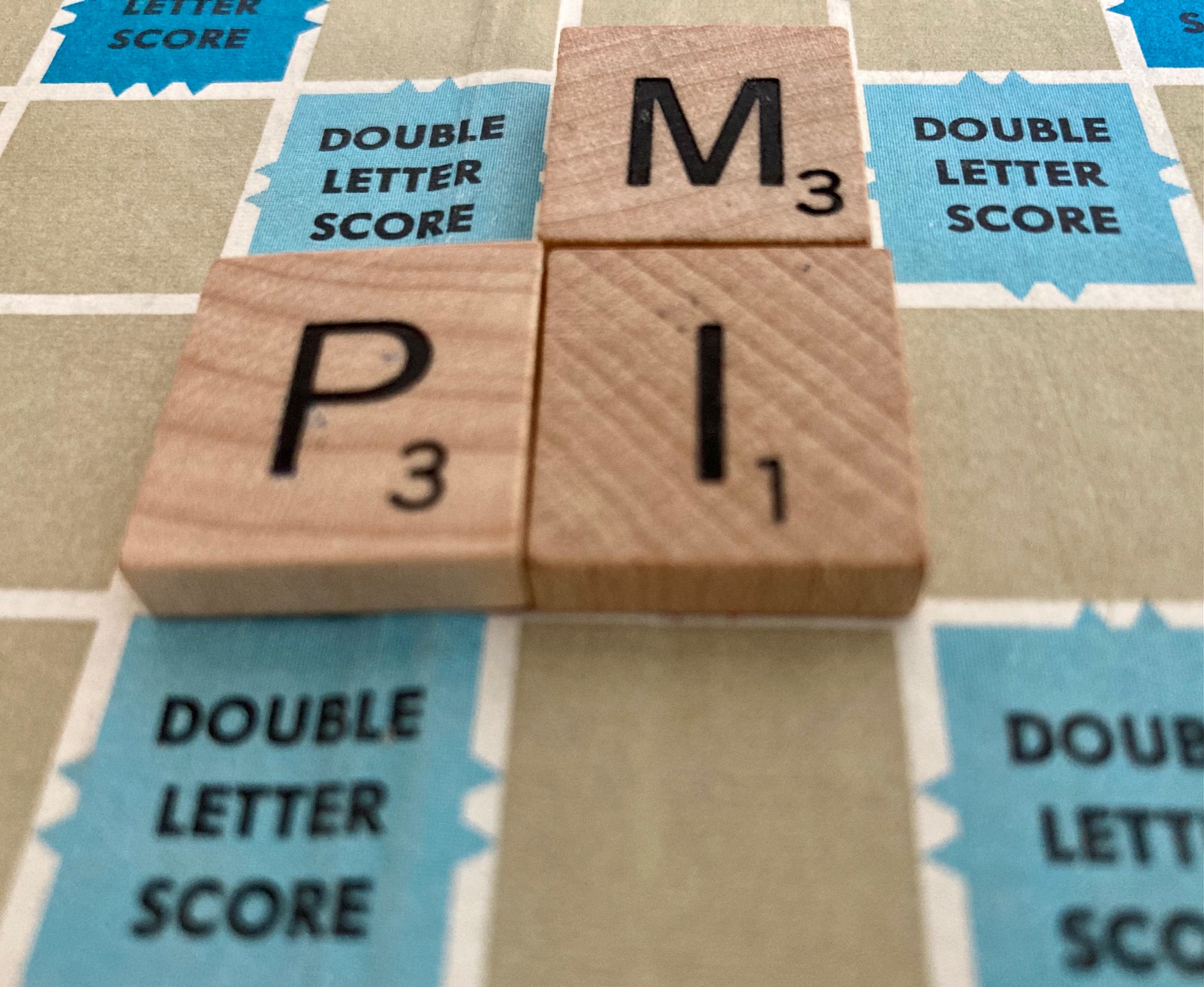
In the previous weeks, I published blog posts featuring the playable two-letter words that begin with a, b, d, e, f, g, h, i, j, k, and l. Today’s post features the playable two-letter words beginning with m, n, o, and p. Learning these two-letter words, as well as the other two-letter words in the alphabet, will enable you to see more options for play and increase the number of points you earn in a single turn.
M, by the way, is the most versatile consonant. In the first position, m pairs with every vowel: ma, me, mi, mo, mu, and also my. In the second position, m pairs with every vowel except i: am, em, om, um.
ma: a mother
me: a singular objective pronoun
mi: a tone of the diatonic scale
mm: an expression of assent
mo: a moment
mu: a Greek letter
my: a first-person possessive adjective
na: no, not
ne: born with the name of (also nee)
no: a negative answer
nu: a Greek letter
od: a hypothetical force
oe: a whirlwind off the Faero Islands
of: originating from
oh: an exclamation of surprise
oi: an expression of dismay (also oy)
om: a sound used as a mantra
on: the batsman’s side in cricket
op: a style of abstract art dealing with optics
or: the heraldic color gold
os: a bone
ow: used to express pain
ox: a clumsy person
oy: an expression of dismay (also oi)
pa: a father
pe: a Hebrew letter
pi: a Greek letter
Next Up
Wordplay Day! To prepare for class, revisit the Dictionary and World Builder pages on the Scrabble website, and review this post.
Previously, I published a blog post featuring playable two-letter words beginning with a, as well as a blog post featuring playable two-letter words beginning with b, d, and e. Today’ s blog post features playable two-letter words beginning with f, g, h, i, j, k, and l. Learning these two-letter words, as well as the other two-letter words in the alphabet, will enable you to see more options for play and increase the number of points you earn in a single turn.
fa: a tone on the diatonic scale
fe: a Hebrew letter
gi: a white garment worn in martial arts
go: a Japanese board game
ha: used to express surprise
he: a pronoun signifying a male
hi: an expression of greeting
hm: used to express consideration
ho: used to express surprise
id: the least censored part of the three-part psyche
if: a possibility
in: to harvest (a verb, takes -s, -ed, -ing)
is: the third-person singular present form of “to be”
it: a neuter pronoun
jo: a sweetheart
ka: the spiritual self in ancient Egyptian spirituality
ki: the vital life force in Chinese spirituality (also qi)
la: a tone of the diatonic scale
li: a Chinese unit of distance
lo: an expression of surprise
Next Up
Wordplay Day! To prepare for class, revisit the Dictionary and World Builder pages on the Scrabble website. Also review this post.
The first Scrabble blog post of the semester featured playable two-letter words beginning with “a.” Learning those two-letter words, as well as the others that follow in the alphabet, will enable you to see more options for play and can increase the number of points you earn in a single turn.
Here’s a list of the playable words beginning with “b,” “d,” and “e.”
ba: the soul in ancient Egyptian spirituality
bi: a bisexual
bo: a pal
by: a side issue
de: of, from
do: a tone on a scale
ed: education
ef: the letter f (also eff)
eh: used to express doubt
el: an elevated train
em: the letter m
en: the letter n
er: used to express hesitation
es: the letter s
et: a past tense of eat
ex: the letter x
Next Up
In class on Monday, we will revisit David Sedaris’s “Me Talk Pretty One Day” and examine Hellen Keller’s “The Day Language Came into My Life” as well as two student literacy narratives.
Last Friday’s blog post offered you the opportunity to earn bonus points if you posted a response that identified the names of students in sections nineteen and twenty with first and last names that are also common nouns, making them playable Scrabble words. The lists below include those students’ names with the playable names in bold.
Section 19
Willow Conley (a tree or shrub)
Bailey Dawkins (an outer castle wall)
James Emery (a granular corundum)
Dalton Holbrook (a unit of atomic mass)
Tai Marchese (an Italian nobleman)
Lexi Painter (one who paints)
Stephanie Salters (pl. of salter, one who salts)
Ananda Williams (extreme happiness)
Section 20
Allie Early (near the beginning)
Chase Eller (to pursue)
Stella Galindo Haas (a formerly used coin of the United States)
Eva Kelly (a bright green color)
Steven Lee (shelter from the wind)
Mark McLaughlin (to make a visible impression on)
Bo Raitto (a friend)
Melody Smith (an agreeable succession of musical sounds, a metal worker)
Brad Weiner (a metal fastener, a hotdog)
Congratulations to Check, Please! bonus-point recipients Cait Bartlett, Jed Negley, Leyla Oruc, Stephanie Salters (section 19), and Chase Eller, Stella Galindo Haas, and Zach Moellendick (section 20) for identifying their classmates’ playable names.
Continue to review last Friday’s blog post, both to increase your word power and to put your classmates’ names with faces.
Next Up
Wordplay Day! To prepare for class, look to the Dictionary and World Builder pages on the Scrabble website, and review the blog posts devoted to Scrabble tips.
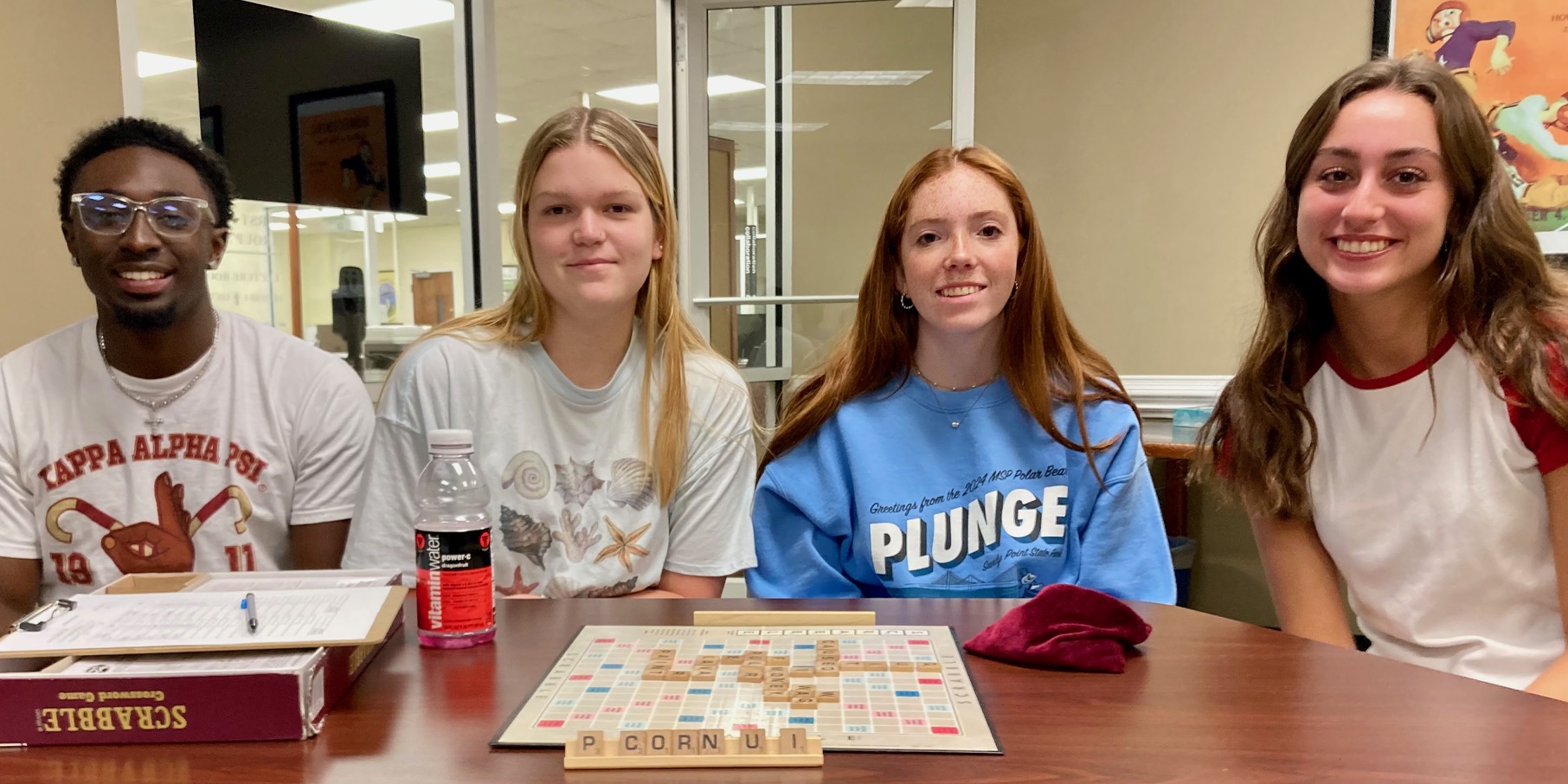
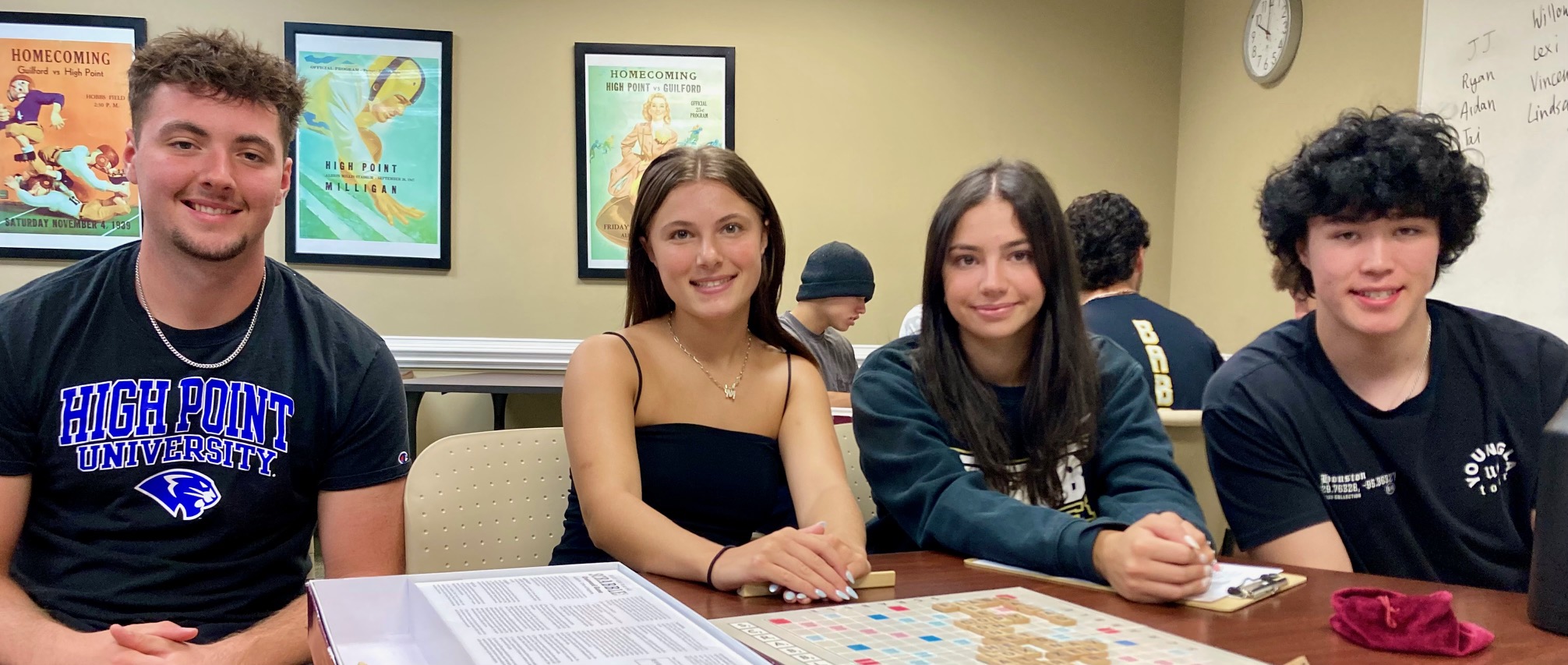
To help us put names with faces, I have included in this post pictures of all of you in sections 19 and 20 with picture captions that list your names. I encourage you to review this page frequently. In between the pictures, I have included lists of first names that are also common nouns, making them playable in Scrabble.
Students who correctly respond to the playable first names and last names question below will earn five bonus points for their first Check, Please! assignment.
How many students in English 1103.19 and 20 have first and/or last names that are playable Scrabble words? Keep in mind that only playable first names appear in the lists above. Some students in each section may have playable last names.
Directions for Finding and Submitting Your Answer
Review the list of playable first names, compare it with the students’ first and last names in the photo captions above, or on the class page, and determine which of the students’ first and last names are playable in Scrabble. If you aren’t sure whether a name is also a common noun, you can consult the Scrabble website’s dictionary
Compose a response of one or more complete sentences that includes (1) the number of students with playable names, and (2) the first and last name of each student with a playable name. Indicate which name, first or last, is playable.
Post your comment as a reply to this blog post by 9:00 a.m. on Monday, August 26.
To post your comment, click the title of the post, “What’s in a Name. . . . ,” then scroll down to the bottom of the post. There you will see the image of an airmail envelope with a white rectangular box for your comment. Type your comment in the box and hit return. Voila! You have submitted your answer. Good luck! I will make the comments visible before class on Monday, August 26.
Next Up
For class on Monday, you will read David Sedaris’s essay “Me Talk Pretty On Day,” In class we will examine Sedaris’s essay as well as some of the collaborative writing that you composed on Wednesday.
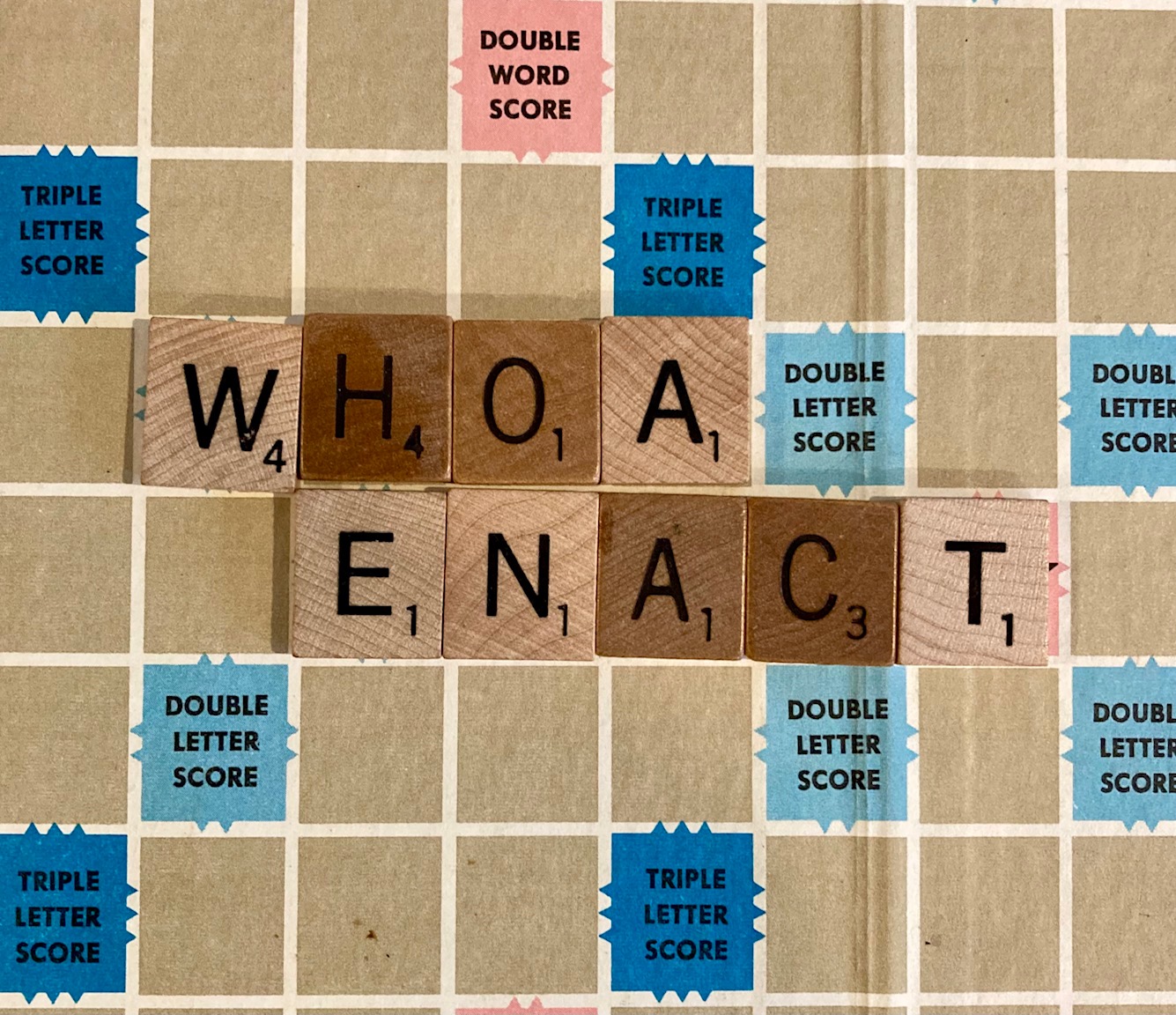
Parallel play increases your score through the points you earn by spelling more than one word in a single turn. In the first play of the hypothetical game pictured above, the first player or team would score sixteen points by spelling enact with the t on the center double-word square. With the second turn, the other player or team could take advantage of the opportunity for parallel play. If the team knew that aa is a type of lava, they could earn twenty-four points with four words: whoa, he, on, and aa.
Aa is one of sixteen playable two-letter words beginning with a. Learning these two-letter words, as well as the others that follow in the alphabet, will enable you to see more options for play and increase the number of points you earn in a single turn.
aa: a type of stony, rough lava
ab: an abdominal muscle
ad: an advertisement
ae: one
ag: agriculture
ah: an exclamation
ai: a three-toed sloth
al: a type of East Indian tree
am: the first-person singular present form of to be
an: an indefinite article
ar: the letter r
as: similar to
at: in the position of
aw: an expression of sadness or protest
ax: a type of cutting tool (also axe)
ay: a vote in the affirmative (also aye)
Important Note about Challenges
The game rules inside the Scrabble box top do not specify that a player or team that challenges a playable word will lose a turn, but David Bukszpan’s book Is That a Word? notes that the player or team does lose a turn. According to Bukszpan:
“[I]f a word is challenged and found not to be legal (called a phony in Scrabble parlance), the player that set it down loses a turn. Conversely, if a challenged word is found to be playable, the challenger loses his turn” (19).
Work Cited
Bukszapan, David. Is That a Word?: From AA to ZZZ, the Weird and Wonderful Language of SCRABBLE. Chronicle, 2012. p.19.
Next Up
Wordplay Day! To prepare for class, look to the Dictionary and World Builder pages on the Scrabble website, and review this post devoted to Scrabble tips.
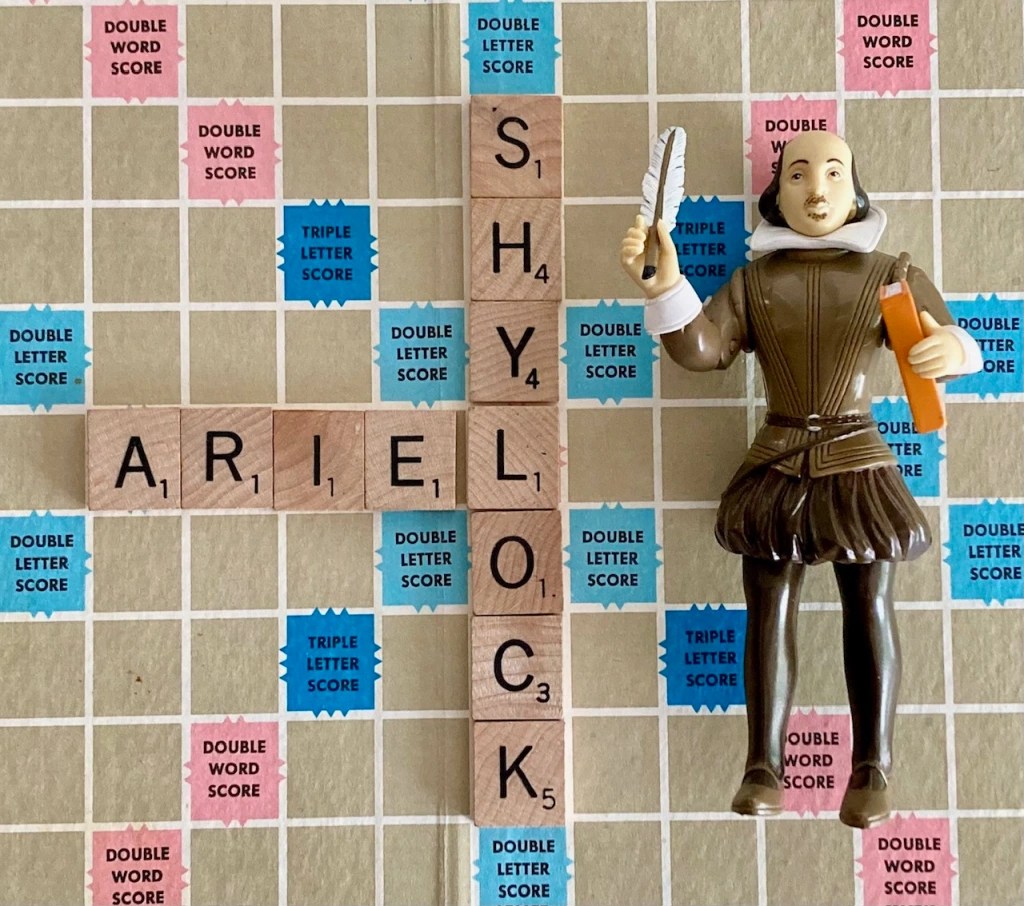
Today’s Scrabble post features Shakespeare characters whose names are also playable common nouns.
ariel: a gazelle found in Africa (Ariel, The Tempest, 1611-12)
dogberry: the fruit of a dogwood tree (Dogberry, Much Ado about Nothing, 1598-1599)
hamlet: a village (the title character of Hamlet, 1600-1601)
lear: learning (the title character of King Lear, 1605-1606)
puck: a disk used in ice hockey and other games (Puck, A Midsummer Night’s Dream, 1595-1596)
romeo: a seductive lover, a male lover (one of the title characters in Romeo and Juliet, 1594-1595)
shylock: to lend money with a high interest rate (Shylock, The Merchant of Venice, 1596-1597)
Next Up
Wordplay Day! To prepare for class, revisit the Dictionary and World Builder pages on the Scrabble website, and review the posts on my blog devoted to Scrabble tips, including this one.