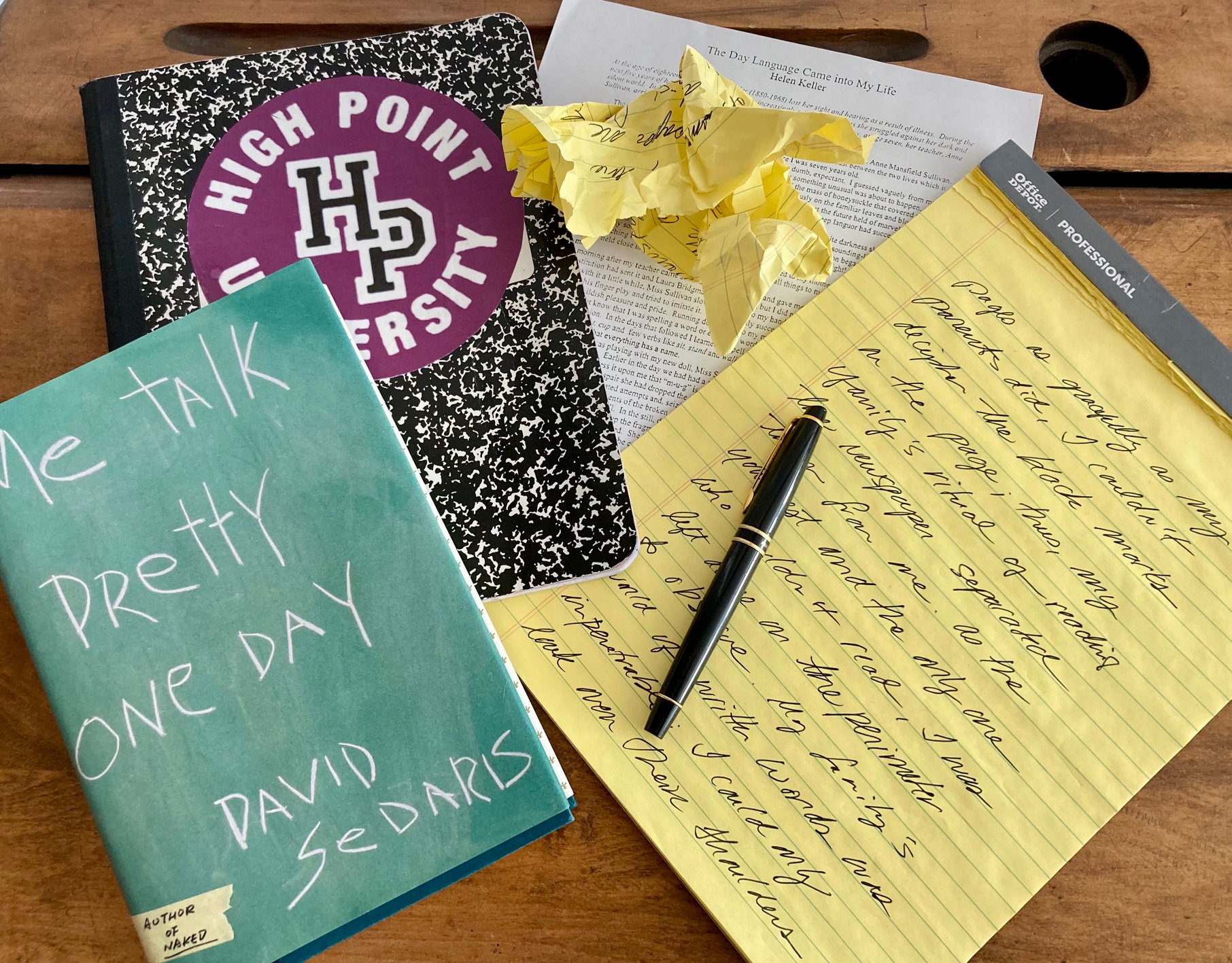
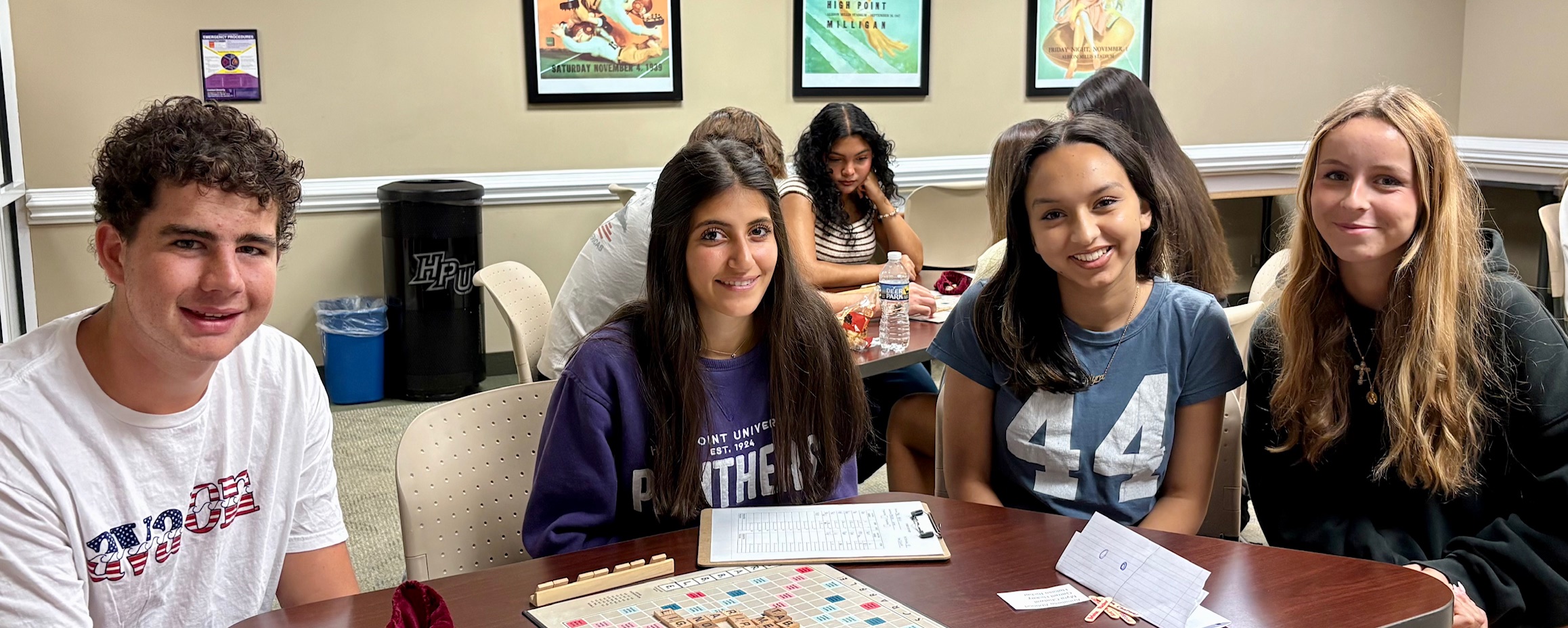
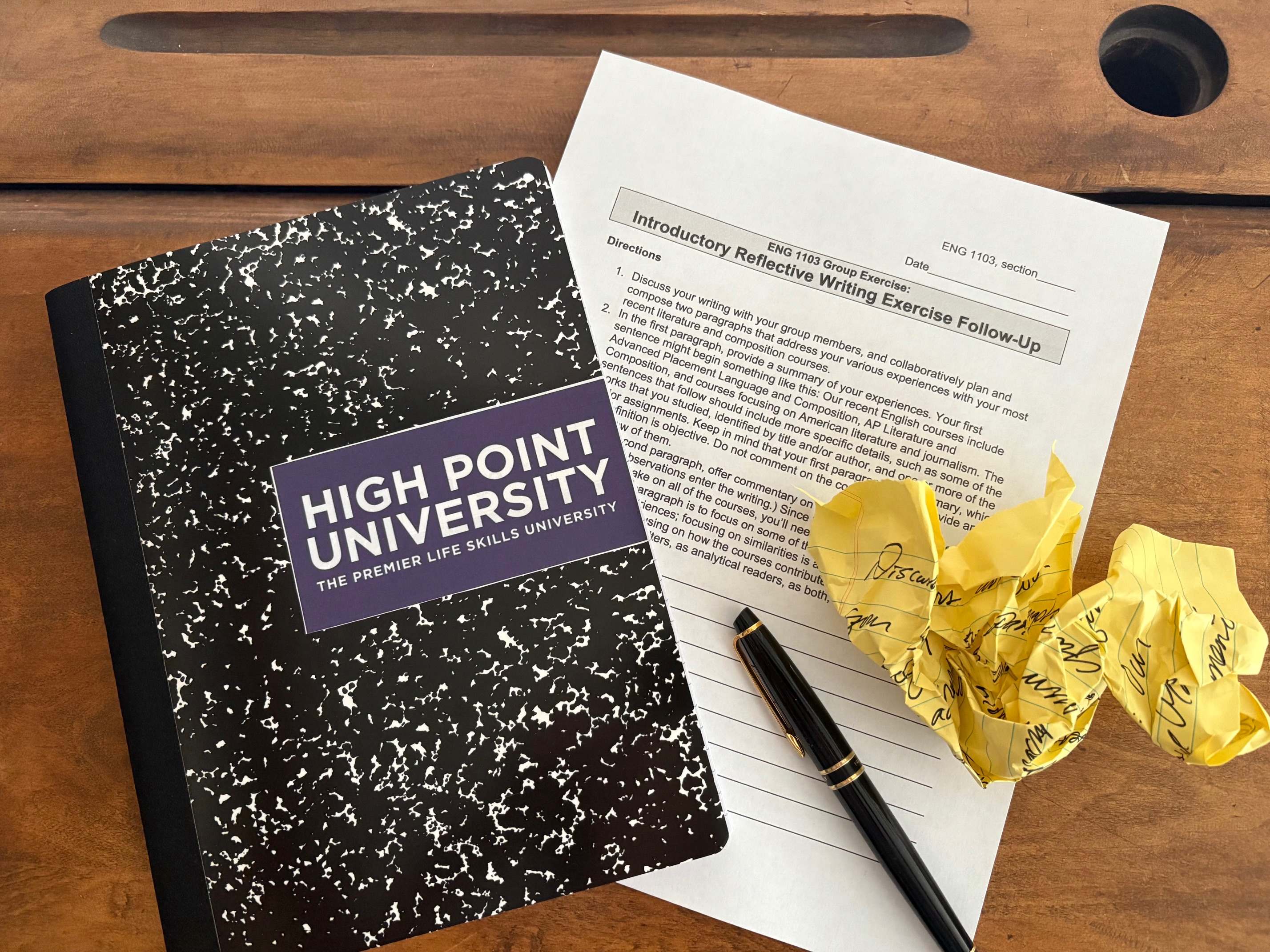
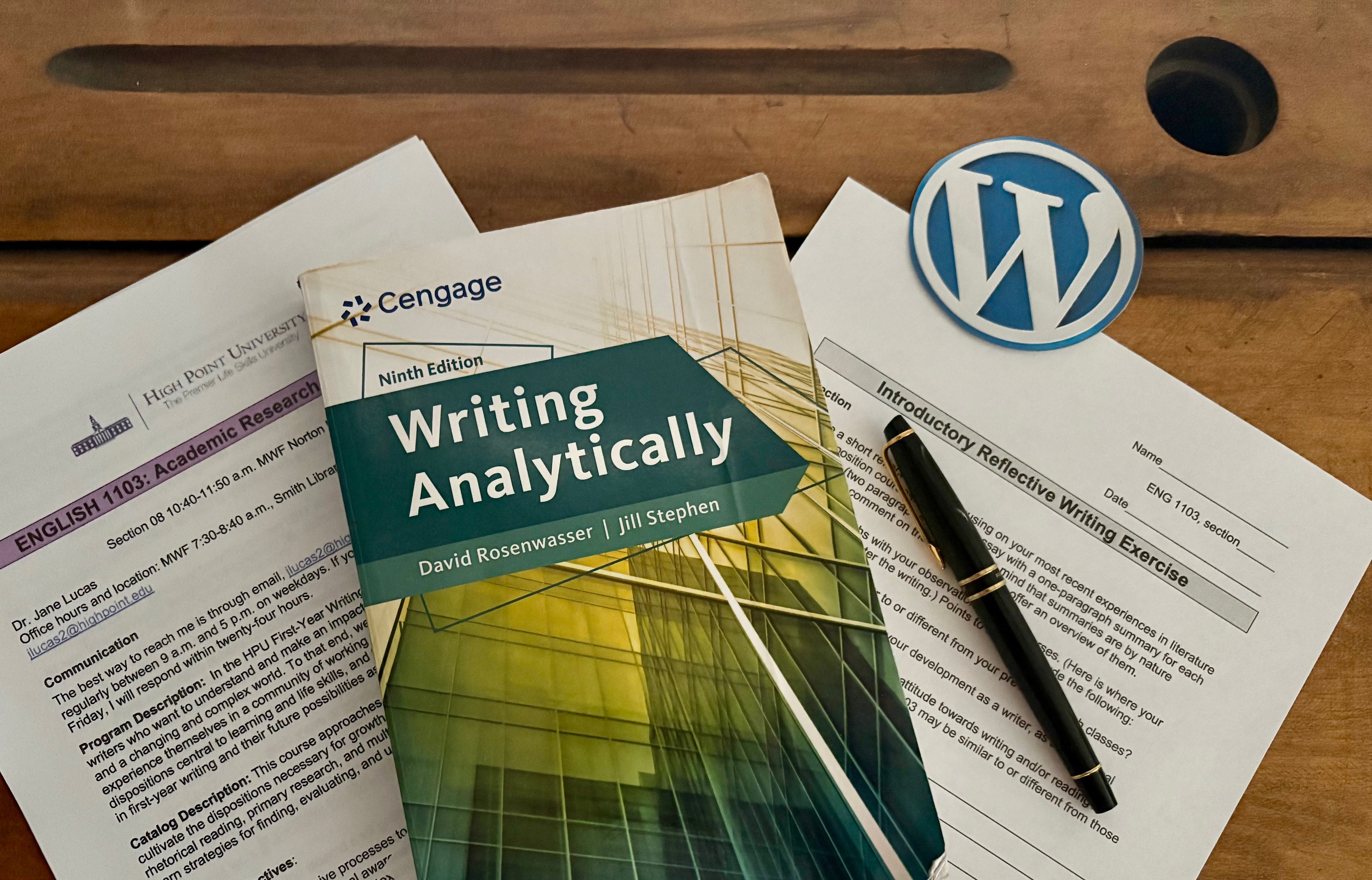
This morning you will have the class period to continue your research and writing. Although you will be working on your laptops and tablets, you will still be required to submit a handwritten exercise at the end of the class period. It will consist of a minimum of two paragraphs, each of which mentions at least two of your sources. The two paragraphs may be paragraphs from your essay, paragraphs from your bibliography, or a combination of the two. I have included sample paragraphs on the assignment handout as guides for you and am including them below as well.
Sample Essay Paragraph
In “Tabletop Games and 21st Century Skills Practice in the Undergraduate Classroom,” Mark Hayse and his colleagues who participated in the study report “that tabletop gameplay helped students move from classroom passivity to classroom ‘engagement’” (298). My own students did not address engagement in their interviews with me—though their engagement is evident during Scrabble play—but instead focused on vocabulary building and the relationship of the game to the composing process. Jesse Brewer noted that the game has “introduced [him] to new words,” and Ava Salvant observed that the game has “[p]robably influenced [her] ability to write.”
Sample Bibliography Paragraph
The research of Hargreaves and his former colleagues at Cardiff is pertinent to educators who seek to understand the cognitive benefits of frequent Scrabble play. Notably, the semantic deemphasis that the study identifies—and that Jonathan Kay addresses in his commentary—contrasts the gains in language skills that Hetty Yelland observes in her students.
Writing Center
As you continue to revise your final essay and annotated bibliography, consider visiting the Writing Center. If you do so, you will earn five bonus points for the assignment.
To schedule an appointment, visit https://highpoint.mywconline.com, email the Writing Center’s director, Professor Justin Cook, at jcook3@highpoint.edu, or scan the QR code below. To earn bonus points for your final essay and annotated bibliography, consult with a Writing Center tutor no later than Thursday, April 10. The due date for posting the assignment to Blackboard and to your WordPress blog is Wednesday, April 9 (before class); the hard deadline is Friday, April 11 (before class).
Next Up
Wordplay Day! To prepare for class, revisit the Dictionary and World Builder pages on the Scrabble website, and review the posts on my blog devoted to Scrabble tips.
Yesterday’s class focused on a review of the sample student essay and annotated bibliography “The King of Storytelling,” an exercise that should continue to serve as a guide for you as you develop and revise your own essay and bibliography.
The notes that follow address some of the points of content and form that we addressed in our review. As you continue your own research and revision work, revisit these notes as well as the paragraph that you wrote in class yesterday.
Content
The essay’s introduction does fulfill its basic requirements: It addresses the writer’s purpose for compiling it, clarifies what drives the research and what interests the writer in the subject, and also states what questions the writer seeks to answer.
The body paragraphs of the essay do include a minimum of two quotations from two of the five sources; however, the student does not mention all of the sources in the body pargraphs. In the introduction, he lists the five sources, but two of them are simply referred to as “two other articles” (par 1).
The student misses the opportunity to draw on lines from “Strawberry Spring” as examples of the writing strategies that King recommends. In the third and fourth paragraphs, the student mentions King’s advice to avoid using adverbs that end in ly and to avoid passive voice but offers examples of neither.
Consider again the examples that I wrote on the board in class:
“‘He got another one,'” someone said to me, his face pallid with excitement” (273).
“He got another one,” someone said excitedly.
The first sentence, which is King’s, is more effective than the second one because the ly-ending adverb “excitedly,” which modifies the verb “said,” contributes virtually nothing to the story or to the reader’s experience of it. “Excitedly” is abstract; it isn’t something readers can see. They can, however, see a “face pallid with excitement” (273), an image that indicates that the speaker’s heightened state of emotion isn’t all together pleasant since “pallid” is a paleness associated with illness.
Springheel Jack . . . “I saw those two words in the paper this morning” (269).
Springheel Jack . . . Those two words in the paper this morning were seen.
Springheel Jack . . . Those two words in the paper this morning were seen by me.
The first sentence, which is King’s, is more effective than the second and third ones because it is written in active voice. Because the narrator is performing the action in the sentence, seeing the words in the paper, readers are looking over his shoulder, seeing the news story for themeslves. In the second sentence, no one performs the action. In the third, the narrator is present but is the recipient of the action. Both the second and the third sentences distance the reader from the narrator, making them passive observers of a passive narrator.
Including such examples would enable the student to enhance his essay in several ways: (1) he would demonstrate his understanding of active voice, passive voice, and ineffectual ly-ending adverbs, (2) he would illustrate how King draws on his own writing advice in his fiction, and (3) he would synthesize information from a secondary source (Marc Hye-Knudsen’s “How Stephen King Writes and Why”) with information from a primary one (Stephen King’s “Strawberry Spring”).
Such enhancements are always the products of revision. Only after rereading your sources and annotating them can you begin to see how they complement one another.
Form
The parenthetical citations include only the author’s last name, and in some cases only part of the last name. The only quotation that should not be followed by a parenthetical citation is the one from the student’s interview with his classmate.
The bibliographic information for two of the three scholarly sources is incomplete and the entries are marred by errors of mechanics and style.
Wherever the parenthetical citation (Knudsen) appears, the student should have replaced it with a (Hye-Knudsen 8) or (Hye-Knudsen, par. 12), depending on whether the source is paginated. Additionally, if the words are actually Stephen King’s, the student should attribute those words to him with a parenthetical citation for an indirect quotation: (King qtd. in Hye-Knudsen 8) or (King qtd. in Hye-Knudsen, par. 12).
Neither the bibliographic entry for Brown’s article or Hye-Knudsen’s includes the title of the journal where the article was published. The absence of the titles coupled with the absence of page or paragraph numbers in the parenthetical citations may lead readers to wonder whether the student actually accessed and read the articles or simply read abstracts or excerpts. More troubling than the omission of the journal names are the references to Brown’s short article as a book. No careful examination of a text would lead the reader to conclude that it’s a full-length book if it’s only a few pages long.
Next Up
Tomorrow you will have the class period to continue your research and writing. Although you will be working on your laptops and tablets, you will still be required to submit a handwritten exercise at the end of the class period. It will consist of a minimum of two paragraphs, each of which mentions at least two of your sources. The two paragraphs may be paragraphs from your essay, paragraphs from your bibliography, or a combination of the two. I will include sample paragraphs on the assignment as guides for you. You will not receive a grade for the individual exercise itself; instead, it will factor in your final essay and annotated bibliography grade.
Some of you have probably already drafted paragraphs that mention two or more sources, which means that you will simply have to transcribe them for tomorrow’s exercise. If that isn’t the case and you are concerned about completing the two paragraphs by the end of the period, give yourself a head start.
This morning’s class will focus on a review of the sample student essay and annotated bibliography “The King of Storytelling,” an exercise that will serve as a guide for you as you develop and revise your own essay and bibliography.
After your Scrabble debriefing at the beginning of class, I will give each of you a writing prompt that asks you to focus on one section of the sample assignment.
If your prompt directs you to examine the final essay, you will begin your writing by addressing one or more of these elements:
The introduction: Does the writer address the purpose for compiling it? Does the writer clarify what drives the research, what interests the writer in the subject, and what questions the writer seeks to answer?
The body: Does the writer address all five of the sources and quote at least two of them.
If your prompt directs you to examine the first three annotations or the last two, you will begin your writing by addressing one or more of these elements:
One of the summaries: Does it provide a clear objective overview of the article, book, or interview?
One of the commentaries: Does the writer identify the purpose that source might serve in a larger project? (Does the writer demonstrate how the source serves as a point of comparison or contrast to another source? Does the writer indicate how it supports or challenges an idea presented in another source? Does the writer identify it as secondary source that sheds light on the meaning of a primary source?)
After you have each completed your individual review, choose a passage from one of them to serve as the starting point for our class discussion. Then use the evaluation criteria on the assignment sheet to determine a letter grade for “The King of Storytelling.”
Time permitting, after our discussion of “The King of Storytelling,” we will preview an exercise for Wednesday’s class.
Next Up
Wordplay Day! To prepare for class, revisit the Dictionary and World Builder pages on the Scrabble website, and review the blog posts devoted to Scrabble.
Since we studied Stephen King’s “Strawberry Spring” earlier this week, today’s Scrabble blog post is a King-inspired one devoted to words for ghosts, including banshee, which appears in the story.
banshee: a female spirit in Gaelic folklore that wails to warn of a family member’s imminent death. Note that this word is featured in Stephen King’s short story “Strawberry Spring,” which we examined in class yesterday.
barguest: a goblin (also barghest)
bogy: a goblin
daimon: a spirit (also daemon and demon)
eidolon: a phantom or specter
fairyism: the quality of being like a fairy (not really a ghost but a great word)
haint: a ghost
kelpie: a water sprite in Scottish folklore known for drowning sailors
wraith: a ghost of a person, often appearing just before that person’s death
zombi: a zombie
Next Up
Wordplay Day! To prepare for class, revisit the Dictionary and World Builder pages on the Scrabble website. Also review the blog posts devoted to Scrabble tips, including this one.
Last Wednesday in class, on the worksheet you completed, you were required to select a phrase or sentence from your interview and introduce it with a signal phrase. You were also required to compose a complete annotated bibliographic entry.
Although you are not required to transcribe your complete interview, I encourage you to do so. If you decide that you want to include in your annotated bibliography and/or final essay a phrase or sentence other than the one you included on your worksheet, having a file of your complete interview will enable you to easily copy and paste lines from your interview into your essay and/or your bibliography.
Transcripts of my own interviews with students are included below as models for your own.
Interview with Jesse Brewer
Q: Jesse, what experience did you have with playing Scrabble before you encountered the game in English 1103?
A: So, whenever I would go up to my grandmother and grandfather’s house in Pennsylvania, we would play Scrabble pretty consistently there. We had a lot of fun playing Scrabble at my grandmother’s house whenever I was a young child.
Q: Has Scrabble changed your perspective on reading and/or writing? If so, how?
A: While I wouldn’t necessarily say it has changed my perspective on reading or writing, it has most certainly introduced me to new words which allows me to read or write more capably in everyday situations.
Q: Will you continue to play Scrabble after the conclusion of the semester?
A: Yes, my grandmother is still going to want to play it every summer.
Interview with Ava Salvant
Q: Ava, what experience did you have with playing Scrabble before you played it in English 1103?
A: I didn’t have any experience with Scrabble beforehand. I didn’t know how to play it at all.
Q: Has Scrabble changed your perspective on reading and/or writing? If so, how?
A: Probably it has influenced my ability to write. Not always when you sit down to write do you know the exact words you want to say. You kind of have to go with the flow. You have to put as many words as you can down on the board in Scrabble or on the paper when writing.
Q: Will you continue to play Scrabble after the end of the semester?
A: I might come back to it a few times to refresh or just use as a pastime.
Next Up
Wordplay Day! To prepare for class, revisit the Dictionary and World Builder pages on the Scrabble website. Also review the blog posts devoted to Scrabble tips.
Today in class you will use the HPU Libraries website and Google Scholar to locate, read, and annotate additional sources for your final essay and annotated bibliography. The work that you submit at the end of class today should include at least one MLA-style annotated bibliographic entry. The sample entry that I composed as a model for you appears below.
Cardell, Kylie, and Victoria Kuttainen. “The Ethics of Laughter: David Sedaris and Humour Memoir.” Mosaic: An Interdisciplinary Critical Journal, vol. 45, no. 3, 2012, pp. 99-114. JSTOR, http://www.jstor.org/stable/44030697.
“The Ethics of Laughter: David Sedaris and Humour Memoir” explores the implications of the blending of truth and artifice in David Sedaris’s writing. In the words of the authors, Sedaris’s “memoirs have attracted controversy for their blurring (or, as we argue, contesting) of boundaries between fiction and non-fiction” (Cardell and Kuttainen 100). While some critics, such as journalist Alex Heard, believe that “Sedaris exaggerates too much for a writer using the non-fiction label” (qtd. in Cardell and Kuttainen 103), Cardell and Kuttainen assert that Sedaris’s use of hyperbole, a staple of his prose style, is ethical in the context of the humor memoir.
Cardell’s and Kuttainen’s essay would serve as a useful source for a study of Sedaris’s mingling of the real and what he refers to as the “realish” in his writing (qtd. in Cardell and Kuttainen 99). It could also play a significant role as a source for a comparative study of the writing of Sedaris and other memoirists who blur the line between fiction and nonfiction.
Kylie Cardell, Ph.D., author of Dear World: Contemporary Uses of Autobiography, is Associate Professor of Humanities at Flinders University. Her co-author, Victoria Kuttainen, Ph.D., author of Unsettling Stories and The Transported Imagination, is Associate Professor of Art and Creative Media at James Cook University.
Note that the blog format of the annotated bibliographic entry above is different from MLA format, which features paragraph indentations and double spacing.
The bibliographic entry above and the three paragraphs that follow total 241 words. The minimum word count for the entire assignment (essay and bibliography together) is 1,800 words.
If you compose five annotations of the length of the one above, you will be well on your way to completing your 1,800-word minimum, and your bibliography may be longer than your essay.
Literary Allusions in “Strawberry Spring”
Monday’s group exercise asked you to look for literary allusions in Stephen King’s “Strawberry King.” The first is an allusion to J.R.R. Tolkein‘s The Lord of the Rings trilogy: “You half expected to see Gollum or Frodo or Sam go hurrying past” (269). The second is an allusion to a poem by Carl Sandburg, titled–perhaps unsurprisingly–“The Fog” (272).
Next Up
Wordplay Day! To up your game and increase your word power, revisit the Dictionary and World Builder pages on the Scrabble website, and review the blog posts devoted to Scrabble tips.
Tomorrow morning, before you continue work on your final essay and annotated bibliography, we will revisit Stephen King‘s “Strawberry Spring” and discuss the answers to your collaborative exercise on the story.
For that exercise, I asked you to determine whether you could identify any details that indicate why the narrator may have murdered any of his victims. Although there is no indication that the narrator knew Gale Cermann, Adelle Parkins, or Marsha Curran, he did know Ann Bray, which he reveals after he tells the readers that she was editor of the school newspaper: “In the hot, fierce bubblings of my freshman youth I had submitted a column idea to the paper and asked for a date–turned down on both counts” (275).
I also asked you to try to identify the two literary allusions in King’s story. The first appears on page 269, the second on 272. We will examine them in detail at the beginning of tomorrow’s class.
Next Up
At the beginning of tomorrow’s class, we will continue our discussion of “Strawberry Spring.” Afterward, you will have the remainder of the period to devote to your final essay and annotated bibliography. Details TBA.
Today in class we will read the second half of Stephen King‘s short story “Strawberry Spring,” which was published in Ubris magazine in 1968 and included in King’s first short story collection, Night Shift (1978).
For the collaborative exercise that you will complete after we read the story, I will ask you to determine whether you can identify any details that indicate why the narrator may have murdered any of his victims. Although there is no indication that the narrator knew Gale Cerman, Adelle Parkins, or Marsha Curran, he did know Ann Bray. I will also ask you to try to identify the two literary allusions in King’s story.
We will address those points near the end of class today, and I will expand on them in tomorrow’s blog. Also in class today, we will discuss King’s story as another possible subject for research and how you might develop a final essay and annotated bibliography on “Strawberry Spring”–or one on your chosen subject–into a larger project for an upper-level course.
Next Up
We will review “Strawberry Spring” at the beginning of Wednesday’s class, and you will have the remainder of the period to continue work on your final essay and annotated bibliography.
The last Scrabble post featured a list of toponyms (place names) in the first half of the alphabet. This post includes a list of toponyms in the second half. These proper nouns are playable in Scrabble because they’re also common nouns. Studying them offers you additional opportunities to broaden your vocabulary and up your game.
oxford: a type of shoe, also known as a bal or balmoral
panama: a type of wide-brimmed hat
paris: a type of plant found in Europe and Asia that produces a lone, poisonous berry
roman: a romance written in meter
scot: an assessed tax
scotch: to put an end to; or to etch or scratch (as in hopscotch)
sherpa: a soft fabric used for linings
siamese: a water pipe providing a connection for two hoses
swiss: a sheer, cotton fabric
texas: a tall structure on a steamboat containing the pilothouse
toledo: a type of sword known for its fine craftsmanship, originally from Toledo
wale: to injure, to create welts on the skin
warsaw: a type of grouper fish
waterloo: a definitive defeat
zaire: a currency of Zaire
Next Up
Wordplay Day! To prepare for class, revisit the Dictionary and World Builder pages on the Scrabble website, and review the posts on my blog devoted to Scrabble tips, including this one.
Today’s blog post features my version of the fifth Check, Please! assignment, which you submitted at the beginning of yesterday’s class. Although you have now completed your final Check, Please! worksheet, this model assignment and the previous four will remain useful to you as you continue to hone your information literacy skills.
Check, Please! Lesson Five
In the fifth lesson of the Check, Please!, Starter Course, Mike Caulfield, author of the course and ra esearch scientist at the University of Washington’s Center for an Informed Public, covers the final step in the five-step SIFT approach: “Trace Claims, Quotes, and Media to Their Original Context.” Caulfield outlines the process of locating the original context as an antidote to the issues of accuracy that occur when information passes through intermediaries.
One of the most instructive portions of lesson five features a passage in which Caulfield cites a study of how stories evolve as gossip through the processes of leveling (stripping details), sharpening (adding or emphasizing details), and assimilating, which combines the two. In the process of assimilation “the details that were omitted and the details that were added or emphasized are chosen because they either fit what the speaker thinks is the main theme of the story, or what the speaker thinks the listener will be most interested in.” Similarly, leveling, sharpening, and assimilating all figure in the altered photographs and memes in lesson four. The abbreviated speech of the NRA’s CEO, Wayne LaPierre, which omits commentary, inaccurately indicates a contradiction in his stance on the presence of guns in schools.
The image of photographer Kawika Singson with flames at his feet serves as an example of leveling. Although the flames are real, they were not caused by the heat of the lava flow where Singson stands with his tripod. Instead, to create the image, a friend of his poured accelerant on the lava before Singson stepped into the frame. The deception wasn’t intentional; Singson simply wanted the image for his Facebook cover photo.
Unlike Singson’s photograph, the altered photograph of the Notorious B.I.G. with Kurt Cobain was created with the intent to deceive. Cropping and merging the two photographs illustrates the assimilation process adopted by photoshop users to appeal to music fans eager to think that such fictional meetings of icons took place. Krist Novoselic, who founded Nirvana with Cobain, replied to the is-it-real question with his own fake photo, making the claim that the hand holding the cigarettes was Shakur’s, that he had been cropped from the right.
Wordplay Day! To prepare for class, revisit the Dictionary and World Builder pages on the Scrabble website, and review the blog posts devoted to Scrabble tips.