Last week, I published a blog post featuring playable four-letter words with three vowels. Knowing those words, and others with multiple vowels, proves useful when you’re faced with a rack of mostly, or all, vowels. Here’s a list of the remaining playable four-letter words with three vowels, beginning with the letters in the second half of the alphabet:
naoi: ancient temples (pl. of naos)
obia: form of sorcery practiced in the Caribbean (also obeah)
odea: concert halls (pl. of odeum)
ogee: an S-shaped molding
ohia: a Polynesian tree with bright flowers (also lehua)
olea: corrosive solutions (pl. of oleum)
olio: a miscellaneous collection
ouzo: a Turkish anise-flavored liquor
raia: a non-Muslim Turk (also rayah)
roue: a lecherous old man
toea: a currency in Papua, New Guinea
unai: a two-toed sloth (pl. unai; an ai is a three-toed sloth)
On Monday, after your Scrabble debriefing, you will receive your group presentation assignment, and you will have the remainder of the period to plan and rehearse.
This morning in class, you will compose a reflective essay that documents the process of planning, drafting, and revising your analysis. Include at least one relevant quotation from Writing Analytically, introduced with a signal phrase and followed by a parenthetical citation. Questions to consider in your reflection include the following:
Questions to Consider in Your Reflection
When you began transferring the words from your handwritten draft onto the screen of your laptop or tablet, what did you observe about the process?
What aspect of the writing seemed the most challenging? Choosing your topic? Deciding which text would serve as your subject? Determining your thesis? Identifying details to support your claims? Organizing the body of the essay? Composing the conclusion? Why did that aspect of the writing seem the most challenging?
Did the subject of your analysis change? If so, what was your original subject, and what did you change it to?
Did any of the sample analyses (“Wait Means Never,” “Princess of the Rock,” “The Strange Fruit of Sosnowiec”) prove helpful to you? If so, which one? How was it helpful?
What do you consider the strongest element of your analysis?
At what point in the process did you decide on a title? Did you change the title during the writing process? If so, what was the original title?
What image that documents part of your writing process away from the screen did you include in your blog post? Why did you choose that image?
What relevant website did you include an embedded link to in your blog post? Why did you choose that site?
Sample Works Cited Entries
Rosenwasser, David, and Jill Stephen. “Focus on Individual Words and Phrases.” Writing Analytically, 9th edition. Wadsworth/Cengage, 2024. pp. 48-49.
Rosenwasser, David, and Jill Stephen. “How Long?: Paragraphs, Readers, and Writers.” Writing Analytically, 9th edition. Wadsworth/Cengage, 2024. p. 308.
Rosenwasser, David, and Jill Stephen. “‘Interesting,’ ‘Revealing,’ ‘Strange’” Writing Analytically, 9th edition. Wadsworth/Cengage, 2024. p. 24.
Rosenwasser, David, and Jill Stephen. “Seems to Be About X, But Could Also Be (Or is ‘Really’) About Y.’” Writing Analytically, 9th edition. Wadsworth/Cengage, 2024. pp. 104-7.
Rosenwasser, David, and Jill Stephen. “What a Good Analytical Thesis Is and Does.” Writing Analytically, 9th edition. Wadsworth/Cengage, 2024. pp. 241-42.
Rosenwasser, David, and Jill Stephen. “Words Matter.” Writing Analytically, 9th edition. Wadsworth/Cengage, 2024. pp. 49-50.
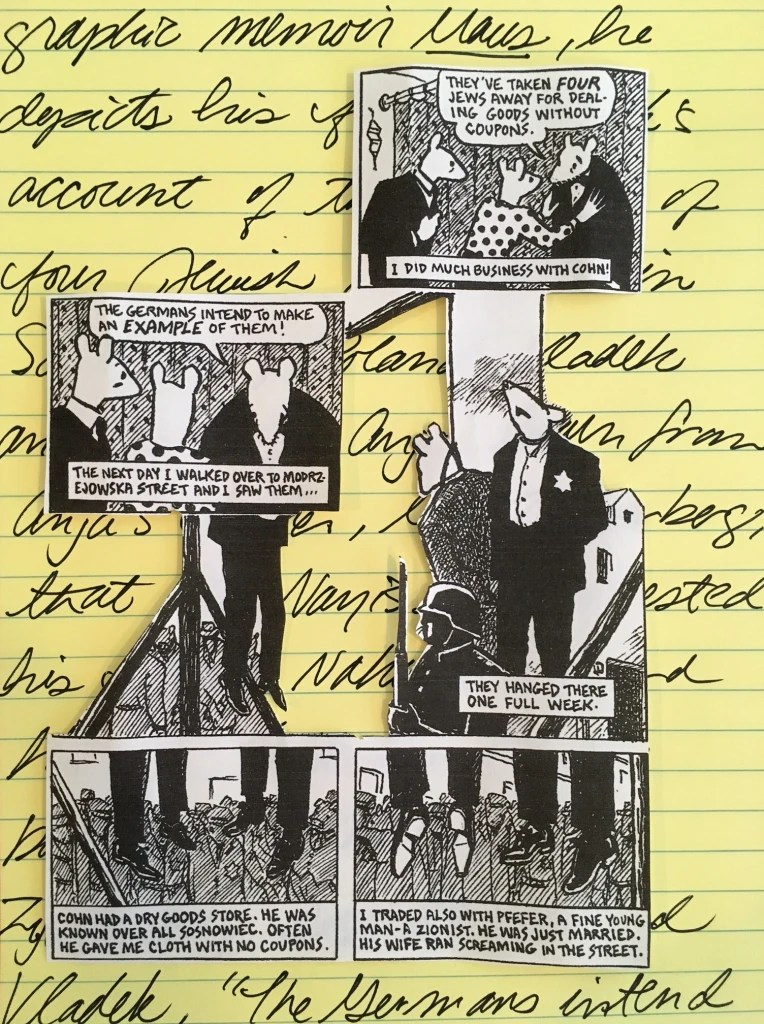
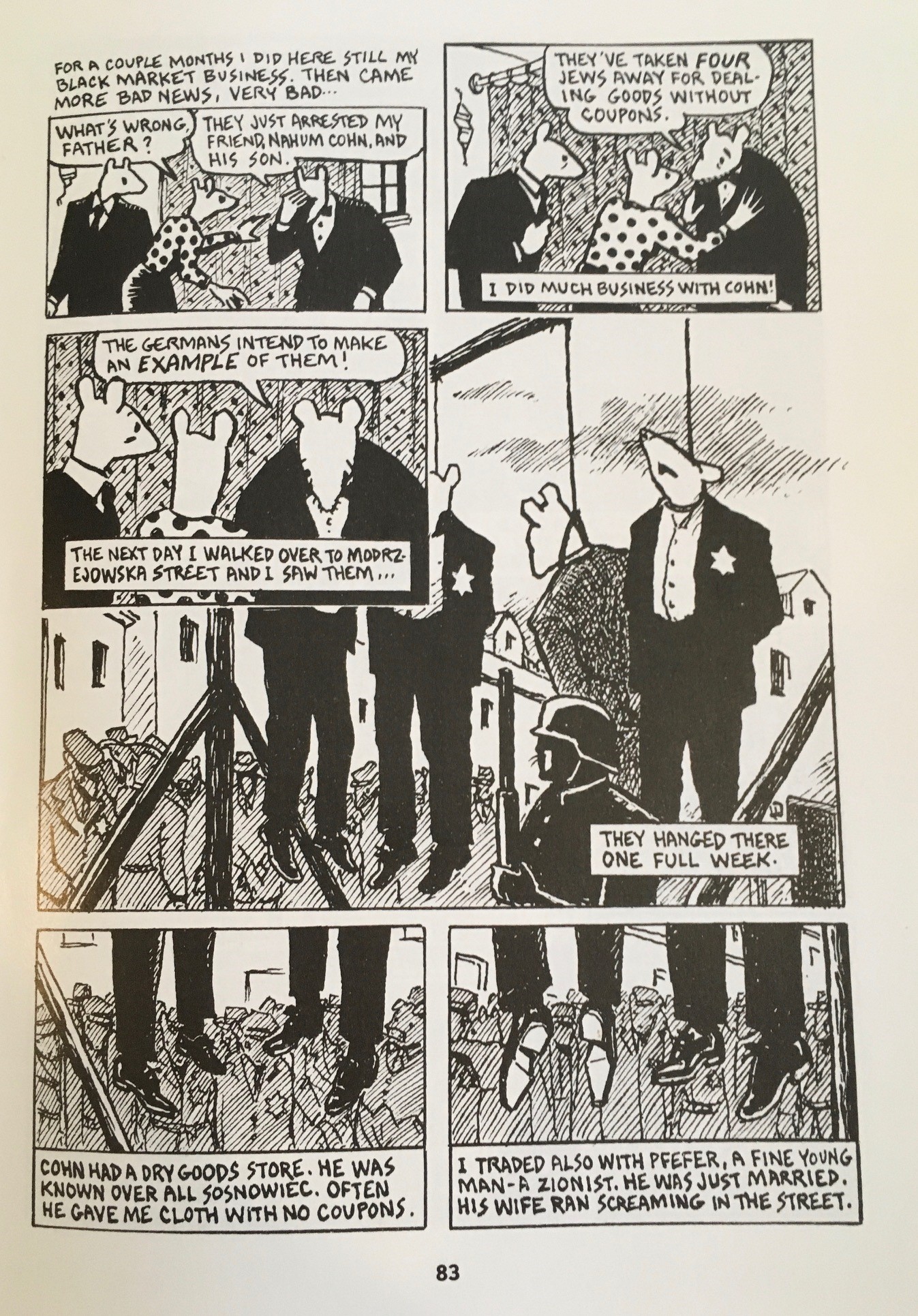
Monday in class, I distributed copies of my study of a page of Art Spiegelman’s Maus, which I wrote as a model analysis in a previous semester. An additional copy, which complies with the guidelines of your analysis blog post, appears below.
The Strange Fruit of Sosnowiec
In his graphic memoir Maus, Art Spiegelman devotes a page to his father Vladek’s account of the hangings of four Jewish merchants in Sosnowiec, Poland. Vladek and his wife, Anja, learn from Anja’s father, Mr. Zylberberg, that the Nazis have arrested his friend Nahum Cohn and his son. With his head bowed in sorrow, Mr. Zylberberg says to Anja and Vladek, “The Germans intend to make an example of them!” (83). That image of Mr. Zylberberg speaking with Vladek and Anja overlies the larger panel that dominates the page, one that depicts the horror that Mr. Zylberberg anticipates: the murder of his friend Nahum Cohn, Cohn’s son, and two other Jewish merchants. That haunting panel and the smaller ones that frame it illustrate the complexity of Spiegelman’s seemingly simple composition. His rendering of the panels of the living in conjunction with the fragmented panels of the hanged merchants simultaneously conveys connection and separation: both the grieving survivors’ ties to the dead and the hanged men’s objectification at the hands of the Nazis.
The placement of the overlying panel not only hides part of the horror behind it, but it also connects Vladek’s father-in-law to one of the victims. Mr. Zylberberg’s head and torso appear directly above the suspended legs and feet of one of the hanged men, creating an image that merges the two.
Spiegelman further emphasizes the mourners’ identification with the hanged men by extending two of the nooses’ ropes upward to the smaller panel above them, linking the living to the dead. Additionally, Spiegelman underscores the link with Vladek’s line of narration at the bottom of the smaller panel: “I did much business with Cohn!” (83). The word with appears directly above the rope, punctuating the connection between both Nahum Cohn and his friend Mr. Zylberberg and Zylberberg’s son-in-law, Vladek.
While the panels of the hangings yoke the living to the dead, Spiegelman’s presentation of the hanged men in fragments also objectifies them. The final panels on the page depict only their shoes and part of their pant legs suspended above the onlookers, images that may evoke in some readers thoughts of the last remnants of the Jews who stepped barefoot into the gas chambers of Auschwitz.
Whether the hanged men’s shoes call to mind those mountains of leather left behind by the Jews, the separation of their lower legs and feet from the rest of their bodies turns them into something less than human—not people, but mere parts. Thus, Spiegelman creates a picture of the hangings that illustrates both the mourners’ identification with the victims and the Nazis’ perception of the Jews as less than human.
Spiegelman’s transformation of the Nazi propaganda portrayals of Jews as rats remains an astounding achievement thirty-five years after the publication of the first volume of Maus. But seeing the hanged merchants in Modrzejowska Street in the midst of the George Floyd murder trial in Minneapolis and less than three months after the January 6 Capitol riot reminds readers that the panels of Spiegelman’s memoir have grown more prescient. The nooses evoke images of Officer Derek Chauvin’s knee on George Floyd’s neck, the January 6 chants to hang the Vice President, and a T-shirt glimpsed in the Capitol crowd, one with a Nazi eagle below the acronym 6MWE (Six Million Wasn’t Enough), a reference to the number of Jews slaughtered in the Holocaust. Our heads are bowed in sorrow with Mr. Zylberberg’s. The strange fruit of our past, both distant and recent, should seem far stranger.
At the beginning of yesterday’s class, we examined “Wait Means Never,” the sample student analysis of Martin Luther King Jr.’s “Letter from Birmingham Jail,” and “Princessof the Rock,” the analysis of the prologue to Tara Westover’s memoir, Educated. Today’s post presents more detailed notes on the essays’ content and form. As you continue to revise, return to these notes for reminders of dos and don’ts for your own analysis.
“Wait Means Never” Content
Rather than beginning with a summary of Martin Luther King, Jr.’s “Letter from Birmingham Jail,” the writer comments on the letter by observing its relevance. Instead the writer should state what the letter is, an epistolary essay King wrote in 1962 while he was jailed in Alabama for leading nonviolent protests.
The writer ends the first paragraph with a thesis, but the statement is primarily description. Essentially, the writer states that King uses stylistic devices to deliver his message to a wider audience, but a thesis or main claim in a textual analysis should offer an assertion about how the writer’s use of those devices achieve a particular effect. The recommended revision that we examined in class–the one on the handout that I distributed–is included below, under the Revision heading.
The writer observes that King repeats “the word ‘wait’ throughout the letter” (par. 2), but King does not introduce that word until his eleventh paragraph. The writer could revise his thesis to focus specifically on King’s eleventh paragraph because that portion of the letter is the source of his claims and textual support.
In the body paragraphs, the writer effectively details King’s diction and sentence structure, but a couple of inaccuaracies undercut the prose. Neither “from bad to worse” (par. 3) nor “at the end of the letter” (par. 5) is accurate.
After ending the final body paragraph with ”’wait'” (par. 5), the writer turns to a conclusion that reads more like the ending of a history report than a textual analysis. Simply revising the opening of the last paragraph to begin, “[t]he words of Dr. Martin Luther King . . .” would maintain the focus of the analysis, the words themselves. The writer could still address the letter’s role in history by noting how the words have endured as a rallying cry for peaceful nonviolent protest. Consider how else the writer might give the analysis closure.
“Wait Means Never” Form
The document lacks a running header.
Because the writer is referring to wait and never as words in his title, both should be italicized.
In the first line, the writer defines King’s letter as a “speech of literature” (par. 1). Although King was an orator, his “Letter from Birmingham Jail,” is not one of his speeches. As the title indicates, it’s a letter. Labeling the letter “literature” is unnecessary because the analysis that unfolds will reveal the literary quality of the prose. If the writer wants to address the letter’s status as a work of literature, in the conclusion, he might note that many students first encounter King’s letter in the pages of their high school and college anthologies.
In the first sentence of the introductory paragraph and the second sentence of the second paragraph, the writer uses coordinating conjunctions that indicate contrast, but the clauses those words connect are not in contrast. See “yet remains” (par. 1) and “but irked” (par. 2). In both cases, “and” would be the accurate conjunction. That said, “yet remains” introduces an assessment of the letter–in particular, its relevance–which shouldn’t be part of the summary at the beginning of the analysis.
The writer refers to King’s voice as “the narrator’s” (par. 2), but a narrator is a person who tells a story, usually a work of fiction or a narrative poem. King should be referred to as the writer or the author.
The clauses “it can easily be acknowledged” (par. 2) and “it can be identified” (par. 5) are passive constructions that de-emphasize the subject. The sentences that contain those clauses should be revised to show the action that King performs as a writer. The second-paragraph sentence might be rewritten as this: King’s repetition of wait emphasizes how frequently he has heard the word and how its “piercing familiarity” (par. 11) has increased his frustration. The two sentences convey the same idea, but the revision is eleven words shorter.
Introductory Paragraph
The paragraphs below are the first paragraph of “Wait Means Never” and my revised version.
Original Introductory Paragraph
Dr. Martin Luther King Jr.’s “Letter from Birmingham Jail,” is a speech of literature that was composed many years ago yet remains relevant. King’s words give insight into the life of an African American during the 1960s and symbolize the significance of taking action and standing up for what is right, justice for African Americans. In this particular letter, King speaks about how it’s easy for people who have never felt pain of being oppressed, discriminated against, and segregated to say the word “wait.” The letter goes further into detail about what “wait” truly means for an African American and specifically tackles the perspective of an American father who also has to explain to his children why the world is the way it is, yet that father does not quite know himself why people act in such a harsh manner. In this letter, Martin Luther King Jr. utilizes repetition, detail, vivid imagery, and sentence structure to deliver a message to not just one person, or even a hundred people, but the entire country that justice for African Americans cannot be a patient matter.
Revision
Dr.Martin Luther King, Jr.’s “Letter from Birmingham Jail” responds to the eight white clergymen who drafted an open letter addressing King’s involvement in the civil rights movement, urging him to seek justice in the courts rather than in the streets. In his answer to the clergymen, King asserts that a Christianity that permits racial oppression and prejudice is immoral and stands in direct opposition to the teachings of the gospel. Though King’s letter draws on his 1956 sermon “Paul’s Letter to American Christians,” the hallmark of his epistolary essay is not the rhythmic cadences of his baritone voice, but instead its artful composition. With the repetition of the word wait and a series of dependent clauses, King encapsulates his testimony and delays the end of the letter’s longest sentence, creating a holding pattern that forces readers to experience their own wait.
“Princess of the Rock” Content
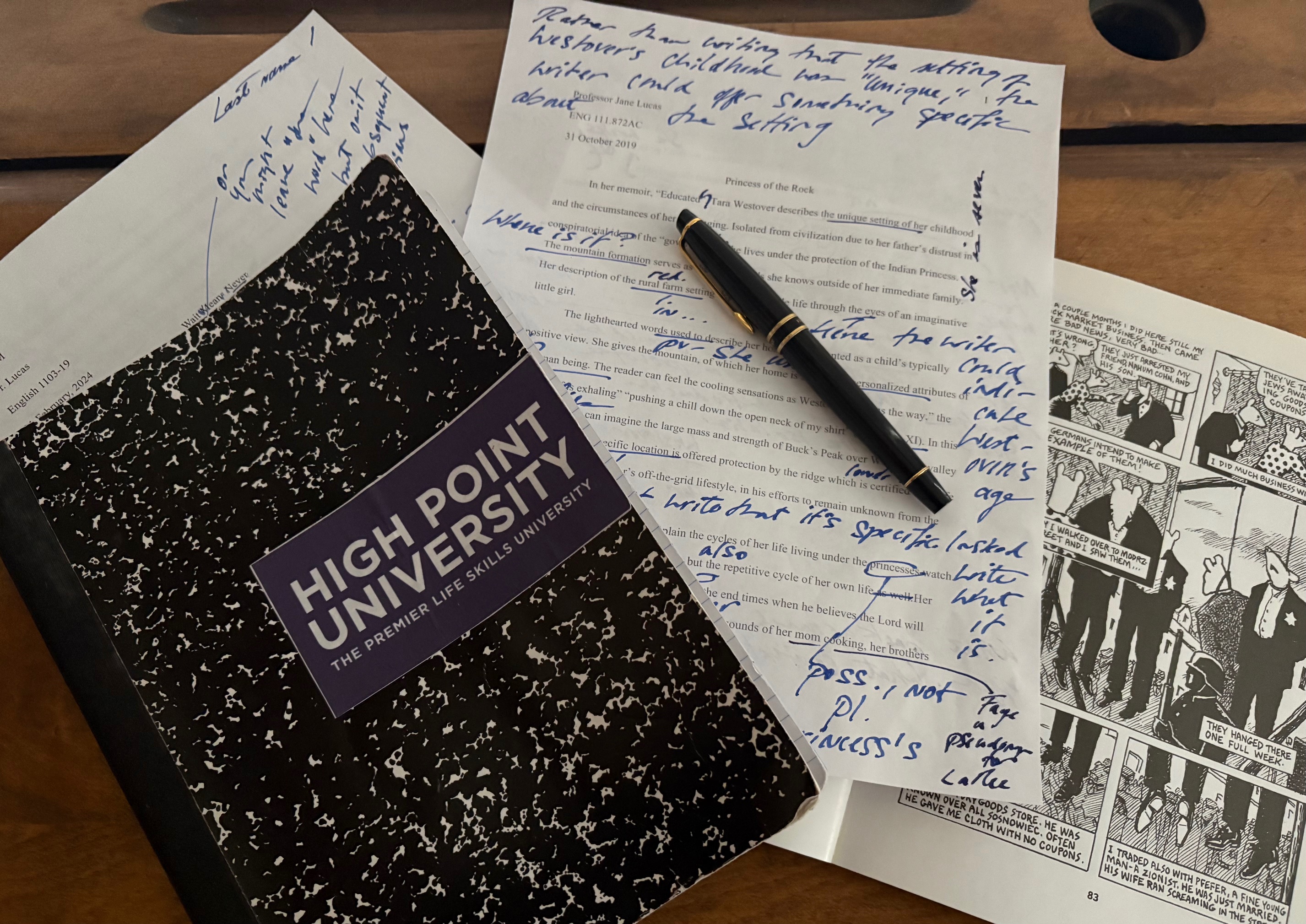
The writer refers to the “unique setting” (par. 1) of Tara Westover’s childhood, but doesn’t specify the location of the mountains that are home to Buck’s Peak, which features the image of the Indian Princess, Westover’s friend and protector. Identifying Buck’s Peak as part of the Bear River Range in southeast Idaho would give readers a better sense of the setting.
What appears to be the essay’s thesis–the sentence that begins, “Her description of the rural farm . . .”–is itself description rather than analysis. Shifting the focus from the fact that Westover depicts herself as a child to what Westover achieves through the adult retrospective narrator’s presentation of her younger self would move the essay in the direction of critical study.
The writer states that Westover uses “lighthearted words” (par. 2), but the line that she quotes as evidence to support her claim is not lighthearted.
Only near the end of the essay–in the fifth of its six paragraphs–does the writer identify the excerpt she is analyzing as the prologue of the memoir. Identifying the text as the prologue in the introduction and addressing its function in the thesis is another change that would move the essay in the direction of critical study. (What background or context does the prologue provide? What does it foreshadow?)
“Princess of the Rock” Form
The memoir’s title, Educated, is incorrectly enclosed in quotation marks (par. 1).
Commas incorrectly follow closing quotation marks (par. 1).
The phrase “rural farm setting” (par. 2) is redundant.
The passive construction “[t]he lighthearted words used” (par.2 ) should be recast in active voice: Westover uses lighthearted words . . .
The first quotation from Educated (par. 2) should not include the author’s last name, and the Roman numerals should be lower-case.
The word “princesses” (par. 3) should be possessive rather than plural (princess’s).
The word “has” (par. 3) should be replaced with an action verb–such as demands or forces to enliven the sentence and give readers a better sense of Westover’s father. The writer should also note that the father’s name in the memoir is Gene, a pseudonym for Val.
The second quotation from Educated (par. 3) lacks both a signal phrase and a parenthetical citation.
The third paragraph ends with an instance of faulty predication.
The writer refers to “Tara’s family” (par. 4) and “Tara wish[ing]” (par. 6) when she should refer to Westover’s and Westover.
Conclusions
Effective strategies for concluding analyses include (1) offering an insight about the text or an additional quotation from it, (2) revisiting the thesis without stating it verbatim, and (3) pointing to the broader implications of the analysis. In “The Strange Fruit of Sosnowiec,” I employ two of the three, specifically one and three. Look back at the final paragraph and note how each sentence offers insights about Maus or points to its broader implications.
As I have noted before, you should avoid the phrase in conclusion or any variation on it at the beginning of the final paragraph of your essay. While that transitional phrase can be useful in a speech (because the audience cannot see that the end is near), there is no reason to write those words when readers can see for themselves that only one paragraph remains. For more, see Harvard University Writing Center’s notes on conclusions.
Relevant Embedded Links
The relevant embedded link that you include in the blog post for your analysis should be a primary or secondary source, not a background one, such as Wikipedia, Encyclopedia Britannica, or a social cataloguing website, such as Goodreads. Appropriate websites to link include the authors’ own sites, sites where the full-text of the essay or chapter is available (without a paywall), and authors’ pages on publications that employ them, such as Michael Lewis’s page on the ESPN site. The list below includes a link to one appropriate site for each of the seven subjects. If you are unsure whether a site is appropriate to link to your analysis, ask me or simply use the relevant link below.
Note that for search purposes, the sites above are listed as complete URLs, not as embedded links. In your blog post, the site address should be embedded in a word or phrase, just as the links are embedded in the earlier sections of this post (and in my other posts).
Next Up
On Wednesday, you will compose a short reflective essay focusing on the process of planning, drafting, and revising your analysis. If you are still in the process of completing your essay on Wednesday (since you have until Friday morning’s hard deadline to post it), your reflection will address your work in progress.
Before class, review the sections of the textbook, Writing Analytically, that have guided you in the writing of your analysis:
“Focus on Individual Words and Sentences” (48-49).
“How Long?: Paragraphs, Readers, and Writers” (308).
“‘Interesting,’ ‘Revealing,’ ‘Strange’” (24).
“Seems to Be About X, But Could Also Be (Or is ‘Really’) About Y’” (104-7).
“What a Good Analytical Thesis Is and Does” (241-42).
“Words Matter” (49-50).
After you have reviewed those sections of Writing Analytically, choose a phrase, clause, or sentence relevant to your writing process and draft in your journal a short passage that connects that quotation to your writing. That passage will serve as part of your reflection. Detailed instructions for composing your reflection and including your chosen quotation will be included on the assignment handout that I distribute on Wednesday. Remember to bring your textbook to class.
For today’s class, you read and annotated “Wait Means Never,” an analysis of Martin Luther King Jr.’s “Letter from Birmingham Jail,” written for English 1103 in a previous semester.
Today in class, you and two or three of your classmates will collaborate on an assessment of “Wait Means Never” that addresses both the content and the form of the analysis. You will also examine a second student analysis–one that I will distribute in class–which focuses on a passage in Tara Westover’s memoir Educated (2018).
As you assess the student analyses, pay close attention to both the assignment guidelines and the grade criteria. Ask yourselves whether each essay includes all of the following elements:
A title that offers a window into your analysis
An introduction that presents a summary of the text
A thesis statement, or main claim, that presents your take on the text based on your close study of it
Textual evidence that supports your claims
A minimum of two relevant quotations from the text, introduced with signal phrases and followed by parenthetical citations
A conclusion that revisits the thesis without restating it verbatim
A work cited entry
A minimum of 600 words
Keep in mind that A and B essays must include all of the elements listed above.
In addition to reading and annotating “Wait Means Never” for today, you examined the page of Art Spiegelman‘s graphic memoir Maus posted in the readings folder on Blackboard, and noted in your journal what elements of the page you might address if you were writing an analysis of it. Time permitting, after we discuss your assessments of “Wait Means Never” and “Princess of the Rock,” we will examine my analysis, “The Strange Fruit of Sosnowiec.”
Spiegelman, Art. Maus I. Pantheon, 1986. p. 83.
Next Up
In class on Wednesday, you will compose a short reflective essay focusing on the process of planning, drafting, and revising your analysis. If you are still in the process of completing your essay on Wednesday (since you have until Friday morning’s hard deadline to post it), your reflection will address your work in progress.
Before class, review the sections of the textbook, Writing Analytically, that have guided you in the writing of your analysis:
“Focus on Individual Words and Sentences” (48-49).
“How Long?: Paragraphs, Readers, and Writers” (308).
“‘Interesting,’ ‘Revealing,’ ‘Strange’” (24).
“Seems to Be About X, But Could Also Be (Or is ‘Really’) About Y’” (104-7).
“What a Good Analytical Thesis Is and Does” (242-42).
“Words Matter” (49-50).
After you have reviewed those sections of Writing Analytically, choose a phrase, clause, or sentence relevant to your writing process and draft in your journal a short passage that connects that quotation to your writing. That passage will serve as part of your reflection. Detailed instructions for composing your reflection and including your chosen quotation will be included on the assignment handout that I distribute on Wednesday. Remember to bring your textbook to class.
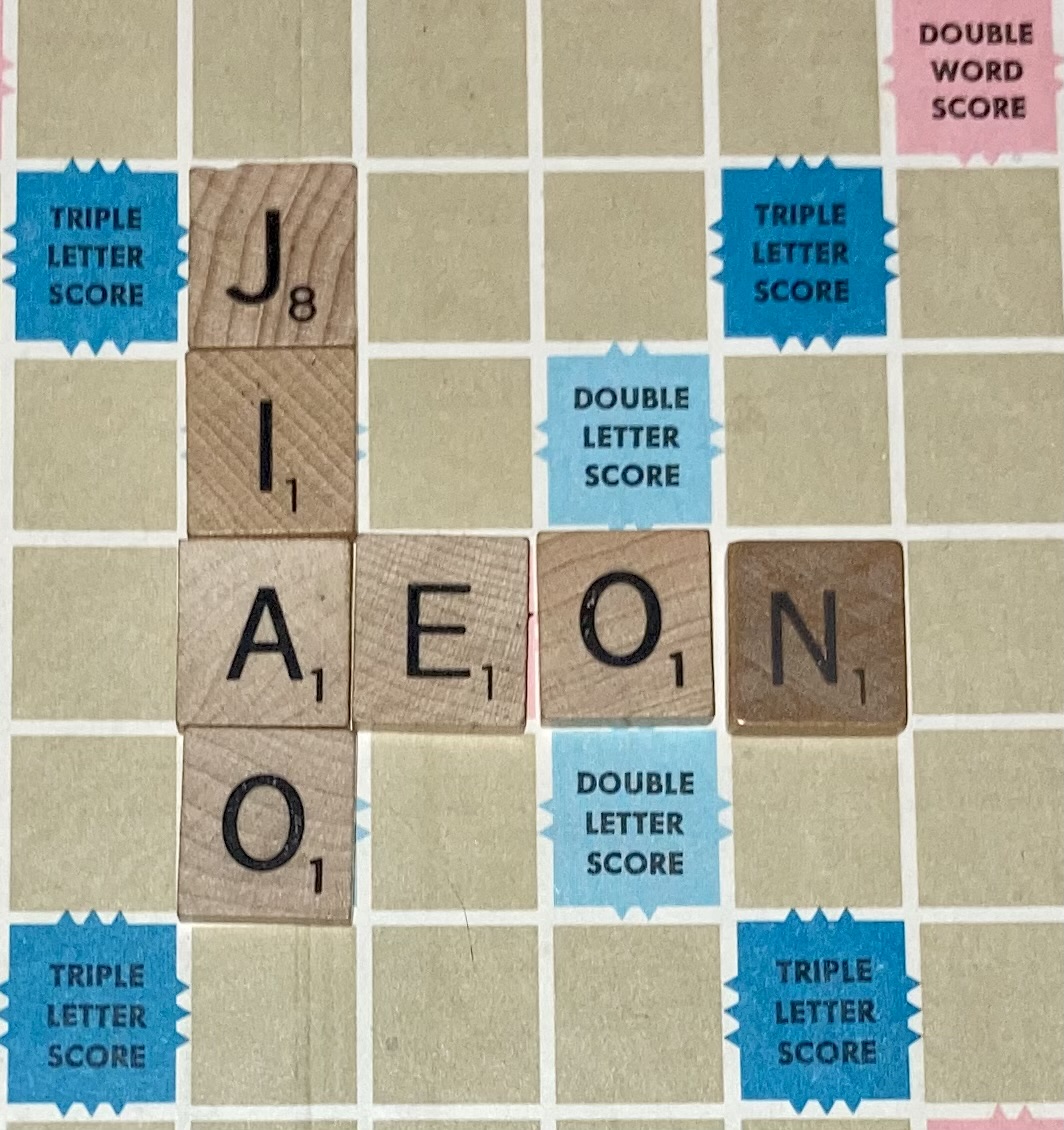
Knowing words with multiple vowels proves useful when you’re faced with a rack of mostly, or all, vowels. Here’s a list of the first twenty-two playable four-letter words with three vowels:
aeon: a long period of time (also eon)
agee: to one side (also ajee)
agio: a surcharge applied when exchanging currency
ague: a sickness associated with malaria
ajee: to one side (also agee)
akee: a tropical tree
alae: wings (pl. of ala)
alee: on the side shielded from wind
amia: a freshwater fish
amoa: a kind of small buffalo
awee: a little while
eaux: waters (pl. of eau)
eide: distinctive appearances of things (pl. of eidos)
emeu: an emu
etui: an ornamental case
euro: an Australian marsupial, also known as wallaroo, for being like the kangaroo and the wallaby; also a unified currency of much of Europe
ilea: the terminal portions of small intestines (pl. of ileum)
After spring break, we will examine the student analysis “Wait Means Never,” which I distributed in class on February 18, and “The Strange Fruit of Sosnowiec,” my model analysis of a page of Art Spiegelman’s graphic memoir Maus, which I will distribute in class on March 2
Before class on Monday, March 2, read and annotate “Wait Means Never,” and study the page of Maus posted in the readings folder on Blackboard. As you examine the page, note in your journal what elements of the page you would address if you were writing an analysis of it.
If you were absent on February 18 or misplaced your copy of “Wait Means Never,” download a copy from Blackboard.
Yesterday in class, before you began typing your revisions, I checked your journal exercises that addressed both the opening of “The Falling Man” and the textbook’s authors’ suggestions for paragraph writing. My version of that exercise follows.
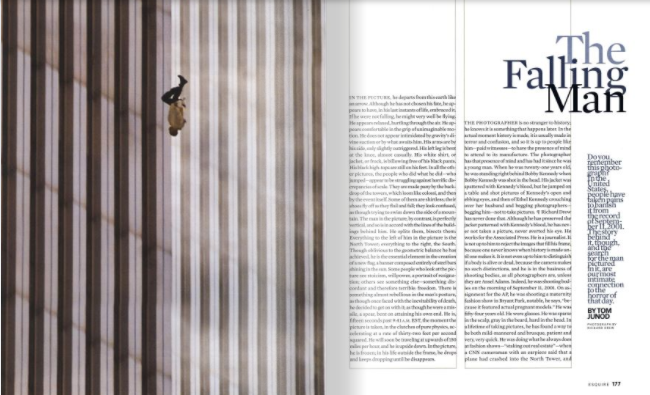
The authors of Writing Analytically recommend that “[i]f you find a paragraph growing longer than half a page–particularly if it is your opening or second paragraph–find a place to make a paragraph break” (Rosenwasser and Stephen 308). Junod does not follow that advice in the opening of “The Falling Man.” He opts instead to begin his article with a paragraph of more than four hundred words.
If Junod had chosen to divide the first paragraph, where might he have divided it?
Junod might have started a second paragraph with the words “[i]n all the other pictures,” because there he shifts the focus from the Falling Man to the photographs of other people who jumped from the Twin Towers. An opportunity for a third paragraph comes with the words “[t]he man in the picture, by contrast,” where Junod turns his attention back to the Falling Man. And he might have begun a fourth paragraph with “[s]ome people who look at the picture,” because there he shifts to viewers’ perceptions of the Falling Man.
Generally, one hundred to one hundred and fifty words is a suitable paragraph length. As a rule, you should begin a new paragraph whenyou present a new idea or point. If you have an extended idea that spans multiple paragraphs, each new point within that idea should have its own paragraph. But the first paragraph of “The Falling Man” defies convention. For Junod, choosing not to divide the first paragraph creates an unbroken movement that parallels the unbroken downward flight of his subject, the Falling Man. Outside of the photograph, “he drops and keeps dropping until he disappears” (par. 1). With “disappears,” the last word of the paragraph,” the Falling Man disappears from the page, and Tom Junod turns to the photographer, whom we learn later in the essay is Richard Drew.
Rosenwasser, David and Jill Stephen. “The Idea of the Paragraph.” Writing Analytically, 9th edition. Wadsworth/Cengage, 2024. pp. 307-313.
“Anyone Who Had a Heart . . .”
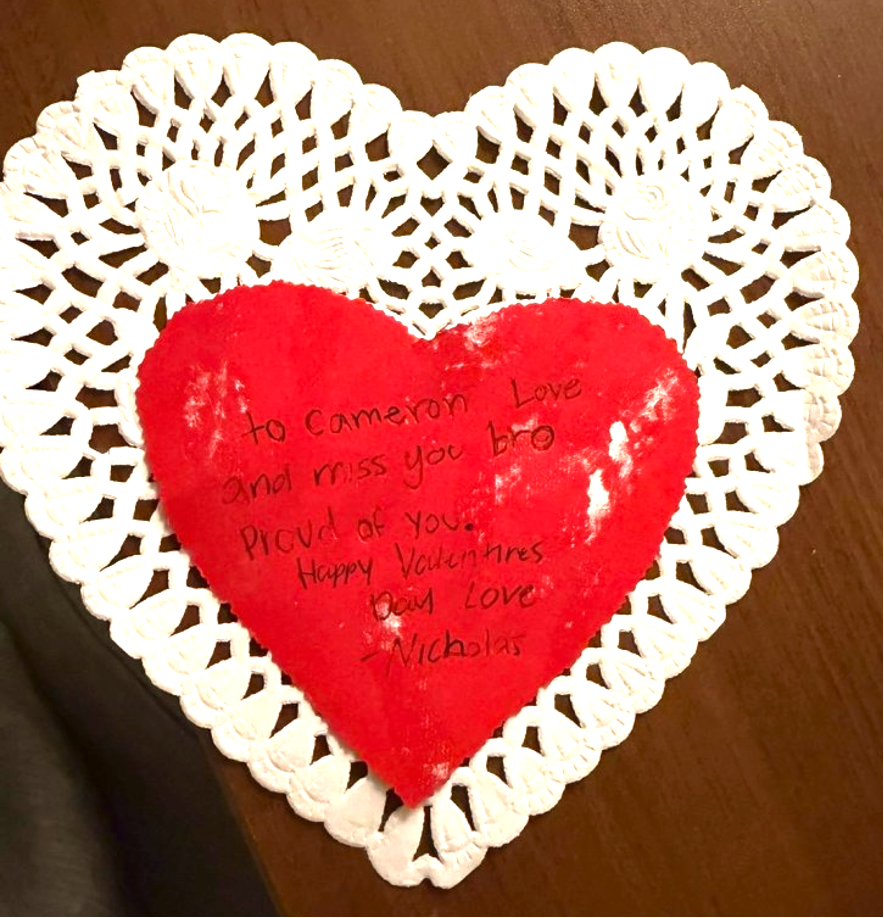
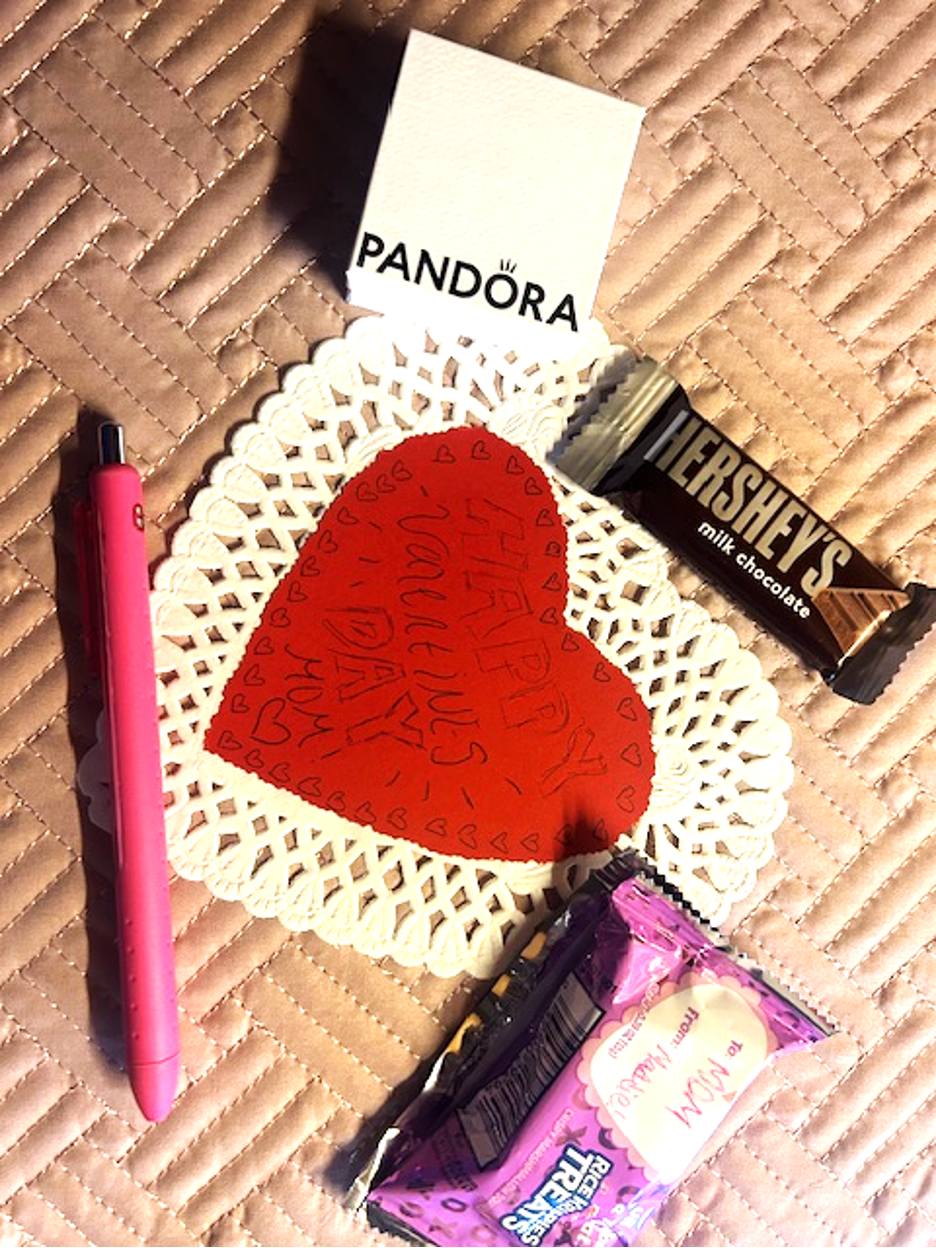
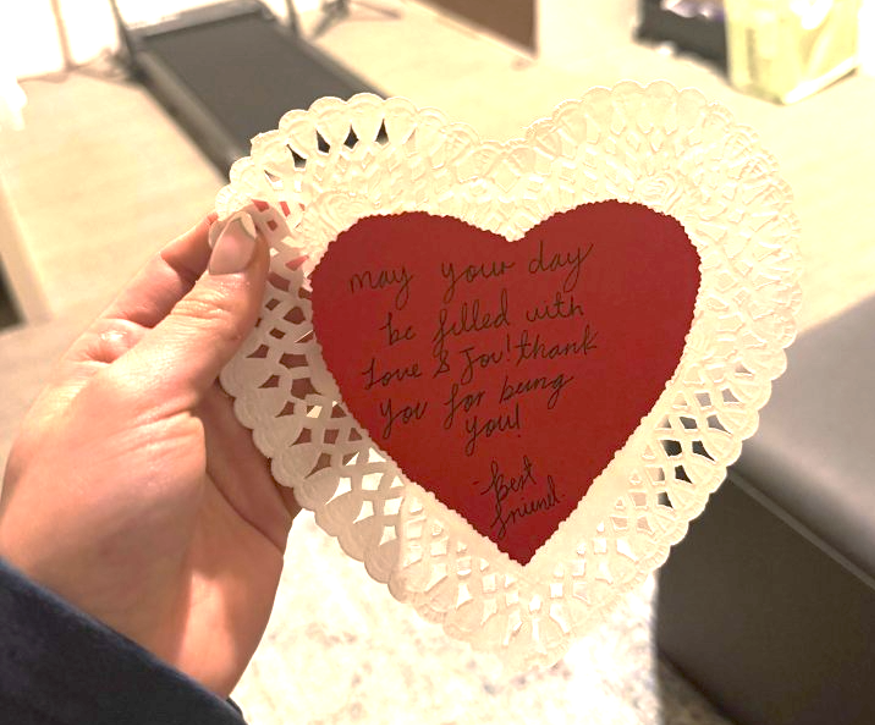
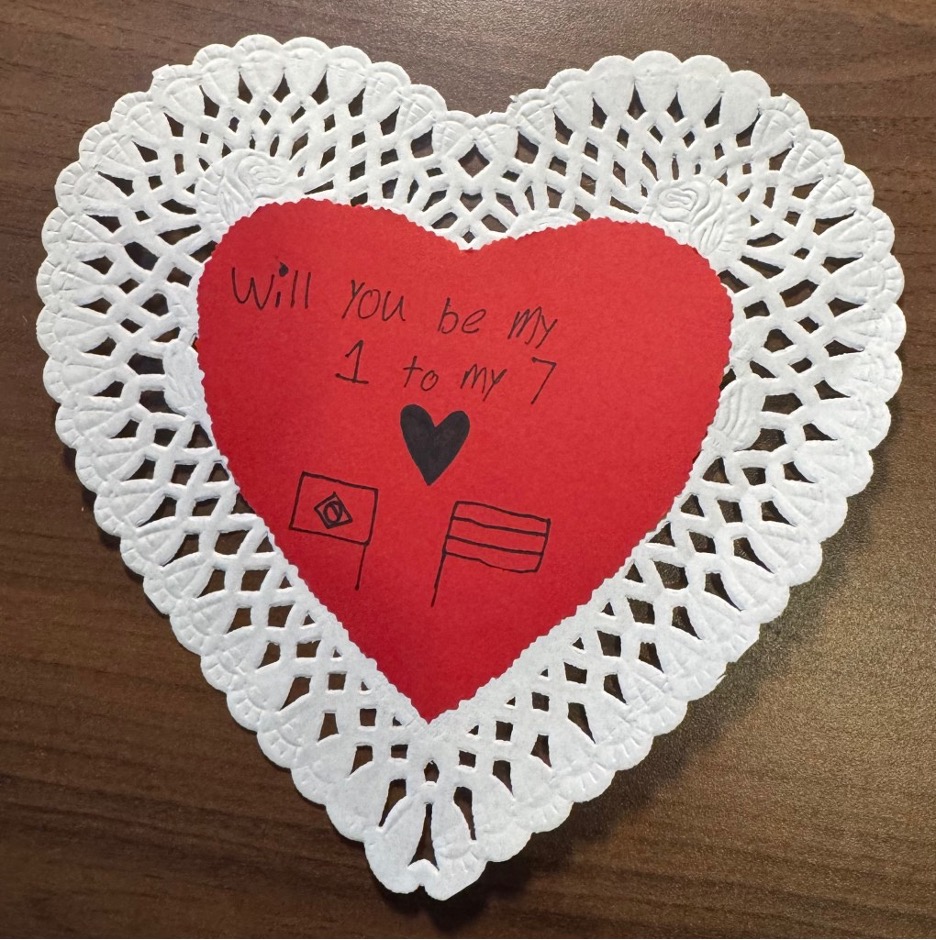
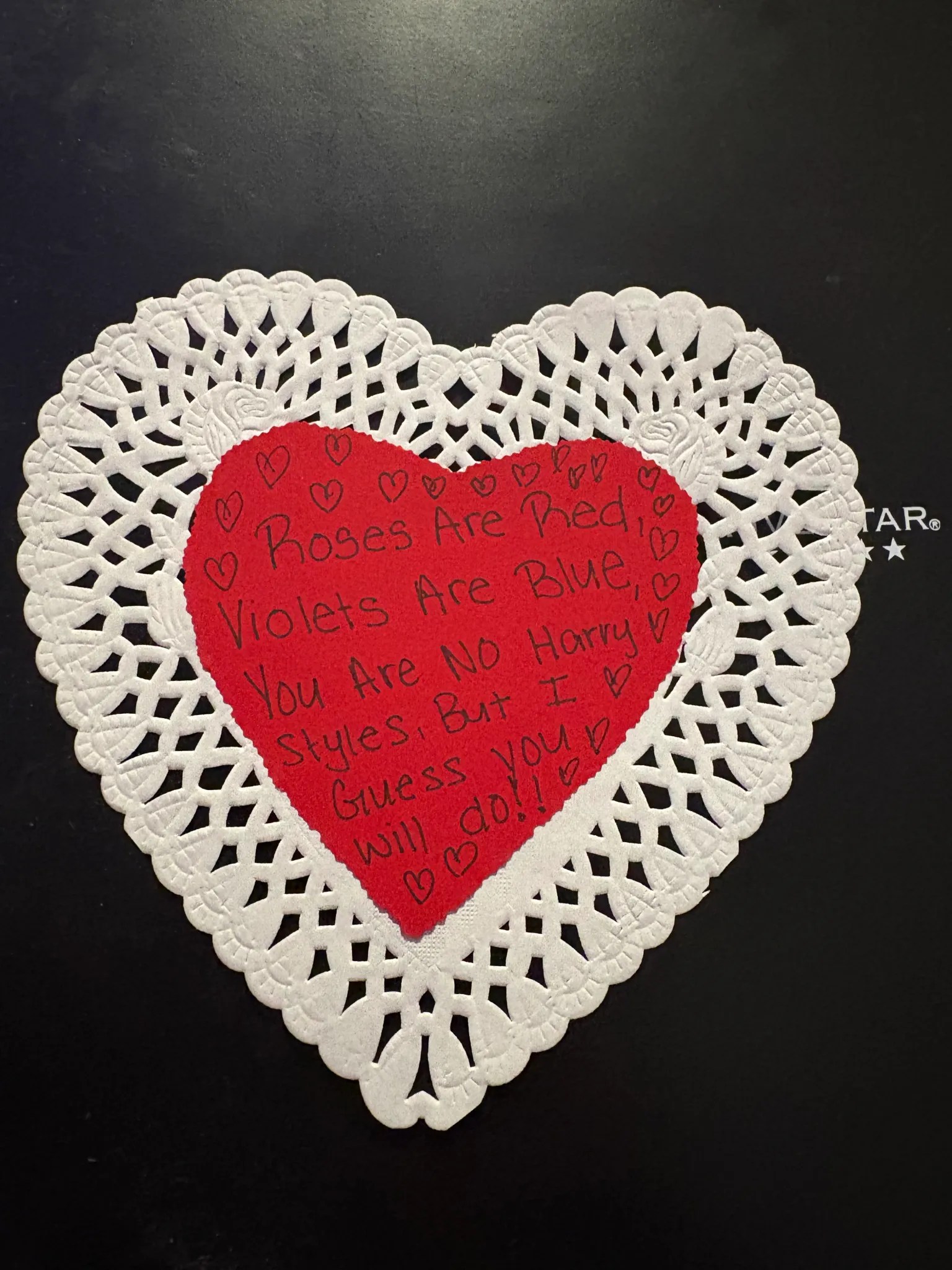
Any of you who had hearts–paper ones with lace doilies, distributed last Friday–could have earned bonus assignment credit for composing a Valentine and posting an image of it on your blog. Kudos to Nick Beeker, Madsion Davis, Sophia Marin, Dylan Virga, and Sierra Welch for taking the initiative to create Valentine’s Day greetings for loved ones.
Nick Beeker, who titled his post “Valentines Day,” wrote, “This word filled heart was sent to my childhood best friend Cameron. As he is going off to boot camp for the Marines. I am very proud of him!”
Madison Davis, who titled her post “Happy Valentine’s Day <3,” wrote, “I made this valentine for my mom because she has been my valentine every year until this year, so now that we have moved on from the tradition of her getting me a valentine, I wanted to make her one to let her know that I am still thinking of her, even when I have my own valentine. Happy Valentine’s Day mom!”
Sophia Marin titled her post “A Valentines to My Best Friend.”
Dylan Virga, who titled his post “Happy Valentine’s Day,” wrote, “My friend is Brazilian, and back in the 2014 World Cup, Brazil lost to Germany 7-1 which is one of the worst blowouts in sports history. So I like to tease her about it every now and again.”
Sierra Welch titled her post “Valentine <3.”
Bonus Assignment Opportunity
Directions
Determine which of the five Valentine’s posts is the strongest in terms of composition. Since each post features both an image of the hand-crafted card and its written text, think of the composition not solely as the words composed but instead as a combination of the words and image. You may also consider the writer’s commentary, where present, and the title of the blog post itself.
Compose a comment of one complete sentence or more that includes (1) the first and last name of the writer, and (2) a brief explanation of the Valentine’s effectiveness.
Post your comment as a reply to this blog entry no later than 9 a.m. tomorrow, Friday, February 20. (To post your comment, click on the post’s title, and scroll down to the bottom of the page. You will then see the image of an airmail envelope with a leave comment option.)
I will approve your comments (make them visible) before Friday’s class.
After I check your journal exercises on the opening of Tom Junod’s “The Falling Man,” I will return your drafts with my notes, and you will have the remainder of the class period to begin revising your analyses on your laptops. Because next week is spring break, you will have two additional weeks to continue your revision work before you submit the assignment to Blackboard and publish it as a WordPress blog entry. The due date is Wednesday, March 4 (before class). The hard deadline is Friday, March 6 (before class). Directions for submitting your analysis are included on your assignment sheet and on the Blackboard submission site.
Analysis Draft Notes
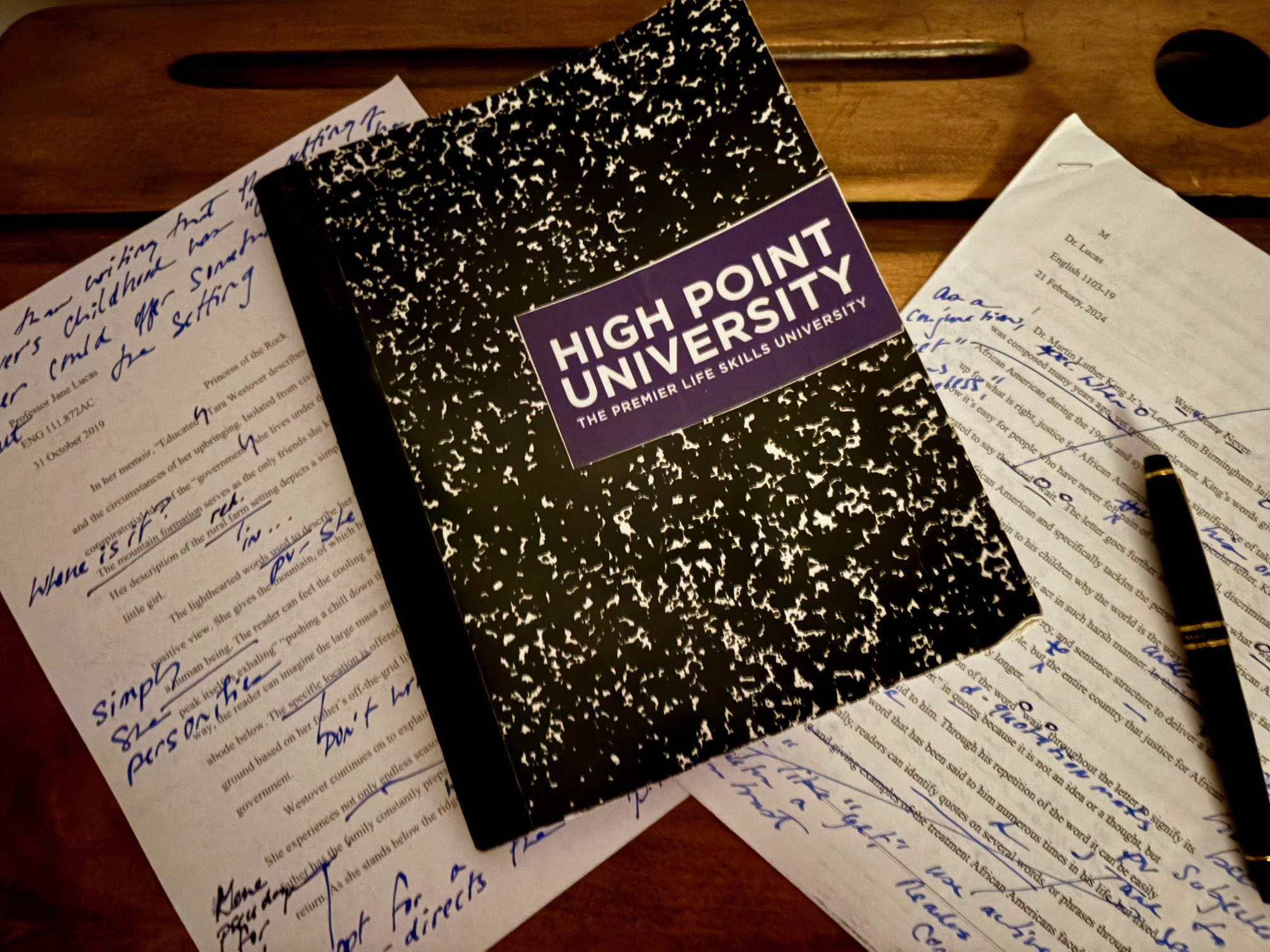
I have attached to your analysis draft a handout of notes for you to review–along with my handwritten annotations–before you begin your revision work. An additional copy of those notes is included in yesterday’s blog post.
The Writing Center
As you continue to revise your analysis, consider visiting the Writing Center. If you do so, you will earn five bonus points for the assignment.
To schedule an appointment, register online here, email the Writing Center’s director, Professor Justin Cook, at jcook3@highpoint.edu, or scan the QR code below. To earn bonus points for your analysis, consult with a Writing Center tutor no later than Thursday, March 5.
Writing Center Consultations for Literacy Narratives
Section 8: 2 of 17 students, 11.7%
If you are one of the students who did not take advantage of the Writing Center when you were composing your literacy narrative, do not miss the opportunity to receive that guidance–and those bonus points–for your analysis, and later for your final essay and annotated bibliography.
Model Analysis
After spring break, we will examine the student sample analysis “Wait Means Never” and “The Strange Fruit of Sosnowiec,” my model analysis of a page of Art Spiegelman’s graphic memoir Maus. Before class on Monday, March 2, read and annotate “Wait Means Never,” which you will receive a copy of today, and read the page of Maus that is posted in the readings folder on Blackboard. As you read the page, make note in your journal of the elements of the page you would address if you were writing an analysis of it.
Next Up
Wordplay Day! To prepare for class, revisit the Dictionary and World Builder pages on the Scrabble website and review the blog posts devoted to Scrabble.
Today in class you will plan and compose a midterm reflective essay that documents your work in the first half of the semester, focusing on two or three assignments or aspects of the course that have contributed to your development as a writer and a student. Since you have already written a reflection devoted solely to your literacy narrative, your midterm reflection should focus primarily on other assignments or aspects of the course, including the following:
Keeping a journal
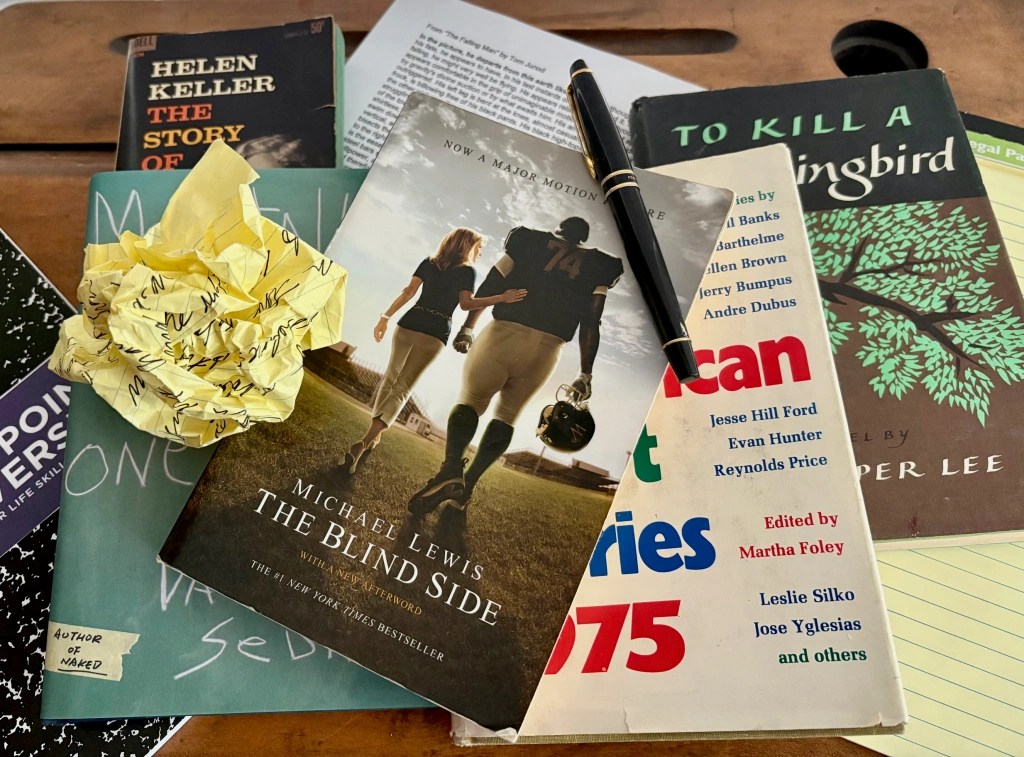
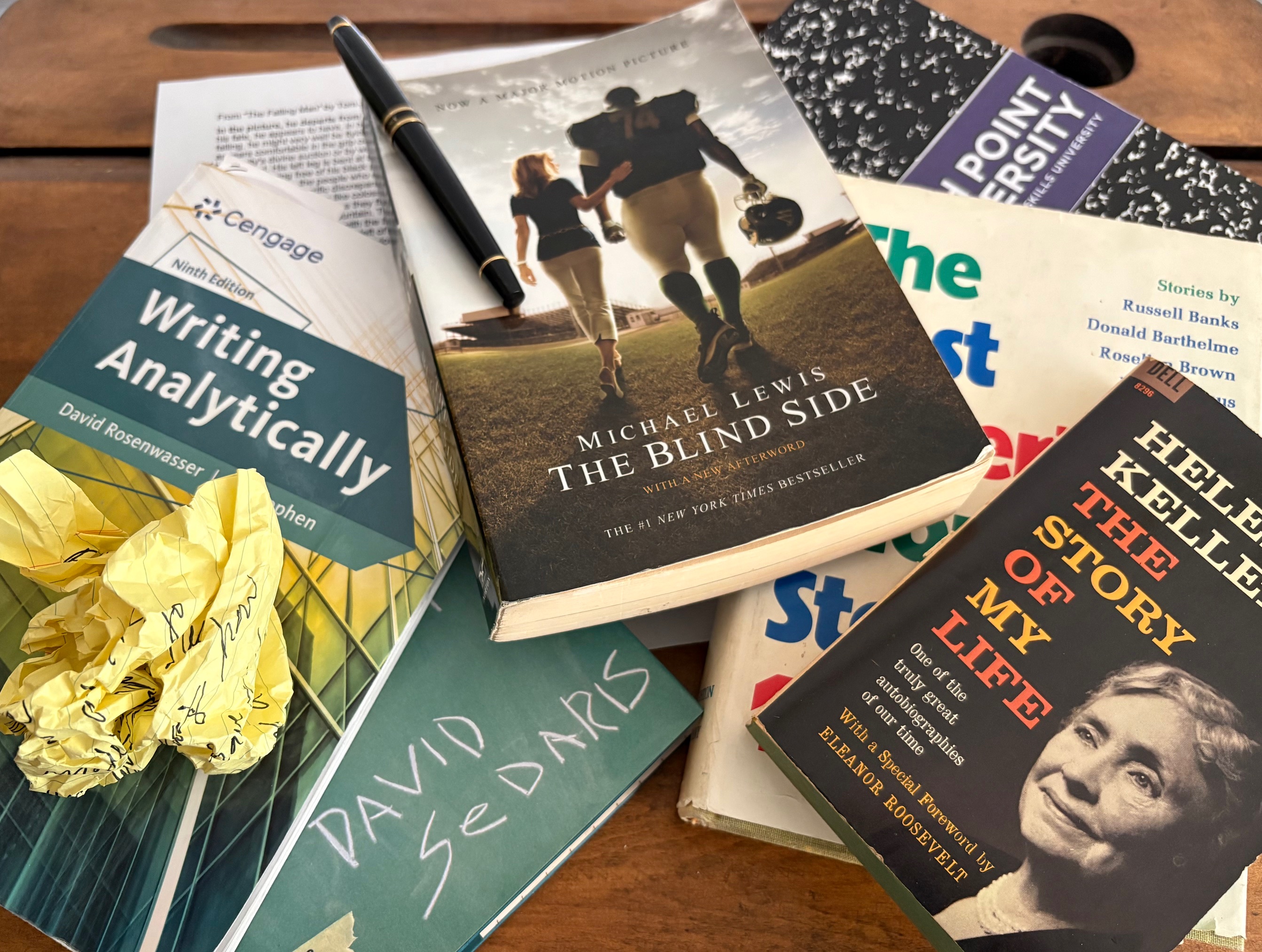
Studying one of the readings examined class, including “Me Talk Pretty One Day,” “The Day Language Came into My Life,” “Letter from Birmingham Jail,” the excerpt from Chapter One of To Kill a Mockingbird, “The School,” “Back Story,” and the excerpt from “The Falling Man.”
Reading and editing samples of student writing
Creating and maintaining a WordPress blog and writing for an online audience beyond the classroom.
Collaborating with your classmates on in-class writing assignments
Playing Scrabble and collaborating with your teammates on Wordplay Day
Writing longhand
Limiting screen time
Include in your refelective essay the following elements:
A title that offers a window into your reflection
An opening paragraph that introduces your focus and presents your thesis
Body paragraphs that offer concrete details from your work to support your claims
One relevant quotation from one of the readings listed above or from Writing Analytically
A signal phrase and a parenthetical citation for the quotation. Consult your class handouts for models. If you include the author’s name in the sentence, include only the page number or the abbreviation par. and the paragraph number in the parenthetical citation. If you do not name the author in the sentence, include his or her name and the page number or the abbreviation par. and the paragraph number.
A conclusion that revisits the thesis without restating it verbatim
A work cited entry for the text that you quote
Sample MLA Works Cited Entries
Barthelme, Donald. “The School.” The Best American Short Stories 1975, edited by Martha Foley, Houghton Mifflin, 1975. pp. 8-11.
Rosenwasser, David and Jill Stephen. “‘Interesting,’ ‘Revealing,’ ‘Strange.’” Writing Analytically, 9th edition. Wadsworth/Cengage, 2024. p. 24.
Rosenwasser, David and Jill Stephen. “On Keeping a Writer’s Notebook.” Writing Analytically, 9th edition. Wadsworth/Cengage, 2024. pp. 157-58.
Rosenwasser, David and Jill Stephen. “Seems to Be About X, But Could Also Be (Or is ‘Really’) About Y.’” Writing Analytically, 9th edition. Wadsworth/Cengage, 2024. pp. 104-7.
Sedaris, David. “Me Talk Pretty One Day.” Me Talk Pretty One Day. Little, Brown, 2000. 166-73.
Note that unlike the works cited entries above, the one on your midterm reflection will have a hanging indent, as will all of the works cited entries in the Microsoft Word files and PDFs that you post to Blackboard.
The complete midterm reflection assignment, along with the grade criteria, is included on the assignment handout that you will receive in class.
Next Up
At the beginning of class on Wednesday, I will return your handwritten analyses drafts with my notes, and I will conduct a check of your journal exercise on the first paragraph of Tom Junod’s “The Falling Man.” Afterward, you will have the remainder of the class period to begin revising on your laptops and tablets. The due date for posting your revised analysis to Blackboard and to your WordPress blog is Wednesday, March 4 (before class). The hard deadline is Friday, March 6 (before class).
Monday in class, you will plan and compose a midterm reflective essay that documents your work in the first half of the semester, focusing on two or three assignments or aspects of the course that have contributed to your development as a writer and a student. Since you have already written a reflection devoted solely to your literacy narrative, your midterm reflection should focus primarily on other assignments or aspects of the course. One of the requirements of the assignment is incorporating a relevant quotation from one of the texts we have studied or from Writing Analytically. Before Monday’s class, determine what phrase, clause, or sentence you will quote, and draft a sentence in your journal that introduces the quotation with a signal phrase and follows it with a parenthetical citation.
One option for integrating a quotation into your essay is to include a line from one of your readings and explain what that passage has taught you about writing.
Examples
In the opening line of “Back Story,” Michael Lewis demonstrates that repetition can be an asset. With the words “[f]rom the snap of the ball to the snap of the first bone” (15), he repeats “snap” as a frame for the seconds leading up to Jo Theismannn’s career-ending injury. The first “snap,” the hike of the football, begins the sequence. The second “snap,” the fracture of Theismann’s tibia and fibula, ends it.
The opening line of “Back Story,” demonstrates that repetition can be an asset. The two prepositional phrases “[f]rom the snap of the ball to the snap of the first bone” (Lewis 15), repeat “snap” as a frame for the seconds leading up to Jo Theismannn’s career-ending injury. The first “snap,” the hike of the football, begins the sequence. The second “snap,” the fracture of Theismann’s tibia and fibula, ends it.
The two examples above are very similar. The first one names the author, so only the page number appears in the parenthetical citation. The second does not name the author, so his last name precedes the page number in the parenthetical citation. Notice how omitting the author’s name from the passage shifts the emphasis from the writer’s actions (“he repeats ‘snap’”) to the words themselves (“prepositional phrases . . . repeat ‘snap’”).
Another option for integrating a quotation into your essay is to include a line from Writing Analytically that presents a concept that figures in your own reading or writing process.
Examples
The observation that “understandings are rarely simple and overt” (Rosenwasser and Stephen 104) led me to reexamine “The School” and reenvision it. No longer was it primarily a chronicle of deaths, but instead it was a narrative about the nature of storytelling itself.
David Rosenwasser and Jill Stephens’ observation that “understandings are rarely simple and overt” (104) led me to reexamine “The School” and reenvision it. No longer was it primarily a chronicle of deaths, but instead it was a narrative about the nature of storytelling itself.
Works Cited
Lewis, Michael. “Back Story.” The Blind Side. 2006. Norton, 2009. pp. 15-23.
Rosenwasser, David, and Jill Stephen. “Seems to Be About X, But Could Also Be (Or is ‘Really’) About Y.’” Writing Analytically, 9th edition. Wadsworth/Cengage, 2024. pp. 104-7.
Happy Valentine’s Day Eve!
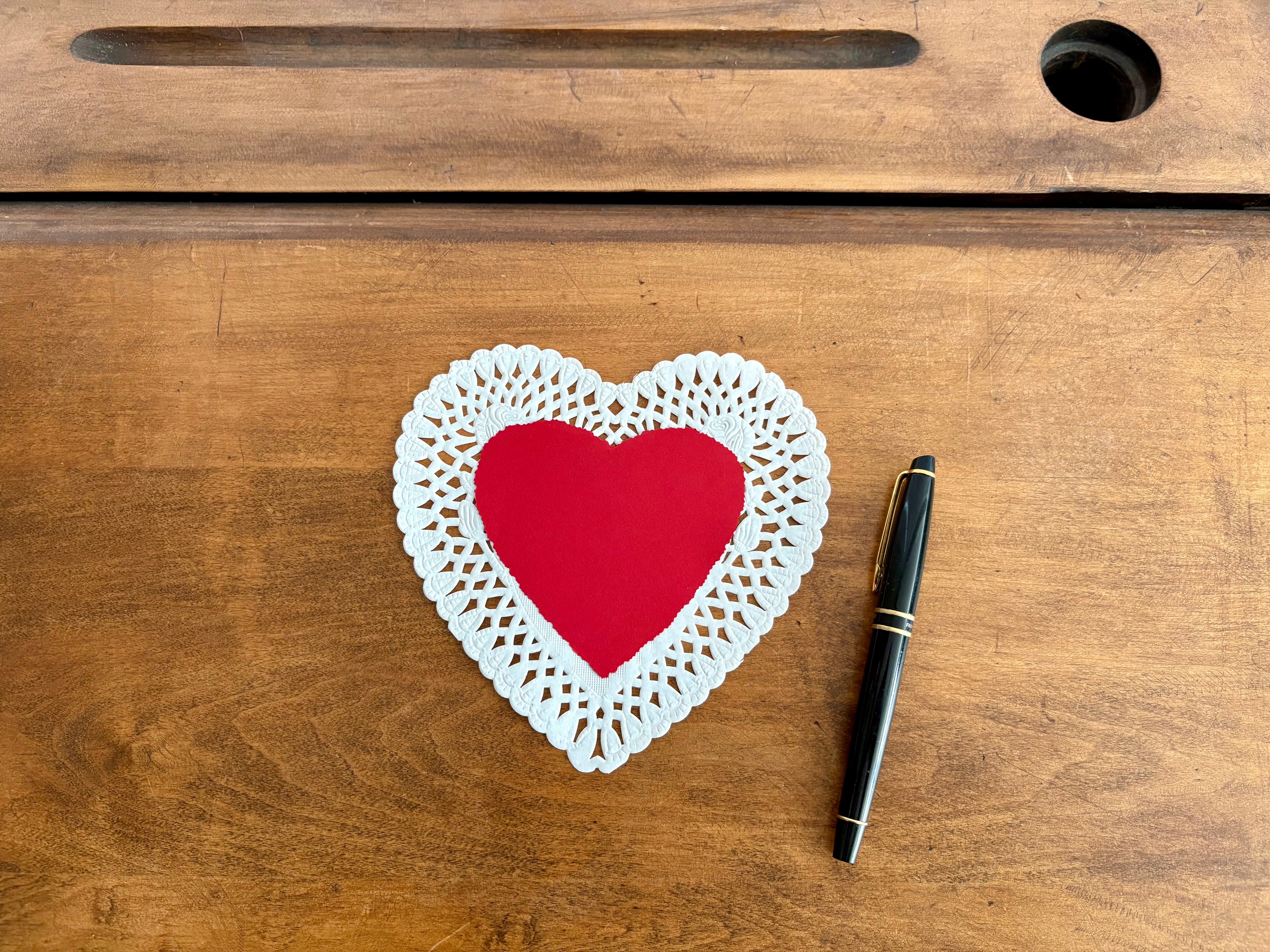
Today in class, you will receive a red paper heart on a lace doily for an informal writing exercise: composing a valentine for someone.
Next Up
In class on Monday, you will compose your midterm reflection. To prepare, choose a phrase, clause, or sentence from one of the course readings–one that is relevant to your work in the course–and draft in your journal a short passage that connects those words to your writing. That passage will serve as part of your reflection.
Postscript
Bonus Assignment: Publish your completed Valentine as a post on your blog before 9 a.m. on Monday, February 16, and you will earn a bonus assignment credit in the short assignments/participation category. You are welcome to include a photo caption or a brief explanation of the Valentine, but that is not required. The photograph alone will suffice. Once you have published your post, email me so I can visit your site and credit you with the assignment.
Yesterday in class, before you began composing your analysis draft, we examined the beginning of Tom Junod‘s article “The Falling Man,” published in Esquire magazine two years after 9-11. One of the elements that we considered–and one that I asked you to address later in your journal–is the unusually long first paragraph.
The authors of Writing Analytically recommend that “[i]f you find a paragraph growing longer than half a page–particularly if it is your opening or second paragraph–find a place to make a paragraph break” (Rosenwasser and Stephen 308). Junod does not follow that advice. He opts instead to open his article with a paragraph of more than four hundred words.
If Junod had chosen to divide the first paragraph, where might he have divided it?
Work Cited
Rosenwasser, David, and Jill Stephen. “The Idea of the Paragraph.”Writing Analytically, 9th edition. Wadsworth/Cengage, 2024. pp. 307-313.
“The Falling Man” presents you with a seventh option for your analysis. (The others six are “MeTalk Pretty One Day,” “The Day Language Came into Life,” “Letter from Birmingham Jail,” the excerpt from the first chapter of To Kill a Mockingbird,” “The School,” and “Back Story.”)
If you would like to analyze more of Junod’s article than the first paragraph and the beginning of the second, you are welcome to study a larger section, just as you are welcome to examine a larger section of the first chapter of To Kill a Mockingbird. The complete first chapter of Harper Lee’s novel is posted in Blackboard. To access all of Junod’s article, see the directions below.
Unless you subscribe to Esquire, the magazine’s paywall will deny you access to the full text of “The Falling Man,” but you can access it through the HPU Library site by following these steps:
Directions for Accessing “The Falling Man” (Full Text)
Under the heading Search HPU Libraries . . . , click on the Articles tab.
Under the Articles tab, type Tom Junod “Falling Man” Esquire in the search box and click search.
On the next screen, you will see a brief summary of the article. Click View full text to see the complete article.
On the next screen, click View full text beside one of the database options.
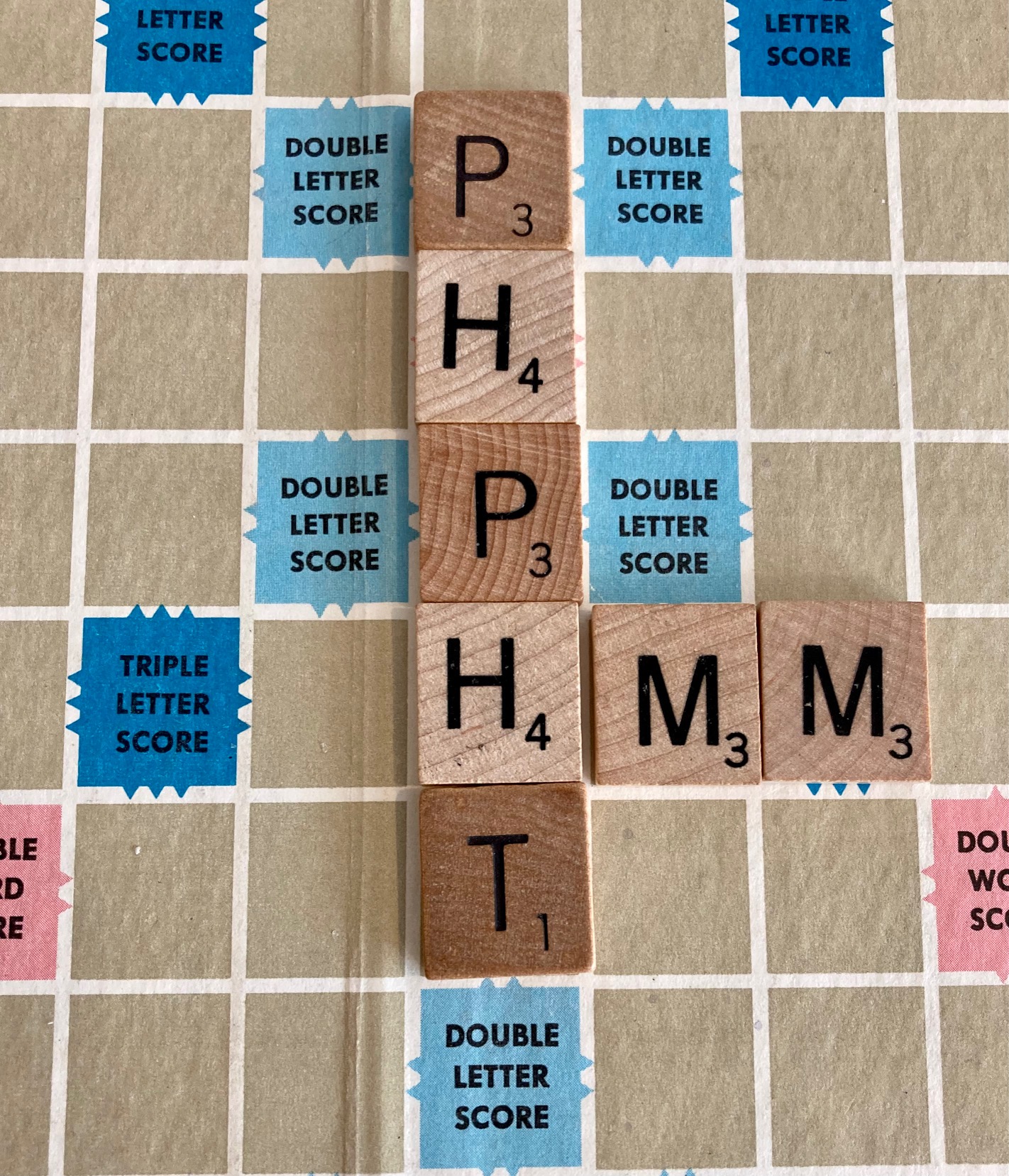
. . . Constant Consonants? Hmm
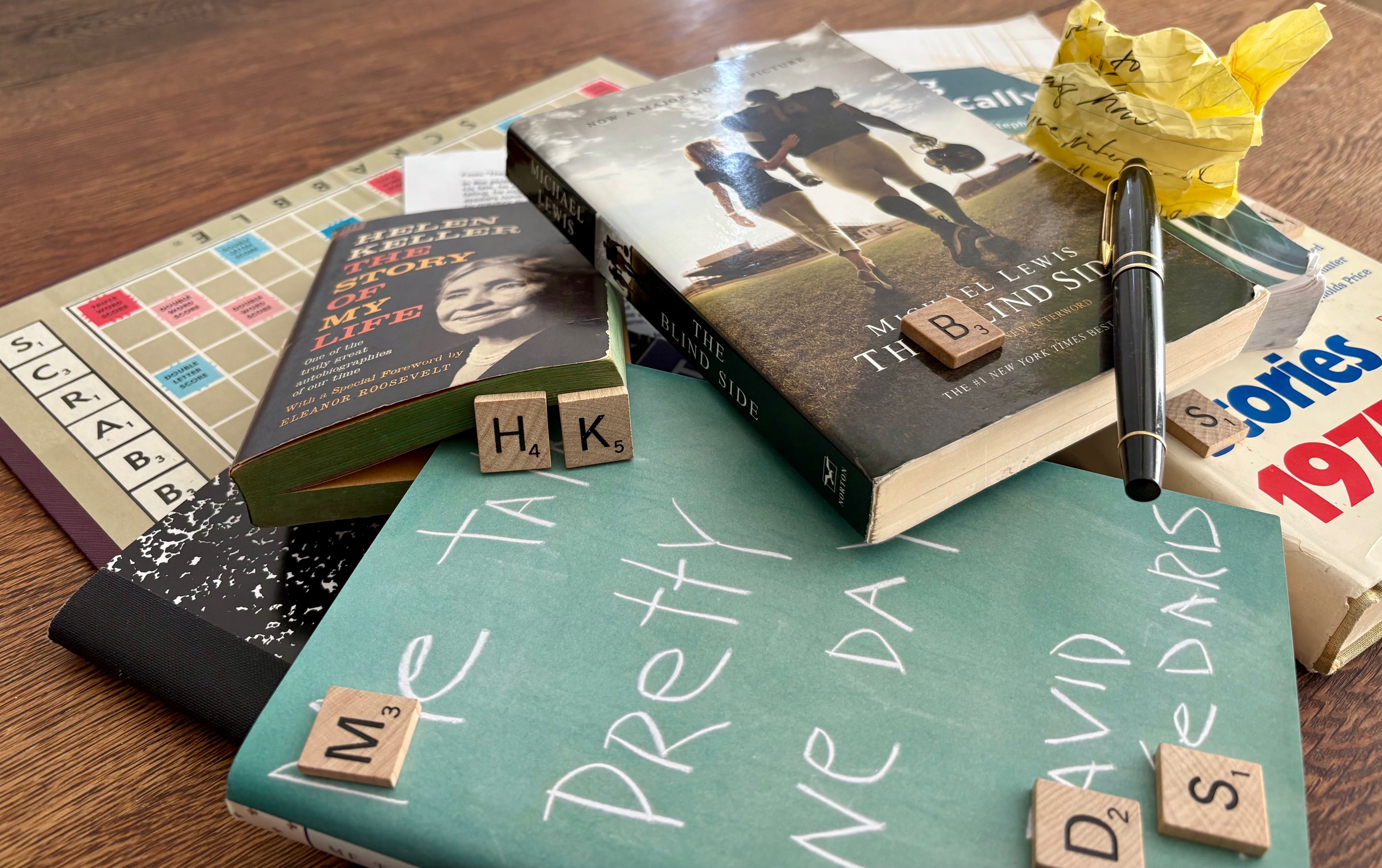
Learning phpht and hmm, pictured above, and other all-consonant words can enable you to continue a Scrabble game when you are faced with a rack without vowels.
brr: used to indicate that one is cold
crwth: an ancient stringed instrument (pl. -s)
cwm: a cirque (a deep, steepwalled basin on a mountain, pl. -s, prounounced to rhyme with “boom”)
hm: used to express thoughtful consideration (also “hmm“)
mm: used to express assent or satisfaction
nth: describing an unspecified number in a series
phpht: used as an expression of mild anger or annoyance (also “pht“)
psst: used to attract someone’s attention
sh: used to urge silence (also “shh” and “sha“)
tsk: to utter an exclamation of annoyance (-ed, -ing, -s)
In class on Monday, you will compose a midterm reflection focusing on the assignments and aspects of the course that have contributed the most to your development as a writer and a student. Tomorrow’s post will serve as a guide for your preparations.



 Jane Lucas