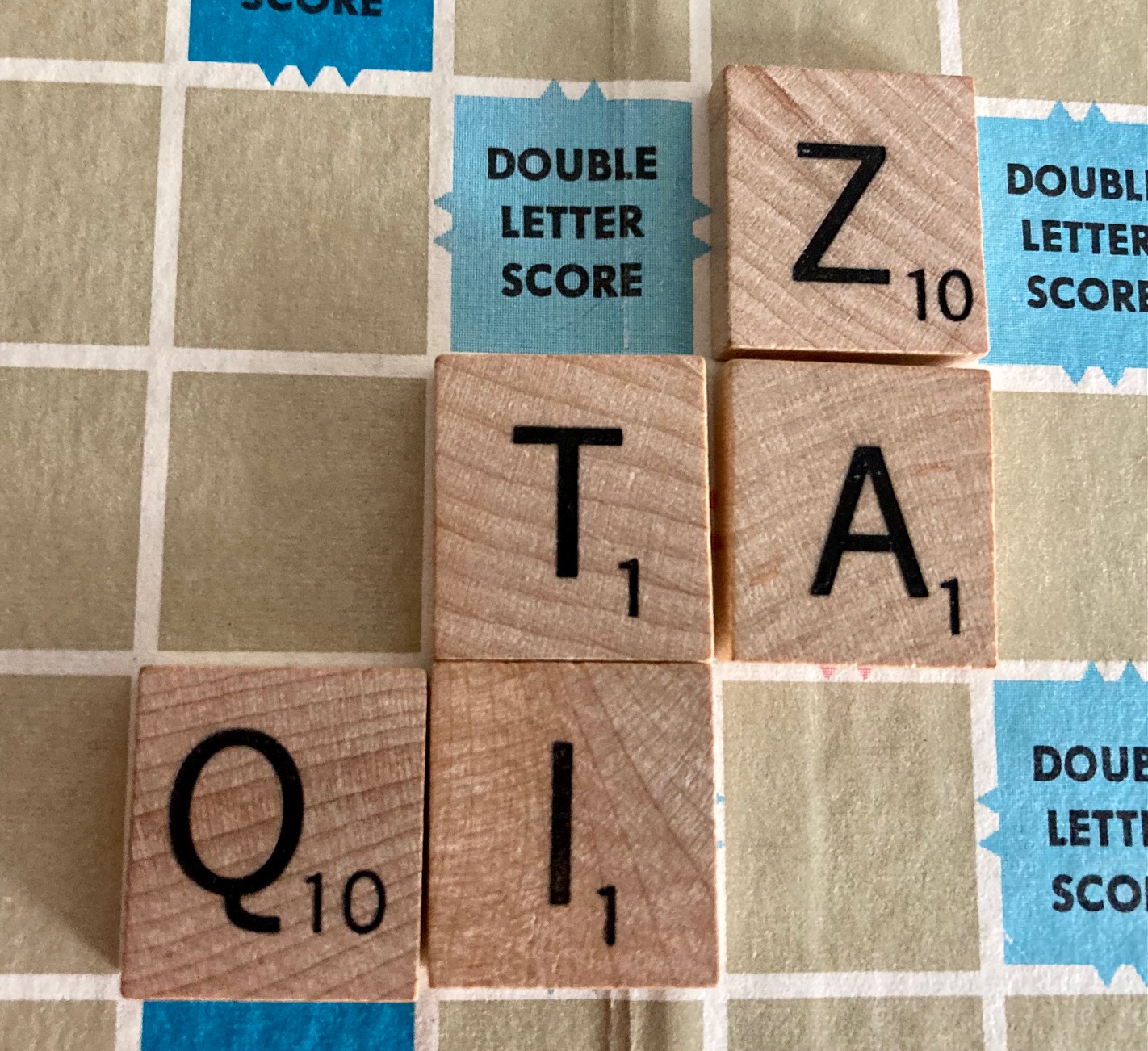
Today’s blog post is the final installment in the series of posts devoted to playable two-letter words. Learning these two-letter words, as well as the other two-letter words in the alphabet, will enable you to see more options for play and increase the number of points you earn in a single turn.
qi: the central life force in Chinese culture (also ki)
re: a tone of the diatonic scale
sh: used to encourage silence
si: a tone of the diatonic scale (also ti)
so: a tone of the diatonic scale (also sol)
ta: an expression of thanks
ti: a tone of the diatonic scale
to: in the direction of
uh: used to express hesitation
um: used to express hesitation
un: one
up: to raise (-s, -ped, -ping)
us: a plural pronoun
ut: the musical tone C in the French solmization system, now replaced by do
we: a first-person plural pronoun
wo: woe
xi: a Greek letter
xu: a former monetary unit of Vietnam equal to one-hundreth of a dong (also sau, pl. xu)
ya: you
ye: you
yo: an expression used to attract attention
za: pizza
Next Up
For Monday’s class, you will read and annotate Brian Aldiss’s short stories “Supertoys When Winter Comes” and “Supertoys in Other Seasons,” which I distributed in class on Wednesday. If you were absent or misplaced your copies, print ones from Blackboard.
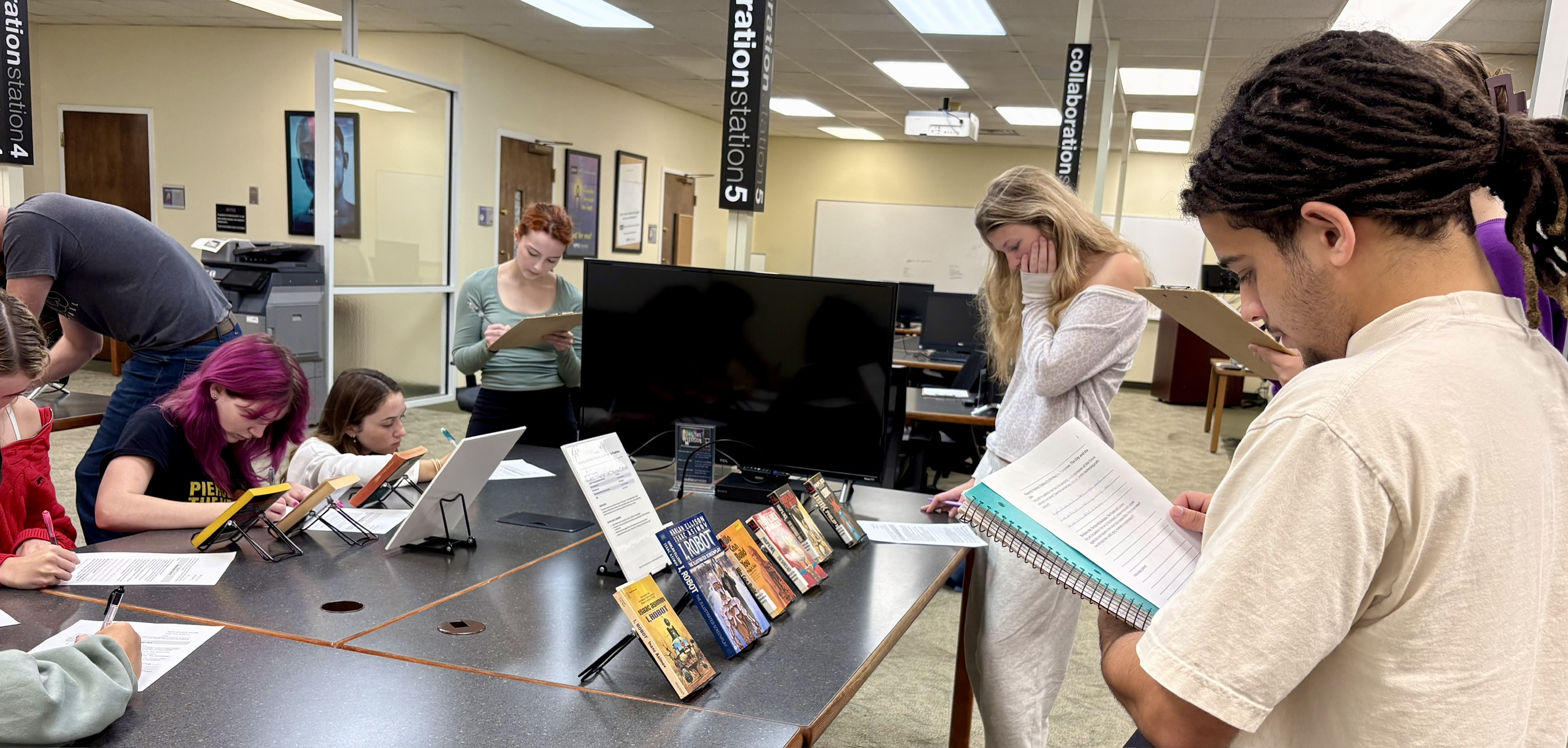
Yesterday in class, after you wrote your individual observations about the paperbacks from the Asimov Collection, you developed talking points for our discussions of “Runaround” and “Supertoys Last All Summer Long.”
Today’s blog post includes the talking points you generated, along with pictures of your observation work.
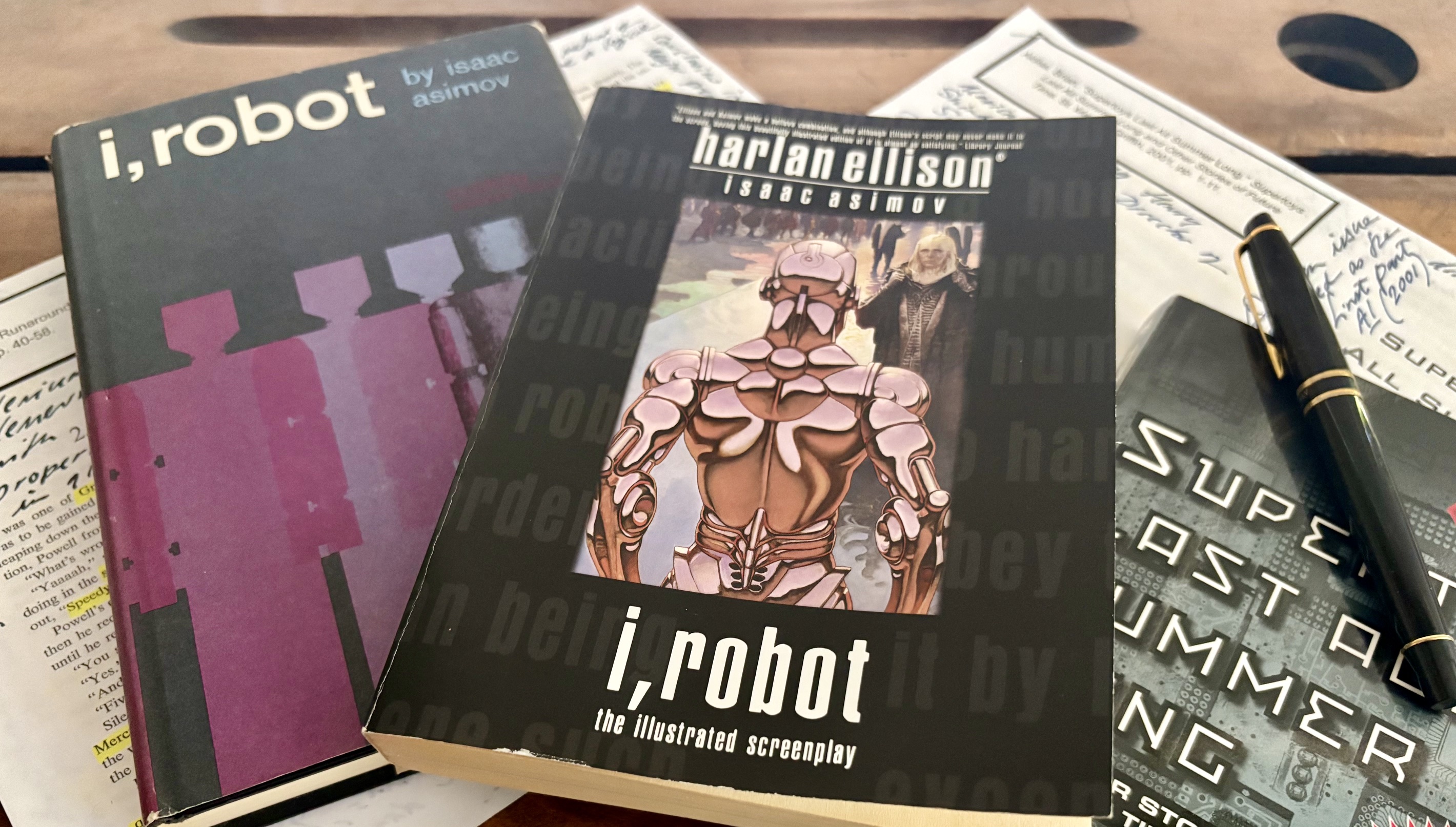
If you would like to revisit the cover art that you examined yesterday, remember that all the paperbacks are included in the images in yesterday’s blog post. Because there is a glare on the cover of I, Robot: The Illustrated Screenplay, that book figures prominently in the photo above. Notice that my copy has a slightly different cover from the one in the Asimov Collection. My edition has the same cover art by Mark Zug, but the image is framed by a black border with words of the Three Laws of Robotics in gray.
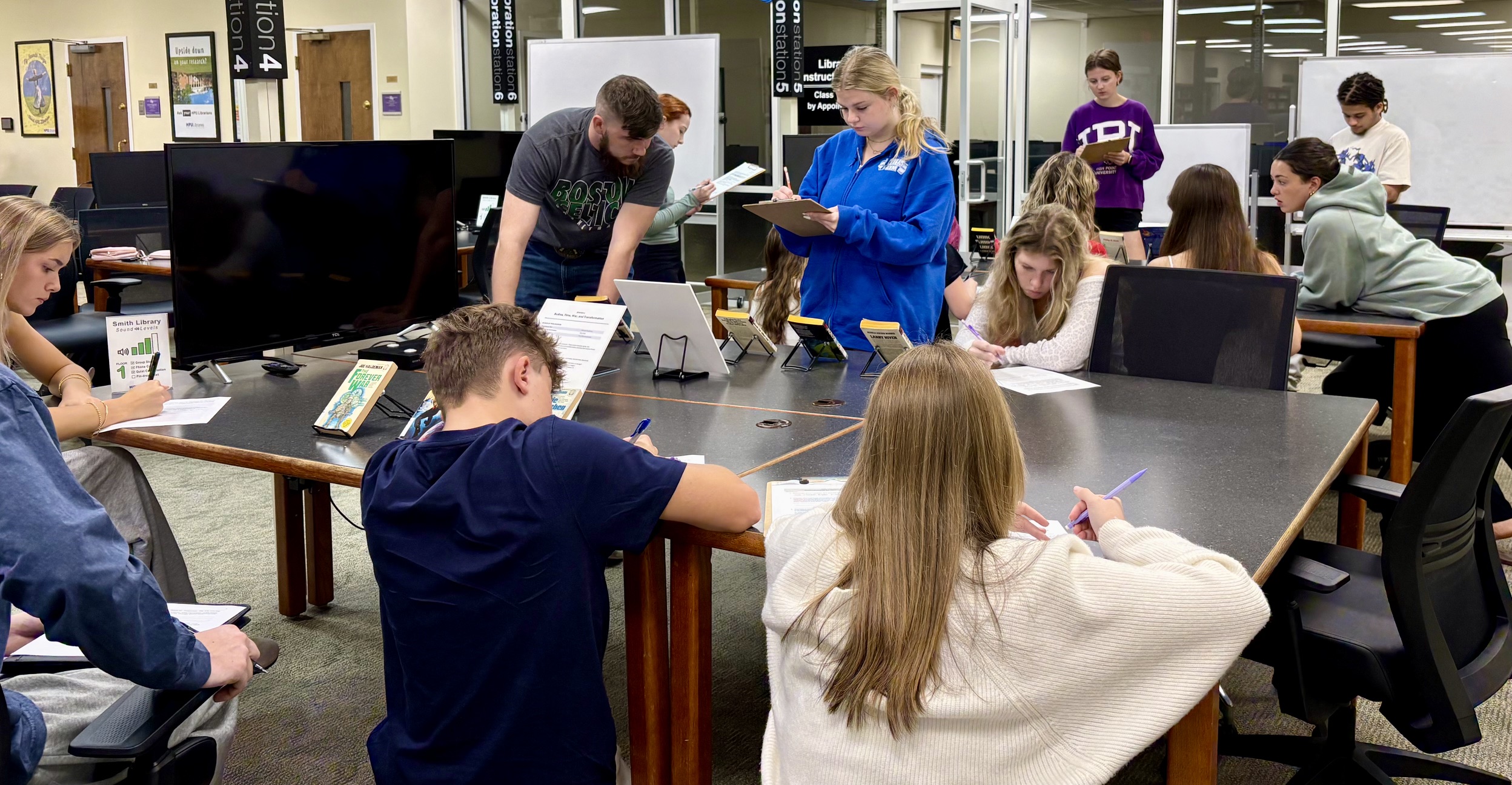
Foreground (L-R): Claire Jahnke, Ryder Pitek, Hayden Porter; Background (L-R): Michael McNamara, Kel Wadley, Brenna Murphy, Bridgette Murphy, Gavin Godfrey-Ryan, Madison Haugk, Nicole Halucka, Grace Duffy, Oliver Henderson
Talking Points
“A common theme of forced space exploration. Why do authors use this topic?”
“All very technologically centered, and show humans’ relationships with technology.”
“We discussed that the covers all convey a sense of danger.”
“The covers all also represent exploration, adventures, and discovering the unknown.”
“The covers convey a negative effect on humanity through artwork.”
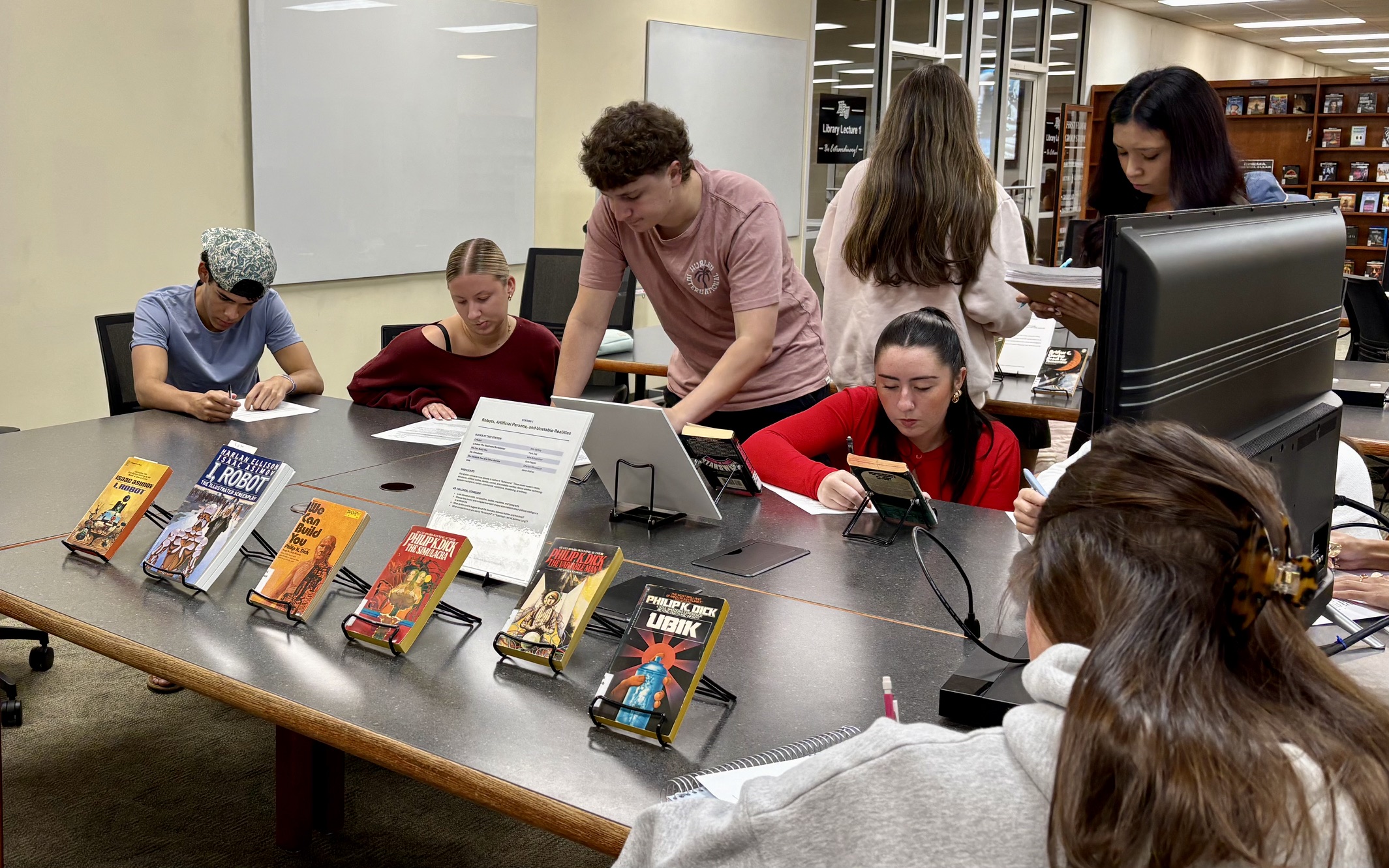
(L-R): Ryder Pitek, Seb Olander, Kai Jarvis, Claire Jahnke, Michael McNamara, Brenna Murphy
“These books relate to the excerpts [sic] by showing the long-lasting detrimental affect [sic] technology has on humans.”
“One talking point is why do you think these authors/illustrators depict a sense of eerie loneliness when taling [sic] about the future?”
“How technology affects how society (high and lower class people) interact/ daily life/ and beliefs.”
“How sci-fi books influence technological development and our view of technology today.”
(L-R): Baylee Shattenberg, Madi Stone, Kel Wadley, Bridgette Murphy, and Oliver Henderson
“Very future orientated with robots and space.”
“The one group of books focused more on aging and time rather than space and technology.”
“The covers from the books we looked at today connect with ‘Runaround’ and ‘Supertoys Last All Summer Long’ by projecting and predicting visions of space and the possible future.”
“The covers of the books also connect to the short stories by visualizing adventure & possible danger.”
“How do humans view their relationships with technology in these novels?”
(Background to Foreground): Lance Morgan, Cole Wilhelmsen, Layla Rothberg
“Why do authors depict AI taking over society?”
“Most covers displayed a very optimistic view of the future through technology that allowed them to accomplish feats, even in space.”
“Some covers conveyed that the relationship between AI and humans was not good and might have caused conflict.”
“Supertoys Last All Summer Long”
Because our class time yesterday focused on the science fiction book covers in the Asimov Collection, we didn’t discuss Brian Aldiss’s short story. We will, however, examine it on Monday, along with his other two Supertoys stories: “Supertoys When Winter Comes” and “Supertoys in Other Seasons.”
As you prepare for Monday’s discussion of “Supertoys Last All Summer Long,” consider these questions:
Unlike Isaac Asimov’s method of presentation in “Runaround,” which maintains the focus on Mike Donovan and Gregory Powell, Aldiss employs cross-cutting: the technique of shifting back and forth between two locations: the Swintons’ apartment and the banquet hall where Henry Swinton, Managing Director of Synthank, delivers his speech. Why might Aldiss have chosen that technique? What does it achieve?
Near the end of the story, Aldiss reveals that Teddy is not the only robot in the Swinton household. What words reveal that fact?
What details foreshadow the story’s revelation?
Next Up
Wordplay Day! To prepare for class, revisit the Merriam-Webster Scrabble Word Finder page, and review your journal notes and the blog posts with Scrabble tips.
Coming Soon
For Monday’s class, you will read and annotate Brian Aldiss’s short stories “Supertoys When Winter Comes” and “Supertoys in Other Seasons,” which I distributed in class yesterday. If you were absent or misplaced your copies, print ones from Blackboard.
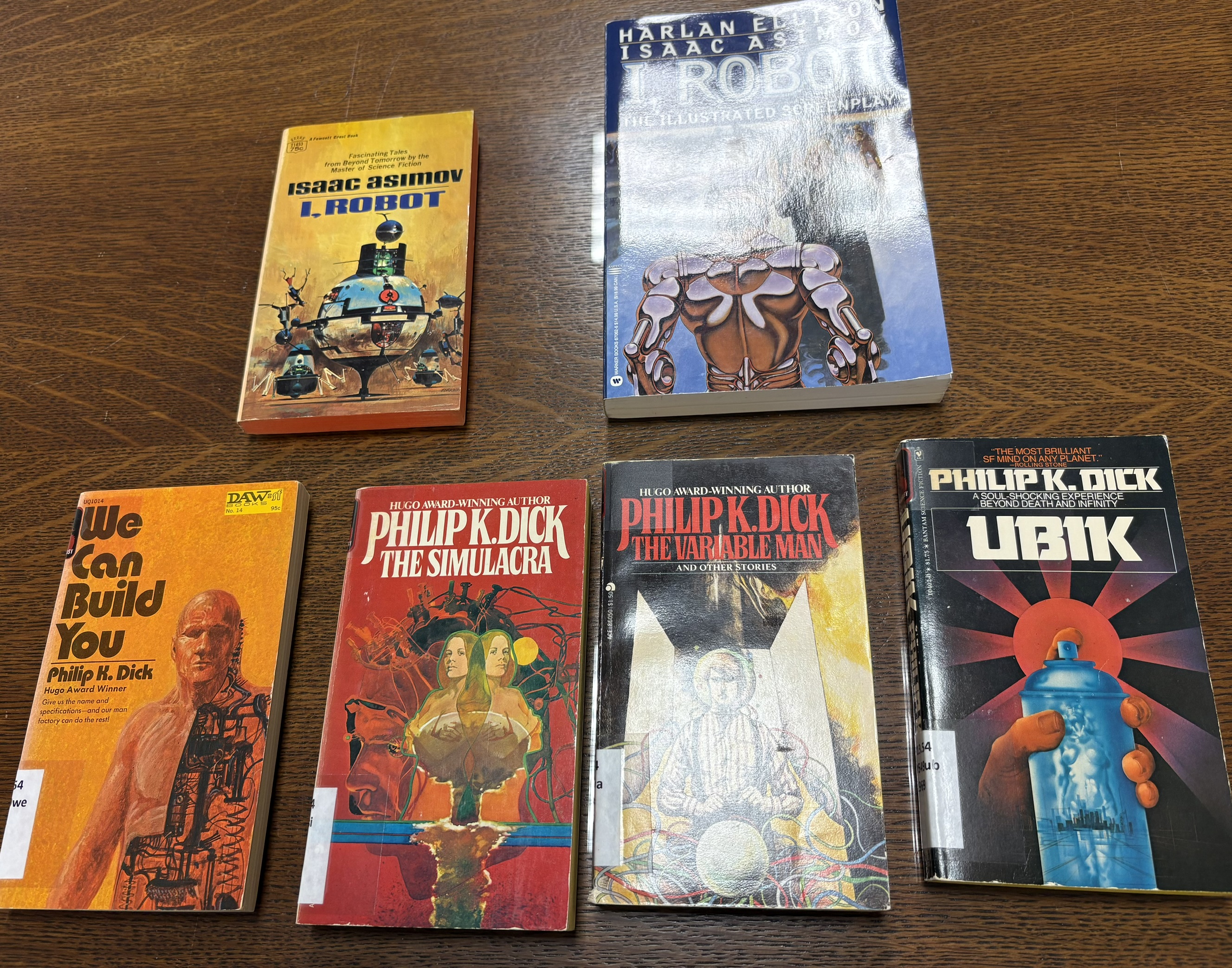
Top row: (l-r) Isaac Asimov’s I, Robot; Harlan Ellison and Asimov’s I, Robot: The Illustrated Screenplay Bottom row: (l-r) Philip K. Dick’s We Can Build You, The Simulacra, The Variable Man, and Ubik
Today’s class will meet on the lower level of Smith Library, where we will examine some of the science fiction novels and short story collections in the Asimov Collection, donated to the library by Dr. John L. Hubisz, a retired physics professor who taught at North Carolina State University. In your perusal of the novels’ covers, you will explore how artists have depicted science fiction in their cover illustrations and what those images reveal not only about the stories themselves but also about readers’ perceptions and marketing.
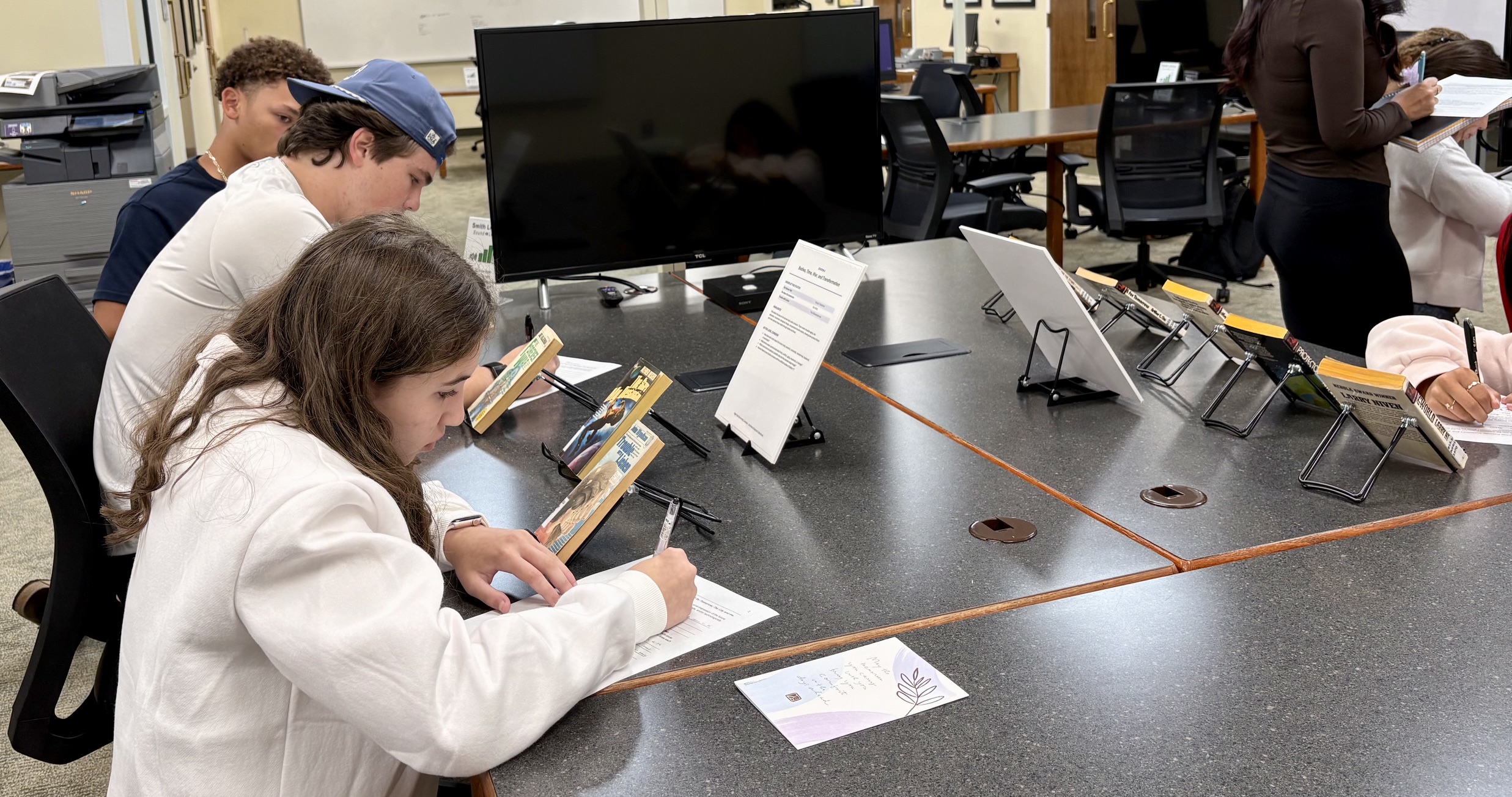
The books will be organized into four groups at four separate stations for your viewing and note-taking. For any students who are absent from class today, and for you to look back at later, I am including images of the books, along with the questions that you will address in your responses to the cover art.
Directions
Closely examine the paperbacks at one of the four stations.
Ask yourself which features are the most prominent. Do any details in the covers bring to mind characters or scenes in Isaac Asimov’s “Runaround” or Brian Aldiss’s “Supertoys Last All Summer Long”? What patterns do you notice? What do the covers convey about humans’ relationship to technology?
Compose a short response, a minimum of one complete sentence, that addresses some of the questions in item two.
Repeat steps one, two, and three with the paperbacks at the other stations
I, Robot; I, Robot: The Illustrated Screenplay; We Can Build You; The Simulacra; The Variable Man and Other Stories; Ubik: Along with the questions in item two, consider how the covers make artificial life appear. (How do color, composition, bodies, machines, and typography shape the readers’ expectations about AI or artificial life?)
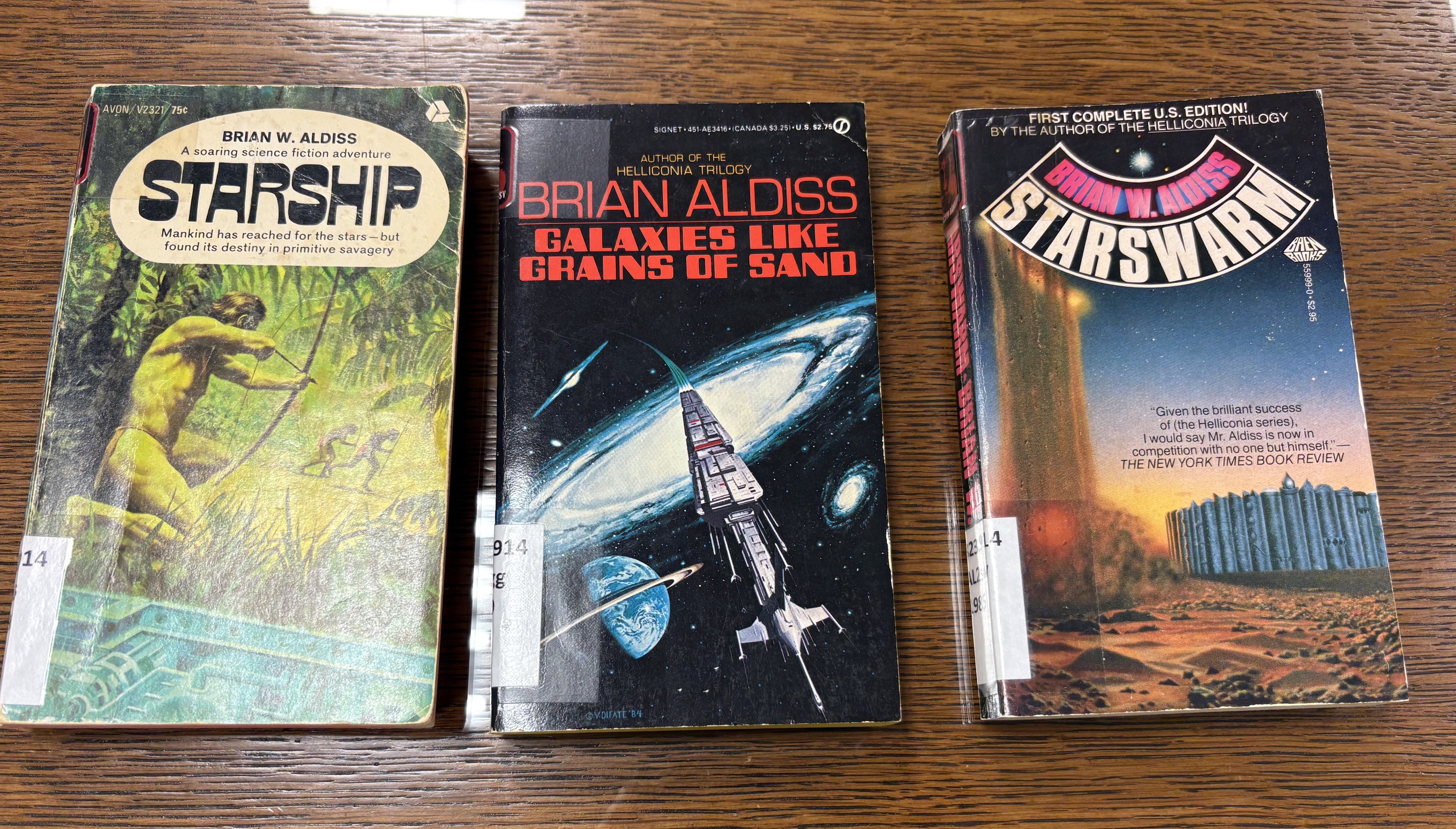
(l-r): Brian Aldiss’s Starship, Galaxies Like Grains of Sand, and Starswarm
Starship; Galaxies Like Grains of Sand; Starswarm: Along with the questions in item two, consider how the covers indicate that the author’s science fiction interests span a variety of subgenres. What kind of sci-fi story does the cover seem to promise? (Is it one of adventure, exploration, danger, social speculation, or cosmic wonder?)
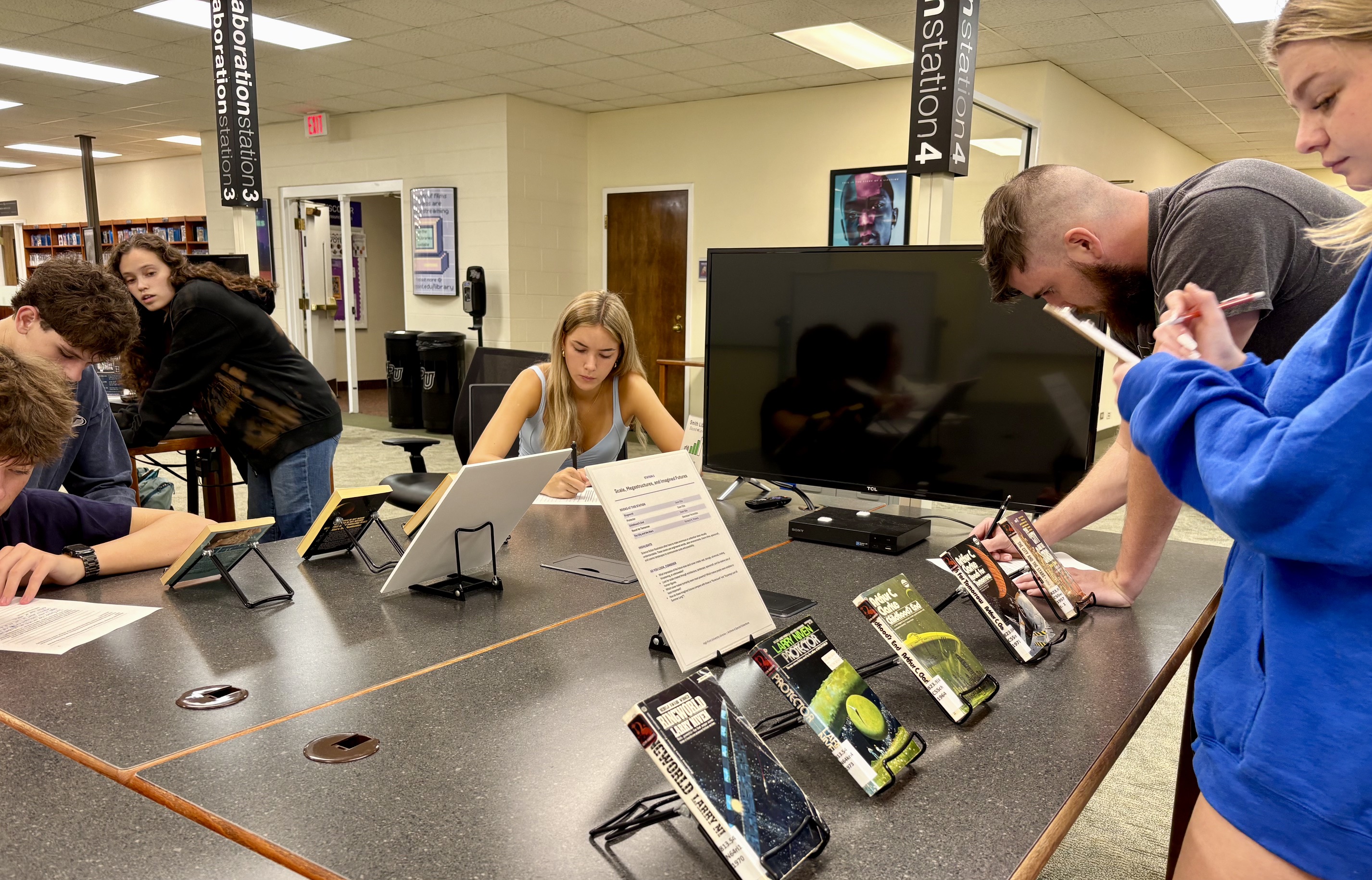
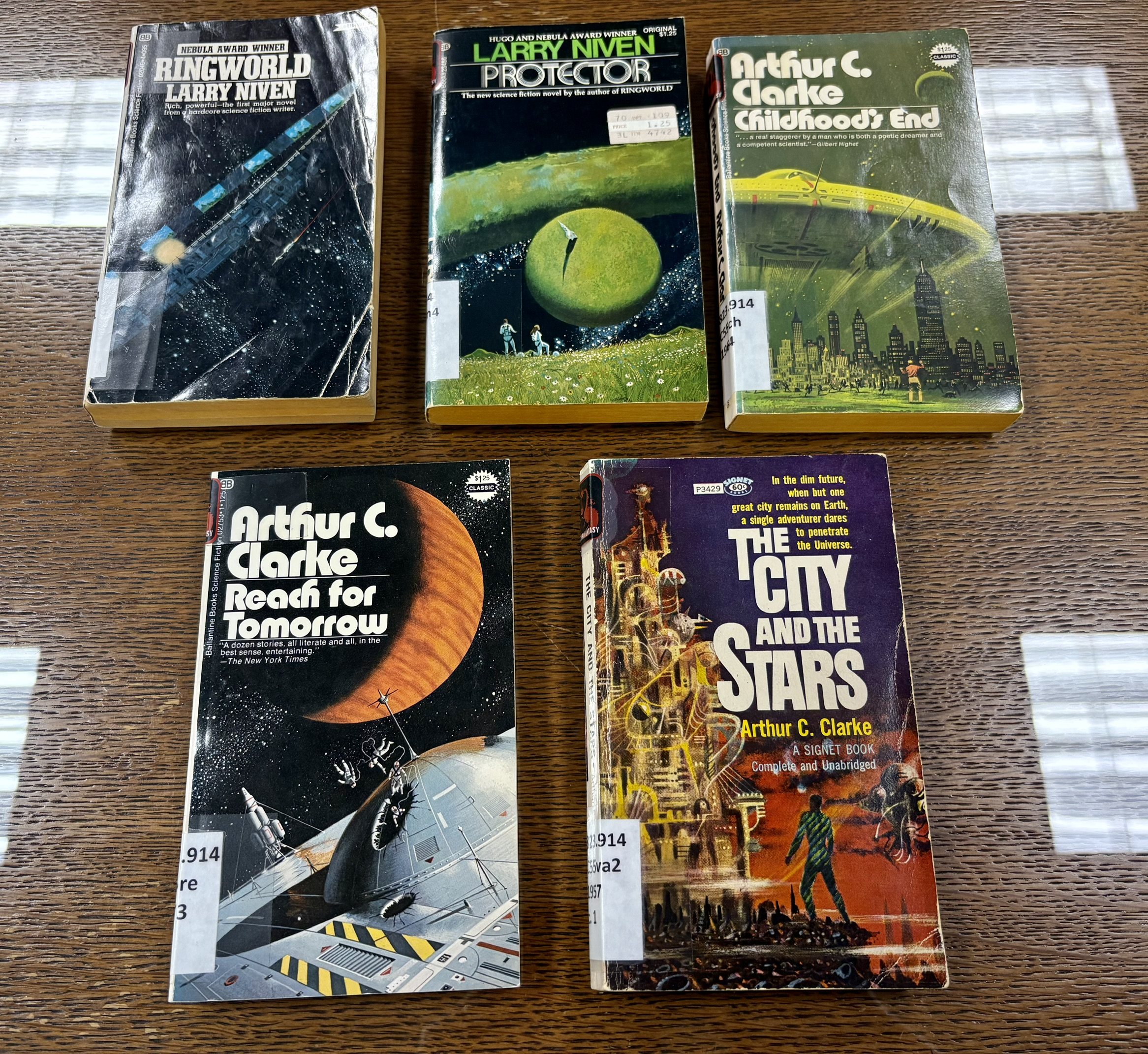
Top row: (l-r) Larry Niven’s Ringworld and Protector ; Arthur C. Clarke’s Childhood’s End Bottom row: Arthur C. Clarke’s Reach for Tomorrow and The City and the Stars
Ringworld; Protector; Childhood’s End; Reach for Tomorrow; The City and the Stars: Along with the questions in item two, what impression of the future does each cover convey? (Does the future feel large, strange, and/or technologically advanced?)
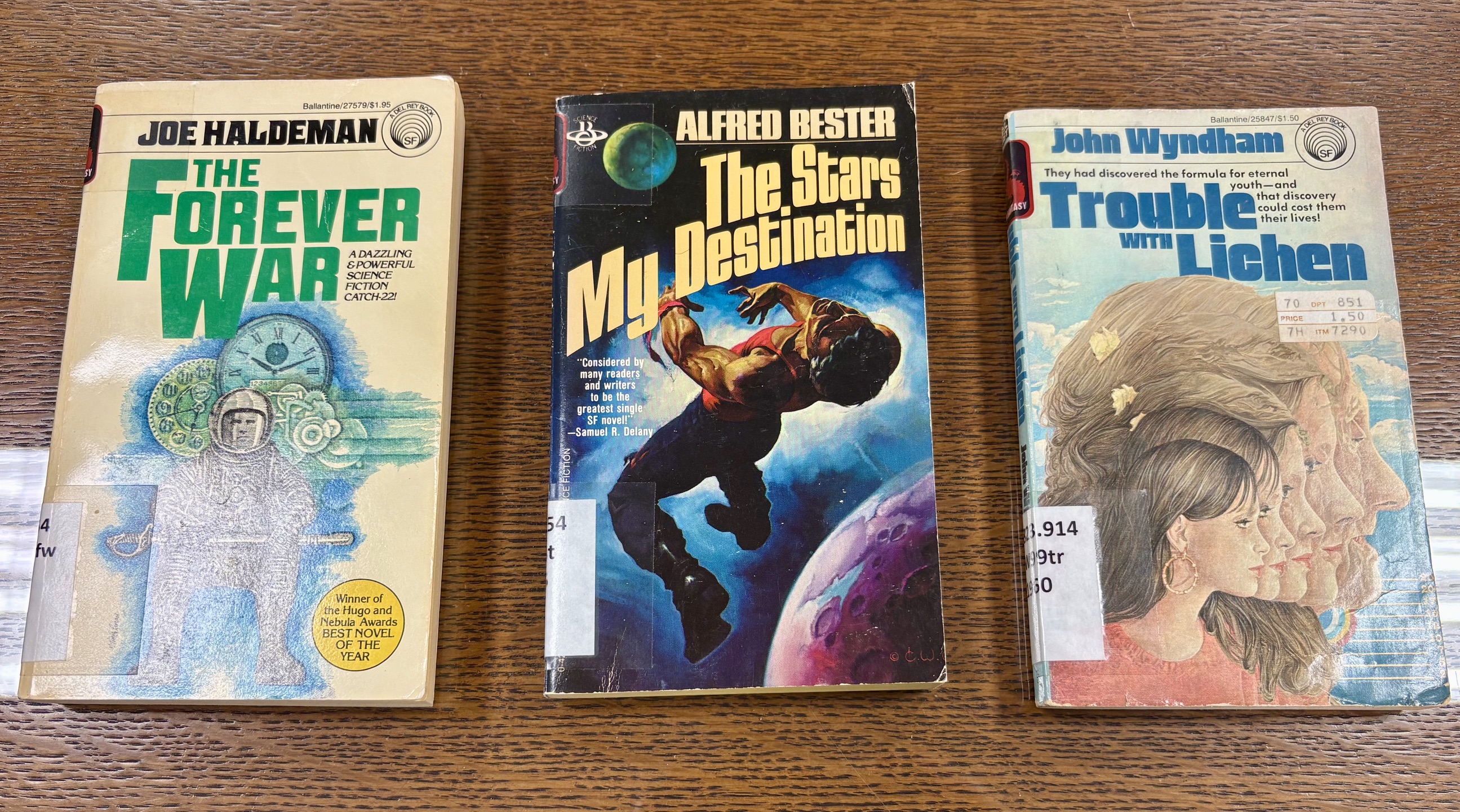
(l-r): John Haldeman’s The Forever War; Alfred Bester’s The Stars My Destination; John Wyndham’s The Trouble with Lichen
Next Up
Wordplay Day! To prepare for class, revisit the Merriam-Webster Scrabble Word Finder page, and review your journal notes and the blog posts with Scrabble tips.
Coming Soon
For Monday’s class, you will read and annotate Brian Aldiss’s short stories “Supertoys When Winter Comes” and “Supertoys in Other Seasons,” which I will distribute in class today. If you were absent or misplaced your copies, print ones from Blackboard.
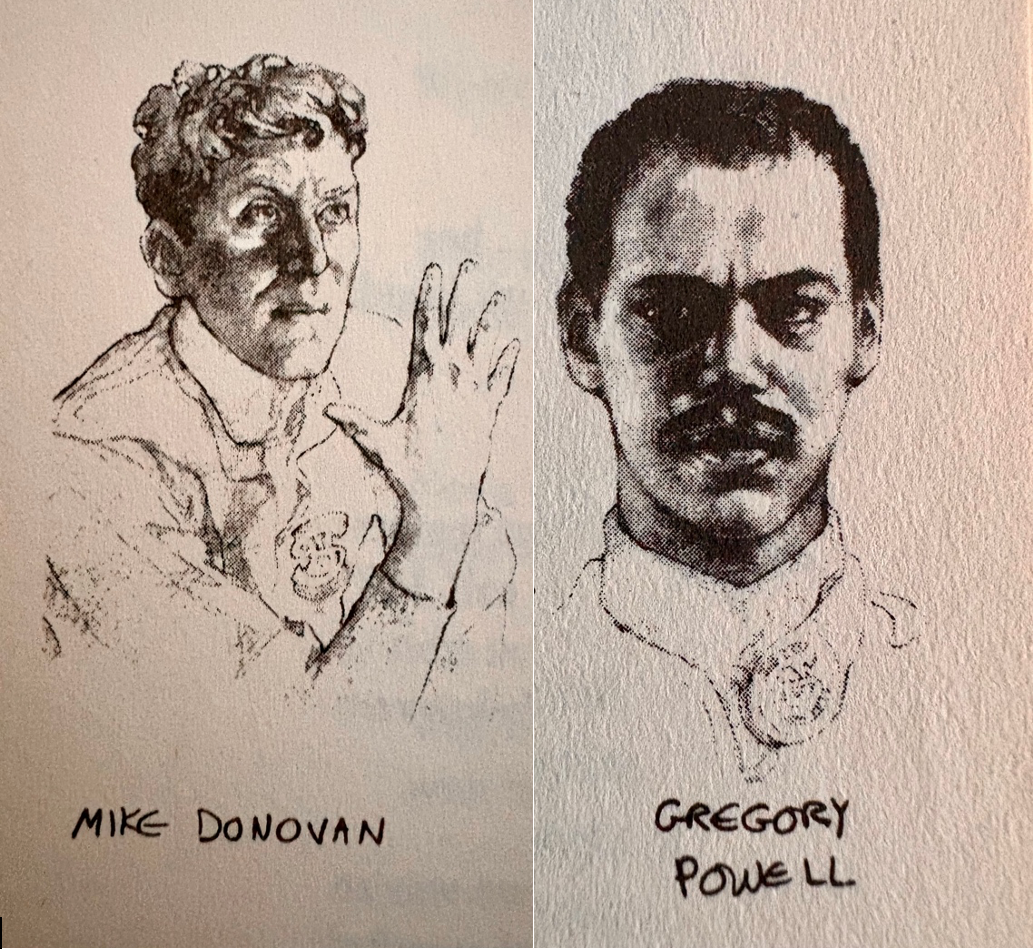
Astronauts Mike Donovan and Gregory Powell, as depicted by artist Mark Zug in I, Robot: The Illustrated Screenplay by Harlan Ellison and Isaac Asimov Ellison, Harlan, and Isaac Asimov. I, Robot: The Illustrated Screenplay, Illustrated by Mark Zug, 1987. ibooks/Simon & Schuster, 1994, pp. 106, 107.
Yesterday in class, in groups, you and two or three of your classmates began your examination of Isaac Asimov’s “Runaround” by identifying the central conflict in the short story and composing a short piece of writing that stated the conflict in your own words. In your statement, you included (1) the first and last name of the author, (2) the title of the short story, and (3) the first and last names of the characters. If you mentioned the malfunctioning robot, you named him as well.
Here is my version of that exercise:
In Isaac Asimov’s short story “Runaround,” astronauts Gregory Powell and Mike Donovan, stationed on Mercury, find their lives in jeopardy when the photo-cell banks on their life support shields begin to fail. To repair the shields, their robot, Speedy, must retrieve selenium from the Sunside of the planet, a place humans cannot withstand. But rather than completing his mission, Speedy circles the selenium pool, leaving Powell and Donovan in danger of burning alive.
Along with composing a statement that outlined the central conflict in Asimov’s story, you developed talking points for our discussion, including these:
The differences between Powell and Donovan
The differences between the treatment of the older robots from the first expedition in 2005 and Speedy, the new robot, the 2015 SPD 13
How did the older robots from the first expedition still work?
Why were the older robots left behind after the first expedition?
The need for Powell and Donovan to ride the old robots like horses
The status of robots in the hierarchy of work
Speedy’s malfunction–something akin to drunkenness–due to the conflicts between Laws Two and Three
The Three Laws of Robotics
What aspects of “Runaround” led it to be considered an influential work of science fiction?
At the end of the story, why did Asimov employ dark humor about the freezing cold when the robot couldn’t understand it?
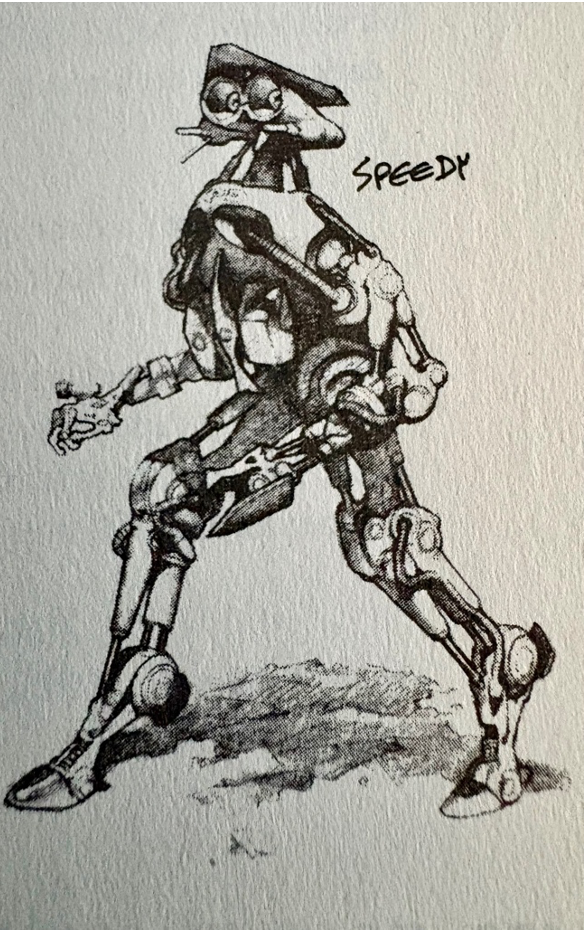
Speedy, the SPD 13 robot, as depicted by artist Mark Zug Ellison, Harlan, and Isaac Asimov. I, Robot: The Illustrated Screenplay, Illustrated by Mark Zug, 1987. ibooks/Simon & Schuster, 1994, p. 109.
The illustrations in today’s blog post were drawn by Mark Zug for I, Robot: The Illustrated Screenplay, by Harlan Ellison and Isaac Asimov. The screenplay was never produced as a film, but it was serialized in Asimov’s Science Fiction magazine in 1987. In 1994, it appeared in book form under the title I, Robot: The Illustrated Screenplay. That book is one of the paperbacks you will examine when we visit Smith Library on Wednesday.
Though the film I, Robot (2004), starring Will Smith, shares its name with Asimov’s short story collection, it isn’t an adaptation of the book. It includes elements of Asimov’s story “Little Lost Robot,” some of Asimov’s character names, and the Three Laws figure in the film as well, but the similarities end there.
For Wednesday’s class, you will read and annotate Brian Aldiss’s short story “Supertoys Last All Summer Long,” which I distributed in class yesterday. If you were absent or misplaced your copy, print one from Blackboard.
Wednesday, we will meet on the lower level of Smith Library, where we will examine some of the science fiction books in the Asimov Collection, donated to the library by Dr. John L. Hubisz, a retired physics professor who taught at North Carolina State University. In your perusal of the novels’ and short story collections’ covers, you will explore how artists have depicted science fiction in their cover illustrations and what those images reveal not only about the stories themselves but also about readers’ perceptions and marketing.
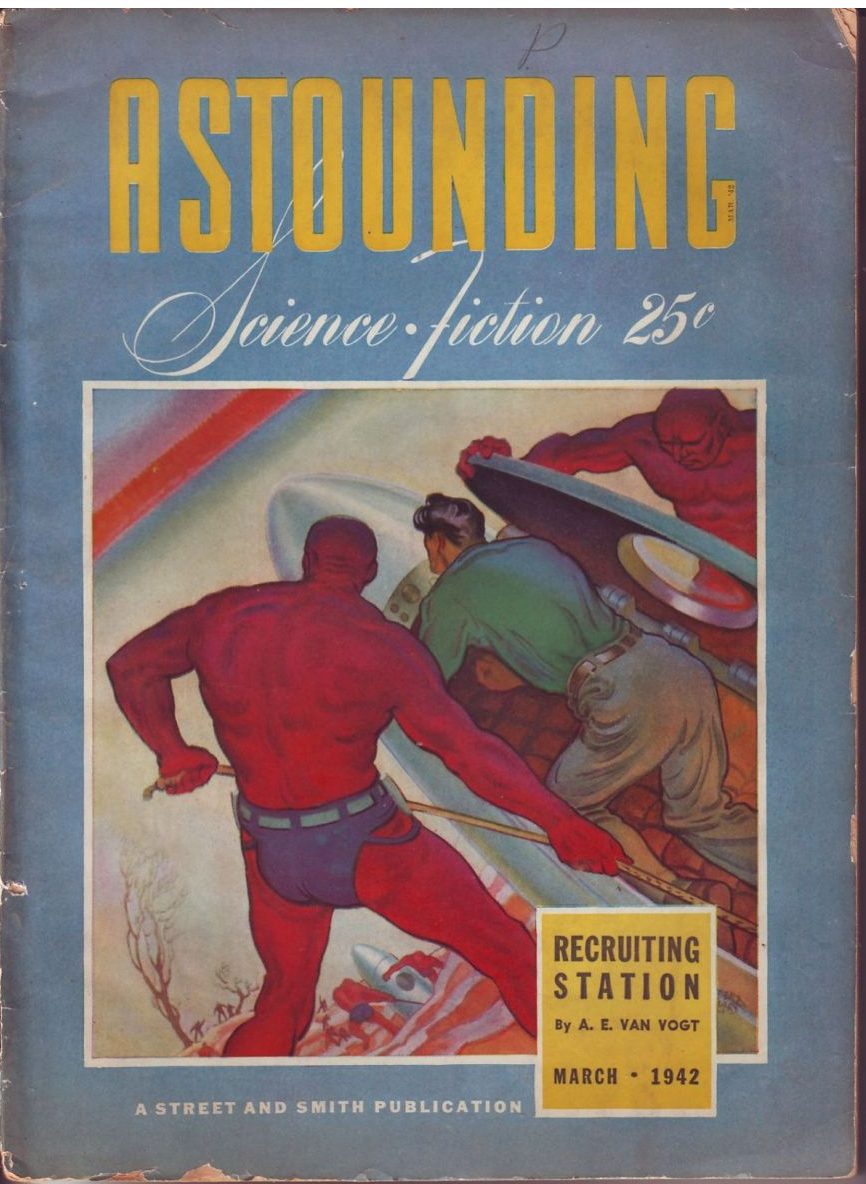
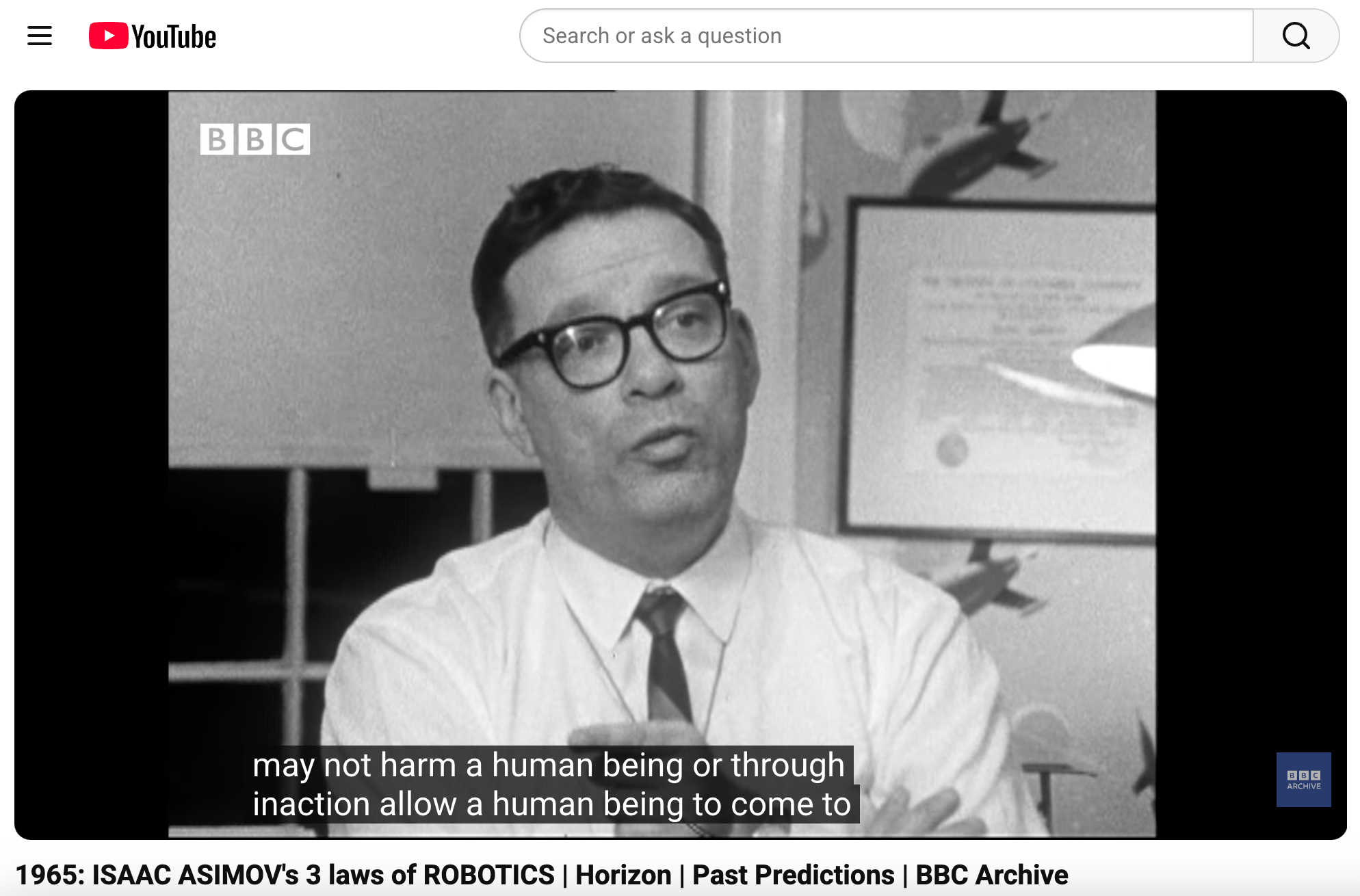
Isaac Asimov’s “Runaround” was first published in the March 1942 issue of Astounding Science Fiction magazine.
Isaac Asimov’s short story “Runaround” introduces his Three Laws of Robotics, the fictional rules that figure prominently in his short stories exploring the relationships between humans and robots. For Gregory Powell and Mike Donovan, the astronauts in “Runaround,” reexamining their application of those three laws–in a sense, tinkering with them as they would a machine–enables them to resolve the central conflict in the story.
Identifying that central conflict and expressing it in your own words will be the focus of your group exercise in the first half of today’s class. In groups, you will also develop talking points for the full-class discussion that will follow in the second half of class.
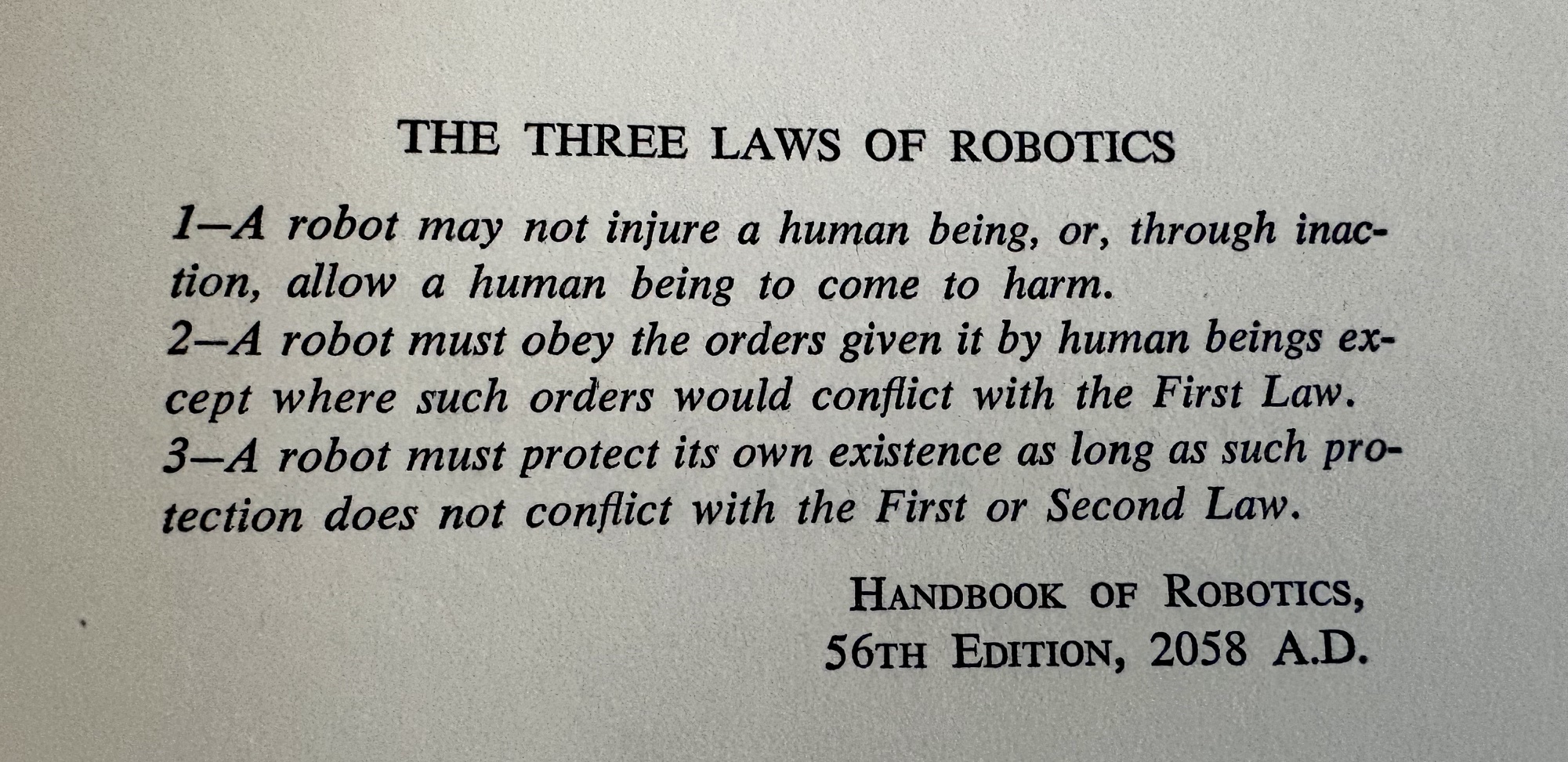
Asimov’s Three Laws of Robotics as the epigraph for I, Robot (1950)
Asimov’s Three Laws of Robotics appear both in the stories collected in his book I, Robot (1950) and as the book’s epigraph: a short quotation at the beginning of a book intended to suggest its theme.
What do the Three Laws of Robotics indicate about Asimov’s vision of humans’ relationships to artificial intelligence?
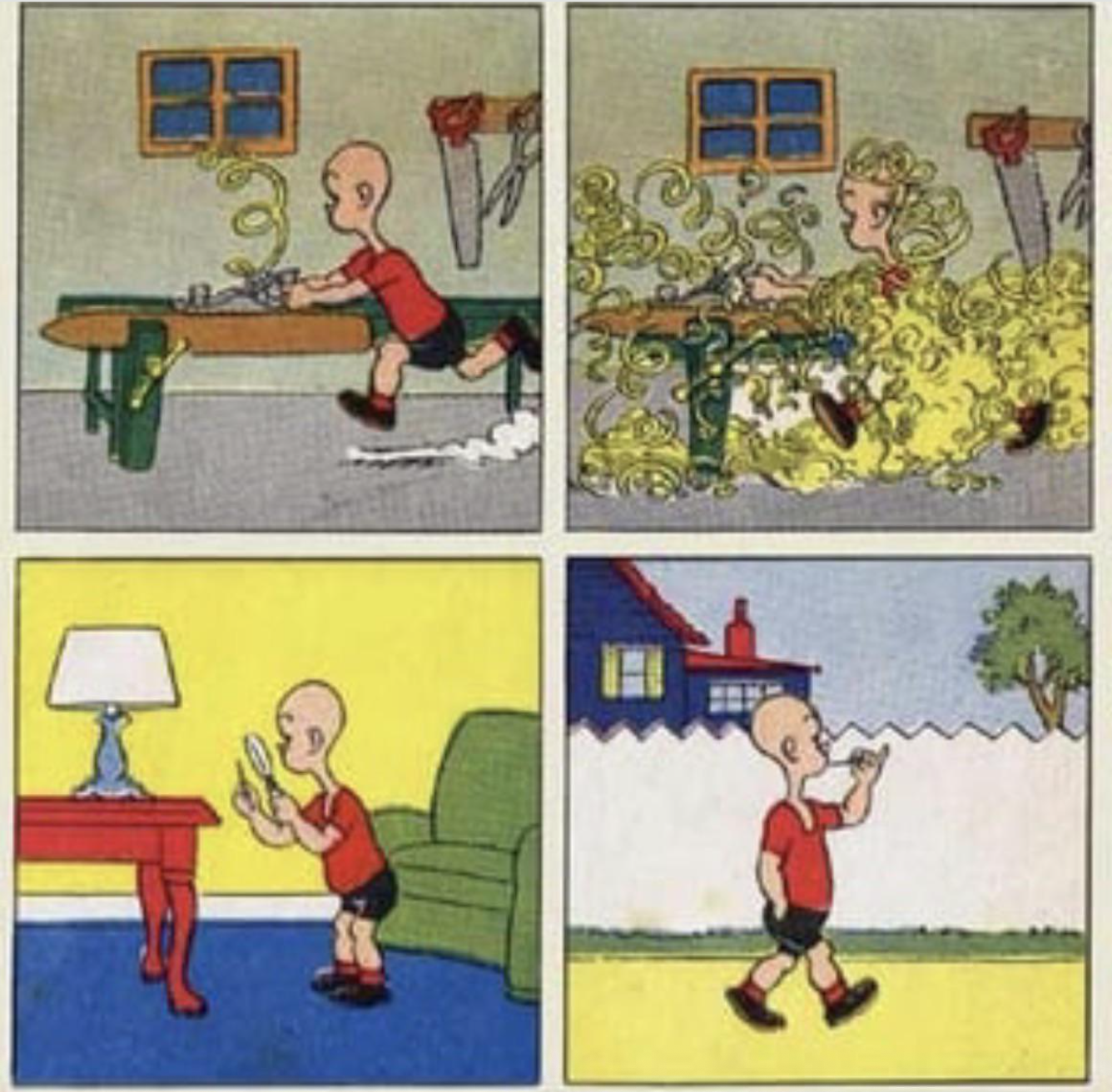
As a model for your own ethical use of generative AI for English 1103, the August 25 blog post featured screenshots of a conversation in which I developed ideas for my literacy narrative with the help of ChatGPT. After you read my literacy narrative, it should have been apparent that despite the AI assistant’s wealth of information, one of its answers revealed a lack of knowledge about the comic strip Henry. What did the AI assistant not know? (What did it say about Henry that was false?)
The September 7 class notes included a bonus assignment for correctly answering the question above. What is the answer?
Panels of Henry by Carl Thomas Anderson
Henry, created by Carl Thomas Anderson in 1932, is a comic strip in which the title character communicates through pantomime. The AI’s observation that I could “‘read’ the strip even though [I] could not yet read its words” reveals the agent’s lack of knowledge about the comic; it did not know that Henry is wordless.
Kudos to Claire Jahnke and Devyn Jones for correctly identifying that error in ChatGPT’s response. For their efforts, they received a bonus assignment credit.
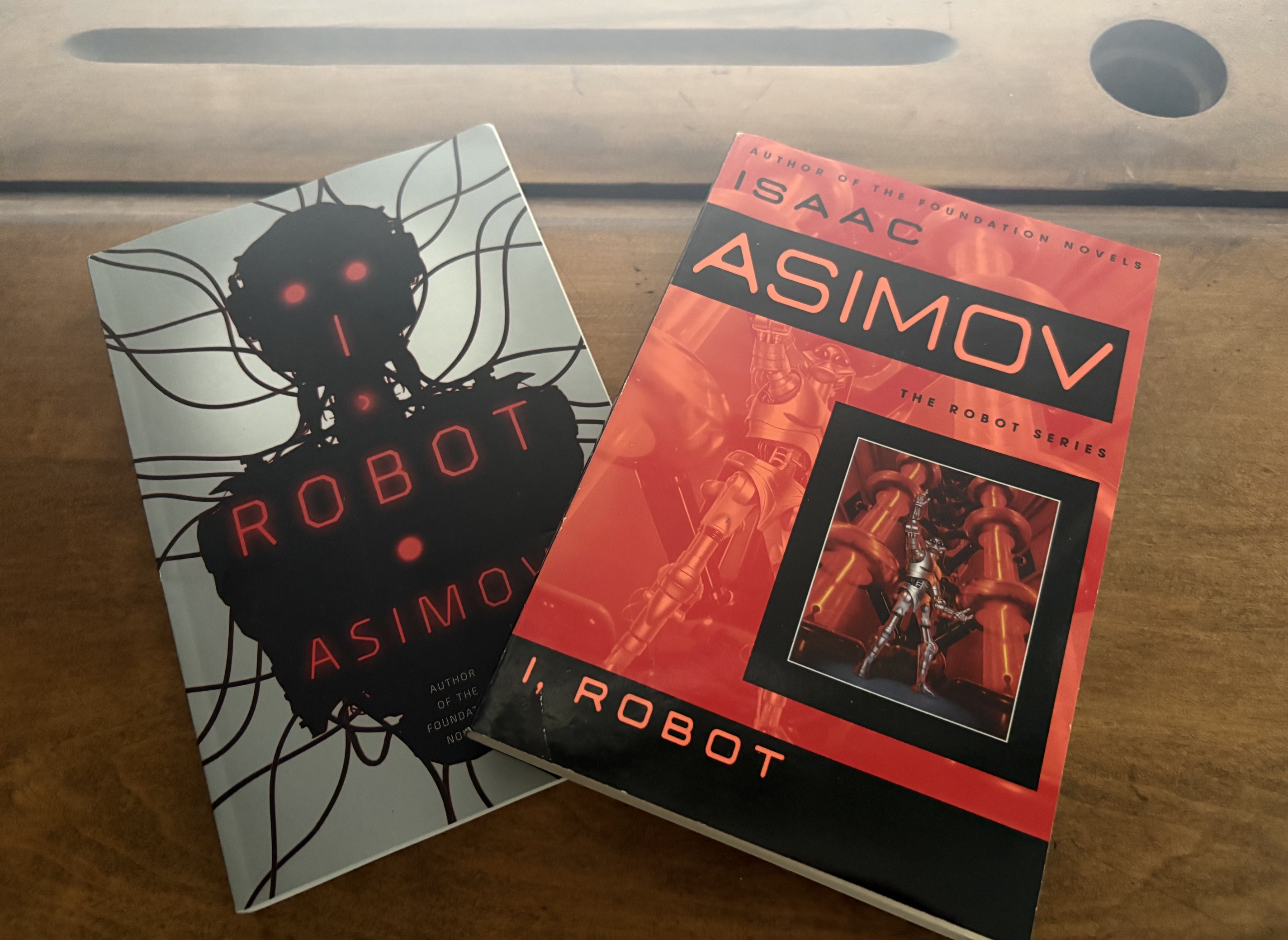
Today’s class marks the beginning of our study of science fiction exploring the nature of artificial intelligence: Isaac Asimov’s “Runaround,” followed by Brian Aldiss’s “Supertoys” stories and Ted Chiang’s “The Lifecycle of Software Objects” in Exhalation.
In a drawing in the second half of today’s class, you will have the chance to win a copy of the book pictured above: Isaac Asimov’s short story collection I, Robot, which includes “Runaround.”
As we continue our study of science fiction, consider how Asimov, Aldis, and Chiang use their imaginations as testing grounds for questions about humanity and the future.
Next Up
For Wednesday’s class, you will read Brian Aldiss’s short story “Supertoys Last All Summer Long,” which I will distribute in class today. If you are absent or misplace your copy, print one from Blackboard.
Wednesday, we will meet on the lower level of Smith Library, where we will examine some of the science fiction novels in the Asimov Collection, donated to the library by Dr. John L. Hubisz, a retired physics professor who taught at North Carolina State University. In your perusal of the novels’ and short story collections’ covers, you will explore how artists have depicted science fiction in their cover illustrations and what those images reveal not only about the stories themselves but also about readers’ perceptions and marketing.
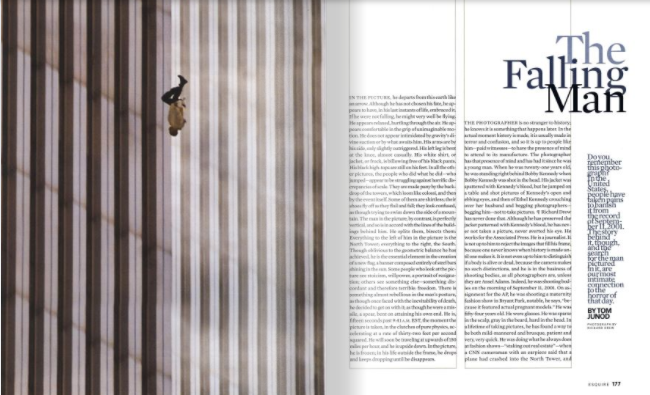
Today in class, before you begin your Scrabble games, we will examine the opening of Tom Junod‘s article “The Falling Man,” published in Esquire magazine two years after 9-11. One of the elements that we will consider is the unusually long first paragraph.
The authors of Writing Analytically recommend that “[i]f you find a paragraph growing longer than half a page–particularly if it is your opening or second paragraph–find a place to make a paragraph break” (Rosenwasser and Stephen 308). Junod does not follow that advice. He opts instead to open his article with a paragraph of more than four hundred words.
If Junod had chosen to divide the first paragraph, where might he have divided it?
Work Cited
Rosenwasser, David, and Jill Stephen. “The Idea of the Paragraph.”Writing Analytically, 9th edition. Wadsworth/Cengage, 2024. pp. 307-313.
If you would like to read more of Junod’s article than the first paragraph, you won’t be able to do so on Esquire‘s website because the magazine’s paywall will deny you access to the full text, unless you are a subscriber. However, students and faculty at HPU can access the full text of articles published in any of the magazines and newspapers included in the libraries’ databases. To access “The Falling Man” through the HPU Library site, follow these steps:
Directions for Accessing “The Falling Man” (Full Text)
Under the heading Search HPU Libraries . . . , click on the Articles tab.
Under the Articles tab, type Tom Junod “Falling Man” Esquire in the search box and click search.
On the next screen, you will see a brief summary of the article. Click View full text to see the complete article.
On the next screen, click View full text beside one of the database options.
Literacy Narrative Blog Response Assignment
Directions
After this morning’s hard deadline for the literacy narrative,10:40, go to the class page, and click on the link for the blog of the classmate whose name follows yours. If you are last on the list, go to the blog of the student whose name is first.
If your designated classmate’s blog is not linked to the page, or his or her literacy narrative is not published, choose another classmate’s blog.
Read the classmate’s literacy narrative.
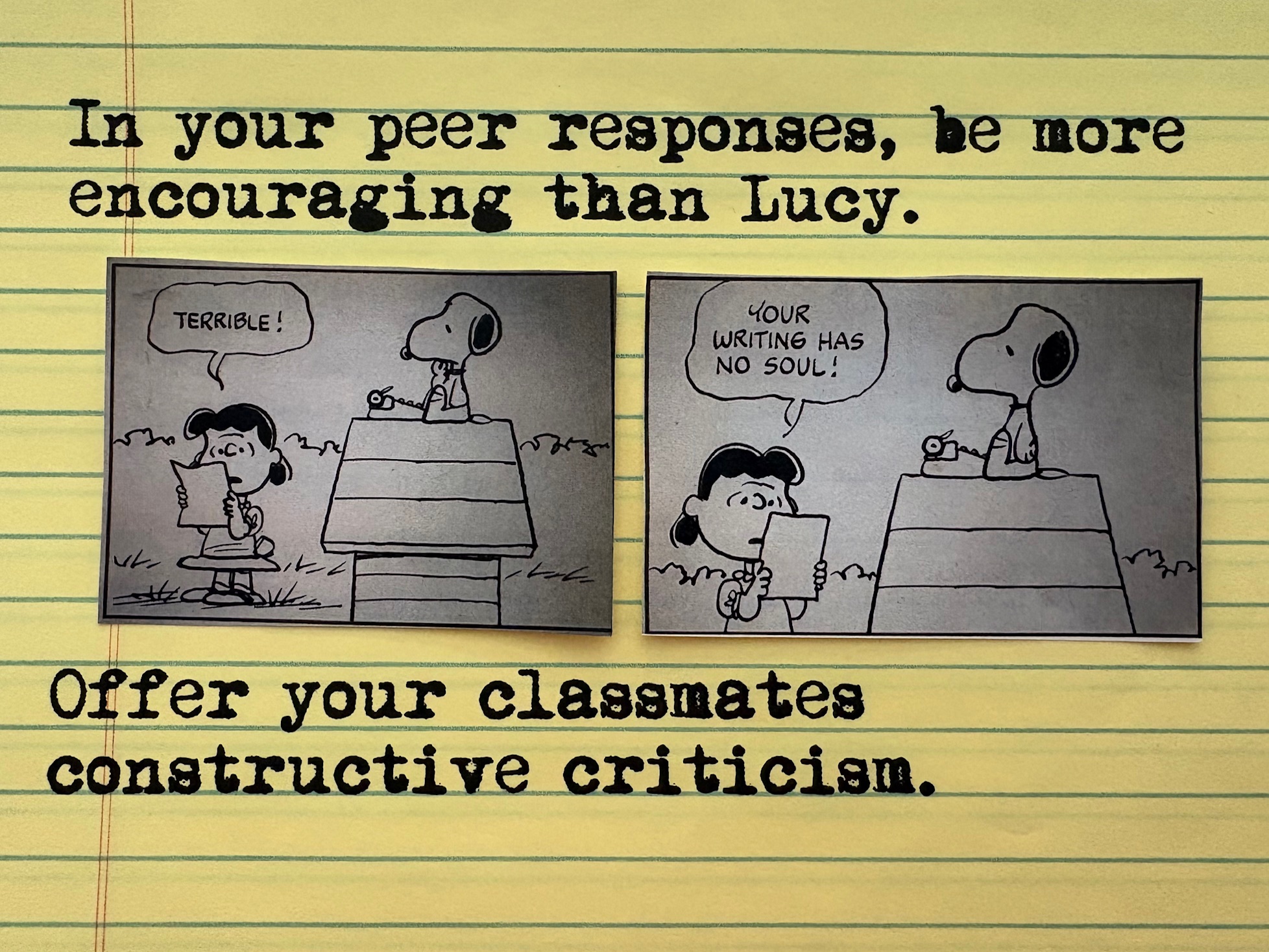
Compose a one- or two-paragraph response (75 words, minimum) that includes both the classmate’s name and the title of his or her literacy narrative. In your comment, address one or more of these elements: the title, vivid details, scene, dialogue, the image documenting part of the writing process away from the screen, the embedded link to a relevant website. Note that you will mention the classmate by name, but you will not refer to him or her in third person. In other words, you will not write, John’s description made me feel as if I were with him in his fourth-grade classroom. Instead, you will write, John, your description made me feel as if I were with you in your fourth-grade classroom.
Recommended (not required): Draft your comment longhand in your journal.
Type your response as a comment. You should see a leave comment/reply option at the top or bottom of the post. If you do not see that option, click the title of the post and scroll down. You should then see leave comment/reply.
Before you click leave comment/reply, copy your comment (on a PC, copy with control + c; on a Mac, copy with command + c).
After you submit your comment on your classmate’s literacy narrative, return to this blog post, and paste your comment as a reply (on a PC, paste with control + v; on a Mac, paste with command + v). This step is critical because your classmate may not approve your comment, which means it will not be visible on his or her blog. To receive credit for the assignment, you must post your duplicate comment as a reply to this post, ENG 1103: “The Falling Man” . . . . To submit your comment, click the title of the post, then scroll down to the bottom. There you will see the image of an airmail envelope with a box for your comment. Type your comment in the box and click Comment. Post your comment by 7:30 a.m. on Monday, September 14. I will make your comments visible after the deadline.
You are not required to read other classmates’ literacy narratives, but I encourage you to browse their blogs and read the posts that pique your interest.
Next Up
Wordplay Day! To prepare for class, revisit the Merriam-Webster Scrabble Word Finder page, and review your journal notes and the blog posts with Scrabble tips, including this one
Coming Soon
For Monday’s class, you will read and annotate Isaac Asimov’s short story “Runaround,” which I distributed in class on Wednesday. If you were absent or misplaced your copy, print one from Blackboard.
Also, before Monday morning’s 7:30 deadline, remember to post your peer blog response as a comment on today’s post.
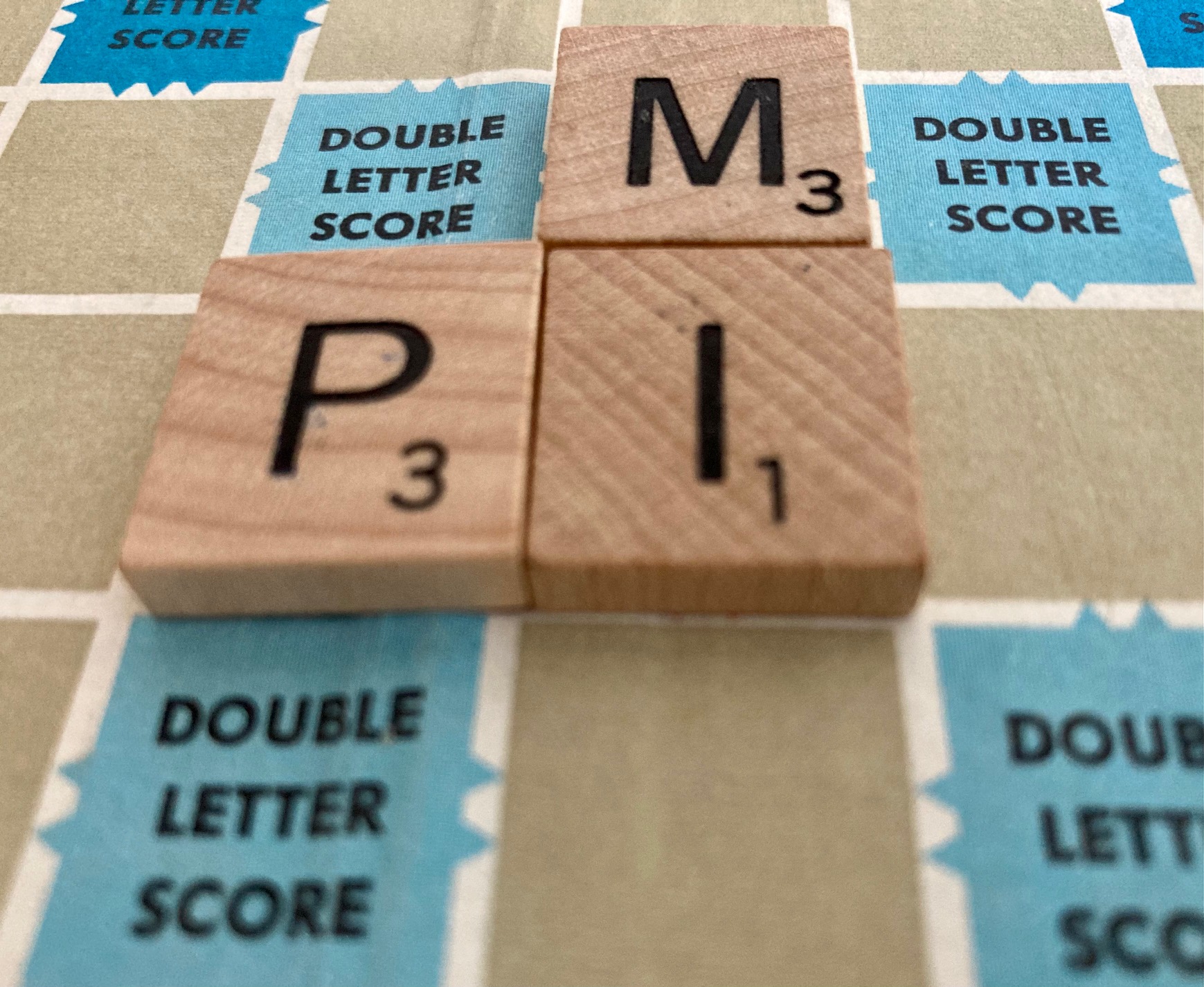
In the previous weeks, Scrabble blog posts have featured playable two-letter words beginning with the letters a through l. Today’s post features the playable two-letter words beginning with m, n, o, and p. Learning these two-letter words, as well as the other two-letter words in the alphabet, will enable you to see more options for play and increase the number of points you earn in a single turn.
M, by the way, is the most versatile consonant. In the first position, m pairs with every vowel: ma, me, mi, mo, mu, and also my. In the second position, m pairs with every vowel except i: am, em, om, um.
ma: a mother
me: a singular objective pronoun
mi: a tone of the diatonic scale
mm: an expression of assent
mo: a moment
mu: a Greek letter
my: a first-person possessive adjective
na: no, not
ne: born with the name of (also nee)
no: a negative answer
nu: a Greek letter
od: a hypothetical force
oe: a whirlwind off the Faero Islands
of: originating from
oh: an exclamation of surprise
oi: an expression of dismay (also oy)
om: a sound used as a mantra
on: the batsman’s side in cricket
op: a style of abstract art dealing with optics
or: the heraldic color gold
os: a bone
ow: used to express pain
ox: a clumsy person
oy: an expression of dismay (also oi)
pa: a father
pe: a Hebrew letter
pi: a Greek letter
Don’t Go There (in Scrabble)
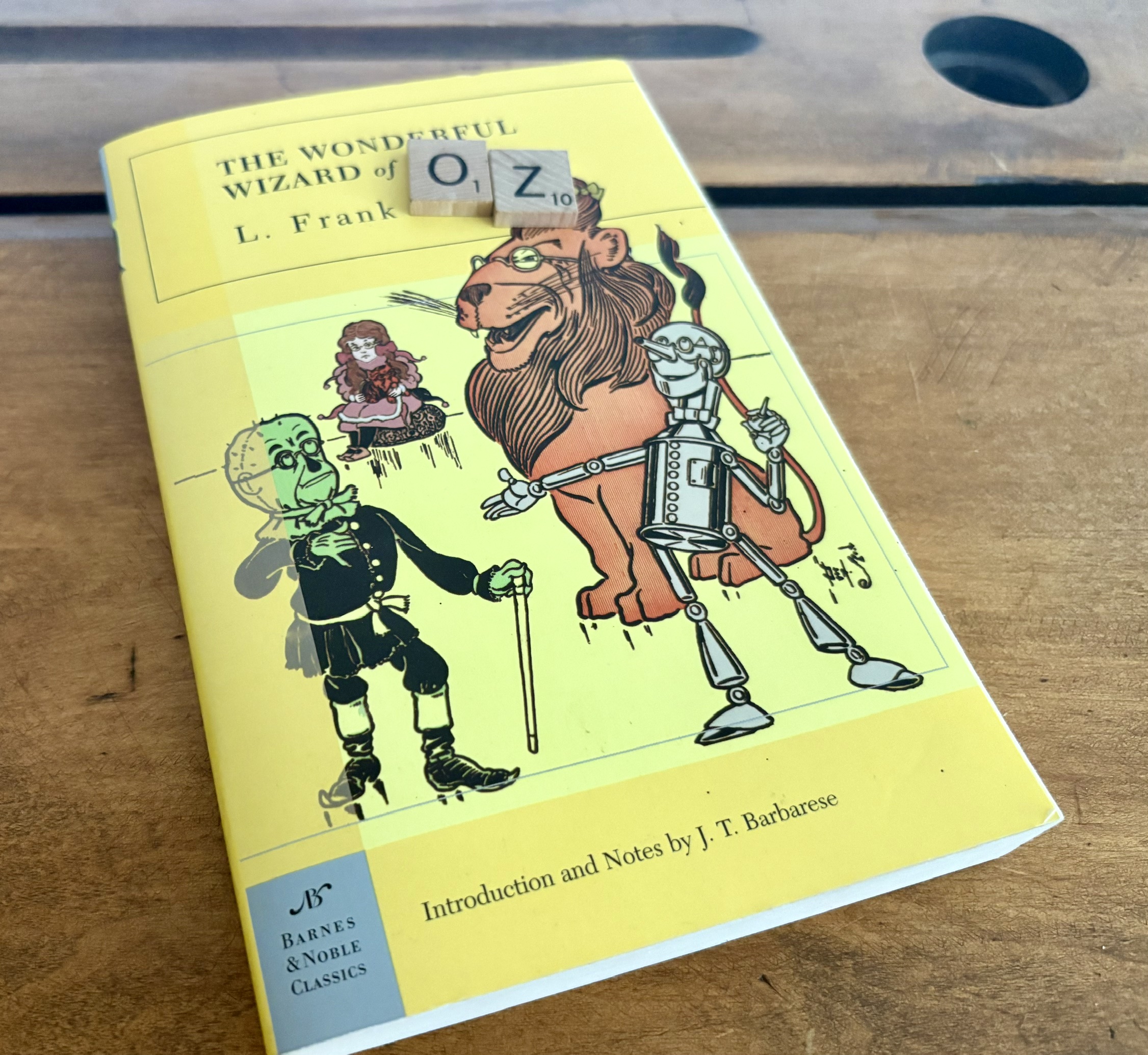
Baum, L. Frank. The Wonderful Wizard of Oz. 1900. Barnes & Noble Classics, 2005.
Occasionally, students will play oz, which isn’t one of the words in the list above. It’s absent from that list because it’s a proper noun that isn’t also a common noun.
That isn’t the case with the name of Dorothy’s aunt, Em, which is playable as the common noun em: the letter m and the width of a piece of type about as wide as it is tall, used as a unit of measure of typeset matter (hence the term em dash).
And if the letters on your rack spell emerald–the first word in the name of Oz’s capital city–and you can play them all in one turn, you will earn an extra fifty points for playing all seven of your letters. Ditto for cyclone and tornado, words for the storm that sends Dorothy on her journey, and woodman, the second word in her tin friend’s name.
Next Up
Wordplay Day! To prepare for class, revisit the Merriam-Webster Scrabble Word Finder page, and review your journal notes and the blog posts devoted to Scrabble.
This morning, you will compose a reflective essay focusing on the process of planning, drafting, and revising your literacy narrative. If you are still in the process of completing your essay (since you have until Friday morning’s hard deadline to post it without penalty), your reflection will address your work in progress. Instructions for your reflective essay are included below.
Directions
Compose a short reflective essay that documents the processes of planning, drafting, and revising your literacy narrative. Questions to consider include the ones listed below. You do not need to address all the questions. Focus on the ones whose answers reveal the most about your work.
In the brainstorming stage, did you follow the model in the August 25 blog post for using AI ethically? If so, did the conversation help you choose a topic? What other useful information did the AI assistant provide?
When you began transferring the words from your handwritten draft onto the screen of your laptop or tablet, what did you observe about the process?
What aspect of the writing seemed the most challenging? Determining the focus of your narrative? Developing the story? Beginning a scene? Introducing dialogue? Crafting the conclusion? Why did that aspect of the writing seem the most challenging?
Did you change the subject of your narrative? If so, what was the original subject? What did you change it to? Why?
Did you change the organization of the narrative? For example, did you initially present the story chronologically, then begin in the present and move to flashback?
What do you consider the strongest element of your literacy narrative?
What is the title, and at what point in the process did you decide on it? Did you change the title during the writing process? If so, what was the original title?
What image did you include in your blog that documents part of your writing process away from the screen? Why did you choose that particular image?
What relevant website did you link to your blog post? Why is that particular site relevant to your narrative?
Include in your reflection a minimum of one relevant quotation from one of the assigned readings (“Me Talk Pretty One Day,” “The Day Language Came into My Life,” the excerpt from To Kill a Mockingbird, “A Bridge to Words,” “Creativity is Key,” “The Journey of the Greatest Story”). Introduce your quotation with a signal phrase and follow it with a parenthetical citation.
At the end of your essay, include the heading Work Cited followed by your works cited entry. (If you followed the preparation guidelines in yesterday’s class notes, the information you need to complete steps three and four is recorded in your journal.)
Remember that the writing following the quotation should demonstrate its relevance. Although you are required to include a quotation, its presence in your writing shouldn’t seem obligatory. In other words, the quotation shouldn’t appear to be there simply because you were required to include it.
Wordplay Day! To prepare for class, review your journal entries on Scrabble and the blog posts devoted to the game. Also, revisit the Merriam-Webster Scrabble Word Finder page.
Today’s blog entry begins with step-by-step instructions for posting your literacy narrative to Blackboard and WordPress.
Posting to Blackboard
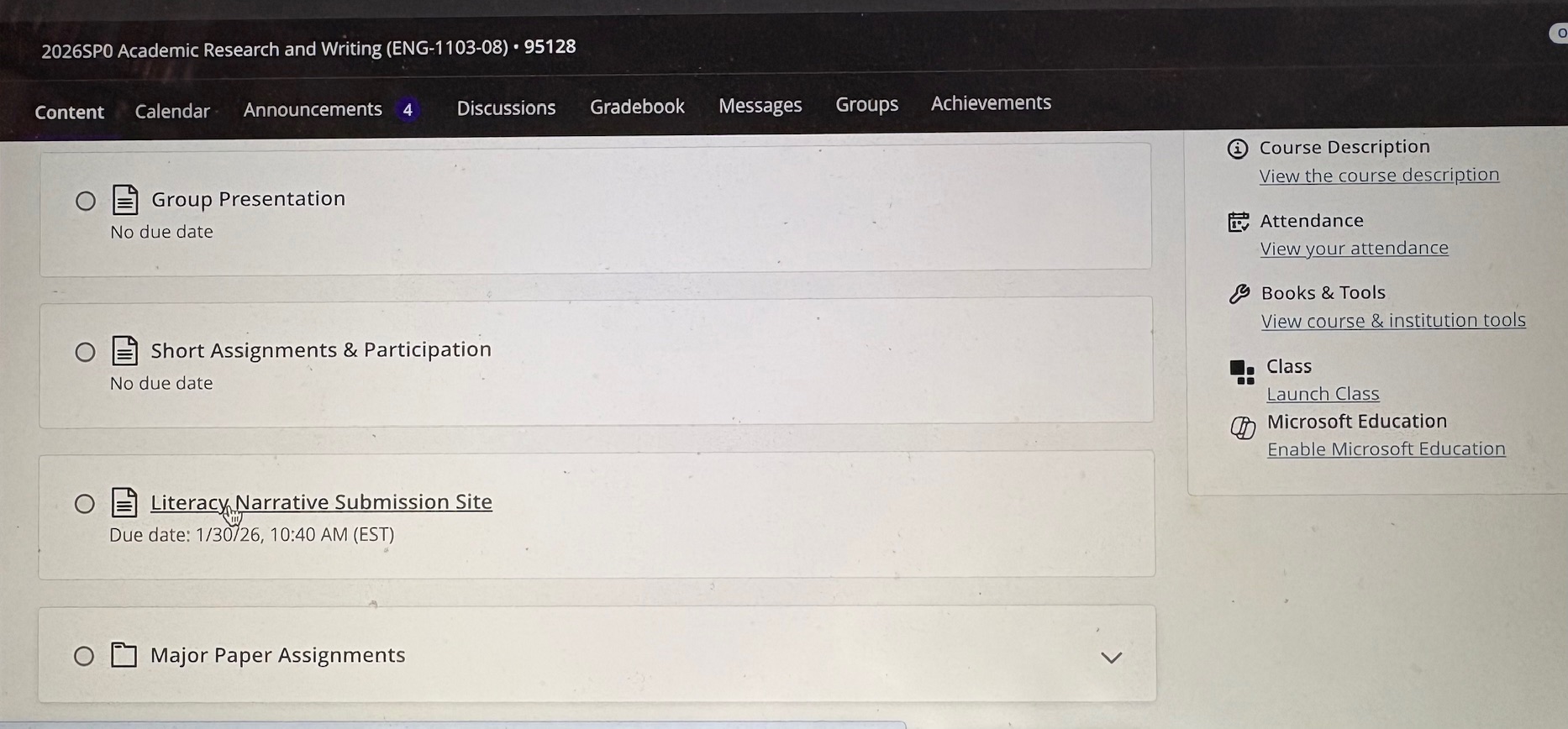
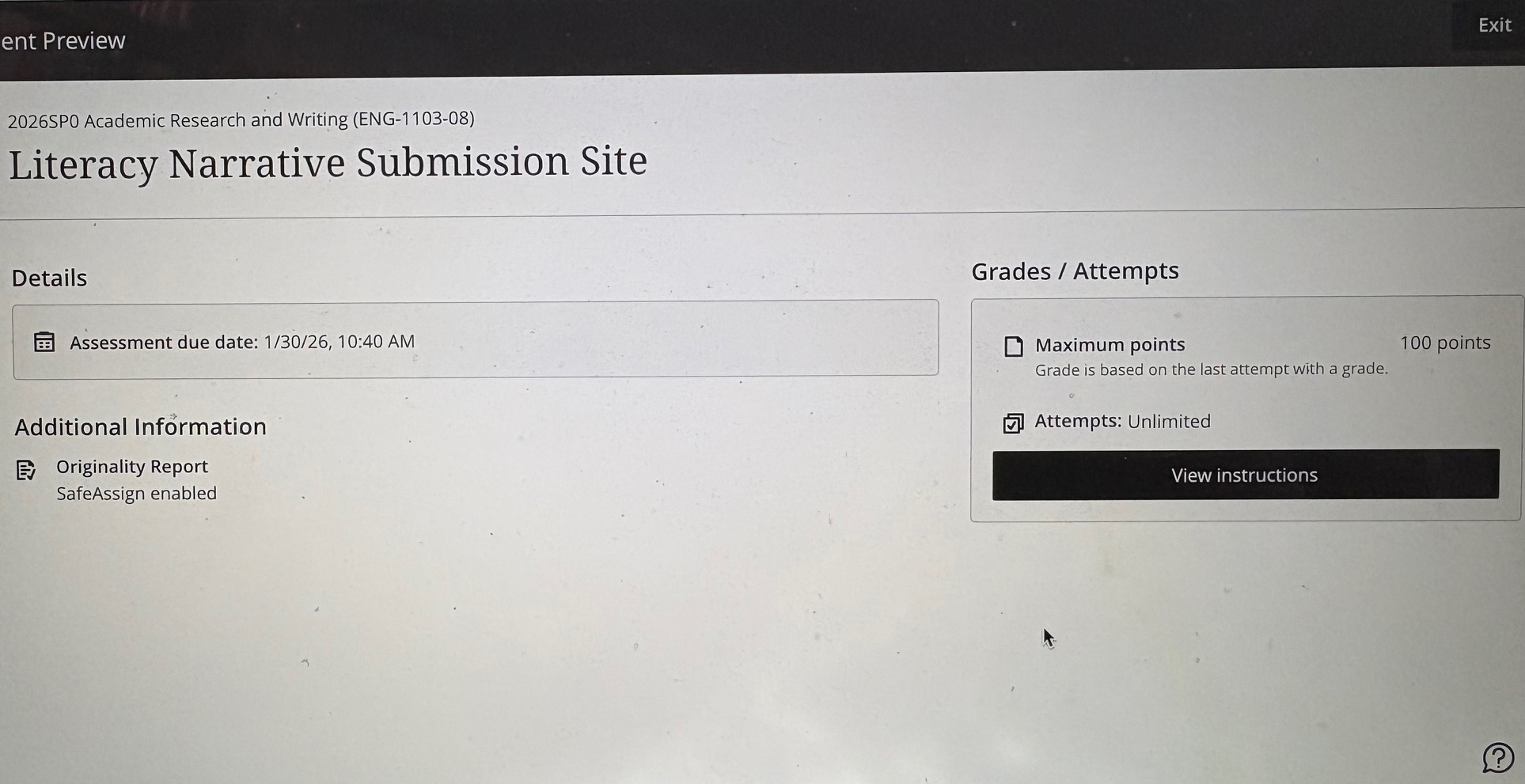
Log in to Blackboard and select the course site for ENG 1108.03, then scroll down to Literacy Narrative Submission Site.
Click LiteracyNarrative Submission Site. On the next page, click the black rectangle on the lower right, labeled View instructions.
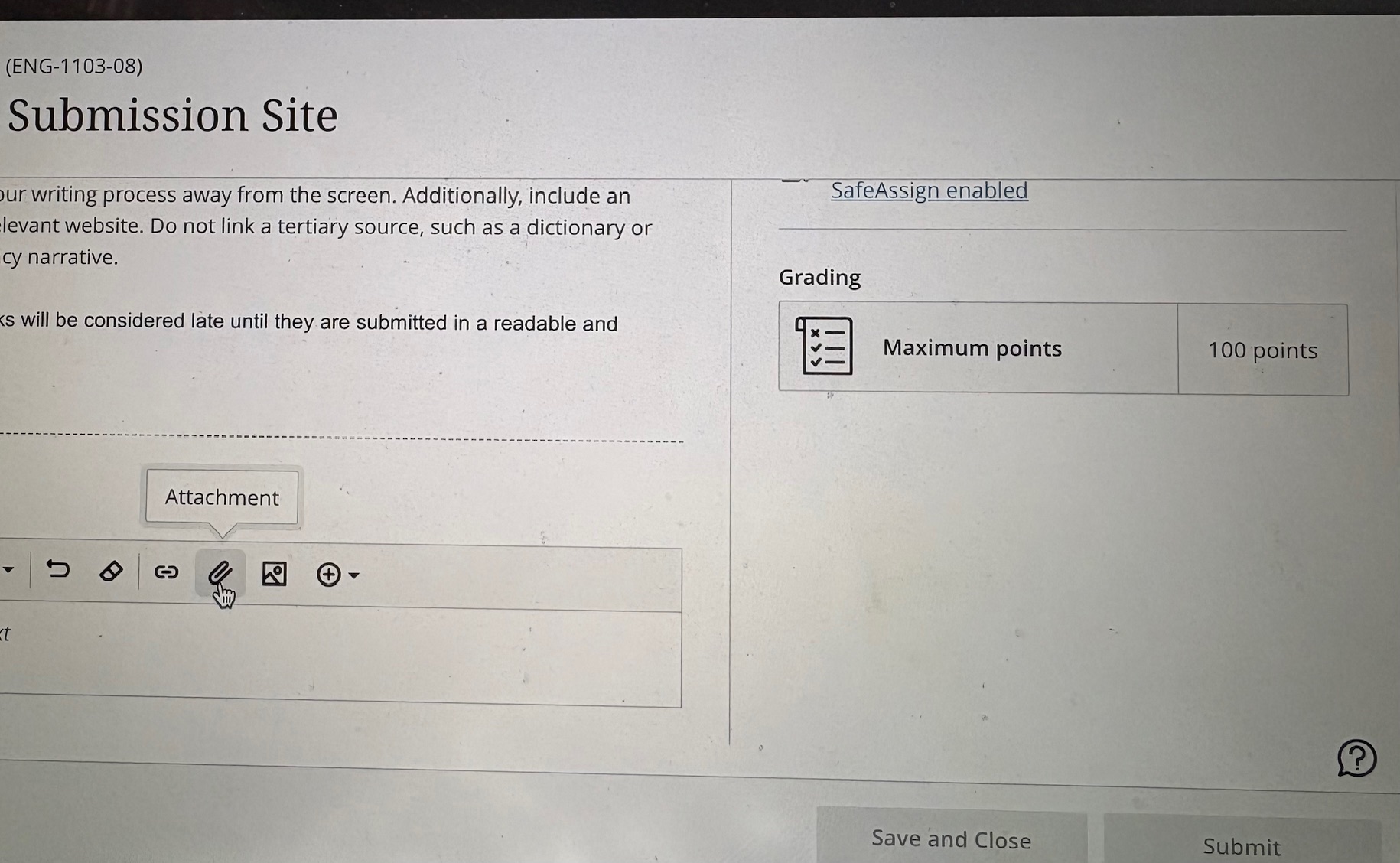
The next page is where you will submit your literacy narrative file as an MS Word document or PDF. Click on the paperclip icon, and attach your file as you would an email attachment.
An important posting note: Be sure to click the gray rectangle labeled Submit, on the lower right. If you click Save and Close, your file will be saved to Blackboard, but it will not be submitted and will not be accessible to me. To submit your file, you must click Submit.
If you follow the steps above, voila! You have submitted your literacy narrative to Blackboard.
Posting to WordPress
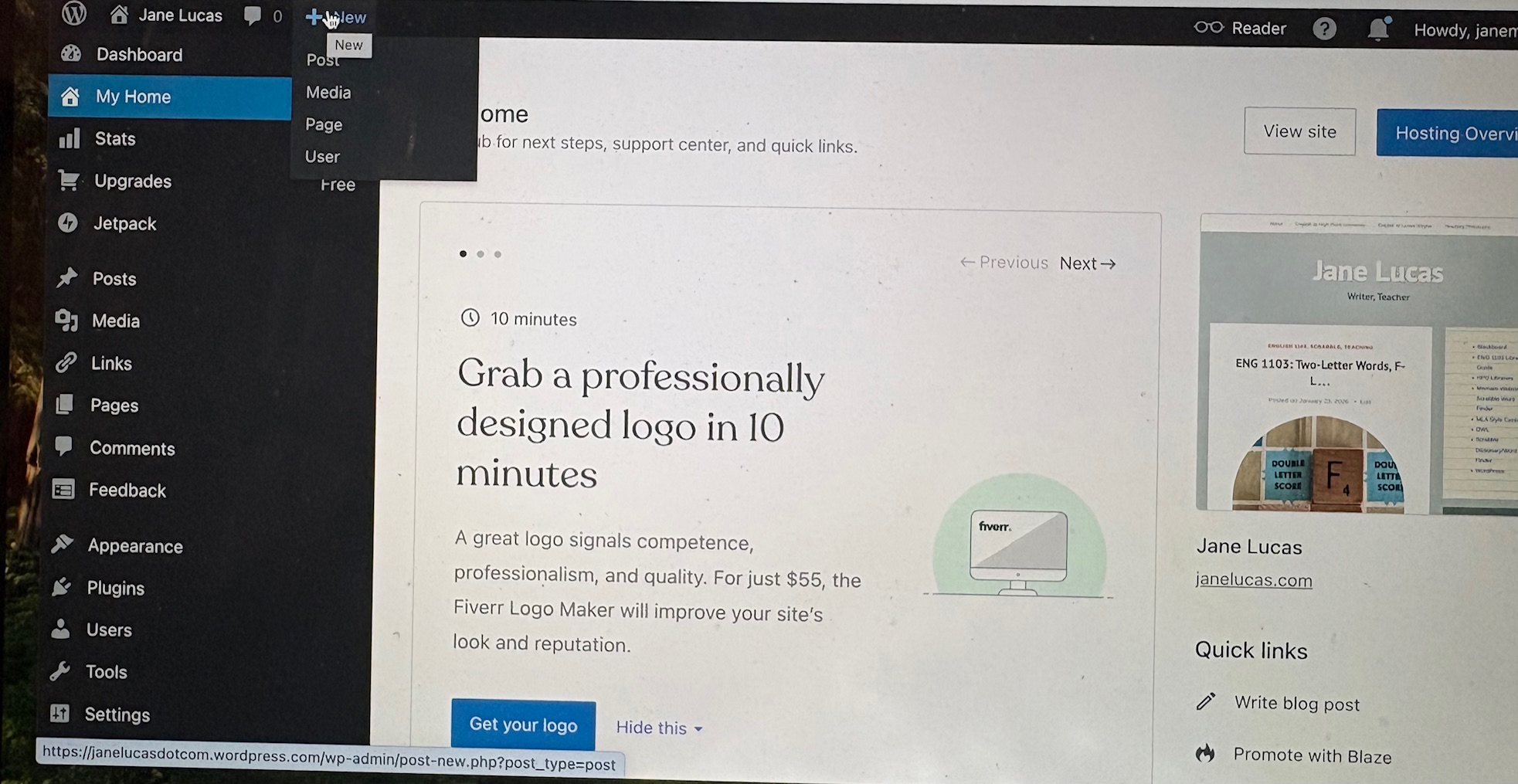
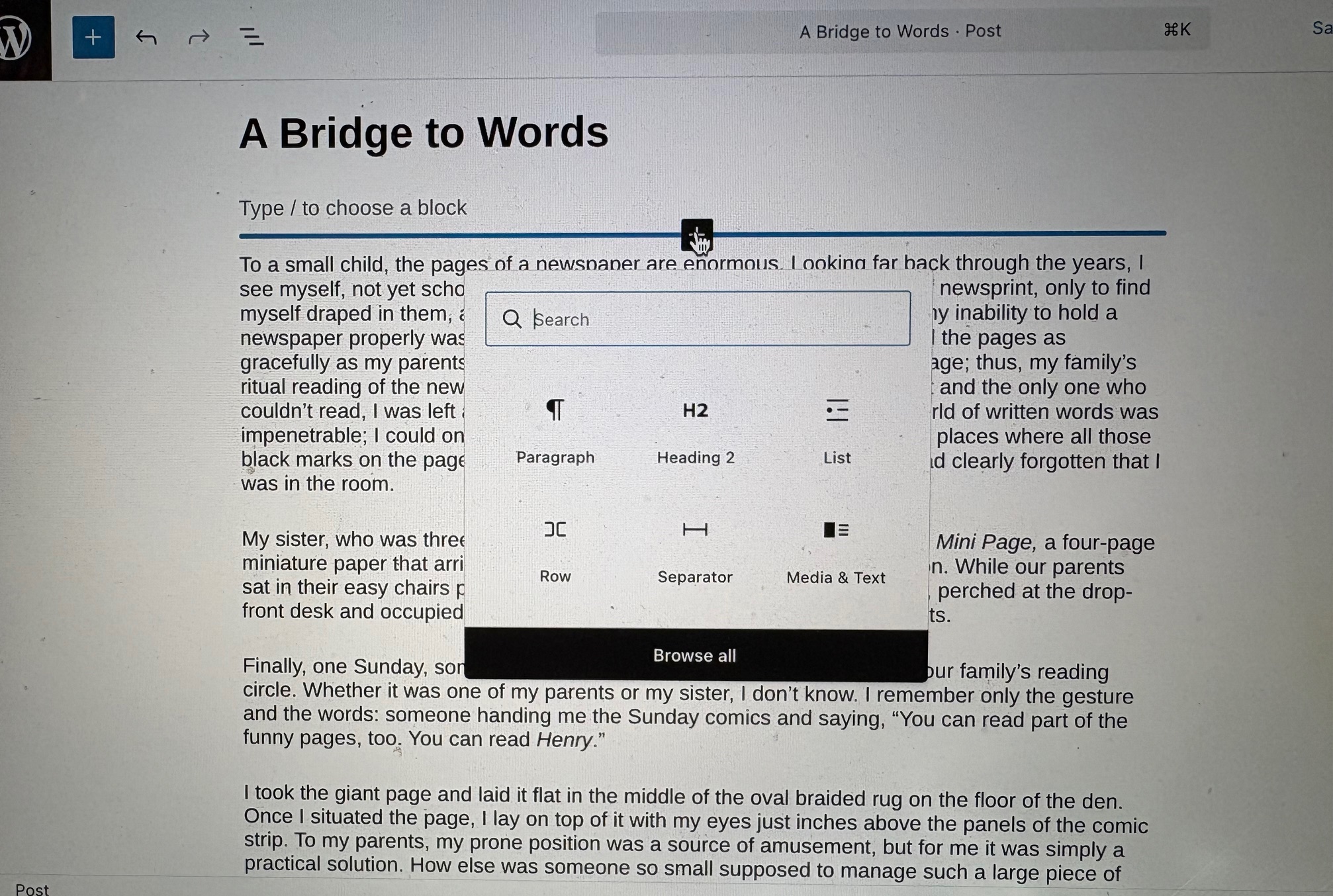
Log in to WordPress, and you will see a home page similar to the one below. Hover over +New in the upper left of the screen, and click Post. You can also add a post by scrolling down the left menu to Posts (beside the pushpin icon) and selecting Add Post.
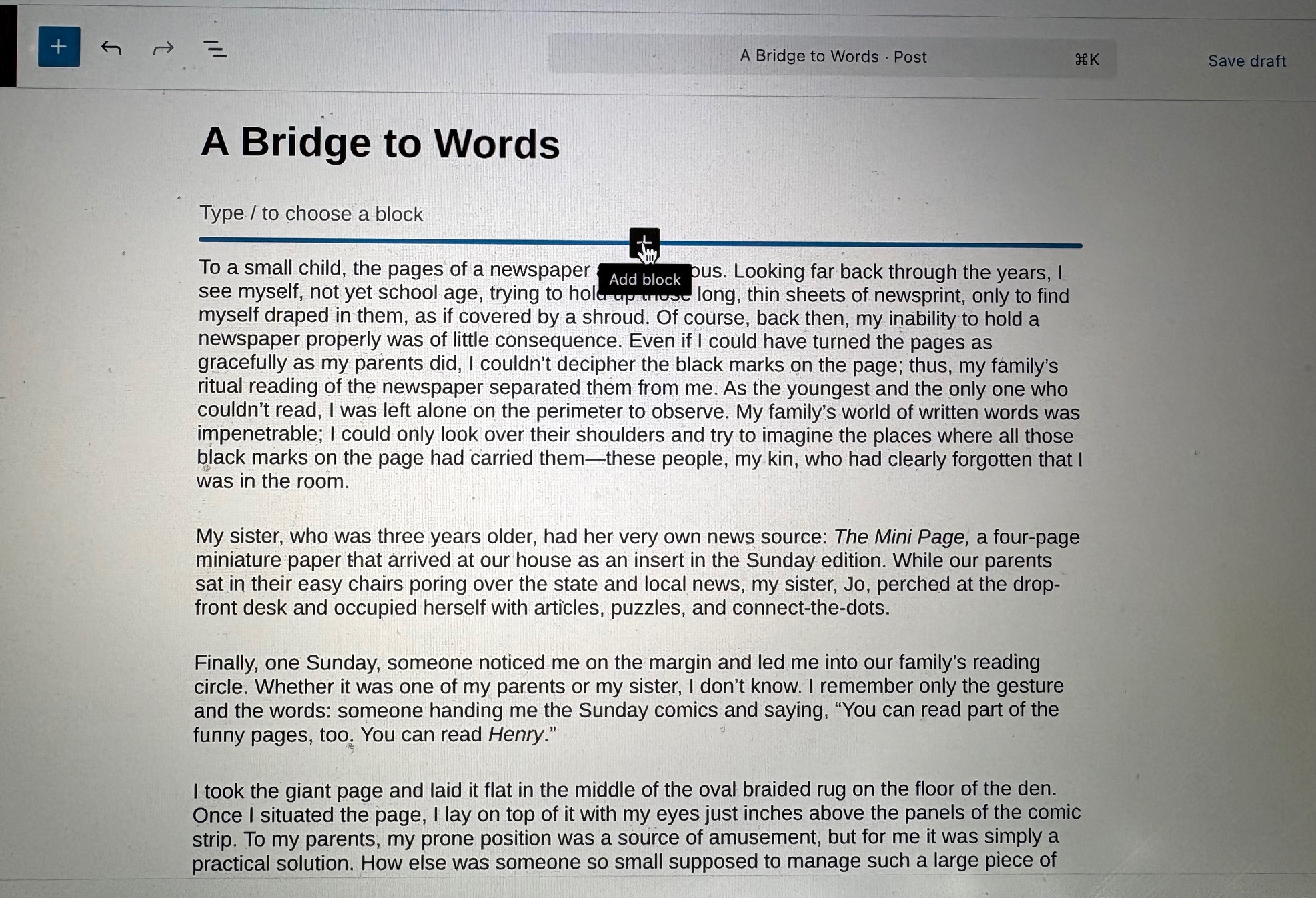
On the next page, type your literacy narrative title in the Add title line and hit return. Then copy and paste the text of your narrative from your MS Word file into the space below the title. On a PC, copy and paste with control + c, control + v; on a Mac, copy and paste with command + c, command + v.
After you have pasted the text, it will appear as single-spaced, block-style paragraphs. Do not indent. Your file posted to Blackboard should follow MLA formatting guidelines, including paragraph indentations, but WordPress posts are easier to manage if you keep the default paragraph settings. To add your required image between the title and the first paragraph, hover below the title, and a + will appear.
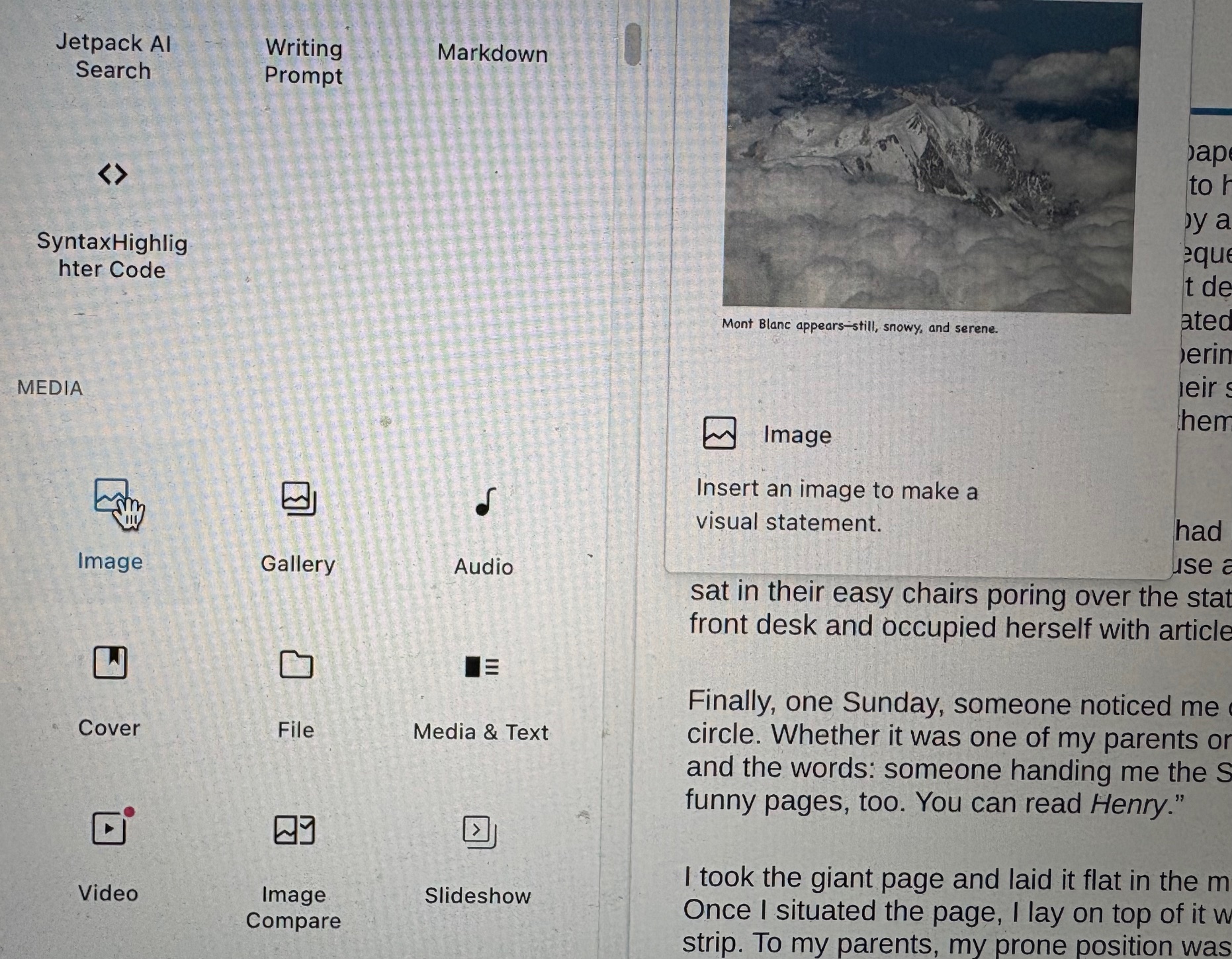
Click the +, and a menu will pop up with various options for add-ins. If Image is not among them, click Browse all.
Scroll down, and under the heading Media, click Image.
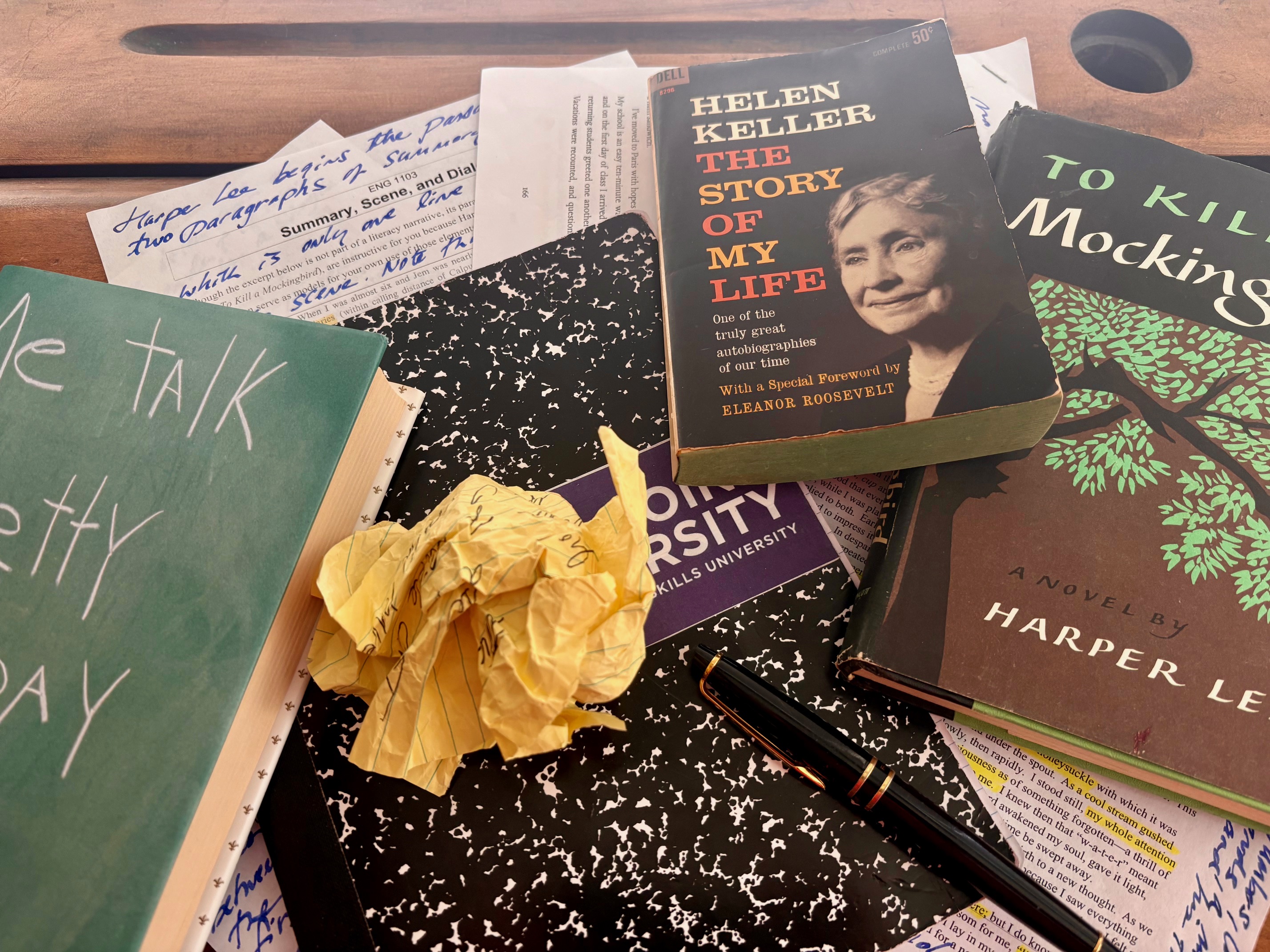
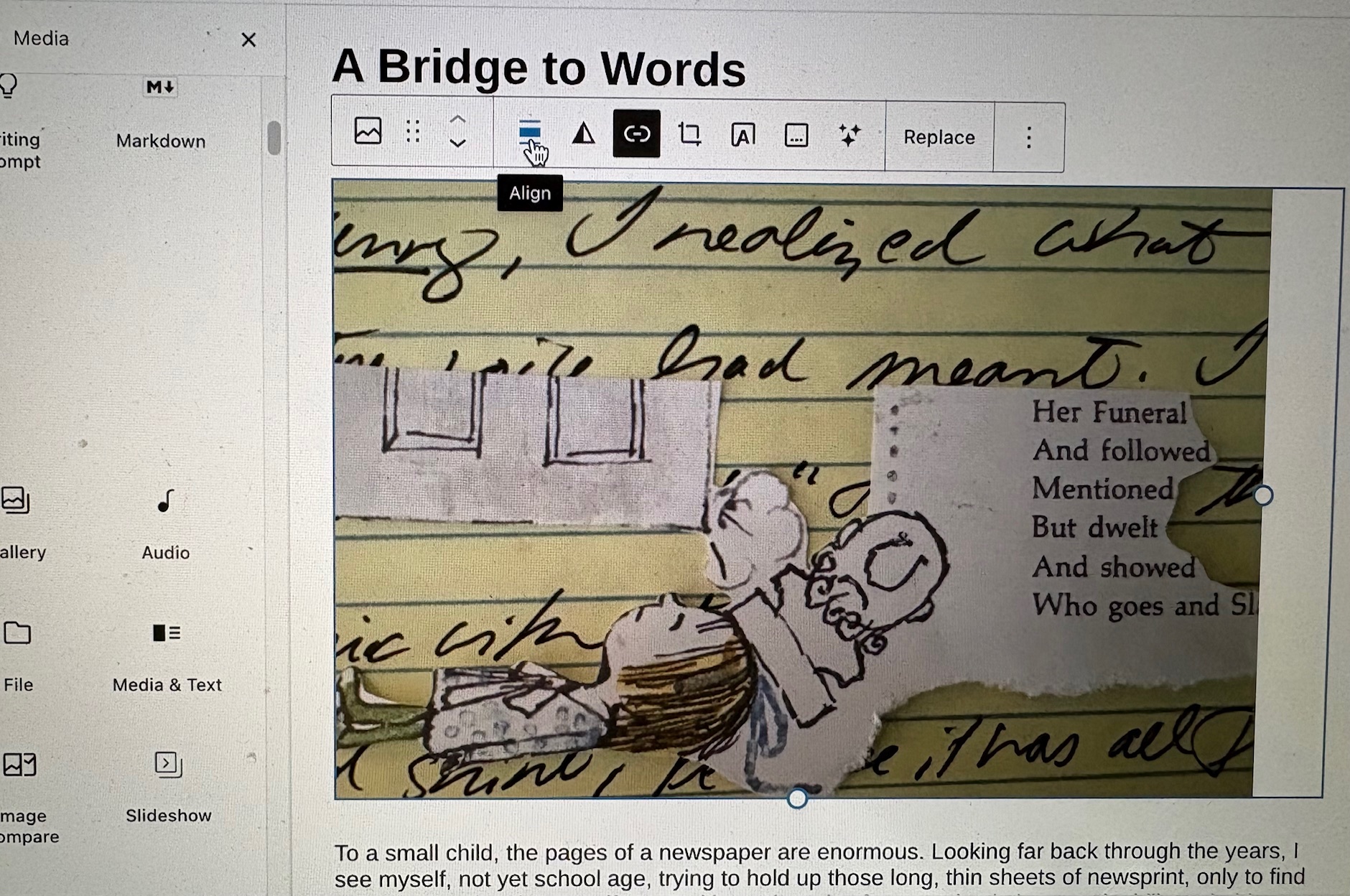
After you select Image, click Upload to add your picture. Do not post an AI-generated image or a stock photo from the Web. The image in your blog post should be a picture you took yourself that documents part of your writing process away from the screen. Note that the blog image you see below, and in Monday’s post, is a collage that includes snippets of my handwritten draft. Your image may be of your writing alone, or it may include other elements, as mine does.
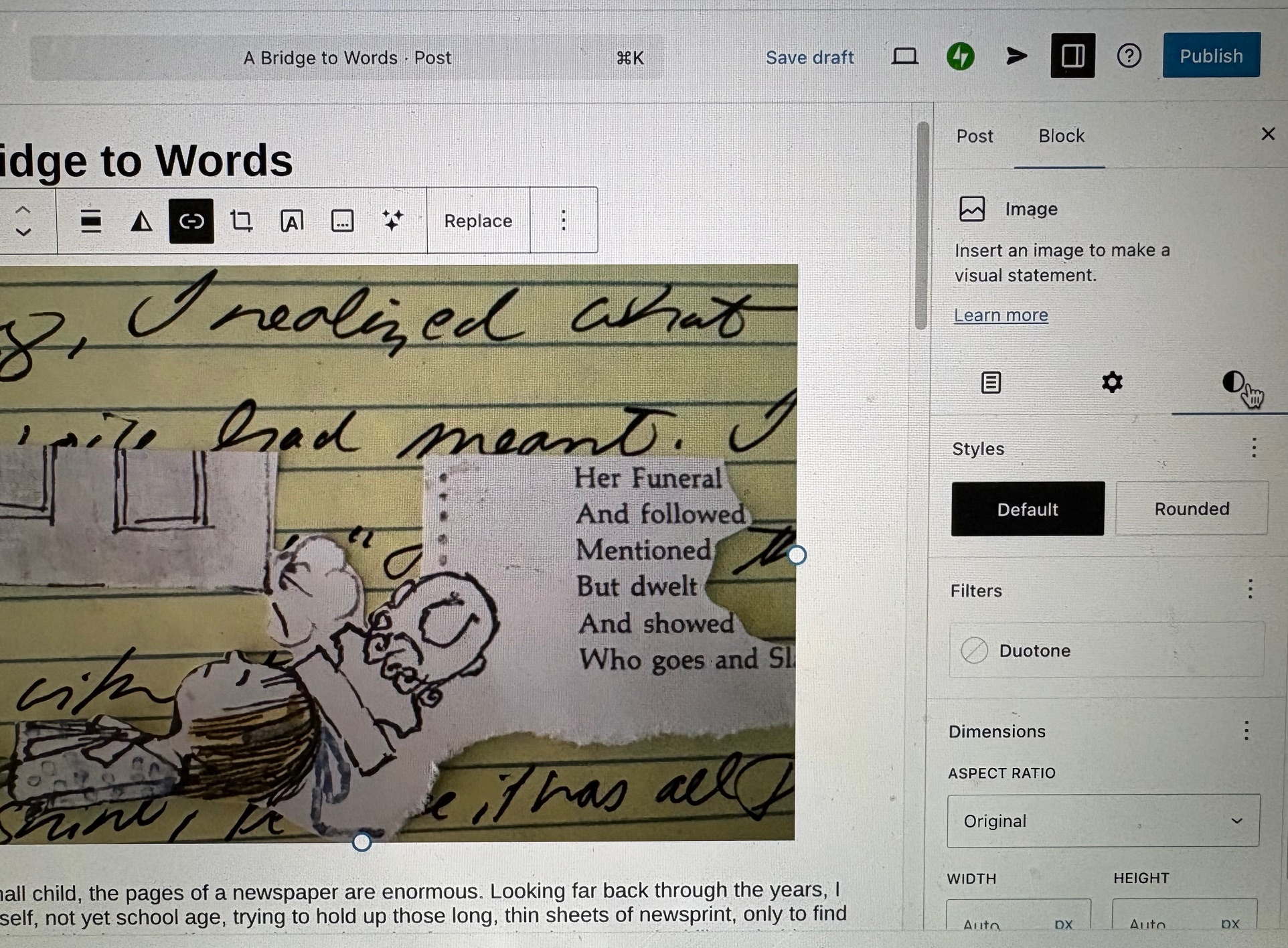
Your image should now be centered on the page. If it isn’t, you can use the Align feature (shown above) to center it. If you would like the picture to be rounded, click on the picture, then click the half-black, half-white circle on the right (shown below). Then select the Rounded option.
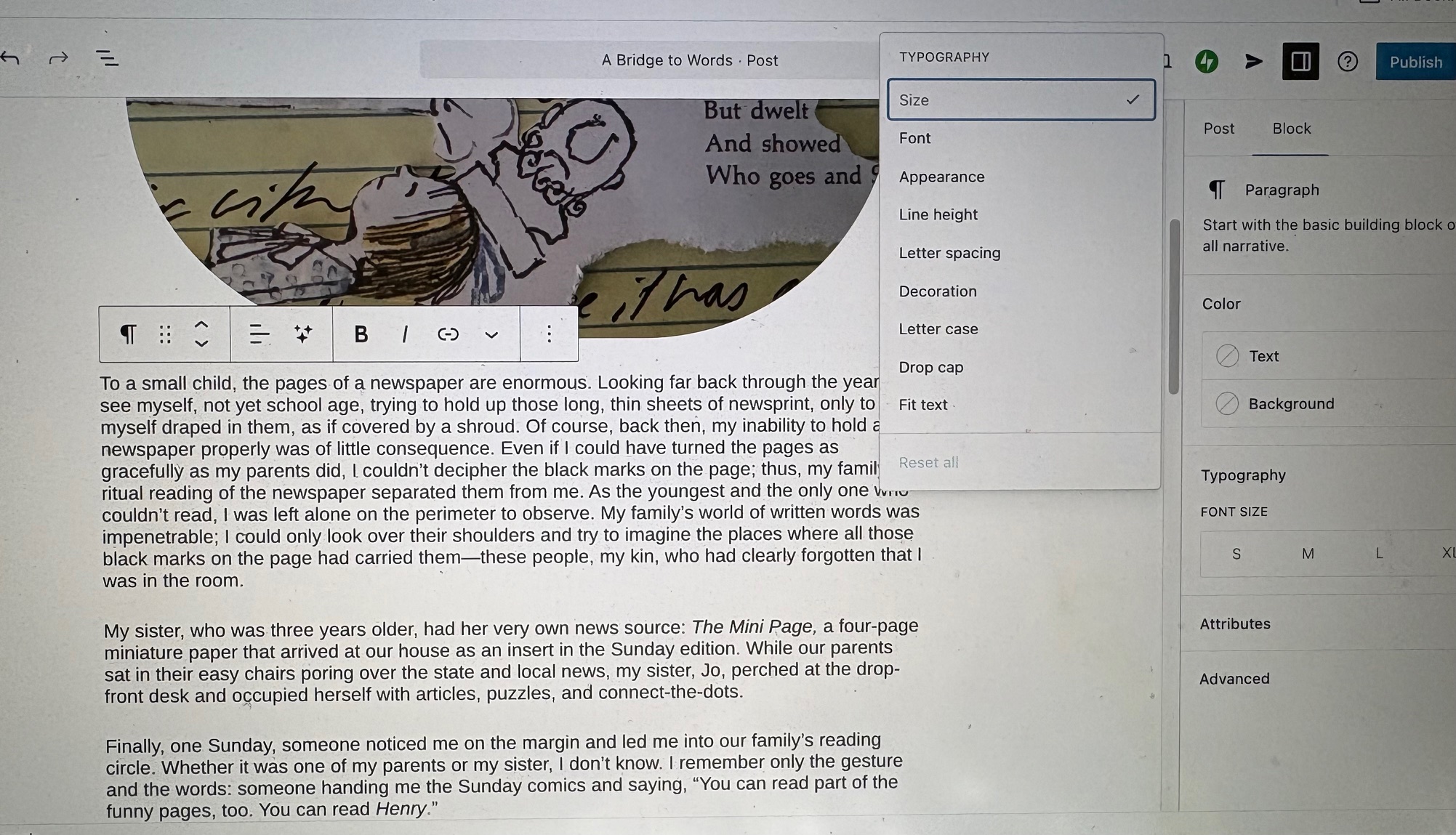
Optional: To make the first letter of the first word of your literacy narrative a drop cap (or monogram), place the cursor on the first paragraph, and click Topography in the menu on the right (see the image below).
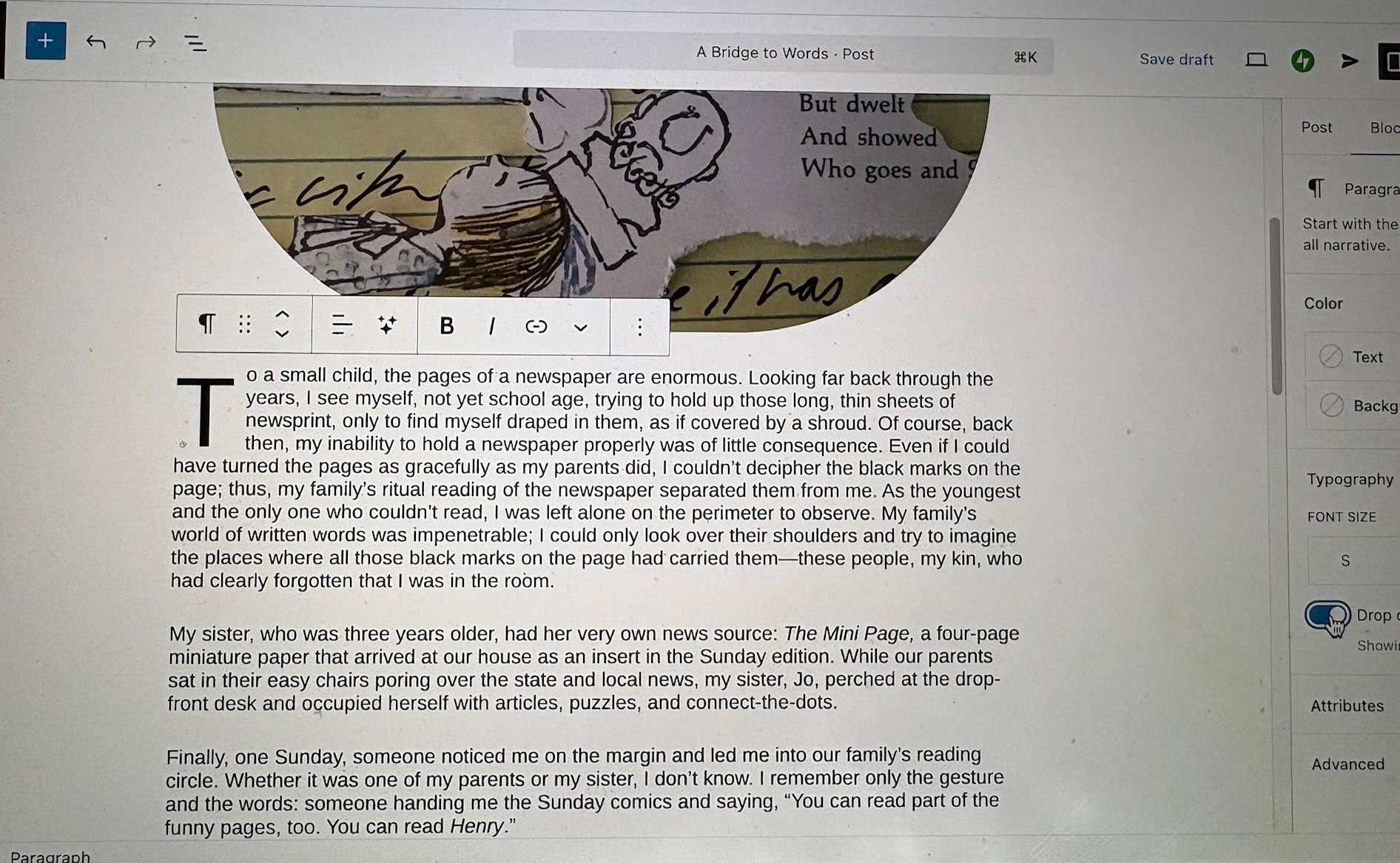
In the pull-down menu, click Drop cap, and a toggle switch will appear (see below). Click the toggle switch, and you will have a drop cap at the beginning of your narrative.
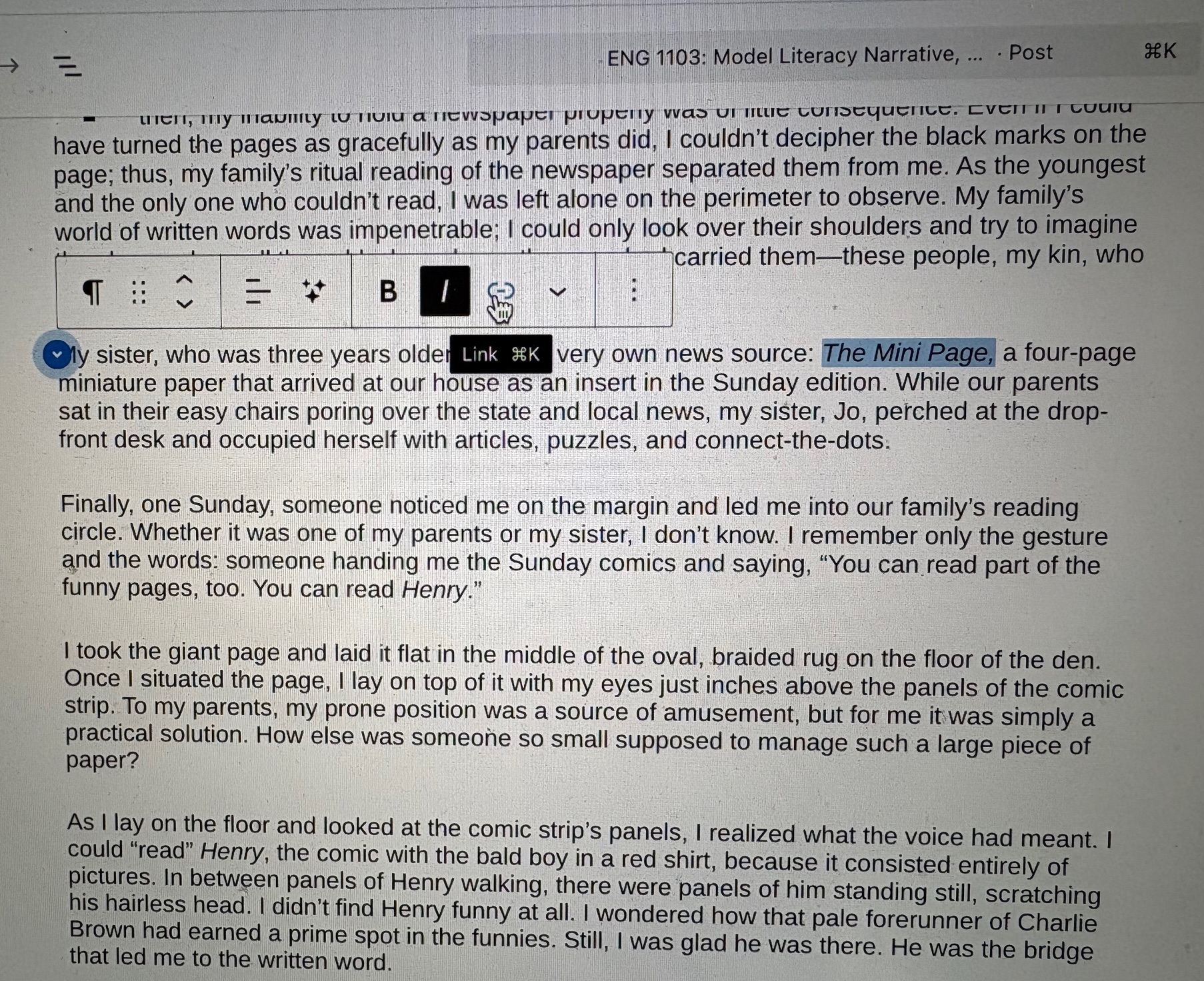
To add the required embedded link, open a new tab and go to the page you want to link to your post. Copy the address and return to the draft of your blog post. Highlight the word or phrase where you want to embed the link, and a link option will appear (see below).
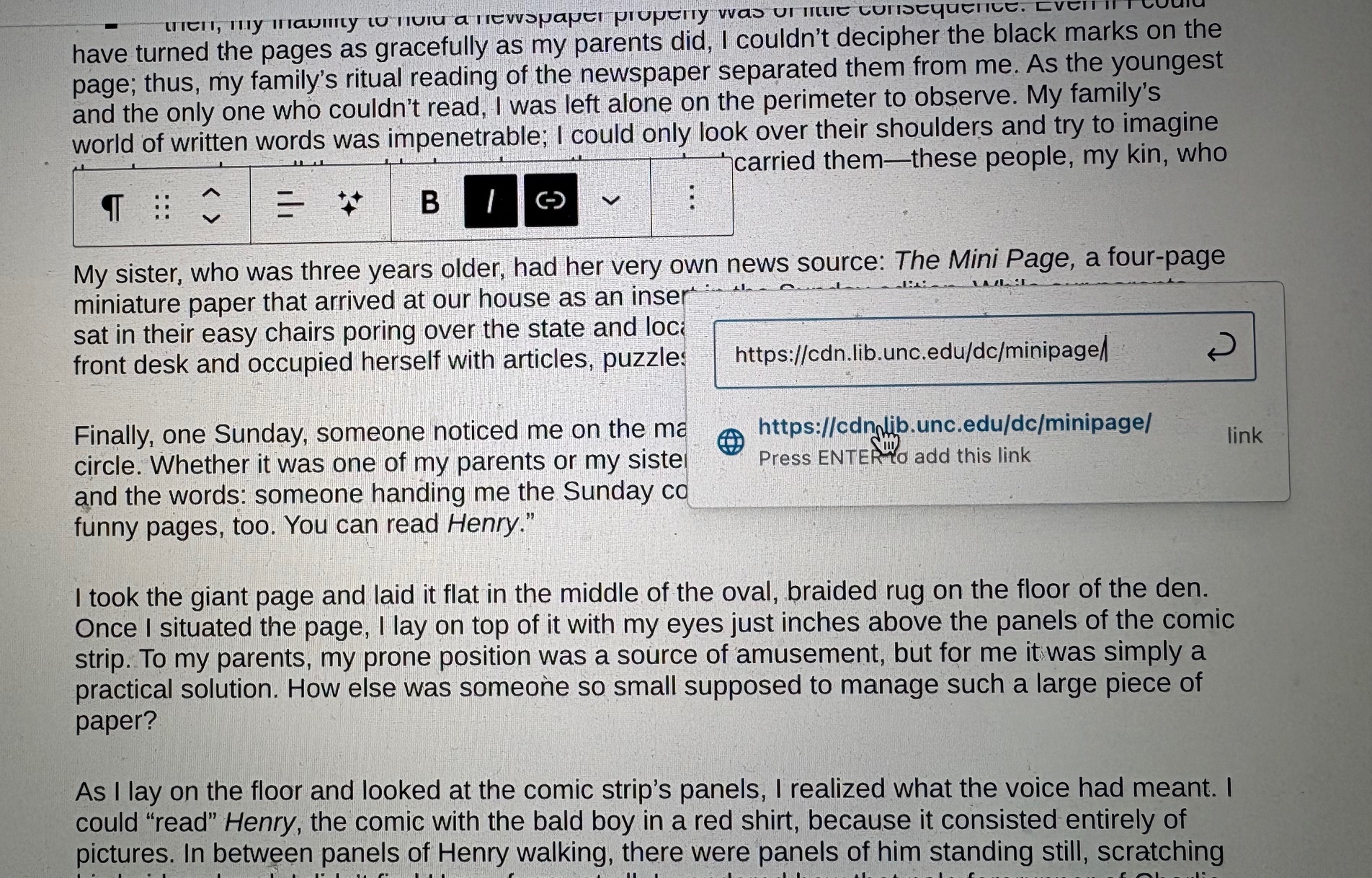
Click the link icon, and a box will appear (see below).
Paste the address into the box, hit enter, or return, and the link will be embedded.
Save your draft (by clicking Save draft in blue in the upper right). Once you have finalized your post, click Publish. After you have published a post, you can still make changes. To do that, simply return to your dashboard, scroll down to Posts, click All Posts, then click edit under the post you want to edit (see below).
Preparing for Your In-Class Reflection
Directions
To comply with the requirements for your reflection assignment, you will need to complete the planning exercise that follows. In class, you will not be permitted to refer to this blog post or any other online resources. You will need to have all the necessary citation information written longhand in your journal.
Review the pieces of writing we have examined in class, and choose a phrase or sentence from one that is pertinent to your own literacy narrative. The passage you choose may be one that reminded you of your experience with reading, writing, or learning a second language, or it may be a turn of phrase that inspired you to use a similar rhetorical device.
After you have chosen a passage, compose a signal phrase in your journal to introduce the quotation. (See the examples below.) Many academic writing assignments, including most that follow MLA style, require a signal phrase. A quotation that lacks one is considered a dropped quotation.
Follow your signal phrase with the quotation, and follow the quote with an MLA-style parenthetical citation. (See the examples below.)
Below your sentence, write the MLA-style works cited entry for the reading you quoted. (See the examples below.)
Sample Quotations with Signal Phrases and Parenthetical Citations
David Sedaris’s hyperbolic description of his classmate’s “front teeth the size of tombstones” (168) led me to seek moments when figurative language would enliven my own narrative.
Helen Keller’s observation that she did “not remember” (par. 8) all the words she learned that day reminded me that gaps in my memory could figure in my story.
The author’s hyperbolic description of his classmate’s “front teeth the size of tombstones” (Sedaris 168) led me to seek moments when figurative language would enliven my own narrative.
Her observation that she did “not remember” (Keller, par. 8) all the words she learned that day reminded me that gaps in my memory could figure in my story.
The third and fourth examples include the author’s last name in the parenthetical citation because the author is not named in the sentence. Note that no comma is included before a page number in an MLA parenthetical citation, but a comma does precede the abbreviation for paragraph (par.).
If you quote “Me Talk Pretty One Day,” cite it as if you are quoting a page in a book because your handout is a photographic image of the essay from David Sedaris’s collection Me Talk Pretty One Day. (See the examples above.)
If you quote a line from any class handout other than “Me Talk Pretty One Day,” include the paragraph number in the parenthetical citation. For your works cited entry, use the MLA format for a course handout. (See the examples below.)
Sample Works Cited Entries
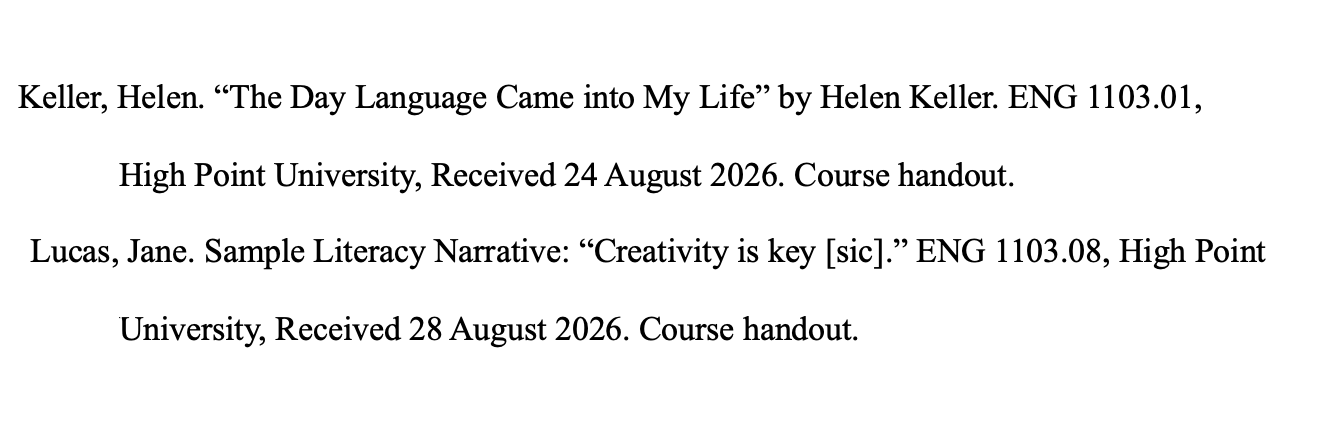
Keller, Helen. “The Day Language Came into My Life” by Helen Keller. ENG 1103.01 (or 08), High Point University, Received 24 August 2026. Course handout.
Lucas, Jane. Sample Literacy Narrative: “A Bridge to Words.” ENG 1103.01 (or 08), High Point University, Received 4 September 2026. Course handout.
Lucas, Jane. Sample Literacy Narrative: “Creativity is key [sic].” ENG 1103.01 (or 08), High Point University, Received 28 August 2026. Course handout.
Lucas, Jane. Sample Literacy Narrative: “The Journey of the Greatest Story.” ENG 1103.01 (or 08), High Point University, Received 31 August 2026. Course handout.
Lucas, Jane. “Summary, Scene, and Dialogue”: An Excerpt from To Kill a Mockingbird by Harper Lee. ENG 1103.01 (or 08), High Point University, Received 26 August 2026. Course handout.
Sedaris, David. “Me Talk Pretty One Day.” Me Talk Pretty One Day. Little, Brown, 2000, pp. 166-73.
Your own works cited entry will not be a bullet point but will have a hanging indent (the first line will be flush left and the second line and any additional lines will be indented five spaces or one-half inch.
You will not include a section number in parentheses. You will simply include your section number. See the examples below.
The word sic, Latin for “thus,” appears in brackets above to indicate the preceding error. Key should be capitalized.
Quiz Follow-Up
Rather than listing the answers to the questions on Monday’s quiz, I have followed each question below with a note regarding where to find the answer. By finding the answers yourself, you will learn more than you would from simply reading them in a list.
What is the term for the kind of narrator the writer employs in “A Bridge to Words”? If you cannot remember the term, describe the nature of the narration. See the September 2 class handout and the September 3 class notes.
Record one concrete detail you recall from “A Bridge to Words.” (What did you see or hear in your mind as you read the words on the page?) See “A Bridge to Words,” paragraphs one through eight.
Record a second concrete detail you remember from “A Bridge to Words.” See “A Bridge to Words,” paragraphs one through eight.
Your quiz also included a bonus opportunity. Possible answers for that bonus are found in the class notes for September 4.
Next Up
In class on Wednesday, you will compose your reflective essay focusing on the process of planning, drafting, and revising your literacy narrative. If you are still in the process of completing your essay on Wednesday (since you have until Friday morning’s hard deadline to post it without a late penalty), your reflection will address your work in progress. Follow the guidelines included above to ensure you will be prepared to complete all requirements for your reflection.
Hillaire Belloc’s “Rebecca,” illustrated by Alice and Martin Provensen
This morning’s blog post features “A Bridge to Words,” my model literacy narrative that you read and annotated for today’s class. After the Scrabble debriefing and our study of “A Bridge to Words,” I will lead you step by step through the process of posting your literacy narrative to Blackboard and WordPress. Tomorrow’s post entry will include step-by-step directions with screenshots.
The image above meets the guidelines for the picture you are required to include in your blog post: one that documents part of your writing process away from the screen. That image may include notes in your journal or lines of your handwritten draft. The image should not include your laptop, tablet, or phone.
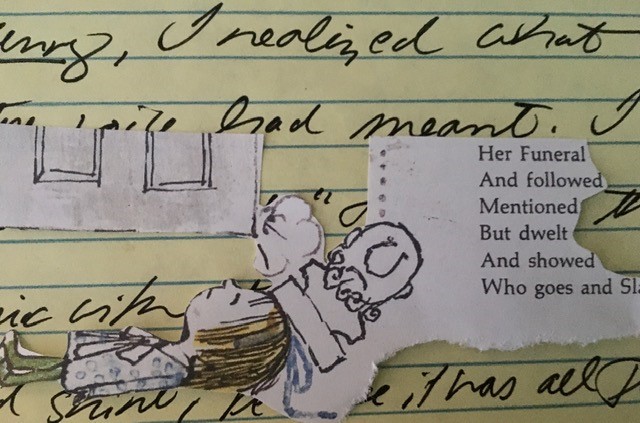
In the picture, a page of my draft serves as the background for a collage with a photocopied illustration of Rebecca, the title character of Hillaire Belloc’s “Rebecca,” and lines of the poem in the foreground. (Note that using a fragment of the illustration for educational purposes constitutes fair use.) The image could simply be the lines of my draft, but I wanted to include Rebecca as well since her poem figures prominently in my narrative.
A Bridge to Words
To a small child, the pages of a newspaper are enormous. Looking far back through the years, I see myself, not yet school age, trying to hold up those long, thin sheets of newsprint, only to find myself draped in them, as if covered by a shroud. Of course, back then, my inability to hold a newspaper properly was of little consequence. Even if I could have turned the pages as gracefully as my parents did, I couldn’t decipher the black marks on the page; thus, my family’s ritual reading of the newspaper separated them from me. As the youngest and the only one who couldn’t read, I was left alone on the perimeter to observe. My family’s world of written words was impenetrable; I could only look over their shoulders and try to imagine the places where all those black marks on the page had carried them—these people, my kin, who had clearly forgotten that I was in the room.
My sister, who was three years older, had her very own news source: The Mini Page, a four-page miniature paper that arrived at our house as an insert in the Sunday edition. While our parents sat in their easy chairs poring over the state and local news, my sister, Jo, perched at the drop-front desk and occupied herself with articles, puzzles, and connect-the-dots.
Finally, one Sunday, someone noticed me on the margin and led me into our family’s reading circle. Whether it was one of my parents or my sister, I don’t know. I remember only the gesture and the words: someone handing me the Sunday comics and saying, “You can read part of the funny pages, too. You can read Henry.”
I took the giant page and laid it flat in the middle of the oval, braided rug on the floor of the den. Once I situated the page, I lay on top of it with my eyes just inches above the panels of the comic strip. To my parents, my prone position was a source of amusement, but for me it was simply a practical solution. How else was someone so small supposed to manage such a large piece of paper?
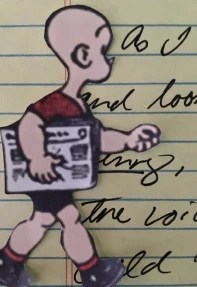
As I lay on the floor and looked at the comic strip’s panels, I realized what the voice had meant. I could “read” Henry, the comic with the bald boy in a red shirt, because it consisted entirely of pictures. In between panels of Henry walking, there were panels of him standing still, scratching his hairless head. I didn’t find Henry funny at all. I wondered how that pale forerunner of Charlie Brown had earned a prime spot in the funnies. Still, I was glad he was there. He was the bridge that led me to the written word.
Reading the wordless comic strip Henry for the first time was the beginning of a years-long habit of stretching out on the floor with newspapers and large books—not thick ones but ones that were tall and wide, among them one of my childhood favorites: The Golden Book of Fun and Nonsense. My sister and I spent hours lying on our bedroom floor, the pink shag carpet tickling our legs as we delighted in the antics of Rebecca, the mischievous title character of one of the poems.
Carl Thomas Anderson’s comic strip character Henry
“Rebecca”—which my sister read to me before I could read it myself—introduced me to the word abhors, the very sound of which appealed to me. Sometimes before Jo had finished reading the opening lines, my uncontrollable giggles collided with her perfect mock-serious delivery. As the last word in the first line, abhors serves as a lead-in to an enjambment: the continuation of a sentence or clause in a line break. It would be years before I learned the term “enjambment,” but I was immediately swept away by its effect in the opening lines: “A trick that everyone abhors/ In Little Girls is Slamming Doors” (Belloc 61). The first line lured me into the second one, and so on and so on. I was drawn both to the individual word abhors—with its side-by-side b and h, rare in English—and the way the words joined, like links in a chain, to yank me giggling through Rebecca’s cautionary tale:
It happened that a marble bust Of Abraham was standing just Above the door this little lamb Had carefully prepared to slam, And down it came! It knocked her flat! It laid her out! She looked like that.
Her funeral sermon (which was long And followed by a sacred song) Mentioned her virtues, it is true, But dwelt upon her vices too, And showed the dreadful end of one Who goes and slams the door for fun. (61)
Why these particular early memories visit me now, I don’t know. Perhaps rereading Art Spiegelman’s graphic memoir Maus with my students has roused the wordless Henry and the word-filled Golden Book of Fun and Nonsense from the corner of my brain where they’ve slumbered. The former wakes and stretches out in my mind as a bridge to the latter: a spot in the world of words I’ve inhabited ever since.
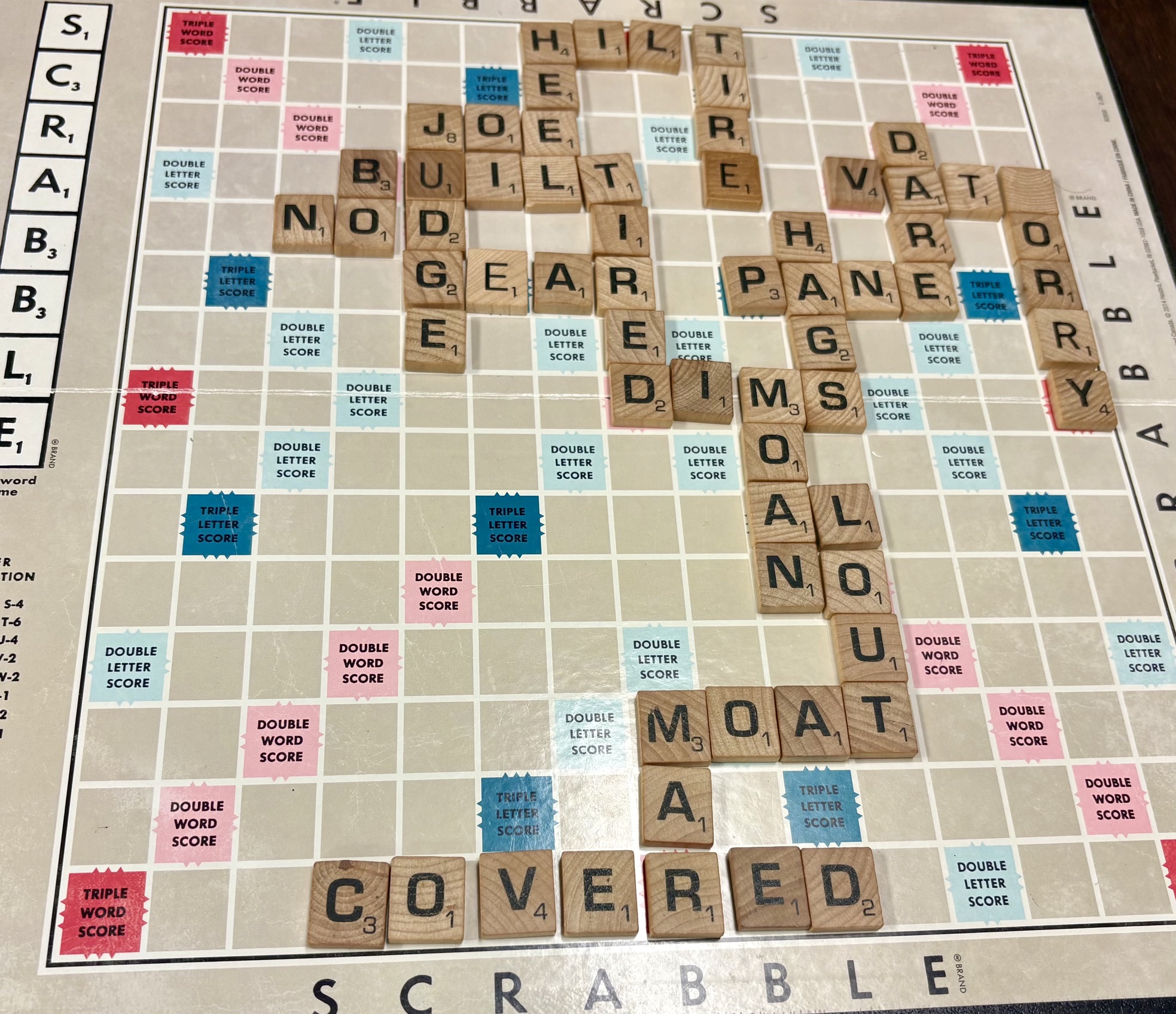
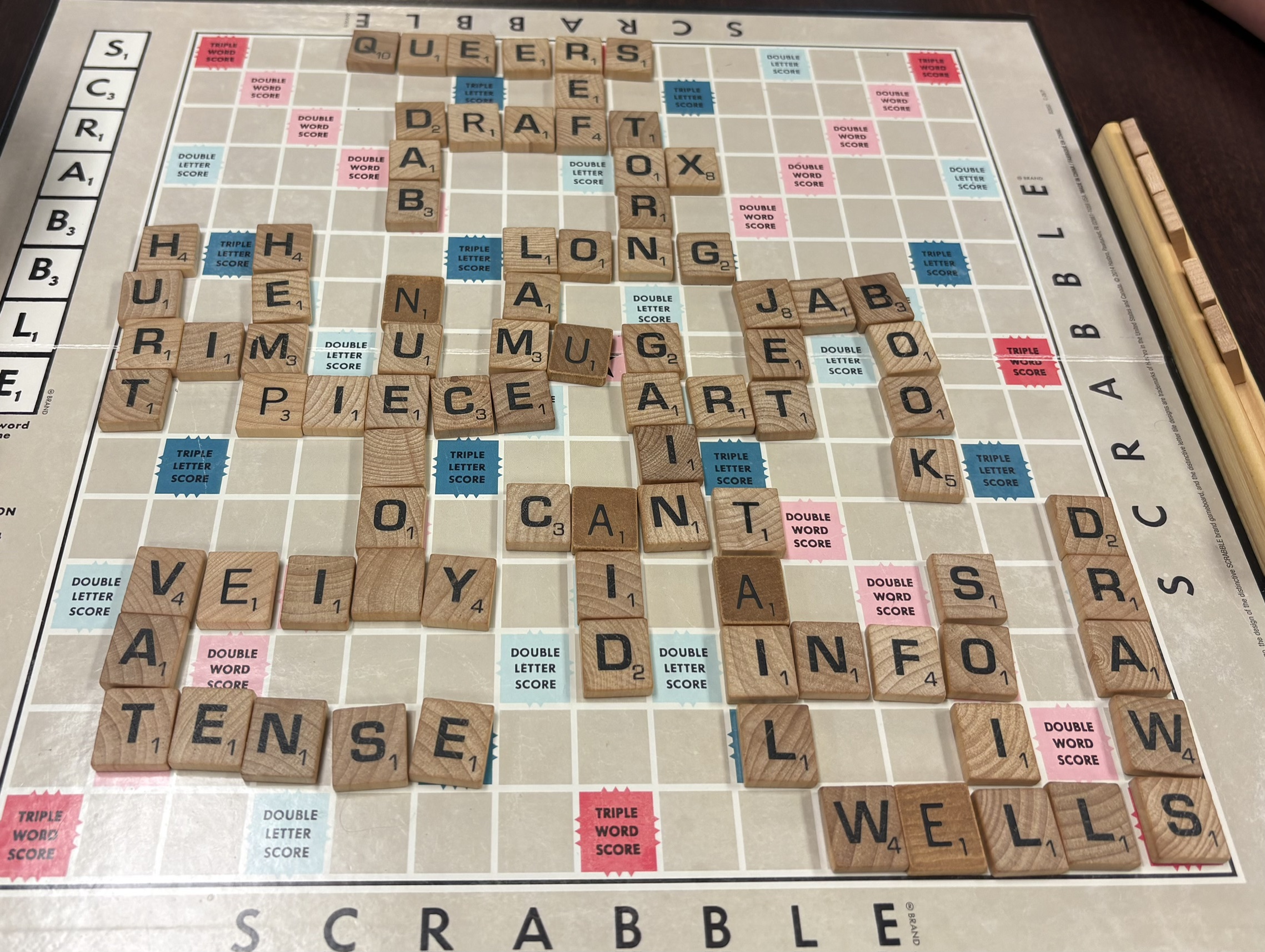
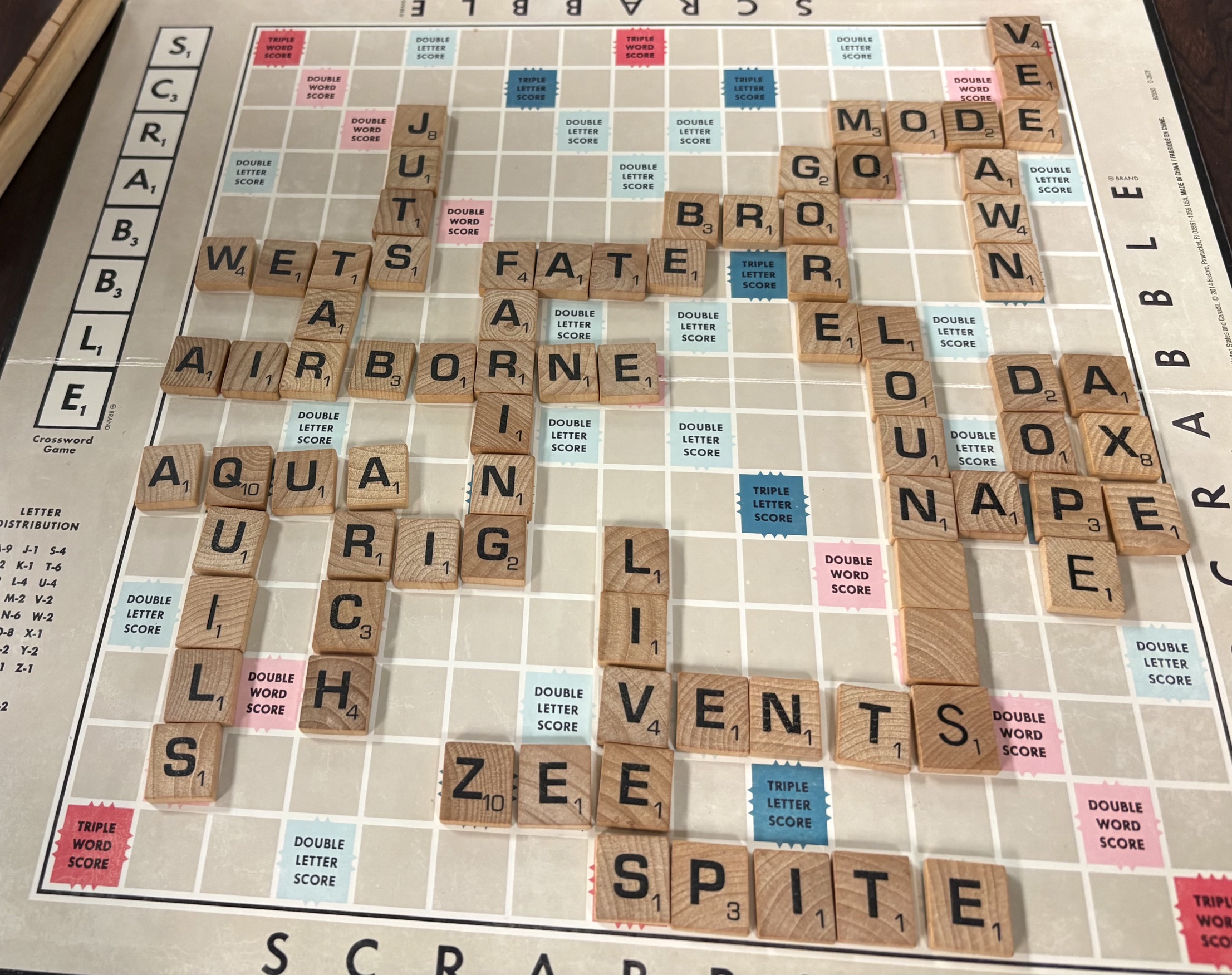
Today’s Scrabble debriefing continues with a study of some of the plays in the games pictured below. Answers to the questions that I pose about those plays are included near the end of the post.
Assessing S
On the board pictured below, the first team opened the game with the play of dims for fourteen points. Even though the s increases the score, playing it there on the first turn may not have been advisable. Why?
You Can’t Do That
In the game below, a team played the verb cant: to tilt or slant. Despite the word’s playability, the group lost five points because of the presentation of the word on the score sheet. What lost the group five points?
When You Draw a Blank (or Two)
On the board pictured below, a team played l after the e in gore, to form el (an elevated train and the two-letter spelling of the letter l), and below the l used blanks for g and e, along with o, u, n, and s to play lounges. Although the other two u‘s on the board (in juts and aqua) had not been played, you may still question the decision to use both blanks and one of the u‘s in a single turn. Why was el and lounges a well-advised play?
Answers
Assessing S: Adding s to dims increases the score by only two points. In the team’s second play or another later play, they could likely raise their score by more than two points by using the s to form two or more words through parallel and/or perpendicular play. Keep in mind that the first play of the game is the only one in which you don’t have the opportunity to form more than one word. If playing an s enables you to form a five-letter word with a consonant–especially a high value one–that opportunity would warrant using an s in the first play. For example, if a team had the letters to spell dimes in the first play, playing the d on the double-letter square would increase the score from fourteen to twenty. Even better, if a team had the letters to spell zones in the first play, playing the z on the double-letter square would increase the score from twenty-six to forty-eight.
You Can’t Do That: Although cant is playable, the team that played it lost points because the scorekeeper recorded the word can’t, the contraction of cannot, on the assignment sheet. Words with apostrophes are not playable in Scrabble, and recording one on the score sheet and subsequently assigning it a point value it cannot have results in a penalty.
When You Draw a Blank (or Two): At first glance, playing both blanks and one of the u‘s in a single turn might seem like a bad idea; however, by playing the two blanks (as g and e) with l, o, u, n, and s the team used all seven of its tiles in one turn which gave them a bonus of fifty points. With ten for lounges for a double-word play and two for el, the team scored a total of sixty-two points. Note that the misspelling of quills went unchallenged, resulting in a five-point loss.
Bonus Assignment Opportunity
Students who correctly respond to the AI misstep question below will earn a bonus assignment credit.
Information Versus Knowledge
As a model for your own ethical use of generative AI for English 1103, the August 25 blog post features screenshots of a conversation in which I developed ideas for my literacy narrative with the help of ChatGPT. Now that you have read my literacy narrative, it should be apparent that despite the AI assistant’s wealth of information, one of its answers revealed a lack of knowledge about the comic strip Henry. What did the AI assistant not know? (What did it say about Henry that was false?)
Directions for Finding and Submitting Your Answer
To find the AI assistant’s error, review the descriptions of Henry in “A Bridge to Words,” then review the AI assistant’s words in the screenshots in the August 25 blog post.
Compose a response of one or more complete sentences that identifies and briefly explains the error.
Post your comment as a reply to this blog post by 7:30 a.m. on Friday, September 11.
To post your comment, click the title of the post, “ENG 1103: A Bridge to Words . . . ,” then scroll down to the bottom of the post. There you will see the image of an airmail envelope with a white rectangular box for your comment. Type your comment in the box and hit return. Voila! You have submitted your answer. Good luck! I will make the comments visible before class on Monday, September 14.
Next Up
In class on Wednesday, you will compose a reflective essay focusing on the process of planning, drafting, and revising your literacy narrative. If you are still completing your essay on Wednesday (since you have until Friday morning’s hard deadline to post it), your reflection will address your work in progress. To ensure that you are prepared to meet all the requirements for your reflection, carefully read the directions for preparing, which will be outlined in tomorrow’s blog post.