Mike Caulfield, author of Check, Please! and Director of Blended and Networked Learning at Washington State University. https://webliteracy.pressbooks.com/ front-matter/updated-resources-for-2021/.
At the beginning of class on Wednesday, August 30, I will collect your worksheets for Lesson One of the Check, Please! starter course. My sample version of the assignment appears below, as well as on your worksheet and on Blackboard.
Sample Check, Please! Assignment
Check, Please! Lesson One Assignment
In the first lesson of the Check, Please! Starter Course, Mike Caulfield, author of the course and Director of Blended and Networked Learning at Washington State University, introduces the four-step SIFT approach to determining the reliability of a source: (1) “Stop,” (2) “Investigate,” (3) “Find better coverage,” and (4) “Trace claims, quotes, and media to the original context.”
One of the most useful practices presented in lesson one is what the author terms the “Wikipedia Trick.” Deleting everything that follows a website’s URL (including the slash), adding a space, typing “Wikipedia,” and hitting “enter” will yield the site’s Wikipedia page. The Wikipedia entry that appears at the top of the screen may indicate the source’s reliability or lack thereof.
The most memorable segment of lesson one is the short, riveting video “The Miseducation of Dylann Roof,” which begins with the narrator asking the question, “How does a child become a killer?” Produced by the Southern Poverty Law Center, it documents how algorithms can lead unskilled web searchers down paths of disinformation. In the worst cases, such as Roof’s, algorithms can lead searchers to the extremist propaganda of radical conspiracy theorists.
As a model for your own literacy narrative, today in class will examine “Me Talk Pretty One Day,” originally published in Esquire magazine and later as the title essay in David Sedaris’s 2000 essay collection.
To read more of Sedaris’s essays, see the list of links under the heading Writing and Radio on his website.
Next Up
As you begin work on your own literacy narrative on Wednesday, study Sedaris’s essay as a model, and consider how he uses the following:
Shifts from summary to scene and vice versa
Figurative language
Hyperbole
Vivid detail
Look for opportunities to use those elements in your own essay.
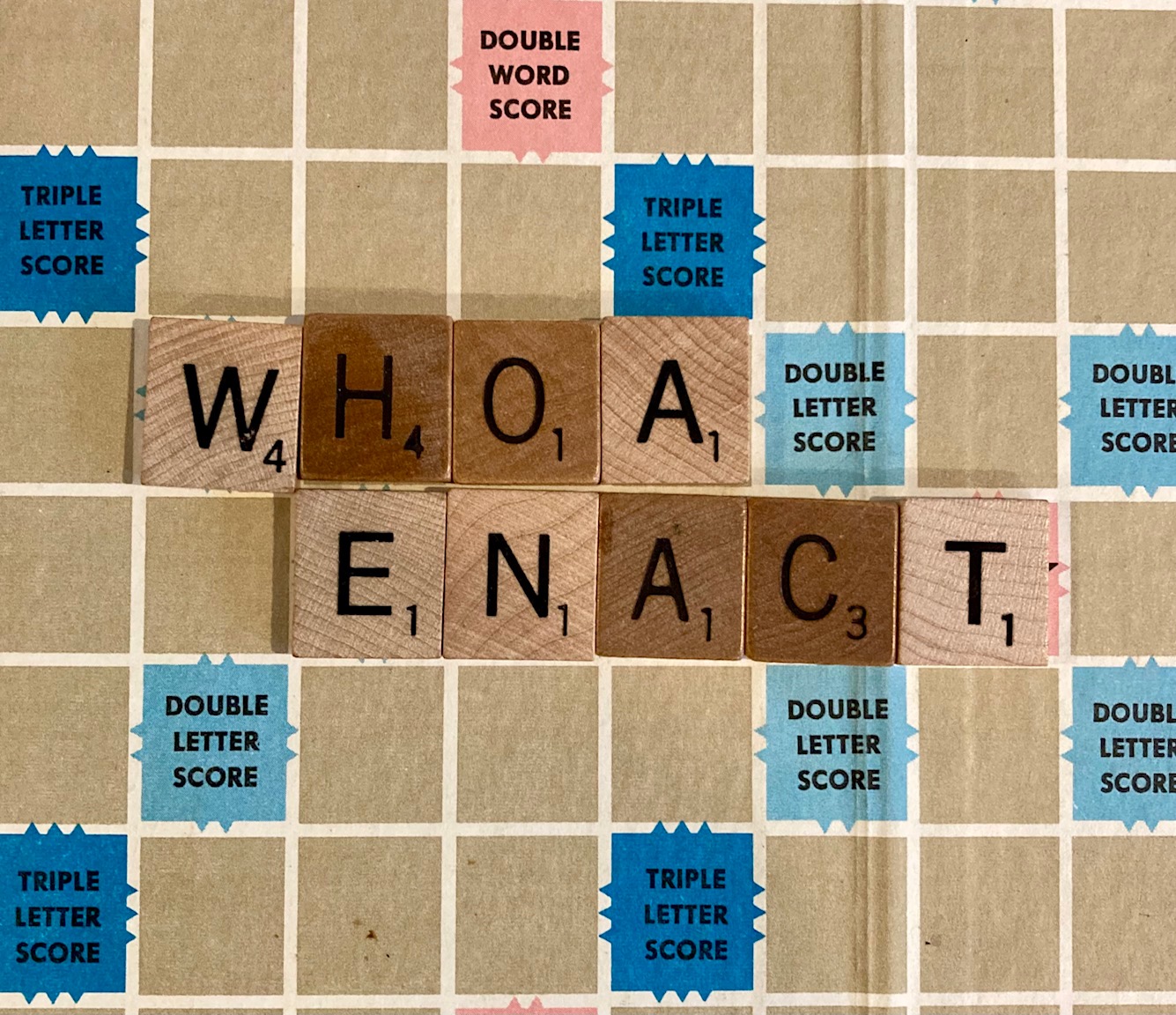
Parallel play increases your score through the points you earn by spelling more than one word in a single turn. In the first play of the hypothetical game pictured above, the first player or team would score sixteen points by spelling enact with the t on the center double word square. With the second turn, the other player or team could take advantage of the opportunity for parallel play. If the team knew that aa is a type of lava, they could earn twenty-four points with four words: whoa, he, on, and aa.
Aa is one of sixteen playable two-letter words beginning with a. Learning these two-letter words, as well as the others that follow in the alphabet, will enable you to see more options for play and increase the number of points you earn in a single turn.
aa: a type of stony, rough lava
ab: an abdominal muscle
ad: an advertisement
ae: one
ag: agriculture
ah: an exclamation
ai: a three-toed sloth
al: a type of East Indian tree
am: the first-person singular present form of to be
an: an indefinite article
ar: the letter r
as: similar to
at: in the position of
aw: an expression of sadness or protest
ay: a vote in the affirmative (also aye)
Important Note about Challenges
The game rules inside the Scrabble box top do not specify that a player or team that challenges a playable word will lose a turn, but David Bukszpan’s book Is That a Word? notes that the player or team does lose a turn. According to Bukszpan:
“[I]f a word is challenged and found not to be legal (called a phony in Scrabble parlance), the player that set it down loses a turn. Conversely, if a challenged word is found to be playable, the challenger loses his turn” (19).
Work Cited
Bukszapan, David. Is That a Word?: From AA to ZZZ, the Weird and Wonderful Language of SCRABBLE. Chronicle, 2012. p.19.
Coming Soon
At the beginning of class on Wednesday, August 30, I will collect your completed worksheet for Lesson One of the Check, Please! starter course. If you were absent yesterday, Wednesday, August 23, when I distributed worksheets or you misplaced your copy, you can download and print one from Blackboard.
College writing offers you the opportunity to develop skills, such as supporting arguments with evidence, writing effective thesis statements, and using transitions well, but it also gives you the opportunity to develop habits. Successful college students develop certain habits of mind, a way of approaching learning that leads to success.
In 2011, the Council of Writing Program Administrators (CWPA), the National Council of Teachers of English (NCTE), and the National Writing Project (NWP) identified eight habits of mind that successful college students adopt.
In class on Monday, we began an exercise in written reflection focusing on four of the eight habits of mind. Later in class today, we will begin writing about the four that you did not address in your writing on Monday. The paragraphs that follow include the descriptions of the habits that you examined (and the ones you will examine today), as well as the questions that you answered in writing (and the ones you will answer in writing today).
Curiosity
Are you the kind of person who always wants to know more? This habit of mind will serve you well in courses in which your curiosity about issues, problems, people, or policies can form the backbone of a writing project.
WRITING ACTIVITY: What are you most curious to learn about? What experiences have you had in which your curiosity has led you to an interesting discovery or to more questions?
Openness
Some people are more open than others to new ideas and experiences and new ways of thinking about the world. Being open to other perspectives and positions can help you to frame sound arguments and counterarguments and solve other college writing challenges in thoughtful ways.
WRITING ACTIVITY: In the family or the part of the world in which you grew up, did people tend to be very open, not open at all, or somewhere in the middle? Thinking about your own level of open-mindedness, reflect on how much or how little your own attitude toward a quality like openness is the result of the attitudes of the people around you.
Engagement
Successful college writers are involved in their own learning process. Students who are engaged put effort into their classes, knowing that they’ll get something out of their classes—something other than a grade. They participate in their own learning by planning, seeking feedback when they need to, and communicating with peers and professors to create their own success. Write about a few of the ways you try (or plan to try) to be involved in your own learning. What does engagement look like to you?
WRITING ACTIVITY: Write about a few of the ways you try (or plan to try) to be involved in your own learning. What does engagement look like to you?
Creativity
You may be thinking that you have to be an artist, poet, or musician to display creativity. Not so. Scientists use creativity every day in coming up with ways to investigate questions in their field. Engineers and technicians approach problem solving in creative ways. Retail managers use creativity in displaying merchandise and motivating their employees.
WRITING ACTIVITY: Think about the field you plan to enter. What forms might creativity take in that field?
Persistence
You are probably used to juggling long-term and short-term commitments—both in school and in your everyday life. Paying attention to your commitments and being persistent enough to see them through, even when the commitments are challenging, are good indicators that you will be successful in college.
WRITING ACTIVITY: Describe a time when you faced and overcame an obstacle in an academic setting. What did you learn from that experience?
Responsibility
College will require you to be responsible in way you may not have had to be before. Two responsibilities you will face as an academic writer are to represent the ideas of others fairly and to give credit to writers whose ideas and language you borrow for your own purposes.
WRITING ACTIVITY: Why do you think academic responsibility is important? What kind of experience have you already had with this kind of responsibility?
Flexibility
Would your friends say you are the kind of person who can just “go with the flow”? Do you adapt easily to changing situations? If so, you will find college easier, especially college writing. When you find, for example, that you’ve written a draft that doesn’t address the right audience or that your peer review group doesn’t understand at all, you will be able to adapt. Being flexible enough to adapt to the demands of different writing projects is an important habit of mind.
WRITING ACTIVITY: Describe a situation in which you’ve had to make changes based on a situation you couldn’t control. Did you do so easily or with difficulty?
Metacognition (Reflection)
As a learner, you have probably been asked to think back on a learning experience and comment on what went well or not well, what you learned or what you wished you had learned, or what decisions you made or didn’t make. Writers who reflect on their own processes and decisions are better able to transfer writing skills to future assignments.
WRITING ACTIVITY: Reflect on your many experiences as a writer. What was your most satisfying experience as a writer? What made it so?
Next Up
Friday marks the first Wordplay Day of the semester. To prepare for class, review the Scrabble Ground Rules posted in Blackboard, as well as the Dictionary and World Builder pages on the Scrabble website. Also, look for a Scrabble tips posts on my blog. Most weeks of the semester, I will publish a post devoted to Scrabble strategies.
Am I the person who will teach your English 1103 class? I posed that question this morning at the beginning of class as a starting point for analysis, one of the key features of the course.
To begin the collaboration and inquiry that will figure prominently this semester—along with analysis—you will work together in groups today to find the answers to some of the most frequently asked questions about the course. After class, continue to review the syllabus, which is posted in Blackboard. If you have any questions about the assignments, the course policies, or the calendar, please let me know.
Textbook
All of you in sections 19 and 20 of English 1103 are required to have the paperback edition of the textbook, Writing Analytically, 8th edition, by David Rosenwasser and Jill Stephen. Bring your copy to class on the days when the title, Writing Analytically, appears in bold on the course calendar. On those days, we will examine portions of the chapters in class and complete some of the exercises related to the reading.
Your first reading assignment in the textbook will be scheduled for mid-September, which will give you ample time to order and receive your copy before you are required to have it in class. (Unlike my copy, pictured at the top of this blog entry, your textbook will not be in a binder.) Your textbook’s cover looks like this:
Other Required Materials
Writer’s notebook/journal, bring to every class.
Loose leaf paper (for drafts and short in-class assignments), bring to every Monday and Wednesday class
Pen with dark ink, bring to every class
Pocket portfolio (for class handouts), bring to every class
WordPress Blog
As practice in developing your web literacy and writing for a broader online audience, you will maintain a free WordPress blog for the class. As soon as possible, create a free blog at wordpress.com. After you create your blog, email the address, or URL, to me, and I will link your blog to our class page, English at High Point. If you encounter technical difficulties creating your blog or publishing a post, email help@wordpress.com or contact the HPU Help Desk: helpdesk@highpoint.edu, 336-841-HELP (3457).
You will post the revisions of all of your major writing assignments both to your blog and to Blackboard. The posts that you publish for class will be public. You are welcome to create additional posts on your own. If you prefer for some of those posts to be private, keep them in draft form or choose the private visibility option.
You may also be asked to post comments to your classmates’ blogs and to mine.
This final Scrabble post of the semester features the names of authors and characters that are playable words. Learning these will not only increase your word power (and up your game), it will also broaden your knowledge of literature. If you haven’t read some of classics listed here, I encourage you to check them out.
eyre: a long journey (the last name of of the title character in Charlotte Bronte’s Jane Eyre, 1847)
dickens: a devil (Charles Dickens, 1812-1870)
fagin: a person, usually an adult, who instructs others, usually children, in crime (from a character of that type in Dickens’ Oliver Twist)
holden: the past participle of hold (Holden Caulfield, the protagonist in J.D. Salinger’s The Catcher in the Rye)
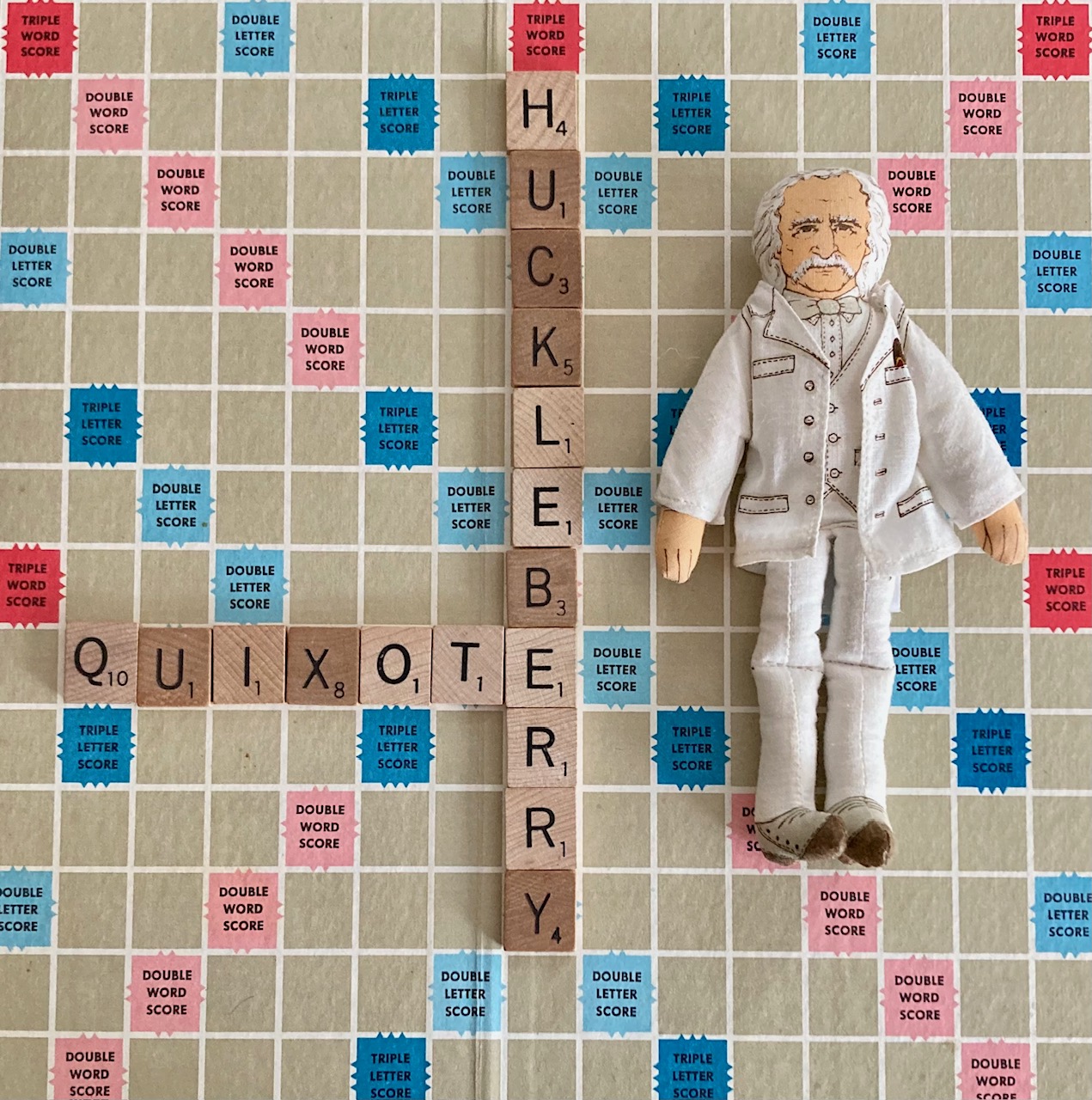
huckleberry: a berry like a blueberry (the first name of the title character in Mark Twain’s Adventures of Hucklebery Finn, 1884)
oedipal: describing libidinal feelings of a child toward the parent of the opposite sex (from the title character in Sophocles’ Oedipus Rex, c. 429 B.C.)
quixote: a quixotic, or extremely idealistic person; also quixotry, a quixotic action or thought (the title character in Michael de Cervantes’ Don Quixote, Part I: 1605, Part II: 1615)
Could the words in the hypothetical game featured in the image at the top of this post be the first plays in an actual game of Scrabble? They couldn’t be the first two plays, but they could be the first three. “Huckleberry” with the “b” on the center square/double-word bonus square would be worth fifty-eight points, but “huckleberry” has eleven letters, and the first player, or team, could not play more than seven letters. But the first play could be “berry” for twenty-eight points. The second player, or team, could follow with “q-u-i-x-o-t” to the left of the “e” in in berry for twenty-five points. Then the first player, or team, could add h-u-c-k-l-e to “berry” for a total of twenty-five points.
Next Up
Beginning at noon on Monday, May 1, you and your classmates will deliver your exam-period presentations. As you prepare, review the directions for rehearsing on your assignment sheet.
Today in class you will review one of your classmates’ blogs and identify a passage that effectively demonstrates the skills that your classmate has developed as a writer, a critical thinker, a problem solver or a collaborator. Afterward, you will compose a short response, seventy-five words or more, in which you (1) recommend that your classmate address that passage in his/her/their individual presentation, and (2) explain why that particular passage stands out as a strong point in the blog.
This assignment serves two purposes: It provides one of your classmates with concrete feedback, and it prompts you to think about what passage in your blog you might address in your own presentation.
Presentation Directions
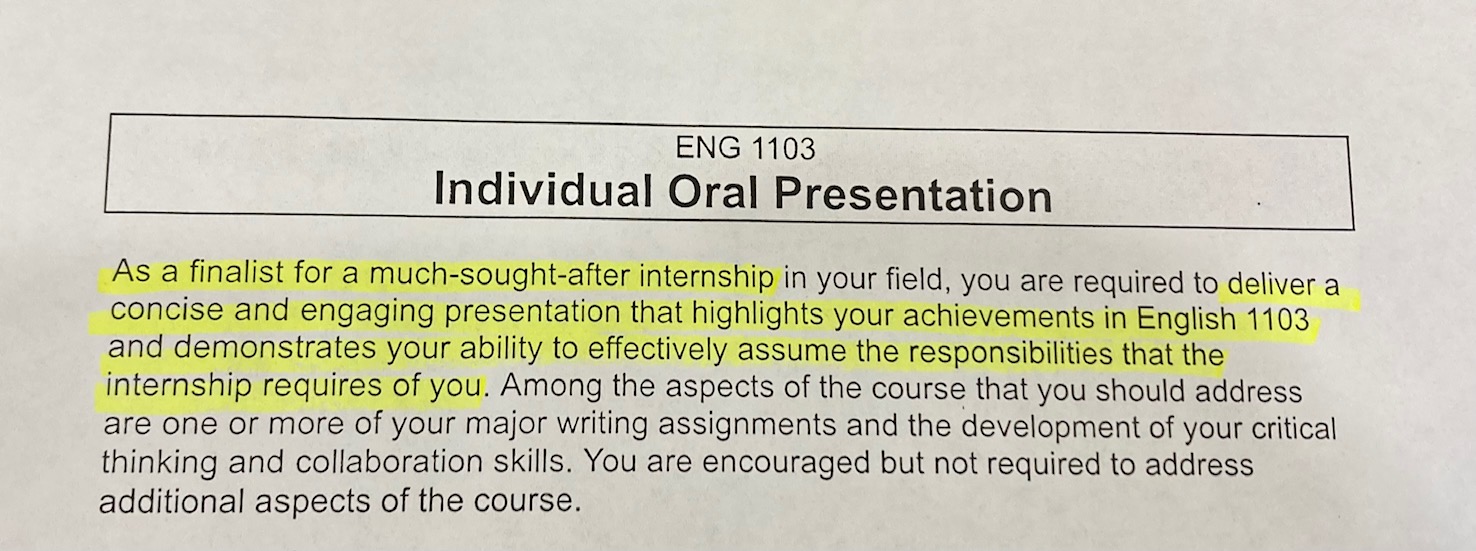
Plan a brief presentation of five minutes or fewer that highlights your achievements in English 1103 and demonstrates your ability to effectively assume the responsibilities that the internship in your field requires of you. (Remember that this assignment requires you to present yourself as a finalist for a much-sought-after internship in your field. See the assignment handout for details.)
Address one or more of your major writing assignments and the development of your critical thinking and collaboration skills. You encouraged but not required to address additional aspects of the course.
Include in your presentation an opening in which you state your first and last names and your major, concrete details in your blog that illustrate the development of your writing, your critical thinking, and/or your collaboration skills.
A close examination of one pertinent passage in your blog.
A conclusion that provides closure and invites questions from the interview committee.
Next Up
Wordplay Day! To up your game and increase your word power, review the tips and tools on the Scrabble website as well as this blog post and my other posts devoted to the game.
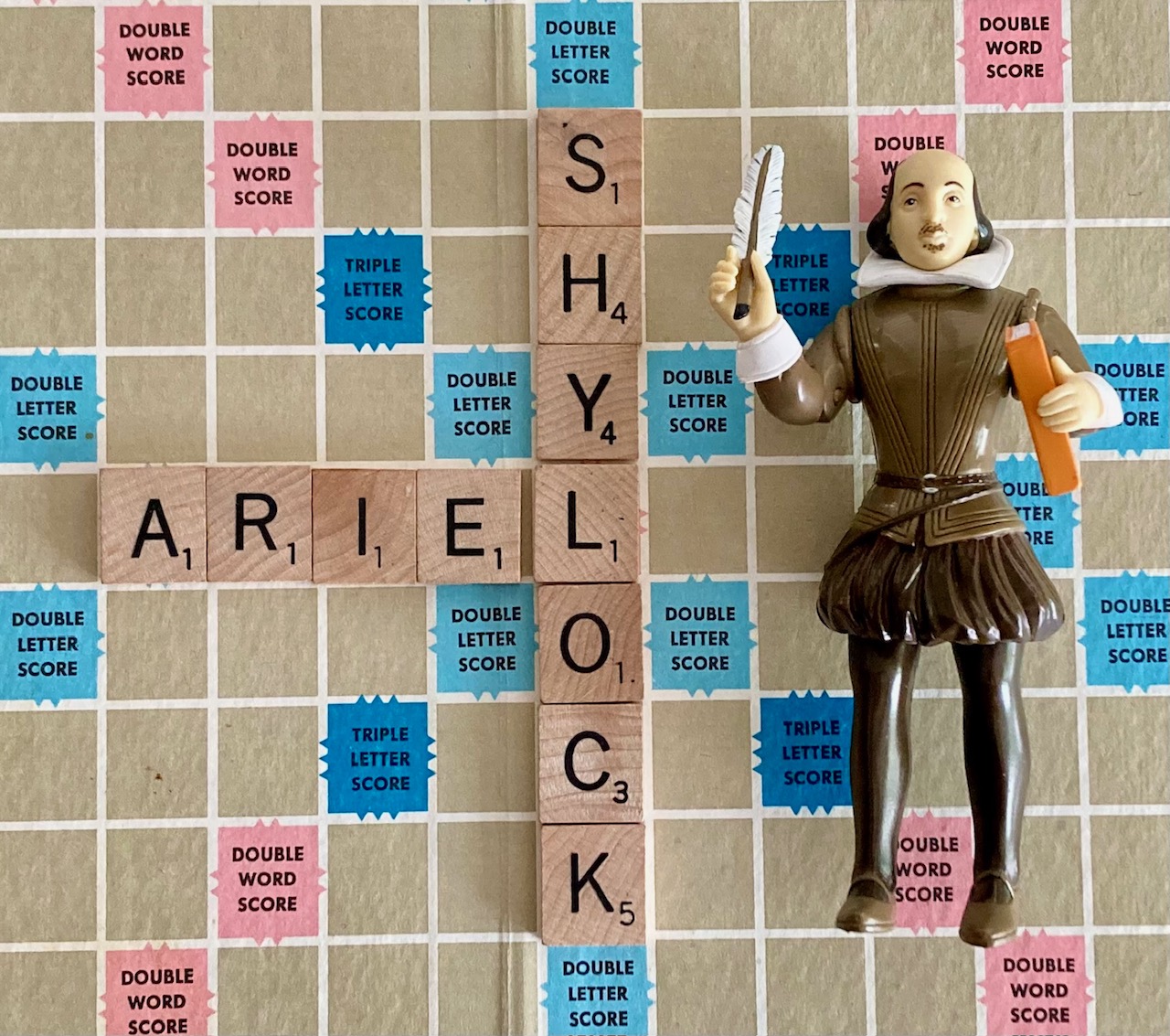
In honor of William Shakespeare’s birthday this weekend, Sunday, April 23,* today’s Scrabble post features Shakespeare characters whose names are also playable common nouns.
ariel: a gazelle found in Africa (Ariel, The Tempest, 1611-12)
dogberry: the fruit of a dogwood tree (Dogberry, Much Ado about Nothing, 1598-1599)
hamlet: a village (the title character of Hamlet, 1600-1601)
lear: learning (the title character of King Lear, 1605-1606)
puck: a disk used in ice hockey and other games (Puck, A Midsummer Night’s Dream, 1595-1596)
romeo: a seductive lover, a male lover (one of the title characters in Romeo and Juliet, 1594-1595)
shylock: to lend money with a high interest rate (Shylock, The Merchant of Venice, 1596-1597)
*April 23, the day of Shakespeare’s death in 1616, is traditionally given for his birth in 1564.
Next Up
Wordplay Day! To up your game and increase your word power, review the tips and tools on the Scrabble website as well as this blog post and my other posts devoted to the game.
Today in class you will compose a short final reflection essay that documents your work over the course of the semester, focusing on what you consider your most significant work and the feature or features of the course that have benefited your development as a writer and a student. Fetures to consider include the following:
Planning, drafting, and revising your literacy narrative and/or your analysis. You are welcome to address your final essay and annotated bibliography, but since you recently composed a refelection for it, you should address it only briefly in your final refelection.
Keeping a journal
Completing Check, Please! assignments
Delivering your group presentation on one of the Check, Please! lessons
Studying one of the readings examined in class, including “Blogs vs. Term Papers,” “The Case for Writing Longhand,” “Skim Reading is the New Normal,” “Letter from Birmingham Jail,” “Me Talk Pretty One Day,” “The Day that Language Came into My Life,” “Back Story” (from The Blind Side), “The Falling Man,” and “Scrabble is a Lousy Game.”
Writing collaboratively with your classmates
Completing follow-up revsving and editing exercises for your collaborative writing
Writing for an online audience/creating and maintaining a WordPress blog, and/or reading and responding to your classmates’ blog posts
Playing Scrabble/collaborating with your teammates on Wordplay Day
Writing longhand
Limiting screen time
You are welcome to focus on more than one feature but no more than four.
Include in your reflective essay the following elements:
An opening paragraph that introduces your focus and presents your thesis
Body paragraphs that offer concrete details from your work to support your thesis
A quotation from Writing Analytically, a quotation from one of the class readings, or a quotation from one of the sources included in your final essay and annotated bibliography. Introduce your quotation with a signal phrase and follow it with a parenthetical citation, if needed.
A conclusion that restates your thesis without restating it verbatim
Wordplay Day! To up your game and increase your word power, review the tips and tools on the Scrabble website as well as my blog posts devoted to the game.
This week’s Scrabble post features comic book characters whose names are playable because they have common noun definitions as well. Learning these playable words will up your game–and it may lead you discover that Scrabble dominance is your super power!
batgirl: a young woman whose job it is to mind baseball equipment
batman: a British officer’s orderly
corsair: a pirate
hulk: to appear large or intimidating
iceman: a man whose job it is to supply ice
ironman: a man of great strength or endurance
joker: one who habitually makes jokes
magneto: a small electric generator containing a magnet
mystique: an aura of attractiveness
riddler: one who poses riddles
robin: a type of thrush
superman: an idealized, superior man
superwoman: an exceptional woman, especially one who succeeds in having a career and raising a family
wolverine: a smallish, vicious carnivore of the weasel family, native to the tundra
Could the words in the hypothetical game featured in the image at the top of this post be the first plays in an actual game of Scrabble? They couldn’t be the first two plays, but they could be the first three. “Wolverine” with the “e” on the double word score would be worth forty points, but “wolverine” has nine letters, and the first player, or team, could not play more than seven letters. But the first play could be “wolver” (one who hunts wolves) for thirty-two points. The second player, or team, could follow with “batgirl” for fifteen points. Then the first player, or team, could add i-n-e to “wolver” for a total of sixteen points.
Next Up
Wordplay Day! To up your game and increase your word power, review the tips and tools on the Scrabble website, this blog post of heroes and villians, and my other posts devoted to the game.
Today in class you willl plan and draft a short reflective essay that documents your writing process and includes at least one relevant quotation from Writing Analytically, the article or essay that served as your starting point, or one of your other sources. Introduce your quotation with a signal phrase, and include a work cited entry for Writing Analytically. For MLA-style entries, see the samples below.
Questions to address in your reflection include the following:
Did your subject change? If so, what was your original subject, and why did you change it?
What aspect of the writing seemed the most challenging? Determining which article or essay would serve as you starting point? Locating additional useful sources? Composing your annotations? Developing the final essay? Why did that aspect of the writing seem the most challenging?
What do you consider the strongest element of your final essay and annotated bibliography?
At what point in the process did you decide on a title? Did you change the title during the writing process? If so, what was the original title?
What image that documents part of your writing process away from the screen did you include in your blog post? Why did you choose that particular image?
What additional images, if any, did you include?
Next Up
Wordplay Day! To up your game and increase your word power, review the tips and tools on the Scrabble website as well as my blog posts devoted to the game.






 Jane Lucas