Posted in Reading, Teaching, Writing

Another Semester of Stumbling and Serendipity

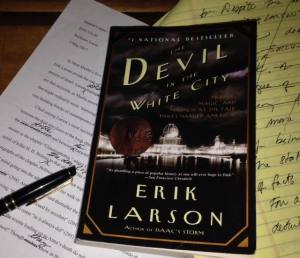
Designing a course that dovetails with campus cultural events not only means crafting new assignments every semester but also reading some books that I might not choose to read—much less teach—on my own. While those challenges could dissuade me from starting anew each semester, repeatedly reinventing English 131 has proven to have lasting benefits. Books whose authors we can see face to face when they visit campus and plays that come to life on the university stage give the course an immediacy it would not have otherwise. And though I cannot fully place myself in the role of my students, I can at least come closer to that by giving myself the task of studying different texts, as they do, every semester. As a writer, I avoid the cliché comfort zone, but as a teacher, I embrace the concept. I try not to get too comfortable. I allow myself to stumble, as Erik Larson, author of The Devil in the White City, would say.

“Stumbling” is one of the words that Larson used to describe his writing process when he visited our campus in October, and in recent days—as I have struggled to organize my own thoughts on paper—I have been reminded of the essential role of stumbling in my own work and of the value of hearing such a masterful writer as Larson say that he stumbles, too.

Along with stumbling, “serendipity,” another word that Larson used to describe his writing process, has played a crucial part in my own work, both as a teacher and a writer, this semester. Through pure serendipity, back in August, just as I was compiling the readings for the course, I came across “Have Smartphones Destroyed a Generation?” in the September issue of The Atlantic. That article by Jean M. Twenge served as a valuable starting point for the course, providing both a model of research writing for a general audience and an example of the findings that inform the practice of process-based writing that I require of my students and of myself, writing that requires turning away from the screen and putting pen to paper, as well as writing for an online audience.

In addition to Twenge’s article, serendipity brought Jordan Makant’s poetry into the classroom this semester. The September publication of his debut collection, Impossible Angles, offered an unexpected opportunity for students to read published poetry by a Lenoir-Rhyne student, one who told the audience at his book launch that he didn’t even like poetry before he enrolled in a poetry workshop at LR. Makant’s account of his discovery—that poetry could become a vital form of expression for him—demonstrated how we may find inspiration where we least expect it. And studying his poem “Thought Twice; It’s Not Alright,” a response to Bob Dylan’s “Don’t Think Twice, It’s All Right” sparked the idea for a journal exercise that my students and I wrote after reading the poem: What song in your playlist stays on your brain? What truth or lie does it tell? Begin there.

Another piece of writing that unexpectedly found its way into the classroom this semester was borne of sorrow. In early October, just hours after my husband, Guy, and I said goodbye to our fifteen-year-old cat, Percy, my husband composed a memoir of our years with Percy, from Guy’s first glimpse of him as a stray kitten to our decision that his failing health meant that it was time to put him down. Though I did not know how my husband managed to write that blog post so soon after Percy’s death, I knew as soon as I read it that I would return to it with my students, to offer it both as a model of narrative nonfiction and as an example of the therapeutic value of writing.

Though all of the textual analyses that I have written this semester along with my students have been instructive for me as a teacher and a writer, the one that lingers in my mind now is my commentary on Our Town: “Through a Glass Darkly: Girl at the Mirror and Grover’s Corners.” While I know it remains on my mind in part because it’s my most recent analysis, I have also continued to reflect on the crucial role of seeing, really seeing, both for the subjects of my essay and for me as a writer. Emily’s observation that she “can’t look at everything hard enough” (105) reminds me of our need to look harder—often harder than we want to—to find the clarity and the answers that we seek in our writing and our lives.

In his introduction to Our Town, theatre professor Donald Margulies writes of the joy we feel as teachers when we introduce students to work that we admire:

Since you can never relive the experience of seeing or hearing or reading a work of art for the first time, you can do the next best thing: You can teach it. And, through the discoveries your students make, you can recapture, vicariously, some of the exhilaration that accompanied your own discovery of that work long ago. (xiii)

If teaching work that you admire rates second only to reading it for the first time, perhaps teaching a work that you last read decades ago (as was the case for me with Our Town) offers another second best. It enables us to see it anew—really see it—with our students, which is another reason for us as teachers to turn to works that we have not read before and discover them as our students do. I will not grow to admire all of the texts that I have studied for the first time with my students, and neither will they. But once again this semester I am reminded of how I have grown to admire the process of stumbling through them, posing questions of them, stumbling more through drafts of writing about them, and making unexpected discoveries, those moments of serendipity, that come when we trust the process.

Works Cited

Larson, Erik. Interview with Jeffrey Delbert. LR Visiting Writers Series. 27 Oct. 2017, Belk Centrum, Lenoir Rhyne U., Hickory, NC.

Margulies, Donald. Foreword. Our Town by Thornton Wilder. 1938. Harper Perennial, 2003, xi-xx.

Wilder, Thornton. Our Town. 1938. Harper Perennial, 2003.

Annotated Bibliography

Larson, Erik. The Devil in the White City. Vintage, 2004.

Erik Larson’s nonfiction narrative, a mix of true crime and popular history, intermingles two nineteenth-century Chicago stories: the 1893 Chicago World’s Fair (the White City of the title) and the life and crimes of serial killer Herman Webster Mudgett, a.k.a. H.H. Holmes, whose World’s Fair Hotel served as the site of his gruesome murders.

Lucas, Guy. “Loss of Unwelcome Burden Devastates Me.” A Newsroom with a View: Thoughts on the Changing Media Landscape, https://guylucas.com/2017/10/05/percy/, 5 Oct. 2017. Accessed 6 Oct. 2017.

In “Loss of Unwelcome Burden Devastates Me,” journalist Guy Lucas recounts the life and death of his pet cat Percy, focusing on two scenes: one in which he teaches the paper-trained kitten to use the litter box, and a second in which and he retrieves Percy from a neighbor’s yard after the cat is lost and too afraid to answer to his calls.

Makant, Jordan. “Thought Twice; It’s Not Alright.” Impossible Angles. Main Street Rag, 2017. 18.

One of the poems in his debut collection, Impossible Angles, Jordan Makant’s “Thought Twice; It’s Not Alright” responds to Nobel Laureate Bob Dylan’s 1963 folk song “Don’t Think Twice It’s All Right,” featured on his album The Freewheelin’ Bob Dylan. The speaker in Makant’s poem observes that “Dylan was lying” but that his lie was “the measure of true love” (18).

Richtel, Matt. “Blogs vs. Term Papers.” The New York Times, http://www.newyorktimes.org, 20 Jan. 2012, Accessed 29 Sept. 2017.

In “Blogs vs. Term Papers,” Matt Richtel reports on the debate in higher education on how best to teach writing in the digital age. While some professors have followed the lead of Duke University’s Cathy Davidson, replacing the traditional term paper with shorter, more frequent blog assignments, their detractors—including Douglas B. Reeves, columnist for The American School Board Journal and William H. Fitzhugh, editor of The Concord Review—argue that blog writing lacks the academic rigor that fosters critical thinking. For Andrea Lunsford, professor of writing at Stanford University, pitting blogs against term papers creates a false opposition. Rather than replacing term papers with blog posts, Lunsford requires students to produce multi-modal assignments: term papers that evolve into blogs, websites, and video presentations.

Schreck, Heidi. Creature. Samuel French, 2011.

Drawing on autobiography The Life of Margery Kempe—considered by many to be the first autobiography written in English–playwright Heidi Schreck’s comedy chronicles the spiritual journey of fifteenth-century Christian mystic Margery Kempe, as she struggles with her religious calling after she believes she experiences a vision of Jesus in purple robes.

Twenge, Jean M. “Have Smartphones Destroyed a Generation?” The Atlantic, https://www.theatlantic.com/magazine/archive/2017/09/has-the-smartphone-destroyed-a-generation/534198/, Sept. 2017, Accessed 28 Aug. 2017.

Jean M. Twenge’s article “Have Smartphones Destroyed a Generation?” focuses on her research into the behaviors and emotional states of young people born between 1995 and 2012—a generation she calls “iGen”—who differ markedly from their predecessors who came of age before the advent of smartphones and Instagram accounts. Twenge, a professor of psychology at San Diego State University, who has studied generational differences for twenty-five years, observed a significant shift in teenagers’ behaviors and emotional states beginning around 2012, the year when the proportion of Americans owning smartphones first exceeded fifty percent. Twenge’s findings present a portrait of adolescents who are psychologically more vulnerable than those of previous generations, and the evidence that links depression to smartphone use leads Twenge to recommend that parents limit their teenagers’ screen time.

Whitehead, Colson. The Underground Railroad. Doubleday, 2016.

In Colson Whitehead’s Pulitzer Prize-winning novel, an alternative history of antebellum America, he creates an actual Underground Railroad, turning the metaphor into a series of subterranean tracks that lead his protagonist, Cora, a fugitive slave, from the cotton plantation she escapes in Georgia, onto South Carolina, North Carolina, Tennessee, Indiana, and an unnamed route northward, where she continues to travel at the novel’s close.

Wilder, Thornton. Our Town. 1938. Harper Perennial, 2003.

Thornton Wilder’s Pulitzer Prize-winning play chronicles the daily life in the fictional town of Grover’s Corners, New Hampshire, from 1901-1913, focusing on two of the town’s prominent families, the Gibbses and the Webbs, whose son (George Gibbs) and daughter (Emily Webb) fall in love and marry, and whose wedding serves as the centerpiece for Act II. With its Stage Manager-character who functions as an omniscient narrator, the play—as theatre scholar Donald Margulies observes—conveys “[t]he simultaneity of life and death, past, present, and future” (xvii).
Posted in Teaching, Theatre, Writing

Through a Glass Darkly: “Girl at the Mirror” and Grover’s Corners

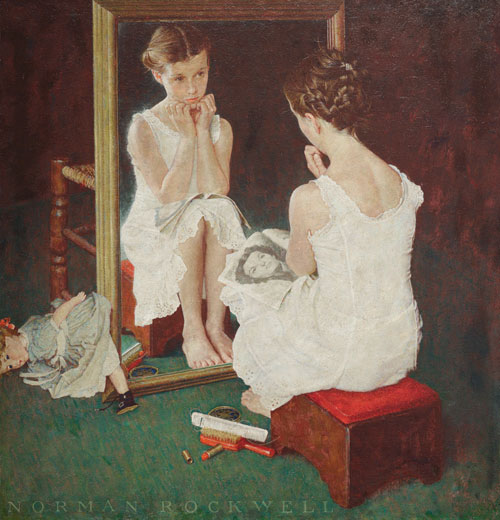
Girl at the Mirror. The Saturday Evening Post. 6 Mar. 1954 / nrm.org

In Norman Rockwell’s painting Girl at the Mirror, the face that viewers see is the girl’s reflection—not her face itself, but the one she sees in the glass. What does she see in herself, and what do the paintings’ observers see, as we witness this private moment? Does her lace-trimmed petticoat evoke in her, or in us, thoughts of the wedding gown that she may wear one day? For Rockwell’s detractors—and for those who consider him a guilty pleasure—Girl at the Mirror and his other covers for The Saturday Evening Post present a sentimentalized depiction of American life, the same picket-fenced cliché that many who find fault with Our Town perceive as the prevailing image of the play. As theatre scholar Donald Margulies writes in his foreword to Our Town, many people who dislike it have “dismissed [it] as a corny relic of Americana and relegated Thornton Wilder to the kitsch bin along with Norman Rockwell and Frank Capra” (xi). Yet a close look at Our Town and Girl at the Mirror reveals portraits of American life that are far from idyllic.

As she gazes pensively in the mirror, the girl in Rockwell’s painting might be asking herself the same question that Emily Webb asks her mother: “[A]m I pretty?” (31). Though Mrs. Webb tries to reassure her daughter, Emily seeks an answer that her mother’s words fail to provide.

Both Emily and the Girl at the Mirror occupy that awkward space between childhood and adulthood—a notion that Rockwell emphasizes with the composition of his painting, placing the girl between her childhood toy, the doll that she has cast aside, and her new grown-up object of interest, movie star Jane Russell, who gazes up at her from the page of a magazine. Will I ever be beautiful and desirable, the way you are? the girl might be asking of Russell. Or, as Emily asks her mother: “Am I pretty enough . . . to get anybody . . . to get people interested in me? (32). Though Mrs. Webb answers Emily, she does not provide the answer that her daughter seeks. Telling Emily, instead, that she has “a nice pretty young face” (31) and that she’s “pretty enough for all purposes” (32), she avoids the subject of adult desire that underlies Emily’s questions.

Though the audience feels the frustration in Emily’s voice as she says, “Oh, Mama, you’re no help at all” (32), only later in the play do we feel the full weight of those words when Mrs. Webb confesses in the wedding scene that she has never talked to Emily about sex: “It’s cruel, I know, but I couldn’t bring myself to say anything” (76). Mrs. Webb’s monologue turns the scene of her daughter’s wedding into a reminder of the vulnerability and pain that come as a consequence of a lack of sexual knowledge. That same darkness at the edge of a seemingly quaint picture appears in Girl at the Mirror. Consider the doll, just beyond the mirror and the viewer’s focus, innocently cast aside perhaps, but backed up to the edge of the mirror’s frame. To the adult eye, the doll’s posture is clearly one of sexual submissiveness.

Both Wilder’s and Rockwell’s visions are more complex than what their critics give them credit for—or more accurately deny them—rendering the trouble that lurks below the surfaces of our daily encounters. And while the sexual innocence of Emily Webb and Rockwell’s Girl at the Mirror may seem distant to us, the silence that endangers their innocence pervades our lives. Now as revelations of celebrities’ and politicians’ transgressions saturate our news streams, the silences of Wilder’s characters seem eerily prescient. Can anyone now hear Mrs. Webb say, “I couldn’t bring myself to say anything” (76), without thinking of our own culture of silence—and of  Roy Moore and Louis C.K. and Kevin Spacey and Harvey Weinstein—and of all the predators in our own towns, places supposedly so far removed Grover’s Corners?

Meanwhile, back in Our Town, Mrs. Gibbs says of Simon Stimson’s alcoholism that “the only thing the rest of us can do is just not to notice it” (40). And Constable Warren says, “‘Twant much” (104), of a Polish immigrant nearly freezing to death, another way of saying that some lives do not matter as much as others, a prejudice that we know all too well as no mere relic of the past.  Those moments in Our Town not only belie the notion of Grover’s Corners as a saccharine portrait of America but also demonstrate that the play critiques the very parochialism that its detractors denounce as its stock-in-trade.

In his reassessment of Rockwell’s paintings, Richard Halpern observes that “[a] false belief in our own sophistication or knowingness is just another form of innocence” (par. 17). The same innocence may prevent us from seeing Our Town with real clarity, the way that Emily only truly sees her twelfth birthday when she revisits it after death. As she says to the Stage Manager, “I can’t look at everything hard enough” (105). Perhaps in our own innocence, neither can we.

Works Cited

Halpern, Richard. “Manufacturing Innocence,” excerpt from Norman Rockwell: The Underside of Innocence, U. of Chicago P., http://press.uchicago.edu/ucp/books/book/chicago/N/bo3750655.html, Accessed 16 Nov. 2017.

Margulies, Donald. Foreword. Our Town by Thornton Wilder. 1938. Harper Perennial, 2003, xi-xx.

Rockwell, Norman. Girl at the Mirror. The Saturday Evening Post, 6 Mar. 1954. Norman Rockwell Museum, 2016, http://www.nrm.org/MT/text/GirlMirror.html, Accessed 16 Nov. 2017.

Wilder, Thornton. Our Town. 1938. Harper Perennial, 2003.

Posted in Reading, Teaching, Writing

Revisiting Erik Larson’s White City, and its Devil

Erik Larson / twitter.com

“Stumbling” and “serendipity” are two of the words that Erik Larson used as he recounted the moments that have unexpectedly led him to the subjects of his books. When he spoke at Lenoir- Rhyne on the morning of Friday, October 27, he told his interviewer, Jeffrey Delbert, Assistant Professor of Communications at LR, that he didn’t intend for his book on serial killer H.H. Holmes to be a dual narrative of Holmes and the 1893 World’s Fair. But his background reading on 1890s Chicago led him to a book–a boring monograph, as he called it–on the Colombian Exposition (the 1893 Chicago World’s Fair). Though the book bored him, one of its footnotes caught his eye: one that listed Juicy Fruit gum among the products first introduced at the fair. If not for that footnote, Larson said, he didn’t know if the book (The Devil in the White City) would have happened.

When an audience member asked about his penchant for crafting nonfiction narratives with the drama of novels, Larson remarked that he believed that such narratives can do more justice to real-life stories than a “bland historical approach.” Those words of his reminded me of Truman Capote’s In Cold Blood, which figures in the analysis of  The Devil in the White City that I wrote along with my students (as they wrote their own analyses) last spring–and that I offer again here:

The White City’s Blueprint: The Architecture of Larson’s Narrative Nonfiction

In Janet Maslin’s New York Times review of The Devil in the White City, she claims that Erik Larson avoids the risk of “turning [the book] into a random compendium.” For all of his density of detail, Larson does manage to avoid that risk, creating instead a gripping dual narrative—one that succeeds, as Maslin asserts that it does—but not by using what Maslin cites as tactics that might ordinarily seem “alarming.” Rather the techniques that Larson employs are among the very building blocks of contemporary narrative.

Chief among Larson’s most successful narrative strategies is his cross cutting, both between the dual storylines of the book (those of the Devil and the White City of the title) and between characters. One of his most compelling uses of cross cutting occurs in the chapter “Claustrophobia,” where Larson deftly shifts from the point of view of serial of killer H. H. Holmes, the devil of the title, to that of one of his victims, Anna “Nannie” Williams. In the first paragraphs of the chapter, Holmes and Anna are together in his office, where he asks her “if she would mind going into the adjacent room, the walk-in vault, to retrieve for him a document he had left inside” (294). Anna complies, and thereafter the point of view shifts between Anna inside the vault, believing “the door had closed by accident” (294), and Holmes standing outside the door, listening for the panic to come “as it always did” (295).

Readers witnessing the events leading up to Anna’s death do not stop to ask: How can Larson know what happened? Though they know in the back of their minds that only Holmes and Anna themselves could know what transpired, Larson’s dramatic cross cutting draws them so close to both the victim and her killer that they experience those moments as Holmes and Anna do.

In his endnotes, Larson addresses his reasons for depicting Anna’s murder as he did. Based on police speculation that Holmes killed both Anna and her sister, Minnie, in his vault, an earlier chronicler of Holmes’ exploits—Harold Schechter, author of Depraved (1994)—proposed that Holmes walked into the vault with Anna: “Grasping Nannie by the hand, he led her toward the vault” (Schechter qtd. in Larson 416). Rather than depicting the events as Schechter did, Larson presents Holmes sending Anna into the vault on a false errand because that scenario, in Larson’s words, “would have suited more closely his temperament” (416).

Whether Holmes sent Anna into his vault on a false errand, Larson’s compelling rendering of it exemplifies how the author employs the dramatic effects of fiction—not tactics that are “alarming” as Maslin claims, but ones that writers have commonly applied to narrative nonfiction for more than fifty years, since the publication of Truman Capote’s groundbreaking  account of the Clutter family murders in In Cold Blood. And like In Cold Blood, The Devil in the White City presents a true crime story with the narrative arc of a novel. But Larson’s book is more ambitious and broader in scope than Capote’s. Ultimately, The Devil in the White City is a hybrid of true crime and popular history—the gruesome murders of a serial killer juxtaposed with the construction of the magical white city that inspired Walt Disney and L. Frank Baum. For readers fascinated by the minds of criminals and visionary architects, it’s a page turner. And for writers drawn to the challenge of giving facts the appeal of fiction, it offers a blueprint.

Works Cited

Larson, Erik. The Devil in the White City. Vintage, 2004.

Maslin, Janet. “Add a Serial Murderer to 1893 Chicago’s Opulent Overkill.” Review of The Devil in the White City, by Erik Larson, The New York Times, 10 Feb. 2003, http://www.nytimes.com, Accessed 26 Apr. 2017.

Posted in Teaching, Writing

“Impossible Angles” and a Place to Begin

At the book launch for his debut collection of poetry, Impossible Angles, Jordan Makant told the audience that he didn’t like writing poetry when he enrolled in a poetry workshop at Lenoir-Rhyne but found himself drawn to the form after his workshop professor, Scott Owens, told him, “write the way you think.” Those words of Owens’ led Jordan, now an LR senior, to begin drafting stream-of-consciousness verse, including “Late Night with Myself and a Four Cylinder,” one of the poems that he read at the launch.

Later this morning when I talk with my students about Jordan’s work, I will tell them about his initial lack of interest in writing poetry, with the hope that some of the students will consider enrolling in a writing workshop, because they may discover unexpectedly—as Jordan did—that  writing poetry (or fiction, or creative nonfiction) can give them a way of making sense of the world. And as an exercise to encourage them, I will offer one of Jordan’s poems as a model: “Thought Twice; It’s Not Alright,” a response to Bob Dylan’s “Don’t Think Twice, It’s All Right.”

Jordan’s poem begins with the line, “Bob Dylan was lying, of course . . .” (18). What song in your playlist stays on your brain? I will ask my students. What truth or lie does it tell? Begin there.


Makant, Jordan. “Thought Twice; It’s Not Alright.” Impossible Angles. Main Street Rag, 2017. 18.

Posted in Teaching, Theatre, Writing

Another Way with Words

TGR’s “Boeing Boeing” (2017) / Ken Burns

A year ago, as a model for my students’ introductory assignment, I composed a post about my work as a writer. Now as I revisit that assignment, rather than turning again to my writing, I have chosen to write about acting.

Though I began performing in community theatre as a teenager in the 1980s, I was away from it—focusing on my teaching and writing—for more than twenty-five years. Becoming an acting student in my forties—enrolling in classes in Richmond, Virginia, in 2011 and 2012—rekindled my passion for the craft. I fell in love with acting all over again, and I found myself wondering how I’d ever left it. Since moving back to North Carolina in 2013, I have performed in plays at Foothills Performing Arts, Hickory Community Theatre, the Green Room Community Theatre, and most recently at the Hickory Playground’s second annual festival of new one-act plays.

HCT’s “Incorruptible” (2016) / Ken Burns
HCT’s “Superior Donuts” (2016) / Ken Burns

For me as a writer, acting is another way of working with words, a process of transporting them from the page to the stage and transforming the language into the utterances of a living, breathing character—someone who isn’t me but in whom I can “live truthfully,” as Sanford Meisner would say, “under the given imaginary circumstances.”

Posted in Reading, Social Media, Teaching

Left to Our Own Devices, or Left to Turn Away from Them

Have Smartphones Destroyed a Generation?” doesn’t offer a definitive answer to the question of its title, but the evidence that its author, Jean M. Twenge, identifies linking depression to smartphone use leads her to recommend that parents limit their teenagers’ screen time. Twenge, a professor of psychology at San Diego State University, who has studied generational differences for twenty-five years, has observed a significant shift in teenagers’ behaviors and emotional states that began around 2012, the year when the proportion of Americans owning smartphones first exceeded fifty percent. Twenge’s findings present a portrait of adolescents who are psychologically more vulnerable, and whose increased vulnerability coincided with the dual rise of smartphones and social media.

For tomorrow, for their first reading assignment of the semester, my students will read Twenge’s article on paper, making notes in the margin as they read. Last week as I composed that assignment, stipulating that students print the article, I heard their voices of dissent in my head.

In the process of reading Twenge’s article, some students may decide that my requirement was reasonable. Others, perhaps most, will see it as unnecessary.

When I first read Twenge’s article a couple of weeks ago in the September issue of The Atlantic, I knew that I would ask my students to read it as well, in part to demonstrate why I limit their use of digital devices in the classroom. But I also knew that I could not in good conscience ask them to read Twenge’s words on the screen. If, as she reports, two or more hours a day on electronic devices negatively impacts mental health and sleep, it would seem nothing short of cruel irony to require my students to read Twenge’s 5,000 words online.


Twenge’s article is adapted from her forthcoming book, iGen: Why Today’s Super-Connected Kids are Growing Up Less Rebellious, More Tolerant, Less Happy–and Completely Unprepared for Adulthood–and What That Means for the Rest of Us.

Posted in Teaching, Theatre

What I’ve Learned about Learning Lines, Part II (or Act II)

Three-and-a-half years after returning to acting, I remain fascinated by the process of learning lines.

Back in 2014, after I finished performing in Third—the play that marked my return to the stage—I began researching the subject of line-learning. The two pieces of writing that resulted from that research (an annotated bibliography and an essay) are ones that I wrote primarily as models for my students. But the research, itself, is work that I would’ve done anyway. Chalk it up to my enduring interest in the subject.

I’m not sure what I expected to find, other than some examinations of best practices. Reading the lectures of Stella Adler, Uta Hagen, Sanford Meisner, and Lee Strasberg momentarily gave me a seat in the classrooms of those great acting teachers, but it didn’t offer much about the practice of line-learning, itself. Similarly, reading a research article on acting and cognitive functioning led me into the lecture halls of its coauthors—one a professor of psychology, the other a professor of theatre—demonstrating that acting may enhance memory, but not revealing how anyone actually learns lines.

So how do we do it?

I was too nervous—and too busy trying to remember my lines—to ask myself that question when I was in rehearsal and performance back in 2014. Only afterward could I begin the research that led to the essay that opened with these words:

How do actors learn their lines? It’s not the same act of memorizing that we perform as students when we commit to memory the steps of photosynthesis for a biology midterm. Actors learn lines to repeat them over and over in performance after performance, and yet must do so as if they have never spoken them before, to create ‘the illusion of the first time’ (Stanislavsky qtd. in Strasberg 35). Earlier this semester, I managed to learn lines for a play and repeat them in six performances, but I still don’t know how I did it. In fact, it was only after the play closed that I could bring myself to count the words. I was curious to know how many I’d memorized, but if I had counted them before I’d learned them, the process of memorizing would have been too daunting. And counting them during the run of the play could have undermined my performance; dwelling on how many words I was keeping in my head might have made me more prone to forget.

So how did I learn those 1,567 words and remember them?

Fast forward to late April 2017, when I found myself cast in a role that required me to learn more than twice that number of words—yes, more than twice. After I picked up my script from the theatre, I began my ritual of cutting and pasting, literally cutting and pasting photocopies of my lines onto three-by-five note cards.

When I began cutting and pasting lines for my twentieth card, panic set in. The most lines I’d ever learned had fit onto twenty-two note cards. I was on card twenty, and I wasn’t even halfway through. How many cards would I have, and how would I ever learn all of these lines?

When I cut and pasted the last lines, I was on card fifty-two. If only I had a year, I thought. One card per week seemed manageable.

Somehow I did manage to learn all of those lines in matter of weeks—not months, or anything close to a year—though I’d feared that all those words (which I still haven’t counted) would far exceed what my brain could store and retrieve.

An earlier draft of these reflections included a list of guidelines I’ve developed. As I revised, I omitted them to avoid prescribing my own idiosyncratic process. Suffice to say, the ritual of cutting and pasting lines, as time consuming as it is, is worth the effort for me. As I cut and paste the words onto note cards, I sense that I am beginning to internalize not only the character’s speech patterns but also the structure of the play.

Though my research and ruminations haven’t taught me how I learn lines, I have developed a keener sense of what draws me back to the process again and again. As with writing, it’s the words. And as I wrestle now with these words on the page, I find myself hoping to be fretting over another stack of note cards soon.

Work Cited

Strasberg, Lee. A Dream of Passion: The Development of the Method. Ed. Evangeline Morphos. Little, Brown, 1987.

Posted in Reading, Teaching

The Devil’s in the Details: Casting Larson’s “White City”

Scorsese and DiCaprio / Paramount

Last month, when Erik Larson cancelled his campus visit to Lenoir-Rhyne, our study of The Devil in the White City took an unexpected turn. No longer would our last weeks of reading be informed by the author’s own commentary. As I asked myself how my students and I might proceed in the absence of Larson, it occurred to me that the film adaptation in development could be the source of a series of assignments. Subsequently, I crafted a research exercise, an individual blog post assignment, and a follow-up collaborative blog assignment that involved looking ahead to the upcoming film while looking back at the pages of Larson’s book for textual support for possible casting choices.

Reading the cast recommendations that my students’ produced–each student’s individual choices as well as the expanded proposals that they produced collaboratively–revealed a level of detail and engagement with the subject that many of their previous short assignments lacked. Notably, most of their individual blog posts far exceeded the 150-word minimum length requirement.

Though I regret that my students and I didn’t have the opportunity to see Larson, I am grateful that his cancellation led me to rethink my approach to teaching The Devil in the White City.

The paragraphs that follow offer my version of the assignment: the casting recommendations that I wrote along with my students.


Martin Scorsese’s adaptation of Erik Larson’s The Devil in the White City—now in development at Paramount—will star Leonardo DiCaprio, an actor well suited to play the devil of the title, H. H. Holmes, not because he possesses the same “striking blue eyes” (35), as the charismatic serial killer—though he does—but instead because of DiCaprio’s ability to embody charming characters who trade in deception. Larson’s descriptions of Holmes as someone who could “bewitch men and women alike” (146) and who had “a talent for deflecting scrutiny” (364) bring to mind roles from his previous collaborations with Scorsese—notably Jordan Belfort of The Wolf of Wall Street—as well as Frank Abagnale, Jr. from Steven Spielberg’s Catch Me if You Can.

While DiCaprio—who bought the film rights to Larson’s book in 2010—is set to play Holmes, the rest of the film’s casting remains undetermined, or at least unknown to outsiders. One possible contender for Daniel Burnham, the other figure at the center of Larson’s book, is Hugh Bonneville. The Downton Abbey actor’s  ability to play a “decisive, blunt, and cordial” (35) figure is evidenced in his portrayal of that other turn-of-century character: Robert Crawley, Earl of Grantham. And Larson’s depiction of Burnham as a man who “symbolized all that stood in the way of [young architect Louis] Sullivan’s emerging ethos” recalls the tension between Grantham and his son-in-law, Tom Branson (Allen Leech).

For Frederick Law Olmsted, chief landscape architect and elder statesmen, Scorsese might turn to Anthony Hopkins. Though Hopkins’ frame is not slight, as Larson describes Olmsted’s (53), his face does fit the description of Olmsted’s as “worn and gray, except for his eyes, which gleamed beneath his skull like marbles of lapis” (113). More importantly, with his signature quiet intensity, Hopkins could masterfully convey Olmsted’s struggle as a visionary figure—a benevolent version of Westworld’s Dr. Ford—striving for his field to be “recognized as a distinct branch of the fine arts” (50), as he transforms the landscape of Jackson Park.

Although Dora Root, wife of John Root (Burnham’s partner in architecture) appears only briefly in the book, the passage in which Larson recounts her mixed emotions upon seeing the White City—finding the park “infinitely sad” but “entrancing” all at once (253)—is among the most poignant that Larson writes. As the widow witnessing the fair that her husband didn’t live to see, Laura Linney could deliver a nuanced performance akin to hers as Abigail Adams, beloved wife and advisor to the second president, in the HBO miniseries John Adams. And Linney’s co-star in John Adams, Paul Giamatti, could adeptly portray detective Frank Geyer, who “never tired” (349) in his investigation of Holmes’ crimes, echoing Giamatti’s role in The Illusionist as Uhl, the police inspector who doggedly pursued Eisenheim (Edward Norton).

Paul Dano / twitter.com
Prendergast / chicagonow.com

Lastly, Paul Dano comes to mind as an apt candidate for the role of Patrick Prendergast, the young Irish immigrant whose murder of Carter Henry Harrison turns the fair’s closing ceremony into a memorial for the slain Chicago mayor. The meltdown that Dano exhibited as Dwayne Hoover in Little Miss Sunshine, when Dwayne’s sister, Olive (Abigail Breslin) reveals to him that he can’t become a pilot (because he’s colorblind), illustrates Dano’s ability to convincingly play the unstable—and eventually delusional assassin—in his “accelerating mental decline” (183).

Work Cited

Larson, Erik. The Devil in the White City. Vintage, 2004.


Scorsese’s choices will likely differ from the ones that my students and I have presented, but the process, itself, of returning to the pages of Larson’s book to explore casting possibilities has offered a valuable exercise in textual analysis, one I may return to in future semesters. Even if the books that my students and I study aren’t slated for film production–and many of them will not be–we can still ask the question, whom would I cast? as a starting point for exercising our imaginations along with our intellects.

Posted in Reading, Teaching, Writing

Carving a Voice Out of the Air: An Evening with Dwayne Betts

R. Dwayne Betts / Rachel Eliza Griffiths

In the first paragraphs of Dwayne Betts’ memoir, A Question of Freedom (2009), he recounts his ride to the Fairfax County jail after his arrest for carjacking: a “certifiable” crime in Virginia, which meant that then-sixteen-year-old Betts would be treated as an adult under state law. Last Thursday night when Betts took the stage at Lenoir-Rhyne, he began by reading those paragraphs, returning to the backseat of that police car, where “[e]verything near enough for me to touch gleamed with the color of violence” (3). After reading from his memoir, Betts turned to his collections of poems, Shahid Reads His Own Palm (2010) and Bastards of the Reagan Era (2015), alternating his readings with stories of his years in prison and his writing. He expressed his concern that some people cited his memoir as evidence that prison benefited him, because he had finished his high school education behind bars; and since leaving, he had completed his undergraduate degree at the University of Maryland, an MFA in Creative Writing at Warren-Wilson, and a law degree at Yale. To see his post-incarceration successes as evidence that his years behind bars benefited him, Betts said, was a misinterpretation. Following his Q&A with the audience, Betts concluded by saying that he’d been desperate and lucky–“but sometimes desperate and lucky works out.”

Among the anecdotes that Betts shared with the audience was one focusing on his answer to a question about one of his poems. A reader asked him why an otherwise innocuous poem ended with an image of crack cocaine. To illustrate why he ended the poem that way, Betts turned to August Wilson’s play Fences, telling the audience how the character Troy tries to explain his adultery to his wife, Rose, by likening his decision to a moment in a baseball game. He’s wrong, Betts said, but it’s the only way Troy knows how to try to communicate what he means. In Betts’ words, “sometimes you only have what you have to explain the world.”

Betts’ memoir isn’t an easy read, showing as it does what a life behind bars can do to the mind and the body. But it also tells the story of the power of the written word, how books sustained Dwayne Betts and led him to become a writer, “carv[ing] a voice out of the air” (123). Though many of my students aren’t drawn to writing or to reading books, I believe that the experience of studying  A Question of Freedom and hearing Betts speak has deepened their understanding of the vital role that reading and writing can play in their lives.

Work Cited

Betts, R. Dwayne. A Question of Freedom.  Avery, 2009.

Posted in Teaching, Theatre

Niagara Falls Again: A Postscript

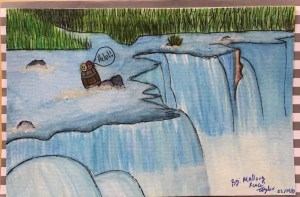
Thank-you card by Mallory Taylor
Thank-you card by Kiyah Davender

When Stephanie Lindsay, who played Karla in the recent LR Playmakers’ production of Wonder of the World, first visited class on February 6, the students had not begun drafting their analyses of the play and opening night was more than a week away. Today when Lindsay returned for a follow-up visit, the students had submitted their revisions of their papers and many had also seen one of the performances of the show. After all of the students projected their analyses-turned-blog posts on the big screen and spoke briefly about the focus of their writing, Lindsay led them in a discussion that traced the journey of the play from page  to stage.

Along with her insightful remarks regarding the actors’ and the director’s roles in bringing the characters to life, Lindsay reflected on the vital opportunity that live theatre offers us in the digital age: the experience of sharing stories together face to face in real time in an increasingly fragmented culture.

thank-you-card-4As Lindsay spoke, my thoughts turned to the readings that I selected for the course, ones that we can see performed on stage or that we can see addressed by the visiting writers who wrote them. In a course titled Critical Thinking and Writing, virtually any texts could serve as our subjects of inquiry. But studying plays produced at Lenoir-Rhyne and books written by the university’s visiting writers creates opportunities for face-to-face, real-time experiences that the study of other texts doesn’t allow.

Thank you, Stephanie Lindsay, for bringing Karla to life, both on the stage and in the classroom, and thank you for your observations on live theatre and stage craft. And thanks also to Kiyah and Mallory for producing cards to express our gratitude.