Posted in Reading, Teaching, Writing

Acadamese, or Academiotics, Ripe for Parody

Essays on Writing (2009)

In “Disruptive ‘Sexual’ Voices in English 101,” writing teacher Lizbeth Bryant recounts a semester marked by students’ sexual comments that she tried unsuccessfully to silence. To learn why their innuendos and puns persisted, Bryant interviewed students, studied composition theory, and re-examined the students’ words, leading her to conclude that she erred on two counts: labeling the comments (as sexual and inappropriate), and seeing the students’ voices solely from her own perspective. Seeing the error of her ways, Bryant shifted her focus from defining the students’ voices to the interactions among those voices, allowing them to develop rather than quelling them. Bryant concludes her essay by addressing how she could have “transformed these conflicts into teaching moments” (100), offering a list of talking points for classroom conversations about voice.

While Bryant’s efforts to make meaning of her students’ voices merit praise, the voice of her own essay reveals how academic jargon invites the very mimicry she seeks to understand. When she turns away from the research that focuses on what “students should be doing” (97), her journey seems promising, but Kay Halasek and Mary Louise Pratt, the scholars whose theories she adopts as an alternative, write in academic jargon that scarcely invites dialogue—except with those who speak the same academese, as Bryant proves she does. She writes that Halasek “asks teachers to examine the preformative nature of our pedagogy as an act that ‘entails answer-ability’” (97). Does Bryant mean performative rather than preformative? And what does she mean by our pedagogy entailing ‘answer-ability’? (Who knows?)

Bryant credits Pratt with helping her understand how she “us[ed] the power of the academy to impede a student’s process in voice development” (97), yet she offers no evidence that she has considered how her own voice as a writer might impede communication with her readers—or how traces of that voice may influence the voices of students in the classroom or in the interview she conducts with them.

Her discussion of the interview reveals that Bryant spoke with only two students, both female. Readers can only wonder what conclusions Bryant believed she could draw from such limited data. The interview prompts other questions as well: Did she request interviews with more students, both male and female? If so, did they decline? And if they did, what are the implications of their reluctance? Notably, in her account of the interview, Bryant quotes the students but not herself, missing the opportunity to let readers hear her own voice in response to theirs. And the absence of her spoken words prompts even more questions: What traces of the academese of her prose might infect her speech, and how might they impede her conversations with students?

Applying the theories of Halasek and Pratt, Bryant reconceives the classroom as a construction zone where her disruptive students “navigated the discourse waters of the academy and decided to bring aspects of their voices of community into the construction zone of the classroom” (99). Her almost-mixed metaphor of navigating discourse water to enter the construction zone brings to mind American Ninja Warrior, which most students—not just hers—would find more appealing than her talking points on voice.

Bryant views her students’ disruptive sexual voices as a response to her power in the classroom. As the one who wields the gradebook, she does possess power that her students lack. But that power alone doesn’t distinguish her from the students. Except for the rare prodigies who pen their dissertations in puberty, professors don’t have the libidos of eighteen- and nineteen-year-olds, and the frontal lobes of their brains aren’t still in development, either. Simply put, freshmen and professors aren’t in the same place sexually or cognitively. A study that considers the body as well the mind might offer more insight into students’ “sexual” voices and professors’ responses to them. But even if Bryant initiated such a study—partnering with a neurobiologist, perhaps—would she and her collaborator write in voices that students or general readers would understand (or want to)?

In a better world, if the jargon of one academic field met the jargon of another, the two would crash and burst, scattering smaller, more intelligible words and phrases. In the real world, though, it’s more likely for the hyper-specialized vocabularies to merge, yielding a mutant form of impenetrable academese seemingly devoid of any real-world relevance. Writer Victoria Dailey calls it “academiotics” in a recent spoof on The New Yorker’s website, where she fashions this monstrosity from the first sentence of Jane Austen’s Pride and Prejudice:

“The heterogeneity of assumed intentions may incur a conclusory stereotype regarding gender selections in marriage-based societies, especially in those where the masculine hegemony of capital resources presupposes the feminization of property and uxorial acquisition.”

Such writing seems ridiculous because it is. That’s why it becomes the subject of ridicule, as the words Bryant spoke to her students became the subject of their mimicry. And the essay that Bryant writes in response to that mimicry risks inviting more of the same. If a student says in class, “I wouldn’t stick mine in there. Don’t know where it’s been,” asking yourself why and reconsidering your own reactions are valuable practices. But a two-thousand-word study of why-my-student-said-I-wouldn’t-stick-it-in-there may not only seem ridiculous, it may also perpetuate the worst stereotypes about scholarship.

Admittedly, Bryant’s initial audience wouldn’t ridicule her essay. The first readers of “Disruptive ‘Sexual’ Voices in English 101” encountered it as a chapter in Voice as Process, a book written primarily for them: scholars of rhetoric and composition, readers fluent themselves in the academese, or academiotics, that’s so ripe for parody. But Bryant’s decision to include the chapter in Essays on Writing, her textbook for first-year writing students, demonstrates her belief that her words speak to freshmen as well. She seems to be saying, I can have a conversation with you that I couldn’t have with those students back then.

Can she? If she turns to her talking points, asking students “How asymmetrical power relations operate in the academy,” or how students “attempt to subvert control by the hegemonic structures” (100), will they answer, or will silence fall on the construction zone?

Byant, Lizbeth A. “Disruptive ‘Sexual’ Voices in English 101.” Essays on Writing. Ed. Lizbeth A. Bryant and Heather M. Clark. Boston: Longman, 2009. 95-100. Print.

Dailey, Victoria. “Pride and Prejudice, Translated into Academiotics.” Newyorker.com. Condé Nast, 7 Oct. 2013. Web. 14 Oct. 2013.
Posted in Reading, Teaching, Writing

“I Won’t Use Writing as Punishment . . .” Rides Again

Essays on Writing (2009)
Posted in Reading, Teaching, Writing

“Against the Workshop”

Against the Workshop (2011)

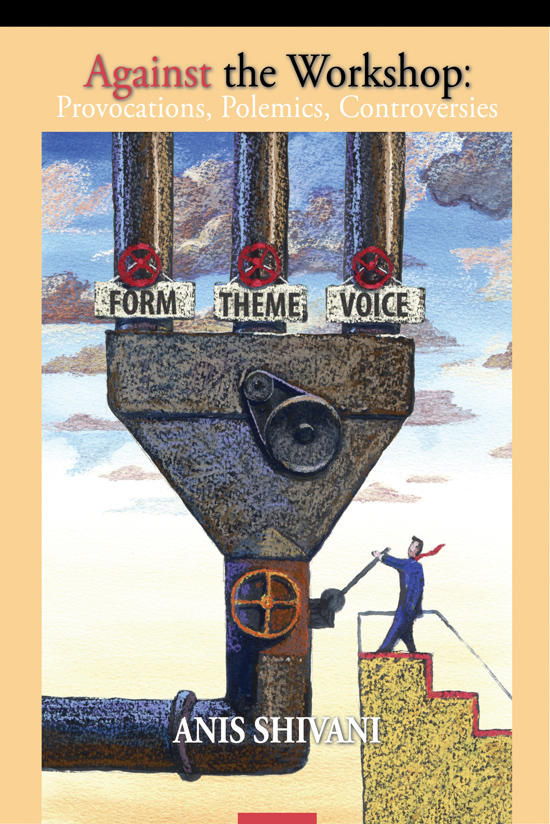
What’s wrong with American letters? Ask Anis Shivani, and he’ll tell you in no uncertain terms: “Mediocre new writers, whose only talent seems to be to have understood the rules of the marketing game, are lauded week after week as brilliant”  while “[o]ld favorites mired in repetitive self-imitation are still offered as awesome masters” (15).  Variations on those lines from his  essay “Why is American Fiction in its Current Dismal State?,” appear throughout his book Against the Workshop, which brings together a decade of his essays and reviews.

Shivani offers convincing arguments, but some of his choices threaten his credibility. He chastens journals for “engag[ing] only in the mutual flattery business” (16) while his review of Jay Parini’s poetry and Parini’s introduction to the book present evidence of the same. Shivani calls Parini’s poetry “fiery hot to the touch, the apparent simplicity a form of high art” (134). Parini reciprocates–because Shivani’s pretty hot, too, it seems–writing of him as “one of the sanest voices in criticism today” a “keen vision” and “cruel wit” (xiv).

For Shivani, Billy Collins‘ poems are “single-mindedly predictable imaginative exercises” (61). But Shivani tends toward formula too, castigating in the same mode, repeatedly pinning the failings of fiction and poetry (in Best New American Voices, Best American Poetry, et al.) on an undemocratic system of graduate Creative Writing Programs rife with problems.

Shivani closes his book with an essay that likens Writing  Programs to medieval guilds.  It’s true; they have their masters, journeymen, and apprentices, but so do graduate programs in all other disciplines. The source of the problem isn’t Creative Writing, it’s the university credentialing system, itself. And that system now faces a challenge from MOOCs (Massive Open Online Courses). I wish that Anis Shivani would consider teaching one, or try working within the current system to effect change.

Shivani, Anis. Against the Workshop: Provocations, Polemics, Controversies. Huntsville: Texas Review, 2011.


Posted in Reading, Teaching, Writing

Appalachian MacBeth

Serena (2008)

As I finished reading Serena last week, my thoughts turned to teaching it. A Southern Gothic novel with the feel, and some of the form, of Elizabethan drama, it’s well-suited for courses in world literature as well as Southern and Appalachian fiction.  It’s a regional novel that’s universal, as all the best “regional” writing is.

In an interview in the journal Grist, Serena’s author, Ron Rash, said: “To me, one of the most interesting aspects of literature is how the most intensely ‘regional’ literature is often the most universal. There’s no better example of this than James Joyce’s Ulysses. The best regional writers are like farmers drilling for water; if they bore deep enough and true enough into that particular place, beyond the surface of local color, they tap into universal correspondences, what Jung called the collective unconscious. Faulkner’s Mississippi, Munro’s Ontario, and Marquez’s Columbia are exotic, and they are also familiar” (5-6).

Rash “consciously evoked MacBeth,” he said in his Grist interview but “see[s] the book more in the tradition of Marlowe’s plays, which are always about the will to power” (8).

September brings the release of the film adaptation, starring Jennifer Lawrence and Bradley Cooper. Will it evoke Tamburlaine or a mash-up of  MacBeth and Silver Linings Playbook?

The interview with Rash published in the premier issue of Grist is reprinted in Ecco’s paperback edition of the novel.

Graves, Jesse and Randall Wilhelm. “An Interview with Ron Rash.” Serena by Ron Rash. 2008. New York: Ecco, 2009.

Posted in Reading, Social Media, Teaching, Writing

Reading for the Norton Writer’s Prize

W. W. Norton’s decision to replace its Scholar’s Prize with the Writer’s Prize reflects some recent and not-so-recent changes in undergraduate writing assignments. From 1998 to 2008, the Scholar’s Prize recognized what Norton calls “an outstanding undergraduate essay on a literary topic,” an essay of the sort that many of us who teach composition frequently wrote when we were freshman. Our own students write fewer literary analyses than we did, because many composition courses are no longer literature based. Instead, they’re interdisciplinary.

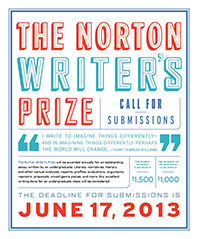
writers_prize_2013I’ve been thinking about these changes for the past few days as I’ve reread my students’ work to select something to nominate for the fourth annual Norton Writer’s Prize, a competition that invites a broad range of submissions, encompassing the variety of writing that’s now typical of composition classes: “[l]iteracy narratives, literary and other textual analyses, reports, profiles, evaluations, arguments, memoirs, proposals, mixed-genre pieces, and more: any excellent writing done for an undergraduate writing class will be considered.”

For their final major writing assignment of the school year, my students wrote ethical reasoning arguments per program requirement. But over the course of the year, they also wrote blog posts, snail mail, personal narratives, timed essay exams, cover letters, résumés, and highly imaginative scripts in which they placed themselves in conversation with the writers of some of the articles and essays they’d read. For some students, those scripts evolved into traditional research arguments. For others, the process of working with those sources revealed that their real research interest lay elsewhere.

I wish I could have nominated more than one piece of writing. For reasons of privacy, I won’t address the particulars of the one that I chose, and I won’t offer any details from the nominating letter that I wrote to accompany it. I will note, instead, how many students shone brightest when an assignment took them by surprise, asking that they write in new ways.

Posted in Reading, Teaching, Writing

Flying Without a Map

Movies and the Meaning of Life (2005), which includes the essay “Flying Without a Map: Chasing Amy and the Quest for Satisfying Relationships”

I don’t want my students to feel as if they’re flying without a map.

So, as a model for them—many of whom are currently writing annotated bibliographies–I spent the better part of the morning composing the sample annotation that follows. The process awakened in me an interest in writing about Chasing Amy and Jerry L. Walls’ study of the film. Perhaps that’s a project for the summer.

Walls, Jerry L. “Flying Without a Map: Chasing Amy and the Quest for Satisfying Relationships.” Movies and the Meaning of Life. Ed. Kimberly A. Blessing and Paul J. Tudico. Chicago: Open Court, 2005. 137-149.

“Flying without a Map: Chasing Amy and the Quest for Satisfying Relationships” considers Kevin Smith’s film Chasing Amy (1997) as a reflection of our moral ambiguity. In the words of the essay’s author, Jerry L. Walls, Chasing Amy offers “a vivid picture of what happens to us emotionally, morally, and relationally when we try to revise morality in some fairly radical ways, while still holding onto selected parts of our traditional morality” (140).

In his analysis of the film’s principle characters, Walls cites Edward O. Wilson’s article “The Biological Basis of Morality,” highlighting the two options Wilson identifies as the ones that determine and divide our worldviews: (1) that moral and ethical principles “exist outside of the human mind,” or (2) “they are inventions of human minds” (141). Subsequently, Walls’ examination of Holden McNeil (Ben Affleck), who holds the former view, and Alyssa Jones (Joey Lauren Adams), who holds the latter view, illustrates how Alyssa challenges Holden to rethink his beliefs. While Holden tells Alyssa that he likes girls “Because that is the standard,” he cannot explain to her why he believes what he believes or why he should believe it.

Walls chronicles Holden’s and Alyssa’s moral evolution, noting the irony of Holden’s 180-degree shift, marked by the solution he proposes to Alyssa and Banky (Jason Lee), and concludes his essay by suggesting that Chasing Amy depicts “an even larger quest,” one for God (149).

Though I agree with Walls’ central thesis (that the film offers “a vivid picture of what happens to us emotionally, morally, and relationally when we try to revise morality. .  .”), I disagree with his conclusion, which rests on the questionable assumption that religion offers a map that other foundations for ethics and morals cannot. It comes as no surprise that Walls as a professor of the philosophy of religion turns to faith in the final pages of his essay. But by choosing that path, he overlooks how the film’s characters—all comic-book artists—turn to art as a way of making sense of their lives.

Posted in Social Media, Teaching, Writing

Letters of Recommendation

Last week in the midst of writing letters of recommendation, I decided to devote my next blog entry to the subject. As I tried to explain to students why they should waive their rights to read their letters, I realized that in our age of social media, many students have never stopped to consider why they should waive their rights to read what their professors and employers have written about them.

Here’s why: You’re asking someone with whom you have an excellent working relationship to vouch for your abilities. If you aren’t sure the person thinks highly enough of you to write a strong recommendation, don’t ask that person for a letter. Ask someone else.

Not waiving your rights implies not only a lack of trust–I’m asking you to write a letter, but I don’t trust that it will be good–it also indicates a degree of self-doubt. (I doubt that I’m good enough.) When selection committees and potential employers read your application, you don’t want them to question your trust in others or your confidence in yourself.

When you ask someone to write a letter for you, give that person a copy of your resume. As a professor, I can address my students’ work in the classroom, but I can’t refer to their extracurricular activities and awards if I don’t know what they are.

Lastly, on a practical note, make sure that you give your letter-writers the full address of the company, school, or scholarship foundation to which you are applying. Even if the letter-writer will be submitting the letter to you in a sealed envelope to include in your application–and often that’s the case–the letter-writer still needs the full address of the recipient.

Why does the letter-writer need the recipient’s address if the letter-writer isn’t going to mail the letter?

The answer is simple: The recipient’s address appears in a business letter below the date and above the salutation (Dear Dr./Professor/Mr./Ms.). If a letter-writer doesn’t follow proper form, the recipient may question his or her credibility. And you don’t want  selection committees and potential employers to question the person you’ve called upon to vouch  for you.

For more valuable advice on letters of recommendation, see Mitch Harden’s “Waiving Your Rights“–which isn’t just about waiving your rights, it offers other useful tips as well.

Posted in Reading, Teaching

Groundhog Day and Nietzsche

Movies and the Meaning of Life (2005), which includes the essay “What Nietzsche Could Teach You: Eternal Return in Groundhog Day.”

For Monday my Focused Inquiry students will read “What Nietzsche Could Teach You,” which considers the film Groundhog Day (1993) as an illustration of eternal return. It’s an essay I’ve never taught before. I decided to teach it this semester as a way of responding to a suggestion some students offered last spring on their anonymous questionnaires—specifically that we discuss more of the big questions that we ponder throughout our lives.

So, for our first post-Groundhog Day class, we’ll view scenes from the film and consider the evolution of Phil Connors (Bill Murray), from unhappy weatherman living for the future to renascence man happily embracing the present.

According to James H. Spence, author of “What Nietzsche Could Teach You,” Phil Connors’ change signifies his rejection of the Christian view of linear time in which the future gives value to the present. Nietzsche’s alternative, his eternal return, posits that “[r]ather than moving on to a better (or worse, if we are bad) place after this life, we would relive our life over and over again, exactly as we had before” (274).

Today as I meditate on Spence’s essay and on the film, I’m aware of how rarely I live in the moment, and I’m reminded of a line that friend and teacher Doug Jones often says: We teach what we need to learn. We do, Doug. We really do.

Spence, James H. “What Nietzche Could Teach You: Eternal Return in Ground Hog Day.” Movies and the Meaning of Life. Ed. Kimberly A. Blessing and Paul J. Tudico. Chicago: Open Court, 2005. 274.

Posted in Reading, Social Media, Teaching, Writing

Storytelling and Simulated Worlds

Sunday’s New York Times Magazine featured an essay on narration that a friend mentioned on Facebook. I didn’t see her comment initially because I don’t frequent Facebook. My husband posts there several times a day though, so he passed the news along to me. Now that I’ve read the essay, I’m ready to enter the conversation–but not on Facebook, where it seems too late. My friend’s request–“I’d love to hear more thoughts on this”–now lies buried beneath four days of links and “likes” and photos.

The essay “Once Upon a Time, There was a Person Who Said, ‘Once Upon a Time‘” reminds me of Ray Bradbury’s story “‘The Veldt” (1950), which my students and I read and studied this week. The  story’s crystal-walled virtual-reality nursery leads the Hadley children away from creativity toward passivity. When the son, Peter, admonishes his father for removing the picture painter from the nursery, George Hadley replies: ‘. . . I wanted you to learn to   paint all by yourself, son” (76).

“I don’t want to do anything but look and listen and smell,” Peter replies. “What else is there to do?” (76).

Ray Bradbury’s short story collection The Illustrated Man (1950), which includes “The Veldt.”

In “Once Upon a Time. . . ,” writer Steven Almond addresses how visual media (Bradbury’s crystal-walled virtual-reality) has changed how we conceive of storytelling. “Traditionally,” Almond writes, “stories represented an active collaboration. Listeners and readers were called upon to create the world described by the artist. Film advanced a new model of collaboration. An array of artists (screenwriters, actors, cinematographers, set designers, etc.) worked together to invent an ultra-vivid artificial world. The audience’s role became increasingly passive–to absorb and react, not to imagine. Television shrunk the wonders of film and delivered them directly to our living rooms.”

The absence of narration in “the shrunken wonders of film”–now shrunken to fit our iPhone 5 screens–isn’t simply the loss of a literary device. It’s the atrophy of an essential skill: one that enables us to make sense of the world. It’s no surprise that Almond’s creative writing students produce short stories that lack coherence. Or that many of the freshman in my classes struggle to produce essays of more than 1,500 words. If I write any more, I’ll be repeating myself, they often say, not because they can’t write more, but because they can’t imagine writing more. To do so would require the sustained attention and reflection that our digital culture leaves behind.

Posting to Facebook about the decline of narration isn’t the equivalent of driving and texting about the dangers of driving and texting. But it does underscore a consistent contradiction in our lives. As a writer and a teacher, I attempt to reconcile that incongruity with blog posts–writing that my students and I can draft and revise before our words enter the sphere Almond describes as “the simulated world through which most of us flit from one context to the next, from Facebook post to Tumblr feed to YouTube clip, from ego moment to snarky rant to carnal wormhole.”

Posted in Social Media, Teaching, Writing

Social Media in the Classroom, Tommy’s Blog

For the past several years, I’ve explored various ways of incorporating social media into my UNIV 112, Focused Inquiry II classes, offering students the option of maintaining blogs and creating a Facebook page for the course, which students weren’t required to “like,” but were encouraged to post to as an alternative to blogging. I was still uncertain of how I would introduce social media next semester, when one of my former students, Tommy McPhail, sent me an email message, which I include below with his permission.

29 November 2012

Prof. Lucas,

I recently underwent a Cultural Discovery Project for my EDUS 476 class (the introductory course to being an RA at VCU). Afterwards, I wrote a blog post comprising my thoughts, and the response was incendiary. Within 24 hours, my post went viral received thousands of hits. To date, the post has received over 40,000 hits on Tumblr alone, and was one of the top posts on Reddit, in addition to being signal-boosted by various Facebook networks, Philadelphia Slutwalk, and my favorite author. I’ve received a plethora of encouragement, criticism, heartfelt praise, objection, and even a marriage proposal from a blogger in New Zealand. The very idea that my writing could reach so many people worldwide, let alone evoke such a response, has been both overwhelming and inspiring. It was only fitting that I forward this along to you. I would not have been able to accomplish something like this without you and your class. It really inspired me, particularly the social media components, to start using my blog for social advocacy purposes. Thank you so much for all that you do. I hope you enjoy the piece.

My essay and the accompanying appendix are attached for your convenience. Here is a link to my original post:

Tommy’s blog post on his Cultural Discovery Project and the overwhelming response it received attest to the value of social media as platforms on which students’ work in the classroom–in Tommy’s case, EDUS 476–can have a life outside of the classroom with an audience of thousands of readers. At last count, Tommy’s Tumblr post had prompted 46,935 notes.

Now I know how I’ll introduce social media next semester: I’ll begin with Tommy’s blog.