Posted in Reading, Teaching, Theatre, Writing

Wendy Wasserstein’s “Third”

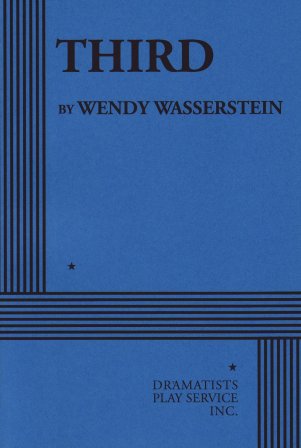
Wendy Wasserstein's "Third," the acting edition (2008)
Wendy Wasserstein’s “Third,” the acting edition (2008)

For their first paper of the semester, an annotated bibliography, my students have the option of choosing as their subject something they’re studying formally (for a class) or informally (on their own). As a model for them, I’ve composed a bibliography on Wendy Wasserstein’s Third, a play I’m studying—both formally and informally, in a sense—as I rehearse for the upcoming production at the Foothills Performing Arts Theatre.

The bibliography that follows includes the play itself, as well as two secondary sources: a review of the original Off Broadway production at the Lincoln Center Theater, and an academic essay by a professor of theater and literature, a harsh critic of Wasserstein’s who reexamined and reevaluated the playwright’s work after her death.

For me, as I rehearse for Third, Wasserstein’s words are far more important than what any drama critic or theatre scholar has written about the play, but I value what I’ve learned from Ben Brantley’s review and Jill Dolan’s essay, regarding both the critical reception of Wasserstein’s final play and the differences among the productions at the Lincoln Center, the Geffen Playhouse, and the Philadelphia Theatre Company.

Annotated Bibliography

Brantley, Ben. “As Feminism Ages, Uncertainty Still Wins.” Nytimes.com. New York Times, 25 Oct. 2005. Web. 25 Jan. 2014.

Ben Brantley’s “As Feminism Ages, Uncertainty Still Wins” reviews the original production of Wendy Wasserstein’s Third, which opened Off Broadway at the Lincoln Center Theater on October 24, 2005. Observing the similarities between the play’s main character, Laurie Jameson (Dianne Weist), and title character of Wasserstein’s Heidi Chronicles, Brantley asserts that Third shares the shortcomings of her other plays: “an overly schematic structure, a sometimes artificial-feeling topicality and a reliance on famous names and titles as a shorthand for establishing character.” Brantley also notes that the supporting characters are more convincing than Laurie Jameson, both as written and performed. Nevertheless, Brantley commends the play as an affecting portrait of a woman confronting the “certainty of the uncertainty in life.”

Brantley, chief theatre critic for The New York Times, is the editor of The New York Times Book of Broadway: On the Aisle for the Unforgettable Plays of the Last Century (2001).

Dolan, Jill. “Feminist Performance Criticism and the Popular: Reviewing Wendy Wasserstein.” Theatre Journal 60.3 (2008): 433-457. Academic Search Complete. Web. 24 Jan. 2014.

In “Feminist Performance Criticism and the Popular: Reviewing Wendy Wasserstein,” Jill Dolan cites the death of Wendy Wasserstein as the impetus for rethinking her harsh criticism of the playwright’s work and the mainstream feminist playwriting that it represents. Dolan asserts that a close examination of Wasserstein’s last play, Third, demonstrates the impact of her work as well as its importance in raising public awareness of the debates within and about American feminism. Along with her analysis of the play’s text, Dolan presents a study of two divergent productions: one at the Geffen Playhouse in Los Angeles (2007), and a second at the Philadelphia Theatre Company (2008).

Jill Dolan is the Annan Professor in English, Professor of Theater in the Lewis Center for the Arts, and Director of the Program in Gender and Sexuality Studies at Princeton University. She is the author of The Feminist Spectator in Action: Feminist Criticism on Stage and Screen (2013).

Wasserstein, Wendy. Third. New York: Dramatists Play Service, 2008. Print.

Wendy Wasserstein’s Third spans one academic year at a prestigious liberal arts college in New England. The play focuses on Professor Laurie Jameson, an acclaimed feminist literary scholar, coping in midlife with her father’s advancing Alzheimer’s, her daughter’s departure for college, her husband’s detachment, and her best friend’s recurring cancer—all amid the onset of her own menopause, replete with hot flashes. On the first day of class, when Laurie encourages her students to contradict her, she has no idea what challenges she’ll face when one of them—the title character, Woodson Bull, III—takes her up on the offer. Angered by what she perceives as the Bush administration’s rush to war, she sees Third as a “walking red state” (27). When she accuses him of plagiarizing a paper she believes he’s incapable of writing, Third claims he’s a victim of “socio-economic profiling” (22).

Wendy Wasserstein’s other plays include An American Daughter (1997), The Sisters Rosensweig (1992), and Uncommon Women and Others (1977). Her most critically-acclaimed play, The Heidi Chronicles, won both the Tony and the Pulitzer Prize for drama in 1989. Third opened Off Broadway in late September 2005, four months before Wasserstein’s death from lymphoma.

Posted in Reading, Theatre, Writing

“One’s Whole Being Becomes Absorbed”

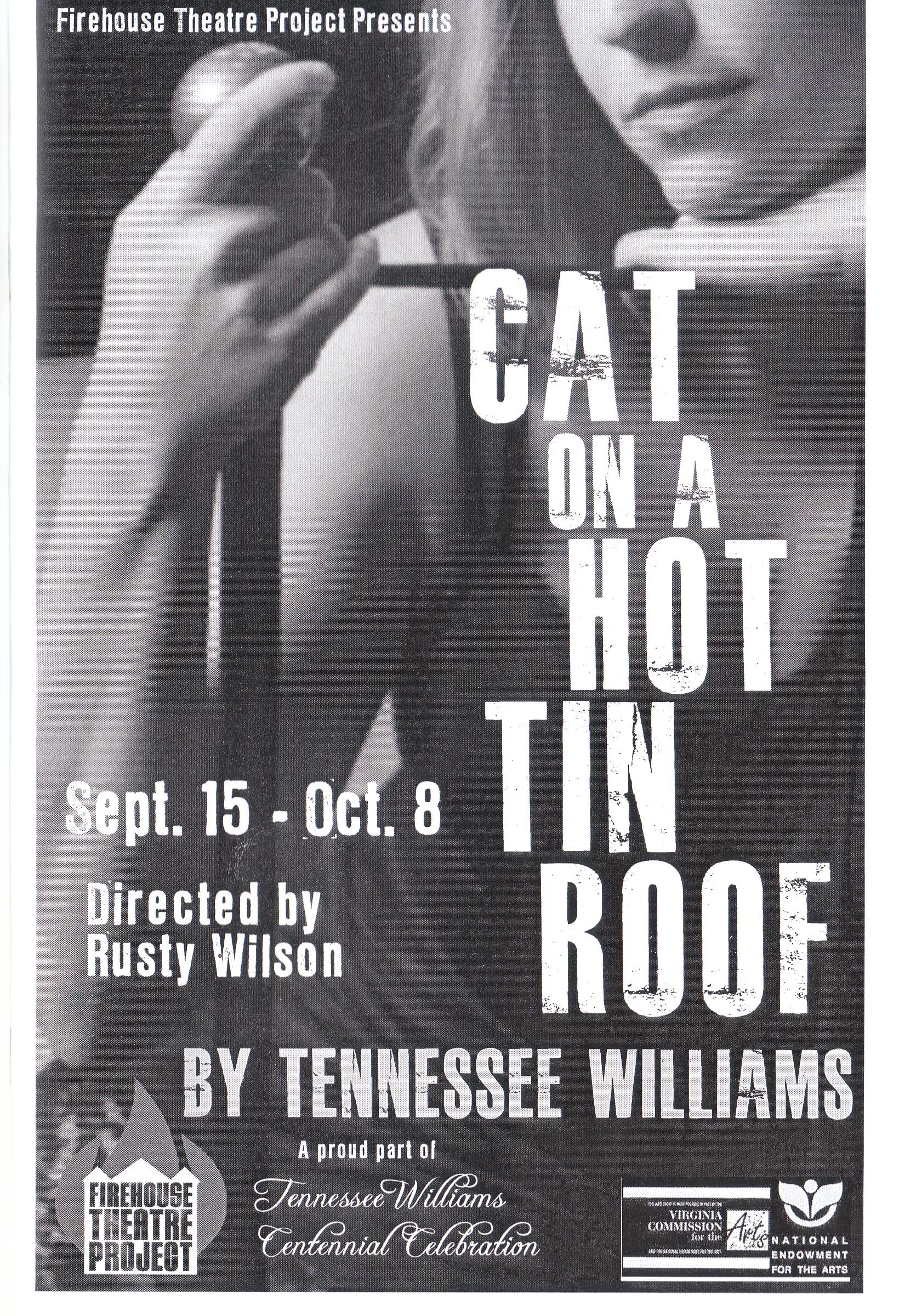
FTP’s Cat on a Hot Tin Roof, September 15 – October 8, 2011

The Firehouse Theatre’s September 19 staged reading of The Night of the Iguana and its current production of Cat on a Hot Tin Roof–both part of Richmond’s Centennial Celebration of Tennessee Williams–sent me back to the pages of Williams’ plays, which I’ve been rereading in the Library of America edition: Plays 1937-1955.

Williams’ Plays 1937 -1955 (2000)

I keep thinking of these words of Big Mama’s: “Time goes by so fast. Nothin’ can outrun it. Death commences too early–almost before you’re half-acquainted with life–you meet the other. . . .” In a recent Fresh Air interview, actress Margo Martindale told Terry Gross how saying those lines as a student differed from saying them decades later:

“I played Big Mama in Cat on a Hot Tin Roof when I was 20 years old at the University of Michigan. And then I played Big Mama on Broadway in 2004. The speech at the end of that play — ‘Time goes by so quickly …’ — boy did that have different weight from when I was 20 years old to when I was 50-something-odd years old. It’s all about what you’ve experienced. You can’t teach that to a younger actor. You have to have lived that.” In the current Firehouse production,
Jacqueline Jones
speaks Big Mama’s lines from experience as well, delivering one of the cast’s strongest performances.

In his introduction to Camino Real, Williams writes of the all-consuming nature of play writing: “It is amazing and frightening how completely one’s whole being becomes absorbed in the making of a play. It is almost as if you were frantically constructing another world while the world that you live in dissolves beneath your feet, and that your survival depends on completing this construction at least one second before the old habitation collapses.”

Today when I was completing an application for a grant, I thought of how it would enable my whole being to become absorbed–at least briefly–in the writing process in a way that it can’t when I’m teaching. Grants buy us time, which “goes by so fast. Nothin’ can outrun it.”

Posted in Reading, Social Media, Teaching, Theatre, Writing

On Readers’ Theatre, Blackboard, and Turning Away from the Screen

I planned to devote this blog entry—my first in two weeks—to the Virginia Blackboard User’s Group Conference, which I attended on Friday. But what lingers in my mind today isn’t the conference, it’s the personal narratives that my students presented in class after their draft workshop on Thursday.

To shift students’ focus away from “correcting” their classmates’ writing, I decided to devote the second half of class to Readers’ Theater. After students read and commented on their group members’ drafts, each group chose an essay to perform for the class, assigned parts, and assembled impromptu costumes and props.

To honor the students’ privacy, I won’t reveal any details about their personal narratives; I will simply say that their work left a lasting
impression on me. As readers they offered descriptive rather prescriptive comments, and as performers they gave their stories a life in the classroom that was separate and distinct from the words on the page.

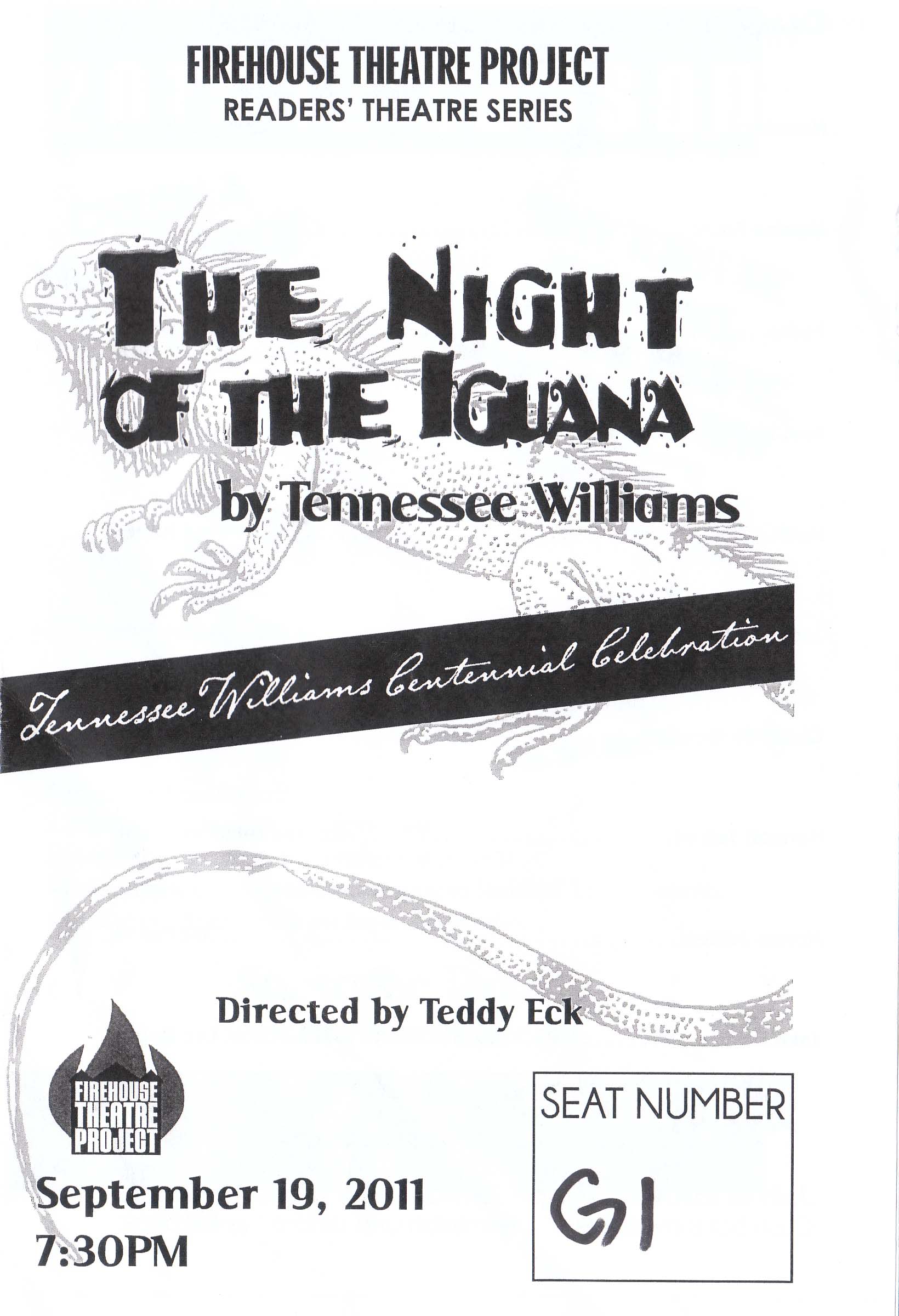
FTP’s The Night of the Iguana

The idea of combining a draft workshop with Readers’ Theater stems from my renewed interest in drama and my recent experiences at  Readers’ Theater performances staged at the Firehouse, including the September 19 reading of The Night of the Iguana, part of Richmond’s Centennial Celebration of Tennessee Williams.

The power of live theater and its influence on my teaching also speaks to my experience at yesterday’s Blackboard conference. Though I use Blackboard on a daily basis—and it’s usually projected on the screen in the classroom at least once during each of my Tuesday-Thursday classes—for me it’s simply a tool: a content management system for content that’s always changing.

During yesterday’s conference sessions, many in the audience divided their attention between the large screens at the front of the room and the small screens in their hands and their laps. In the 1:15 session, I overheard a man say his iPad was attached to his thigh.

More and more I see the need for opportunities to turn away from the screen and to face each other.  Though I don’t agree with many of David Mamet’s sentiments—in particular some of his pronouncements in his latest book, The Secret Knowledge: On the Dismantling of American Culture (2011)—I do concur with his notion that people go to the theater to see that real communication between human beings is still possible.  I know for me it’s true. My own return to the theater is in part a response to our increasingly digital lives.

Posted in Teaching, Theatre

“Acting Lessons for Teachers”

Acting Lessons for Teachers. 2nd Ed. (2007).

I wish I could have read Acting Lessons for Teachers (1994, 2007) in 1990 when I was teaching my first college classes. Robert T. Tauber and Cathy Sargent Mester‘s book would have shown me that my teaching act wasn’t a gimmick but a pedagogical necessity–not simply because I was a twenty-two-year-old who could have passed for seventeen but because all of us who teach are performers.

Despite its title, Acting Lessons for Teachers doesn’t offer tutorials on craft but instead describes the acting strategies that enhance teaching: physical and vocal animation, teacher role-playing, strategic entrances and exits, humor, props, suspense and surprise, and creative use of space. It also presents anecdotes from teachers, both K-12 and college professors, who have successfully employed those strategies in the classroom. Raymond J. Clough, Professor Emeritus of Modern Languages at Canisius College, recalls an evening in the mid-1960s when he saw Vincent Price perform a dramatic reading of Edgar Allan Poe’s “The Tell-Tale Heart.” For Clough, then a young college teacher, Price’s mesmerizing performance served as an epiphany, illustrating the importance of “training the voice” and of “knowing materials cold” (192).

Scott Richardson, Professor of Classics at St. John’s University, recounts how he presents a Viewer Mail segment in his classes to address the relevance of studying a dead language and broader questions regarding the value of higher education (202). To introduce the Greek god Dionysus, he invokes The Rocky Horror Picture Show (203).

While some teachers readily draw on the tools of actors in the classroom, others would rather not identify themselves as performers, believing that focusing on performance emphasizes entertainment over instruction. But all of us who teach–whether we call ourselves performers or not–share the aim of instructing our students, which requires their attention.  Acting Lessons for Teachers shows us how we can capture that attention as an actor would.

Posted in Social Media, Theatre

An Online Dating Musical

FTP’s Hearts on Line, August 14 and 15, 2011.

If you saw Hearts on Line last Sunday or Monday, you were face to face with characters pursuing relationships that began without face-to-face contact. I’ve been thinking about that since I saw Monday night’s performance, which I almost didn’t see.  I was one of the last people ushered to the section of folding chairs set up for the overflow crowd.

Live theater has far less cultural impact than the Internet now, yet  the staged reading of Hearts on Line played to sold-out crowds on both nights of its run at the Firehouse, August 14-15.

Playwright Rebecca Jones, Marketing Program Coordinator for VCU’s School of Business, depicts online dating with humor and insight, and the successful run of her show at the Firehouse attests to the value of black box theater as a venue for reflecting on our increasingly digital lives–if we’re willing to unplug for an evening.