 In my mind I have traveled back to my tenth-grade English classroom, to a desk where I haven’t sat for more than thirty-five years. Yet despite that temporal distance, parts of that room remain vivid to me: the side-by-side, long, narrow window and back door typical of public high schools built in the early 1970s and the air conditioning unit below the window. It was, in fact, the first public school in our county that was air-conditioned.
The relative smallness of the room seems at odds with the vast worlds of words that opened to me there in the pages of my textbook. I do not remember its title—all of those high-school literature anthologies had the word discovery or horizon in their titles, didn’t they? Though the title escapes me, I can still feel the waxy, uneven texture of the worn cover and the pages softened from semester after semester of students turning to these poems and short stories: “Because I Could Not Stop for Death” by Emily Dickinson, “The Death of the Ball Turret Gunner” by Randall Jarrell, “The Gift of the Magi” by O. Henry, “Grass” by Carl Sandburg, “An Occurrence at Owl Creek Bridge” by Ambrose Bierce, “Naming of Parts” by Henry Reed, and “The Song of the Wandering Aengus” by William Butler Yeats.
Why I recall more of those readings from my sophomore year of high school than I remember from the two years that followed, I do not know. Perhaps those poems and stories remain distinct in my mind because I was just starting to enjoy reading again. Books were my constant companions when I was a child, but in junior high I became too restless and distracted for them.
Along with those works of literature that I encountered for the first time in the pages of my sophomore anthology, I also discovered among them, to my surprise, some lines that I knew very well but didn’t expect to see in a textbook: the lyrics to “Eleanor Rigby.” (“Ah, look at all the lonely people / Ah, look at all the lonely people.”)
When Miss Peggy Stanton played “Eleanor Rigby” for us, I thought that she, my staid, middle-aged teacher (probably younger then than I am now) was antithetical to the screaming teenage girls in the footage of Beatles concerts. Miss Stanton was a woman of quiet strength. Childhood polio had left one of her legs shorter than the other, and she wore one shoe with a very thick sole to minimize her limp. I was so fascinated by her physical imbalance, I began to imagine her as a fictional character, a spinster school teacher whose brilliant mind compensated for her impairment.
As I sat in her class and listened to the words of “Eleanor Rigby,” I thought of my own loneliness. I dwelled on its particulars then, not old enough yet to understand that it wasn’t mine alone. But I began to understand something about the universality of our particular human struggles and began to develop my capacity for empathy in those days in Miss Stanton’s class, especially on the days when we turned in our textbook to the pages of Twelve Angry Men.
Though I may have seen the Henry Fonda film before I read the play, my first memory of Twelve Angry Men is reading it aloud in Miss Stanton’s class. I don’t remember which juror I was asked to read. What I remember clearly is holding one firm belief about the nineteen-year-old boy on trial for murdering his father and gradually realizing that what I had viewed as facts were merely suppositions, and that reasonable doubt warranted a verdict of not guilty.
Unlike the other works of literature that I’d read in English class, Twelve Angry Men didn’t dazzle me with poetic language or character development. The jurors spoke plainly. They were numbers without names. But when Juror Eight led his peers to question their assumptions, he led me to question mine. When I was a high school student in the early 1980s, critical thinking wasn’t the pervasive term that it is now in conversations about education. But that’s exactly what I was doing: thinking critically. And I was developing my capacity for empathy as I witnessed Juror Nine explain why he identified with one of the witnesses, an old man whose credibility is called into question:
I think I know him better than anyone here. This is a quiet, frightened, insignificant, old man who has been nothing all his life, who has never had recognition, his name in the newspapers. Nobody knows him, nobody quotes him, nobody seeks his advice after seventy-five years. That’s a very sad thing, to be nothing. A man like this needs to be recognized, to be listened to, to be quoted just once. This is very important. It would be so hard for him to recede in the background . . . . (Rose 36)
That old man was Eleanor Rigby, and so was Juror Nine.
Now, so many years later, I find myself revisiting the play as a reader of a different sort. I am sitting with its lines before me on three-by-five index cards, part of the line-learning ritual that I adopted when I returned to acting in my forties. Back in that tenth-grade classroom, 188 miles and decades away, I see that fifteen-year-old version of myself who had just started acting a year earlier. I am a stranger to her. I, this woman she would become, who would turn away from acting—to focus on college, and teaching, and writing—and then turn back to acting, and fall in love with it all over again, decades later.
As I study my lines, I continue to reflect on first reading Twelve Angry Men and on “Eleanor Rigby,” the two inextricably yoked in my mind—not only because I read them both my sophomore year but also because of their music. In the twelve jurors of Rose’s play, I hear the violins, violas, and cellos of “Eleanor Rigby.” And to be one of Rose’s players, to carry the music of a juror’s voice from page to stage, makes my heart sing.
Works Cited
Lennon, John and Paul McCartney. “Eleanor Rigby.” Revolver. Capitol, 1966.
Rose, Reginald. Twelve Angry Jurors. 1954. Penguin, 2006.


 When the thought of making small talk with the other guests at a fishing lodge overwhelms Charlie Baker, his friend Froggy LeSueur concocts a story to enable the shy, fretful Charlie to avoid conversation—and to do so without seeming rude. Froggy tells Betty Meeks, the owner of the lodge, that Charlie is a foreigner who doesn’t speak English. And to stave off questions about Charlie’s homeland, Froggy implies that he can’t disclose that information because Charlie is on a classified mission.
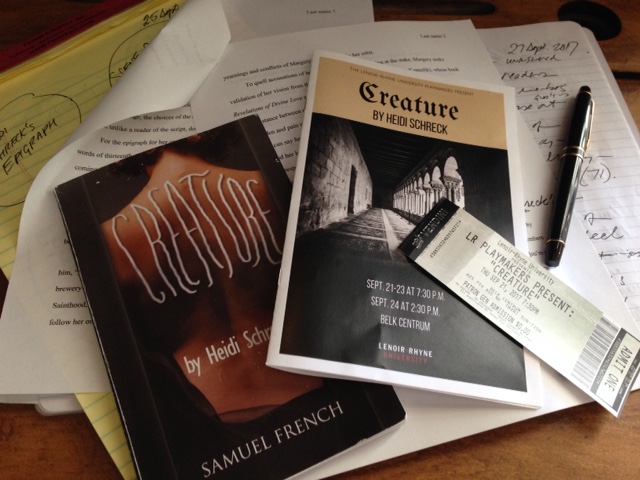 An epigraph stands out as a curious element in a play. For readers of the script, that quotation,which precedes the opening of the play and presents its prevailing theme, offers a signpost to guide them on their journey. However, for those who first encounter the play on the stage, the choices of the director and the actors must convey that idea, which the audience, unlike readers of the script, does not see in written form.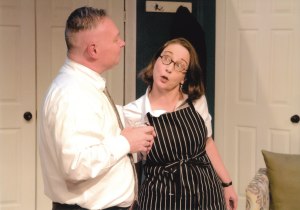





 struggles to come to terms with it. Though Cass chooses to start a new life, she continues to see the world through the lens of the ninth-grade teaching job that she leaves behind (along with Kip), equating her mistake of marriage to a mathematical miscalculation. As she explains to Kip: “Look, I agreed to marry you based on what I knew to be true. Kip equals X. X will make me happy. Everything added up. Seven years later I find out that you’re not X at all, you’re Z. And if you’re Z, then I did the math wrong” (1.1). Ever the math teacher, Cass perceives the world as a series of signs with determinate meaning, a tendency that seems to compound the difficulty of her quest. On the bus to Niagara, where Cass adopts fellow traveler Lois Coleman as her sidekick, Cass continues to think in terms of numbers, measuring her old life as “463 road signs behind me” (1.2). Though she eventually loses track of the signs, she remains focused on her numbered to-do list, which includes becoming a contestant on The Newlywed Game, a show that turns couples’ compatibility into a numbers game.
 therapy session, Cass says that “[i]t’s not just a game! Things have meaning. Or at least they should” (2.3). Her emphasis on “should” indicates that she has embraced the concept that meaning may be indeterminate. But neither she nor the other characters can leave numbers behind, not altogether. After Captain Mike, Kip’s rival for Cass’ affection, accidentally shoots himself, rather than reflecting on his death, the characters attempt to quantify fears as they quibble over which is number one: being alone, public speaking, or needles (2.3).
 The final scene on the river leaves the audience, along with Cass and Lois, in a holding pattern. What happens remains unclear. The ambiguity comes at a risk; it may try the patience of audience members who find the play’s farcical humor too ridiculous or contrived, or as New York Times reviewer Ben Brantley wrote “
