As you continue to revise your final essay and annotated bibliography, consider visiting the Writing Center. If you do so, you will earn five bonus points for the assignment.
To schedule an appointment, visit https://highpoint.mywconline.com, email the Writing Center’s director, Professor Justin Cook, at jcook3@highpoint.edu, or scan the QR code below. To earn bonus points for your final essay and annotated bibliography, consult with a Writing Center tutor no later than Thursday, November 21. The due date for posting the assignment to Blackboard and to your WordPress blog is Wednesday, November 20 (before class); the hard deadline is Friday, Novemeber 22 (before class).
The number of students who met with Writing Center consultants to receive feedback on their analyses was significantly lower than the number of students who met with Writing Center consultants to receive feedback on their literacy narratives.
Analysis Consultations
Section 19: 13 of 20 students, 65%
Section 20: 4 of 19 students, 21%
Literacy Narrative Consultations
Section 19: 18 of 20 students, 90%
Section 20: 7 of 19 students, 36.8%
Please take advantage of the opportunity to receive feedback from a Writing Center consultant and earn five bonus points for your assignment.
Next Up
Wordplay Day! To prepare for class, revisit the Dictionary and World Builder pages on the Scrabble website, and review the posts on my blog devoted to Scrabble tips.
Monday in class, after your Scrabble debriefing, you read a sample final essay and annotated bibliography written by a student in a previous semester. After you read and took notes on that sample assignment, you and two or three of your classmates collaboratively composed a one-paragraph assessment of it. Among the points that some of you addressed in your assessments include these:
The writer does mention her interest in whether writing longhand is more beneficial that typing, but she does not move beyond the simple either/or notion of the subject. A more substantive introduction would find her posing such questions as, in what contexts might writing longhand prove more beneficial than typing, and in what other contexts might the opposite be the case? The choice of sources might shed light on that, but her bibliography lacks a variety of perspectives. All of the sources except her interview with a classmate focus on published authors’ pereferences for beginning the writing process by composing longhand.
The final essay does include the minimum requirement of two quotations (one quotation from one source, a second from a second source), but the quotations are not followed by parenthetical citations.
The bibliography does meet the five-source minimum, but the sources are not presented in the correct order. They should be alphabetized by the authors’ last names.
One of the bibliographic entries does not include the author’s name.
The publication/interview information for each source is followed by a paragraph of summary and a second paragraph of commentary, but the commentaries are insufficient. Rather than offering some assessment of the source (explaining its usefulness, comparing it to another source), the commentaries primarily reiterate the ideas presented in the summaries that precede them.
The final essay and annotated bibliography is marred by errors of diction, grammar, punctuation, mechanics, and style. The mistake of writing the word cancer, instead of the intended word, chance, is an egregious error of diction (par. 4).
Additional Research and Writing
Wednesday morning we will review the points outlined above, and you will have the remainder of the class period to conduct additional research and compose additional portions of your final essay and annotated bibliography. Tasks to undertake include these:
Using the HPU Libraries databases to locate additional sources.
If the subject of your final essay/annotated bibliography has a Wikipedia page, locating that page, scrolling down to the list of references, and identifying one that might serve as one of your sources.
Using Google Scholar to locate a potential source.
Composing an annotation for one of your sources.
Reviewing the sources you have gathered and noting what similarities and differences you can identify among them. Those similarities and differences may serve as material for your essay or your commentaries.
Continuing to draft or revise your essay.
Next Up
Wordplay Day! To prepare for class, revisit the Dictionary and World Builder pages on the Scrabble website, and review the posts on my blog devoted to Scrabble tips. hen class resumes next Wednesday.
Today in class, after your Scrabble debriefing, you will read a sample final essay and annotated bibliography written by a student in a previous semester. After you read and make notes on it, you and two or three of your classmates will collaboratively compose a one-paragraph assessment of it. Questions to consider in your assessment include these:
Does the essay answer the questions included in the first bullet point in the key features section of the assignment?
Does the essay include quotations from at least two of the sources in the bibliography? Are the quotations introduced with signal phrases? Are parenthetical citations included where needed?
Does the bibliography include a minimum of five sources, an interview with a classmate and at least four print sources?
Are the sources in the bibliography listed in the correct order?
Does the bibliographic entry for each source include complete MLA-style publication or interview information?
Is the publication or interview information for each source followed by a paragraph of summary?
Is each summary followed by a paragraph of commentary?
Does each commentary answer some of the questions included in the third bullet point in the key features section of the assignment?
Is the final essay and annotated bibliography marred by errors of diction, grammar, punctuation, mechanics, and/or style? If so, note at least one specific example in your assessment.
After you complete your assessment, review the grade criteria on your final essay and annotated bibliography assignment handout, and assign a grade.
For those of you who are absent today, the sample student paper is posted on Blackboard.
Next Up
In class on Wednesday, you will have additional time for locating sources and composing annotations for your own final essay and annotated bibliography.
Tuesday’s blog post includes a sample annotated bibliographic entry for a research project devoted to David Sedaris’s writing. Today’s post features a second sample, one for a study of Helen Keller’s prose. As you continue to compile your own bibliography, look to this sample and Tuesday’s sample as models. Also refer to the samples in the model paper that I distributed in class yesterday and posted to Blackboard.
Note that the sample below lacks the indentations that will appear in the entries in your MS Word and PDF files. The first section of the bibliographic entry, the publication information, will have a hanging indent. The first lines of the summary and commentary paragraphs that follow will be indented five spaces or one-half inch.
Sample Annotated Bibliographic Entry
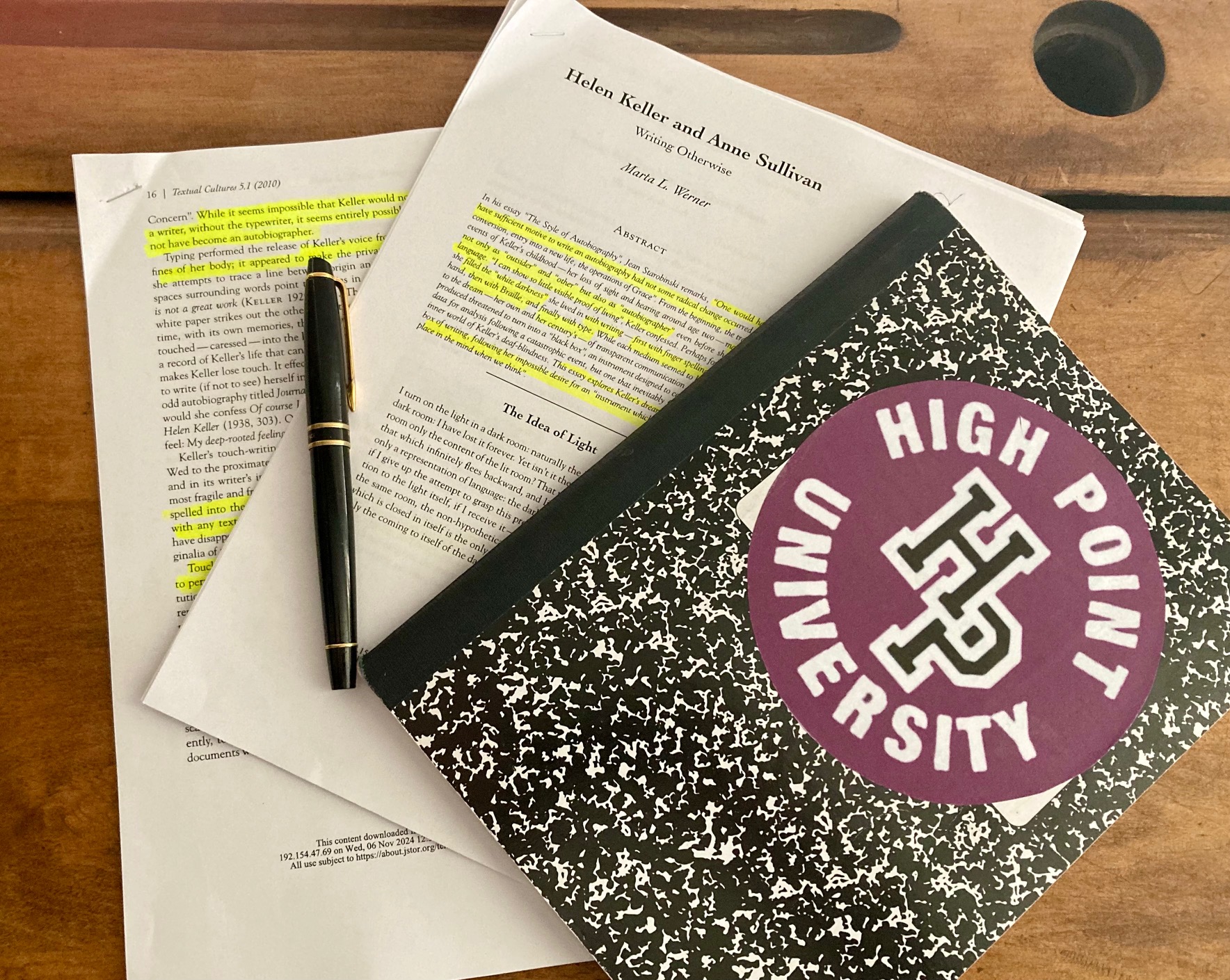
Werner, Marta L. “Helen Keller and Anne Sullivan: Writing Otherwise.” Textual Cultures, vol. 5, no. 1, 2010, pp. 1-45. JSTOR, https://doi.org/10.2979/tex.2010.5.1.1. Accessed 7 Nov. 2024.
In “Helen Keller and Annie Sullivan: Writing Otherwise,” Marta L. Werner traces the evolution of Keller’s writing from the words she first spelled with her fingers to the typewritten narratives she later produced. Werner observes that the typewriter enabled Keller “to translate the private tactile language of finger spelling into the public, visual code of print” (14).
Werner is a professor of English and the Svalgic Chair in Textual Studies at Loyola University Chicago. She is the author of several book-length studies of Emily Dickinson’s and Nathaniel Hawthorne’s writing, most recently The Master Hours of Emily Dickinson (2021). “Helen Keller and Annie Sullivan: Writing Otherwise” illuminates the differences between Keller’s early and later modes of writing and demonstrates how the latter gave her private world a public life. In Werner’s words, “without a typewriter, it seems entirely possible that she would not have become an autobiographer” (16).
Next Up
Wordplay Day! To prepare for class, revisit the Dictionary and World Builder pages on the Scrabble website, and review the posts on my blog devoted to Scrabble tips.
This morning in class you will read one of your classmate’s analyses and post a comment on his or her blog. The complete assignment appears below.
Go to the class blog page, https://janelucas.com/english-at-high-point/,and click on the link for the blog of the of classmate whose name precedes yours on the roster. If you are first on the list, go to the blog of the student whose name is last on the list.
If the student’s blog is not accessible, email the student and ask that he/she email you a copy of his/her literacy analysis.
Read the classmate’s analysis and compose a response (75 words, minimum) that addresses one or more of these elements: the title, the thesis, textual evidence, a quotation from the text.
Does the blog post include an image that documents part of the blogger’s writing process away from the screen? ___ (yes or no)
Does the post include a relevant embedded link? ___ (yes or no)
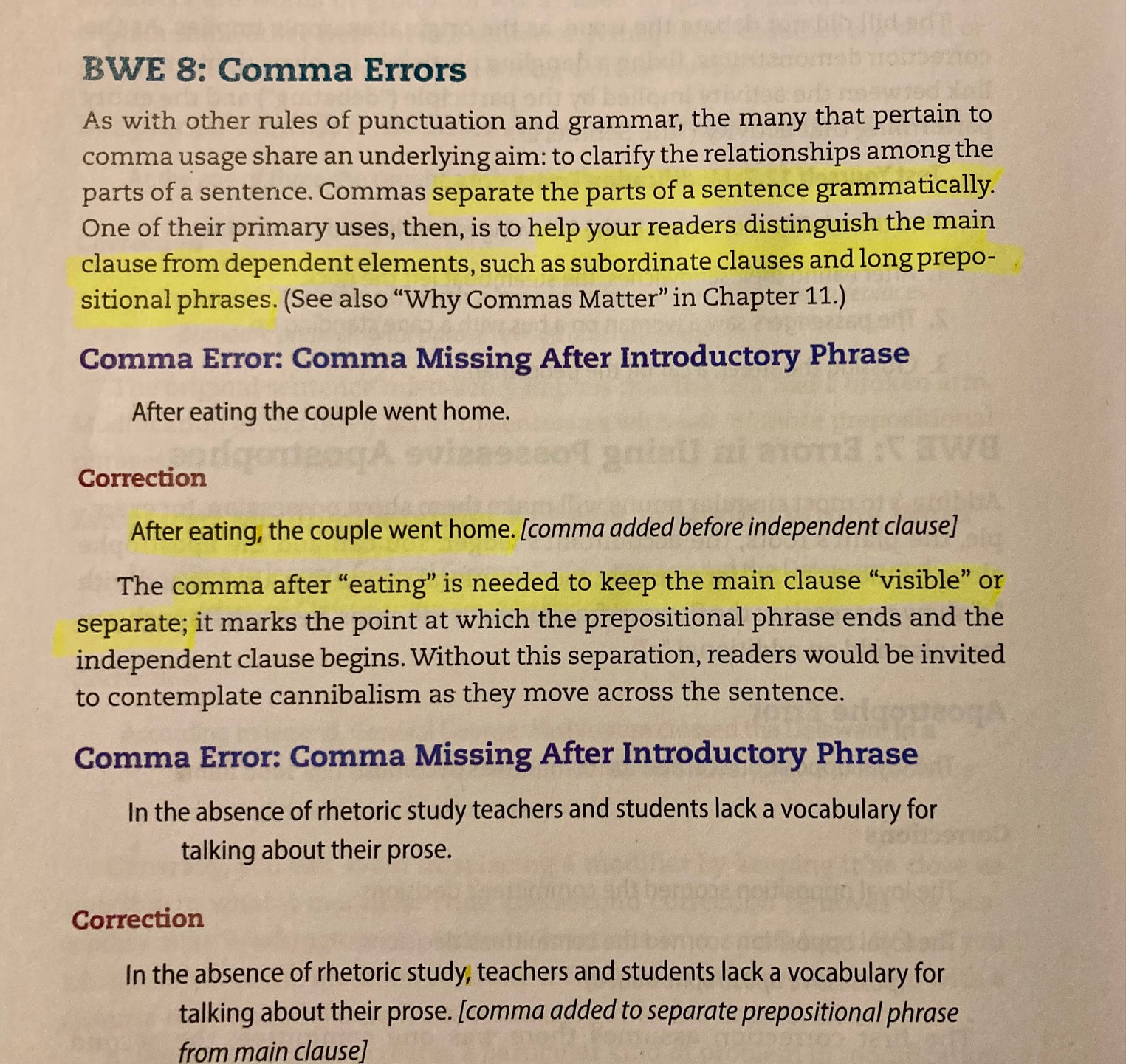
Identify one or more of the “Nine Basic Writing Errors” (see Writing Analytically, 423-44). In your response identify the error by name and number, and also quote the writer’s error. If you cannot identify one of the nine basic errors, include a sentence in your response that quotes a sentence of your peer’s and identify by name and number the error that he or she avoids.
Examples
An instance of BWE (Basic Writing Error) 3: Errors in Subject-Verb Agreement occurs when you write, “Mr. Zylberberg’s head and torso appears” (par. 2). The singular verb “appears” should be “appear” because the subject, head and torso, is plural.
You avoid an instance of BWE (Basic Writing Error) 7: Errors in Using Possessive Apostrophes when you write, “Spiegelman further emphasizes the mourners’ identification with the hanged men by extending two of the nooses’ ropes upward” (par. 3). Both “mourners” and “nooses” are correctly presented as possessives with the addition of an apostrophe after the final “s” in each.
Next Up
In class on Wednesday, we will review a sample final essay and annotated bibliography, and you will have the remainder of class to devote to your own research and writing.
Yesterday in class, on the worksheet you completed, you were required to select a phrase or sentence from your interview and introduce it with a signal phrase. You were also required to compose a complete annotated bibliographic entry. (See the assignment handout or the copy posted in Blackboard for annotated bibliographic entry requirements.)
Although you are not required to transcribe your complete interview, I encourage you to do so. If you decide that you want to include in your annotated bibliography and/or final essay a phrase or sentence other than the one you included on your worksheet, having a file of your complete interview will enable you to easily copy and paste lines from your interview into your essay and/or your bibliography.
Transcripts of my own interviews with students are included below as models for your own.
Interview with Jesse Brewer
Q: Jesse, what experience did you have with playing Scrabble before you encountered the game in English 1103?
A: So, whenever I would go up to my grandmother and grandfather’s house in Pennsylvania, we would play Scrabble pretty consistently there. We had a lot of fun playing Scrabble at my grandmother’s house whenever I was a young child.
Q: Has Scrabble changed your perspective on reading and/or writing? If so, how?
A: While I wouldn’t necessarily say it has changed my perspective on reading or writing, it has most certainly introduced me to new words which allows me to read or write more capably in everyday situations.
Q: Will you continue to play Scrabble after the conclusion of the semester?
A: Yes, my grandmother is still going to want to play it every summer.
Interview with Ava Salvant
Q: Ava, what experience did you have with playing Scrabble before you played it in English 1103?
A: I didn’t have any experience with Scrabble beforehand. I didn’t know how to play it at all.
Q: Has Scrabble changed your perspective on reading and/or writing? If so, how?
A: Probably it has influenced my ability to write. Not always when you sit down to write do you know the exact words you want to say. You kind of have to go with the flow. You have to put as many words as you can down on the board in Scrabble or on the paper when writing.
Q: Will you continue to play Scrabble after the end of the semester?
A: I might come back to it a few times to refresh or just use as a pastime.
Additional Sources
At the beginning of yesterday’s class, I distributed copies of four articles, each of which focuses on one of the aspects of the course. If you choose one of those aspects as the subject of your final essay and annotated bibliography, the corresponding article will be the one that serves as the starting point for your research. (See item two under the Assignment Directions on page two of the assignment handout.) If you were absent yesterday, download copies from Blackboard and print them. The titles, authors, and subjects are listed below.
“Blogs vs. Term Papers” by Matt Richel (blogging in the classroom)
“The Case for Writing Longhand” by Sarah Bahr (writing longhand)
“Scrabble is a Lousy Game” by Jonathan Kay (playing Scrabble)
Wordplay Day! To prepare for class, revisit the Dictionary and World Builder pages on the Scrabble website. Also review the blog posts devoted to Scrabble tips.
Your final essay and annotated bibliography will focus on one of the authors we have studied or one of elements of the course, including (1) blogging in the classroom, (2) limiting screen time, (3) writing longhand, and (4) playing Scrabble. As a starting point, you will conduct a short personal interview that will serve as one of the sources for your project. If you decide that you do not want to use the interview that you conduct today, you are welcome to include another one in your project. Keep in mind, however, that the interview you include in your project must be conducted with a student currently enrolled in section twenty or twenty-one, and the subject of the interview must be the subject of your project.
Questions to ask your interviewee include the following:
What experience, if any, did you have with the subject (the reading or the aspect of the course) before you encountered it in English 1103?
Has it changed your perspective on reading and/or writing? If so, how?
Will you continue to pursue the subject (read more work by the author, continue the classroom practice or activity) after the conclusion of the semester?
After you conduct your interview, compose on the worksheet provided a sentence in which you introduce a quotation from the interview with a signal phrase or clause, such as, According to . . . , or [insert first and last name] notes or observes or points out that . . . .” Your quotation will not be followed by a parenthetical citation because it is a form of oral communication (without page or paragraph numbers). See the sample on your worksheet.
Follow your quotation with annotated bibliography entry in this format:
Annotated Bibliography*
Last Name, First Name. Interview. Conducted by Your First Name Your Last Name. Day Month Year.
*Note that you will use the header annotated bibliography, not works cited, in your final essay and annotated bibliography.
Below the work cited/bibliography entry, compose a one-paragraph summary of the interview followed by a second shorter paragraph that identifies the student by class and major (or undeclared) and addresses what role the interview might serve in a larger project. Would it serve as a point of comparison or contrast to another source? Would it support or challenge an idea presented in another source? See the model below.
Sample Quotation with Signal Clause
English 1103 student Jesse Brewer observes that Scrabble has expanded his vocabulary, saying it has “introduced me to new words, which allows me to read and write more capably in everyday life.”
Sample Annotated Bibliographic Entry
Brewer, Jesse. Interview. Conducted by Jane Lucas. 20 Oct. 2023.
English 1103 student Jesse Brewer recounts how he has played Scrabble for most of his life. Ever since he was a young child, he has played the game with his grandparents whenever he visited their home in Pennsylvania. Brewer will continue to play Scrabble after the end of the semester because the game remains a tradition in his family. In his words, “[M]y grandmother is still going to want to play it every summer.” Brewer also notes that the game has expanded his vocabulary, saying it has “introduced me to new words, which allows me to read and write more capably in everyday life.”
Brewer is a freshman computer science major at High Point University, where he is currently enrolled in English 1103, section 20. His remarks on vocabulary building highlight the game’s verbal benefits, and his observations on Scrabble as a family tradition serve as a point of contrast to that of some other students,’ such as Ava Salvant’s, who have not played Scrabble before playing it as a weekly exercise in English 1103.
Note that the first paragraph of the bibliography entry, the summary, is written in present tense and third person. Also note that after the first mention of the interviewee’s name, he is referred to by last name.
The annotated bibliographic entry for your interview will be shorter than your other entries because (1) you are annotating a brief interview, and (2) your classmate does not have the credentials that you will list in the annotations for your other sources.
The complete final essay/annotated bibliography assignment appears below.
Overview
An annotated bibliography is a list of sources on a subject that includes a summary of each source. Some bibliographies include additional information, such as the authors’ credentials. That is the type of bibliography that you will compose along with your final essay for the course.
Key Features
Your final essay, which is an introductory essay of three or more paragraphs that (1) presents the subject of your bibliography, and (2) addresses your purpose for compiling it. In other words: What drives your research? What interests you about the subject, and what question/s do you seek to answer about your subject?
A complete MLA-style bibliography entry for each source.
A one-paragraph summary of each source followed by a shorter second paragraph that presents the writer’s credentials and addresses the purpose that the source might serve in a larger project. Would it serve as a point of comparison or contrast to another source? Would it support or challenge an idea presented in another source? Is it a secondary source that sheds light on the meaning of a primary source? The last question pertains primarily to bibliographies that focus on one of the writers studied in the course.
Preliminary Work—What to Complete in Class Today
Personal Interview
Your final essay and annotated bibliography will focus on one of the authors we have studied or one of elements of the course, including (1) blogging in the classroom, (2) limiting screen time, (3) writing longhand, and (4) playing Scrabble. As a starting point, you will conduct a short personal interview that will serve as one of the sources for your project. If you decide that you do not want to use the interview that you conduct today, you are welcome to include another one in your project. Keep in mind, however, that the interview you include in your project must be conducted with a student currently enrolled in section 20 or 21, and the subject of the interview must be the subject of your project.
Begin by conducting a short personal interview and composing an annotated bibliographic entry for the interview. For more information, see the paragraphs under the header PRELIMINARY WORK—What to Complete in Class Today.
Compose an annotated bibliographic entry for the source that serves as the starting point for your research. See the list of texts that follows.
Use the HPU Libraries site, https://www.highpoint.edu/library/, and Google Scholar to locate a minimum of three additional reliable and relevant print sources (articles, essays, and/or books) devoted to the same subject. Compose your summaries and commentaries in complete sentences, introduce any quotations with signal phrases, and include parenthetical citations where needed. Your bibliography must include five sources, four of which must be print. (Your personal interview is a nonprint source.) If you wish to include an additional non-print source, such as a video, you may include that as a sixth source.
After you have composed your annotated bibliography entries, write an introductory essay that (1) presents the subject of your bibliography, and (2) addresses your purpose for compiling it. In other words: What drives your research? What question do you seek to answer about your subject? Also, (3) What larger project might develop from your bibliography? Would it be a project for a course in psychology, science, education, or another discipline? Address all five of your sources in your essay, and quote at least two of them.
Note: Though your introductory essay will precede your annotated bibliography, you will compose it last because you will need to re-read and summarize your sources before you will know how to address them in your essay.
Directions for Researching, Drafting, Revising, and Submitting
Devote today’s class primarily to conducting a personal interview and composing an annotated bibliography entry for the interview. You will have two additional Wednesdays to work in class on your final essay and annotated bibliography before you post your revision to Blackboard and to your WordPress blog.
Before class on the due date: Post a copy of your revision to Blackboard and to your blog. In your blog post, omit the first-page information included in your file submitted to Blackboard (your name, professor’s name, course and section, and date). Add to your blog post an image that documents some part of your writing process away from the screen, such as the summary of your source in your journal, today’s worksheet, or a page of your draft. Also add an embedded link to a relevant web site. Even though your work for this assignment will take place primarily in front of the screen, your writing process still involves putting pen to paper, and photographic documentation of that on your blog is a requirement of the assignment.
An A final essay and annotated bibliography includes these components:
An introductory essay of three or more paragraphs that (1) presents the subject of your bibliography, and (2) addresses your purpose for compiling it. In other words: What drives your research? What question do you seek to answer about one of the subjects that you’ve studied in the course or about one aspect of the course? Also, (3) what larger project might develop from your bibliography? Would it be a project for a course in science, psychology, education, or another discipline?
A complete works cited/bibliographic entry for a minimum of five reliable and relevant sources, four of which are print. Alphabetize the list by the writers’ last names.
A one-paragraph summary of each source followed by a shorter paragraph of commentary that presents the writer’s credentials.
An A final essay and annotated bibliography complies with the requirements above and is also cohesive and relatively free of surface errors.
A B final essay and annotated bibliography effectively meets all of the requirements above but may be flawed by minor issues of organization and/or surface errors.
A C final essay and annotated bibliography meets most but not all of the requirements above and may also be flawed by issues of organization and/or surface errors.
A D final essay and annotated bibliography meets only a few of the requirements above and may also be flawed by issues of organization and/or surface errors.
An F final essay and annotated bibliography fails to meet the requirements above and may also be flawed by substantial issues of organization and/or surface errors.
Next Up
Wordplay Day! To prepare for class, revisit the Dictionary and World Builder pages on the Scrabble website. Also review the blog posts devoted to Scrabble tips.
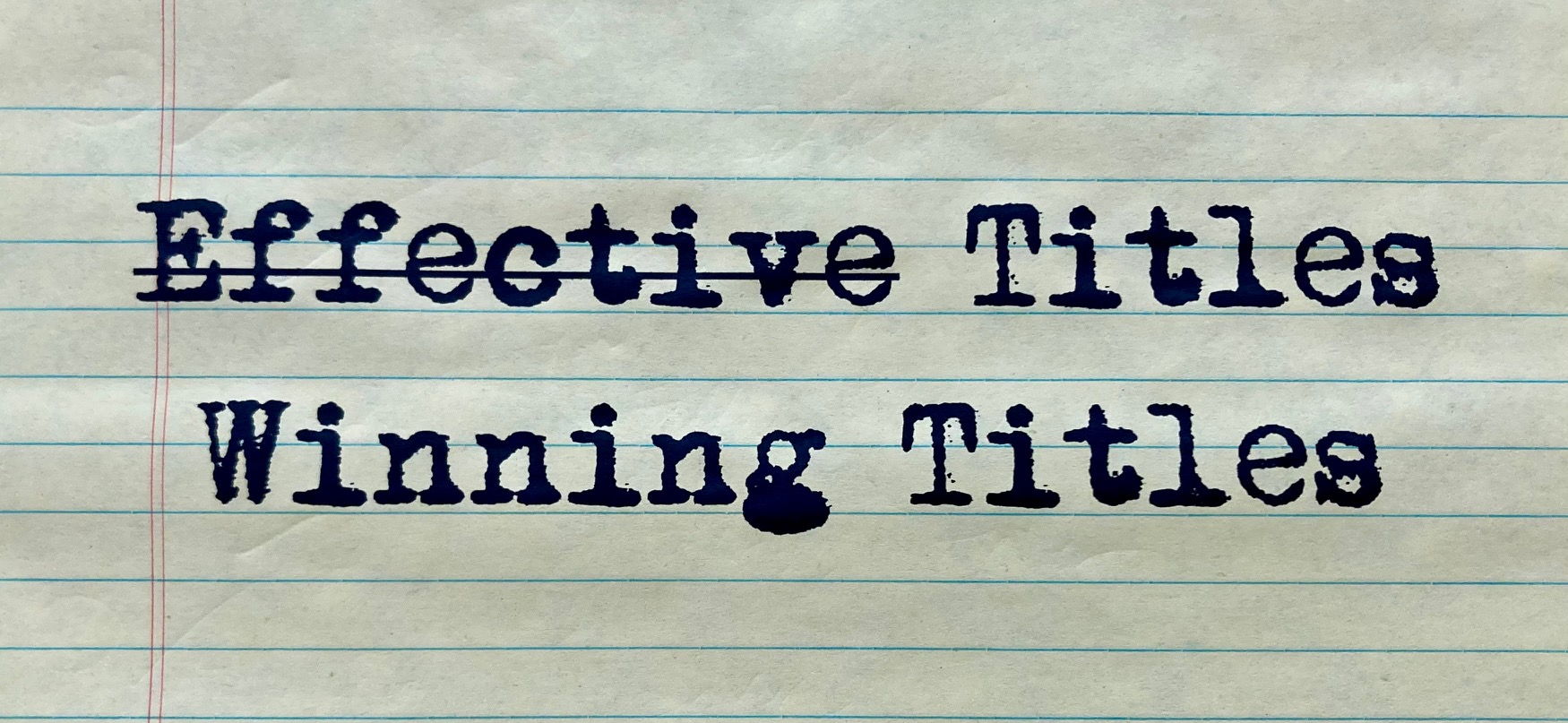
After you submitted your midterm reflections, I published a blog post featuring a list of your titles and gave you the opportunity to weigh in on your classmates’ titles and earn bonus points to boot. This post offers you a similar opportunity. (See the directions that follow.)
As I noted in my previous “Winning Titles” post, titles are important because they contain the first words of yours that a reader will encounter. First, a title should be descriptive; it should evoke an image in the reader’s mind. It should also be relevant to your subject; it should convey something about the writing to follow. Lastly, it should be intriguing; it should create in the reader a desire to keep reading. With those traits in mind, review the titles of your classmates’ analyses listed below. Which of ones of these are the most effective and why?
“Adding Impact to Injury”
“All Good Things Must Come to an End”
“The Back Story of ‘Back Story'”
“Breaking Down ‘The Falling Man'”
“A Closer Look into ‘The Blind Side'”
“The Death of School”
“A Decision of Fate”
“The Emotional Landscape of Football”
“Fear Factor”
“A Few Seconds Can Make a Difference”
“A Frozen Moment in Free Fall”
“Frozen in Time”
“How Fear Changed Football”
“Humor and Characterization in ‘Me Talk Pretty One Day'”
“Last Moments”
“Learning: A Significant Part of Life”
“The Light in a Field of Darkness”
“Light, Language, Life”
“Lost in Translation”
“Lost in the Moment”
“Literary Analysis of the School”
“Maturing and Learning”
“Michael Lewis’s Message through Fear and Dialogue”
“The Mindset that Brings Fear”
“Oher’s Blind Side Journey”
“Passion Put into Words”
“The Reader inside a Story”
“School Hallucinations”
“Seeing through Blind Eyes”
“Sink or Swim”
“Two-Way Street”
“The Value of Persevering through Discomfort”
“The White Savior”
Bonus-Point Opportunity
Directions:
Determine which two or more of your classmates’ titles you deem most effective.
Compose a comment that includes (1) each title enclosed in quotation marks, (2) a brief explanation of each title’s effectiveness, and (3) a comparison (and contrast) of each. Consider addressing two or more titles with similarities, such as alliteration or wordplay.
Post your comment as a reply to this blog entry no later than 9 a.m. tomorrow, Friday, October 25. (To post your comment, click on the post’s title, and scroll down to the bottom of the page. You will then see the image of an airmail envelope with a leave comment option.)
I will approve your responses (make your comments visible) after 9 a.m. deadline on Friday morning. Commenters will receive five bonus points for their October 25 Scrabble assignment.
Next Up
Wordplay Day! To prepare for class, revisit the Dictionary and World Builder pages on the Scrabble website. Also review the blog posts devoted to Scrabble.
This morning in class you will compose a short reflective essay that documents the processes of planning, drafting, and revising your analysis. In your reflection, you will include at least one relevant quotation from one of the sections of Writing Analytically listed below or from another section of the textbook.
Sample Works Cited Entries for Writing Analytically
Rosenwasser, David and Jill Stephen. “Late-Stage Editing and Revising: Some Tips.” Writing Analytically, 9th edition. Wadsworth/Cengage, 2024. pp. 151-52.
Rosenwasser, David and Jill Stephen. “On Keeping a Writer’s Notebook.” Writing Analytically, 9th edition. Wadsworth/Cengage, 2024. pp. 157-58.
Rosenwasser, David and Jill Stephen. “Putting X in Tension with Y.” Writing Analytically, 9th edition. Wadsworth/Cengage, 2024. pp. 248-49.
Rosenwasser, David and Jill Stephen. “The Thesis and the Writing Process.” Writing Analytically, 9th edition. Wadsworth/Cengage, 2024. pp. 237-38.
Questions to Consider in Your Reflection
What aspect of the writing seemed the most challenging? Choosing your topic? Deciding which text would serve as your subject? Determining your thesis? Identifying details to support your claims? Organizing the body of the essay? Composing the conclusion? Why did that aspect of the writing seem the most challenging?
Did the subject of your analysis change? If so, what was your original subject, and what did you change it to?
What do you consider the strongest element of your analysis?
At what point in the process did you decide on a title? Did you change the title during the writing process? If so, what was the original title?
What image that documents part of your writing process away from the screen did you include in your blog post? Why did you choose that particular image?
Next Up
Wordplay Day! To prepare for class, revisit the Dictionary and World Builder pages on the Scrabble website. Also review the blog posts devoted to Scrabble tips.
This morning in class you will read the sample student analysis “Wait Means Never” and collaboratively answer the questions that follow.
Does the writer present a summary of Martin Luther King, Jr.’s “Letter from Birmingham Jail” before he presents his thesis?
The authors of Writing Analytically note that “a productive thesis statement usually contains tension, the balance of this against that” (Rosenwasser and Stephen 248). Reread the thesis and note whether it includes any instances of “this against that.”
What specific example stands as the writer’s most effective support for his thesis
Effective strategies for concluding analyses include (1) offering an insight about the text or an additional quotation from it, (2) revisiting the thesis without stating it verbatim, and (3) pointing to the broader implications of the analysis. Does the writer employ any of those strategies? If so, which one or ones?
After you answer the questions above, review the grade criteria on your analysis assignment handout, and assign a grade. If you cannot reach a consensus, write each recommended grade.
Next Up
In class on Wednesday, you will compose a reflective essay on your analysis.





 Jane Lucas