Last week I published a blog post that listed the first twenty-two playable four-letter words with three vowels. Knowing those words, and others with multiple vowels, proves useful when you’re faced with a rack of mostly, or all, vowels. Here’s a list of the remaining fourteen playable four-letter words with three vowels:
naoi: ancient temples (pl. of naos)
obia: form of sorcery practiced in the Caribbean (also obeah)
odea: concert halls (pl. of odeum)
ogee: an S-shaped molding
ohia: a Polynesian tree with bright flowers (also lehua)
olea: corrosive solutions (pl. of oleum)
olio: a miscellaneous collection
ouzo: a Turkish anise-flavored liquor
raia: a non-Muslim Turk (also rayah)
roue: a lecherous old man
toea: a currency in Papua, New Guinea
unai: a two-toed sloth (pl. unai; an ai is a three-toed sloth)
zoea: the larvae of some crustaceans
Next Up
Wordplay Day! To prepare for class, revisit the Dictionary and World Builder pages on the Scrabble website. Also review the blog posts devoted to Scrabble tips.
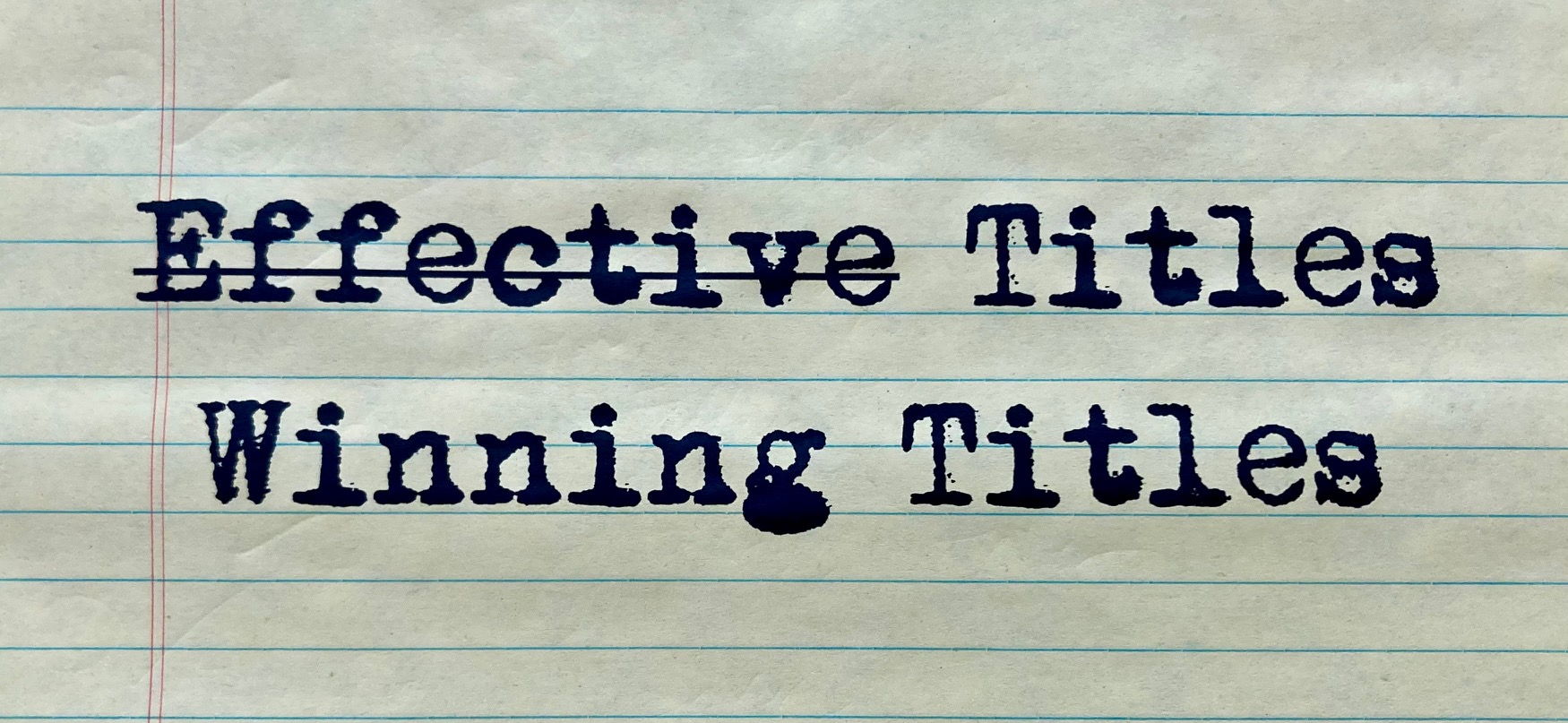
What makes for an effective title? That’s an important question to consider since the title contains the first words of yours that a reader will encounter. First, it should be descriptive; it should evoke an image in the reader’s mind. It should also be relevant to your subject; it should convey something about the writing to follow. Lastly, it should be intriguing; it should create in the reader a desire to keep reading. With those traits in mind, review the titles of your classmates’ midterm reflections listed below. Which of these is most effective and why?
“Aspects Leading to Success”
“The Awakening of My Inner Writer”
“Becoming a Better Writer
“Becoming a Stronger Writer”
“Controlled Writing”
“Developing as a Writer”
“Developing Skills”
“The First Half”
“Growth as a Writer”
“Growth in Analyzing”
“Growth-Mindedness”
“Highlights of Working with Others”
“How a Board Game Changed My Writing”
“How I have Grown”
“Impact of a Class”
“Impact of Collaboration”
“Improvements in My Writing”
“The Key to Writing”
“My Personal Development”
“My Road to Success”
“Professionalism”
“A Semester of Improvement”
“Seven Tiles but a Lifetime of Knowledge”
“The Start of a New Beginning”
“Think before You Write”
“Thinking beyond What I Knew”
“Transition to College”
“Unforeseen Clarity”
“Ways of Learning”
Bonus-Point Opportunity
Directions:
Determine which of your classmates’ titles you deem most effective.
Compose a comment that includes the title enclosed in quotation marks and a brief explanation of its effectiveness.
Post your comment as a reply to this blog entry no later than 4 p.m. today, Thursday, October 3. (To post your comment, click on the post’s title, and scroll down to the bottom of the page. You will then see the image of an airmail envelope with a leave comment option.)
I will approve your responses (make your comments visible) after the 4 p.m. deadline on October 3. Commenters will receive five bonus points for their October 4 Scrabble assignment.
Postscript
Congratulations to Ryan Kelley and Annalise Lindsay (section 19) whose titles were chosen as the most effective. Nicole Edelman (section 19) chose Ryan’s title “Impact of a Class,” and Cristique Duvall (section 20) chose Annalise’s title “Seven Tiles but a Lifetime of Knowledge.” Nicole and Cristique will each receive five bonus points for their October 4 Scrabble assignment/score sheet.
Next Up
Wordplay Day! To prepare for class, revisit the Dictionary and World Builder pages on the Scrabble website. Also review the blog posts devoted to Scrabble.
This morning, I will return your drafts with my notes, and you will have the remainder of the class period to begin revising your analyses on your laptops. Because next week is fall break, you will have two additional weeks to continue your revision work before you submit the assignment to Blackboard and publish it as a WordPress blog entry. The due date is Wednesday, October 16 (before class). The hard deadline is Friday, October 18 (before class). Directions for submitting your analysis are included on your assignment sheet and on the Blackboard submission site.
As you continue to revise your analysis, consider visiting The Writing Center. If you do so, you will earn five bonus points for the assignment.
To schedule an appointment, visit https://highpoint.mywconline.com, email the Writing Center’s director, Professor Justin Cook, at jcook3@highpoint.edu, or scan the QR code below. To earn bonus points for your analysis, consult with a Writing Center tutor no later than Thursday, October 17.
Nearly all of you in section nineteen consulted a Writing Center tutor as you worked on your literacy narrative, while less than half of you in section twenty did so:
Section 19: 18 of 20 students, 90%
Section 20: 7 of 19 students, 36.8%
Please encourage your classmates to take advantage of the opportunity to have an additional reader for your analysis-in-progress–and earn five bonus points to boot.
Next Up
Wordplay Day! To prepare for class, revisit the Dictionary and World Builder pages on the Scrabble website and review the blog posts devoted to Scrabble.
This morning in class you will plan and compose a midterm reflective essay that documents your work in the first half of the semester, focusing on two or three assignments or aspects of the course that have contributed to your development as a writer and a student. Since you have already written a reflection devoted solely to your literacy narrative, your midterm reflection should focus primarily on other assignments or aspects of the course, including the following:
Keeping a journal
Completing Check, Please! assignments
Studying one of the readings examined class, including “Letter from Birmingham Jail,” “Me Talk Pretty One Day,” “The Day that Language Came into My Life,” “The Power of the Pun,” “Back Story” (from The Blind Side), “The Falling Man,” “The School,” or the sample literacy narrative (“A Bridge to Words”)
Reading and editing samples of student writing
Writing for an online audience beyond the classroom/creating and maintaining a WordPress blog
Collaborating with your classmates on in-class writing assignments
Playing Scrabble/Collaborating with your teammates on Wordplay Day
Writing longhand
Limiting screen time
Include in your reflective essay the following elements:
A title that offers a window into your reflection
An opening paragraph that introduces your focus and presents your thesis
Body paragraphs that offer concrete details from your work to support your thesis.
A conclusion that revisits the thesis without restating it verbatim
Optional: A quotation from one the readings, introduced with a signal phrase and followed by a parenthetical citation. See the citation handout for models.
Sample MLA Works Cited Entries
Bartheleme, Donald. “The School.” The Best American Short Stories 1975, edited by Martha Foley, Houghton Mifflin, 1975. pp.8-11.
Sedaris, David. “Me Talk Pretty One Day.” Me Talk Pretty One Day. Little, Brown, 2000. 166-73.
Grade Criteria
GRADE CRITERIA
An A midterm reflection complies with all assignment guidelines, demonstrates a depth of understanding by using relevant and accurate detail, and is also well organized and relatively free of surface errors.
A B midterm reflection complies with all assignment guidelines and presents an adequate reflection that is well organized and relatively free of surface errors.
A C midterm reflection complies with most but not all assignment guidelines and may also be flawed by issues of organization and/or surface errors.
A D midterm reflection complies with only a few of the assignment guidelines and may also be flawed by issues of organization and/or surface errors.
An F midterm reflection fails to comply with most or all assignment guidelines and may also be flawed by substantial issues of organization and/or surface errors.
Next Up
On Wednesday, I will return the drafts of your analyses with my notes, and you will have the class period to devote to your revisions. The due date for your final revision is Wednesday, October 16 (before class). The hard deadline is Friday, October 18 (before class).
This morning in class, after I collect your fifth Check, Please! worksheets, you will begin planning and drafting your analysis. You will receive a hard copy of the assignment in class, and I am including an additional copy below.
Directions for Planning and Drafting
Review the texts that you have read for class, and determine which one appeals to you most as a subject of analysis.
Identify two or more elements that contribute to its effectiveness.
Develop your analysis through a close examination of those elements.
Write in dark ink, preferably black. You are welcome to use both sides of the page.
Before you leave class today, staple this handout on top of your draft and submit it to me. Next week I will return your draft with notes, and you will have the class period to begin revising and editing on your laptop or tablet.
Directions for Revising
The revision of your analysis should include the following:
A title that offers a window into your analysis
An introduction that includes a summary of the essay, essay excerpt, chapter, or story
A thesis statement, or main claim, that presents your take on the essay, essay excerpt, or chapter based on your close study of it
Textual evidence that supports your claims
A minimum of one relevant quotation from the text, introduced with a signal phrase and followed by a parenthetical citation
A conclusion that revisits the thesis without restating it verbatim
A work cited entry
A minimum of 600 words
Sample Works Cited Entries
Barthelme, Donald. “The School.” The Best American Short Stories 1975, edited by Martha Foley, Houghton Mifflin, 1975. pp.8-11.
Lewis, Michael. Chapter One: “Back Story.” The Blind Side. 2006. Norton, 2009, pp. 15-23.
Sedaris, David. “Me Talk Pretty One Day.” Me Talk Pretty One Day. Little Brown, 2000. pp. 166-73.
Think of your preliminary draft as your down draft; your aim in the early stage of the process is to get your ideas down on the page. You may need the process of drafting to discover what you think the essay, essay excerpt, or chapter means and how it makes its meaning.
Directions for Formatting and Posting Your Revision—See the Course Calendar for the Due Date and Hard Deadline
Save your revised essay as a Microsoft Word file or PDF and submit it to Blackboard in compliance with MLA manuscript guidelines.
Publish your revision as a blog post. In your post, omit the first-page information included in your file submitted to Blackboard (your name, course, section, instructor’s name, and date). Add to your blog post an image that documents some part of your writing process away from the screen, such as a photo of your reading notes or a page of your draft. Also add to your blog post an embedded link to a relevant website.
Grade Criteria
An A analysis complies with all assignment guidelines, demonstrates a depth of understanding by using relevant and accurate detail, and is also well organized and relatively free of surface errors.
A B analysis complies with all assignment guidelines and presents an adequate analysis but examines little more than what was addressed in class. A B analysis is also well organized and relatively free of surface errors.
A C analysis complies with most but not all assignment guidelines and may also be flawed by issues of organization and/or surface errors, or more consequential factual errors.
A D analysis complies with only a few of the assignment guidelines and may also be flawed by issues of organization and/or surface errors, or more consequential factual errors.
An F analysis fails to comply with most or all assignment guidelines and may also be flawed by substantial issues of organization and/or surface errors, or more consequential factual errors.
MLA Style
Look to my sample assignments on Blackboard as models of MLA style. For more information on MLA style, see the MLA Style Center and OWL sites linked to my blog.
Next Up
Wordplay Day! To prepare for class, revisit the Dictionary and World Builder pages on the Scrabble website, and review the blog posts devoted to Scrabble tips.
In the final revision of your analysis, you will include a minimum of one quotation, introduced by a signal phrase and followed by a parenthetical citation. The rough draft that you will begin in class tomorrow does not need to include a quotation because you may still be focused on determining which of the texts will serve as your subject. However, as your analysis progresses, you should be sure to review the citation notes in this blog post (and on the handout you will receive in class tomorrow) to ensure that you are citing the text correctly.
Parenthetical Citations
In your analysis, you will include parenthetical citations for quotations and paraphrases. Since you are writing a textual analysis, I recommend quoting rather than paraphrasing because the writer’s particular word choices are vital to the text’s overall effect. If your subject is one of the unpaginated texts (“The Day Language Came into My Life,” “The Power of the Pun,” or “The Falling Man”), your parenthetical citations will include the abbreviation par. for paragraph, followed by the paragraph number. If your subject is one of the paginated texts (“Me Talk Pretty One Day,” “Back Story,” or “The School”), your parenthetical citations will include the page number by itself.
Including the author’s last name as well would be redundant because you have established in your introduction that your essay focuses solely on a work by him or her. When you write a paper in which you cite multiple sources, you will need to include the author’s last name in the parenthetical citation to clarify which of your sources you are citing.
Here are some examples of how to use parenthetical citations in your analysis:
For “Me Talk Pretty One Day”:
The nonsense words “meimslsxp” and “lgpdmurct” underscore his utter lack of comprehension in French class (167).
For “The Day Language Came into My Life”:
The line “‘like Aaron’s rod, with flowers’” alludes to Numbers 17.8 (par. 9).
For “The Power of the Pun, from Shakespeare to Walter Cronkrite to Roy Peter Clark”:
He observes that in Act I, Scene IV of Hamlet, “Four words collide with multiple meanings: memory, seat, distracted, globe” (par. 10).
For the excerpt from “The Falling Man”:
He notes that in contrast to the Falling Man, the others who jumped appeared “confused, as though trying to swim down the side of a mountain” (par. 1).
For “Back Story” (the first chapter of The Blind Side):
He employs the “One Mississippi . . . Two Mississippi . . .” count to mark the seconds leading up to Joe Theismann’s career-ending injury (15).
For “The School”:
With the words, “[I]s death that which gives meaning to life?,” the story shifts from realism to surrealism (10).
Work Cited Entries
At the end of your analysis, you will include an MLA-style work cited entry. Refer to the models below.
Barthelme, Donald. “The School.” The Best American Short Stories 1975, edited by Martha Foley, Houghton Mifflin, 1975. pp. 8-11.
Lewis, Michael. Chapter One: “Back Story.” The Blind Side. 2006. Norton, 2009, pp. 15-23.
Sedaris, David. “Me Talk Pretty One Day.” Me Talk Pretty One Day. Little Brown, 2000. pp. 166-73.
Next Up
In class on Wednesday you will begin planning and drafting your analysis of one of the texts we have studied in class: “Me Talk Pretty One Day,” “The Day Language Came into My Life,” “The Power of Pun . . . ,” the excerpt from “The Falling Man,” “Back Story” (Chapter One of The Blind Side), or “The School.” If you were not in class on the day that I distributed copies of one of the texts or you misplaced your copy, you can download and print the text file posted in the readings folder on Blackboard.
Looking Ahead
A week from tomorrow, October 2, I will return your analysis drafts with my comments, and you will have the remainder of the class period to begin revising on your laptops. Because fall break is the week of October 7, you will have an additional week to continue revising before your revision is due on Blackboard and on your WordPress blog. The due date is Wednesday, October 16 (before class). The hard deadline is Friday, October 18 (before class).
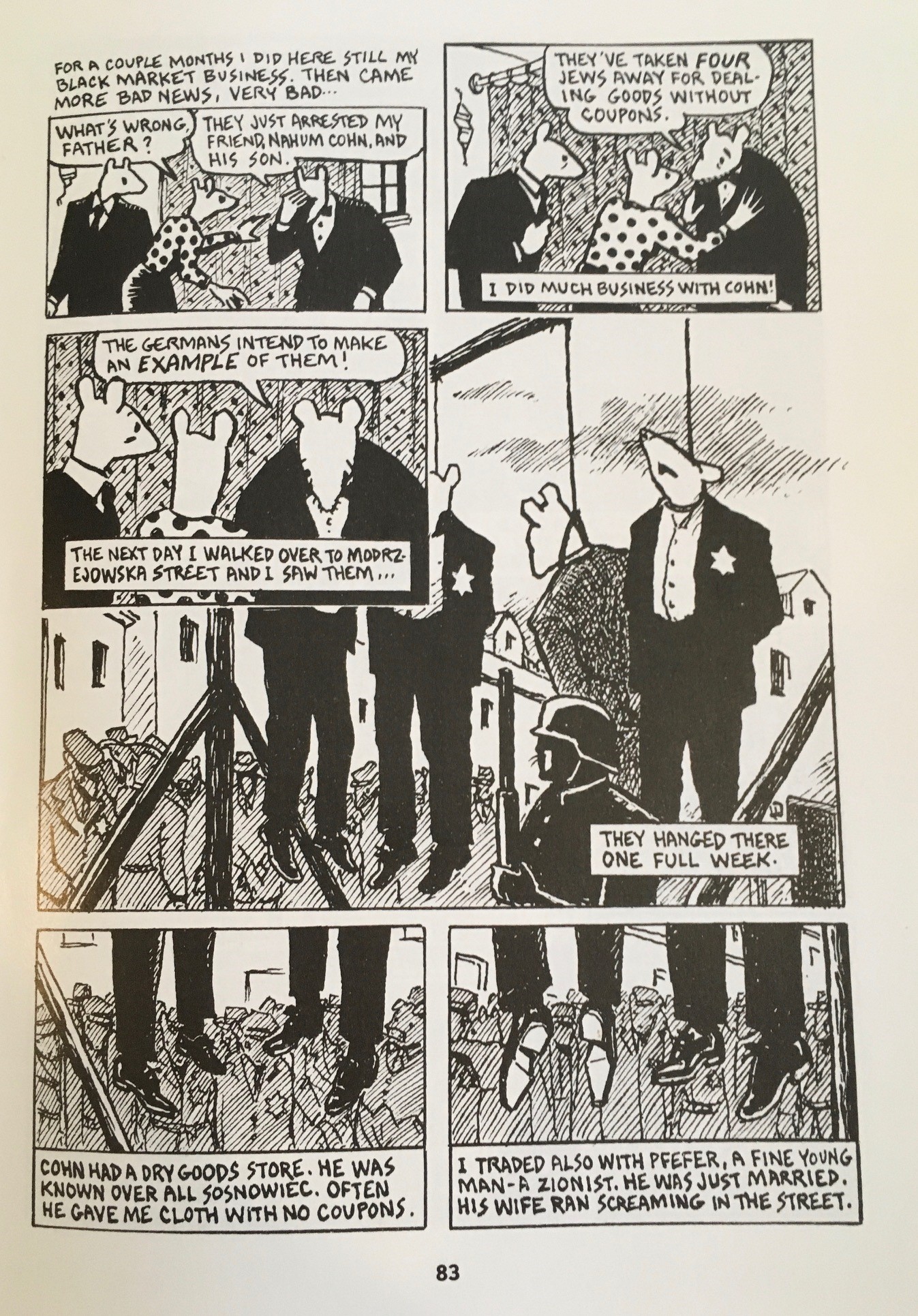
Today in class, after the Scrabble debriefing and the discussion of last Friday’s quiz, we will closley examine the page of Art Spiegelman’s Maus featured above.
Afterward, we will study an analysis of the page that I wrote as a model for my students in a previous semester, and you and two or three of your classmates will collaborate on an assignment that asks you to consider these questions:
Where in the essay does the writer present an instance of the connection that she addresses in her thesis? Offer one example in your answer.
Where in the essay does the writer present an instance of the separation that she addresses in her thesis?
Effective strategies for concluding analyses include (1) offering an insight about the text or an additional quotation from it, (2) revisiting the thesis without stating it verbatim, and (3) pointing to the broader implications of the analysis. Reread the conclusion of “The Strange Fruit of Sosnowiec” and compose a paragraph that identifies the strategy or strategies listed above that the writer employs.
Friday’s Quiz
The first question asked you to list one punctuation rule that you learned or were reminded of in class. Some of you simply listed a term rather than a rule. Merely writing “comma splices” does not demonstrate that you know what a comma splice, or fused sentence, is or how to avoid or eliminate one. Here is one way to demonstrate your understanding of the term in your answer:
A writer creates a comma splice, or a fused sentence, when he or she places a comma, rather than a period or semicolon, between two independent clauses (complete sentences).
The second question asked you to list one style rule that you learned or were reminded of in class. Again, some of you simply listed a term rather than a rule. Merely writing “MLA style” does not demonstrate that you know the rules of MLA style. Here are some ways to demonstrate your understanding of the term in your answer:
In MLA style, numbers that can be expressed in one or two words are written as words, not figures.
In MLA style, titles of short works, such as essays, are enclosed in quotation marks, and titles of long works, such a book-length texts and feature films, are italicized (or underlined in longhand).
Thoughts are not enclosed in quotation marks; they are italicized.
The third question asked you to identify Michael Lewis, who is the author of The Blind Side, which you read an excerpt from on Monday.
Michael Lewis’s name appears on your copy of the excerpt from The Blind Side. It should also appear in the first sentence of the summary of the excerpt that you wrote in your journal, as well as in your journal notes on my September 16 blog post. We write to remember. Write notes in your journal on every reading and every blog post to retain what we have covered in class.
The fourth question asked you to identify the mostversatile consonant. Some of you answered s, but the most common consonant is not the same as the most versatile. M is the most versatile In the first position in two-letter words, it pairs with every vowel: ma, me, mi, mo, mu, and also my. In the second position, it pairs with every vowel except i: am, em, om, um.
The fifth question asked you to explain why that letter is the most versatile consonant. M is the most versatile one because in the first position in two-letter words, it pairs with every vowel: ma, me, mi, mo, mu, and also my. In the second position, it pairs with every vowel except i: am, em, om, um.
The sixth question asked you to identify the topic of Friday’s blog post. Some of you answered “Scrabble.” Others answered “Wordplay Day.” Scrabble is the subject of the post; Wordplay Day is the occasion for it. The topic of a Scrabble post is always something more specific. Last Friday’s topic was two-letter words beginning with the letters q-z.
Lastly, you had the opportunity to earn bonus points by listing words that you had learned from last Friday’s Scrabble blog and any of the other previous Scrabble posts. Many of you earned points by listing playable names from the August 23 playable names blog post and/or the two-letter words blog posts published on August 22 and 30, and September 7, 13, and 30.
Next Up
On Wednesday, after I collect your fifth and final Check, Please! worksheets, you will begin planning and drafting your textual analyses. Review all of the texts that we have studied in class, reread your journal notes on them, and determine which one appeals to you most as a subject for analysis. As your writing progreses, you may decide to focus on a different text, but making a preliminary selection before Wednesday’s class will likely lead to a more productive planning and drafting period.
Today in class, after I collect your worksheets for lesson four of Check, Please! we will examine Donald Barthelme’s short story “The School,” and in groups of three or four you will address in writing some of the elements of the story that you might explore in an analysis. Among the elements of Barthelme’s story that you will considered are these:
the narrator and the narrative voice
conflict
narrative shift (Where does “The School” make an unexpected turn?)
Whether the subject of your analysis is Bartheleme’s story or one of our earlier readings, you will begin your first paragraph with a summary of the text. Remember that a summary is an objective synopsis of a text’s key points. It should be written in third person and present tense. For example, if you choose to analyze “The School,” you might summarize it this way:
Donald Barthelme’s short story “The School” recounts a series of classroom lessons that end with the deaths of plants and animals–deaths that serve as a prelude to the unexplained death of a Korean orphan, followed by the senseless deaths of classmates and family members.
Notice that the summary above does not comment on the story in any way. What follows the summary will be the beginning of your commentary, or analysis, the thesis statement that offers your particular close reading, or interpretation, of the story. The passage below is the same as the one above, but at the end of it I have added a thesis statement in bold.
Donald Barthelme’s short story “The School” recounts a series of classroom lessons that end with the death of plants and animals–deaths that serve as a prelude to the death of a Korean orphan, followed by the deaths of classmates and family members. With conversational narration, accumulation of detail, and a shift in fictional mode, Barthelme deftly depicts the reality of the fleeting nature of life, even as the story itself veers from reality.
If I were to continue to write the analysis that I began in the previous paragraph, I would follow that opening paragraph with body paragraphs that address each of the three story elements that I include in my thesis: (1) “conversational narration,” (2) “accumulation of detail,” and (3) “shift in fictional mode.”
Next Up
Wordplay Day! To prepare for class, revisit the Dictionary and World Builder pages on the Scrabble website, and review the blog posts devoted to Scrabble tips.
Rosenwaser, David and Jill Stephen. Chapter 12: “Nine Basic Writing Errors and How to Fix Them.” Writing Analytically, 9th edition. Wadsworth/Cengage, 2024. pp. 421-55.
Yesterday in class you composed a blog comment in repsonse to one of your classmates’ literacy narratives. That assignment required you to either (1) identify and address one of the nine basic writing errors outlined in Writing Analytically, or (2) identify and address a particularly effective phrase, clause, or sentence.
In the sample comments that follow, I demonstrate my careful examination of the narratives through my use of concrete details.
Sample Comments
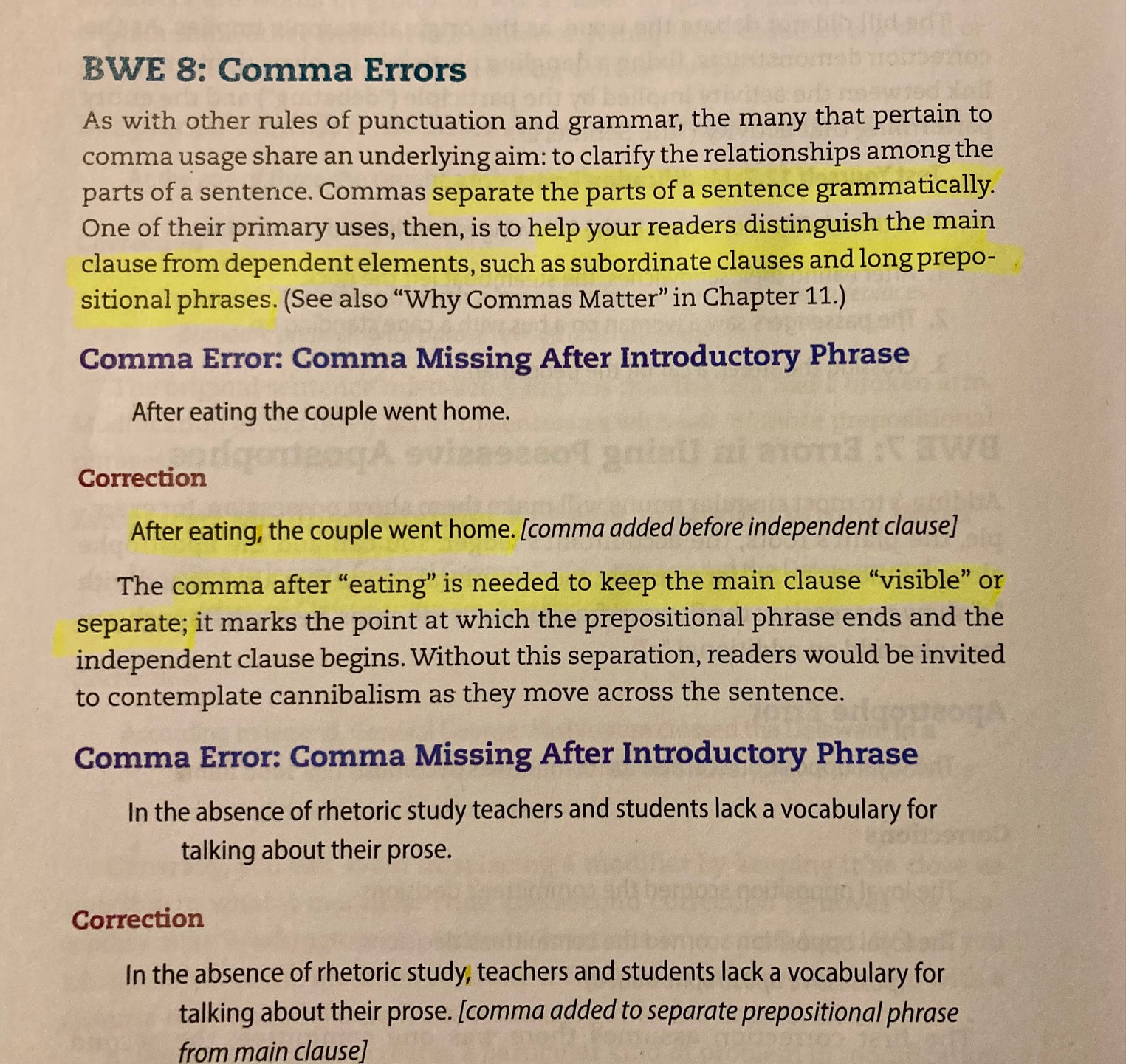
The final paragraph of your literacy narrative, includes an instance of BWE (Basic Writing Error) 8, Comma Errors, in the sentence, “For me to be a a good writer I really have to enjoy what I’m writing about” (par. 3). The omission of the required comma after “writer” is what the textbook authors label “Comma Missing After Introductory Phrase” (Rosenwasser and Stephen 440).
When you write, “my hands would break out in a sweat, my breathing would get shortened, and my knees would start to shake” (par. 18), you effectively convey your dread of public speaking, a dread you could express more succinctly with this revision: “my hands would sweat, my breathing would shortenen, and my knees would shake.”
Citations
Yesterday’s assignment required you to include a parenthetical citation for your quotation. It did not require you to include a work cited entry because the writing was a blog comment. If the assignment had been an essay, such as the reflection that you wrote last Wednesday, you would have been required to include a work cited entry, such as this:
Work Cited
Rosenwaser, David and Jill Stephen. Chapter 12: “Nine Basic Writing Errors and How to Fix Them.” Writing Analytically, 9th edition. Wadsworth/Cengage, 2024. pp. 421-55.
Reviewing Chapter 12
Returning to the pages of Chapter 12 throughout the semester will help you better understand the errors that you make and will enable you to better proofread your writing and the writing of your classmates.
Bonus-Point Opportunity
Taking advantage of the following bonus-point opportunity will not only earn you five points toward your final Check, Please! assignment, it will also provide one of your classmates with additional feedback on his or her literacy narrative.
Directions
Read your classmates’ literacy narratives on their blogs, and make brief notes on them in your journal.
Determine which literacy narrative you think is the strongest. Think in terms of both form and content.
Compose a comment that includes the writer’s first and last name, the section number, the title of the literacy narrative, and a specific detail that demonstrates the strength of the essay.
Post your response as a comment on this blog post no later than 9 a.m. on Wednesday, September 25. (To post your comment, click on the posts’s title, and scroll down to the bottom of the page. You will then see the image of an airmail envelope with a leave comment option.)
I will approve (make your comments visible) after the 9 a.m. deadline on September 25.
Next Up
In class on Wednesday, after you submit your worksheets for the fourth lesson of Check, Please!, we will examine Donald Barthelme’s short story “The School.” You do not need to print a copy of “The School”; you will receive a copy in class.
Today’s class will be devoted primarily to reading and responding to the blog post of one of your classmates’ literacy narratives. Elements you will consider in your response included these:
the title
vivid details
dialogue, the use of scene and/or summary
You should also identify one or more of the “Nine Basic Writing Errors” (see Writing Analytically, 423-44), and address that error in your response. If you cannot identify one, include a sentence in your response that quotes a sentence of your peer’s and explains what makes it effective.
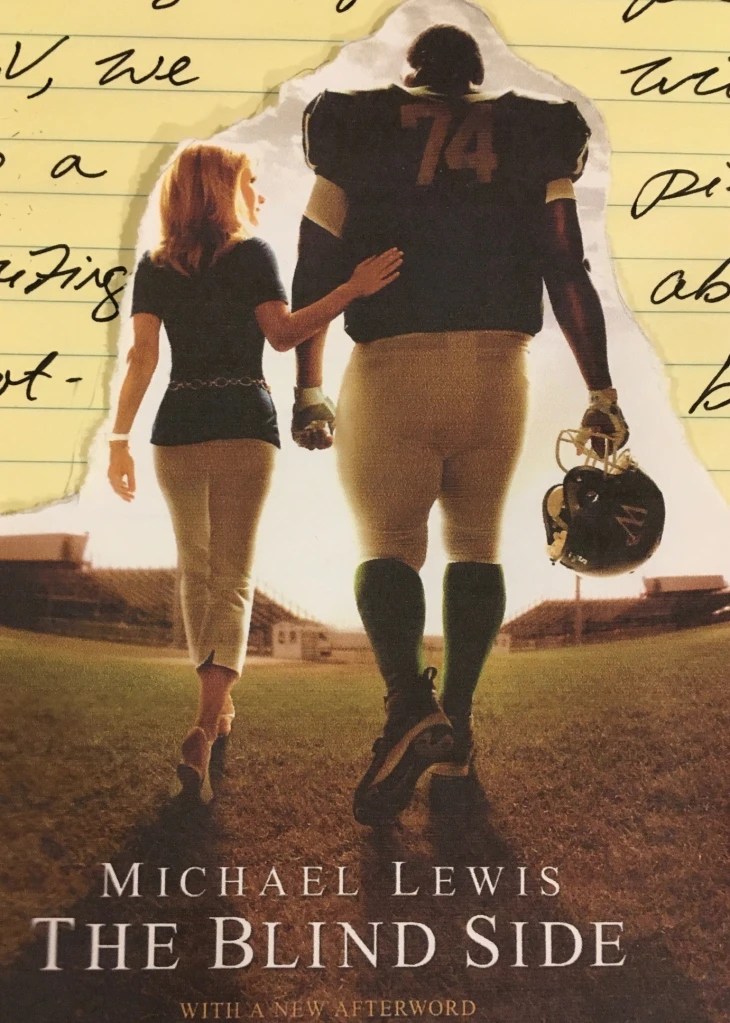
Before you begin that assignment, we will examine the opening pages of “Back Story,” the first chapter of Michael Lewis‘s The Blind Side, which dramatizes the moments in the November 1985 Redskins-Giants football game leading up to the injury that ended quarterback Joe Theismann’s career:
“From the snap of the ball to the snap of the first bone is closer to four seconds than to five. One Mississippi: The quarterback of the Washington Redskins, Joe Theismann, turns and hands the ball to running back John Riggins. He watches Riggins run two steps forward, turn, and flip the ball back to him. It’s what most people know as a ‘flea-flicker,’ but the Redskins call it a ‘throw-back special.’ Two Mississippi: Theismann searches for a receiver but instead sees Harry Carson coming straight at him. It’s a running down—the start of the second quarter, first and 10 at midfield, with the score tied 7–7—and the New York Giants’ linebacker has been so completely suckered by the fake that he’s deep in the Redskins’ backfield. Carson thinks he’s come to tackle Riggins but Riggins is long gone, so Carson just keeps running, toward Theismann. Three Mississippi: Carson now sees that Theismann has the ball. Theismann notices Carson coming straight at him, and so he has time to avoid him. He steps up and to the side and Carson flies right on by and out of the play. The play is now 3.5 seconds old. Until this moment it has been defined by what the quarterback can see. Now it–and he–is at the mercy of what he can’t see” (15).
What Theismann cannot see is Lawrence Taylor. A second later, as Taylor sacks Theismann, Taylor’s knee drives straight into Theismann’s lower right leg, leading to the “snap of the first bone” that Lewis mentions in the first line of the chapter. He hooks the reader by linking the beginning of the play, “the snap of the ball” to the gruesome “snap of the first bone” that will follow. Lewis develops the opening paragraph using the common one-Mississippi, two-Mississippi method of marking seconds to present the events leading up to the compound fracture that ends Theisman’s career.
Lewis doesn’t dramatize the injury itself because his interest lies instead in the blind side that led to it and subsequently elevated the status and salary of the left tackle, the player who protects the quarterback’s blind side.
When you’re struggling to develop a piece of writing, reread the opening paragraph of The Blind Side. Observe how Lewis dramatizes 3.5 seconds–yes, only 3.5 seconds–with about two-hundred words.
Next Up
In class on Wednesday, after you submit your worksheets for the fourth lesson of Check, Please!, we will examine Donald Barthelme’s short story “The School.” You do not need to print a copy of “The School”; you will receive a copy in class.





 Jane Lucas