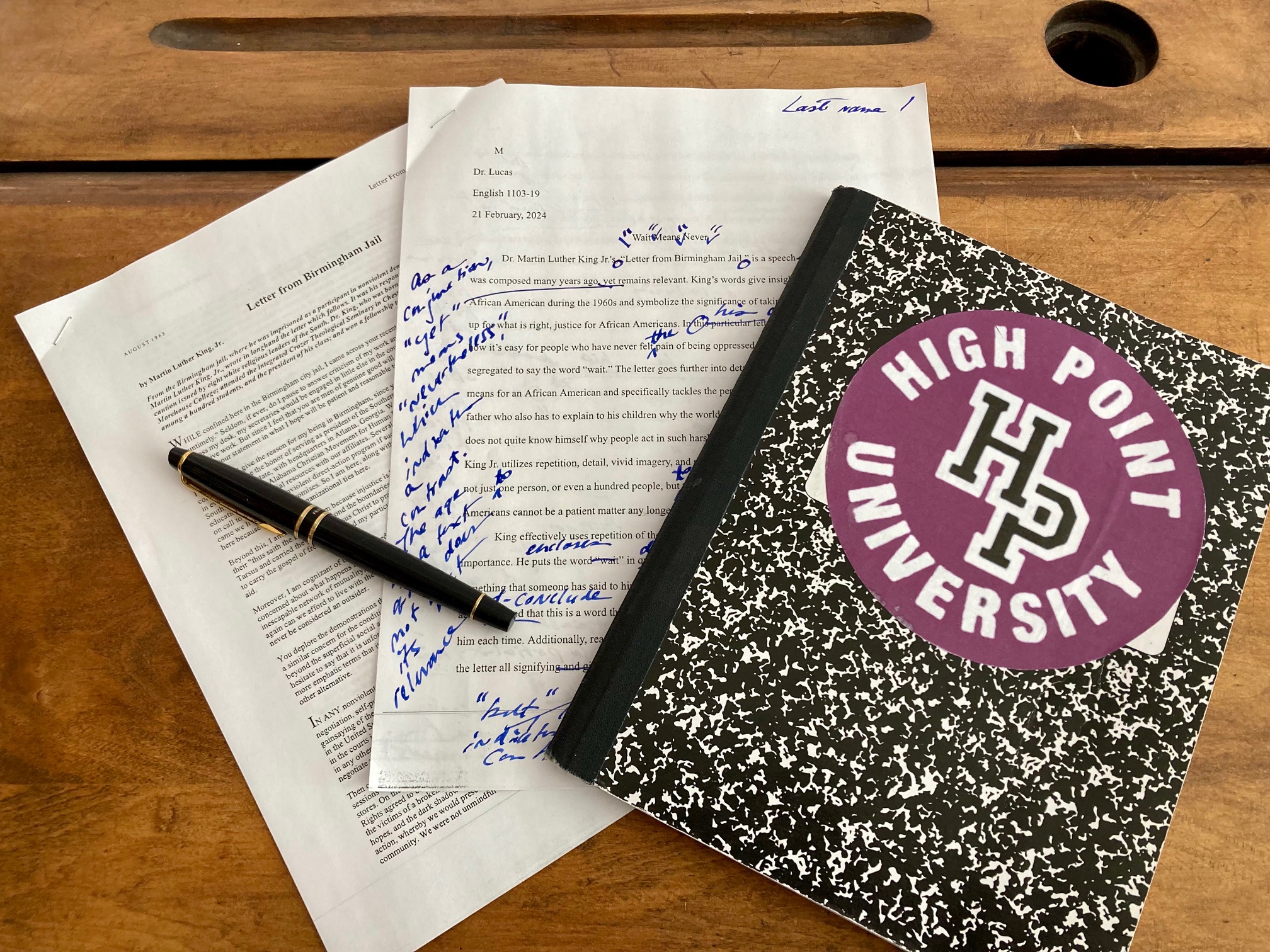
This morning, after I return your Check, Please! worksheets for lesson four, I will return your drafts with my notes, and you will have the remainder of the class period to begin revising your analyses on your laptops. Because next week is spring break, you will have two additional weeks to continue your revision work before you submit the assignment to Blackboard and publish it as a WordPress blog entry. The due date is Wednesday, March 5 (before class). The hard deadline is Friday, March 7 (before class). Directions for submitting your analysis are included on your assignment sheet and on the Blackboard submission site.
As you continue to revise your analysis, consider visiting The Writing Center. If you do so, you will earn five bonus points for the assignment.
To schedule an appointment, visit https://highpoint.mywconline.com, email the Writing Center’s director, Professor Justin Cook, at jcook3@highpoint.edu, or scan the QR code below. To earn bonus points for your analysis, consult with a Writing Center tutor no later than Thursday, March 6.
Next Up
Wordplay Day! To prepare for class, revisit the Dictionary and World Builder pages on the Scrabble website and review the blog posts devoted to Scrabble.
As you continue to draft your analysis, you may be unsure of how to develop it into a full-length essay of at least six hundred words. Here are some recommendations:
If you know you want to include a particular point but do not know where to place it in the essay, go ahead and write it down in your journal or type it into your document file. Sometimes the act of putting words on the page will lead you to additional ideas and give you a sense of where you might include that point without a home. In other words, try following this advice from Writing Analytically: “Don’t wait to write until you have an idea around which you can organize a paper. Instead, use writing to get you to the idea” (Rosenwasser and Stephen 123).
The authors of Writing Analytically also note that writers of analyses “usually find that subtler, less obvious meanings are cloaked by more obvious ones, and so they are distracted from seeing them” (Rosenwasser and Stephen 104). Moving beyond the obvious to the subtle creates a path for development. Applying Rosenwasser and Stephen’s “Seems to Be About X” strategy (104) may provide you with additional claims and textual evidence. Consider these possibilities: “Me Talk Pretty One Day” seems to be about learning French, but could also be (or is really) about the healing power of humor; “The Day Language Came into My Life” seems to be about learning sign language, but could also be (or is really) about overcoming despair; “Letter from Birmingham Jail” seems to be about the need for nonviolent protest, but could also be (or is really) about the deaf ears of those who have not been the victims of segregration; “Back Story” seems to be about Joe Theismann’s career-ending injury and players’ fear of Lawrence Taylor but could also be (or is really) about the excessive violence of football; “The Falling Man” seems to be about the title figure but could also be (or is really) about symbolization: the process of becoming a symbol.
Imagine that the task at hand is not an analysis but a letter to a friend about the essay or chapter that serves as your subject. Draft that letter in your journal. Begin with a summary and follow with the reasons that your friend will find the essay or chapter as appealing as you do. Offer textual evidence to support your claims. Then step back and ask yourself whether that letter could become a more formal analysis–chances are, it could.
Works Cited
Rosenwasser, David and Jill Stephen. “Rule 6: Use Freewriting to Find and Interpret Topics.” Writing Analytically, 9th edition. Wadsworth/Cengage, 2024. pp. 123.
—. “Seems to Be About X, But Could Also Be (Or is ‘Really’) About Y.” Writing Analytically, 9th edition. Wadsworth/Cengage, 2024. pp. 104-7.
Next Up
At the beginning of Wednesday’s class, I will collect your worksheets for the fourth lesson of Check, Please! Afterward, I will return your handwritten drafts with my notes, and you will have the remainder of the period to begin revising your analyses on your laptops and tablets.
Today in class you will plan and compose a short midterm reflective essay that documents your work in the first half of the semester, focusing on two or three assignments or aspects of the course that have contributed to your development as a writer and a student. Since you have already written a reflection devoted solely to your literacy narrative, your midterm reflection should focus primarily on other assignments or aspects of the course, including the following:
Keeping a journal
Studying one of the readings examined class, including “Me Talk Pretty One Day,” “The Day that Language Came into My Life,” “Letter from Birmingham Jail,” “Back Story,” or “The Falling Man”
Reading and editing samples of student writing
Writing for an online audience beyond the classroom/creating and maintaining a WordPress blog
Collaborating with your classmates on in-class writing assignments
Playing Scrabble/Collaborating with your teammates on Wordplay Day
Completing Check, Please! assignments
Writing longhand
Limiting screen time
Beginning your analysis
Include in your refelective essay the following elements:
A title that offers a window into your reflection
An opening paragraph that introduces your focus and presents your thesis
Body paragraphs that offer concrete details from your work to support your thesis
One relevant quotation from one of the essays or chapters that you have read or from Writing Analytically—see the accompanying handout for examples
A signal phrase and a parenthetical citation for the quotation
A conclusion that revisits the thesis without restating it verbatim
Rosenwasser, David and Jill Stephen. “Becoming Conversant with a Reading.” Writing Analytically, 9th edition. Wadsworth/Cengage, 2024. p. 46.
Rosenwasser, David and Jill Stephen. “Process and Product.” Writing Analytically, 9th edition. Wadsworth/Cengage, 2024. pp. 141-42.
Rosenwasser, David and Jill Stephen. “The Writer as Both Observer and Observed.” Writing Analytically, 9th edition. Wadsworth/Cengage, 2024. pp. 163.
Sedaris, David. “Me Talk Pretty One Day.” Me Talk Pretty One Day. Little, Brown, 2000. 166-73.
Note that unlike the works cited entries above, the one on your midterm reflection will have a hanging indent, as will all of the works cited entries in the Microsft Word files and PDFs that you post to Blackboard.
The complete midterm reflection assignment, along grade criteria, is included on the assignment handout that you will receive in class.
Next Up
At the beginning of class on Wednesday, I will collect your worksheets for the fourth Check, Please! lesson. Afterward, I will return your handwritten analyses drafts with my notes, and you will have the remainder of the class period to begin revising on your laptops and tablets.
This morning in class, after I collect your third Check, Please! worksheets, you will begin planning and drafting your analysis. You will receive a hard copy of the assignment in class, and I am including an additional copy below.
Directions for Planning and Drafting
Review the texts that you have read for class, and determine which one appeals to you most as a subject of analysis.
Identify one or more elements that contribute to its effectiveness.
Develop your analysis through a close examination of those elements.
Write in dark ink, preferably black. You are welcome to use both sides of the page.
Before you leave class today, staple this handout on top of your draft and submit it to me. Next week I will return your draft with notes, and you will have the class period to begin revising and editing on your laptop or tablet.
Directions for Revising
The revision of your analysis should include the following:
A title that offers a window into your analysis
An introduction that presents a summary of the essay, essay excerpt, or chapter
A thesis statement, or main claim, that presents your take on the essay, essay excerpt, or chapter based on your close study of it
Textual evidence that supports your claims
A minimum of one relevant quotation from the text, introduced with a signal phrase and followed by a parenthetical citation
A conclusion that revisits the thesis without restating it verbatim
Lewis, Michael. Chapter One: “Back Story.” The Blind Side. 2006. Norton, 2009, pp. 15-23.
Sedaris, David. “Me Talk Pretty One Day.” Me Talk Pretty One Day. Little Brown, 2000. pp. 166-73.
Think of your preliminary draft as your down draft; your aim in the early stage of the process is to get your ideas down on the page. You may need the process of drafting to discover what you think the essay, essay excerpt, or chapter means and how it makes its meaning.
Directions for Formatting and Posting Your Revision—See the Course Calendar for the Due Date and Hard Deadline
Save your revised essay as a Microsoft Word file or PDF and submit it to Blackboard in compliance with MLA manuscript guidelines.
Publish your revision as a blog post. In your post, omit the first-page information included in your file submitted to Blackboard (your name, course, section, instructor’s name, and date). Add to your blog post an image that documents some part of your writing process away from the screen, such as a photo of your reading notes or a page of your draft. Also add to your blog post an embedded link to a relevant website.
Grade Criteria
An A analysis complies with all assignment guidelines, demonstrates a depth of understanding by using relevant and accurate detail, and is also well organized and relatively free of surface errors.
A B analysis complies with all assignment guidelines and presents an adequate analysis but examines little more than what was addressed in class. A B analysis is also well organized and relatively free of surface errors.
A C analysis complies with most but not all assignment guidelines and may also be flawed by issues of organization and/or surface errors, or more consequential factual errors.
A D analysis complies with only a few of the assignment guidelines and may also be flawed by issues of organization and/or surface errors, or more consequential factual errors.
An F analysis fails to comply with most or all assignment guidelines and may also be flawed by substantial issues of organization and/or surface errors, or more consequential factual errors.
MLA Style
Look to my sample assignments on Blackboard as models of MLA style. For more information on MLA style, see the MLA Style Center and OWL sites linked to my blog.
Next Up
Wordplay Day! To prepare for class, revisit the Dictionary and World Builder pages on the Scrabble website, and review the blog posts devoted to Scrabble tips.
Tomorrow in class, you will begin planning and drafting an analysis, your second major writing assignment for the course. Your subject may be any one of the following texts that we have studied.
“Me Talk Pretty One Day” by David Sedaris
“The Day Language Came into My Life” by Helen Keller
“Letter from Birmingham Jail” by Martin Luther King, Jr.
“Back Story” by Michael Lewis
As I noted in yesterday’s post, you should review your assigned readings, and determine which one appeals to you most as a subject for analysis. I asked you to consider this question: Which text are you most interested in examining in closer detail to determine what makes it an effective piece of writing? Your answer to that question is likely the best subject for you. That said, in the process of planning and drafting, your answer may change. Sometimes the writing process involves discovering that a subject you weren’t interested in–or were less interested in than others–deserves a closer look.
Rather than trying to begin the writing process with a thesis (or main claim, or controlling idea), jot down the words, phrases, and sentences from the text that have lingered in your mind the most. Ask yourself these questions:
What do some of these words, phrases, and sentences have in common?
How are they different?
What patterns can you identify among them?
After repeated readings, do any of them seem to take on additional meanings?
Answering those questions will lead you to identify patterns that will give you the framework for your analysis.
Elements to address in your analysis include these:
Scene
Summary
Figurative language
Sensory details
Structure
Theme
To determine one of the themes of your subject, think about the ideas that the writer conveys throughout the text. Humor in the face of adversity and antagonism (“Me Talk Pretty One Day”), language as illumination and liberation (“The Day Language Came into My Life”), social injustice and the urgency of nonviolent protest (“Letter from Birmingham Jail”), fear and the unseen (“Back Story”) are among the themes to consider.
Keep in mind that themes are abstractions that writers convey through concrete details. If you address a theme in your subject, be sure to refer to concrete details that convey that theme.
As you continue to work on your analysis, read these sections of Writing Analytically:
“Focus on Individual Words and Sentences” (49-50)
“Find the Analytical Potential: Locate an Area of Uncertainty” (120-21)
“Six Rules of Thumb for Responding to Assignments more Analytically” (121-23)
Next Up
At the beginning of class on Wednesday, you will submit your third Check, Please! worksheet, and you will have the rest of the class period to begin planning and drafting your analyses.
Today’s class will be devoted primarily to reading and responding to the blog post of one of your classmates’ literacy narratives. Elements you will consider in your response included these:
the title
vivid details
scene and summary (and dialogue, if present)
the conclusion
the image documenting part of the writing process away from the screen
the link to a relevant website
Before you begin that assignment, we will examine the opening pages of “Back Story,” the first chapter of Michael Lewis‘s The Blind Side, which dramatizes the moments in the November 1985 Redskins-Giants football game leading up to the injury that ended quarterback Joe Theismann’s career:
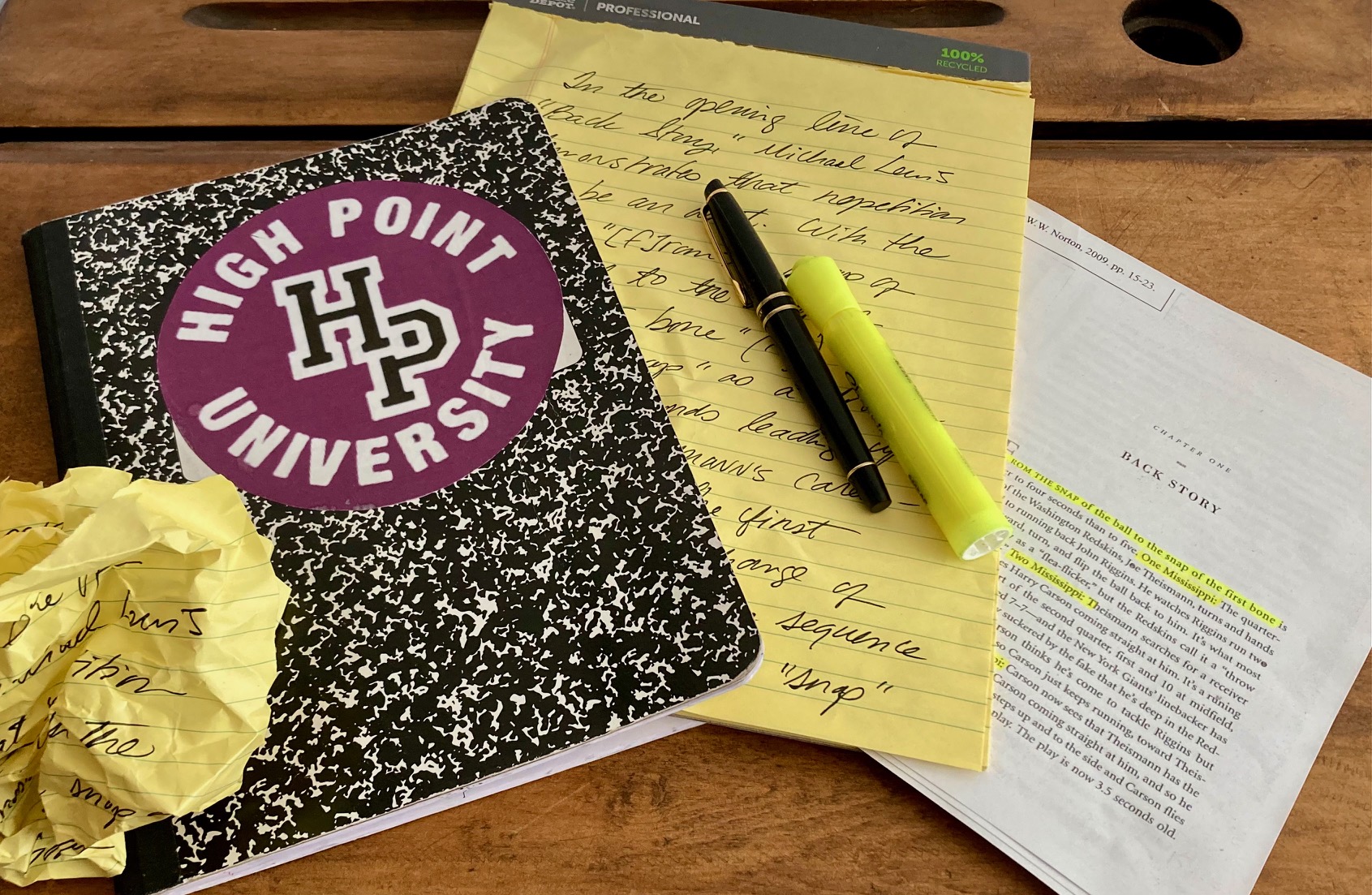
“From the snap of the ball to the snap of the first bone is closer to four seconds than to five. One Mississippi: The quarterback of the Washington Redskins, Joe Theismann, turns and hands the ball to running back John Riggins. He watches Riggins run two steps forward, turn, and flip the ball back to him. It’s what most people know as a ‘flea-flicker,’ but the Redskins call it a ‘throw-back special.’ Two Mississippi: Theismann searches for a receiver but instead sees Harry Carson coming straight at him. It’s a running down—the start of the second quarter, first and 10 at midfield, with the score tied 7–7—and the New York Giants’ linebacker has been so completely suckered by the fake that he’s deep in the Redskins’ backfield. Carson thinks he’s come to tackle Riggins but Riggins is long gone, so Carson just keeps running, toward Theismann. Three Mississippi: Carson now sees that Theismann has the ball. Theismann notices Carson coming straight at him, and so he has time to avoid him. He steps up and to the side and Carson flies right on by and out of the play. The play is now 3.5 seconds old. Until this moment it has been defined by what the quarterback can see. Now it–and he–is at the mercy of what he can’t see” (15).
What Theismann cannot see is Lawrence Taylor. A second later, as Taylor sacks Theismann, Taylor’s knee drives straight into Theismann’s lower right leg, leading to the “snap of the first bone” that Lewis mentions in the first line of the chapter. He hooks the reader by linking the beginning of the play, “the snap of the ball,” to the gruesome “snap of the first bone” that will follow (15). Lewis develops the opening paragraph using the common one-Mississippi, two-Mississippi method of marking seconds to present the events leading up to the compound fracture that ends Theisman’s career.
Lewis doesn’t dramatize the injury itself because his interest lies instead in the blind side that led to it and subsequently elevated the status and salary of the left tackle, the player who protects the quarterback’s blind side.
When you’re struggling to develop a piece of writing, reread the opening paragraph of The Blind Side. Observe how Lewis dramatizes 3.5 seconds–yes, only 3.5 seconds–with about two-hundred words.
Next Up
In class on Wednesday, after you submit your worksheets for the third lesson of Check, Please!, you will begin planning and drafting your analysis, your second major writing assignment for the course. To prepare for Wednesday’s class, review your assigned readings, and determine which one appeals to you most as a subject for analysis. Which text are you most interested in examining in closer detail to determine what makes it an effective piece of writing? Your answer to that question is likely the best subject for you.
Today in class you will compose a short reflective essay that documents the processes of planning, drafting, and revising your literacy narrative. Questions to consider include the ones below. You don’t need to address all of the questions; focus on the ones whose answers reveal the most about your work.
Include in your reflection a minimum of one relevant quotation from the textbook, Writing Analytically. Introduce your quotation with a signal phrase and follow it with a parenthetical citation.
Examples:
The authors of Writing Analytically observe that “[o]ne goal of a writer’s notebook is to teach yourself through repeated practice that you are capable of finding things to write about” (Rosenwasser and Stephen 157).
In Writing Analytically, Rosenwasser and Stephen note, “to a significant extent, writing of all kinds tells a story—the story of how we have come to understand something” (162).
In the first example above, the authors’ last names appear in the parenthetical citation because they are not named in the signal phrase. In the second example, only the page number appears in the parenthetical citation because the authors are named in the signal phrase.
Sample Work Cited Entries:
Rosenwasser, David and Jill Stephen. “On Keeping a Writer’s Notebook.” Writing Analytically, 9th edition. Wadsworth/Cengage, 2024. pp. 157-58.
Rosenwasser, David and Jill Stephen. “Writing from Life: The Personal Essay.” Writing Analytically, 9th edition. Wadsworth/Cengage, 2024. pp. 161-68.
What aspect of the writing seemed the most challenging? Determining the focus of your narrative? Developing the story? Crafting the conclusion? Why did that aspect of the writing seem the most challenging?
Did you change the subject of your narrative? If so, what was the original subject? What did you change it to? Why?
Did you change the organization of the narrative? For example: Did you initially present the story chronologically, then begin in the present and move to flashback?
Did any of the sample essays we examined (“Me Talk Pretty One Day,” “The Day Language Came into My Life,” “A Bridge to Words”) prove helpful to you as a model? If so, how? (Offer one or more concrete details to support your claim.)
What do you consider the strongest element of your literacy narrative?
At what point in the process did you decide on a title? Did you change the title during the writing process? If so, what was the original title?
What photograph did you include in your blog that documents part of your writing process away from the screen? Why did you choose that particular image?
What relevant website did you link to your blog post. Why is that particular site relevant to your narrative?
In addition to metacognition, did any of the other habits of mind of successful college students play a significant role in your writing process? If so, which one? The other seven are curiosity, openness, engagement, creativity, persistence, responsibility, and flexibility.
Next Up
Wordplay Day! To prepare for class, revisit the Dictionary and World Builder pages on the Scrabble website, and review the blog posts devoted to Scrabble tips.
Yesterday before you and your group members assessed the literacy narratives that you read for class, we examined a page (pictured above) from Harper Lee’s novel To Kill a Mockingbird. That page from Chapter One serves as a useful model for three narrative elements: summary, scene, and dialogue–at least two of which will figure in your literacy narrative.
The first paragraph of the passage sets the scene with summary, designating the “summertime boundaries” within which the narrator, Jean Louise, “Scout,” Finch, and her older brother, Jem, may play outdoors (12). The short one-sentence paragraph that follows continues the summary, informing readers that the summer Scout has just summarized is the one in which Dill (Charles Baker Harris) first visits Maycomb, Alabama.
With the first words of the next paragraph, “[e]arly one morning,” Scout shifts from summary to scene (12). All of the remaining paragraphs except the final one continue the scene with dialogue. Scout returns to summary with the words “Dill was from Meridian” (12).
Note that Harper Lee begins a new paragraph whenever the speaker changes. Also note that every line of dialogue does not include a dialogue tag, such as “he said” or “she said.” If a passage of dialogue includes only two speakers, none of the paragraphs require dialogue tags after the speakers’ first lines because the start of a new paragraph signals to the reader that the other person is speaking. If a dialogue includes three or more speakers–such as Scout’s conversation with Jem and Dill–occasional tags are essential.
In my notes above, I have been careful to distinguish between the author, Harper Lee, and the narrator, the fictional character Scout. When you write about an autobiographical work, such as a literacy narrative, you may use the terms writer and narrator interchangeably. When you write about a work of fiction, it’s important to separate the narrative voice from the author. Reserve the term author for published writers. When you write about a piece of student writing, refer to the student as a writer, not an author.
Sample Student Literacy Narratives
The paragraphs that follow include detailed but not comprehensive notes on the two sample narratives that you assessed in class yesterday. Look to these notes as a guide for editing your own literacy narrative.
“Creativity is Key”
The writer changes the font of the body of the paper to Times New Roman but does not change the font of the running header, which should also be Times New Roman.
The writer incorrectly adds an extra space between the first-page course information (in the upper left) and between the title and the first line of the essay. MLA-style manuscripts are double-spaced. Note that later, the writer also incorrectly adds space between the paragraphs.
The title should be typed in twelve-point font, which is the font size that should be used throughout the document.
The title should not appear in boldface.
In MLA style, all major words in a title, including the final one, are capitalized (“key” should be “Key).
Form, which is the focus of the previous notes, is less important than content, but easily avoidable errors of form may prevent a reader from appreciating the content of your narrative. Creating a compelling story is hard work, proofreading isn’t. If you don’t get the easy part right, readers may stop reading.
The second “sentence” of the second paragraph is a fragment because the meaning of “one being my senior year . . .” is dependent upon the clause that ends the previous sentence. See Writing Analytically, page 426-29.
The comma between “all” and “matter” is a comma splice. See Writing Analytically, 429.
“[R]eal life” should be hyphenated (as real-life) when it functions as a compound modifier. Ditto for “open minded” and “four to five.”
Errors of letter case–upper rather than lower, or vice versa–are mistakes of mechanics, which are prevalent in the second paragraph “Track, “Field,” “Defensive,” “Back,” and “Athlete” should all began with a lower-case letter.
“[F]elt like” should be “felt as if.” In comparisons, use “like” before a noun and “as if” before a clause.
“I’m a writer that” should be “I’m a writer who.” The correct relative pronoun for a person is “who,” not “that.”
The essay is not a narrative. The writer mentions his experience writing a Southern gothic story, and he briefly recounts writing about his training for track and field and international football (soccer), but the writer offers very few details. Focusing on one of those experiences and recreating one or more moments from it would transform the essay into a narrative and develop it into one that meets the six hundred-word minimum requirement.
“Giving a Speech: Worst Nightmare to Best Feeling”
In the second line of the second paragraph, “Megan” is a parenthetical element that should be set off by commas. See Writing Analytically, 441.
The parenthetical element is the next line, “Mrs. Hron’s,” is correctly set off with commas, but the word that precedes “Mrs. Hron’s” should be possessive (“teacher’s,” not “teachers”).
Several other minor punctuation errors occur in the essay, but overall it’s a strong literacy narrative that’s notable for its vivid scenes and the writer’s self-deprecating humor.
Notes on Monday’s Quiz
Rather than posting the answers to the quiz, I am asking you to review the sample student literacy narratives, my annotations on your assignments, and the class notes for January 28 and February 3 and to find the answers on your own. Doing so will enable you to retain more of the course content from the past two weeks of class.
Keep in mind that one of the reasons we write is to remember. Taking notes on all of the blog entries that I publish and on all of your other reading assignments will both engage you in learning process and enable you to demonstrate your learning in the course.
Integrating Quotations
Writing your reflective essay on your literacy narrative tomorrow will include an exercise in integrating a quotation into your writing, a practice you will engage in more frequently as the semester progresses.
In your reflection, you are required include a minimum of one relevant quotation from the textbook, Writing Analytically, which you will introduce with a signal phrase and follow with a parenthetical citation.
Examples
The authors of Writing Analytically observe that “[o]ne goal of a writer’s notebook is to teach yourself through repeated practice that you are capable of finding things to write about” (Rosenwasser and Stephen 157).
In Writing Analytically, Rosenwasser and Stephen note, “to a significant extent, writing of all kinds tells a story—the story of how we have come to understand something” (162).
In the first example above, the authors’ last names appear in the parenthetical citation because they are not named in the signal phrase. In the second example, only the page number appears in the parenthetical citation because the authors are named in the signal phrase.
At the end of your essay, you will include a work cited entry for the section of the textbook that you quote.
Sample Work Cited Entries
Rosenwasser, David and Jill Stephen. “On Keeping a Writer’s Notebook.” Writing Analytically, 9th edition. Wadsworth/Cengage, 2024. pp. 157-58.
Rosenwasser, David and Jill Stephen. “Writing from Life: The Personal Essay.” Writing Analytically, 9th edition. Wadsworth/Cengage, 2024. pp. 161-63.
Next Up
In class tomorrow, you will compose a short essay that reflects on the processes of planning, drafting and composing your literacy narrative. If you do not post your essay to Blackboard and WordPress before class (you have until Friday morning to do so), you should refer to your work as ongoing. Be sure to bring your copy of Writing Analytically to class.
The excerpt featured in the image above (on the far right) isn’t part of a literacy narrative; it’s a page from Harper Lee’s novel To Kill a Mockingbird. That page from Chapter One serves as a useful model for three narrative elements, at least two of which will figure in your literacy narrative. We will examine the page today in class, and I will address the page in more detail in Wednesday’s class.
After we examine the page from To Kill a Mockingbird, you and two or three of your classmates will collaboratively assess the two student literacy narratives that you read for today’s class.
First, you will discuss your annotations on “Creativity is Key,” and you will collaboratively compose a brief assessment, a minimum of one complete sentence. After that, you will use the grade criteria on your literacy narrative assignment sheet to assign a grade for the essay.
Next, you will complete the steps above with the second literacy narrative, “Giving a Speech: Worst Nightmare to Best Feeling.”
Next Up
In class on Wednesday, you will compose a short essay that reflects on the processes of planning, drafting and composing your literacy narrative. If you do not post your essay to Blackboard and WordPress before class (you have until Friday morning to do so), you should refer to your work as ongoing.
Remember that Wednesday is the first day that you are required to bring your copy of Writing Analytically to class. In the reflection that you write in class, you will quote one relevant line from the textbook. Reviewing tomorrow’s blog post, which will include notes on quoting Writing Analytically, will ensure that you are able to effectively integrate a quotation into your essay in the allottted time.
This morning, after I collect your Check, Please! worksheets for lesson two, I will return your drafts, and you will have the remainder of the class period to begin revising your literacy narratives on your laptops. You will have an additional week to continue your revision work before you submit the assignment to Blackboard and publish it as a WordPress blog entry. The due date is next Wednesday, February 5 (before class). The hard deadline is Friday, February 7 (before class). Directions for submitting your literacy narrative are included on your assignment sheet and on the Blackboard submission site. I will also guide you through the submission process step by step in today’s class.
As you continue to revise your literacy narrative, consider visiting The Writing Center. If you do so, you will earn five bonus points for the assignment.
To schedule an appointment, visit https://highpoint.mywconline.com, email the Writing Center’s director, Professor Justin Cook, at jcook3@highpoint.edu, or scan the QR code below. To earn bonus points for your literacy narrative, consult with a Writing Center tutor no later than Thursday, February 6.
Next Up
Wordplay Day! To prepare for class, revisit the Dictionary and World Builder pages on the Scrabble website and review the blog posts devoted to Scrabble.