Posted in English 1103, Reading, Teaching, Writing

ENG 1103: Blog Responses and “Back Story”

Today’s class will be devoted primarily to reading and responding to the blog post of one of your classmates’ literacy narratives. Elements to consider in your response include these:

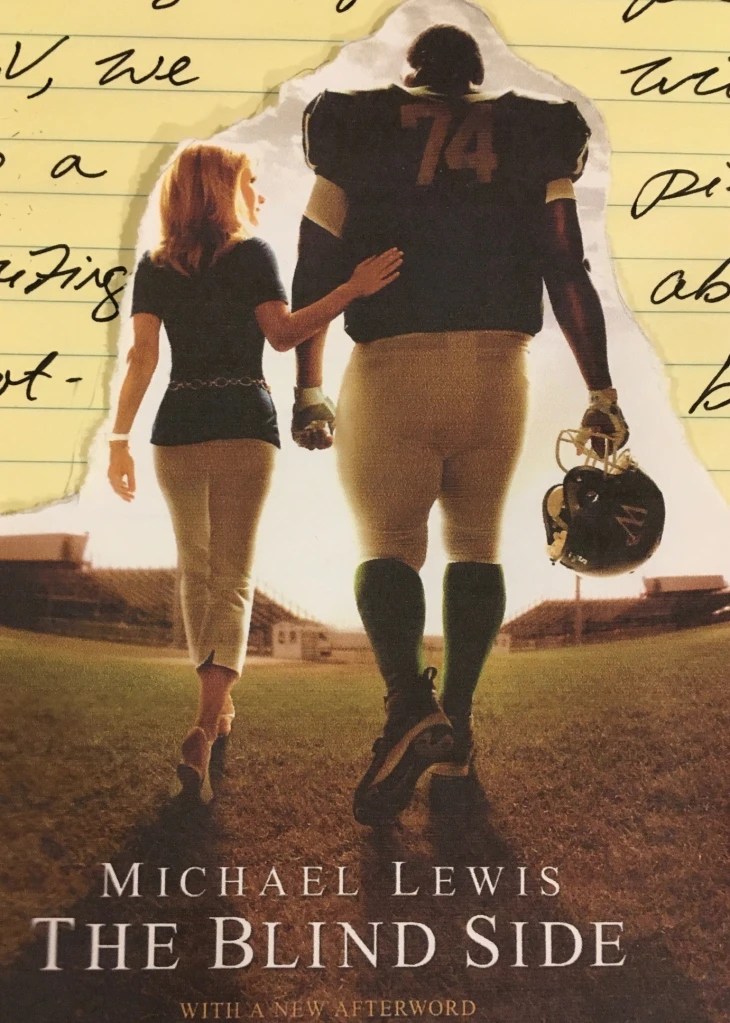
After you complete that assignment, you will begin reading the opening pages of “Back Story,” the first chapter of Michael Lewis’s The Blind Side, which dramatizes the moments in the November 1985 Redskins-Giants football game leading up to the injury that ended quarterback Joe Theismann’s career:

“From the snap of the ball to the snap of the first bone is closer to four seconds than to five. One Mississippi: The quarterback of the Washington Redskins, Joe Theismann, turns and hands the ball to running back John Riggins. He watches Riggins run two steps forward, turn, and flip the ball back to him. It’s what most people know as a “flea-flicker,” but the Redskins call it a “throw-back special.” Two Mississippi: Theismann searches for a receiver but instead sees Harry Carson coming straight at him. It’s a running down—the start of the second quarter, first and 10 at midfield, with the score tied 7–7—and the New York Giants’ linebacker has been so completely suckered by the fake that he’s deep in the Redskins’ backfield. Carson thinks he’s come to tackle Riggins but Riggins is long gone, so Carson just keeps running, toward Theismann. Three Mississippi: Carson now sees that Theismann has the ball. Theismann notices Carson coming straight at him, and so he has time to avoid him. He steps up and to the side and Carson flies right on by and out of the play. The play is now 3.5 seconds old. Until this moment it has been defined by what the quarterback can see. Now it–and he–is at the mercy of what he can’t see” (15).

What Theismann cannot see is Lawrence Taylor. A second later, as Taylor sacks Theismann, Taylor’s knee drives straight into Theismann’s lower right leg, leading to the “snap of the first bone” that Lewis mentions in the first sentence. He hooks the reader by linking the beginning of the play, “the snap of the ball” to the gruesome “snap of the first bone” that will follow. Lewis develops the paragraph using the common one-Mississippi, two-Mississippi method of marking seconds to present the events leading up to the compound fracture that ends Theisman’s career.

Lewis doesn’t dramatize the injury itself because his interest lies instead in the blind side that led to it and subsequently elevated the status and salary of the left tackle, the player who protects the quarterback’s blind side.

When you’re struggling to develop a piece of writing, reread the opening paragraph of The Blind Side. Study how Lewis dramatizes 3.5 seconds–yes, only 3.5 seconds–with 224 words.


Posted in English 1103, Teaching, Writing

ENG 1103: Reflecting on Your Literacy Narrative


Postscript

In the third lesson of the Check, Please! Starter Course, Mike Caulfield, author of the course and research scientist at the University of Washington’s Center for an Informed Public, continues his instruction on the second step in four-step SIFT approach to determining the reliability of a source. Lesson three, “Further Investigation,” covers these topics: (1) Just add Wikipedia for names and organizations, (2) Google Scholar searches for verifying expertise, (3) Google News searches for information about organizations and individuals, (4) the nature of state media and how to identify it, and (5) the difference between bias and agenda.

One of the most instructive parts of lesson three focuses on two news stories about MH17, Malyasia Airlines Flight 17, a passenger flight scheduled to land in Kuala Lumpur that was shot down over eastern Ukraine on July 17, 2014. While the second story, a television news segment, appears to present detailed investigative reporting challenging the conclusion of the Dutch Safety Board and Dutch-led joint investigation team–the conclusion that Russia was to blame–a quick just-add-Wikipedia check reveals that RT (formerly Russia Today) is a Russian state-controlled international TV network, a government propaganda tool rather than a source of fair and balanced news. The first video, the one produced by Business Insider, a financial and business news site, delivers accurate coverage of MH17.

Another notable segment of “Further Investigation” addresses the important distinction between bias and agenda. There, Caulfield observes that “[p]ersonal bias has real impacts. But bias isn’t agenda, and it’s agenda that should be your primary concern for quick checks,” adding that “[b]ias is about how people see things; agenda is about what a news or research organization is set up to do.”

Work Cited

Caulfield, Mike. Check, Please! Starter Course, 2021, https://webliteracy.pressbooks.com/front-matter/updated-resources-for-2021/.


Posted in English 1103, Reading, Teaching, Writing

ENG 1103: “The Falling Man”

Junod, Tom. “The Falling Man.” Esquire, vol. 140, no. 3, Sept. 2003, pp. 176+. Gale Academic OneFile Selecthttps://link.gale.com/apps/doc/A106423422/EAIM?u=hpu_main&sid=bookmark-EAIM&xid=ce48797f.

Posted in English 1103, Reading, Teaching, Writing

ENG 1103: A Bridge to Words

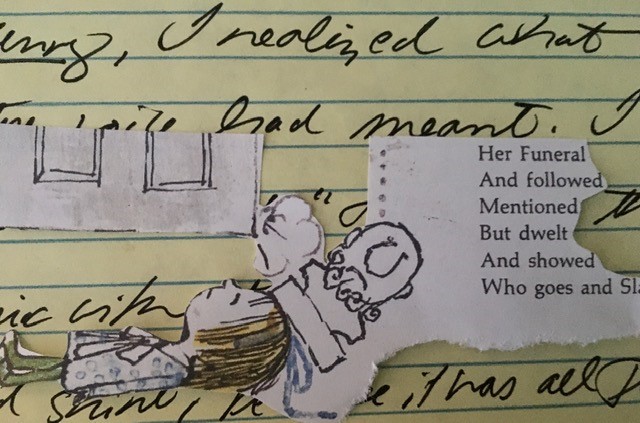
Hilaire Belloc’s “Rebecca,” illustrated by Alice and Martin Provensen
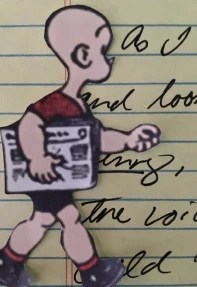
Carl Thomas Anderson’s comic strip character Henry
Posted in English 1103, Teaching, Writing

ENG 1103: Revising Your Literacy Narrative

As you continue to revise your literacy narrative, consider visiting The Writing Center. If you do so, you will earn five bonus points for the assignment.

To schedule an appointment, visit https://highpoint.mywconline.com, email the Writing Center’s director, Professor Justin Cook, at jcook3@highpoint.edu, or scan the QR code below. To earn bonus points for your literacy narrative, consult with a Writing Center tutor no later than Thursday, September 14.


https://wordpress.com
Posted in Check, Please!, English 1103, Teaching, Writing

ENG 1103: Completing Your Second “Check, Please!” Assignment

https://webliteracy.pressbooks.com/
            front-matter/updated-resources-for-2021/.

Posted in English 1103, Reading, Teaching, Writing

ENG 1103: A Second Look at Sedaris and a First Glimpse of Keller

Humorist David Sedaris with his sister Amy, a writer herself as well as an actress, https://www.cbsnews.com/news/david-sedaris-amy-sedaris-60-minutes-2022-10-30/

Posted in English 1103, Teaching, Writing

ENG 1103: Beginning Your Literacy Narrative


Posted in Check, Please!, English 1103, Reading, Teaching, Writing

ENG 1103: Check, Please! and an Introduction to Literacy Narratives

Mike Caulfield, author of Check, Please! and Director of Blended and Networked Learning at Washington State University. https://webliteracy.pressbooks.com/
            front-matter/updated-resources-for-2021/.

At the beginning of class on Wednesday, August 30, I will collect your worksheets for Lesson One of the Check, Please! starter course. My sample version of the assignment appears below, as well as on your worksheet and on Blackboard.

Sample Check, Please! Assignment

Check, Please! Lesson One Assignment

In the first lesson of the Check, Please! Starter Course, Mike Caulfield, author of the course and Director of Blended and Networked Learning at Washington State University, introduces the four-step SIFT approach to determining the reliability of a source: (1) “Stop,” (2) “Investigate,” (3) “Find better coverage,” and (4) “Trace claims, quotes, and media to the original context.”

One of the most useful practices presented in lesson one is what the author terms the “Wikipedia Trick.” Deleting everything that follows a website’s URL (including the slash), adding a space, typing “Wikipedia,” and hitting “enter” will yield the site’s Wikipedia page. The Wikipedia entry that appears at the top of the screen may indicate the source’s reliability or lack thereof.

The most memorable segment of lesson one is the short, riveting video “The Miseducation of Dylann Roof,” which begins with the narrator asking the question, “How does a child become a killer?” Produced by the Southern Poverty Law Center, it documents how algorithms can lead unskilled web searchers down paths of disinformation. In the worst cases, such as Roof’s, algorithms can lead searchers to the extremist propaganda of radical conspiracy theorists.

Work Cited

Caulfield, Mike. Check, Please! Starter Course, 2021, https://webliteracy.pressbooks.com/front-matter/updated-resources-for-2021/.


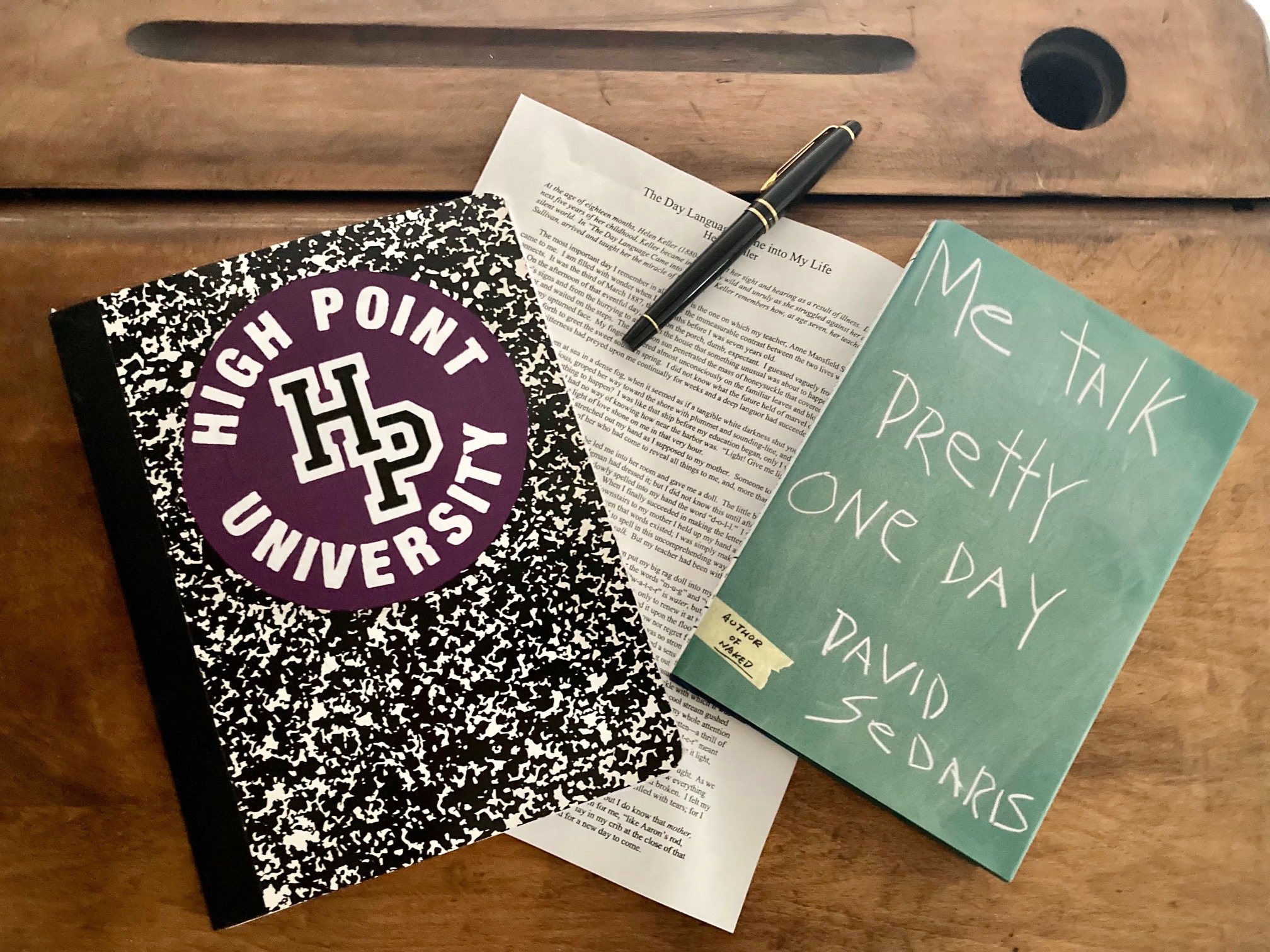
As a model for your own literacy narrative, today in class will examine “Me Talk Pretty One Day,” originally published in Esquire magazine and later as the title essay in David Sedaris’s 2000 essay collection.

To read more of Sedaris’s essays, see the list of links under the heading Writing and Radio on his website.

As you begin work on your own literacy narrative on Wednesday, study Sedaris’s essay as a model, and consider how he uses the following:

  • Shifts from summary to scene and vice versa
  • Figurative language
  • Hyperbole
  • Vivid detail

Look for opportunities to use those elements in your own essay.

Posted in English 1103, Reading, Teaching, Writing

ENG 1103: First-Day Follow-Up