Today in class, after your Scrabble debriefing, you will read a sample final essay and annotated bibliography written by a student last semester. After you read and make notes on the sample assignment, you and two or three of your classmates will collaboratively compose a one-paragraph assessment of it. Questions to consider in your assessment include these:
Does the essay answer the questions included in the first bullet point in the key features section of the assignment?
Does the essay include quotations from at least two of the sources in the bibliography? Are the quotations introduced with signal phrases? Are parenthetical citations included where needed?
Does the bibliography include a minimum of five sources, an interview with a classmate and at least four print sources?
Are the sources in the bibliography listed in the correct order?
Does the bibliographic entry for each source include complete MLA-style publication or interview information?
Is the publication or interview information for each source followed by a paragraph of summary?
Is each summary followed by a paragraph of commentary?
Does each commentary answer some of the questions included in the third bullet point in the key features section of the assignment?
Is the final essay and annotated bibliography marred by errors of diction, grammar, punctuation, mechanics, and/or style? If so, note at least one specific example in your assessment.
After you complete your assessment, review the grade criteria on your final essay and annotated bibliography assignment handout, and assign a grade.
Next Up
In class on Wednesday, you will have additional time for locating sources and composing annotations for your own final essay and annotated bibliography.
Your final essay and annotated bibliography will focus on one of the authors we have studied or one of elements of the course, including (1) blogging in the classroom, (2) limiting screen time, (3) writing longhand, and (4) playing Scrabble. As a starting point, you will conduct a short personal interview that will serve as one of the sources for your project. If you decide that you do not want to use the interview that you conduct today, you are welcome to include another one in your project. Keep in mind, however, that the interview you include in your project must be conducted with a student currently enrolled in section 20 or 21, and the subject of the interview must be the subject of your project.
Questions to ask your interviewee include the following:
What experience, if any, did you have with the subject (the reading or the aspect of the course) before you encountered it in English 1103?
Has it changed your perspective on reading and/or writing? If so, how?
Will you continue to pursue the subject (read more work by the author, continue the classroom practice or activity) after the conclusion of the semester?
After you conduct your interview, compose on the worksheet provided a sentence in which you introduce a quotation from the interview with a signal phrase or clause, such as, According to . . . , or [insert first and last name] notes or observes or points out that . . . .” Your quotation will not be followed by a parenthetical citation because it is a form of oral communication (without page or paragraph numbers). See the sample on your worksheet.
Follow your quotation with annotated bibliography entry in this format:
Annotated Bibliography*
Last Name, First Name. Interview. Conducted by Your First Name Your Last Name. Day Month Year.
*Note that you will use the header annotated bibliography, not works cited, in your final essay and annotated bibliography.
Below the work cited/bibliography entry, compose a one-paragraph summary of the interview followed by a second shorter paragraph that identifies the student by class and major (or undeclared) and addresses what role the interview might serve in a larger project. Would it serve as a point of comparison or contrast to another source? Would it support or challenge an idea presented in another source? See the model below.
Sample Quotation with Signal Clause
English 1103 student Jesse Brewer observes that Scrabble has expanded his vocabulary, saying it has “introduced me to new words, which allows me to read and write more capably in everyday life.”
Sample Annotated Bibliographic Entry
Brewer, Jesse. Interview. Conducted by Jane Lucas. 20 Oct. 2023.
English 1103 student Jesse Brewer recounts how he has played Scrabble for most of his life. Ever since he was a young child, he has played the game with his grandparents whenever he visited their home in Pennsylvania. Brewer will continue to play Scrabble after the end of the semester because the game remains a tradition in his family. In his words, “[M]y grandmother is still going to want to play it every summer.” Brewer also notes that the game has expanded his vocabulary, saying it has “introduced me to new words, which allows me to read and write more capably in everyday life.”
Brewer is a freshman computer science major at High Point University, where he is currently enrolled in English 1103, section 20. His remarks on vocabulary building highlight the game’s verbal benefits, and his observations on Scrabble as a family tradition serve as a point of contrast to that of some other students’—such as Ava Salvant’s—who had not played Scrabble before playing it as a weekly exercise in English 1103.
Note that the first paragraph of the bibliography entry, the summary, is written in present tense and third person. Also note that after the first mention of the interviewee’s name, he is referred to by last name.
The annotated bibliographic entry for your interview will be shorter than your other entries because (1) you are annotating a brief interview, and (2) your classmate does not have the credentials that you will list in the annotations for your other sources.
The complete final essay/annotated bibliography assignment appears below.
Overview
An annotated bibliography is a list of sources on a subject that includes a summary of each source. Some bibliographies include additional information, such as the authors’ credentials. That is the type of bibliography that you will compose along with your final essay for the course.
Key Features
Your final essay, which is an introductory essay of three or more paragraphs that (1) presents the subject of your bibliography, and (2) addresses your purpose for compiling it. In other words: What drives your research? What interests you about the subject, and what question/s do you seek to answer about your subject?
A complete MLA-style bibliography entry for each source.
A one-paragraph summary of each source followed by a shorter second paragraph that presents the writer’s credentials and addresses the purpose that the source might serve in a larger project. Would it serve as a point of comparison or contrast to another source? Would it support or challenge an idea presented in another source? Is it a secondary source that sheds light on the meaning of a primary source? The last question pertains primarily to bibliographies that focus on one of the writers studied in the course.
Preliminary Work—What to Complete in Class Today
Personal Interview
Your final essay and annotated bibliography will focus on one of the authors we have studied or one of elements of the course, including (1) blogging in the classroom, (2) limiting screen time, (3) writing longhand, and (4) playing Scrabble. As a starting point, you will conduct a short personal interview that will serve as one of the sources for your project. If you decide that you do not want to use the interview that you conduct today, you are welcome to include another one in your project. Keep in mind, however, that the interview you include in your project must be conducted with a student currently enrolled in section 20 or 21, and the subject of the interview must be the subject of your project.
Begin by conducting a short personal interview and composing an annotated bibliographic entry for the interview. For more information, see the paragraphs under the header PRELIMINARY WORK—What to Complete in Class Today.
Compose an annotated bibliographic entry for the source that serves as the starting point for your research. See the list of texts that follows.
Use the HPU Libraries site, https://www.highpoint.edu/library/, and Google Scholar to locate a minimum of three additional reliable and relevant print sources (articles, essays, and/or books) devoted to the same subject. Compose your summaries and commentaries in complete sentences, introduce any quotations with signal phrases, and include parenthetical citations where needed. Your bibliography must include five sources, four of which must be print. (Your personal interview is a nonprint source.) If you wish to include an additional non-print source, such as a video, you may include that as a sixth source.
After you have composed your annotated bibliography entries, write an introductory essay that (1) presents the subject of your bibliography, and (2) addresses your purpose for compiling it. In other words: What drives your research? What question do you seek to answer about your subject? Also, (3) What larger project might develop from your bibliography? Would it be a project for a course in psychology, science, education, or another discipline? Address all five of your sources in your essay, and quote at least two of them.
Note: Though your introductory essay will precede your annotated bibliography, you will compose it last because you will need to re-read and summarize your sources before you will know how to address them in your essay.
Directions for Researching, Drafting, Revising, and Submitting
Devote today’s class primarily to conducting a personal interview and composing an annotated bibliography entry for the interview. You will have two additional Wednesdays to work in class on your final essay and annotated bibliography before you post your revision to Blackboard and to your WordPress blog.
Before class on the due date: Post a copy of your revision to Blackboard and to your blog. In your blog post, omit the first-page information included in your file submitted to Blackboard (your name, professor’s name, course and section, and date). Add to your blog post an image that documents some part of your writing process away from the screen, such as the summary of your source in your journal, today’s worksheet, or a page of your draft. Also add an embedded link to a relevant web site. Even though your work for this assignment will take place primarily in front of the screen, your writing process still involves putting pen to paper, and photographic documentation of that on your blog is a requirement of the assignment.
Rosenwasser, David and Jill Stephen. “Arriving at an Interpretive Conclusion: Making Choices.” Writing Analytically, 9th edition. Wadsworth/Cengage, 2024. pp. 111-12.
Sedaris, David. “Me Talk Pretty One Day.” Me Talk Pretty One Day. Little, Brown, 2000. pp. 166-73.
An A final essay and annotated bibliography includes these components:
An introductory essay of three or more paragraphs that (1) presents the subject of your bibliography, and (2) addresses your purpose for compiling it. In other words: What drives your research? What question do you seek to answer about one of the subjects that you’ve studied in the course or about one aspect of the course? Also, (3) what larger project might develop from your bibliography? Would it be a project for a course in science, psychology, education, or another discipline?
A complete works cited/bibliographic entry for a minimum of five reliable and relevant sources, four of which are print. Alphabetize the list by the writers’ last names.
A one-paragraph summary of each source followed by a shorter paragraph of commentary that presents the writer’s credentials.
An A final essay and annotated bibliography complies with the requirements above and is also cohesive and relatively free of surface errors.
A B final essay and annotated bibliography effectively meets all of the requirements above but may be flawed by minor issues of organization and/or surface errors.
A C final essay and annotated bibliography meets most but not all of the requirements above and may also be flawed by issues of organization and/or surface errors.
A D final essay and annotated bibliography meets only a few of the requirements above and may also be flawed by issues of organization and/or surface errors.
An F final essay and annotated bibliography fails to meet the requirements above and may also be flawed by substantial issues of organization and/or surface errors.
Next Up
Wordplay Day! To prepare for class, revisit the Dictionary and World Builder pages on the Scrabble website. Also review the blog posts devoted to Scrabble tips.
Today in class, before you continue planning your group presentations, you will complete an exercise that offers you practice in some of the key moves of academic writing: (1) introducing a quotion with a signal phrase, (2) following it with a parenthetical citation, and (3) developing a paragraph by offering your own ideas on the subject of the quotation.
As model for you, I offer the sample paragraph below, which focuses on the Diego Velaszquez painting above and the Pablo Picasso painting below.
Sample Paragraph
The authors of Writing Analytically note, “There are provocative differences between Velásquez’s original and Picasso’s copy in size, spatial configuration, and palette” (Rosewasser and Stephen 268). Yet despite those differences, The Maids of Honor (Las Meninas, after Velásquez) features all of the figures in the same spirit Velásquez depicts them. Along with the painter’s canvas out of view, the artists’ foregrounding of elements ordinarily relegated to the perimeter—children, pets, servants, the artist, himself—invite a new way of seeing. Both Velásquez’s seventeenth-century baroque rendering of King Phillip IV’s court and Picasso’s cubist reassembling of it challenge viewers’ expectations of the subjects of art.
Picasso, Pablo. The Maids of Honor (Las Meninas, after Velazquez). 1957.
The paragraph that follows is the same as the one above, but the parenthetical citation includes only the page number because the authors are named in the signal phrase. In academic writing, whenever you quote more than one source, the authors’ names should appear either in a signal phrase or in the parenthetical citation, not both. Your analysis was an exception to this rule because your cited only one source, the text that served as your subject.
Sample Paragraph
David Rosenwasser and Jill Stephens, the authors of Writing Analytically, note, “There are provocative differences between Velásquez’s original and Picasso’s copy in size, spatial configuration, and palette” (268). Yet despite those differences, The Maids of Honor (Las Meninas, after Velásquez) features all of the figures in the same spirit Velásquez depicts them. Along with the painter’s canvas out of view, the artists’ foregrounding of elements ordinarily relegated to the perimeter—children, pets, servants, the artist, himself—invite a new way of seeing. Both Velásquez’s seventeenth-century baroque rendering of King Phillip IV’s court and Picasso’s cubist reassembling of it challenge viewers’ expectations of the subjects of art.
Directions
As practice in three of the key moves of academic writing, use the paragraphs above as models for your own paragraph focusing on Ian Falconer’s The Competition. (See page 108.)
Include in your paragraph a signal phrase that introduces one of the following two quotations:
“At its most serious, The New Yorker cover may speak to American history, in which New York has been a major point of entry for generations of immigrants, embracing diversity and nonconformity, while viewing the rest of the nation as more homogenous.”
“[T]he magazine is [. . .] admitting, yes America, we New Yorkers do think that we’re cooler and more individual than the rest of you, but we also know that we shouldn’t be so smug about it.”
Follow the quotation with a parenthetical citation. If you name the authors in the signal phrase, include only the page number, 112, in the parenthetical citation. If you do not name the authors in the signal phrase, include their last names before the page number.
Develop the paragraph with two or more sentences that offer your own reading of the magazine cover.
Follow your paragraph with a work cited entry:
Work Cited
Rosenwasser, David and Jill Stephen. “Arriving at an Interpretive Conclusion: Making Choices.” Writing Analytically. 9th edition, Wadsorth/Cengage, 2024. pp. 111-12.
Next Up
Wordplay Day! To prepare for class, revisit the Dictionary and World Builder pages on the Scrabble website. Also review the blog posts devoted to Scrabble tips.
This morning in class, you will plan and draft a short midterm reflective essay that documents your work in the first half of the semester, focusing on your analysis and one or two other assignments or aspects of the course that have contributed to your development as a writer and a student. In addition to your analysis, assignments and aspects of the course to consider include the following:
Keeping a journal
Completing Check, Please! assignments
Studying one of the readings examined class, including “Letter from Birmingham Jail,” “Me Talk Pretty One Day,” “The Day that Language Came into My Life,” “Back Story” (from The Blind Side), “The Falling Man,” “The School,” the sample literacy narrative (“A Bridge to Words”), or the sample analysis (“The Strange Fruit of Sosnowiec”)
Reading and editing samples of student writing
Writing for an online audience beyond the classroom/creating and maintaining a WordPress blog
Collaborating with your classmates on in-class writing assignments
Playing Scrabble/Collaborating with your teammates on Wordplay Day
Writing longhand
Limiting screen time
Include in your reflective essay the following elements:
A title that offers a window into your reflection
An opening paragraph that introduces your focus and presents your thesis
Body paragraphs that offer concrete details from your work to support your thesis.
A relevant quotation from Writing Analytically. Introduce your quotation with a signal phrase and follow it with a parenthetical citation. In addition to quoting a relevant passage from Writing Analytically, you may quote one of the texts that we have studied in class.
A conclusion that revisits the thesis without restating it verbatim
An MLA-style works cited entry for your source or sources
Sample MLA Style Works Cited Entries
Bartheleme, Donald. “The School.” The Best American Short Stories 1975, edited by Martha Foley, Houghton Mifflin, 1975. pp.8-11.
Rosenwasser, David and Jill Stephen. “Analysis and Argument.” Writing Analytically, 9th edition. Wadsworth/Cengage, 2019. pp. 7-8.
—. “Analysis and Everyday Life: More Than Breaking a Subject into Its Parts.” Writing Analytically, 9th edition. Wadsworth/Cengage, 2024. pp. 6-7.
—. “Integrating Quotations into Your Paper.” Writing Analytically, 9th edition. Wadsworth/Cengage, 2019. pp. 343-46.
—. “The Idea of the Paragraph.” Writing Analytically, 9th edition. Wadsworth/Cengage, 2019. pp. 307-313.
Sedaris, David. “Me Talk Pretty One Day.” Me Talk Pretty One Day. Little, Brown, 2000. 166-73.
Next Up
Wordplay Day! To prepare for class, revisit the Dictionary and World Builder pages on the Scrabble website. Also review the posts on my blog devoted to Scrabble tips.
Rosenwasser, David and Jill Stephen. Writing Analytically, 9th edition. Wadsworth/Cengage, 2019.
Revising Your Analysis
As you continue to revise your analysis, review “The Strange Fruit of Sosnowiec” and consider the elements of the essay that we examined in class on Monday: the thesis, the examples of connections and separations that I offer as support for my thesis, and conclusion strategies that I employ in the final paragraph.
Additional Citations
You are not required to cite any text other than the essay, essay excerpt, or chapter excerpt that serves as your subject, but if you include any ideas from my class notes, you should name me in sentence and include a parenthetical citation and a work cited entry for the blog post in which the idea appears. In class on Monday, I distributed a handout with samples of additional citations and am including them here as well:
Example
Dr. Jane Lucas observes that “choosing not to divide the first paragraph creates an unbroken movement that parallels the unbroken downward flight of his [Junod’s] subject, the Falling Man” (par. 3).
In class on Wednesday, you will plan and compose a midterm reflection that documents your work in the first half of the semester, focusing on your analysis and one or two other assignments or aspects of the course that have contributed to your development as a writer and a student. In addition to reflecting on your analysis, you may reflect on one or two of the following:
Keeping a journal
Completing Check, Please! assignments
Studying one of the readings examined class, including “Letter from Birmingham Jail,” “Me Talk Pretty One Day,” “The Day that Language Came into My Life,” “Back Story” (from The Blind Side), “The Falling Man,” “The School,” the sample literacy narrative (“A Bridge to Words”), or the sample analysis “The Strange Fruit of Sosnowiec”
Writing for an online audience beyond the classroom/creating and maintaining a WordPress blog
Collaborating with your classmates on in-class writing assignments
Playing Scrabble/collaborating with your teammates on Wordplay Day
Writing longhand
Limiting screen time
You will be required to include a relevant quotation from Writing Analytically. To prepare for that element of the reflection, review the sections of the textbook listed below, and select a relevant sentence, clause, or phrase to quote.
Rosenwasser, David and Jill Stephen. “Analysis and Argument.” Writing Analytically, 9th edition. Wadsworth/Cengage, 2019. pp. 7-8.
—. “Analysis and Everyday Life: More Than Breaking a Subject into Its Parts.” Writing Analytically, 9th edition. Wadsworth/Cengage, 2024. pp. 6-7.
—. “Integrating Quotations into Your Paper.” Writing Analytically, 9th edition. Wadsworth/Cengage, 2019. pp. 343-46.
—. “The Idea of the Paragraph.” Writing Analytically, 9th edition. Wadsworth/Cengage, 2019. pp. 307-313.
Next Up
In class on Wednesday, you will compose your midterm reflection. (See the notes above.) Wednesday, March 6 (before class) is also the due date for your analysis; the hard deadline is Friday, March 8 (before class). Review the assignment submission requirements, and be sure to post your analysis both as a Word or PDF file to Blackboard and as a blog entry on your WordPress site.
The analysis that follows is one that I wrote as a model for my students in 2021. As you read it, note how I turn from summary to thesis (in bold) in the first paragraph. Also note how the paragraphs that follow offer support for the thesis with concrete details from the comic’s panels.
Since concluding paragraphs can be particularly difficult to write without repeating the introduction, today’s group work will include a close look at strategies for conclusions.
The Strange Fruit of Sosnowiec
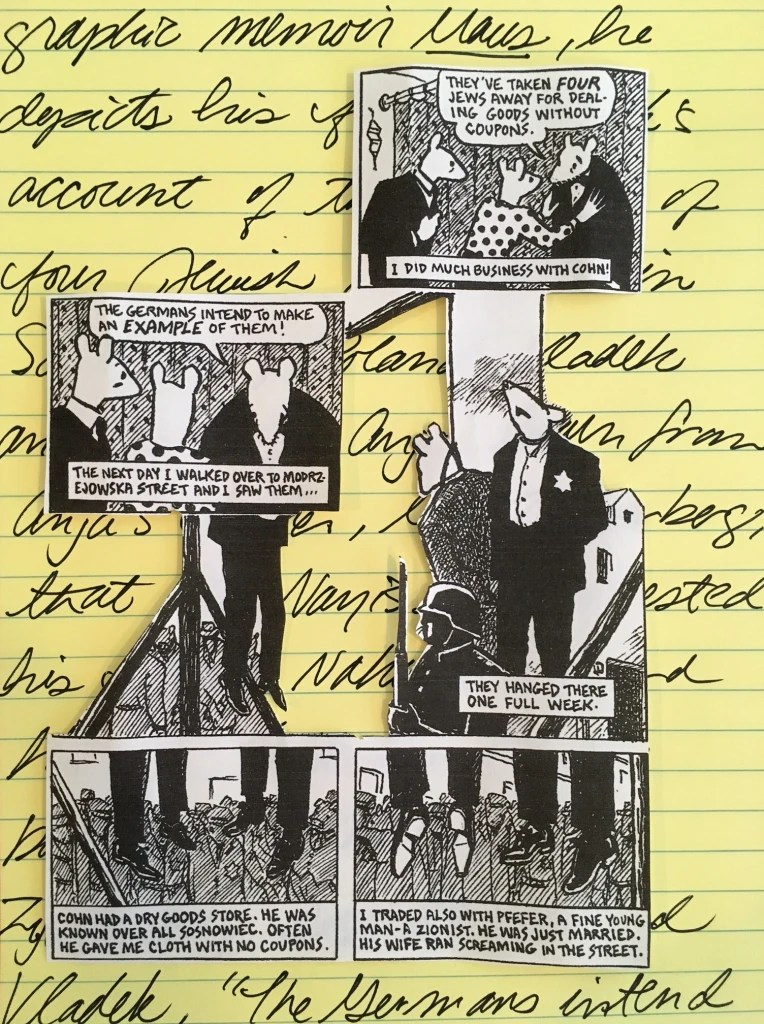
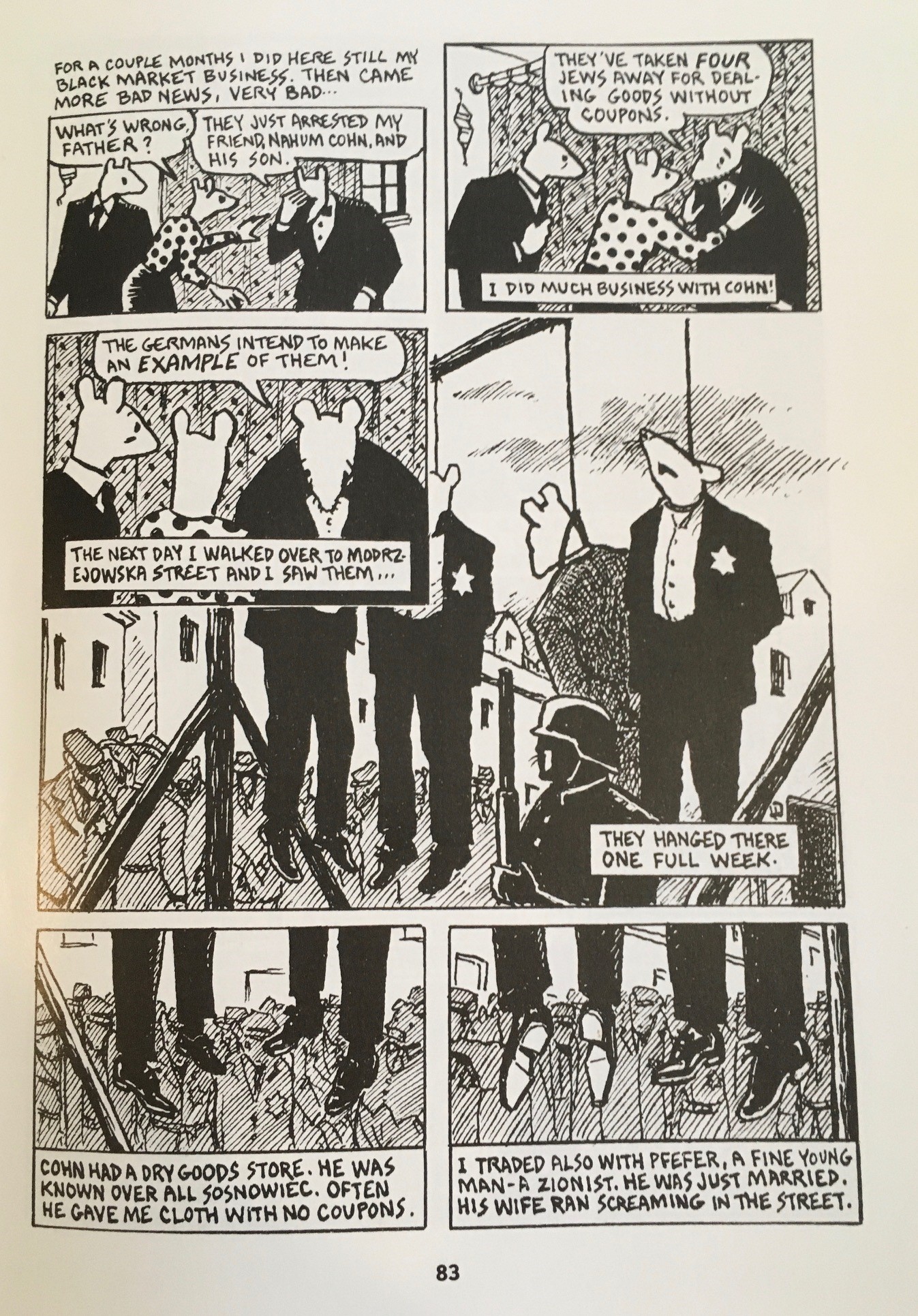
In Chapter 4 of Art Spiegelman’s graphic memoir Maus, he depicts his father Vladek’s account of the hangings of four Jewish merchants in Sosnowiec, Poland. Vladek and his wife, Anja, learn from Anja’s father, Mr. Zylberberg, that the Nazis have arrested his friend Nahum Cohn and his son. With his head bowed in sorrow, Mr. Zylberberg says to Anja and Vladek, “The Germans intend to make an example of them!” (83). That image of Mr. Zylberberg speaking with Vladek and Anja overlays the larger panel that dominates the page, one that depicts the horror that Mr. Zylberberg anticipates: the murder of his friend Nahum Cohn, Cohn’s son, and two other Jewish merchants. That haunting panel and the smaller ones that frame it illustrate the complexity of Spiegelman’s seemingly simple composition. His rendering of the panels of the living in conjunction with the fragmented panels of the hanged merchants simultaneously conveys connection and separation: both the grieving survivors’ ties to the dead and the hanged men’s objectification at the hands of the Nazis.
The placement of the overlaying panel not only hides part of the horror behind it, but it also connects Vladek’s father-in-law to one of the victims. Mr. Zylberberg’s head and torso appear directly above the suspended legs and feet of one of the hanged men, creating an image that merges the two.
Spiegelman further emphasizes the mourners’ identification with the hanged men by extending two of the nooses’ ropes upward to the smaller panel above them, linking the living to the dead. Additionally, Spiegelman underscores the link with Vladek’s line of narration at the bottom of the smaller panel: “I did much business with Cohn!” (83). The word “with” appears directly above the rope, punctuating the connection between both Nahum Cohn and his friend Mr. Zylberberg and Zylberberg’s son-in-law, Vladek.
While the panels of the hangings yoke the living to the dead, Spiegelman’s presentation of the hanged men in fragments also objectifies them. The final panels on the page depict only their shoes and part of their pant legs suspended above the onlookers, images that may evoke in some readers thoughts of the last remnants of the Jews who stepped barefoot into the gas chambers of Auschwitz.
Whether the hanged men’s shoes call to mind those mountains of leather left behind by the Jews, the separation of their lower legs and feet from the rest of their bodies turns them into something less than human—not people, but mere parts. Thus, Spiegelman creates a picture of the hangings that illustrates both the mourners’ identification with the victims and the Nazis’ perception of the Jews as less than human: the malignant ideology that the artist has pinpointed “at the very heart of the killing project.”
Spiegelman, Art. Maus 1. Pantheon, 1986, p. 83.
Spiegelman’s transformation of the Nazi propaganda portrayals of Jews as rats remains an astounding achievement thirty-five years after the publication of the first volume of Maus. But seeing the hanged merchants in Modrzejowska Street in the midst of the George Floyd murder trial in Minneapolis and less than three months after the January 6 Capitol riot reminds readers that the panels of Spiegelman’s memoir have grown more prescient. The nooses evoke images of Officer Derek Chauvin’s knee on George Floyd’s neck, the January 6 chants to hang the Vice President, and a T-shirt glimpsed in the Capitol crowd, one with a Nazi eagle below the acronym “6MWE” (Six Million Wasn’t Enough), a reference to the numbers of Jews slaughtered in the Holocaust. Our heads are bowed in sorrow with Mr. Zylberberg’s. The strange fruit of our past, both distant and recent, should seem far stranger.
After we examine “The Strange Fruit of Sosnowiec,” you and two or three of your classmates will collaborate on an exercise that asks you to consider an example of the connections and separations that I address in my thesis. The exercise will also ask you to explore the conclusion strategies that I employ in the final paragraph.
Next Up
In class on Wednesday, you will compose a reflective essay that focuses on your work over the first half of the semester. In your reflection, you will be required address your analysis and one or two other assignments or aspects of the course that have contributed to your development as a writer and a student. You will also be required to include at least one relevant quotation from a section of Writing Analytically devoted to analysis.
This morning, after I collect your Check, Please! worksheets for lesson four, I will return your drafts, and you will have the remainder of the class period to begin revising your analyses on your laptops and tablets. Because next week is spring break, you will have two additional weeks to continue your revision work before you submit the assignment to Blackboard and publish it as a WordPress blog entry. The due date is Wednesday, March 6 (before class). The hard deadline is Friday, March 8 (before class). Directions for submitting your analysis are included on your assignment sheet and on the Blackboard submission site.
As you continue to revise analysis, consider visiting the Writing Center. If you do so, you will earn five bonus points for the assignment.
To schedule an appointment, visit https://highpoint.mywconline.com, email the Writing Center’s director, Professor Justin Cook, at jcook3@highpoint.edu, or scan the QR code below. To earn bonus points for your literacy narrative, consult with a Writing Center tutor no later than Thursday, February 8.
Parethetical Citations for Your Analysis
In your analysis, you will include parenthetical citations for quotations and paraphrases. Since you are writing a textual analysis, I recommend quoting rather than paraphrasing because the writer’s particular word choices are vital to the text’s overall effect. If your subject is one of the unpaginated texts (“Letter from Birmingham Jail,” “The Day Language Came into My Life,” or “The Falling Man”), your parenthetical citations will include the abbreviation par. for paragraph, followed by the paragraph number. If your subject is one of the paginated texts (“Me Talk Pretty One Day,” “Back Story,” or “The School”), your parenthetical citations will include the page number by itself.
Including the author’s last name as well would be redundant because you have established in your introduction that your essay focuses solely on a work by him or her. When you a writing a paper in which you cite multiple sources, you will need to include the author’s last name in the parenthetical citation to clarify which of your sources you are citing.
Here are some examples of how to use parenthetical citations in your analysis:
The nonsense words “meimslsxp” and “lgpdmurct” underscore his utter lack of comprehension in French class (167).
The line “‘like Aaron’s rod, with flowers’” alludes to Numbers 17.8 (par. 9).
He notes that in contrast to the Falling Man, the others who jumped appeared “confused, as though trying to swim down the side of a mountain” (par. 1).
He employs the “One Mississippi . . . Two Mississippi . . .” count to mark the seconds leading up to Joe Theismann’s career-ending injury (15).
With the words, “[I]s death that which gives meaning to life?,” the story shifts from realism to surrealism (10).
Works Cited Entries for Your Analysis
At the end of your analysis, you will include an MLA-style work cited entry. Refer to the models below.
Barthelme, Donald. “The School.” The Best American Short Stories 1975, edited by Martha Foley, Houghton Mifflin, 1975. pp. 8-11.
King, Martin Luther, Jr. “Letter from Birmingham Jail.” The Martin Luther King, Jr. Research and Education Institute, Stanford University, https://kinginstitute.stanford.edu/ sites/mlk/files/letterfrombirmingham_wwcw_0.pdf.
Lewis, Michael. Chapter One: “Back Story.” The Blind Side. 2006. Norton, 2009, pp. 15-23.
Sedaris, David. “Me Talk Pretty One Day.” Me Talk Pretty One Day. Little Brown, 2000. pp. 166-73.
Note that the sample work cited entries above do not have a hanging indent (because of the limitations of the blog platform), but your MLA-style work cited entries in your Word and PDF files should have a hanging indent. See the entries in my sample papers and on the citations handout that I will distibute in class this morning.
Next Up
Wordplay Day! To prepare for class, revisit the Dictionary and World Builder pages on the Scrabble website and review the blog posts devoted to Scrabble.
Yesterday in class we examined Donald Barthelme’s short story “The School,” and in groups of two, three, or four you addressed in writing some of the elements of the story that you might explore in an analysis. As I mentioned last week, if you find the prospect of analyzing “The School” more appealing than analyzing one of the texts we studied previously (“Me Talk Pretty One Day,” “The Day Language Came into My Life,” the opening of “The Falling Man,” “Back Story”), you are welcome to change the subject of your analysis to “The School.”
Among the elements of Barthelme’s story that you considered yesterday are these:
the narrator and the narrative voice
conflict
narrative shift (Where does “The School” make an unexpected turn?)
Whether the subject of your analysis is Bartheleme’s story or one of our earlier readings, you will begin your first paragraph with a summary of the text. Remember that a summary is an objective synopsis of a text’s key points. It should be written in third person and present tense. For example, if you choose to analyze “The School,” you might summarize it this way:
Donald Barthelme’s short story “The School” recounts a series of classroom lessons that end with the deaths of plants and animals–deaths that serve as a prelude to the unexplained death of a Korean orphan, followed by the senseless deaths of classmates and family members.
Notice that the summary above does not comment on the story in any way. What follows the summary will be the beginning of your commentary, or analysis, the thesis statement that offers your particular close reading, or interpretation, of the story. The passage below is the same as the one above, but at the end of it I have added a thesis statement in bold.
Donald Barthelme’s short story “The School” recounts a series of classroom lessons that end with the death of plants and animals–deaths that serve as a prelude to the death of a Korean orphan, followed by the deaths of classmates and family members. With conversational narration, accumulation of detail, and a shift in fictional mode, Barthelme deftly depicts the reality of the fleeting nature of life, even as the story itself veers from reality.
If I were to continue to write the analysis that I began in the previous paragraph, I would follow that opening paragraph with body paragraphs that address each of the three story elements that I include in my thesis: (1) “conversational narration,” (2) “accumulation of detail,” and (3) “shift in fictional mode.”
Next Up
In class on Wednesday, after I collect your fourth Check, Please! assignments, I will return your handwritten analysis plans and drafts (with my notes), and you will have the remainder of the class period to devote to revising on your laptops and tablets. Because next week is spring break, you will have two additional weeks to continue revising. Your revision is due on Blackboard and on your WordPress blog Wednesday, March 6 (before clas). The hard deadline in Friday, March 8 (before class).
This morning in class, you will begin your analysis of one of the texts we have studied in class, which include these:
The first paragraphs of “The Falling Man” by Tom Junod
“The Day Language Came into My Life” by Helen Keller
“Letter from Birmingham Jail” by Martin Luther King, Jr.
The first paragraphs of “Back Story” by Michael Lewis
“Me Talk Pretty One Day” by David Sedaris
On Monday we will read a short story, “The School” by Donald Barthelme, which will serve as an additional option for your analysis. If you begin an analysis of one of the texts listed above and decide you would rather write about “The School,” you are welcome to change your focus.
Directions
Review the essays, essay excerpt, and chapter excerpt you’ve read, and determine which one appeals to you most as a subject of analysis.
Reread it and identify three or more elements that contribute to its effectiveness.
Develop your analysis through a close examination of those elements.
Write in dark ink, preferably black. You are welcome to use both sides of the page.
Before you leave class today, staple your assignment handout on top of your draft and submit it to me. Next week I will return your draft with notes, and you will have the class period to begin revising and editing on your laptop or tablet.
Think of your preliminary draft as your down draft; your aim in the early stage of the process is to get your ideas down on the page. You may need the process of drafting to discover what you think the essay, essay excerpt, or chapter excerpt means and how it makes its meaning.
Lewis, Michael. Chapter One: “Back Story.” The Blind Side. 2006. Norton, 2009, pp. 15-23.
Sedaris, David. “Me Talk Pretty One Day.” Me Talk Pretty One Day. Little Brown, 2000. pp. 166-73.
Next Up
Wordplay Day! To prepare for class, revisit the Dictionary and World Builder pages on the Scrabble website, and review the posts on my blog devoted to Scrabble tips.
Yesterday’s class was devoted primarily to reading and responding to the blog post of one of your classmates’ literacy narratives. Elements you considered in your response included these:
the title
vivid details
dialogue, the use of scene and/or summary
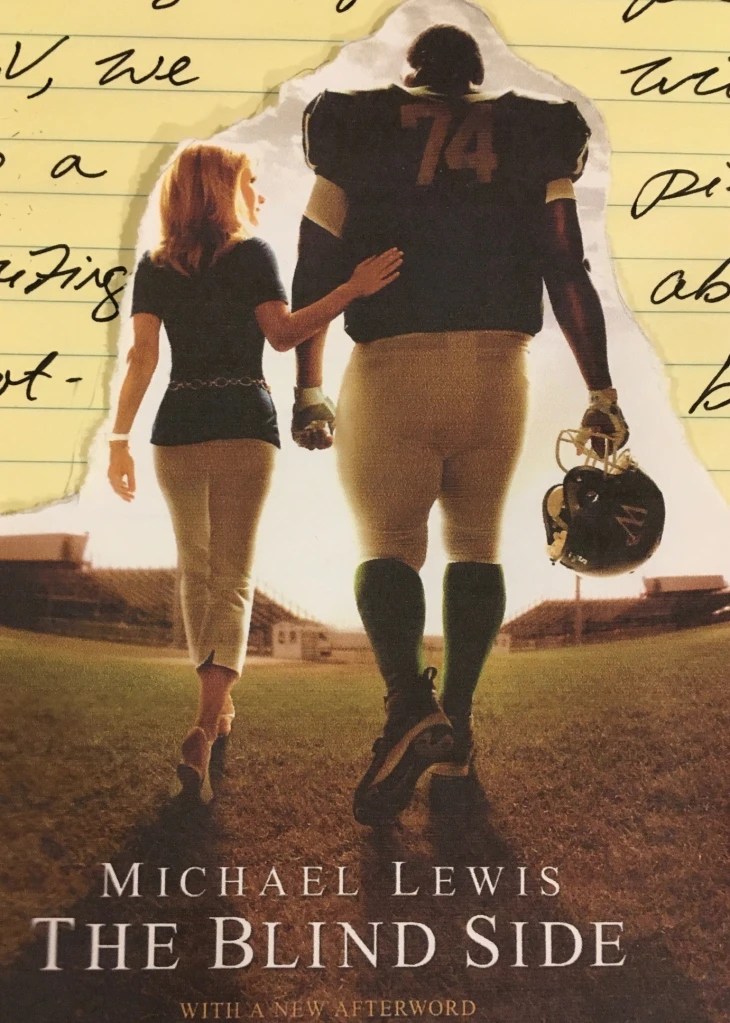
Before you began that assignment, we examined the opening pages of “Back Story,” the first chapter of Michael Lewis‘s The Blind Side, which dramatizes the moments in the November 1985 Redskins-Giants football game leading up to the injury that ended quarterback Joe Theismann’s career:
“From the snap of the ball to the snap of the first bone is closer to four seconds than to five. One Mississippi: The quarterback of the Washington Redskins, Joe Theismann, turns and hands the ball to running back John Riggins. He watches Riggins run two steps forward, turn, and flip the ball back to him. It’s what most people know as a ‘flea-flicker,’ but the Redskins call it a ‘throw-back special.’ Two Mississippi: Theismann searches for a receiver but instead sees Harry Carson coming straight at him. It’s a running down—the start of the second quarter, first and 10 at midfield, with the score tied 7–7—and the New York Giants’ linebacker has been so completely suckered by the fake that he’s deep in the Redskins’ backfield. Carson thinks he’s come to tackle Riggins but Riggins is long gone, so Carson just keeps running, toward Theismann. Three Mississippi: Carson now sees that Theismann has the ball. Theismann notices Carson coming straight at him, and so he has time to avoid him. He steps up and to the side and Carson flies right on by and out of the play. The play is now 3.5 seconds old. Until this moment it has been defined by what the quarterback can see. Now it–and he–is at the mercy of what he can’t see” (15).
What Theismann cannot see is Lawrence Taylor. A second later, as Taylor sacks Theismann, Taylor’s knee drives straight into Theismann’s lower right leg, leading to the “snap of the first bone” that Lewis mentions in the first line of the chapter. He hooks the reader by linking the beginning of the play, “the snap of the ball” to the gruesome “snap of the first bone” that will follow. Lewis develops the opening paragraph using the common one-Mississippi, two-Mississippi method of marking seconds to present the events leading up to the compound fracture that ends Theisman’s career.
Lewis doesn’t dramatize the injury itself because his interest lies instead in the blind side that led to it and subsequently elevated the status and salary of the left tackle, the player who protects the quarterback’s blind side.
When you’re struggling to develop a piece of writing, reread the opening paragraph of The Blind Side. Observe how Lewis dramatizes 3.5 seconds–yes, only 3.5 seconds–with about two-hundred words.
Yesterday, after we studied the opening of The Blind Side, we examined the first two paragraphs of Tom Junod‘s Esquire magazine feature “The Falling Man” and considered why Junod may have chosen to present the beginning of his essay as an unusually long single paragraph, one that could have been divided into three or more paragraphs.
Peer Responses
In the last few minutes of Monday’s class (or on your own if you were still completing your blog comment at the end of class), you began reading your other classmates’ literacy narratives and began taking notes on them in your journal.
Once you have read and taken notes on all of the essays, compose a brief comment that states which of the narratives is the strongest and why. Include in your response the title of the narrative, the writer’s first and last name, and the section number. Post your response as a comment on this blog post no later noon on Thursday, February 15.
After the posting deadline (but not immediately after), I will make the comments visible. In the coming days and weeks, we will look at some of the comments in class, as well as the literacy narratives that they address.
Next Up
In class on Wednesday you will begin planning and drafting your analysis, which will focus on one of the texts that we have studied in class, including Martin Luther King Jr.’s “Letter from Birmingham Jail,” David Sedaris‘s “Me Talk Pretty One,” Helen Keller‘s “The Day Language Came into My Life,” Michael Lewis‘s “Back Story,” and Tom Junod‘s “The Falling Man.” If you have misplaced your copy of any of those or were absent the day that I distributed copies, you can download a copy from Blackboard and print it. Next Monday we will examine an additional text that may serve as the subject of your analysis. If it appeals to your more than the text you write about on Wednesday, you are welcome to change your subject to that latest addition to the readings.