
In my childhood home, the bedroom closets were so small, the one in my parents’ room was too diminutive for my mother and father to share. It held only my mother’s clothes and shoes. My father claimed for himself a closet downstairs in a room that had been converted from a garage by the previous owners. My father’s closet with its sliding door became one of my favorite hiding places. In my mind, I am back there now, standing under the clothes rack, half hidden by corduroy and gaberdine, eyeing the pale sneakers nestled among the other shoes. Those sneakers on the floor of my father’s closet were my first glimpse of Converse Chuck Taylor All-Stars and my introduction to a part of my father’s life that ended, for the most part, before mine began.
The white, low-cut All-Stars in my father’s closet were ones that he’d worn playing rec-league basketball. Though I hold one brief memory of him on the court in his Piggly Wiggly jersey, those days of his mostly predated me and my older sister. Our father played basketball only rarely after he became a father and left his job as a junior-high biology teacher to operate a marina on a lake near our hometown.
That former life of his that I could never truly see remained a source of fascination for me. The man I saw most often wearing a uniform that resembled a gas station attendant’s, complete with an oval chest patch with Dave stitched in script, had once been a multi-sport athlete. He was a first-generation college student whose baseball skills had won him a scholarship to High Point, an opportunity that my grandparents approved of only because it was a Methodist school. Though he never wore his Chuck Taylors on the baseball diamond, those shoes were an emblem of his years as a student-athlete.
In 1921, ten years before my father was born, Charles “Chuck” Taylor, a travelling salesman who’d played farm-league basketball, was hired by Converse. Wanting a basketball shoe for himself that wouldn’t hurt his feet after a game, he recommended design changes that Converse adopted in 1922. In 1923, to honor his contributions, Converse added Chuck Taylor’s signature to the ankle patch (Dalesio par. 8, AP par. 3).
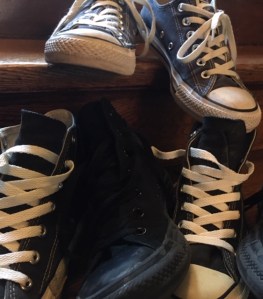 I bought my first pair of Chuck Taylors at the Salvation Army when I was in high school. My then-boyfriend had introduced me to thrift-store shopping, much to my parents chagrin. They didn’t mind when my boyfriend and I combed the local flea market and thrift stores for vinyl records, but buying clothes there was a different matter. We’ve worked hard so you don’t have to wear clothes from thrift stores, they said. My parents continued to repeat those words until I was in graduate school. That’s when they began to remark on the quality of my consignment-shop and thrift-store finds. For me, in those years as a graduate teaching assistant, used clothes were my creative solution to a problem: how to assemble a professional wardrobe on a meager grad-school stipend. But I digress.
The first Chucks that I bought–navy high-tops from the Salvation Army–weren’t just a retro fashion statement, they also proved ideal for my summer jobs in factories. With their thick rubber soles and ankle support, those navy Converse saw me through eight-hour days of standing on cement floors, two summers in a furniture factory and one in a glass plant.
In 1972, a few years after I first glimpsed my father’s All-Stars on the floor of his closet, Converse leased an old rubber factory in Lumberton, North Carolina. From 1972 until the factory closed in March 2001, all Converse were finished or made entirely at that factory (Dalesio par. 12), including the navy high-tops that I wore for three summers. Back then, when I was a student, I had no idea that All-Stars were made in North Carolina, just 136 miles from my hometown. I still didn’t know it in 2001, two months after the Converse plant closed, when my husband’s newspaper job found us relocating to Virginia.
In a thrift store in Richmond, I happened upon my second pair of Chuck Taylors. When I spotted them on the shelf, my mind traveled back to the navy ones that I’d worn years earlier. I’d forgotten how comfortable they were and have since acquired several more pairs, none of which I bought new. As a woman with small feet, I can wear the size six Converse that teenage boys have grown out of.
My older nephew, now beyond his teenage years, wears Converse, too.
How many more generations will rediscover them?
Works Cited
Associated Press. “Who the Heck was Chuck Taylor Anyway?” Kentucky New Era. 28 March
A7. Google News. https://news.google.com/newspapers?id=Fv4rAAAAIBAJ&sjid=
M20FAAAAIBAJ&pg=1717%2C8232748. Accessed 21 Jan. 2019.
Dalesio, Emery P. “Converse Closes Chuck Taylor Plant.” Kentucky New Era. 28 March
A7. Google News.https://news.google.com/newspapers?id=Fv4rAAAAIBAJ&sjid=
M20FAAAAIBAJ&pg=1717%2C8232748. Accessed 21 Jan. 2019.
 For my students’ final writing assignment in English 111: Writing and Inquiry, they compose a reflective essay that addresses the features of the course that have contributed to their development as writers and critical thinkers. As I embarked on this final assignment with them, my thoughts repeatedly returned to the hours they had devoted to playing Scrabble on Wordplay Days, a bimonthly feature that I included in my classes for the first time this semester.
 When the students in the Monday-Wednesday 8 o’clock class tore the plastic from the boxes of Retro Edition Scrabble, I had no idea how they would respond to the game. Back in August, when I had decided to include bimonthly Wordplay Days on the calendar, I did so to achieve two of my goals as a teacher: first, to offer students an opportunity to collaborate on low-stakes assignments that would develop their critical thinking skills and word power; and second, to provide another chance for them to turn away from screens.
 Noting that transformation isn’t to say that all of the students liked Scrabble. Some clearly didn’t. But even the students who agreed that “Scrabble, to put it bluntly, is a lousy game” (Kay C5) seemed to appreciate the opportunity to earn credit for an activity that didn’t seem dull or menial. And their other work in the classroom began to seem less arduous to them. Perhaps they didn’t mind reading and writing as much when they knew more Wordplay Days were still to come. Or perhaps they began to make connections between their book work and board play as they increased their word power and became more sophisticated strategists.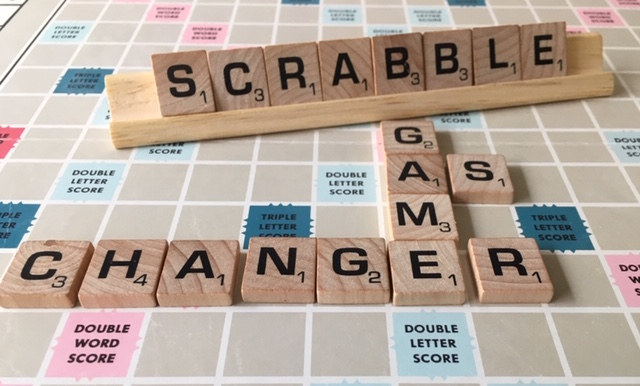
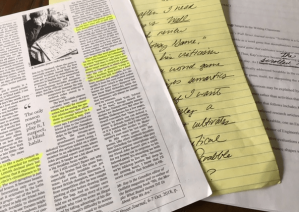
 In “Just One More Game . . . ,” journalist and critic Sam Anderson examines the appeal of hand-held video games—Tetris and its offspring—observing the concurrence of the crumbling of the Berlin Wall and Japanese game-maker Nintendo’s introduction of the Game Boy, the hand-held device that freed gamers to play wherever they chose. No longer were they confined to play within the walls of rec rooms and arcades.


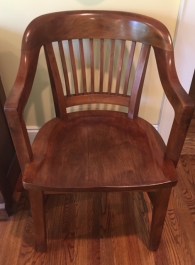
 I never became an auction-goer, but I share my parents’ fascination with objects from the past. And I can trace the allure of artifacts back to those outings with them. Rather than standing and listening to an auction chant, I prefer the quiet pastime of browsing the shelves of antique shops and thrift stores. What appeals to me about such excursions is the possibility of the unexpected find: most recently a set of wooden letter blocks at

 In Zadie Smith’s novel Swing Time, the narrator recalls how she and her childhood friend Tracey watched snippets of Top Hat over and over to study Fred Astaire and Ginger Rogers’ dance routine for “Cheek to Cheek.” Recounting Tracey’s knack for forward-winding the video tape to the exact moment she sought, the narrator observes that “she [Tracey] began to read the dance, as I never could, she saw everything” (56). As I read those words, I realized that Tracey’s attention to detail and her ability to see “the lesson within the performance” (56), was the same practice of close study that I require of myself and my students.
 Jane Lucas