Posted in Reading, Teaching, Writing

Revisiting Erik Larson’s White City, and its Devil

Erik Larson / twitter.com

“Stumbling” and “serendipity” are two of the words that Erik Larson used as he recounted the moments that have unexpectedly led him to the subjects of his books. When he spoke at Lenoir- Rhyne on the morning of Friday, October 27, he told his interviewer, Jeffrey Delbert, Assistant Professor of Communications at LR, that he didn’t intend for his book on serial killer H.H. Holmes to be a dual narrative of Holmes and the 1893 World’s Fair. But his background reading on 1890s Chicago led him to a book–a boring monograph, as he called it–on the Colombian Exposition (the 1893 Chicago World’s Fair). Though the book bored him, one of its footnotes caught his eye: one that listed Juicy Fruit gum among the products first introduced at the fair. If not for that footnote, Larson said, he didn’t know if the book (The Devil in the White City) would have happened.

When an audience member asked about his penchant for crafting nonfiction narratives with the drama of novels, Larson remarked that he believed that such narratives can do more justice to real-life stories than a “bland historical approach.” Those words of his reminded me of Truman Capote’s In Cold Blood, which figures in the analysis of  The Devil in the White City that I wrote along with my students (as they wrote their own analyses) last spring–and that I offer again here:

The White City’s Blueprint: The Architecture of Larson’s Narrative Nonfiction

In Janet Maslin’s New York Times review of The Devil in the White City, she claims that Erik Larson avoids the risk of “turning [the book] into a random compendium.” For all of his density of detail, Larson does manage to avoid that risk, creating instead a gripping dual narrative—one that succeeds, as Maslin asserts that it does—but not by using what Maslin cites as tactics that might ordinarily seem “alarming.” Rather the techniques that Larson employs are among the very building blocks of contemporary narrative.
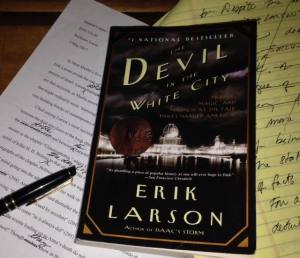
Chief among Larson’s most successful narrative strategies is his cross cutting, both between the dual storylines of the book (those of the Devil and the White City of the title) and between characters. One of his most compelling uses of cross cutting occurs in the chapter “Claustrophobia,” where Larson deftly shifts from the point of view of serial of killer H. H. Holmes, the devil of the title, to that of one of his victims, Anna “Nannie” Williams. In the first paragraphs of the chapter, Holmes and Anna are together in his office, where he asks her “if she would mind going into the adjacent room, the walk-in vault, to retrieve for him a document he had left inside” (294). Anna complies, and thereafter the point of view shifts between Anna inside the vault, believing “the door had closed by accident” (294), and Holmes standing outside the door, listening for the panic to come “as it always did” (295).

Readers witnessing the events leading up to Anna’s death do not stop to ask: How can Larson know what happened? Though they know in the back of their minds that only Holmes and Anna themselves could know what transpired, Larson’s dramatic cross cutting draws them so close to both the victim and her killer that they experience those moments as Holmes and Anna do.

In his endnotes, Larson addresses his reasons for depicting Anna’s murder as he did. Based on police speculation that Holmes killed both Anna and her sister, Minnie, in his vault, an earlier chronicler of Holmes’ exploits—Harold Schechter, author of Depraved (1994)—proposed that Holmes walked into the vault with Anna: “Grasping Nannie by the hand, he led her toward the vault” (Schechter qtd. in Larson 416). Rather than depicting the events as Schechter did, Larson presents Holmes sending Anna into the vault on a false errand because that scenario, in Larson’s words, “would have suited more closely his temperament” (416).

Whether Holmes sent Anna into his vault on a false errand, Larson’s compelling rendering of it exemplifies how the author employs the dramatic effects of fiction—not tactics that are “alarming” as Maslin claims, but ones that writers have commonly applied to narrative nonfiction for more than fifty years, since the publication of Truman Capote’s groundbreaking  account of the Clutter family murders in In Cold Blood. And like In Cold Blood, The Devil in the White City presents a true crime story with the narrative arc of a novel. But Larson’s book is more ambitious and broader in scope than Capote’s. Ultimately, The Devil in the White City is a hybrid of true crime and popular history—the gruesome murders of a serial killer juxtaposed with the construction of the magical white city that inspired Walt Disney and L. Frank Baum. For readers fascinated by the minds of criminals and visionary architects, it’s a page turner. And for writers drawn to the challenge of giving facts the appeal of fiction, it offers a blueprint.

Works Cited

Larson, Erik. The Devil in the White City. Vintage, 2004.

Maslin, Janet. “Add a Serial Murderer to 1893 Chicago’s Opulent Overkill.” Review of The Devil in the White City, by Erik Larson, The New York Times, 10 Feb. 2003, http://www.nytimes.com, Accessed 26 Apr. 2017.

Posted in Teaching, Writing

“Impossible Angles” and a Place to Begin

At the book launch for his debut collection of poetry, Impossible Angles, Jordan Makant told the audience that he didn’t like writing poetry when he enrolled in a poetry workshop at Lenoir-Rhyne but found himself drawn to the form after his workshop professor, Scott Owens, told him, “write the way you think.” Those words of Owens’ led Jordan, now an LR senior, to begin drafting stream-of-consciousness verse, including “Late Night with Myself and a Four Cylinder,” one of the poems that he read at the launch.

Later this morning when I talk with my students about Jordan’s work, I will tell them about his initial lack of interest in writing poetry, with the hope that some of the students will consider enrolling in a writing workshop, because they may discover unexpectedly—as Jordan did—that  writing poetry (or fiction, or creative nonfiction) can give them a way of making sense of the world. And as an exercise to encourage them, I will offer one of Jordan’s poems as a model: “Thought Twice; It’s Not Alright,” a response to Bob Dylan’s “Don’t Think Twice, It’s All Right.”

Jordan’s poem begins with the line, “Bob Dylan was lying, of course . . .” (18). What song in your playlist stays on your brain? I will ask my students. What truth or lie does it tell? Begin there.


Makant, Jordan. “Thought Twice; It’s Not Alright.” Impossible Angles. Main Street Rag, 2017. 18.

Posted in Reading, Writing

Colson Whitehead’s “MacArthur Park”

Colson Whitehead / Madeline Whitehead

Colson Whitehead grew up listening to the Donna Summer version. Others of you know the Richard Harris version, he said, and some of you have no idea what I’m talking about. And then for anyone in the audience who belonged to the last group—who may have said, “Huh?” when he started talking about “MacArthur Park”—he held his tablet up to the mic so everyone in P.E. Monroe auditorium could hear the Disco Queen sing: “MacArthur’s Park is melting in the dark/ All the sweet, green icing flowing down/ Someone left the cake out in the rain/ I don’t think that I can take it’ ‘Cause it took so long to bake it/ And I’ll never have that recipe again.”

And then as Donna Summer, began to cry, “Oh no!,” Whitehead joined in, losing himself for a moment in song. He had the audience then, at “Oh no!,” if his self-effacing humor hadn’t already won them over. What’s not to love about a writer who says, “I usually spend my Thursday nights in my apartment weeping over my regrets, so this is a nice change of pace”?

Whitehead’s remarks began with a false start, as writing often does. But his false introduction was intentional: “I was born a poor black child. I remember the days, sittin’ on the porch with my family, singin’ and dancin’ down in Mississippi,” riffing on Steve Martin’s opening scene of The Jerk. After that, Whitehead turned to the real beginning.

I wasn’t one of those writers who spent time indoors because I was a sickly child, he said. (Marcel Proust comes to mind.) He was just a kid who liked to stay inside and watch The Twilight Zone and Outer Limits and read comic books. I wanted to be a writer because you didn’t have to go out, he said. As a teenager he wanted to write the black Salem’s Lot or the black The Stand. He wanted to write the black-anything Stephen King, he said, until later he read literary fiction and was drawn to the stylings of the modernists, noting in particular the magic realism of Gabriel García Márquez.

After college, while working as a TV writer for The Village Voice, Whitehead penned his first novel: the later-in-life adventures of a former child star, a Gary Colemanesque character. That novel was never published. He received rejection after rejection, which brought him back to “MacArthur Park.”

The song was an enigma, he said, until he realized that it was an investigation of the author’s journey. Why, he asked, did you leave my cake out in the rain, Alfred A. Knopf? Why did you leave my cake out in the rain, Houghton Mifflin? “I don’t think that I can take it/ ‘Cause it took so long to bake it/ And I’ll never have that recipe again.”

Rejection after rejection—or layer after layer of soggy cake—led Whitehead to rethink his decision to become a writer. He considered other professions, but he didn’t seemed well-suited to any of them—surgeon, for instance. Surgeries can last for more than twenty hours. What if you have to go to the bathroom? he asked.

And then there was the matter of the minuscule audience. A literary novel might sell 5,000 copies, and if there’s ten readers for each copy, that’s still only 50,000 readers in a world with a population of over seven billion. So if you’re a writer of literary fiction, “you aren’t the gnat in the butt of the elephant,” he said. “You’re a microbe in the gnat in the butt of the elephant.” Colson Whitehead kept writing anyway, realizing that he had no choice—that’s who he was—so he started over.

Seventeen years ago, he got the idea to create a fictional antebellum America where the Underground Railroad wasn’t a metaphor, but the literal railroad he imagined as a child. He didn’t think that he was up to the task then, but three years ago he decided to give it a try.  That try became The Underground Railroad, which has now received the Pulitzer Prize, the National Book Award, the Carnegie Medal for Fiction, the heartland Prize, and the Arthur C. Clarke Award. Though he’s become one of the most celebrated novelists of his generation, as a writer Whitehead still finds himself filled with uncertainty.

Near the end of the Q&A session that followed his talk, a woman asked what is was like for him, that stay-inside, work-at-home guy, to be the public figure that he has now become. He answered that it’s very different from being a writer and having all these doubts . . . is this paragraph too long? It’s a very lovely thing.


Whitehead, Colson. “An Evening with Colson Whitehead.” LR Visiting Writers Series. 14 Sept. 2017, P.E. Monroe Auditorium, Lenoir Rhyne U., Hickory, NC.

Posted in Teaching, Theatre, Writing

Another Way with Words

TGR’s “Boeing Boeing” (2017) / Ken Burns

A year ago, as a model for my students’ introductory assignment, I composed a post about my work as a writer. Now as I revisit that assignment, rather than turning again to my writing, I have chosen to write about acting.

Though I began performing in community theatre as a teenager in the 1980s, I was away from it—focusing on my teaching and writing—for more than twenty-five years. Becoming an acting student in my forties—enrolling in classes in Richmond, Virginia, in 2011 and 2012—rekindled my passion for the craft. I fell in love with acting all over again, and I found myself wondering how I’d ever left it. Since moving back to North Carolina in 2013, I have performed in plays at Foothills Performing Arts, Hickory Community Theatre, the Green Room Community Theatre, and most recently at the Hickory Playground’s second annual festival of new one-act plays.

HCT’s “Incorruptible” (2016) / Ken Burns
HCT’s “Superior Donuts” (2016) / Ken Burns

For me as a writer, acting is another way of working with words, a process of transporting them from the page to the stage and transforming the language into the utterances of a living, breathing character—someone who isn’t me but in whom I can “live truthfully,” as Sanford Meisner would say, “under the given imaginary circumstances.”

Posted in Reading, Writing

The White City’s Blueprint: The Architecture of Larson’s Narrative Nonfiction

In Janet Maslin’s New York Times review of The Devil in the White City, she claims that Erik Larson avoids the risk of “turning [the book] into a random compendium.” For all of his density of detail, Larson does manage to avoid that risk, creating instead a gripping dual narrative—one that succeeds, as Maslin asserts that it does—but not by using what Maslin cites as tactics that might ordinarily seem “alarming.” Rather the techniques that Larson employs are among the very building blocks of contemporary narrative.

Chief among Larson’s most successful narrative strategies is his cross cutting, both between the dual storylines of the book (those of the Devil and the White City of the title) and between characters. One of his most compelling uses of cross cutting occurs in the chapter “Claustrophobia,” where Larson deftly shifts from the point of view of serial of killer H. H. Holmes, the devil of the title, to that of one of his victims, Anna “Nannie” Williams. In the first paragraphs of the chapter, Holmes and Anna are together in his office, where he asks her “if she would mind going into the adjacent room, the walk-in vault, to retrieve for him a document he had left inside” (294). Anna complies, and thereafter the point of view shifts between Anna inside the vault, believing “the door had closed by accident” (294), and Holmes standing outside the door, listening for the panic to come “as it always did” (295).

Readers witnessing the events leading up to Anna’s death do not stop to ask: How can Larson know what happened? Though they know in the back of their minds that only Holmes and Anna themselves could know what transpired, Larson’s dramatic cross cutting draws them so close to both the victim and her killer that they experience those moments as Holmes and Anna do.

In his endnotes, Larson addresses his reasons for depicting Anna’s murder as he did. Based on police speculation that Holmes killed both Anna and her sister, Minnie, in his vault, an earlier chronicler of Holmes’ exploits—Harold Schechter, author of Depraved (1994)—proposed that Holmes walked into the vault with Anna: “Grasping Nannie by the hand, he led her toward the vault” (Schechter qtd. in Larson 416). Rather than depicting the events as Schechter did, Larson presents Holmes sending Anna into the vault on a false errand because that scenario, in Larson’s words, “would have suited more closely his temperament” (416).

Whether Holmes sent Anna into his vault on a false errand, Larson’s compelling rendering of it exemplifies how the author employs the dramatic effects of fiction—not tactics that are “alarming” as Maslin claims, but ones that writers have commonly applied to narrative nonfiction for more than fifty years, since the publication of Truman Capote’s groundbreaking  account of the Clutter family murders in In Cold Blood. And like In Cold Blood, The Devil in the White City presents a true crime story with the narrative arc of a novel. But Larson’s book is more ambitious and broader in scope than Capote’s. Ultimately, The Devil in the White City is a hybrid of true crime and popular history—the gruesome murders of a serial killer juxtaposed with the construction of the magical white city that inspired Walt Disney and L. Frank Baum. For readers fascinated by the minds of criminals and visionary architects, it’s a page turner. And for writers drawn to the challenge of giving facts the appeal of fiction, it offers a blueprint.

Works Cited

Larson, Erik. The Devil in the White City. Vintage, 2004.

Maslin, Janet. “Add a Serial Murderer to 1893 Chicago’s Opulent Overkill.” Review of The Devil in the White City, by Erik Larson, The New York Times, 10 Feb. 2003, http://www.nytimes.com, Accessed 26 Apr. 2017.


Posted in Reading, Writing

A Poet’s Apprenticeship Behind Bars

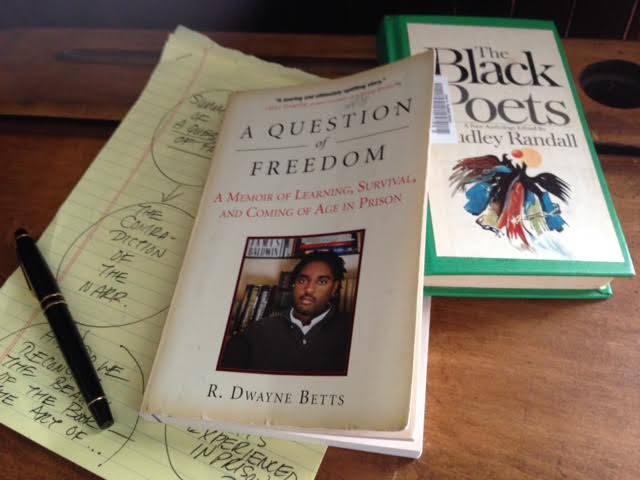
Dwayne Betts’ A Question of Freedom chronicles his development as a writer during his years behind bars for a carjacking he committed at sixteen. Betts’ memoir pulls readers into the cells of the prisons that housed him, places where, in Betts’ words, “I have lived things I will not recover from” (176), but also where he observes that he “found creativity” (63). The knowledge that Betts discovered his voice behind bars prompts a troublesome question: Would he have found it elsewhere? Whether he would have become a writer outside of prison remains unclear. There is however, certainty in this: As a man who became a writer in prison, his writing and incarceration are inextricably linked. Betts’ testament to that, his memoir, tells not only the story of his prison sentence but also the story of the words of others coming to shape his own story and leading him to find his voice as a poet. For all that he shows his readers of prison, Betts’ memoir is ultimately more about the transformative power of art.

In the chapter “Joseph’s Hand,” Betts meditates on the unconventional drawing style of another inmate, a young man whose pen scratches lead Betts to see art in a new way:

I went to prison and found creativity I’d never thought to search for on the streets. I had been there for a few months and ran into Joseph, drawing in a way that broke down all of my ideas of what a picture should look like and what it should do. (63)

Joseph’s drawing was a revelation to Betts, what he describes as a “symbol for the idea that art can translate, subconsciously and consciously, your world into your images” (64).

Later, Betts finds his own path as an artist after someone slips a copy of Dudley Randall’s anthology The Black Poets under his cell door. As he reads Randall’s book in solitary confinement, he discovers that his desperation and isolation enable him to see the words on the page as he has never seen them before. In his own words, “[s]olitary confinement gave me a gift I could have gotten nowhere else: the opportunity to start looking for the sense behind the words” (165). For Betts, The Black Poets serves both as a groundbreaking influence and a motif in A Question of Freedom. The first sentence of the memoir alludes to Etheridge Knight’s For Freckled-Faced Gerald”—a poem Betts first encounters in Randall’s anthology—paraphrasing its lines, “sixteen years hadn’t even done / a good job on his voice” (6-7). And lines from Knight’s poem also serve as the epigraph for the second part of the memoir.

Near the end of A Question of Freedom, Betts reflects on The Black Poets as he recalls receiving a response to a letter that he had written to the poet Tony Hoagland:

When I’d gotten my first book of poems, The Black Poets by Dudley Randall, I was a seventeen-year-old kid in a solitary confinement cell wondering if he was going to survive prison. By the time Mr. Hoagland wrote me, I was a few years away from release and still standing. (217)

Readers unfamiliar with The Black Poets cannot see initially how importantly that volume of poetry figures in the pages of Betts’ memoir, but slowly its significance becomes clear, just as the scratches of Joseph’s pen slowly—and seemingly miraculously—become a hand. The lines of Betts’ memoir serve as testament not only to his survival but also to the troubling truth that prison, for all of its harrowing experiences, gave Betts a writing life, endowing him with gift for “[w]eaving prison’s hurt into poetry” (165).

Would Betts have become a writer without the creativity that he discovered in prison and the way of reading that he found in solitary confinement?  Betts’ memoir yields no clear answer to that question, nor does it offer a definitive answer to why he made the mistake—the moment of aberrant behavior—that led to more than eight years behind bars. Prison, as Betts observes, “blossoms contradictions” (181). The gift he found there, one of  “carving a voice” (123) remains one of those contradictions, one that will likely remain in the minds of readers long after they have followed Betts out of the pages of his memoir to a place where many inmates will never return.

Works Cited

Betts, R. Dwayne. A Question of Freedom. Avery, 2009.

Knight, Etheridge. “For Freckled-Faced Gerald.” The Black Poets. Ed. Dudley Randall. Bantam, 1971. p. 205.


Posted in Reading, Teaching, Writing

Carving a Voice Out of the Air: An Evening with Dwayne Betts

R. Dwayne Betts / Rachel Eliza Griffiths

In the first paragraphs of Dwayne Betts’ memoir, A Question of Freedom (2009), he recounts his ride to the Fairfax County jail after his arrest for carjacking: a “certifiable” crime in Virginia, which meant that then-sixteen-year-old Betts would be treated as an adult under state law. Last Thursday night when Betts took the stage at Lenoir-Rhyne, he began by reading those paragraphs, returning to the backseat of that police car, where “[e]verything near enough for me to touch gleamed with the color of violence” (3). After reading from his memoir, Betts turned to his collections of poems, Shahid Reads His Own Palm (2010) and Bastards of the Reagan Era (2015), alternating his readings with stories of his years in prison and his writing. He expressed his concern that some people cited his memoir as evidence that prison benefited him, because he had finished his high school education behind bars; and since leaving, he had completed his undergraduate degree at the University of Maryland, an MFA in Creative Writing at Warren-Wilson, and a law degree at Yale. To see his post-incarceration successes as evidence that his years behind bars benefited him, Betts said, was a misinterpretation. Following his Q&A with the audience, Betts concluded by saying that he’d been desperate and lucky–“but sometimes desperate and lucky works out.”

Among the anecdotes that Betts shared with the audience was one focusing on his answer to a question about one of his poems. A reader asked him why an otherwise innocuous poem ended with an image of crack cocaine. To illustrate why he ended the poem that way, Betts turned to August Wilson’s play Fences, telling the audience how the character Troy tries to explain his adultery to his wife, Rose, by likening his decision to a moment in a baseball game. He’s wrong, Betts said, but it’s the only way Troy knows how to try to communicate what he means. In Betts’ words, “sometimes you only have what you have to explain the world.”

Betts’ memoir isn’t an easy read, showing as it does what a life behind bars can do to the mind and the body. But it also tells the story of the power of the written word, how books sustained Dwayne Betts and led him to become a writer, “carv[ing] a voice out of the air” (123). Though many of my students aren’t drawn to writing or to reading books, I believe that the experience of studying  A Question of Freedom and hearing Betts speak has deepened their understanding of the vital role that reading and writing can play in their lives.

Work Cited

Betts, R. Dwayne. A Question of Freedom.  Avery, 2009.

Posted in Reading, Writing

Shenanigans Again and Again: An Evening with Sarah Vowell

Sarah Vowell / Bennett Miller

Thursday night at Lenoir-Rhyne, Sarah Vowell spoke of herself as a writer who takes her readers on a trip with her. Seeing Vowell interviewed on stage was a similar journey, one that led the audience from her childhood in Montana to her most recent book, Lafayette in the Somewhat Unites States (2015), with digressions along the way on Charlies Angels, the Trail of Tears, Louis Armstrong, The Incredibles, and Paul Gauguin.

When interviewer Mike Collins asked Vowell about her work on This American Life, she spoke of her writing process, noting that although the stories she wrote sounded casual, there wasn’t one from her twelve-year stint on the show (1996-2008) that underwent fewer than sixty-four revisions. Vowell recalled that Ira Glass, producer and host of the show, chided her for her repeated tangents–what she calls shenanigans–reminding her again and again of the need for brevity in radio. Paring her writing for the airwaves taught Vowell that she was better suited to writing books because they gave her room for shenanigans, citing her detour through the Oneida Community in Assassination Vacation.

In response to an audience member’s question about her writing process, Vowell said that it begins while she is travelling. Vowell explained that she takes “voluminous notes” on index cards. Later, when she returns home, she puts the cards on her living room floor and the process of organizing her research begins. The image of Vowell sitting cross-legged in her living room, placing cards on the floor in front of her as if she’s playing Solitaire, reminds me of her earlier remarks about radio, how each of those casual-sounding pieces she wrote was the product of sixty-four or more drafts. The meandering narratives of her books have a casual quality as well, but they’re the product of a highly organized process.

Vowell is one of the featured authors in the Visiting Writers Series as well as the author of this year’s Campus Read, Assassination Vacation. Her interview with WFAE’s Mike Collins was recorded for later broadcast on Charlotte Talks.

Work Cited

Vowell, Sarah. Visiting Writers Series Interview by Mike Collins. 27 Oct. 2016, P.E. Monroe Auditorium, Lenoir-Rhyne U., Hickory, NC.

Posted in Writing

Marlon James on Dylan and Marley, and Beginnings and Endings

Marlon James / macalester.edu

Only a few hours after the announcement of this year’s Nobel Prize for literature, novelist Marlon James, recipient of the 2015 Man Booker prize, took the stage at Lenoir-Rhyne’s Belk Centrum and said that he was “very excited” about Bob Dylan’s win. James questioned whether the people who opposed the choice of Dylan had heard much of his music. Many ancient epics were written to be sung, James observed, and he challenged the audience to “listen to ‘It’s Alright, Ma (I’m Only Bleeding)’” and “tell me it’s not literature.”

Turning from Bob Dylan’s Nobel Prize to his own writing, James—one of the featured authors in Lenoir-Rhyne’s Visiting Writers Series—said that the first sentence that he wrote of his third novel, A Brief History of Seven Killings (2014), was now on page 458 and joked that the 680-plus page novel was actually an 800-page book, but he reduced the font and narrowed the margins.

James said that he had begun by writing a novel about a really sloppy hit man who was also in love, but around page fifty he ran into a dead end. After creating additional characters and running into more dead ends, James concluded that he was writing a string of failed novellas. Then he had a Eureka moment: He reread William Faulkner’s As I Lay Dying (1930), narrated by fifteen characters, and realized that he was writing about the failed dream of the Jamaican 1960s, and that one voice alone could not tell the story. James also credited James McEllroy’s novel American Tabloid (1995) as a major influence on the writing of A Brief History of Seven Killings.

Among the excerpts James read from the novel include ones featuring the ghost of the dead Jamaican politician Arthur Jennings and immigrant Dorcas Palmer—whose name isn’t really Dorcas Palmer—who works a series of no-questions-asked jobs as a care giver in New York. They are the branches of the novel, James said, noting the book began with them rather than the trunk—though it may seem like the opposite, that the book began with Marley at the center.

James noted that one of the difficulties of writing about Marley was that by the time of the 1976 assassination attempt, Marley was already a literary device of sorts. For me growing up, James noted, he was a series of news reports: Marley is on tour, Marley has been shot, Marley has cancer . . . .

To guide him as he wrote around the dying man at the center of his novel, Marlon James turned to the classic Esquire magazine story “Frank Sinatra Has a Cold” (1966), a profile that Gay Talese had been assigned to write as an interview with Frank Sinatra, but the singer refused to talk to him. Talese’s solution to the problem was to talk to everyone around Sinatra. Similarly, instead of moving in close, James’s narrators circle Marley in his last days.

In response to an audience member’s questions about knowing when you’ve finished revising, James said that he knows early on in the process when he’s done, but that it takes him four or five months to admit it. James said that A Brief History of Seven Killings doesn’t end with a flourish or with a profound statement about the human condition; it doesn’t end as much as it stops. He kept working on the book until a voice in his head told him, you finished four months ago.

One of the problems with writing stories, James said, is that we start too early and end too late. James recounted that once while submitting copies of the manuscript of his first novel, John Crow’s Devil, that he was short on paper and money, so he sent out a copy without the first and the last twenty pages. The agent who read it, James said, didn’t say that it started too late or ended too early.

Reflecting on James’s observations about writing—beginning with his opening remarks about Bob Dylan—brings to mind the role of music in his own writing, starting with the lines from Captain Beefheart’s “Dachau Blues,” lyrics that serve as the epigraph for his debut novel, John Crows’ Devil. Those song lyrics are some of the first words we see in the book, but it’s likely that neither those words nor the words of the chapter that they introduce are the first ones he put on the page, evidenced by the fact that the first sentence he wrote for A Brief History of Seven Killings appears on page 458.

Beginnings and endings are difficult, Marlon James reminds us, though in the case of these words about his Thursday-night presentation, I knew from the start that I would begin with his opening remarks on Bob Dylan. (How I would begin was another matter altogether, and so was where and how I would end.) Of A Brief History of Seven Killings, James said that the novel doesn’t end as much as it stops. Taking a cue from him, I will stop here, reflecting on the insight that his remarks shed on his first novel—one that my students and I studied earlier this semester—one that begins with the chapter “The End” and ends with the chapter “The Beginning.”

Work Cited

James, Marlon. “An Evening with Marlon James.” Visiting Writers Series, 13 Oct. 2016, Belk Centrum, Lenoir-Rhyne U., Hickory, NC.


Posted in Teaching, Writing

“I Could Tell You Stories . . .”

Early illustrated writing c. 1974

Three pictures, one-hundred words, minimum: That’s what I asked of my students, and of myself, for the introductory blog assignment for the semester. “Rather than trying to tell your whole life story,” I wrote in the assignment,  “focus on one aspect of your life or one interest of yours.” It sounds simple enough, doesn’t it? But when I sat down to complete the assignment, words initially failed me. As I tried to compose a draft in my mind, what came to me instead were these lines from Patricia Hampl’s essay “Red Sky in the Morning”:

How much reality can subject-verb-object bear on the frail shoulders of the sentence? The sigh within the sentence is more like this: I could tell you stories–if only stories could tell what I have in me to tell. (178)

Choosing to include those lines of Hampl’s reflects my passion for writing, while the words themselves illustrate the struggle of writing–even for those of us who identify ourselves as writers.

Heat ms
1989 manuscript with notes from my teacher. The story, which she titled “Heat,” was published in 1991.

At the beginning of last semester, when I projected my own blog on the screen for the first time, one of the students remarked on the tagline: “Writer, Teacher.”

Have you written any books? she asked.

Written, not published, I started to say (“I could tell you stories . . .”), but instead I said, “I am not an author of any books, but I identify myself as a writer because I am someone for whom writing has always been a way of making sense of the world.

Review of "Go Set a Watchman" (2015)
Review of “Go Set a Watchman” (2015)


Work Cited

Hampl, Patricia. “Red Sky in the Morning.” Imaginative Writing: The Elements of Craft. Ed. Janet Burroway. 3rd ed. Longman, 2011.