Posted in Reading, Social Media, Teaching, Writing

Storytelling and Simulated Worlds

Sunday’s New York Times Magazine featured an essay on narration that a friend mentioned on Facebook. I didn’t see her comment initially because I don’t frequent Facebook. My husband posts there several times a day though, so he passed the news along to me. Now that I’ve read the essay, I’m ready to enter the conversation–but not on Facebook, where it seems too late. My friend’s request–“I’d love to hear more thoughts on this”–now lies buried beneath four days of links and “likes” and photos.

The essay “Once Upon a Time, There was a Person Who Said, ‘Once Upon a Time‘” reminds me of Ray Bradbury’s story “‘The Veldt” (1950), which my students and I read and studied this week. The  story’s crystal-walled virtual-reality nursery leads the Hadley children away from creativity toward passivity. When the son, Peter, admonishes his father for removing the picture painter from the nursery, George Hadley replies: ‘. . . I wanted you to learn to   paint all by yourself, son” (76).

“I don’t want to do anything but look and listen and smell,” Peter replies. “What else is there to do?” (76).

Ray Bradbury’s short story collection The Illustrated Man (1950), which includes “The Veldt.”

In “Once Upon a Time. . . ,” writer Steven Almond addresses how visual media (Bradbury’s crystal-walled virtual-reality) has changed how we conceive of storytelling. “Traditionally,” Almond writes, “stories represented an active collaboration. Listeners and readers were called upon to create the world described by the artist. Film advanced a new model of collaboration. An array of artists (screenwriters, actors, cinematographers, set designers, etc.) worked together to invent an ultra-vivid artificial world. The audience’s role became increasingly passive–to absorb and react, not to imagine. Television shrunk the wonders of film and delivered them directly to our living rooms.”

The absence of narration in “the shrunken wonders of film”–now shrunken to fit our iPhone 5 screens–isn’t simply the loss of a literary device. It’s the atrophy of an essential skill: one that enables us to make sense of the world. It’s no surprise that Almond’s creative writing students produce short stories that lack coherence. Or that many of the freshman in my classes struggle to produce essays of more than 1,500 words. If I write any more, I’ll be repeating myself, they often say, not because they can’t write more, but because they can’t imagine writing more. To do so would require the sustained attention and reflection that our digital culture leaves behind.

Posting to Facebook about the decline of narration isn’t the equivalent of driving and texting about the dangers of driving and texting. But it does underscore a consistent contradiction in our lives. As a writer and a teacher, I attempt to reconcile that incongruity with blog posts–writing that my students and I can draft and revise before our words enter the sphere Almond describes as “the simulated world through which most of us flit from one context to the next, from Facebook post to Tumblr feed to YouTube clip, from ego moment to snarky rant to carnal wormhole.”

Posted in Social Media, Teaching, Writing

Social Media in the Classroom, Tommy’s Blog

For the past several years, I’ve explored various ways of incorporating social media into my UNIV 112, Focused Inquiry II classes, offering students the option of maintaining blogs and creating a Facebook page for the course, which students weren’t required to “like,” but were encouraged to post to as an alternative to blogging. I was still uncertain of how I would introduce social media next semester, when one of my former students, Tommy McPhail, sent me an email message, which I include below with his permission.

29 November 2012

Prof. Lucas,

I recently underwent a Cultural Discovery Project for my EDUS 476 class (the introductory course to being an RA at VCU). Afterwards, I wrote a blog post comprising my thoughts, and the response was incendiary. Within 24 hours, my post went viral received thousands of hits. To date, the post has received over 40,000 hits on Tumblr alone, and was one of the top posts on Reddit, in addition to being signal-boosted by various Facebook networks, Philadelphia Slutwalk, and my favorite author. I’ve received a plethora of encouragement, criticism, heartfelt praise, objection, and even a marriage proposal from a blogger in New Zealand. The very idea that my writing could reach so many people worldwide, let alone evoke such a response, has been both overwhelming and inspiring. It was only fitting that I forward this along to you. I would not have been able to accomplish something like this without you and your class. It really inspired me, particularly the social media components, to start using my blog for social advocacy purposes. Thank you so much for all that you do. I hope you enjoy the piece.

My essay and the accompanying appendix are attached for your convenience. Here is a link to my original post:

Tommy’s blog post on his Cultural Discovery Project and the overwhelming response it received attest to the value of social media as platforms on which students’ work in the classroom–in Tommy’s case, EDUS 476–can have a life outside of the classroom with an audience of thousands of readers. At last count, Tommy’s Tumblr post had prompted 46,935 notes.

Now I know how I’ll introduce social media next semester: I’ll begin with Tommy’s blog.

Posted in Reading, Writing

VCU’s Southern Film Festival: Screening Southern Rebellion

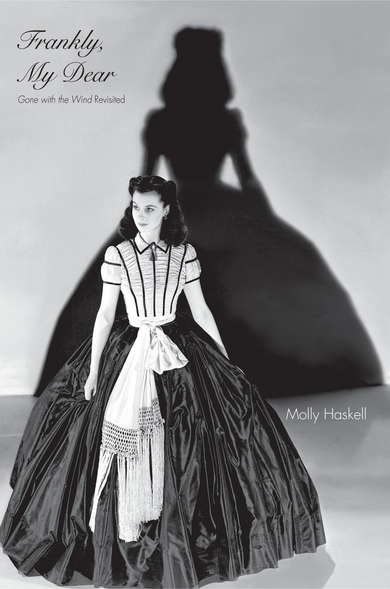
Frankly, My Dear (2009)

Molly Haskell grew up here in Richmond, and it’s here that she fell in love with movies. One of her most vivid childhood memories finds her standing before a magazine rack in the Broad Street station waiting for the train to Florida, and persuading her father to buy her a magazine devoted to the child star Margaret O’Brien.* The pleasure Molly Haskell took in reading that movie magazine is one she would later pass on to the readers of her own film reviews and books.” Those are some of the words that I spoke about Haskell Friday night when I introduced her as keynote speaker at the third annual VCU Southern Film Festival at the Virginia Museum of Fine Arts.

In her keynote address, Haskell discussed her most recent book, Frankly My Dear: Gone With the Wind Revisited (2009), which expolores Gone With the Wind as the product of three strong personalities: author Margaret Mitchell, film producer David O. Selznick, and actress Vivien Leigh. Published on the seventieth anniversary of the film’s release, Haskell’s book looks back more than eighty years to Mitchell’s drafting of the novel in the 1920s, while also considering the book and film in multiple cultural contexts and reflecting on its enduring presence in our collective memory and imagination.

Margaret Mitchell’s Gone With the Wind (2011)

Haskell‘s speech led into the screening of the recent documentaryMargaret Mitchell: American Rebel (2011), which features Haskell as well as John Wiley, Jr., who co-authored–along with Ellen F. BrownMargaret Mitchell’s Gone With the Wind: A Bestseller’s Odyssey from Atlanta to Hollywood (2011). Both Wiley, of Midlothian, and Brown, of Richmond, were in the audience Friday night as well, and after the film they joined Haskell on stage for a panel discussion moderated by me.

At the outset of the panel, I noted that the publication of Brown and Wiley‘s book marked an important contribution to Mitchell scholarship as well as studies of book publishing and copyright. Though I was prepared to offer more talking points  about their work and Haskell‘s, I didn’t need to. Their own observations about Mitchell, her novel, and the film prompted a nearly hour-long conversation with the audience, cut short only by the announcement that the museum would close at 9 p.m.

When one man sitting near the front of the auditorium expressed his ambivalence about calling himself a fan, I was reminded of the “Seven Stages of Gone With the Wind” that Haskell outlines in Frankly My Dear:

“For those of us who fell under its spell, the range of emotions attached to the film fluctuate over time with the predictable volatility of a love affair and its aftermath, in my own case what we might clinically designate as the Seven Stages of Gone With the Wind: Love, Identification, Dependency, Resentment, Embarrassment, Indifference, and then something like Half-Love again, a more grown-up affection informed by a film-lover’s appreciation of the small miracle by which a mere ‘woman’s film’ with a heroine who never quite outgrows adolescence was tansfigured into something much larger, something profoundly American, a canvas that contains, if not Walt Whitman’s multitudes, at least multiple perspectives” (xiii).

Along with those words of Haskell‘s about the Seven Stages of Gone With the Wind, I would’ve liked to address how fans of the novel and the film have formed online communities, particularly on Facebook. That’s something that Ellen Brown mentioned back stage when the four of us–Brown, Wiley, Haskell, and I–were clipping on our wireless microphones.

In their introduction to Margaret Mitchell’s Gone With the Wind, Brown and Wiley write: “We do not claim to have rewritten Gone With the Wind, but we have refocused the lens” (3). Similarly, Haskell‘s Frankly My Dear refocuses the lens, and the insights of the three authors inspired Friday’s night’s audience to see the book and film anew.

*The childhood memory of Haskell‘s that I mentioned in my introduction is one that she recounts in From Reverence to Rape: The Treatment of Women in the Movies (1974, Second Edition 1987).

Posted in Reading, Theatre, Writing

“One’s Whole Being Becomes Absorbed”

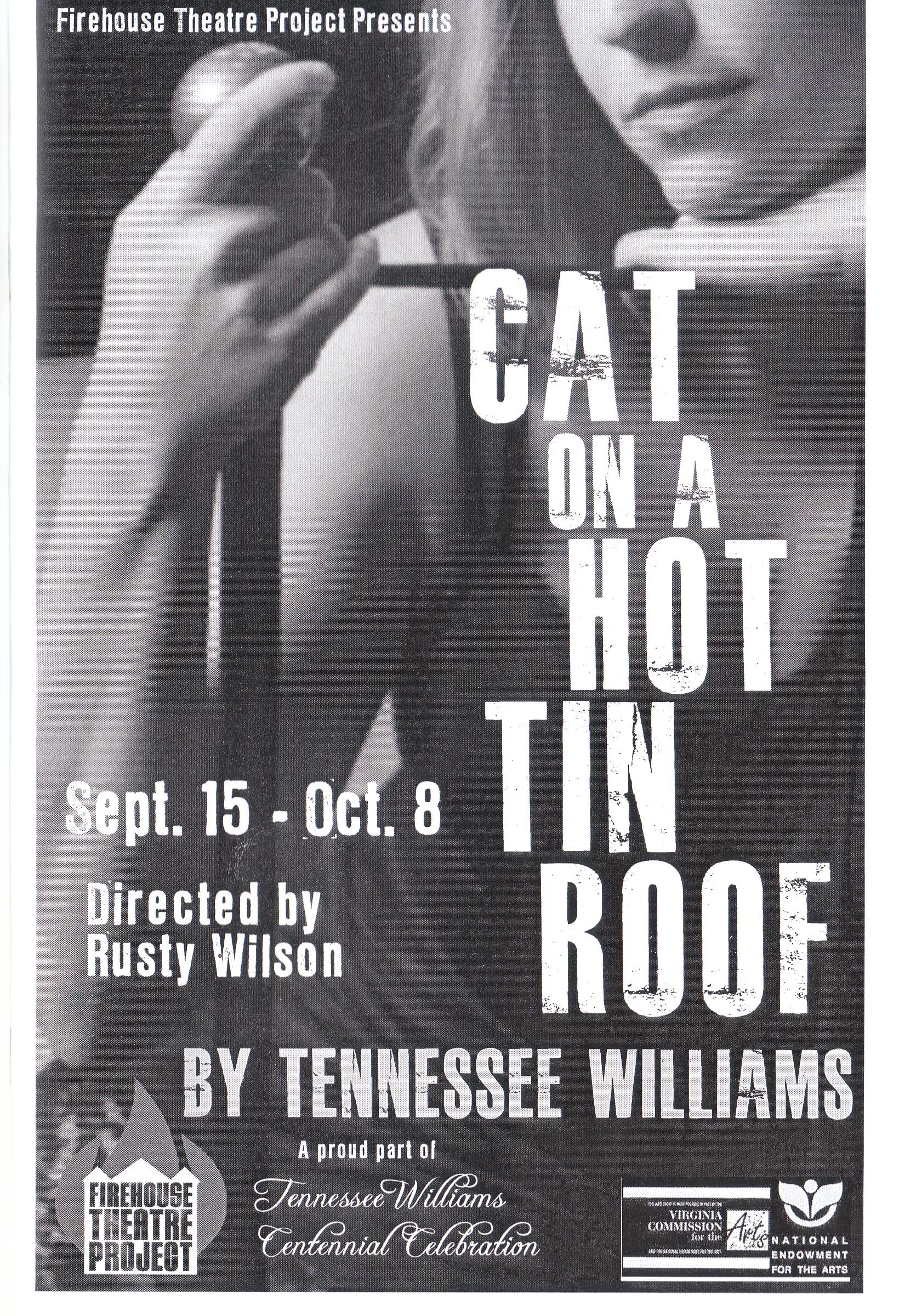
FTP’s Cat on a Hot Tin Roof, September 15 – October 8, 2011

The Firehouse Theatre’s September 19 staged reading of The Night of the Iguana and its current production of Cat on a Hot Tin Roof–both part of Richmond’s Centennial Celebration of Tennessee Williams–sent me back to the pages of Williams’ plays, which I’ve been rereading in the Library of America edition: Plays 1937-1955.

Williams’ Plays 1937 -1955 (2000)

I keep thinking of these words of Big Mama’s: “Time goes by so fast. Nothin’ can outrun it. Death commences too early–almost before you’re half-acquainted with life–you meet the other. . . .” In a recent Fresh Air interview, actress Margo Martindale told Terry Gross how saying those lines as a student differed from saying them decades later:

“I played Big Mama in Cat on a Hot Tin Roof when I was 20 years old at the University of Michigan. And then I played Big Mama on Broadway in 2004. The speech at the end of that play — ‘Time goes by so quickly …’ — boy did that have different weight from when I was 20 years old to when I was 50-something-odd years old. It’s all about what you’ve experienced. You can’t teach that to a younger actor. You have to have lived that.” In the current Firehouse production,
Jacqueline Jones
speaks Big Mama’s lines from experience as well, delivering one of the cast’s strongest performances.

In his introduction to Camino Real, Williams writes of the all-consuming nature of play writing: “It is amazing and frightening how completely one’s whole being becomes absorbed in the making of a play. It is almost as if you were frantically constructing another world while the world that you live in dissolves beneath your feet, and that your survival depends on completing this construction at least one second before the old habitation collapses.”

Today when I was completing an application for a grant, I thought of how it would enable my whole being to become absorbed–at least briefly–in the writing process in a way that it can’t when I’m teaching. Grants buy us time, which “goes by so fast. Nothin’ can outrun it.”

Posted in Reading, Social Media, Teaching, Theatre, Writing

On Readers’ Theatre, Blackboard, and Turning Away from the Screen

I planned to devote this blog entry—my first in two weeks—to the Virginia Blackboard User’s Group Conference, which I attended on Friday. But what lingers in my mind today isn’t the conference, it’s the personal narratives that my students presented in class after their draft workshop on Thursday.

To shift students’ focus away from “correcting” their classmates’ writing, I decided to devote the second half of class to Readers’ Theater. After students read and commented on their group members’ drafts, each group chose an essay to perform for the class, assigned parts, and assembled impromptu costumes and props.

To honor the students’ privacy, I won’t reveal any details about their personal narratives; I will simply say that their work left a lasting
impression on me. As readers they offered descriptive rather prescriptive comments, and as performers they gave their stories a life in the classroom that was separate and distinct from the words on the page.

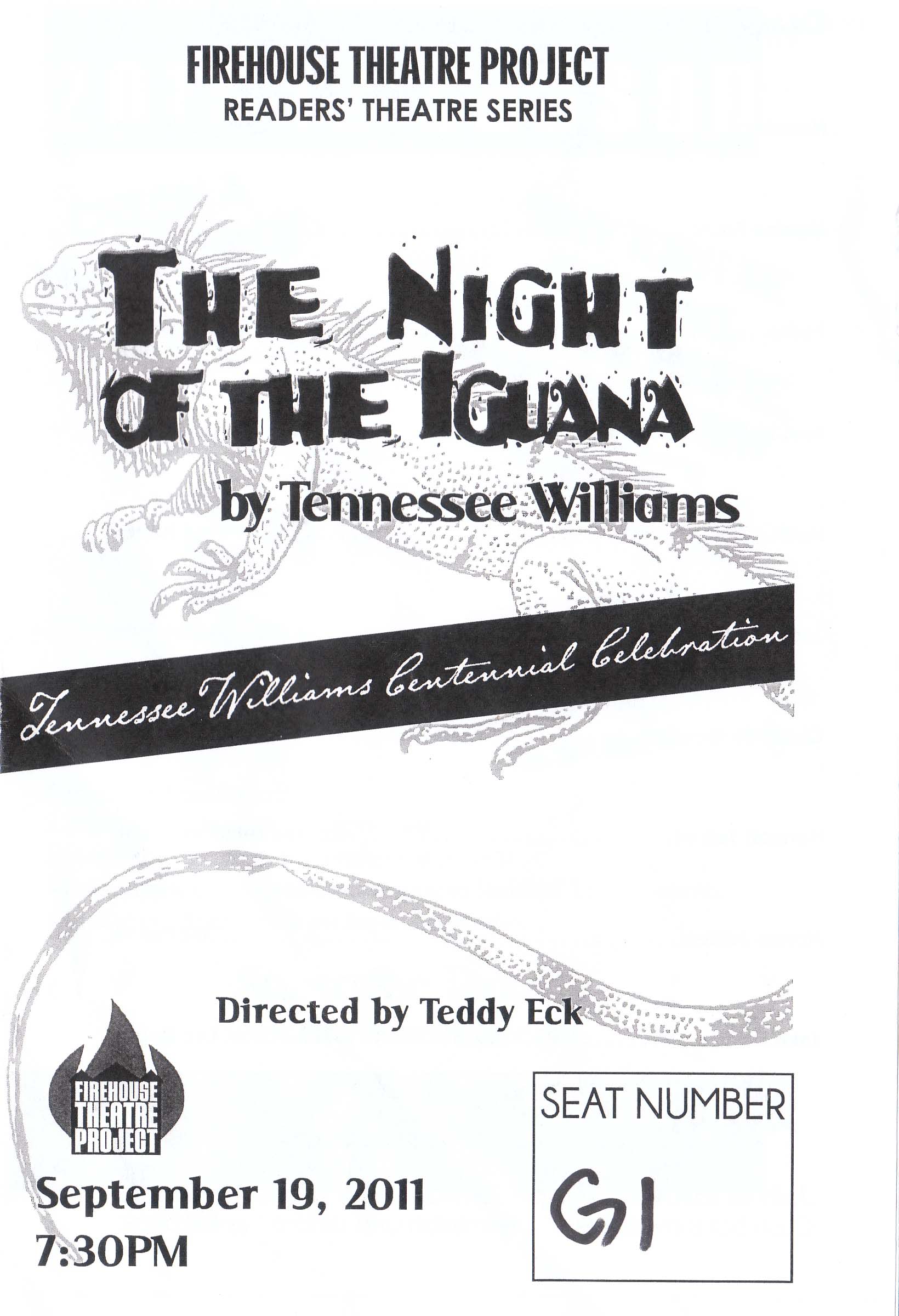
FTP’s The Night of the Iguana

The idea of combining a draft workshop with Readers’ Theater stems from my renewed interest in drama and my recent experiences at  Readers’ Theater performances staged at the Firehouse, including the September 19 reading of The Night of the Iguana, part of Richmond’s Centennial Celebration of Tennessee Williams.

The power of live theater and its influence on my teaching also speaks to my experience at yesterday’s Blackboard conference. Though I use Blackboard on a daily basis—and it’s usually projected on the screen in the classroom at least once during each of my Tuesday-Thursday classes—for me it’s simply a tool: a content management system for content that’s always changing.

During yesterday’s conference sessions, many in the audience divided their attention between the large screens at the front of the room and the small screens in their hands and their laps. In the 1:15 session, I overheard a man say his iPad was attached to his thigh.

More and more I see the need for opportunities to turn away from the screen and to face each other.  Though I don’t agree with many of David Mamet’s sentiments—in particular some of his pronouncements in his latest book, The Secret Knowledge: On the Dismantling of American Culture (2011)—I do concur with his notion that people go to the theater to see that real communication between human beings is still possible.  I know for me it’s true. My own return to the theater is in part a response to our increasingly digital lives.

Posted in Writing

Writing 26.2, and Tennessee Williams, Too

Chop Suey Books, 2913 West Cary Street, Richmond, VA

Local writers gathered for workshops on the second floor of Chop Suey Books this weekend, and in between sessions sipped Tall Bike Coffee on the sidewalk and ordered burgers and hot dogs from store owner/grill master Ward Tefft–all as part of  a 26.2 All-Write, All-Night Writing Marathon and Cook-Out to benefit the Richmond Young Writers.

At Saturday’s opening session, “Write Now,” workshop leader Valley Haggard, Executive Director of Richmond Young Writers, led us through a couple of timed writing exercises from Natalie Goldberg‘s Writing Down the Bones, a book that I read years ago and now realize that I need to revisit.

Vivien Leigh and Marlon Brando as Blanche DuBois and Stanley Kowalski in the 1951 film adaptation of the 1947 play / britannica.com.

Early in the afternoon, I left Chop Suey to focus on another writer’s work across the street: To mark the beginning of Richmond’s  Tennessee Williams’ Centennial Celebration, the Byrd Theatre hosted a free screening of A Streetcar Named Desire, introduced by Carol Piersol, Artistic Director of the Firehouse Theatre (and my acting teacher), and John Knapp, Artistic Director of Richmond Triangle Players.

After Streetcar, I returned to Chop Suey and to my own writing, catching the end of a Writing Sampler workshop followed by a free-writing session.  I noticed something that I hadn’t seen earlier in the day. On the curtain that serves as the door to the closet in the back corner of the writing room, someone had pinned a sign that read “Enter the Fort of Solitude.” Throughout the free-writing session, one of the Richmond Young Writers wrote there, behind the curtain.

At the end of the free-writing session, I retreated to my own Fort of Solitude on Grace Street but returned to Carytown before daylight.  On the sidewalk across from Chop Suey,  author Eliezer Sobel led  a small circle of writers through a sunrise meditation and writing session. When we closed our eyes to begin, it was still dark. When we opened our eyes, it was light, and we wrote about 9/11 and other numbers on our brains.

Posted in Reading, Writing

The Writing Show’s Voldemort Panel

James River Writers’ Writing Show

At Thursday night’s Writing Show–Tall, Dark, and Creepy?: Writing a Believable Villain, author John Milliken Thompson thanked James River Writers for scheduling the event between natural disasters. Despite the pre-Irene showers, a crowd of about seventy-five gathered in the pavillion of the Richmond Childrens’ Museum to hear Thompson, author of The Reservoir,  Katherine Neville, author of The Eight, and Alma Katsu, author of The Taker, discuss villains–both their own and others.

The show’s host, writer Meriah Crawford, an Assistant Professor in VCU’s University College as well as a private investigator, referred to the authors assembled on stage as the “Voldemort Panel.” Along with Voldemort, the panelists discussed Hannibal Lechter, another villain known to more movie-goers than readers. Neville observed that what drives The Silence of the Lambs isn’t the search for Buffalo Bill but the character of Hannibal Lechter. Thompson noted his affinity for villains like Wickham of Jane Austen’s Pride and Prejudice, a character who isn’t evil incarnate but who is deeply flawed. Katsu bemoaned the tendency for some writers to provide motivation for every villian’s actions: It’s a zombie, come on, she said.

Though villains dominated the conversation, the panelists and the host also addressed the importance of the writing habit, of returning to the desk every day. That’s a challenge for all three panelists, who are currently promoting new books. In the words of Thompson, promoting a book is like a wedding ceremony: You want to share your love of the writing with everyone, but then you’re ready to go back to the part that you do in private.

Posted in Reading, Writing

River City Reads: “Ashes to Water”

Ashes to Water (2010)

Last night at the office of Richmond’s Frontier Project, on the corner of East Franklin and 20th Street, writer and actress Irene Ziegler  met with readers to discuss her mystery novel Ashes to Water:  the July-August selection for Richmond’s city-wide book club co-sponsored by Chop Suey Books and River City Reads. Rather than reading a long passage from her work–as many authors do–Ziegler alternated short excerpts from Ashes to Water and Rules of the Lake, its prequel, with reflections on writing and anecdotes from her life growing up in Pre-Disney, Florida.

As an author who is also an actress, Ziegler possesses an awareness of audience that many writers lack. When an author reads an entire chapter, even the best listeners are likely to lose their way. One image captures our interest, we linger with it, and never catch up to the narrative that’s unfolding. Ziegler encouraged the audience to write about what scares us and recounted how Francine Prose offered the same advice to playwright David Lindsay-Abaire. Following her advice,  he wrote Rabbit Hole, which received the Pulitzer Prize for drama in 2007.

Read more about Ashes to Water in the blog post for August 9 and on Irene Ziegler’s website.

Posted in Reading, Teaching, Writing

Belles Gone Bad, Summer Reading

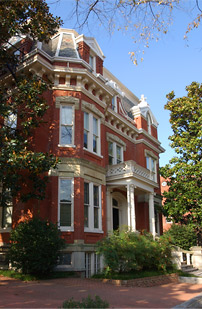
VCU’s Founders Hall, site of “Belles Gone Bad,” April 26 – May 24, 827 W. Franklin St., Richmond, VA.

April 26 – May 24 found me revisiting some of my favorite writers—including Flannery O’Connor, Katherine Anne Porter, and Eudora Welty—with the women enrolled in Belles Gone Bad, a course that I developed for the Commonwealth Society, VCU’s institute for lifelong learning.

Elisabeth “Betsy” Muhlenfeld, president emerita of Sweet Briar College  (1996 – 2009) and Mary Boykin Chesnut scholar, joined the class for our final Tuesday-morning  meeting on May 24. Her remarks on Chesnut brought to life a woman whose incisive diary, Mary Chesnut’s Civil War, offers not only one of the most important historical accounts of the Civil War years but also a document of considerable literary merit.

Muhlenfeld’s biography of Chesnut sustained me while I was icing a sprained ankle back in March and renewed my interest in the diarist, so I added Muhlenfeld’s edition of Chesnut’s novel manuscripts (UVA Press, 2002) to my summer reading list. Chesnut’s unfinished apprentice novels, The Captain and the Colonel and Two Years—or The Way We Lived Then, don’t place you in her world the way her diary so beautifully does, but they reveal how she fictionalized her life as she taught herself to write, and in her developing voice you can hear a hint of what’s to come.

Other notable summer reads include the first chapter of colleague Mary Lou Hall’s Dogs and Heroes, which received the third annual Best Unpublished Novel prize, sponsored by James River Writers and Richmond Magazine. Mary Lou read the opening of the novel at the Focused Inquiry Faculty  symposium on Friday, November 12, and I enjoyed reacquainting myself with the first chapter–in the pages of the July issue of RM–which introduces a boy named Clarence and his new friend Mona, the albino Great Dane “all white with the baby blue eyes” (66). Congratulations, Mary Lou!

Still lingering in my mind is the closing image of the writer learning to dance in the personal essay “Lady Lessons” by Lee Smith in the June/July issue of Garden and Gun. Studying with Smith in 1989 filled me with the love that Bobbie’s dancing lesson gives the young Lee. And her writing continues to delight and instruct me.