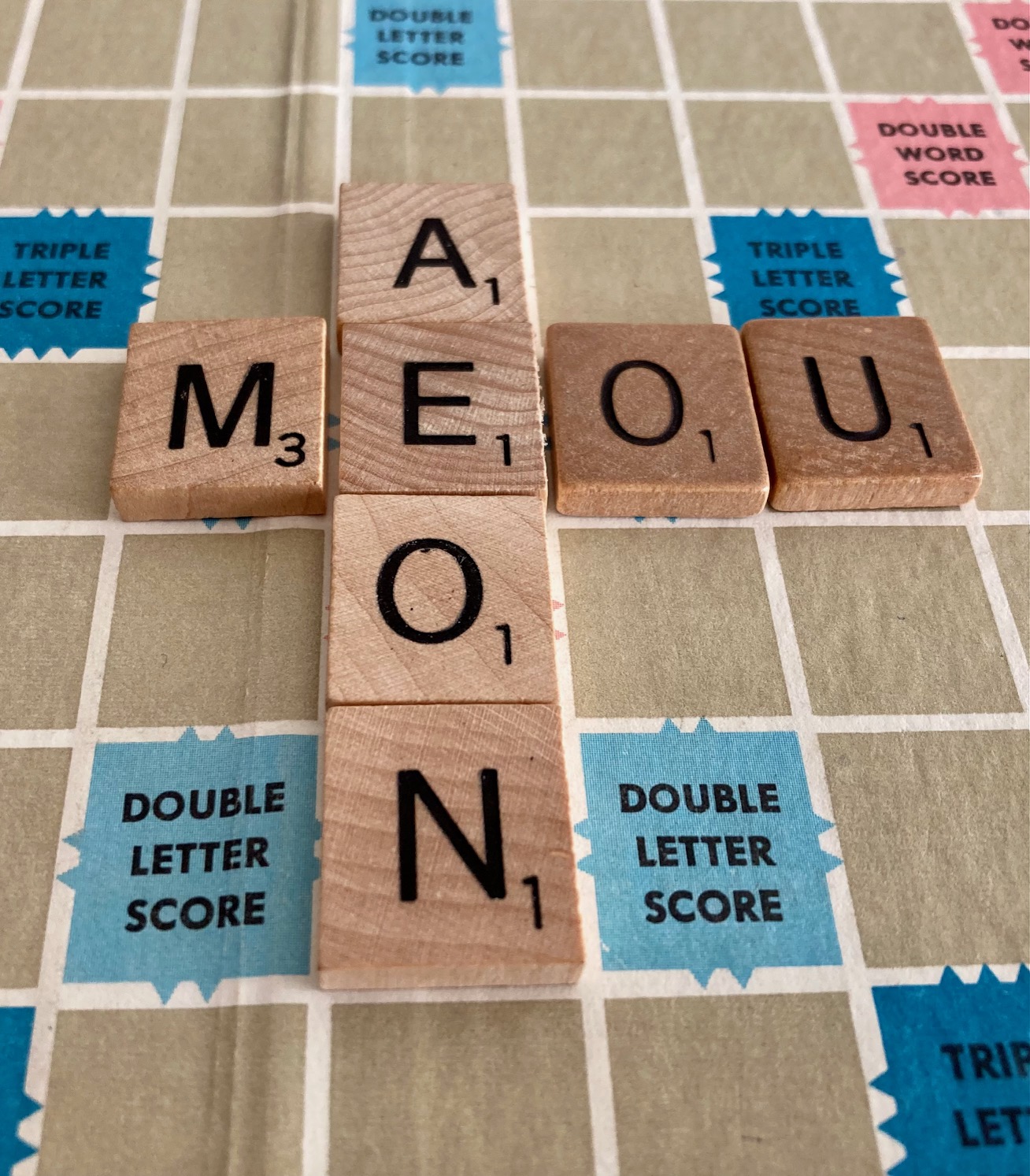
Knowing words with multiple vowels proves useful when you’re faced with a rack of mostly, or all, vowels. Here’s a list twenty-five four-letter words with three vowels:
aeon: a long period of time (also eon)
agee: to one side (also ajee)
agio: a surcharge applied when exchanging currency
ague: a sickness associated with malaria
ajee: to one side (also agee)
akee: a tropical tree
alae: wings (pl. of ala)
alee: on the side shielded from wind
amia: a freshwater fish
amoa: a kind of small buffalo
awee: a little while
eaux: waters (pl. of eau)
eide: distinctive appearances of things (pl. of eidos)
emeu: an emu
etui: an ornamental case
euro: an Australian marsupial, also known as wallaroo, for being like the kangaroo and the wallaby; also a unified currency of much of Europe
ilea: the terminal portions of small intestines (pl. of ileum)
Yesterday in class you began planning collaboratively for the group presentations that you will deliver in class next Monday, October 24.
These presentations serve three purposes: 1) They are an exercise in reviewing one of the lessons in the Check, Please!, 2) an exercise in collaboration, and 3) they offer practice in and oral communication.
For more details on the assignment, see the handout that I distributed in class yesterday. If you were absent, you can download a copy from Blackboard.
Next Up
In class tomorrow you will begin planning and drafting your final essay and annotated bibbliography.
This morning in class you will plan and draft a short midterm reflection essay that documents your work in the first weeks of the semester, focusing on what you consider your most significant work and the feature or features of the course that have benefited your development as a writer and a student. Features to consider include the following:
Planning, drafting, and revising your literacy narrative and your analysis
Keeping a journal
Completing Check, Please! assignments
Studying one of the readings examined class, including “Blogs vs. Term Papers,” “Skim Reading is the New Normal,” “Me Talk Pretty One Day,” “The Day that Language Came into My Life,” ‘Back Story” (from The Blind Side), “The Falling Man,” the sample literacy narrative and analysis, “Another Way with Words” and “On Its Face, Who Could Disagree with the Transformation?,” and The Competition, The New Yorker cover by Ian Falconer.
Writing for an online audience beyond the classroom/creating and maintaining a WordPress blog
Collaborating with your classmates on in-class writing assignments
Playing Scrabble/Collaborating with your teammates on Wordplay Day
Writing longhand
Limiting screen time
You will include in your reflective essay the following elements:
An opening paragraph that introduces your focus and presents your thesis
Body paragraphs that offer concrete details from your work to support your thesis.
A quotation or paraphrase from Writing Analytically and a quotation or paraphrase from one additional relevant source. Introduce your quotations/paraphrases with signal phrases and follow them with parenthetical citations where needed.
A conclusion that reiterates the thesis without restating it verbatim
MLA-style works cited entries for your sources
SAMPLE MLA WORKS CITED ENTRIES
Junod, Tom. “The Falling Man.” Esquire, vol. 140, no. 3, Sept. 2003, pp. 176+. Gale Academic OneFile Select, https://link.gale.com/apps/doc/ A106423422/EAIM?u=hpu_main&sid=bookmark-EAIM&xid=ce48797f.
Keller, Helen. “The Day Language Came into My Life.” Chapter Four. The Story of My Life. ttps://digital.library.upenn.edu/women/keller/life/life.html.
Rosenwasser, David and Jill Stephen. “Analysis Does More than Break a Subject into Its Parts.” Writing Analytically, 8th edition. Wadsworth/Cengage, 2019. pp. 4-5.
—“Making an Interpretation: The Example of a New Yorker Cover. Writing Analytically, 8th edition. Wadsworth/Cengage, 2019. pp. 84-89.
Falconer, Ian. The Competition. 2000. The New Yorker, 9 Oct. 2000. Copyright 2000 Condé Nast Publications, Inc.
This morning in class, we examined Ian Falconer’s The Competition, and you read two possible interpretations that the authors of Writing Analytically offer. As a group exercise in moving from observation to implication, you collaboratively composed a statement that included a detail that led you to find the first or second possibility more plausible.
Here are sample claims for each of the two interpretations:
The contrast between the raven hair and eyes of Miss New York and the platinum-blonde and pale-eyed contestants from Georgia, California, and Florida in The New Yorker cover The Competition by Ian Falconer suggests what the authors of Writing Analytically present as the first of two possible interpretations: The cover “speak[s] to American history, in which New York has been the point of entry for generations of immigrants, the ‘dark’ (literally and figuratively) in the face of America’s blonde European legacy” (Rosenwasser and Stephen 89).
The self-satisfied expression of Miss New York in The New Yorker cover The Competition by Ian Falconer suggests what the authors of Writing Analytically present as the second of two possible interpretations: “[T]he magazine is . . . admitting , yes America, we do think that we’re cooloer and more individual and less plastic than the rest of you, but we also know that we shouldn’t be so smug about it” (Rosenwasser and Stephen 89).
As you continue to revise your analysis, review these samples as models for your own shift from observation to implication in your analysis. Also note that each one is a statement that presents a quotation as an appostive, which is a word or group of words that explains the noun it follows. In each case, the noun is “interpretation” and what follows is the specific interpretation itself.
Work Cited
Rosenwasser, David and Jill Stephen. Chapter 3: “Interpretation: Moving from Observation to Implication.” Writing Analytically, 8th edition. Wadsworth/Cengage, 2019. pp. 70-97.
Learning these two-letter words, as well as the others in the alphabet, will enable you to see more options for play and increase the number of points you earn in a single turn.
qi: the central life force in Chinese culture (also ki)
re: a tone of the diatonic scale
sh: used to encourage silence
si: a tone of the diatonic scale (also ti)
so: a tone of the diatonic scale (also sol)
ta: an expression of thanks
ti: a tone of the diatonic scale
to: in the direction of
uh: used to express hesitation
um: used to express hesitation
un: one
up: to raise (-s, -ped, -ping)
us: a plural pronoun
ut: the musical tone C in the French solmization system, now replaced by do
we: a first-person plural pronoun
wo: woe
xi: a Greek letter
xu: a former monetary unit of Vietnam equal to one-hundreth of a dong (also sau pl. xu)
Today at the beginning of class I returned your analysis drafts with my comments, and you devoted the class period to working on your revisions. My revision of the analysis that I wrote as a sample for my students last semester appears below.
“On its Face, Who Could Disagree with the Transformation?”: Revisiting Richtel’s Report on the Blog-Term Paper Question
In The New York Times article “Blogs vs. Term Papers,” Matt Richtel reports on the debate in higher education on how best to teach writing in the digital age. While some professors have followed the lead of City University of New York’s Cathy N. Davidson, replacing the traditional term paper with shorter, more frequent blog assignments, their detractors—including Douglas B. Reeves, columnist for The American School Board Journal and William H. Fitzhugh, editor of The Concord Review—argue that blog writing lacks the academic rigor that fosters critical thinking. For Andrea Lunsford, professor of writing at Stanford University, pitting blogs against term papers creates a false opposition. Rather than replacing term papers with blog posts, Lunsford requires students to produce multi-modal assignments: term papers that evolve into blogs, websites, and video presentations. Although Richtel’s article appears to present an objective account of the disagreements among experts, a close examination of the diction and structure of “Blogs vs. Term Papers” reveals a preference for the innovations advocated by Davidson and Lundsford.
The opening paragraph of Richtel’s article focuses on the academic paper as a primary cause of “angst, profanity, and caffeine consumption” among high school and college students. In stark contrast to the images of the term paper-induced misery in his lead, Richtel writes in the second paragraph that students may be “rejoicing” because Cathy Davidson—a professor at Duke when Richtel interviewed her—favors replacing the term paper with the blog. Richtel refers to Davidson as a “champion” for students and outlines her use of a course blog as a practice that has become commonplace in a variety of academic disciplines. Richtel reports that blogs provide students with a “feeling of relevancy” and “instant feedback,” then poses the question: “[W]hy punish with a paper when a blog is, relatively, fun?”
From that question Richtel turns to the argument of defenders of the traditional academic paper, namely that the term paper teaches essential components of writing and thinking that may be absent from blog posts. Yet after letting the advocates of old-school writing have their say, Richtel undercuts their claim with this one-sentence paragraph: “Their reductio ad absurdum: why not just bypass the blog, too, and move on to 140 characters about Shermn’s Mrch?” To assert that defenders of traditional academic writing carry their opponents’ argument to an absurd conclusion presents those advocates of old-school writing as purveyors of the same flawed logic that their own traditional rhetoric supposedly teaches students to avoid.
Notably, the one-sentence paragraph, unlike paragraphs with multiple sentences, places heavy emphasis on a single idea. It says to readers, this is important. By introducing an apparent contradiction in the argument of the advocates of old-school writing, Richtel subverts their claim; and by presenting that incongruity as a one-sentence paragraph, he highlights the issue.
Richtel’s reductio ad absurdum paragraph is one of only two one-sentence paragraphs in his article. The other consists entirely of Professor Davidson’s own words. Speaking of the mechanistic quality of the term paper, she says: “As a writer, it offends me deeply.” In addition to devoting that one-sentence paragraph to Davidson’s negative feelings about term papers, Richtel returns to those feelings of hers at the end of his article and lets Davidson have the last word, literally.
In the final paragraphs of the article, Richtel recounts a tutoring session Davidson conducted with a community college student. Though she frowned on his assignment’s rigid guidelines—including prescribed sentence length—she told the student to follow the rules, knowing that teaching him what she deemed the best practice might have led the student to fail. Reflecting on that moment, Davidson said, “I hated teaching him bad writing,” and with those words of hers, Richtel’s article ends.
Along with giving Davidson the last word, Richtel devotes far more of his article to the new literacies she and Lunsford foster in their students. Arguably, the innovative nature of the work could account for the considerable space that Richtel devotes to it. After all, what readers are familiar with—in this case the traditional term paper—isn’t news. But the preponderance of word choices that place old literacies in a negative light combined with a structure that diminishes the merits of old-school writing reveals Richtel’s implicit preference for Davidson’s and Lundsford’s innovations.
Readers revisiting Richtel’s article now, nearly ten years after he wrote it, may wonder how he would respond to the question he poses about the shift from page to screen: “On its Face, Who Could Disagree with the Transformation?” Richtel wrote “Blogs vs. Term Papers” in 2012, the year deemed the year of the MOOCs (massive open online courses). Once touted as the key to revolutionizing higher education, their success has been hampered by the same issues linked to the learning losses experienced during the pandemic. For the many students who have had little or no face-to-face instruction—writing or otherwise—in recent memory, more technology may not seem like an answer, much less an innovation.
Remember that you have the opportunity to earn five bonus points for your analysis if you consult with a Writing Center tutor.
To schedule an appointment, visit https://highpoint.mywconline.com, email the Writing Center’s director, Justin Cook, at jcook3@highpoint.edu, or scan the QR code below. To earn bonus points for your literacy narrative, consult with a writing center tutor no later than Thursday, October 6.
Fake photo of Biggie Smalls and Curt Cobain featured in Lesson Five of Check, Please! as an example of assimilatuing.
This morning at the beginning of class, I collected your fifth and final Check, Please! worksheets. My version of the assignment appears below.
Check, Please! Lesson Five Assignment
In the fifth lesson of the Check, Please!, Starter Course, Mike Caulfield, author of the course and Director of Blended and Networked Learning at Washington State University, covers the final step in the five-step SIFT approach: “Trace Claims, Quotes, and Media to Their Original Context.” Caulfield outlines the process of locating the original context as an antidote to the issues of accuracy that occur when information passes through intermediaries.
One of the most instructive portions of lesson five features a passage in which Caulfield cites a study of how stories evolve as gossip through the processes of leveling (stripping details), sharpening (adding or emphasizing details), and assimilating, which combines the two. In the process of assimilation “the details that were omitted and the details that were added or emphasized are chosen because they either fit what the speaker thinks is the main theme of the story, or what the speaker thinks the listener will be most interested in.” Similarly, leveling, sharpening, and assimilating all figure in the altered photographs and memes in lesson four. The abbreviated speech of the NRA’s CEO, Wayne LaPierre, which omits commentary, inaccurately indicates a contradiction in his stance on the presence of guns in schools.
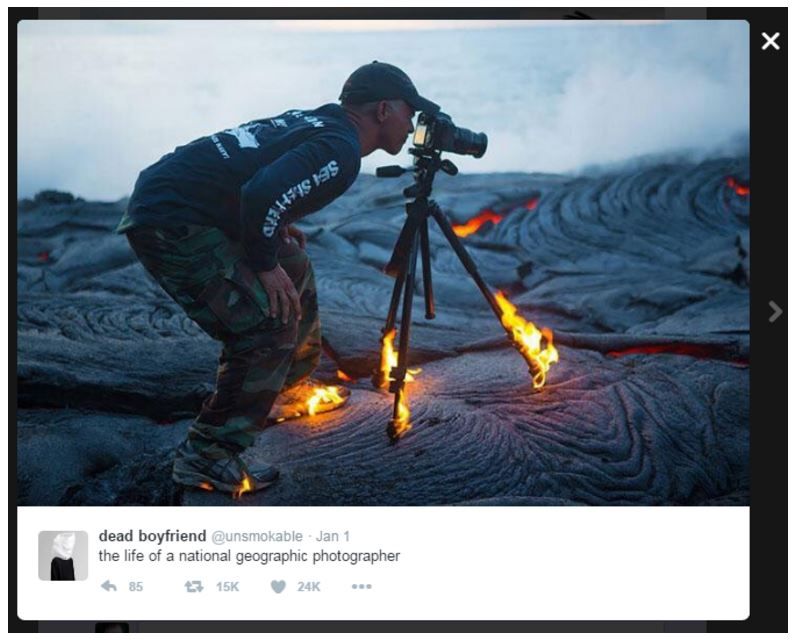
The picture of photographer Kawika Singson featured in Lesson Five of Check, pLease as an example of leveling.
The image of photographer Kawika Singson with flames at his feet serves as an example of leveling. Although the flames are real, they were not caused by the heat of the lava flow where Singson stands with his tripod. Instead, to create the image, a friend of his poured accelerant on the lava before Singson stepped into the frame. The deception wasn’t intentional; Singson simply wanted the image for his Facebook cover photo.
Unlike Singson’s photograph, the altered photograph of the Notorious B.I.G. with Kurt Cobain was created with the intent to deceive. Cropping and merging the two photographs illustrates the assimilation process adopted by Photoshop users to appeal to music fans eager to think that such fictional meetings of icons took place. Krist Novoselic, who founded Nirvana with Cobain, replied to the is-it-real question with his own fake photo, making the claim that the hand holding the cigarettes was Shakur’s, that he had been cropped from the right.
Learning these two-letter words, as well as the others in the alphabet, will enable you to see more options for play and increase the number of points you earn in a single turn.
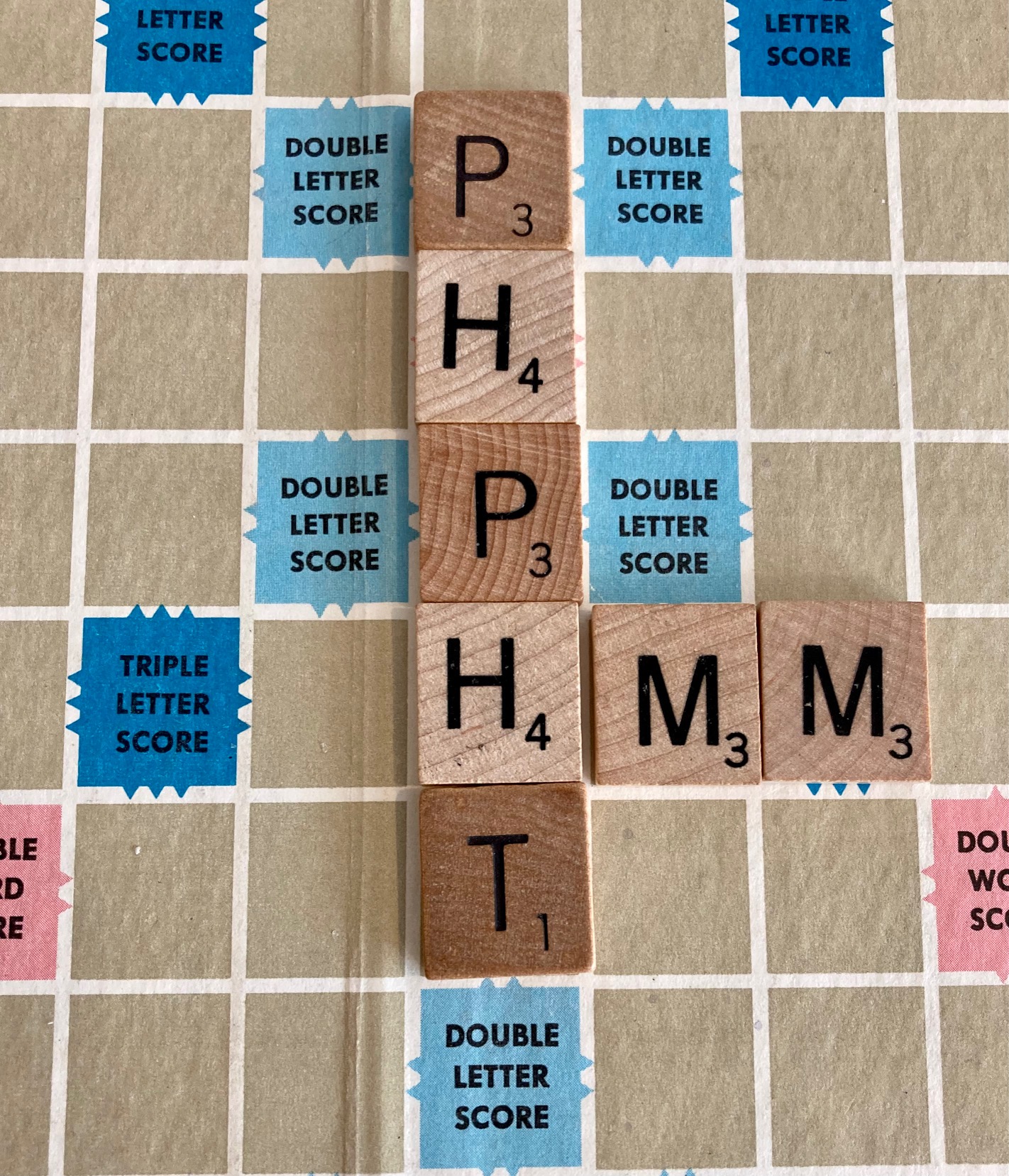
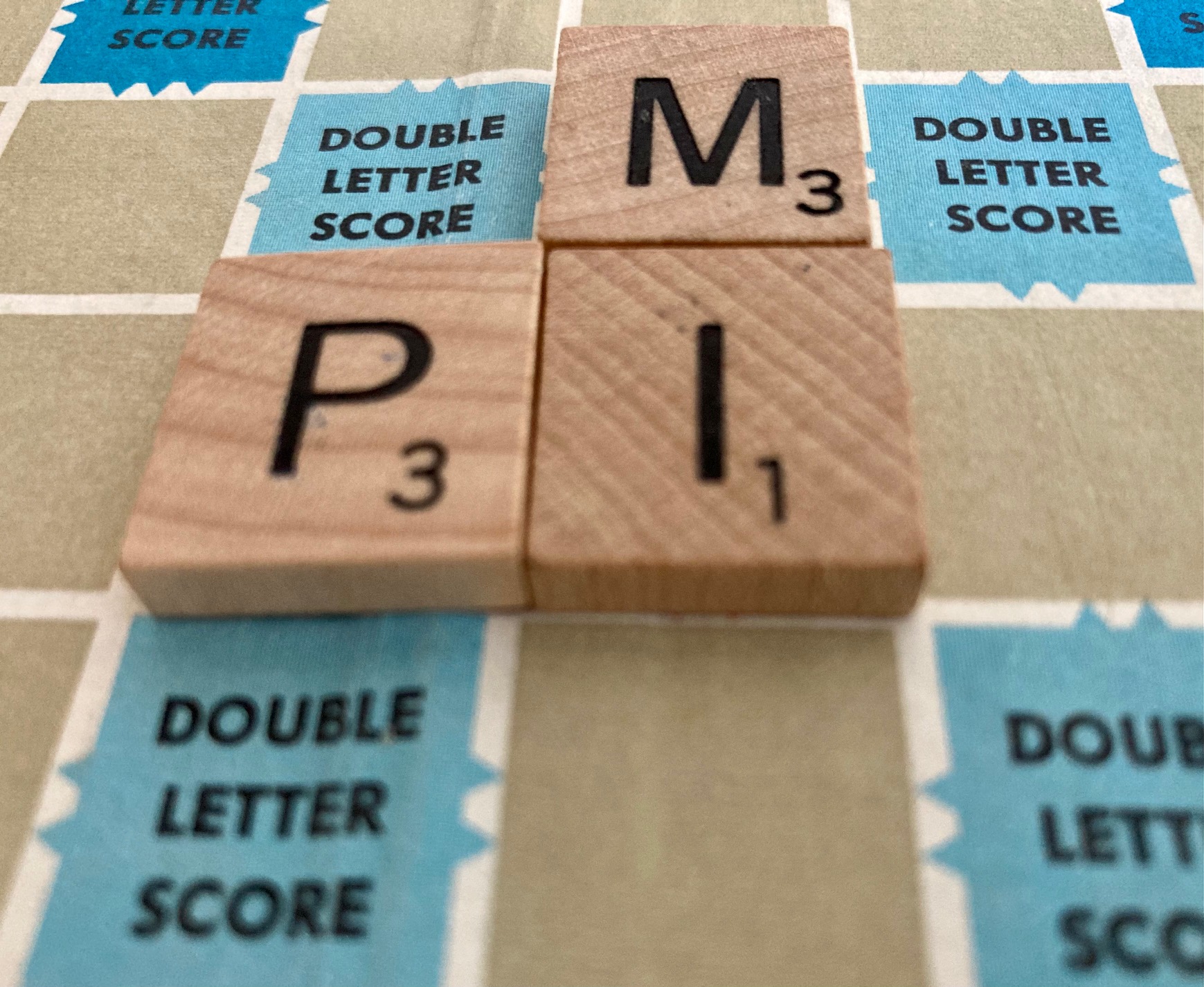
M, by the way, is the most versatile consonant. In the first position, m pairs with every vowel, ma, me, mi, mo, mu, and also my. In the second position, m with pairs with every vowel except i: am, em, om, um.
ma: a mother
me: a singular objective pronoun
mi: a tone of the diatonic scale
mm: an expression of assent
mo: a moment
mu: a Greek letter
my: a first-person possessive adjective
na: no, not
ne: born with the name of
no: a negative answer
nu: a Greek letter
od: a hypothetical force
oe: a whirlwind off the Faero Islands
of: originating from
oh: an exclamation of surprise
oi: an expression of dismay (also oy)
om: a sound used as a mantra
on: the batsman’s side in cricket
op: a style of abstract art dealing with optics
or: the heraldic color gold
os: a bone
ow: used to express pain
ox: a clumsy person
oy: an expression of dismay
pa: a father
pe: a Hebrew letter
pi: a Greek letter
Next Up
Wordplay Day! To up your game and increase your word power, review the tips and tools on the Scrabble website as well as my blog posts devoted to the game.
In class today you will plan and draft your analysis, which will focus on one of the articles or essays that we have studied in class: “Me Talk Pretty One Day,” “The Day that Language Came into My Life,” “Back Story” (from The Blind Side), “The Falling Man,” “Skim Reading is the New Normal,” or the essay that I will distribute today, “Scrabble is a Lousy Game.”
Many students find the transition from expressive writing, such as a literacy narrative, to analysis to be a difficult one, but as the authors of your textbook note, “[i]n practice though, the best versions of analysis and expressive writing can overlap a lot” (Rosenwasser and Stephen 7). They go on to observe that “[v]irtually all forms of description are implicitly analytical” (7).
“When you choose to take what you take to be the three most telling details about your subject, you have selected significant parts and used them as a means of getting at what you take to be the character as a whole. This is what analysis does: it goes after an understandingof what something means, its nature, by zeroing in on the function of significant detail.” (7)
As a starting point, you will read some of the passages in Writing Analytically devoted to analysis, including “Analysis Does More than Break a Subject into Its Parts,” 4-5; and “Distinguishing Analysis from Summary, Expressive Writing, and Argument,” 5-8.
After you read the pages in Writing Analytically devoted to analysis, you will review the articles and essays you’ve read, and read “Scrabble is a Lousy Game.” Determine which article or essay appeals to you most as a subject of analysis. Reread that article or essay and identify three or more elements that contribute to its effectiveness. Develop your analysis through a close examination of those elements.
Work Cited
Rosenwasser, David and Jill Stephen. Writing Analytically, 8th edition. Wadsworth/Cengage, 2019.






 Jane Lucas