 This post serves as both a welcome back note and a blog entry on the writer’s craft, the second one I’ve written with you. (I posted the first one on January 22.)
I’m always grateful when I discover that readings and assignments in my various courses dovetail. It reminds me that although the particulars of the courses differ, communicating effectively in writing and closely examining written texts are fundamentals they all share.
Two dovetail discoveries occurred earlier this semester. The first one happened when I was reading the composition students’ weekly assignment in The Norton Field Guide to Writing. It was in the chapter devoted to description. There the textbook’s authors include excerpts from two pieces of writing about multiple sclerosis that together illustrate lucidly the differences between the general description of objective nonfiction and the concrete, significant details and voice that bring creative nonfiction to life. Read the two excerpts that follow and consider both the differences between the words and how the words in each excerpt affect you.
First, a description from a brochure published by the National Multiple Sclerosis Society:
Multiple sclerosis is a chronic, unpredictable disease of the central nervous system (the brain, optic nerves, spinal cord). It is thought to be an autoimmune disorder. This means the immune system incorrectly attacks a person’s healthy tissue.
MS can cause blurred vision, loss of balance, poor coordination, slurred speech, tremors, numbness, extreme fatigue, problems with memory and concentration, paralysis, and blindness. These problems may be permanent, or they may come and go. (qtd. in Bullock et al. 444)
Second, an excerpt from “On Being a Cripple,” by Nancy Mairs, a writer with MS:
During its course, which is unpredictable and uncontrollable, one may lose vision, hearing, speech, the ability to walk, control bladder and/or bowels, strength in any or all extremities, sensitivity to touch, vibration and/or pain, potency, coordination of movements–the list of possibilities is lengthy and yes, horrifying. One may also lose one’s sense of humor. That’s the easiest to lose and the hardest to survive without.
In the past ten years, I have sustained some of these losses. Characteristic of MS are sudden attacks, called exacerbations, followed by remissions, and these I have not had. Instead my disease has been slowly progressive. My left leg is now so weak that I walk with the aid of a brace and a cane, and for distances I use an Amigo, a variation on the electric wheelchair that looks rather like an electrified kiddie car. I no longer have much use of my left hand. Now my right side is weakening as well. I still have the blurred spot in my right eye. Overall, though, I’ve been lucky so far. (qtd. in Bullock et al. 443-44)
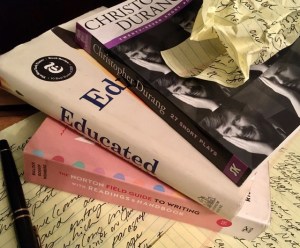 Another dovetail discovery occurred when my composition students were studying Chapter 11 of Tara Westover’s memoir, Educated. The latter half of that chapter, “Instinct,” depicts Westover’s brother Shawn reining in the frightened gelding, Bud, preventing him from throwing Tara.
As my composition students and I examined the series of conflicts that propel the chapter forward, it occurred to me that the concluding pages of Chapter 11 would serve as an ideal segue from our study, in English 126, of creative nonfiction to our study of fiction. That scene exemplifies the structural similarities between fiction and memoirs, such Westover’s, that follow the same narrative arc.
In the span of only two and a half pages, Westover presents five conflicts: (1) Bud, the gelding, in conflict with the angry mare, (2) Tara in conflict with the frightened Bud, (3) Tara in conflict with herself (Should she let go of the saddle horn?), (4) Shawn in conflict with the mare, and (5) Shawn in conflict with–and ultimately prevailing over–Bud. Thanks to Brennan for pointing out the fourth conflict, which I had overlooked earlier.
Lastly, I’ll address our final in-class reading on March 12, Christopher Durang’s For Whom the Southern Belle Tolls. Not only did Durang’s play let us exit laughing, it also showed us how quirky, well-wrought parody can pull readers into a play regardless of their knowledge of the source. When Lawrence says: “I call this [cocktail stirrer] Q-tip because I realized it looks like a Q-tip” (19), readers will laugh even if they don’t know that he’s a spoof of Laura Wingfield.
Remember to check your CVCC email and Blackboard regularly for updates and assignments. We will get through these days–and exit laughing again, I hope.
Bullock, Richard et al. Chapter 42: “Describing.” The Norton Field Guide to Writing with Handbook. 5th ed., 2019. pp. 443-44.
Durang, Christopher. For Whom the Southern Belle Tolls. Christopher Durang: Twenty-Seven Short Plays. Smith and Krauss, 1995. pp. 12-27.
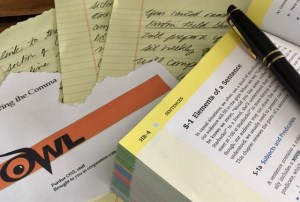 Your revised readings in The Norton Field Guide to Writing will prepare you for the six quizzes that you will complete during the remaining weeks of the semester. I selected the six subjects for the quizzes (words often confused, punctuation, precise words, active and passive voice, main points and support, and MLA documentation) based on patterns that I have identified in your essays. Most of the readings that will prepare you for the quizzes are in the yellow-edged Handbook section of Norton.
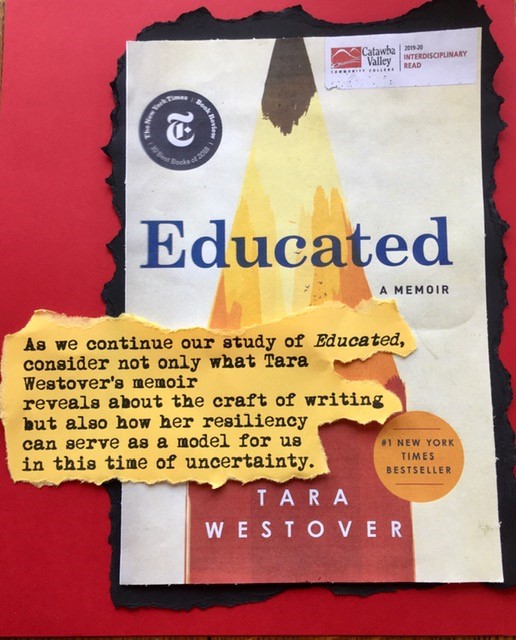 Wherever you are in your reading of Educated, I encourage you to look back at the pages where Tara Westover recounts her first days on campus at Brigham Young University (155-58). Stepping into the unfamiliar–as she was then and we are now–is always difficult.
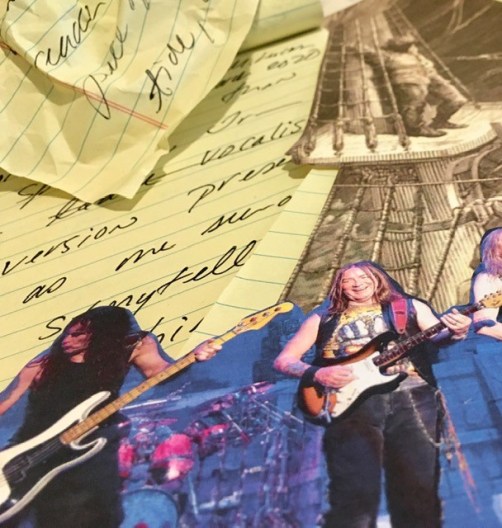 A sailor kills a bird of good omen, his destructive act dooms his shipmates and curses him with retelling the tale over and over: So the story of the Ancient Mariner goes. Yet those plot details convey neither the epic nature of Samuel Taylor Coleridge’s poem nor its influence on later writers. Only the poem itself places readers fully in the imaginative realm of the tale, but its late eighteenth-century diction creates a gulf between the poem and contemporary readers. Consequently, one of the challenges of introducing “The Rime of the Ancient Mariner” to millennial students is bridging that gulf. Iron Maiden’s adaptation offers one solution. By eliminating the shifts in the narrative voice and updating the story with contemporary language, their heavy-metal version draws listeners into the story with emphatic rhythms that capture the spirit of the original lines.
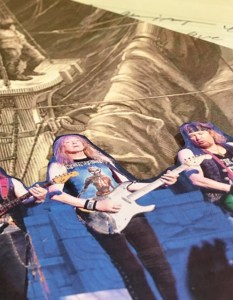 Iron Maiden’s adaptation eliminates those issues with updated diction and a consistent narrative voice. Rather than shifting speakers, Iron Maiden’s version presents the tale sung by a single storyteller, not the sailor himself, but a narrator who tells listeners to “[h]ear the rime of the ancient mariner” (1). Those first words of the song, penned by lead singer Bruce Dickinson, form an imperative sentence: a command with the understood subject “you”—“[You] hear the rime . . . ” (1). I am master and commander of this story, Dickinson seems to say, and you will hear it now. Such is the power of the imperative. Rather than leaving the reader questioning, as Coleridge’s first stanzas may, Iron Maiden’s song speaks directly to listeners, taking hold of them with the pull of a powerful tide, drawing them out to sea to witness the Mariner as he kills the albatross and seals his fate.
 A flannel shoe bag, a pile of mini craft sticks, and a repurposed Q-Tip travel box: These items are in my hands most days. They’re often in the hands of my students as well. Any of them who walk into the classroom early—before the beginning of the hour—and spot the bag and the box of sticks on the front desk know that they’ll be working in groups that day, at least for part of the class period. Their job, if they choose to volunteer, is to make random groups by drawing sticks, which are labeled with the students’ names.
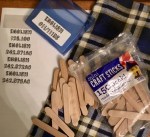 To me, all of these noises are sounds of collaboration and community building, of students not sitting passively but instead taking an active role in preparing for class. A flannel shoe bag, a pile of mini craft sticks, and a repurposed Q-Tip travel box: In the classroom these are small, good things.
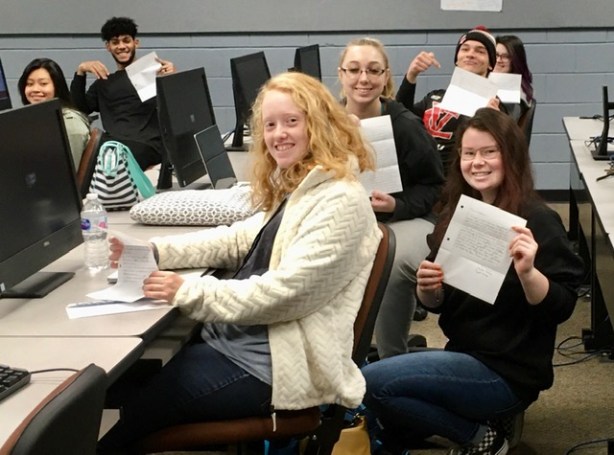 More than twenty years ago, in August of 1997, National Public Radio’s Morning Edition featured a story about Nancy Johnson, a second- and third-grade teacher who gave her students the assignment of writing letters to themselves, letters that covered such details as “their favorite toys, what makes them different from other kids and what they want to do in the future” (Morning par. 1). Johnson collected the letters and mailed them back to her pupils at the end of their senior year of high school. As I pictured Nancy Johnson’s eighteen-year-old students reading the words written by their seven- and eight-year-old selves, I began wondering how I might create a similar letter-writing experience for my college students. Following Johnson’s model wouldn’t be practical. My students’ addresses would change repeatedly throughout their twenties; I doubted that many of their letters would find their way back to them. Rather than requiring pieces of writing that might end up at the dead letter office, I crafted an alternate assignment. I required my students to write to themselves at the beginning of the semester, and I returned their letters to them on the last day of class.
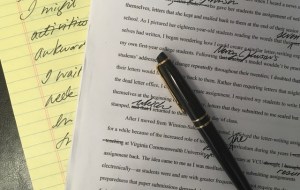 I was thinking about that last spring—how few of my students receive snail mail and how I wished more of them received replies—when it occurred to me that retirement communities offered potential pen pals—people who might not only welcome snail mail from college students but who might also write them back. Margaret Shepherd, author of The Art of the Handwritten Note, recommends that if you don’t know whom to write snail mail to, “reach out to deserving strangers” (qtd. in
  When the students composed their letters in class, some asked when they would receive a reply. I could only tell them, I don’t know when you will, or if you will. After a month passed and I hadn’t heard from Abernethy Laurels, it occurred to me that the activities director may have been overwhelmed by the number of letters she received, forty-one in all. And what if the residents didn’t want to write back? Or what if some wanted to reply, but couldn’t? I imagined the activities director transcribing letter after letter for residents with arthritic hands. If I had given her a formidable task, I didn’t want her to feel compelled to complete it. If I phoned or emailed to request an update, I might put her in an awkward position. So I waited until the first week of November to email her. She replied that the residents had responded to thirty-five of the letters and would soon complete responses to the remaining six.
 What makes a book a page-turner? If it’s fiction, it’s the narrative arc. If it’s nonfiction, it’s the same arc imposed on truths that are stranger than the lies of novels.
  I wrote my first research paper in seventh grade. All of us in Mr. Lord’s English class were required to select a subject of our choice, perhaps the subject had to be a historical figure. Whatever the case, I chose Albert Einstein. I remember sitting at the small, drop-front desk in my bedroom, printing sentence after sentence on three-by-five index cards. Mr. Lord had told us in class that we should limit each card to one fact. One of my most vivid memories of that project is the sight of my large, uneven letters spilling over onto the back of the cards. What I construed as one fact wouldn’t fit on one side.
 Jane Lucas