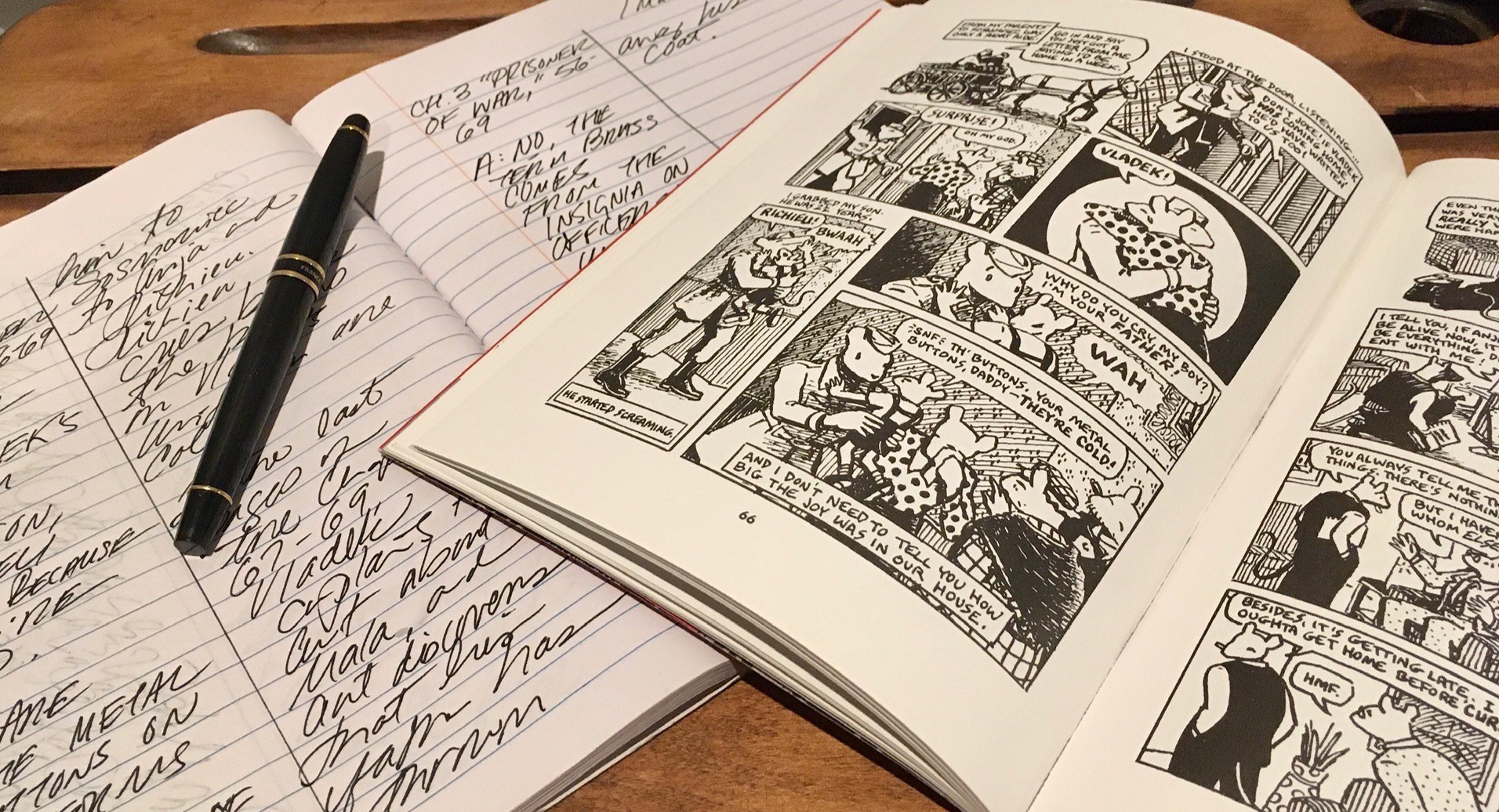
Posted in Reading, Teaching, Writing

ENG 111: Of Mice and Memoirs, Part II

Narrative Conflict or Tension

Last week I advised you to Study Spiegelman’s scenes closely. As you continue to read Maus, and as you prepare to write your first essay for English 111, your literacy narrative, note which panels of Spiegelman’s convey conflict, either a character’s inner conflict or a character’s conflict with another character. Conflict, which is essential to narrative, appears on virtually every page of Maus.

The first half of Chapter 2, “The Honeymoon,” depicts six conflicts or problems:

  • Vladek combatting his medical condition (heart disease, diabetes)
  • the policemen’s pursuit of Anja
  • the interrogation of Anja’s aide, the seamstress,  Miss Stefanska
  • Art questioning his father’s storytelling
  • Anja’s struggles with post-partum depression, and
  • the train passengers facing the threat of the Nazi regime, signified by the flag in the center of the page (32).

Scene and Summary

As a comic, Maus consists primarily of scenes but it includes summary as well. In the panel below, which depicts Miss Stefanska’s interrogation by the Polish police, the scene is depicted with the panel’s drawing and its speech balloons. Spiegelman presents summary in the rectangles.

Panel from page 28 of Maus.
Spiegelman, Art. Maus I. Pantheon, 1986. p. 28.

Scene and summary are the building blocks of narratives. Simply put, scenes show and summaries tell. Narratives can consist primarily of scenes, but ones that rely heavily on summary don’t capture our imagination. As you plan your literacy narrative, keep this in mind: Readers would rather be shown than told.

The paper-craft graphic below illustrates the organization of scene and summary in a narrative essay.

Illustration of narrative essay structure.

Dialogue

Maus demonstrates the important role that dialogue often plays in narrative, but it doesn’t show how dialogue is presented in an essay. In comics, dialogue appears in speech balloons. Prose narratives (essays, short stories, novels, and book-length  nonfiction) present dialogue with lines of speech enclosed in quotation marks and with dialogue tags. A dialogue tag is a short phrase at the beginning, in the middle, or at the end of the dialogue that attributes the dialogue to a particular person or character.

“Have you chosen a topic for your literacy narrative?” she asked.

In the sentence above, she asked is the dialogue tag.

When you write dialogue, you begin a new paragraph whenever the speaker changes. That’s why paragraphs of dialogue are generally short, often only one line.

Consider the dialogue below, from Annie Dillard’s memoir, An American Childhood:

Excerpt from An American Childhood by Annie Dillard.
Dillard, Annie. An American Childhood. Harper & Row, 1987. p. 112.

In the first paragraph, Annie Dillard summarizes how her mother would tell her to spell words. In the second paragraph, Dillard moves to the scene of one particular evening, the night when her mother says there’s a deer in the hall.  Only the first of the three short paragraphs that follow the summary includes a dialogue tag. The other two don’t need tags because the new paragraph itself, the indentation of five spaces, signals a change in the speaker.

Once you’ve established who the speakers are in a dialogue between two people, you don’t need to include dialogue tags.

Notice that the first and last paragraphs include single quotation marks within the lines of dialogue. In the first paragraph, the words poinsettia and sherbet are enclosed in single quotation marks because words referred to as words are enclosed in quotation marks. Since the two words are contained within a longer quotation, Dillard’s mother’s line of dialogue, the words are enclosed in single quotation marks.

In the last paragraph, the words I know are enclosed in single quotation marks because the mother is quoting her daughter.

Words referred to as words in dialogue and quotations within lines of dialogue are enclosed in single quotation marks.

For more information on quotation marks, see A Writer’s Reference (279-80).

Look to the passage that follows as another model for your literacy narrative. Here, Annie Dillard recounts seeing an amoeba for the first time:

Finally late that spring I saw an amoeba. The week before, I had gathered puddle water from Frick Park; it had been festering in a jar in the basement. This June night after dinner I figured I had waited long enough. In the basement at my microscope table I spread a scummy drop of Frick Park puddle water on a slide, peeked in, and lo, there was the famous amoeba. He was as blobby and grainy as his picture; I would have known him anywhere.

Before I had watched him at all, I ran upstairs. My parents were still at table, drinking coffee. They, too, could see the famous amoeba. I told them, bursting, that he was all set up, that they should hurry before his water dried. It was the chance of a lifetime.

Father had stretched out his long legs and was tilting back in his chair. Mother sat with her knees crossed, in blue slacks, smoking a Chesterfield. The dessert dishes were still on the table. My sisters were nowhere in evidence. It was a warm evening; the big dining-room windows gave onto blooming rhododendrons.

Mother regarded me warmly. She gave me to understand that she was glad I had found what I had been looking for, but that she and Father were happy to sit with their coffee, and would not be coming down. She did not say, but I understood at once, that they had their pursuits (coffee?) and I had mine. She did not say, but I  began to understand then, that you do what you do out of your private passion for the thing itself.

I had essentially been handed my own life, in subsequent years my parents would praise my drawings and poems, and supply me with books, art supplies, and sports equipment, and listen to my troubles and enthusiasm, and supervise my hours, and discuss and inform, but they would not get involved with my detective work, nor hear about my reading, nor inquire about my homework or term papers or exams, nor visit the salamanders I caught, nor listen to me play piano, nor attend my field hockey games, nor fuss over my insect collection. My days and nights were my own to plan and fill.

Those paragraphs from An American Childhood don’t include any direct quotations. In the second paragraph, Dillard recounts what her mother said, but she doesn’t present it as dialogue. If the exact words spoken aren’t crucial to a scene, you can present the conversation indirectly, as Dillard does above.

Narratives Don’t Have to Center on Dramatic Events

The excerpts that you’ve just read from An American Childhood demonstrate how to write dialogue and shift between scene and summary. And perhaps most importantly, they demonstrate this: Narratives don’t have to center on dramatic events.

If you think that you don’t have a story to write as your literacy narrative, look again at Dillard’s depiction of herself as a student of the natural world. There’s no dramatic conflict, but there’s desire. First, she wants to see an amoeba,  something she’s never seen before. Second, she wants her parents to share her excitement, but they don’t. With her microscope, Annie Dillard develops her knowledge of nature, but the larger learning experience that takes place is her realization that “you do what you do out of your private passion for the thing itself” (149). She has “essentially been handed [her] own life” (149).

What quiet, significant learning experience of yours has lingered in your mind? Your answer to that question could be the start of your literacy narrative.

Literacy Narrative Topics

I included your options in the previous blog post and am listing them here as well:

  • any early memory about writing, reading, speaking, or another form of literacy that you recall vividly
  • someone who taught you to read or write
  • someone who helped you understand how to do something
  • a book that has been significant to you in some way
  • an event at school that was related to your literacy and that you found interesting, humorous, or embarrassing
  • a literacy task that you found (or still find) especially difficult or challenging
  • a memento that represents an important moment in your literacy development
  • the origins of your current attitudes about writing, reading, or speaking
  • creating and maintaining your WordPress blog

Length Requirement

Your literacy narrative should be no fewer than five-hundred words. I encourage you to challenge yourself to exceed the minimum.

When to Begin

You are not required to begin your literacy narrative before the class period devoted to drafting, but you are welcome to sketch out ideas and begin drafting in your journal.


Dillard, Annie. An American Childhood. Harper & Row, 1987.

Spiegelman, Art. Maus I. Pantheon, 1986.

Posted in Reading, Teaching, Writing

ENG 111: Of Mice and Memoirs, Part I

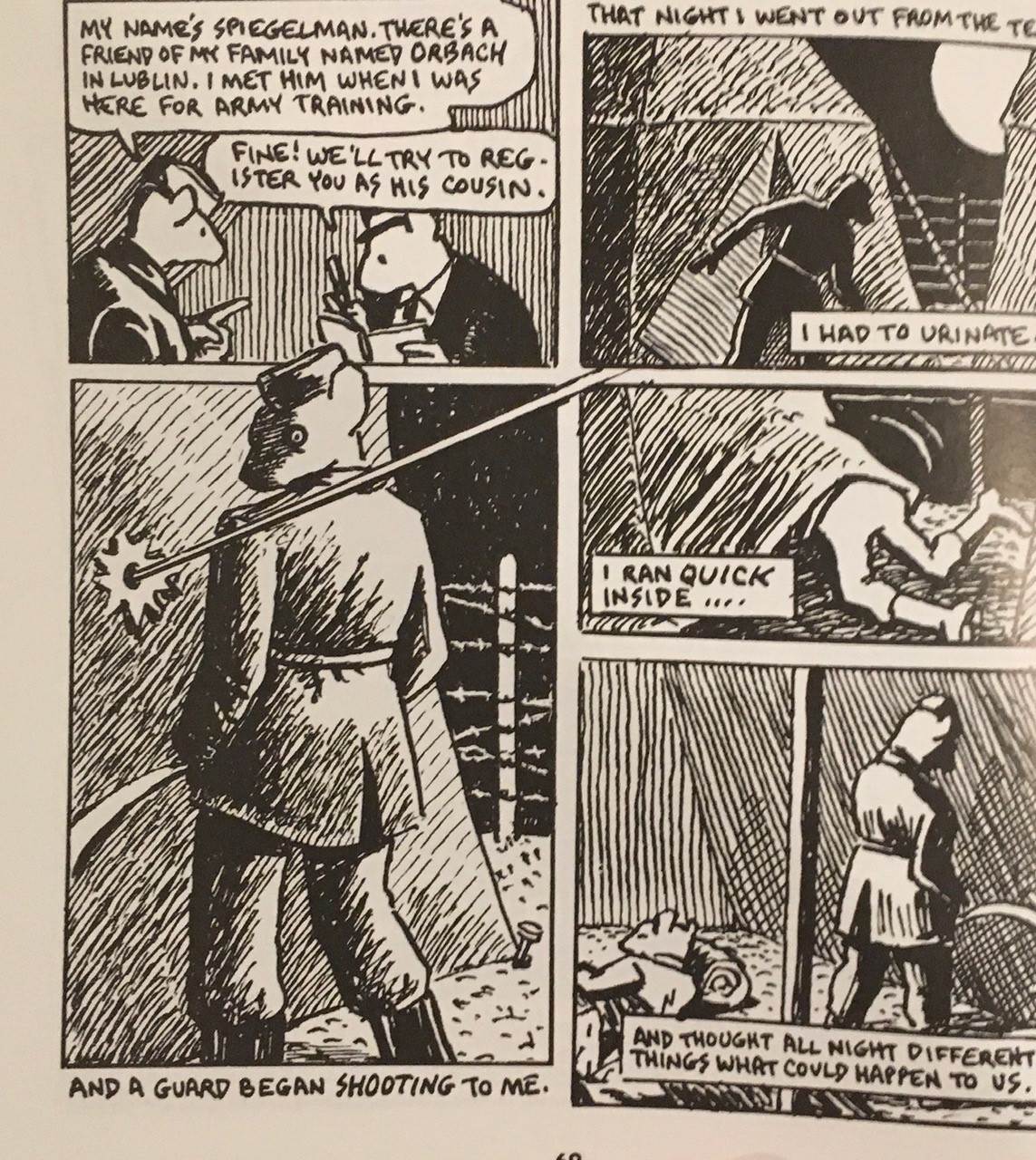
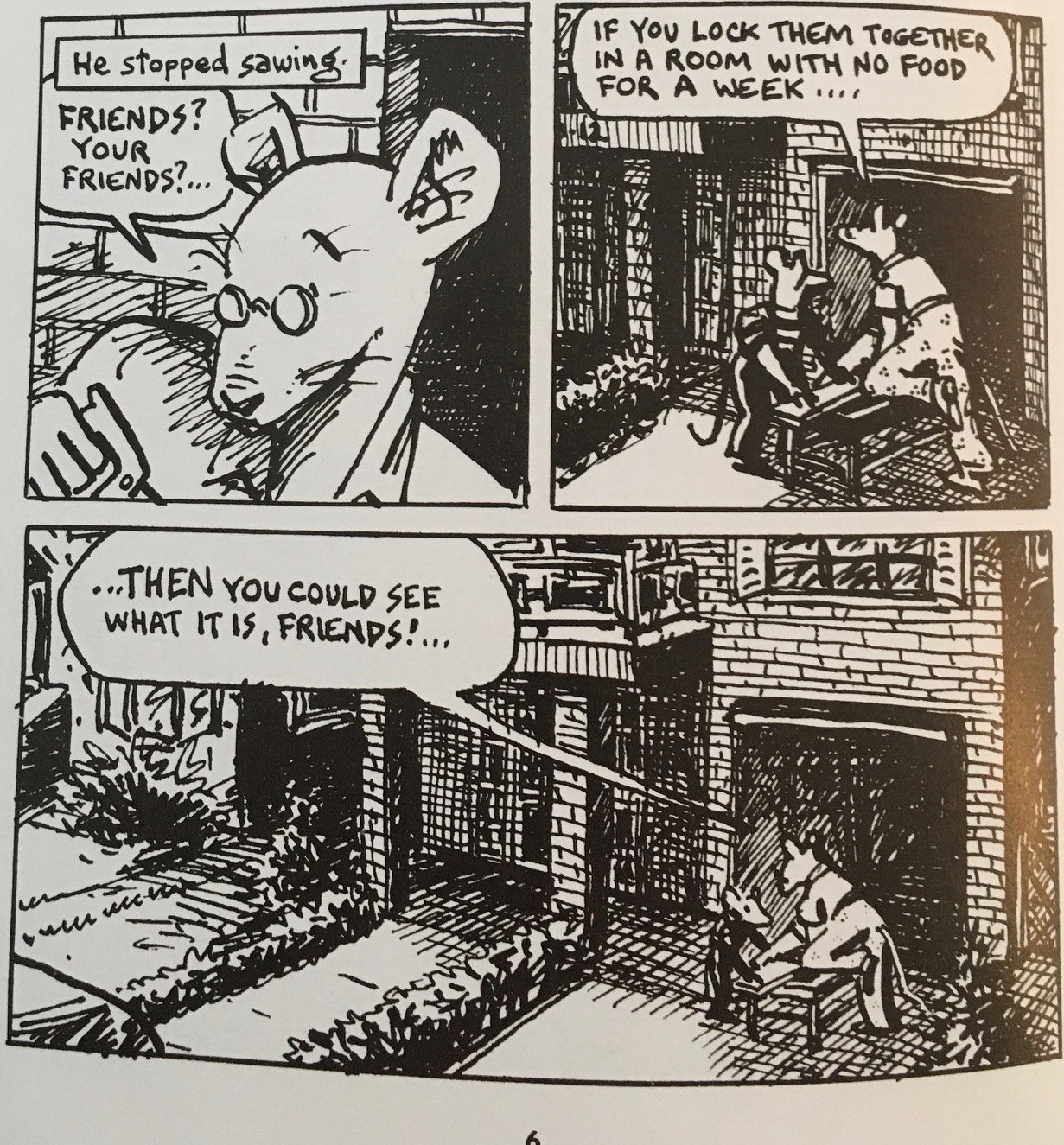
Spiegelman, Art. Maus I. Pantheon, 1986. p. 6.

Summary

Last week I asked you to focus your journal writing on the epigraph for Maus I, first by writing a short summary and afterward by writing about how the short two-page epigraph relates to Chapter 1.

Here’s my version of that journal exercise:

In Art Spiegelman’s epigraph for Maus I, “Rego Park, N.Y., c. 1958,” he recounts the events of a summer’s day when he was ten or eleven years old. He and two of his friends are racing together on roller skates until one of Artie’s skates comes loose and he falls. Rather than waiting for Artie, the other two boys skate away, leaving him behind to be the “Rotten egg” (5). After Artie returns home, his father asks why he is crying. When Artie tells his father what happened, his father questions his son’s use of the word “friend.” He replies, “If you lock them together in a room with no food for a week . . . / . . . Then you could see what is, friends! . . .” (6).

The cutting remark that Spiegelman’s father makes as he saws wood illustrates the communication breakdown between him and Artie. Spiegelman’s depiction of that gulf foreshadows the trials he will encounter: struggling to understand his father and himself as he aims to make meaning of their lives through his comics.

Notice how the first paragraph, the summary, does not express my opinion. By definition, summaries are objective. When you write a summary, you aim to convey a text’s main ideas in your own words but without offering your own opinion.

Analysis

In the second paragraph, I turn to analysis. I connect the father’s cutting, or unkind, remark to the sawing of the wood, which is itself an act of separation—a detail that I might add to the paragraph if choose to develop my analysis.

Summary and analysis are building blocks of both academic and professional writing. We summarize to increase our understanding of texts, and we analyze them to demonstrate our ability to think critically.

For more information on summary and analysis, see pages 63-64 of A Writer’s Reference.

Writing about Maus in Your Journal

After you complete each reading assignment in Maus, summarize it in your journal. You are not required to analyze each reading, but you should make note of any questions you have and points that you would like to address in class.

What to Focus on as You Read Maus

Because Maus is a memoir and your first essay assignment for English 111 is a literacy narrative, a form of memoir, focus on this question: How can Maus serve as a model for my own memoir, my literacy narrative?

In your literacy narrative, which you will draft and revise in September, you will write on one of these topics:

  • any early memory about writing, reading, speaking, or another form of literacy that you recall vividly
  • someone who taught you to read or write
  • someone who helped you understand how to do something
  • a book that has been significant to you in some way
  • an event at school that was related to your literacy and that you found interesting, humorous, or embarrassing
  • a literacy task that you found (or still find) especially difficult or challenging
  • a memento that represents an important moment in your literacy development
  • the origins of your current attitudes about writing, reading, or speaking
  • creating and maintaining your WordPress blog

Spiegelman, Art. Maus I. Pantheon, 1986. p. 6.

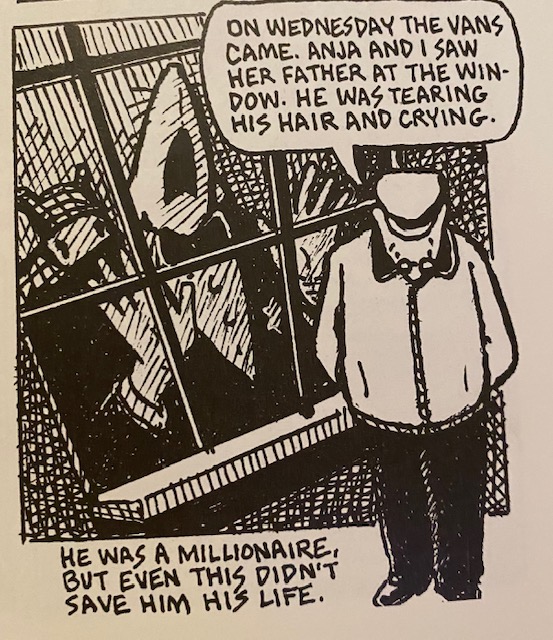
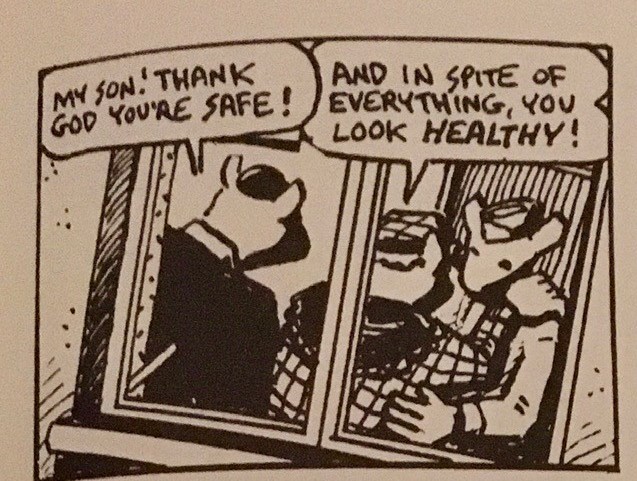
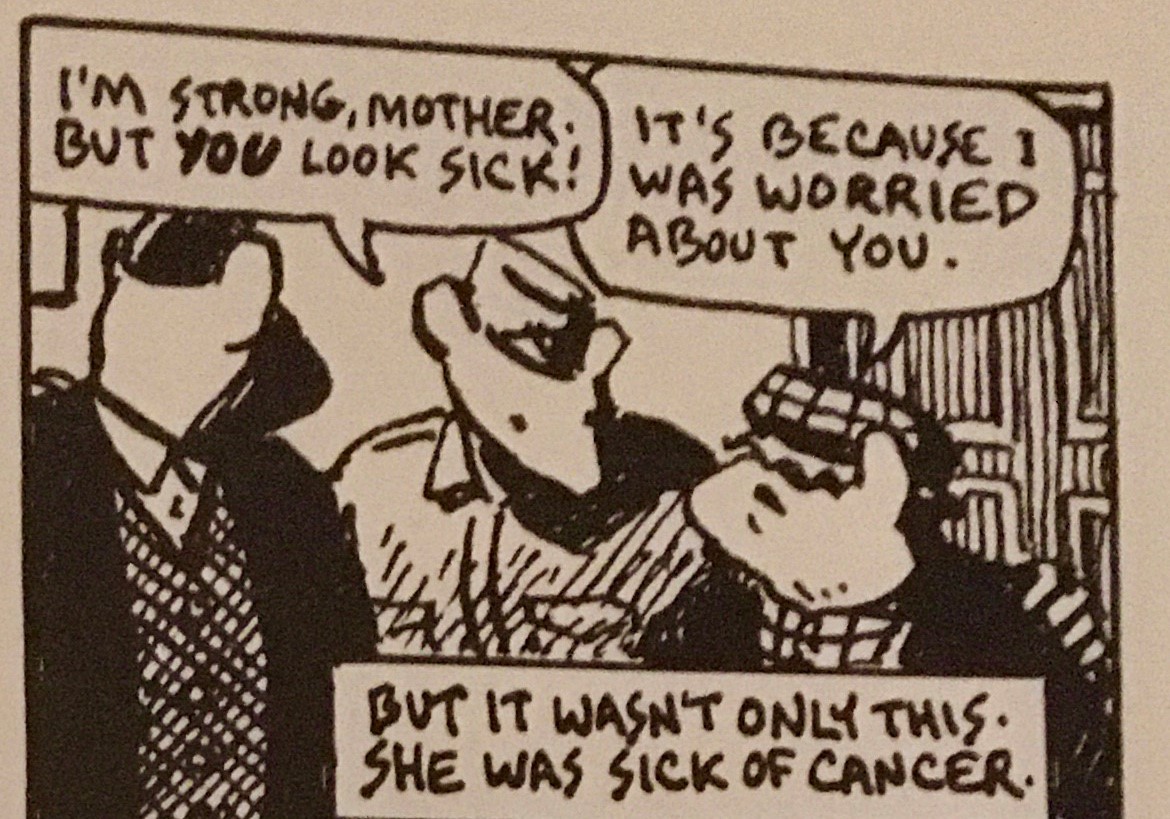
Maus isn’t a precise model; it’s a book-length comic rather than an essay, but Spiegelman’s memoir serves as a guide for us as writers. Here are some points to consider:

  • Consider the title, Maus, the subtitle of the book, A Survivor’s Tale, and the subtitle of Part I, My Father Bleeds History. What does each one tell you about the book? After you decide on a topic for your literacy narrative, ask yourself what you want the title to tell the reader. Will your essay also have a subtitle? Sometimes the best title isn’t clear at the beginning of the writing process. Think about your title, but don’t get hung up on it. Return to it after you have finished drafting.
  • Study Spiegelman’s scenes. Your narrative will include one or more scenes, but yours will be created solely with words, rather than with words and drawings.  As you examine the panels in Maus, note which ones convey conflict, either a character’s inner conflict or a character’s conflict with another character. Conflict is essential to narrative.
  • Note that the epigraph for Maus could be scenes in a literacy narrative. Imagine the two scenes in paragraph form. What would Art Spiegelman add as the final paragraph to give his readers some sense of the narrative’s significance? (What did it mean to him, and what did he learn from it?)

Spiegelman, Art. Maus I. Pantheon, 1986.

Posted in Teaching, Writing

Burrowed Time

It started with the rock. Actually, it started for me with the rock. For you, the story would start elsewhere, I’m sure. I came across the rock, now your rock, in the backyard shortly after my husband and I moved into the house. I was struck by the granite’s natural beauty, its graceful belt of pale stripes. I moved the rock from its cradle of broken bricks and overgrown grass to a spot on the corner of the deck. There I could see it from the window in the kitchen door, and from there I would soon see you, too.

At first, the novelty of seeing you drew me to the window. Then I began to meditate on our similarities, not the fact that I’m a small mammal, too—not chipmunk-small, but human-small—or that I’m omnivorous. Instead, my thoughts turned to how we are both solitary creatures who construct intricate tunnels.

Back in mid-March when the civilized world was forced to shelter in place, I developed a heightened awareness of my tendency to burrow, as well as my need to emerge. Teaching from my burrow, rather than in the classroom, confined me to a solitary labyrinth that I tunneled through by writing. The writing—the blog posts that I composed for my students and the comments that I posted for them— distracted me from the uncertainty that came with COVID-19. Writing had a calming effect. Yet at the same time, all that tunneling within a tunnel meant too much solitude.

Moving to a new burrow and returning to the classroom—the actual, not the virtual, classroom—has roused me. But I am not up to speed. The back-to-back trials of navigating remote instruction and packing my life into boxes led to a state akin to your annual torpor. I am still crawling out, even as the tunneling act of writing continues to help me make sense of it.

Now, as I continue to forage for the right words, I pause in my writing and picture you back on your perch, contemplating life. The stripes in the granite reflect the ones that border your curved back.

I don’t know whether you visited the rock before I moved it, or whether you simply like the corner where you found it. I only know that seeing you stake your claim has brightened the quiet moments when this human has watched you from the window.

Thank you for welcoming me home.

Posted in Teaching, Writing

ENG 111: WordPress RSVP

  • Welcome to WordPress blogging. For English 111, you will publish an introductory post and the revisions* of your three essays to your blog. You are welcome to post additional items, but keep in mind that websites are public spaces. If you want to compose a private post, change the post’s visibility from public to private.
  • After you have set up your blog and before you write your introduction, reply to this post. To do that, scroll down to the bottom of the post, and look for the image of the air mail envelope. If you don’t see it, click on the post’s title, “WordPress RSVP” and scroll down again. I will use the blog addresses in your replies to create the links on our class page, “English at GTCC.”
  • If you encounter any technical difficulties, email help@wordpress.com.
  • WordPress will automatically save your drafts as you write, but posts will not be visible to others until you publish them.
  • You can repeatedly edit your posts after you publish them. If you see something that needs changing, return to the editing mode, make any changes needed, and click “update.”
  • I encourage you to maintain your blog after the end of the semester. Let it continue to grow and evolve to suit your personal and/or professional needs.

*In addition to posting your essay revisions to WordPress, you will post them in Moodle.

Posted in Teaching, Writing

ENG 126: Poetry Workshop, Session 2

Reading your recommendations for revisions last week reminded me of poet Marianne Moore’s relentless revisions, including changes to one poem titled “Poetry,” which she tinkered with for five decades. Many of her readers were puzzled and frustrated when they opened The Complete Poems of Marianne Moore (1967) to find “Poetry” radically reduced to three lines. Gone from the poem were thirty-five lines, including this metaphor that speaks to many forms of art: “imaginary gardens with real toads in them” (line 32).

Our imaginary gardens thrive, with toads springing to life, when language transforms the artificial landscape. But there are so many choices. What words do we plant, and where do we plant them, and when do we uproot and start over?

Welcome to our final workshop session, and thank you for your thoughtful feedback on the “He is the Man,” “Change,” “Dependent,” and “Self-Preservation.” Before we turn to the last poems, “The Concessions of the Conscious Collective” and “Disappearing People,” I offer these follow-up notes:

“He is the Man” 

  • Mia and Brandy noted the stark contrast between the connotation of “he is the man” and the voice of the poem, and Mia recommended ending the first line with “man” to intensify the discrepancy between between readers’ expectations and the meaning that unfolds on the page.
  • Zane recommended developing “He is the Man” into a poem with multiple stanzas.
  • Brennan remarked on the poem’s assonance (no, known, tomorrow) and its internal rhyme (man, plans). His recommended revision for the poem created a slant or half rhyme with “doubts” and “thoughts.”
  • Brandy observed that the final line of the poem is the only one that ends without an s sound.
  • Consider how that change Brandy noted affects the last line and the impact of the last word. As Janet Burroway observes in Imaginative Writing, “the end of just about anything—line, paragraph, stanza, story—is the strongest position, and the beginning is the second strongest” (306).
  • It’s also worth noting that poem’s final word, “die,” drops the s sound but continues the internal rhyme of “crying” and “silence.”

“Change”

  • BrennanZane, and Brandy recommended developing “Change” into a longer poem.
  • Mia remarked on the double meaning of change in the poem and recommended incorporating more imagery.
  • Trevor suggested additional lines to address freedom apart from financial independence.
  • Brandy noted the effectiveness of repeating “no change” in the last line to emphasize the inevitability of repetition in the absence of change.

“Dependent”

  • Brennan addressed the ambiguity of the title and noted how the poem conveys a sense of the complexity of dependency. Brennan also questioned the choice of presenting “Everyday” as a one-word line at the beginning of the second stanza.
  • Mia remarked on the poems’s ambiguity.
  • Zane and Mia both recommended additional figurative language.
  • Trevor remarked that “Dependent” addresses the human condition with “nuance and skill.”
  • Brandy observed that the final stanza seemed out of place. Consider whether the last stanza would seem integral to the poem if were the first stanza or the third. Does the last stanza seem out of place because the third stanza, the one that immediately precedes it, conveys a strong sense of finality?

Self-Preservation

  • Zane remarked on the appeal of speaker‘s perspective on happiness and the aptness of “slivers” and “chunks.”
  • Brennan and Mia addressed how effectively the first stanza evokes the hidden cost of casual exchanges. They also both noted the shift from the first stanza to the second, which made the second stanza seem out of place. Consider the distancing effect of a shift from first person to third.
  • Trevor noted that the poem addresses the universal human condition with “tact and grace.”
  • Brandy remarked on the appeal of the poem as one whose speaker aims to describe self-preservation and connect with others. Her recommended revision reverses the order of the first four clauses in the third stanza. Notice how those changes result in end words that are more concrete (“rises” replaces “this” and “face” replaces “reach”).

As you read the poems for this week’s workshop, again consider where the writers indicate pauses with punctuation and line breaks. In Imaginative Writing, Janet Burroway notes that “[t]he line directs the breath; the rhythm of the line is played against the rhythm of the sense, and this is one of the ways that poets alter, stress, and redirect their meaning” (305-06). As an additional example, consider Marianne Moore’s final revision of “Poetry”:

I, too, dislike it / Reading it, however, with a perfect contempt for it, one discovers in / it, after all, a place for the genuine. (36)

Look carefully at any caesuras, or pauses within the line (such as the ones in all three lines of Moore’s poem above). Do the poems include any enjambment, the running of a thought from one line to the next (“one discovers in  / it, after all . . .”)? Are the lines of the poems end-stopped? In other words, does the end of each line coincide with the end of each thought?

In addition to the pauses and line breaks, here are some points to consider. As always, these are not ones that you’re required to address in your comments. I offer them as suggestions only.

The Concessions of the Conscious Collective

  • Consider the definitions of concession. It’s a special allowance, or something granted, and it’s also a device used in written arguments to acknowledge an opponent’s point. How does the sequence of poems convey one or both of those meanings of the word?
  • Is the alliteration in the title of the poetry sequence repeated in any of the poems? If so, where?
  • The verses that follow the title “The Concessions of the Conscious Collective” are presented as individual poems. Might they serve as stanzas in a single poem, or are they more effective as individual voices that contribute to the collective? Why?

Disappearing People

  • Consider the poet’s use of assonance, slant rhyme, and repetition. What do they achieve?
  • Note that the word appear appears within disappear. How might the poet play on that through enjambment?
  • How might the form or content of the final stanza amplify disappearance? For example: What would be the impact of tapering lines or the absence of “I”?

Remember to check your CVCC email and Blackboard regularly for updates.

Works Cited

Burroway, Janet. Imaginative Writing. 4th ed. Pearson, 2014.

Moore, Marianne. “Poetry.” The Complete Poems of Marianne Moore. MacMillan/Viking, 1967. p. 36, n. 266-67.

Posted in Reading, Teaching, Theatre

ENG 242: Sherlock Holmes and the Mystery of May the Fourth

What links English 242 to the British actors Benedict Cumberbatch and Johnny Lee Miller? The answer is three characters, two that we reflected on when we moved online in March and a third that’s the focus for the final week of the course, which begins today.

Both Cumberbatch and Miller have played the role of Sherlock Holmes; Cumberbatch portrayed him in the BBC series Sherlock (2010-17), set in present-day London, and Miller played him in the CBS series Elementary, which transformed the Scotland Yard detective into an investigator in present-day New York City. In between the launches of those two series, Cumberbatch and Miller performed together in the Royal National Theatre production of Frankenstein (2011). The two actors alternated the roles of Victor and the Creature and shared the Olivier Award (the equivalent of Broadway’s Tony) for their performances. The pairs of photographs that follow feature Cumberbatch and Miller as Holmes and in their dual roles in Frankenstein.

Top: (L-R) Cumberbatch and Miller as Sherlock Holmes / CBS, BBC; Bottom: Trading the roles of Victor and the Creature in Frankenstein / Royal National Theatre

Playwright Nick Dear‘s Frankenstein and the series Sherlock and Elementary are but three of the many adaptations that attest to the enduring appeal of the narratives that bookend our semester. The popularity of Sir Arthur Conan Doyle‘s detective and his many incarnations in film and television inspired the first of three options for your blog response this week.

Option One:

Have you watched Sherlock, Elementary, or one of the Holmes films featuring Robert Downey, Jr. as the title character? If so, address the similarities and differences between the portrayal of the detective on screen and Sir Arthur Conan Doyle‘s portrayal of him in “The Adventure of the Speckled Band.” If you write about Sherlock or Elementary, don’t focus on the obvious difference in the time setting, ditto for the location (New York City) of Elementary. Include both the title of the series/film and the actor’s name in your response.

Option Two:

The Adventure of the Speckled Band” belongs to the subgenre of detective story known as the locked room mystery, in which a murder occurs in a closed space where the perpetrator seemingly vanishes into thin air, and there are few, if any, suspects. Which detail about the locked room mystery of Julia Stoner’s death, or her bedroom where the murder took place, do you find most intriguing?

Option Three:

In The Norton Anthology of British Literature, the editor notes that Sir Arthur Conan Doyle named “The Adventure of the Speckled Band” as his favorite Sherlock Homes story and that “[m]any fans have agreed; readers’ polls over the years have frequently rated ‘The Speckled Band’ as the best Holmes story of all” (920). If you have you read another Sherlock Holmes story that you favor over “The Adventure of the Speckled Band,” write a response that addresses its merits. If you’ve read other Holmes stories and prefer “The Speckled Band,” explain why.

Extra Credit:

It’s no mystery why the force is with us today, but how does May the fourth figure in one of the works of Victorian literature that we’ve studied? In your response, cite the two lines that together solve the mystery. Follow each quotation with a parenthetical citation.

Remember to check your CVCC email and Blackboard regularly for updates.

Work Cited

Robson, Catherine. Biographical Note: “Sir Arthur Conan Doyle, 1859-1930.” The Norton Anthology of British Literature: The Victorian Age. 10th ed. Stephen Greenblatt, General Editor. W.W. Norton, 2018. pp. 920-21.

Posted in Teaching, Writing

ENG 011/111: Revisiting Your Reflection

Directions:

  1. Compose a short commentary (fifty words or more) on your reflection, and submit it as a response to this blog post. For recommended starting points for your commentary, see the list of questions below.
  2. After you post your response, read the reflective essay written by the classmate whose name precedes (not follows) yours on the class page, and post an assessment of twenty-five words or more on the student’s blog. If that classmate’s blog post is not accessible, comment on the post by the student whose name precedes that classmate’s. If your name is first on the list, comment on the reflection of the student whose name is last.

Questions to consider include the following:

  • Which assignments of yours and which features of the course served as the focus of your reflective essay? In the process of drafting your essay, did the focus change? If so, how?
  • How did you organize your reflection? Did you begin by defining or describing your subject, or did you start with an anecdote or observation? Is your essay a series of reflections that together create an overall impression?
  • Did Westover’s memoir, Educated, or one or more of the essays that you read in The Norton Field Guide to Writing serve as a model or source of inspiration? If so, which one? See the list below.
  • At what point in the process did you decide upon a title? Did you change the title during the writing process? If so, what was the original title?
  • What image that documents part of your writing process away from the screen did you include in your blog post? (Is it a photo of a page of your journal or part of your draft? Is it a photo of you reading, drafting, or revising?) Why did you choose that particular image?
  • What do you consider the strongest element of your essay?
  • If you had more time to devote to your final reflective essay would you have addressed additional assignments or features of the course? If so, which ones?

Reflections and Memoirs in The Norton Field Guide to Writing

  • Barrientos, Tanya Maria. “Se Hable Español.” The Norton Field Guide to Writing with Readings and Handbook. 5th ed., by Richard Bullock, Maureen Daly Goggin, and Francine Weinberg, 2019, pp. 693-96.
  • de la Peña, Matt. “Some Times the ‘Tough Teen’ is Quietly Writing Stories.” The Norton Field Guide to Writing with Readings and Handbook. 5th ed., by Richard Bullock, Maureen Daly Goggin, and Francine Weinberg, 2019, pp. 688-91.
  • Dubus III, Andre. “My Father was a Writer.” The Norton Field Guide to Writing with Readings and Handbook. 5th ed., by Richard Bullock, Maureen Daly Goggin, and Francine Weinberg, 2019, pp. 891-99.
  • Feslenfeld, Daniel. “Rebel Music.” The Norton Field Guide to Writing with Readings and Handbook. 5th ed., by Richard Bullock, Maureen Daly Goggin, and Francine Weinberg, 2019, pp. 81-84.
  • Kassfy, Ana-Jamileh. “Automotive Literacy.” The Norton Field Guide to Writing with Readings and Handbook. 5th ed., by Richard Bullock, Maureen Daly Goggin, and Francine Weinberg, 2019, pp. 84-86.
  • Lepucki, Edan. “Our Mothers as We Never Saw Them.” The Norton Field Guide to Writing with Readings and Handbook. 5th ed., by Richard Bullock, Maureen Daly Goggin, and Francine Weinberg, 2019, pp. 256-59.
  • Sedaris, David. “Us and Them.” The Norton Field Guide to Writing with Readings and Handbook. 5th ed., by Richard Bullock, Maureen Daly Goggin, and Francine Weinberg, 2019, pp. 883-89.
  • Tan, Amy. “Mother Tongue.” The Norton Field Guide to Writing with Readings and Handbook. 5th ed., by Richard Bullock, Maureen Daly Goggin, and Francine Weinberg, 2019, pp. 697-703.
  • Vallowe, Emily. “Write or Wrong Identity.” The Norton Field Guide to Writing with Readings and Handbook. 5th ed., by Richard Bullock, Maureen Daly Goggin, and Francine Weinberg, 2019, pp. 75-81.
  • Yousafazai, Malala. “Who is Malala?” The Norton Field Guide to Writing with Readings and Handbook. 5th ed., by Richard Bullock, Maureen Daly Goggin, and Francine Weinberg, 2019, pp. 900-04.
Posted in Reading, Teaching

ENG 242: Dr. Jekyll and Mr. Typo

Congratulations to Breanna Bowman, the first student to identify the error in “Dr. Lanyon’s Narrative.” And the early-bird bonus points go to Breanna and these nine additional students: Joe Robbins, Madison St. Clair, Joe Van Story, Ruben Castillo, Luke Noble, Caeley Arney, Allison Lasher, Kenna Sipe, and Ashton Canipe! Well done!

The date of Jekyll’s letter to Lanyon should be January 9, not December 10. Here’s the note on the error in The Norton Anthology of English Literature:

Stevenson’s own error; the first sentence of ‘Dr. Lanyon’s Narrative’ makes it clear that the letter should be dated ‘9th January.’ Literary critic Richard Dury attributes the slip to the following circumstances: Stevenson had originally wanted to publish his story in time for the Christmas market and align Lanyon’s witnessing of Hyde’s transformation with December, a time for mysterious events. Later he forgot to change the detail. (794n1)

Work Cited

Stevenson, Robert Louis. The Strange Case of Dr. Jekyll and Mr. Hyde. 1886. The Norton Anthology of British Literature: The Victorian Age. 10th ed. Stephen Greenblatt, General Editor; Catherine Robson, Volume Editor. W.W. Norton, 2018. pp. 767-809.